The future of social media
JUNE 14, 2019

JUNE 14, 2019

By Victor Davis Hanson
What drives the growing estrangement of southern and eastern Europe from the European Union establishment? What fuels the anti-EU themes of recent European elections and the stunning recent Australian re-election of conservatives?

Put simply, the middle classes are revolting against Western managerial elites. The latter group includes professional politicians, entrenched bureaucrats, condescending academics, corporate phonies and propagandistic journalists.
What are the popular gripes against them?
One, illegal immigration and open borders have led to chaos. Lax immigration policies have taxed social services and fueled multicultural identity politics, often to the benefit of boutique leftist political agendas.
Two, globalization enriched the cosmopolitan elites who found worldwide markets for their various services. New global markets and commerce meant Western nations outsourced, offshored and ignored their own industries and manufacturing (or anything dependent on muscular labor that could be replaced by cheaper workers abroad).
Three, unelected bureaucrats multiplied and vastly increased their power over private citizens. The targeted middle classes lacked the resources to fight back against the royal armies of tenured regulators, planners, auditors, inspectors and adjusters who could not be fired and were never accountable.
Four, the new global media reached billions and indoctrinated rather than reported.
Five, academia, rather than focusing on education, became politicized as a shrill agent of cultural transformation — while charging more for less learning.
Six, utopian social planning increased housing, energy, and transportation costs.
One common gripe framed all these diverse issues: The wealthy had the means and influence not to be bothered by higher taxes and fees, or to avoid them altogether. Not so much the middle classes, who lacked the clout of the virtue-signaling rich and the romance of the distant poor.
In other words, elites never suffered the firsthand consequences of their own ideological fiats.
Green policies were aimed at raising fees on, and restricting the use of, carbon-based fuels. But proposed green belt-tightening among the hoi polloi was not matched by cutbacks in their second and third homes, overseas vacations, luxury cars, private jets and high-tech appurtenances.
In education, government directives and academic hectoring about admissions quotas and ideological indoctrination likewise targeted the middle classes but not the elite. The micromanagers of Western public schools and universities often preferred private academies and rigorous traditional training for their own children.
Elites relied on old-boy networks to get their own kids into colleges. Diversity administrators multiplied at universities while indebted students borrowed more money to pay for them.
In matters of immigration, the story was much the same. Western elites encouraged the migration of indigent, unskilled and often poorly educated foreign nationals who would ensure that government social programs — and the power of the elites themselves — grew.
The champions of open borders made sure that such influxes did not materially affect their own neighborhoods, schools and privileged way of life.
Elites masked their hypocrisy by virtue-signaling their disdain for the supposedly xenophobic, racist or nativist middle classes. Yet the non-elite have experienced firsthand the impact on social programs, schools and safety from sudden, massive and often illegal immigration from Latin America, the Middle East, Africa and Asia into their communities.
As for trade, few still believe in “free” trade when it remains so unfair. Why didn’t elites extend to China their same tough-love lectures about global warming or about breaking the rules of trade, copyrights and patents?
The middle classes became nauseated by elites’ constant trashing of their culture, history and traditions, including the tearing down of statues, the Trotskyizing of past heroes, the renaming of public buildings and streets and, for some, the tired and empty whining about “white privilege.”
If Western nations were really so bad, and so flawed at their founding, why were millions of non-Westerners risking their lives to reach Western soil?
How was it that elites themselves had made so much money, had gained so much influence and had enjoyed such material bounty and leisure from such a supposedly toxic system — benefits that they were unwilling to give up despite their tired moralizing about selfishness and privilege?
In the next few years, expect more grass-roots demands for the restoration of the value of citizenship. There will be fewer middle-class apologies for patriotism and nationalism. The non-elite will become angrier about illegal immigration, demanding a return to the idea of measured, meritocratic, diverse and legal immigration.
Because elites have no answers to popular furor, the anger directed at them will only increase until they give up — or finally succeed in their grand agenda of a nondemocratic, all-powerful Orwellian state.

by Shane Trejo
Mario Draghi, president of the European Central Bank (ECB) and Christine Lagarde, managing director of the International Monetary Fund (IMF), are urging Trump to abandon his trade war and return to the status quo preferred by globalist financiers.
“We meet at a moment when support for global cooperation and multilateral solutions is waning,” Lagarde said at the 8th ECB conference for the central, eastern and south-eastern European (CESEE) nations on Wednesday.
“Global growth has been subdued for more than six years and the largest economies in the world are putting up, or threatening to put up, new trade barriers. And this might be the beginning of something else, which might affect us all in a more broad way,” she added.
Lagarde also warned: “These troubling developments will create headwinds for all, but certainly for the CESEE growth model, a model that has relied on openness and integration.”
Draghi also forecast doom unless Trump submitted to China, abandoned his nationalistic policies, and let he and his fellow bankster cronies go back to running the global economy.
“Global trade has faced headwinds in recent years as trade-restrictive measures have outpaced liberalising measures,” Draghi said.
“The central and eastern European business model has become vulnerable to shocks to international trade and financial conditions,” he added, warning of potential ill effects of Trump threatening to hike tariffs on European autos.
“The effect of tariffs could be amplified, as a large share of goods cross borders multiple times during the production process,” Draghi said.
“The main long-term challenge is moving towards a more balanced growth and financing model, which is more reliant on domestic innovation and on higher investment spending than it has been so far,” he added.
Regardless of the fear-mongering of the international bankers, President Trump remains undaunted in his resolve to cut China down to size and approve the standing of the U.S. in the world.


JUNE 13, 2019
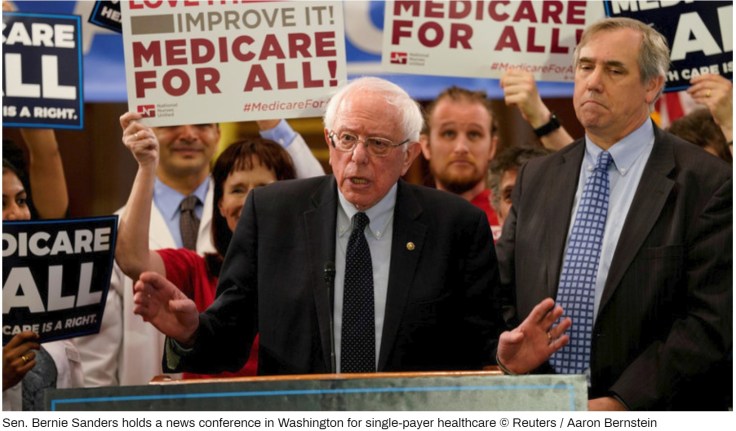
Speaking to CNN’s Anderson Cooper on Wednesday night, the socialist stalwart made the case for bringing a European-style healthcare system to the US.
“I suspect that a lot of people in the country would be delighted to pay more in taxes if they had comprehensive health care as a human right,” Sanders told Cooper.
“Your kids in many countries around the world can go to the public colleges and universities tuition-free, wages in many cases are higher,” Sanders continued. “So, there is a tradeoff, but at the end of the day, I think… most Americans will understand that is a good deal.”
Though Sanders cited Germany as an example of an ideal healthcare system, there are some key differences between the German model and the ‘Medicare for All’ plan advocated by Sanders. The German system is a multi-payer system funded by private and public sources. ‘Medicare for All,’ at least in its current iteration, is a single-payer system that would bar employers from providing competing private alternatives and could eliminate America’s $600 billion private insurance industry.
Medicare for All is a generous package that comes with a hefty price tag. The Committee for a Responsible Federal Budget – a supposedly non-partisan think tank – puts the price at $28 trillion, or nearly ten percent of the US’ GDP. Sanders’ own estimate turns out a cost of $13 trillion over ten years, still a roughly 30 percent increase in federal spending and an outlay more than 18 times larger than even the US military’s astronomical annual budget.
Americans largely support the idea of Medicare for All, with 70 percent in favor of a single-payer system, according to a Reuters poll taken last August. However, support for such a system drops off to 37 percent once they learn it would necessitate a massive tax hike to implement.
Bernie Sanders blasts Trump as ‘socialist for rich & powerful’
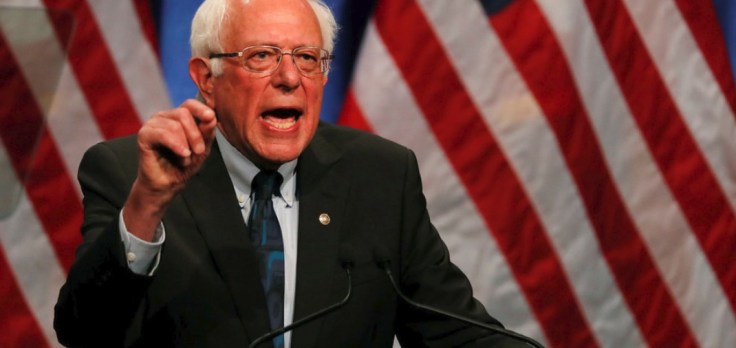
The sheer cost to the taxpayer of overhauling the US healthcare system has been trumpeted by conservatives to dismiss Sanders’ proposal. To date, Sanders has not managed to clarify exactly how this money would be raised. A paperreleased by his office in April suggested foisting some of the tax burden on employers, applying a premium to middle class households, increasing taxes on the wealthy, and imposing levies on financial institutions and offshore accounts.
Sanders maintains that these tax hikes would cut the country’s overall healthcare expenditure and leave the average American family “in a better financial position than they are under the current system.”
Published on Jun 11, 2019





 Tom's Blog