Youtube says Crowder engaged in ‘egregious actions that harmed the broader community’ with his far-right videos; The Intercept co-founding editor Glenn Greenwald reacts on ‘Tucker Carlson Tonight.’ #Tucker #FoxNews

Published on Jun 6, 2019


Although the committee did not name any companies, chairman Jerrold Nadler (D-New York) spoke of “a handful of gatekeepers” who gained control “over key arteries of online commerce, content, and communications.”

House Republicans, usually at odds with Nadler over his investigations into President Donald Trump, seem to have embraced the probe with enthusiasm.
Mere rumors of a Justice Department probe of Google’s parent company Alphabet Inc. and the Federal Trade Commission (FTC) investigation of Amazon and Facebook, caused a massive drop of major technology stocks on Monday, with billions of dollars in market valuation wiped out in minutes.
Alphabet stock was down by more than 6 percent, Facebook went down 7.5 percent, and Amazon dropped 4.6 percent by market closing time. Apple stocks were also down one percent amid rumors of an antitrust probe, even as the company got a bump due to new product announcements.
Conservative journalists and commentators were quick to point out that the antitrust investigations were likely related to the persistent censorship on social media platforms, though there is no direct evidence to that effect.

Silicon Valley tech giants have maintained that they have every right to police their platforms for “hate speech” and other “unacceptable” content, the definition of which keeps expanding by the day.
Democrats have put pressure on Big Tech to be more censorious – under the guise of rooting out “Russian bots and trolls” – after the 2016 election, when Trump used Twitter and Facebook to bypass the overwhelmingly negative mainstream media coverage and win the presidency. However, it then drew the anger of Republicans, who argued that the suspensions and bans have disproportionately targeted conservative voices.
As voice after voice gets purged from social media, still think there’s no censorship?
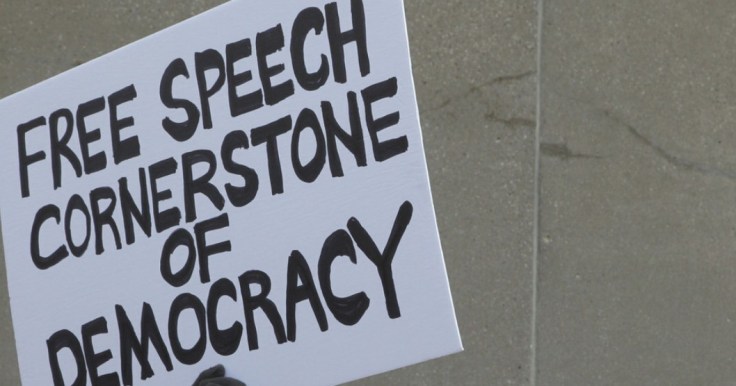
Most recently, Facebook banned any mention of Alex Jones or Infowars from its platforms, including Instagram, unless the posts were critical or hostile. The company also threatened to ban anyone who shared any Infowars content. Several other conservatives were removed in the same purge, and there were reports even photos and mentions of them would get deleted in the aftermath.
Facebook maintained that the ban was part of an ongoing campaign against “individuals or organizations that promote or engage in violence and hate, regardless of ideology.”
For some Democrats running for the 2020 presidential nomination, breaking up big tech has become a trendy rallying cry as they attempt to recruit those unhappy with the online expression monopoly. Elizabeth Warren (D-Mass.) has so far been the most aggressive in her offensive on tech giants, launching a social media campaign to break Facebook, Google, Amazon and Apple up. Other Democratic hopefuls jumped in, with the latest being Sen. Bernie Sanders (I-VT), who last month said that he would “of course” back the proposal to disband Facebook. Rep. Tulsi Gabbard (D-HI) has sided with Warren, while a number of other Democrats, including presidential race frontrunner Joe Biden and Sen. Kamala Harris (D-Calif.) said that the idea is worth a serious look at least.

Thursday, March 07, 2019
When asked by Rogan if company employees “read direct messages,” Dorsey replied, “We don’t read direct messages.”
Gadde followed up, explaining that the only direct messages read by employees are those which have been reported to Twitter support.
Rogan pressed further, asking if it was possible for Twitter employees to intentionally peruse a user’s direct messages.
“I don’t think so,” Gadde replied.
However, according to multiple Twitter engineers who discussed the subject of direct messages with undercover Project Veritas journalists, Dorsey and Gadde may have been misleading with their answers, at best.
“There’s teams dedicated to it [reading direct messages],” said Clay Haynes, a senior network security engineer at Twitter. “I mean, we’re talking… at least three or four hundred people… they’re paid to look at dick pics.”
“It is creepy Big Brother.”
Pranay Singh, a direct messaging engineer, revealed that all content shared on the platform — including private messages — are stored on Twitter servers for analytical and advertising purposes.
“So all your sex messages and your dick pics are on my server now,” Singh said. “Everything. Anything you post online.”
“A machine is going to look at it. An algorithm will look at it, and they’ll make a virtual profile about you.”
Watch the full exchange here.
/cdn.vox-cdn.com/uploads/chorus_image/image/63188116/acastro_180720_1777_facebook_0001.0.jpg)
By Nick Statt
In addition to Yelp and Duolingo, PI found that two Muslim prayer apps, as well as a bible app and a job search app called Indeed, also sent similar data to Facebook that could be used to help identify users for ad targeting purposes when they browse the social network. It’s not clear exactly what type of data is being sent in this case, other than that a user opened the app at a given time, but PI’s report says this transmission may also reveal custom identifiers that help Facebook track that user across its network of services and when that person opens Facebook on a mobile device.
The report builds on a similar investigation from PI last December that first revealed that big-name Android apps were sending data to Facebook without a user’s consent and without proper disclosure. It also highlights that this problem is universal across both iOS and Android; last month, The Wall Street Journal revealed that these same set of developer tools that scrape data when you use a mobile app and send it to Facebook are employed on iPhone apps, despite Apple’s much more stringent privacy rules and protections.
“This is hugely problematic, not just for privacy, but also for competition. The data that apps send to Facebook typically includes information such as the fact that a specific app, such as a Muslim prayer app, was opened or closed,” reads PI’s report, published earlier today. “This sounds fairly basic, but it really isn’t. Since the data is sent with a unique identifier, a user’s Google advertising ID, it would be easy to link this data into a profile and paint a fine-grained picture of someone’s interests, identities and daily routines.”
As Facebook’s privacy practices come under even greater scrutiny in the aftermath of last year’s Cambridge Analytica data privacy scandal, a spotlight is being shone on the lesser-known arrangements between large advertising companies and the smaller app makers that use those platforms to reach new users and target existing ones with ads. As revealed by the WSJ last month, a number of prominent iOS app makers use a Facebook analytics tool known as “custom app events” that, in this case, was sharing sensitive health, fitness, and financial data with the social network for ad targeting purposes.
On Android, Facebook has long collected sensitive user data such as contact logs, call histories, SMS data, and real-time location data, for the purpose of informing its ad targeting and improving features like friend suggestions. Yet the practices have caused vocal outcry from privacy advocates and users concerned Facebook is amassing far too much data about their personal lives and online and offline behaviors. Following reports about Facebook using its location-tracking capabilities to catch company interns skipping work, it said it would allow Android users the ability to explicitly disable the feature.
In this case, PI is underscoring one of Facebook’s longstanding indirect data collection policies, one that relies on third-party apps to autonomously collect and send information about app usage to the social network without telling users about the arrangement.
“Facebook routinely tracks users, non-users, and logged-out users outside its platform through Facebook Business Tools. App developers share data with Facebook through the Facebook Software Development Kit (SDK), a set of software development tools that help developers build apps for a specific operating system,” PI explained in the initial December 2018 report. The report found that nearly two thirds of the 34 Android apps PI tested — including big names like Spotify and Kayak and all of which had between 10 and 500 million installs — sent information to Facebook without informing users or gaining express consent.
PI says that a number of apps stopped the practice following its December report. Similarly, most of the operators of the iOS apps highlighted in the WSJ report also ceased using Facebook’s analytics and developer tools to collect sensitive user data. However, it appears some apps, like Yelp’s and Duolingo’s, continue to do so. PI says it’s in contact with Duolingo, and the company has agreed to suspend the practice, but it’s not clear how many other apps in the Android or iOS ecosystem may be skirting Apple and Google’s data-collection and user privacy policies to improve Facebook’s ad targeting tools.
In these situations, Facebook puts the onus on app makers not to break platform rules or misuse its developer tools by collecting sensitive information. The company has also claimed not to use a majority of this sensitive data and, in some extreme cases like credit card numbers and Social Security numbers, automatically deletes it. But it’s not clear why the data is being collected in the first place and what ways it’s been put to use in the past, either by the apps collecting it or by Facebook.
“Apps relay on the Facebook SDK to integrate their product with Facebook services, like Facebook’s login and ad tracking tools. However, Facebook places all responsibility on apps to ensure that the data they send to Facebook has been collected lawfully,” reads PI’s report. Facebook not immediately available for comment.
By Reid Wilson
By Shane Trejo

Despite the fact that the blatantly sexist Absher app allows men to invade the privacy of women and rescind their ability to freely travel throughout Saudi Arabia, Google found that it did not violate the rules of its app store. It will remain available so Saudi men can use it to enforce Sharia Law and heinous inequality.
Ex-Muslim women’s rights advocate Yasmine Mohammed is crying foul at Google for fueling ‘archaic misogyny’ because of their apparent alliance with the Saudis.
“What irony,” she said. “In the West these technologies are used to improve lives and in Saudi Arabia they’re used to enforce gender apartheid.”
Meanwhile, Google punishes entities that stand for universal free speech. They booted Gab from its app store because enraged leftists demanded it. Because the platform heroically refuses to censor its content, they were targeted by Orwell’s minions, and Google was more than happy to comply.
“We have had an app on the Play Store for months. This is targeted. We have been very consistent with promoting free and lawful expression and speech for everyone for over a year now,” Gab founder Andrew Torba told Tech Crunch after Google announced their ban.
Google’s video platform, YouTube banned Alex Jones of Infowars from its platform. Infowars is the leading alternative media platform, but the pro-Trump wrong think coming from Jones was ultimately deemed unacceptable for audiences by Google’s wannabe thought controllers.
“All users agree to comply with our Terms of Service and Community Guidelines when they sign up to use YouTube,” YouTube said in a statement. “When users violate these policies repeatedly, like our policies against hate speech and harassment or our terms prohibiting circumvention of our enforcement measures, we terminate their accounts.”
Although Google pays lip service to fighting hate speech, they are still happy to do the bidding of the most totalitarian governments of the world when it benefits them.
It is not just the Saudis who are lobbying Google and other tech corporationswith great success. Google is also doing the bidding of the communist Chinese as they fight a crucial trade war against the US that will determine the future direction of the global economy.
“Google is planning to launch a censored version of its search engine in China that will blacklist websites and search terms about human rights, democracy, religion, and peaceful protest,” according to exclusive reporting released last year by The Intercept.
“The project – code-named Dragonfly – has been underway since spring of last year, and accelerated following a December 2017 meeting between Google’s CEO Sundar Pichai and a top Chinese government official, according to internal Google documents and people familiar with the plans.”
Google is happy to serve the enemies of freedom throughout the world with the overriding goal of making Big Brother an inescapable reality.
Until Google proves that they respect American values such as free speech and the right to privacy, they should be appropriately sanctioned, punished and perhaps even banned from the US marketplace.




 Tom's Blog