
“We are just starting to push back.”
Max Blumenthal and Jeb Sprague | GrayZoneProject.com – OCTOBER 29, 2018
At a Berlin security conference, hardline neocon Jamie Fly appeared to claim some credit for the recent coordinated purge of alternative media…

This October, Facebook and Twitter deleted the accounts of hundreds of users, including many alternative media outlets maintained by American users. Among those wiped out in the coordinated purge were popular sites that scrutinized police brutality and U.S. interventionism, like The Free Thought Project, Anti-Media, and Cop Block, along with the pages of journalists like Rachel Blevins.
Facebook claimed that these pages had “broken our rules against spam and coordinated inauthentic behavior.” However, sites like The Free Thought Project were verified by Facebook and widely recognized as legitimate sources of news and opinion. John Vibes, an independent reporter who contributed to Free Thought, accused Facebook of “favoring mainstream sources and silencing alternative voices.”
In comments published here for the first time, a neoconservative Washington insider has apparently claimed a degree of credit for the recent purge — and promised more takedowns in the near future.
“Russia, China, and other foreign states take advantage of our open political system,” remarked Jamie Fly, a senior fellow and director of the Asia program at the influential think tank the German Marshall Fund, which is funded by the U.S. government and NATO.
“They can invent stories that get repeated and spread through different sites. So we are just starting to push back. Just this last week Facebook began starting to take down sites. So this is just the beginning.”
Fly went on to complain that “all you need is an email” to set up a Facebook or Twitter account, lamenting the sites’ accessibility to members of the general public. He predicted a long struggle on a global scale to fix the situation, and pointed out that to do so would require constant vigilance.
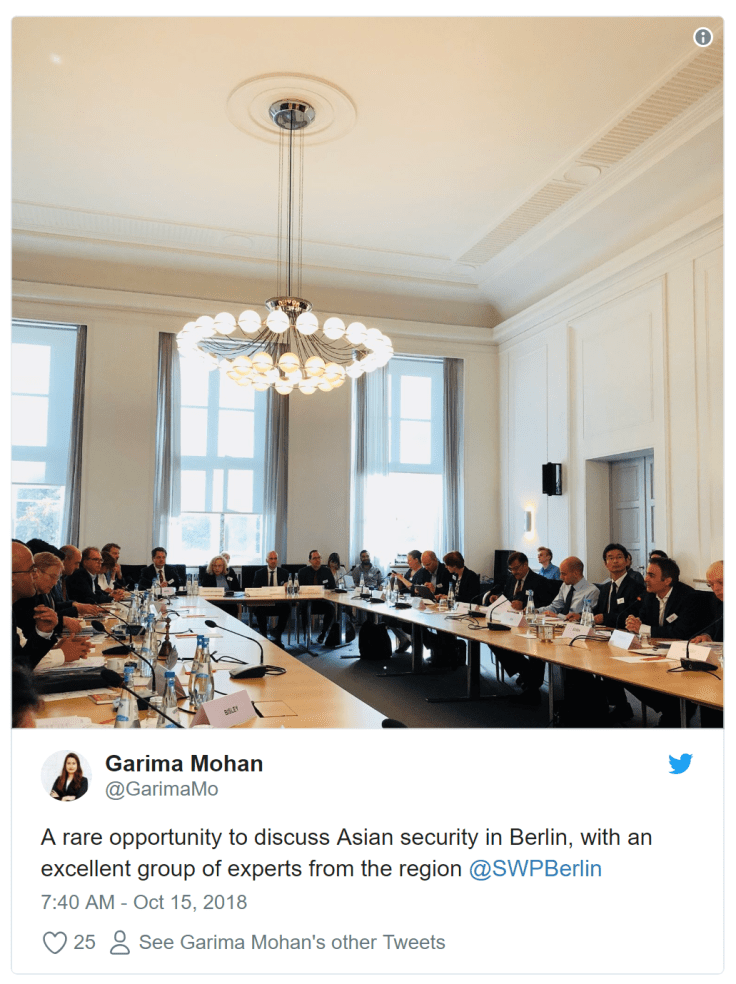
Fly made these stunning comments to Jeb Sprague, who is a visiting faculty member in sociology at the University of California-Santa Barbara and co-author of this article. The two spoke during a lunch break at a conference on Asian security organized by the Stiftung Wissenschaft und Politik in Berlin, Germany.
In the tweet below, Fly is the third person from the left who appears seated at the table.
The remarks by Fly — “we are just starting to push back” — seemed to confirm the worst fears of the alternative online media community. If he was to be believed, the latest purge was motivated by politics, not spam prevention, and was driven by powerful interests hostile to dissident views, particularly where American state violence is concerned.
JAMIE FLY, RISE OF A NEOCON CADRE
Jamie Fly is an influential foreign policy hardliner who has spent the last year lobbying for the censorship of “fringe views” on social media.Over the years, he has advocated for a military assault on Iran, a regime change war on Syria, and hiking military spending to unprecedented levels. He is the embodiment of a neoconservative cadre.
Like so many second-generation neocons, Fly entered government by burrowing into mid-level positions in George W. Bush’s National Security Council and Department of Defense.
In 2009, he was appointed director of the Foreign Policy Initiative (FPI), a rebranded version of Bill Kristol’s Project for a New American Century, or PNAC. The latter outfit was an umbrella group of neoconservative activists that first made the case for an invasion of Iraq as part of a wider project of regime change in countries that resisted Washington’s sphere of influence.
By 2011, Fly was advancing the next phase in PNAC’s blueprint by clamoring for military strikes on Iran. “More diplomacy is not an adequate response,” he argued. A year later, Fly urged the US to “expand its list of targets beyond the [Iranian] nuclear program to key command and control elements of the Republican Guard and the intelligence ministry, and facilities associated with other key government officials.”
Fly soon found his way into the senate office of Marco Rubio, a neoconservative pet project, assuming a role as his top foreign policy advisor. Amongst other interventionist initiatives, Rubio has taken the lead in promoting harsh economic sanctions targeting Venezuela, even advocating for a U.S. military assault on the country. When Rubio’s 2016 presidential campaign floundered amid a mass revolt of the Republican Party’s middle American base against the party establishment, Fly was forced to cast about for new opportunities.
He found them in the paranoid atmosphere of Russiagate that formed soon after Donald Trump’s shock election victory.
PROPORNOT SPARKS THE ALTERNATIVE MEDIA PANIC
A journalistic insider’s account of the Hillary Clinton presidential campaign, Shattered, revealed that “in the days after the election, Hillary declined to take responsibility for her own loss.” Her top advisers were summoned the following day, according to the book, “to engineer the case that the election wasn’t entirely on the up-and-up … Already, Russian hacking was the centerpiece of the argument.”
Less than three weeks after Clinton’s defeat, the Washington Post’s Craig Timberg published a dubiously sourced report headlined, “Russian propaganda effort helped spread ‘fake news.’”The article hyped up a McCarthyite effort by a shadowy, anonymously run organization called PropOrNot to blacklist some 200 American media outlets as Russian “online propaganda.”
The alternative media outfits on the PropOrNot blacklist included some of those recently purged by Facebook and Twitter, such as The Free Thought Project and Anti-Media. Among the criteria PropOrNot identified as signs of Russian propaganda were “Support for policies like Brexit, and the breakup of the EU and Eurozone” and “Opposition to Ukrainian resistance to Russia and Syrian resistance to Assad.” PropOrNot called for “formal investigations by the U.S. government” into the outlets it had blacklisted.
According to Craig Timberg, the Washington Post correspondent who uncritically promoted the media suppression initiative, Propornot was established by “a nonpartisan collection of researchers with foreign policy, military and technology backgrounds.” Timberg quoted a figure associated with the George Washington University Center for Cyber and Homeland Security, Andrew Weisburd, and cited a report he wrote with his colleague, Clint Watts, on Russian meddling.
Timberg’s piece on PropOrNot was promoted widely by former top Clinton staffers and celebrated by ex-Obama White House aide Dan Pfeiffer as “the biggest story in the world.” But after a wave of stinging criticism, including in the pages of the New Yorker, the article was amended with an editor’s note stating, “The [Washington] Post… does not itself vouch for the validity of PropOrNot’s findings regarding any individual media outlet.”
PropOrNot had been seemingly exposed as a McCarthyite sham, but the concept behind it — exposing online American media outlets as vehicles for Kremlin “active measures” — continued to flourish.
THE BIRTH OF THE RUSSIAN BOT TRACKER — WITH U.S. GOVERNMENT MONEY
By August, a new, and seemingly related initiative appeared out of the blue, this time with backing from a bipartisan coalition of Democratic foreign policy hands and neocon Never Trumpers in Washington. Called the Alliance for Securing Democracy (ASD), the outfit aimed to expose how supposed Russian Twitter bots were infecting American political discourse with divisive narratives. It featured a daily “Hamilton 68” online dashboard that highlighted the supposed bot activity with easily digestible charts. Conveniently, the site avoided naming any of the digital Kremlin influence accounts it claimed to be tracking.
The initiative was immediately endorsed by John Podesta, the founder of the Democratic Party think tank the Center for American Progress, and former chief of staff of Hillary Clinton’s 2016 presidential campaign. Julia Ioffe, the Atlantic’s chief Russiagate correspondent, promoted the bot tracker as “a very cool tool.”
Unlike PropOrNot, the ASD was sponsored by one of the most respected think tanks in Washington, the German Marshall Fund, which had been founded in 1972 to nurture the special relationship between the US and what was then West Germany.
The German Marshall Fund is substantially funded by Western governments, and largely reflects their foreign-policy interests. Its top two financial sponsors, at more than $1 million per year each, are the U.S. government’s soft-power arm the U.S. Agency for International Development (USAID) and the German Foreign Office (known in German as the Auswärtiges Amt). The U.S. State Department also provides more than half a million dollars per year, as do the German Ministry of Economic Cooperation and Development and the foreign affairs ministries of Sweden and Norway. It likewise receives at least a quarter of a million dollars per year from NATO.

The US government and NATO are top donors to the German Marshall Fund
Though the German Marshall Fund did not name the donors that specifically sponsored its Alliance for Securing Democracy initiative, it hosts a who’s who of bipartisan national-security hardliners on the ASD’s advisory council, providing the endeavor with the patina of credibility. They range from neocon movement icon Bill Kristol to former Clinton foreign policy advisor Jake Sullivan and ex-CIA director Michael Morell.
Jamie Fly, a German Marshall Fund fellow and Asia specialist, emerged as one of the most prolific promoters of the new Russian bot tracker in the media. Together with Laura Rosenberger, a former foreign policy aide to Hillary Clinton’s 2016 campaign, Fly appeared in a series of interviews and co-authored several op-eds emphasizing the need for a massive social media crackdown.

During a March 2018 interview on C-Span, Fly complained that “Russian accounts” were “trying to promote certain messages, amplify certain content, raise fringe views, pit Americans against each other, and we need to deal with this ongoing problem and find ways through the government, through tech companies, through broader society to tackle this issue.”
Yet few of the sites on PropOrNot’s blacklist, and none of the alternative sites that were erased in the recent Facebook purge that Fly and his colleagues take apparent credit for, were Russian accounts. Perhaps the only infraction they could have been accused of was publishing views that Fly and his cohorts saw as “fringe.”
What’s more, the ASD has been forced to admit that the mass of Twitter accounts it initially identified as “Russian bots” were not necessarily bots — and may not have been Russian either.
“I’M NOT CONVINCED ON THIS BOT THING”
A November 2017 investigation by Max Blumenthal, a co-author of this article, found that the ASD’s Hamilton 68 dashboard was the creation of “a collection of cranks, counterterror retreads, online harassers and paranoiacs operating with support from some of the most prominent figures operating within the American national security apparatus.”
These figures included the same George Washington University Center for Cyber and Homeland Security fellows — Andrew Weisburd and Clint Watts — that were cited as experts in the Washington Post’s article promoting PropOrNot.
Weisburd, who has been described as one of the brains behind the Hamilton 68 dashboard, once maintained a one-man, anti-Palestinian web monitoring initiative that specialized in doxxing left-wing activists, Muslims and anyone he considered “anti-American.” More recently, he has taken to Twitter to spout off murderous and homophobic fantasies about Glenn Greenwald, the editor of the Intercept — a publication the ASD flagged without explanation as a vehicle for Russian influence operations.
Watts, for his part, has testified before Congress on several occasions to call on the government to “quell information rebellions” with censorious measures including “nutritional labels” for online media. He has received fawning publicity from corporate media and been rewarded with a contributor role for NBC on the basis of his supposed expertise in ferreting out Russian disinformation.

Clint Watts has urged Congress to “quell information rebellions”
However, under questioning during a public event by Grayzone contributor Ilias Stathatos, Watts admitted that substantial parts of his testimony were false, and refused to provide evidence to support some of his most colorful claims about malicious Russian bot activity.
In a separate interview with Buzzfeed, Watts appeared to completely disown the Hamilton 68 bot tracker as a legitimate tool. “I’m not convinced on this bot thing,” Watts confessed. He even called the narrative that he helped manufacture “overdone,” and admitted that the accounts Hamilton 68 tracked were not necessarily directed by Russian intelligence actors.
“We don’t even think they’re all commanded in Russia — at all. We think some of them are legitimately passionate people that are just really into promoting Russia,” Watts conceded.
But these stunning admissions did little to slow the momentum of the coming purge.
ENTER THE ATLANTIC COUNCIL
In his conversation with Sprague, the German Marshall Fund’s Fly stated that he was working with the Atlantic Council in the campaign to purge alternative media from social media platforms like Facebook.
The Atlantic Council is another Washington-based think tank that serves as a gathering point for neoconservatives and liberal interventionists pushing military aggression around the globe. It is funded by NATO and repressive, US-allied governments including Saudi Arabia, Bahrain and Turkey, as well as by Ukrainian oligarchs like Victor Pynchuk.
This May, Facebook announced a partnership with the Atlantic Council’s Digital Forensic Research Lab (DFRLab) to “identify, expose, and explain disinformation during elections around the world.”
The Atlantic Council’s DFRLab is notorious for its zealous conflation of legitimate online dissent with illicit Russian activity, embracing the same tactics as PropOrNot and the ASD.
Ben Nimmo, a DFRLab fellow who has built his reputation on flushing out online Kremlin influence networks, embarked on an embarrassing witch hunt this year that saw him misidentify several living, breathing individuals as Russian bots or Kremlin “influence accounts.” Nimmo’s victims included Mariam Susli, a well-known Syrian-Australian social media personality, the famed Ukrainian concert pianist Valentina Lisitsa, and a British pensioner named Ian Shilling.
In an interview with Sky News, Shilling delivered a memorable tirade against his accusers.
“I have no Kremlin contacts whatsoever; I do not know any Russians, I have no contact with the Russian government or anything to do with them,” he exclaimed.
“I am an ordinary British citizen who happens to do research on the current neocon wars which are going on in Syria at this very moment.”
With the latest Facebook and Twitter purges, ordinary citizens like Shilling are being targeted in the open, and without apology. The mass deletions of alternative media accounts illustrate how national security hardliners from the German Marshall Fund and Atlantic Council (and whoever was behind PropOrNot) have instrumentalized the manufactured panic around Russian interference to generate public support for a wider campaign of media censorship.
In his conversation in Berlin with Sprague, Fly noted with apparent approval that, “Trump is now pointing to Chinese interference in the 2018 election.” As the mantra of foreign interference expands to a new adversarial power, the clampdown on voices of dissent in online media is almost certain to intensify.
As Fly promised, “This is just the beginning.”





/https%3A%2F%2Fblueprint-api-production.s3.amazonaws.com%2Fuploads%2Fcard%2Fimage%2F872573%2F5b86b06f-d7b8-4a15-9359-c4dab8ea35aa.jpg)



 Tom's Blog