UK Deploys Ships to English Channel Over Migrant Crisis

Capture

According to the UK’s home secretary, while saving the lives of migrants is important, protecting the nation’s borders is important, too.

The UK Border Force had to re-deploy two of its largest ships, known as “cutters,” from overseas missions to the English Channel, after some 100 migrants attempted to cross the strait on dinghies.

I have made a decision today to redeploy two of the Border Force’s largest vessels, known as cutters, from abroad back to the UK, to south-east England, and they will be joining a cutter that is already there and two other coastal patrol vessels,” Home Secretary Sajid Javid said.

In the most recent incident, 12 migrants, including a 10-year-old child, were detained on the UK’s Kent beach Monday.

See the source image

According to a Home Office spokesperson, the migrants presented themselves as Iranian nationals.

“They all received a medical assessment and have now been transferred to immigration officials for interview,” the spokesperson said.

“It’s both about protecting human life but also about protecting our borders,” Javid said regarding his decision. “This will help both with the human side of this situation but also to better protect our borders.”

https://www.brighteon.com/embed/5984855073001

In a poorly concealed attempt to paint the justification for the ships’ relocation as a humanitarian one, Javid pointed out that “we must remember that this is one of the most treacherous stretches of water that there is, 21 miles with people taking grave risk, really putting their lives into their own hands by taking this journey.”

However, under a humanitarian façade, a more pragmatic approach is clearly visible.

Javid disclosed that, besides the ships’ deployment, the UK Home Office will also step up its efforts to return detained migrants to France.

“We will do everything we can to make sure [illegal border crossing] is not a success, in the sense that I don’t want people to think that if they leave a safe country like France, they can get to Britain and then just get to stay,” he said.

British cooperation with French authorities is improving, with around 40 percent of attempted crossings disrupted, and the two countries working together “both directly but also in more covert ways,” according to Javid.

According to the home secretary, some 230 migrants attempted to cross the Channel in December, with “just under half” being disrupted by French authorities before taking to the seas.

You can read this story as it originally appeared at Sputnik here.

Fireworks Launched at Swedish Police, Elderly Woman In Slew of Attacks

See the source image

Police officers, an elderly woman and a family home were the targets of attacks involving fireworks or similar explosives across Sweden, according to local media.

A gang of youths launched firecrackers at a woman in her 70s as she exited a grocery store in Skövde, police say.

The woman suffered some injuries, including damage to her hearing, GT reports.

Police say dozens of youths had been firing off ‘rockets’ in the neighborhood the night before, and responding officers were ambushed when they attempted to investigate.

“When police patrol came to the site, they directed the rockets at their colleagues,” said a police spokesman.

In Trollhättan, police are investigating suspected arson after a villa was set ablaze overnight while a family slept inside.

Police believe the fire was the result of fireworks being shot at the home.

“Someone has heard some form of a whistling sound and then the bang, which woke the family up,” a police spokesman told GT. “It could have ended really badly.”

In yet another incident, ‘rockets’ were launched at police responding to a multiple car fire in Uppsala.

“In connection with the police investigating a car fire in Stenhagen in Uppsala, a rocket was shot at one of the police,” SVT reports. “The rocket missed, but was suspected of being fired from a passing car.”

Gunnar Appelgren, a security specialist and head of Stockholm police force’s gang conflict division, recently expressed his concern over growing violence in Sweden, saying the country was effectively entering “some form of a state of war.”

CFR’s Martin Indyk Slams Trump: Soon He May Be Asking ‘Why Are We Giving Israel So Much Money?’

By Chris Menahan

Capture

Martin Indyk, two-time US Ambassador to Israel and current Distinguished Fellow at the Council on Foreign Relations, attacked President Trump on Twitter Wednesday for saying Israel will be okay despite the US pulling out of Syria because we give them “billions of dollars.”

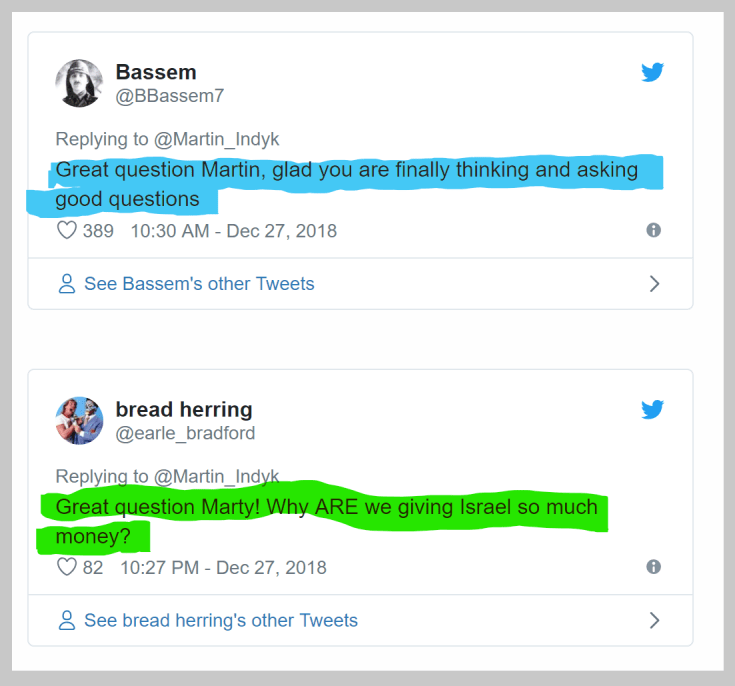
“This cavalier attitude is deeply worrying,” Indyk said. “Ignores the role of US as force multiplier for Israeli deterrence. From here it’s a short step to Trump asking: why are we giving Israel so much money?”

Capture

Here’s Trump’s full comments as reported Thursday by the Times of Israel:

Speaking with reporters, Trump was asked about criticism that the move could put Israel in jeopardy by allowing Iran to expand its foothold in Syria.

“Well, I don’t see it. I spoke with Bibi,” he said, referring to Prime Minister Benjamin Netanyahu. “I told Bibi. And, you know, we give Israel $4.5 billion a year. And they’re doing very well defending themselves, if you take a look.”

“So that’s the way it is,” Trump said, according to a White House transcript.

“We’re going to take good care of Israel. Israel is going to be good. But we give Israel $4.5 billion a year. And we give them, frankly, a lot more money than that, if you look at the books — a lot more money than that. And they’ve been doing a very good job for themselves,” he added.

Here’s some of the top responses to Indyk’s tweet:

Capture

Capture

Indyk has a rather fascinating history according to his Wikipedia page (click through for source links):

In 1982, Indyk began working as a deputy research director for the American Israel Public Affairs Committee (AIPAC), a pro-Israel lobbying group in Washington.[4][5] From 1985 Indyk served eight years as the founding Executive Director of the Washington Institute for Near East Policy, a research institute specializing in analysis of Middle East policy.[6]

[…]He served as special assistant to President Bill Clinton and as senior director of Near East and South Asian Affairs at the United States National Security Council. While at the NSC, he served as principal adviser to the President and the National Security Advisor on Arab–Israeli issues, Iraq, Iran, and South Asia. He was a senior member of Secretary of State Warren Christopher’s Middle East peace team and served as the White House representative on the U.S. Israel Science and Technology Commission.

He served two stints as United States Ambassador to Israel, from April 1995 to September 1997, and from January 2000 to July 2001. He was the first and so far, the only, foreign-born US ambassador to Israel.

He has served on the board of the New Israel Fund.[7] Indyk currently serves on the Adivsory Board for DC based non-profit America Abroad Media.[8]

On July 29, 2013, Indyk was appointed by President Barack Obama as Washington’s special Middle East envoy for the resumption of peace talks between Israel and the Palestinian Authority.[9] Both Israeli Prime Minister Benjamin Netanyahu and Palestinian President Mahmoud Abbas favored his appointment.[10] He resigned from this position June 27, 2014, returning to the Brookings Institution as its vice president and director for foreign policy.[11][12]

Controversy

In 2000, Indyk was placed under investigation by the FBI after allegations arose that he improperly handled sensitive material by using an unclassified laptop computer on an airplane flight to prepare his memos of meetings with foreign leaders.[13][14][15] There was no indication that any classified material had been compromised, and no indication of espionage.[16]

Indyk was “apparently … the first serving U.S. ambassador to be stripped of government security clearance.”[16] The Los Angeles Times reported that “veteran diplomats complained that Indyk was being made a scapegoat for the kinds of security lapses that are rather common among envoys who take classified work home from the office.”[16] Indyk’s clearance was suspended but was reinstated the next month, “for the duration of the current crisis,” given “the continuing turmoil in Israel, the West Bank and Gaza [Strip] and for compelling national security reasons.”[16]

Criticism
Receiving donations from Qatar

In 2014, Indyk came under scrutiny when a New York Times investigation revealed that wealthy Gulf state of Qatar made a $14.8 million, four-year donation to Brookings Institution, in order to fund two Brookings initiatives,[17] the Brookings Center in Doha and the Project on U.S. Relations with the Islamic World.[18] The Times investigation found that Brookings was one of more than a dozen influential Washington think tanks and research organizations that “have received tens of millions of dollars from foreign governments in recent years while pushing United States government officials to adopt policies that often reflect the donors’ priorities.”[17] A number of scholars interviewed by the Times expressed alarm at the trend, saying that the “donations have led to implicit agreements that the research groups would refrain from criticizing the donor governments.”[17]

The revelation of the think tank’s choice to accept the payment from Qatar was especially controversial because at the time, Indyk was acting as a peace negotiator between Israel and the Palestinians, and because Qatar funds jihadist groups in the Middle East and is the main financial backer of Hamas, “the mortal enemy of both the State of Israel and Mahmoud Abbas’ Fatah party.”[19] Hamas political chief Khaled Meshaal, who directs Hamas’s operations against Israel, is also harbored by Qatar.[17] Indyk defended the arrangement with Qatar, contending that it did not influence the think tank’s work and that “to be policy-relevant, we need to engage policy makers.”[17] However, the arrangement between Qatar and Brookings caused Israeli government officials to doubt Indyk’s impartiality.[20]

Soros ‘person of the year’ indeed: In 2018 globalists pushed peoples’ patience to the edge

By Robert Bridge

Capture.PNG

Since 2015, the proponents of neoliberalism have been pushing ahead with their plans for open borders and globalist agenda without the consent of the people. The last 365 days saw that destructive agenda greatly challenged.

In light of the epic events that shaped our world in 2018, it seems the Yellow Vests – the thousands of French citizens who took to the streets of Paris to protest austerity and the rise of inequality – would have been a nice choice for the Financial Times’ ‘person of the year’ award. Instead, that title was bestowed upon the billionaire globalist, George Soros, who has arguably done more meddling in the affairs of modern democratic states than any other person on the planet.

Perhaps FT’s controversial nomination was an attempt to rally the forces of neoliberalism at a time when populism and nascent nationalism is sweeping the planet. Indeed, the shocking images coming out of France provide a grim wake-up call as to where we may be heading if the globalists continue to undermine the power of the nation-state.

See the source image

It is no secret that neoliberalism relentlessly pursues a globalized, borderless world where labor, products, and services obey the hidden hand of the free market. What is less often mentioned, however, is that this system is far more concerned with promoting the well-being of corporations and cowboy capitalists than assisting the average person on the street. Indeed, many of the world’s most powerful companies today have mutated into “stateless superpowers,” while consumers are forced to endure crippling austerity measures amid plummeting standards of living. The year 2018 could be seen as the tipping point when the grass-roots movement against these dire conditions took off.

Since 2015, when German Chancellor Angela Merkel allowed hundreds of thousands of undocumented migrants into Germany and the EU, a groundswell of animosity has been steadily building against the European Union, perhaps best exemplified by the Brexit movement. Quite simply, many people are growing weary of the globalist argument that Europe needs migrants and austerity measures to keep the wheels of the economy spinning. At the very least, luring migrants with cash incentives to move to Germany and elsewhere in the EU appears incredibly shortsighted.

Indeed, if the globalist George Soros wants to lend his Midas touch to ameliorating the migrant’s plight, why does he think that relocating them to European countries is the solution? As is becoming increasingly apparent in places like Swedenand France, efforts to assimilate people from vastly different cultures, religions and backgrounds is an extremely tricky venture, the success of which is far from guaranteed.

One worrying consequence of Europe’s season of open borders has been the rise of far-right political movements. In fact, some of the harshest criticism of the ‘Merkel plan’ originated in Hungary, where its gutsy president, Viktor Orban, hopes to build “an old-school Christian democracy, rooted in European traditions.” Orban is simply responding to the democratic will of his people, who are fiercely conservative, yet the EU parliament voted to punish him regardless. The move shows that Brussels, aside from being adverse to democratic principles, has very few tools for addressing the rise of far-right sentiment that its own misguided policies created.

Here it is necessary to mention once again that bugbear of the political right, Mr. Soros, who has received no political mandate from European voters, yet who campaigns relentlessly on behalf of globalist initiatives through his Open Society Foundations (OSF) (That campaign just got some serious clout after Soros injected $18bn dollars of his own money into OSF, making it one of the most influential NGOs in the world).

With no small amount of impudence, Soros has condemned EU countries – namely his native Hungary – for attempting to protect their territories by constructing border barriers and fences, which he believes violate the human rights of migrants (rarely if ever does the philanthropist speak about the “human rights” of the native population). In the words of the maestro of mayhem himself: “Beggar-thy-neighbor migration policies, such as building border fences, will not only further fragment the union; they also seriously damage European economies and subvert global human rights standards.”

Through a leaked network of compromised EU parliamentarians who do his bidding, Soros says the EU should spend $30 billion euros ($33bln) to accommodate “at least 300,000 refugees each year.” How will the EU pay for the resettling of migrants from the Middle East? Soros has an answer for that as well. He calls it “surge funding,” which entails “raising a substantial amount of debt backed by the EU’s relatively small budget.”

See the source image

Any guesses who will be forced to pay down the debt on this high-risk venture? If you guessed George Soros, guess again. The already heavily taxed people of Europe will be forced to shoulder that heavy burden. “To finance it, new European taxes will have to be levied sooner or later,” Soros admits. That comment is very interesting in light of the recent French protests, which were triggered by Emmanuel Macron’s plan to impose a new fuel tax. Was the French leader, a former investment banker, attempting to get back some of the funds being used to support the influx of new arrivals into his country? The question seems like a valid one, and goes far at explaining the ongoing unrest.

At this point, it is worth remembering what triggered the exodus of migrants into Europe in the first place. A large part of the answer comes down to unlawful NATO operations on the ground of sovereign states. Since 2003, the 29-member military bloc, under the direct command of Washington, has conducted illicit military operations in various places around the globe, including in Iraq, Libya and Syria. These actions, which could be best described as globalism on steroids, have opened a Pandora’s Box of global scourges, including famine, terrorism and grinding poverty. Is this what the Western states mean by ‘humanitarian activism’? If the major EU countries really want to flout their humanitarian credentials, they could have started by demanding the cessation of regime-change operations throughout the Middle East and North Africa, which created such inhumane conditions for millions of innocent people.

This failure on the part of Western capitals to speak out against belligerent US foreign policy helps to explain why a number of other European governments are experiencing major shakeups. Sebastian Kurz, 32, won over the hearts of Austrian voters by promising to tackle unchecked immigration. In super-tolerant Sweden, which has accepted more migrants per capita than any other EU state, the anti-immigrant Sweden Democrats party garnered 17.6 percent of the vote in September elections – up from 12.9 percent in the previous election. And even Angela Merkel, who is seen by many people as the de facto leader of the European Union, is watching her political star crash and burn mostly due to her bungling of the migrant crisis. In October, after her Christian Democratic Union (CDU) suffered a stinging setback in Bavaria elections, which saw CDU voters abandon ship for the anti-immigrant AfD and the Greens, Merkel announced she would resign in 2021 after her current term expires.

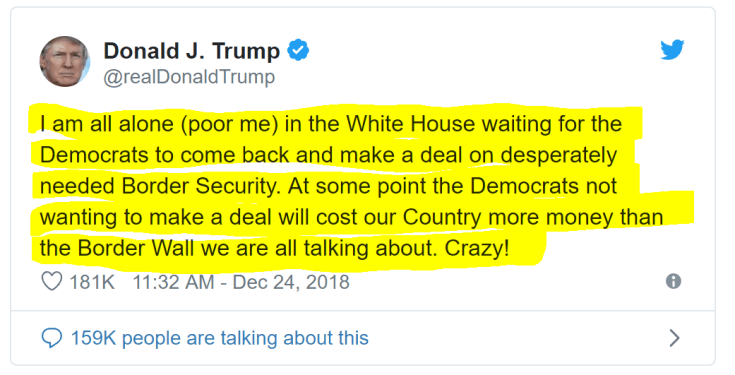
Meanwhile, back in the US, the government of President Donald Trump has been shut down as the Democrats refuse to grant the American leader the funds to build a wall on the Mexican border – despite the fact that he essentially made it to the White House on precisely that promise. Personally, I find it very hard to believe that any political party that does not support a strong and viable border can continue to be taken seriously at the polls for very long. Yet that is the very strategy that the Democrats have chosen. But I digress.

Capture

The lesson that Western governments should have learned over the last year from these developments is that there exists a definite red line that the globalists cross at risk not only to the social order, but to their own political fortunes. Eventually the people will demand solutions to their problems – many of which were caused by reckless neoliberal programs and austerity measures. This collective sense of desperation may open the door to any number of right-wing politicians only too happy to meet the demand.

Better to provide fair working conditions for the people while maintaining strong borders than have to face the wrath of the street or some political charlatan later. Whether or not Western leaders will change their neoliberal ways as a populist storm front approaches remains to be seen, but I for one am not betting on it.

@Robert_Bridge

Like this story? Share it with a friend!

Islamic State Flag Found Near Suspected Sabotage on Railway – German Police

Capture

By Ben Warren

An Islamic State (IS) flag was discovered near a damaged overhead power cable on a Berlin railway track, according to German police.

Leaflets in Arabic were also found and authorities are investigating if the propaganda is related to the apparent sabotage.

“Since the beginning of the investigation, several pieces of evidence have been secured,” said police.

Additionally, a torn steel cable was found at the scene of Sunday’s suspected attack on the tracks.

Given the possibility of this being a terrorist attack, federal police have taken over the investigation to officially deduce any “political motivations” linked to the findings.

Correspondingly, in October, German authorities discovered a threatening letter written in Arabic alongside mangled steel cables that were stretched across the tracks of a high-speed railway line between Nuremberg and Munich.

As of this writing, it is unclear if the two incidents are connected.


EUROPEAN NEWS European civilization is at great risk and the process sped up in recent years – Douglas Murray

By   

Capture

Interviewed by Echo TV, British author and journalist Douglas Murray warned again about the future of European civilization. 

“I think that our future is at risk. It is obvious, and this process has been going on for a very long time, and it just sped up in recent years.

“And, I think it has come about more in the absence of mind, in the absence of preparedness, than as a part of a bigger plan. Our civilisation is at great risk,” the author of The Strange Death of Europe said.

Douglas says that although a lot of writers disagree with his conclusions about Europe’s future, it’s his task to write the truth.

“My view is that the general public is like me. They are able to see things with their own eyes. They do not need to be told what they should be seeing, because they open their eyes and they can see.

“There are some people who would like to stop that and they would like us to not see things. Nevertheless, I think that the general public and I are able to say honestly what we see,” he says.

According to Douglas, Western Europe made a “colossal mistake” by inviting guest labourers since the 1950s.

“Since the 1950s, Western European countries, from Germany to other places, have been inviting guest laborers in order to rebuild their societies after the Second World War. In my book I show that they did not fully understand this process.

“For example, in her 2010 Potsdam speech, Angela Merkel said that they had thought that the guest laborers would eventually go home.

“Now, I have to say that it is very unlikely that a person who came from a very poor country would return to his or her country of origin after having experienced life in a rich country. As I said, even Angela Merkel admitted that they were wrong to believe that, and Western European societies had to catch up in this regard.

“For example, they had to face that entire families would immigrate and that a chain of migration would start.”

Watch the full interview below, it starts around 10:30 minutes.


‘Journalists come down’: Yellow Vests chant ‘fake news’ outside French TV station (VIDEOS)

Capture

Dozens of Yellow Vest protesters have descended on the headquarters of France’s BFM TV channel accusing the station of broadcasting “fake news” and calling for the resignation of President Emmanuel Macron.

The demonstrators arrived at the offices in Paris around an hour after the gathering was announced on Facebook. There was already a heavy police presence at the building in the city’s 15th arrondissement when the crowd formed.

One of the protesters told RT France that BFM TV spreads false information about the movement, alleging that the channel purposefully underplays the size of its demonstrations.

AFP is reporting that “several hundred” Yellow Vests gathered outside the headquarters and Police used tear gas grenades on the crowd after the protesters lobbed projectiles in their direction.

The group reportedly chanted “journalists come down”, “fake news” and “Macron out”.

Riot police also fired tear gas during clashes in Rouen in Normandy and in Nantes in western France on Saturday, which is the seventh week of the mass rallies that have divided the country since the movement sprang up in November.

ALSO ON RT.COMTear gas fired as Yellow Vests and police clash in French city of Rouen (VIDEOS)

Official turnout numbers have dropped significantly on earlier weeks but organizers say the dip is due to the holiday season. The protesters say the movement will continue to grow in 2019 and plans are underway for New Year’s Eve protests.

The rallies initially began as a demonstration against fuel hikes but have since morphed into a broad rejection of Macron’s policies. On Thursday a group of about 40 Yellow Vests tried to storm the medieval fort of Bregancon that serves as the president’s official summer retreat.

Like this story? Share it with a friend!

Tear gas fired as Yellow Vests and police clash in French city of Rouen (VIDEOS)

Yellow Vests in Rouen as the street fills with tear gas.

French police have deployed tear gas in a bid to quell Yellow Vest protesters in a tense stand-off in the city of Rouen in Normandy.

Demonstrations quickly spiralled out of control in the northern French city on Saturday as protesters and riot police clashed in the streets of the picturesque town.

Journalist Simon Louvet, who is in Rouen, tweeted: “The GJ (Gilet Jaunes) are in the streets around Jeanne D’Arc Street and are gassed, they flee running and regroup.”are gassed, they flee running and regroup.”

The protesters also set fire to the entrance of the local office of the Bank of France, the country’s central bank.

Away from the violence, a large group of protesters also marched through the streets, waving French flags and chanting slogans.

Paris, the scene of the most dramatic demonstrations since the rallies began in November, was significantly quieter than previous weeks but it also saw dozens of Yellow Vests gathered on Champs-Elysees on Saturday.

On Thursday, a group of the protesters attempted to storm the Mediterranean castle that serves as President Emmanuel Macron’s summer retreat.

The weeks of demonstrations have polarized France. The movement began as rallies against fuel-price hikes, but it soon morphed into nationwide protests against government policies.

The fuel hikes were scrapped by the government but people have continued to demand more concessions, including lower taxes and even Macron’s resignation.

Like this story? Share it with a friend!

Suspected Bombing In Swedish Town

See the source image

By

Swedish police are investigating a Christmas morning explosion at an apartment building in Gislaved as a targeted bombing and attempted murder, according to local media.

Authorities arrived on the scene of a strong blast in the locality of Anderstorp, located roughly 80 miles southeast of Gothenburg, SVT Nyheter reports.

“There are parts of the wall that are clearly damaged, so it was a more powerful detonation,” said police spokesman Thomas Agnevik. “There were people in the house. Exactly how many, I don’t know. I only have information that they should be unharmed.”

See the source image

Forensics specialists and bomb technicians are investigating the damage and collecting evidence and testimonials from neighbors, but no suspects have been identified.

“The case is classified as attempted murder,”police report reads. “There is still no suspect. The event is judged to be aimed at a specific person.”

Sweden has seen an escalation in explosions and bombings in recent years.

“Sweden may be known for its popular music, IKEA and a generous welfare state. It is also increasingly associated with a rising number of Islamic State recruits, bombings and hand grenade attacks,” Politico reported in April, 2018.

Weeks ago, Malmö was the scene of multiple explosions in a single night, and in early 2018, the city was rocked by at least five detonations in the span of two weeks.

Blog at WordPress.com.

Up ↑