Leftists Angry At Trump Donating Salary To Coronavirus Fight

By Steve Watson – 3/4/2020

“Hitler Never Took A Salary”

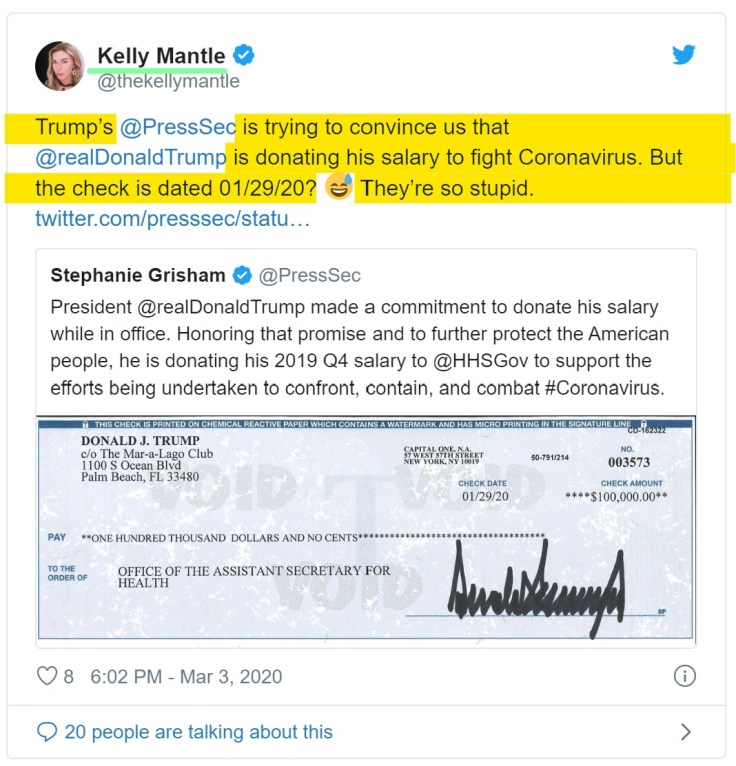
President Trump donated his fourth quarter salary to the Department of Health and Human Services this week in an effort to help fight the Coronavirus, but leftists are angry about it because…  Orange man bad.

The donation of $100,000 is part of Trump’s promise to never take any salary while he is President. He has previously given away his salary to the Surgeon General’s office, border enforcement, and Veterans’ Affairs, to name but a few.

CAP

The move was no where near good enough for leftists though, who immediately compared the move to Hitler (an obvious starting point):

CAP

This one was furious that the Orange man’s salary would only pay for 50 coronavirus tests:

CAP

Presumably she has donated more money?

This one called it a ‘drop in the bucket’ and got angry about Trump owning property:

CAP

In an important counterpoint, these leftists want to know how “we” get back money Trump has spent on golfing:

CAP

CAP

This one flat out denied that Trump is donating anything. The proof? The check is dated January 29th:

CAP

Who’d have thought Trump could do something before announcing it?

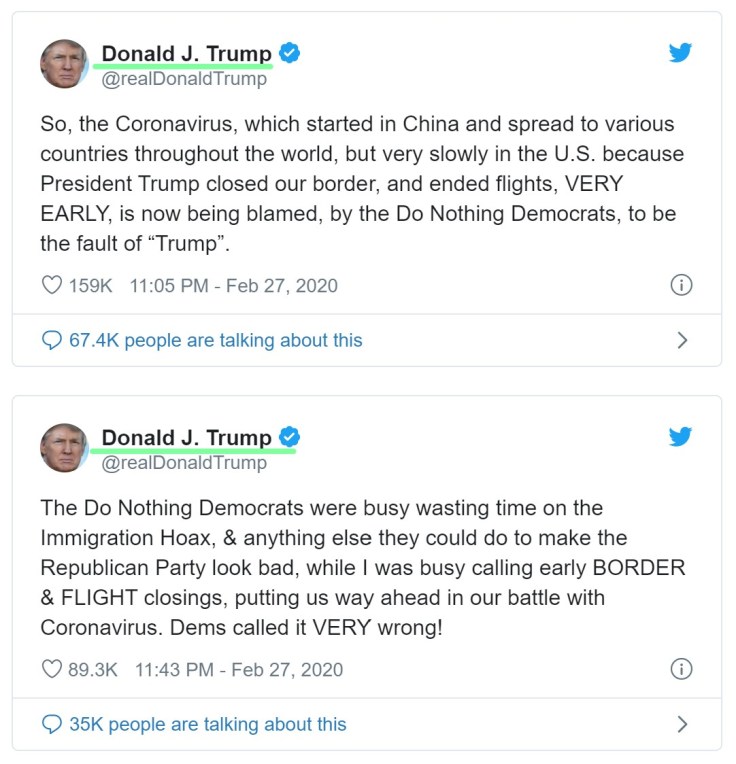
And this one repeated a fake narrative spread by Democrats that Trump defunded pandemic response:

CAP

CAP

CAP

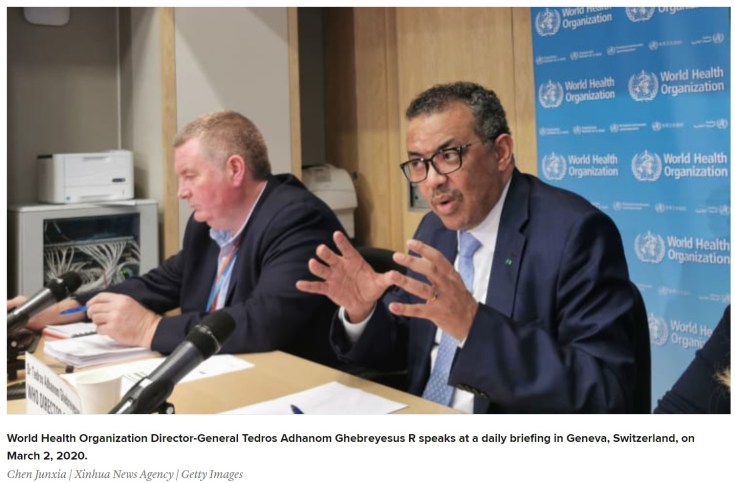
WHO officials make urgent plea for medical gear: ‘Supplies are rapidly depleting’

CAP

By Noah Higgins-Dunn

  • The WHO estimates that each month 89 million medical masks, 76 million examination gloves and 1.6 million goggles will be required for the COVID-19 response.

  • It said manufacturers need to increase personal protective gear supplies by 40% to meet the needs of the medical community.

World Health Organization officials called on medical supply manufacturers to “urgently increase production” to meet the global demand that is needed to respond to the COVID-19 outbreak rapidly spreading across the world.

“Supplies are rapidly depleting. WHO estimates that each month 89 million medical masks will be required for the COVID-19 response, 76 million examination gloves and 1.6 million goggles,” Director-General Tedros Adhanom Ghebreyesus told reporters at the organization’s Geneva headquarters.

Tedros said manufacturers need to increase personal protective gear supplies by 40% to meet the needs of the medical community.

On Capitol Hill in Washington, Health and Human Services’ assistant secretary for preparedness and response, Dr. Robert Kadlec, said the U.S. has about 35 million N95 respirator masks. That’s about 10% of the 3.5 billion he estimates the U.S. will need if COVID-19 erupts into a full-blown pandemic.

World health officials have said that N95 face masks are effective in protecting health-care workers from the infection, prompting global demand for them to surge. In China, demand for face masks has depleted the country’s stockpile where doctors and nurses face shortages, according to the South China Morning Post.

WHO officials announced on Monday that the number of new coronavrius cases outside China was almost nine times higher than that inside the country in the previous 24 hours. They also increased the risk assessment of the coronavirus Friday to “very high” at the global level. In January, it declared the virus a global health emergency, while urging the public against overreacting to the virus.

“As one epidemic looks like ending, one front of the fight closing, another is becoming increasingly complex” Tedros said Tuesday. China reported 120 new cases in the last 24 hours, compared with 1,848 new infections in 48 countries, with most of those cases coming from Italy, Korea and the Islamic Republic of Iran, he said. Emerging from Wuhan, China, more than two months ago, COVID-19 has already spread to more than 91,300 people across at least 73 countries, killing at least 3,110 — including at least six in the U.S.

“Iranian medical doctors and nurses have concerns that they don’t necessarily have enough equipment, supplies, ventilators, respirators, oxygen and all the things you’ve heard spoken about in many of the press conferences,” said Dr. Michael Ryan, who runs WHO’s emergency program. “Those needs are more acute for the Iranian health system than they are most any other health system.”

The organization has yet to classify the virus as a pandemic and has maintained that its attention is on containing the spread, although the virus has substantially moved beyond China and has now been found in nearly 60 countries.

Dr. Anne Schuchat, principal deputy director of the U.S. Centers for Disease Control and Prevention, told Senate lawmakers Tuesday that the current outbreak already meets two of the three main criteria under the technical designation of a pandemic.

“It is a new virus, and it is capable of person-to-person spread,” she said in prepared testimony at a hearing. “If sustained person-to-person spread in the community takes hold outside China, this will increase the likelihood that the WHO will deem it a global pandemic.”

Epidemics have emerged in Iran, Italy, and South Korea, where the number of cases is rapidly increasing. The U.S. recorded its first six deaths from the virus since this weekend, while New York state confirmed a second case earlier Tuesday. Every country should prepare for its first case and no one should assume it won’t get any cases, Tedros said last month.

“This is a unique virus, with unique features. This virus is not influenza,” Tedros said. “We are in uncharted territory.”

Tedros shed more light on the virus Tuesday, saying it spreads similar to influenza, by small droplets of fluid from the nose and mouth of someone who’s sick.

“However, there are some important differences,” he said. “First COVID-19 does not transmit as efficiently as influenza from the data we’ve seen so far. With influenza, people who are infected but not yet sick are major drivers of transmission, which doesn’t appear to be the case with COVID-19.”

Tedros said last week that health officials would not “hesitate” to declare the outbreak a pandemic if “that’s what the evidence suggests.” On Friday at a press briefing, he said that most cases of COVID-19 can still be traced to known contacts or clusters of cases and there isn’t any “evidence as yet that the virus is spreading freely in communities.” That’s one reason why WHO hasn’t declared the outbreak a pandemic, Tedros said Friday.

Ryan said Monday scientists still don’t know exactly how COVID-19 “behaves,” saying it’s not like influenza. “We know it’s not transmitting in exactly the same way that influenza was, and that offers us a glimmer, a chink of light, that this virus can be suppressed and pushed and contained,” he said.

Ryan also said health officials think countries are being transparent, but “it’s very easy to be caught unaware in an epidemic situation.”

WHO officials on Friday increased the risk assessment of the coronavirus to “high” to “very high” at a global level. The world can still avoid “the worst of it,” but the increased risk assessment means the WHO’s “level of concern is at its highest,” Ryan said at the time.

Health officials have said the respiratory disease is capable of spreading through human-to-human contact, droplets carried through sneezing and coughing and germs left on inanimate objects. The virus appears to be particularly troublesome for older people and those with underlying health conditions. Symptoms can include a sore throat, runny nose, fever or pneumonia and can progress all the way to multiple organ failure or death in some severe cases.


COVID-19 3rd March Tuesday

By Dr. John Campbell

I am a nurse from the US and yes they are being reactive instead of proactive and they really aren’t doing much. Not shutting down anything in WA state where a lot is happening.


Buttigieg set to endorse Biden

Joe Biden, Peter Buttigieg are posing for a picture: Biden Klobuchar Buttigieg Warren Yang Booker

BY JULIA MANCHESTER AND AMIE PARNES – 

Former South Bend, Ind., Mayor Pete Buttigieg is set to endorse former Vice President Joe Biden in the Democratic presidential race one day after ending his own bid, according to a source close to the Biden campaign. 

Buttigieg’s planned endorsement comes as fellow moderate Sen. Amy Klobuchar (D-Minn.) also throws her support behind Biden after dropping out of the race Monday.

The latest endorsements for Biden point to a consolidation of the moderate lane of the Democratic race in an effort to block progressive Sen. Bernie Sanders (I-Vt.) from getting the nomination.

Biden’s campaign got a new push after Saturday’s South Carolina primary, where the former vice president won every county in the state.

DEVELOPING

FEMA preparing for possible coronavirus emergency declaration

CAP

By Laura Strickler and Suzy Khimm

WASHINGTON — The Federal Emergency Management Agency is planning for the possibility that President Donald Trump could make an emergency declaration to bring in extra funds and personnel to assist the administration’s coronavirus response, according to internal documents obtained by NBC News.

FEMA officials are preparing for an “infectious disease emergency declaration” by the president that would allow the agency to provide disaster relief funding to state and local governments, as well as federal assistance to support the coronavirus response, according to agency planning documents reviewed by NBC News.

The Trump administration would have to use the 1988 Stafford Act to enable FEMA to provide such disaster assistance. Emergency declarations are most often used in the event of natural disasters but can be used to help manage disease outbreaks.

Full coverage of the coronavirus outbreak

“To me this is another indication that the president and the White House are finally aware of the gravity of the situation,” said Michael Coen, who was FEMA chief of staff during the Obama administration. “They need to consider all tools available to them and have contingencies for action.”

“I actually find this reassuring,” said Tim Manning, who was a FEMA deputy administrator under President Barack Obama. “I hope this discussion has been happening continuously over the last couple of months.”

An emergency declaration would allow FEMA to provide disaster medical assistance teams, mobile hospitals and military transport, among other kinds of federal support, Manning said.

FEMA’s disaster relief fund has a current balance of $34 billion, according to the latest agency update. “It’s money that’s sitting there and ready,” said another former FEMA official, who declined to be identified.

FEMA spokesperson Lizzie Litzow said the agency is currently focused on supporting the Department of Health and Human Services (HHS), which separately declared a “public health emergency” on Jan. 31, allowing HHS to access funds and other resources to aid the government’s virus response. “At this time, there isn’t anything additional to the HHS public health emergency,” Litzow said.

CAP

It would not be the first time the federal government has used FEMA’s resources to assist in a medical event.

In 2000, President Bill Clinton used a Stafford Act emergency declaration for outbreaks of the West Nile virus in New York and New Jersey, ordering up to $5 million in federal aid to supplement state efforts to combat the mosquito-borne virus.

Emergency declarations are distinct from “major disaster” declarations, which are more far-reaching and are typically used for hurricanes, floods and other natural disasters.


PANIC BUYING HITS GERMAN STORES AS CORONAVIRUS CASES DOUBLE

Panic Buying Hits German Stores as Coronavirus Cases Double

Grocery chains report rising demand for canned goods, other long-term provisions

Deutsche Welle – MARCH 2, 2020

Germans are slowly coming to realize that they, just like 50 other nations in the world today, could soon be facing a coronavirus epidemic.

Indeed, the pathogen has become a major topic of discussion in the country – so much so, in fact, that some residents are now stockpiling food out of fear they could be placed under quarantine.

Bulk-buying supplies

On Friday, a spokeswoman for one of the country’s largest supermarket groups, REWE, told DW that while they didn’t register any panic at the start of the week, the situation quickly changed.

“We have noticed rising foodstuff and canned goods purchases across the entire country to which we are adapting accordingly,” said Kristina Schütz from REWE Group, which is headquartered in Cologne and runs the Penny, REWE and Nahkauf grocery chains.

Discount chain Lidl has recorded a similar spike in purchases, with a spokesperson confirming that “we are noticing a rise in sales in certain regions and stores.”

According to the chains, Germans are stockpiling long-lasting and canned food, pasta as well as toilet paper and disinfectants.

CAP

What do authorities recommend?

Four years ago, the Bonn-based Federal Office of Civil Protection and Disaster Assistance (BBK) published a checklist of long-lasting foods it recommends stockpiling for emergencies.

The BBK, which is staffed by some 300 civil servants, educates the general population on how to prepare for crises. It advises Germans to stockpile food and drink for about ten days.

Specifically, the checklist states that one person needs 14 liters of liquid a week, and recommends stocking mineral water and fruit juice in particular. Even so, the BBK warns against panic buying, advising Germans to stockpile only foods and drinks “that you and your family would consume anyway.”

The BKK also suggests stocking food that keeps for a long time without needing refrigeration, to pay attention to sell-by dates, and mark when items were purchased, in case they don’t have dates printed on them. It also advises Germans to “store newly bought food items at the back of the cupboard so that you consume older items first.”

Sound advice

This comprehensive emergency checklist hasn’t gone unnoticed abroad. Bulgarian daily 24 Tschassa, for example, praised the advice provided by German authorities, saying that in most cases “consumers just hoard all kinds of products – without a proper idea how long they will come in useful or whether they might need them at all.”

The paper said sticking to the German checklist is a good idea “as it makes no sense to buy excessive amounts of supplies.”

Warning against stoking fear

While many pundits in Germany agree the list is useful, they simultaneously warn against stirring hysteria. So far, Germany has confirmed 129 cases of coronavirus, with 16 having already recovered, and no deaths reported. More than half of the cases are in the western state of North Rhine-Westphalia, the country’s most populous state.

The German Journalists Association (DJV) therefore emphasizes that media outlets should avoid stoking fear.

Accordingly, DJV head Frank Überall stated that “people need clear information as well as advice” to make sense of the situation.

He has called on journalists to heed the German press code which calls on them to “avoid an inappropriately sensationalist tone when reporting on medical issues, as this may give rise to unfounded fears or hopes.”

The press code also states that “stoking fear and hysteria is incompatible with responsible journalism.”

https://banned.video/watch?id=5e5c645c265ff4005b24a7d9

https://infowarsmedia.com/js/player.js

THIS ISN’t HELPING: Devout Muslims Lick Shia Shrine in Iran to “Prove” Their Faith Can Beat the Coronavirus (VIDEOS)


According to the Coronavirus website there have been 1,501 cases of coronavirus in Iran and 66 deaths.

These numbers are suspect as the regime is not open with its data.

** The Gateway Pundit posted an extensive report from Iran on the coronavirus on Sunday night.

What is clear is that devout Muslims are not making the situation better by licking the Shia shrines.

There are currently several videos making the rounds on social media of Muslims licking shrines to prove their faith is greater than the coronavirus.

Yuck.

Embedded video


Blog at WordPress.com.

Up ↑