Warren, de Blasio: I Would Abolish Private Health Insurance

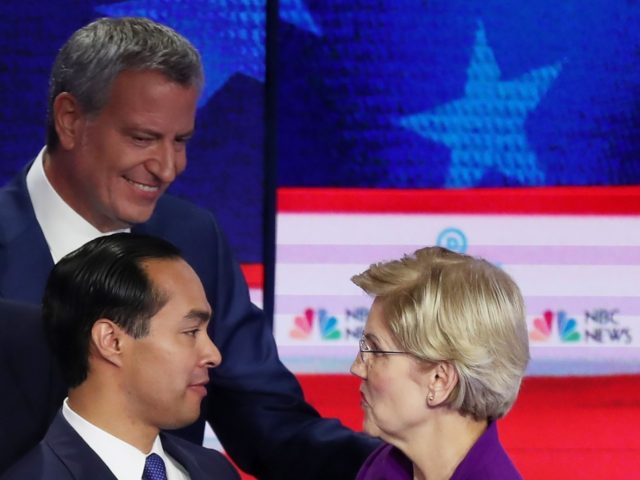
MIAMI, FLORIDA - JUNE 26: (L-R) Sen. Cory Booker (D-NJ), New York City Mayor Bill De Blasio, former housing secretary Julian Castro and Sen. Elizabeth Warren (D-MA) shake hands after the first night of the Democratic presidential debate on June 26, 2019 in Miami, Florida. A field of 20 Democratic …

By Alana Mastrangelo

Senator Elizabeth Warren (D-MA) and New York City Mayor Bill de Blasio admitted they would abolish private health insurance during the 2020 Democratic Presidential Primary debate on Wednesday evening.

“Many people watching at home have health insurance coverage through their employer,” asked NBC’s Lester Holt, “Who here would abolish their private health insurance in favor of a government-run plan? Just a show of hands.”

Sen. Warren and Mayor de Blasio raised their hands in response to Holt’s question, admitting that they would abolish private health insurance in favor of cradle to grave, government-run healthcare.

Warren and de Blasio, however, are likely not the only candidates on stage who agree with abolishing private health insurance, but rather, the only candidates bold enough to actually admit it.

The Green New Deal, for example, would ban private health insurance, including employer-provided insurance plans. The Green New Deal was endorsed by Senator Cory Booker (D-NJ), and Representative Robert Francis “Beto” O’Rourke (D-TX), two presidential candidates who shared the debate stage with Warren and de Blasio on Wednesday night.

Moreover, over 100 Democrats have endorsed “Medicare for All,” a proposal that would also effectively do away with private health insurance.

Another Democratic Presidential candidate, Senator Kamala Harris (D-CA) — although not present on Wednesday night — has also admitted to wanting to eliminate private health insurance to replace it with a single-payer, government-run “Medicare for All” program.

Less than 24 hours later, however, Harris seemed to have thought better of her statement, quickly walking back her call to abolish private health insurance, and later insisting that “Medicare for All” would not eliminate the entire private health insurance industry.

While it is apparent that not every 2020 Democratic Presidential candidate may be comfortable with confessing their views on private health insurance just yet, the fact that some are willing to openly endorse socialist policies is a cause for concern, and a testimony to the radical shift the Democratic Party has taken over recent years.


Julian Castro Says He Would Force Taxpayers to Pay For Trans Peoples’ Abortions

By Chris Menahan

Powerful.

Published on Jun 26, 2019

From National Review:

“All of you on stage support a women’s right to abortion. You all support some version of a government health-care option. Would your plan cover abortion, Mr. Secretary?” asked MSNBC debate moderator Lester Holt.

“Yes it would. I don’t believe only in reproductive freedom, I believe in reproductive justice. And what that means is just because a woman, or let’s also not forget someone in the trans community — a trans female — is poor, doesn’t mean they shouldn’t exercise that right to choose. So I absolutely would cover that right to have an abortion,” Castro said.

Finally someone is talking about the REAL ISSUES!

CIRCUS COMES TO MIAMI!

Screen Shot 2019-06-26 at 11.34.34 AM

By Laurie Kellman

WASHINGTON (AP) — Sixty seconds for answers, a television audience of millions and, for some candidates, a first chance to introduce themselves to voters.

The back-to-back Democratic presidential debates beginning Wednesday are exercises in competitive sound bites featuring 20 candidates hoping to oust President Donald Trump in 2020. The hopefuls range widely in age, sex and backgrounds and include a former vice president, six women and a pair of mayors.

The challenge: Convey their plans for the nation, throw a few elbows and sharpen what’s been a blur of a race so far for many Americans.

What to watch Wednesday at 9 p.m. Eastern on NBC, MSNBC and Telemundo:

___

WHAT’S HER PLAN?

Sen. Elizabeth Warren’s task is to harness the recent momentum surrounding her campaign to prove to voters that she has what it takes to defeat Trump. As the sole top-tier candidate on stage Wednesday, she could have the most to lose.

The Massachusetts senator and former Harvard professor is known for her many policy plans and a mastery of classical, orderly debate. But presidential showdowns can be more “Gladiator”-style than the high-minded “Great Debaters.” This is no time for a wonky multipoint case for “Medicare for All,” student debt relief or the Green New Deal.

So, one challenge for Warren, 70, is stylistic. Look for her to try to champion her progressive ideas — and fend off attacks from lesser-known candidates — with gravitas, warmth and the brevity required by the format.

“Preparing for the debates is trying to learn to speak in 60 seconds or less,” she said in Miami, ahead of a visit she live-streamed to a migrant detention center in Homestead, Florida.

Another obstacle is to do so without alienating moderates any Democrat would need in a general election against Trump.

Being the front-runner on stage conveys a possible advantage: If the others pile on Warren, she gets more time to speak because the candidates are allowed 30 extra seconds for responses.

___

WHO’S THAT?

There may be some familiar faces across the rest of the stage, such as New Jersey Sen. Cory Booker, 50, or former Texas congressman Beto O’Rourke, 46. But a few names probably won’t ring any bells at all.

These virtual strangers to most Americans may be enjoying their first — and maybe last — turn on the national stage, so they have the least to lose.

Take John Delaney, 56, a former member of the House from Maryland. Look for him to try to make an impression by keeping up his criticism of Warren’s plans.

Or Ohio Rep. Tim Ryan, 45, who sits on the powerful House Appropriations Committee. He has likened the Democratic primary to “speed dating with the American people.”

BREAKING OUT, GOING VIRAL

For several of the candidates onstage Wednesday, the forum is about finding the breakout moment — a zinger, a burn — that stays in viewers’ minds, is built for social media and generates donations, the lifeblood of campaigns.

In 2015, Carly Fiorina won applause and a short surge for her response to Trump, who had been quoted in Rolling Stone as criticizing Fiorina’s face.

“Look at that face,” Trump was quoted as saying. “Would anyone vote for that?”

Asked on CNN to respond, Fiorina evenly replied: “I think women all over this country heard very clearly what Mr. Trump said.”

For candidates such as O’Rourke, a breakthrough moment on Wednesday is critical to revitalizing a campaign that has faded. The 10 White House contenders have two hours on stage that night and up until the curtain rises on the star-studded second debate the next day to make their mark. Former Vice President Joe Biden, 76, and Vermont Sen. Bernie Sanders, 77, headline Thursday’s debate and are certain to take up much of the spotlight.

___

BREAKING OUT BADLY

An “oops” moment can be politically crippling to any presidential campaign.

Just ask Energy Secretary Rick Perry, the former Texas governor who, in a 2011 debate, blanked on the third agency of government he had said would be “gone” if he became president.

“Commerce, Education and the, uh, what’s the third one there?” Perry said.

“EPA?” fellow Republican Ron Paul offered. Yep, Perry said, the Environmental Protection Agency.

“Oops,” he finished. Perry’s campaign, already struggling, never recovered.

___

WHAT ISSUES?

There’s simply no time for an in-depth discussion of issues. But the migrant crisis would be an apt topic, even in shorthand. Dominating the news in the hours before the showdown were vivid reports and images of the toll of the administration’s policy on children, especially.

Expect at least a mention, or perhaps the appearance, of a bracing photo of the bodies of a migrant father and his 23-month-old daughter face-down along the Rio Grande.

In addition to Warren, other candidates, such as Sen. Amy Klobuchar, were visiting the migrant center.

___

TRUMP

This is the Democrats’ night.

But Trump has dominated the political conversation since that escalator ride four years ago, and he loathes being upstaged. It’s worth asking: Will he tweet during the debates? And if he does, will NBC and the moderators ignore him or respond in real time?

NBC News executive Rashida Jones said the focus will be on the candidates and the issues.

“Beyond that, it has to rise to a certain level,” she said.

During Wednesday’s debate, Trump will be on Air Force One on his way to the Group of 20 summit in Osaka, Japan. The plane’s cable televisions are usually turned to Fox News, which is not hosting the debates. For the second debate, Trump will be beginning meetings at the G-20.

Trump told Fox Business Network on Wednesday that he’d watch because “it’s part of my life” but that “It just seems very boring. … That’s a very unexciting group of people.”

JOE BIDEN ADVOCATES “REAL PHYSICAL REVOLUTION” TO PUSH THROUGH HIS POLITICAL AGENDA

Joe Biden Advocates "Real Physical Revolution" to Push Through His Political Agenda

Imagine if a Republican had said this

JUNE 18, 2019

Presidential frontrunner Joe Biden advocated a “real physical revolution” to push through his political agenda during a speech at Trinity University in Washington.

Asked by host Joy Reid how he would get his proposals through a Senate controlled by the GOP, Biden said, “There are certain things where it just takes a brass knuckle fight.”

The former Vice-President then appeared to walk back his rhetoric, saying it was the president’s job to “persuade the public”.

“So you go out and beat them….you make the case — you make an explicit case,” said Biden.

However, he then suggested, rather than to just “go home,” it was better to turn to more extreme methods.

“Or let’s start a real physical revolution if you’re talking about it because we have to be able to change what we’re doing within our system,” said Biden.

Given how polarized America is right now, one wonders what the reaction would have been to a Republican making similar comments.

———————————————————————————————————————

There is a war on free speech. Without your support, my voice will be silenced.

Please sign up for the free newsletter here. Donate to me on SubscribeStar here.

Support my sponsor – Turbo Force – a supercharged boost of clean energy without the comedown.

Americans would be ‘delighted’ to pay more taxes for socialized healthcare – Bernie Sanders

CAP

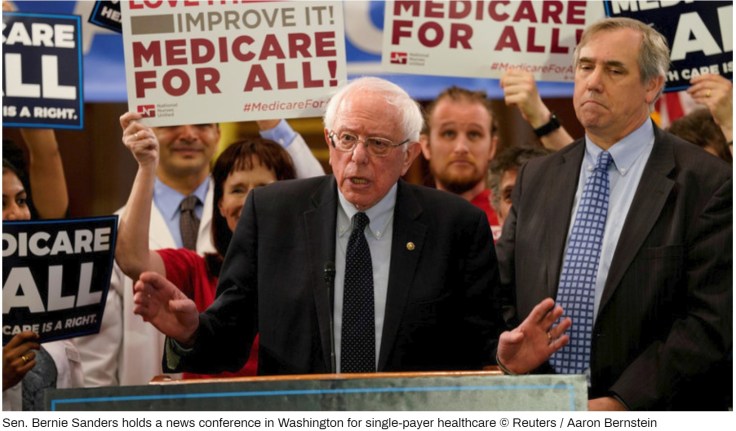
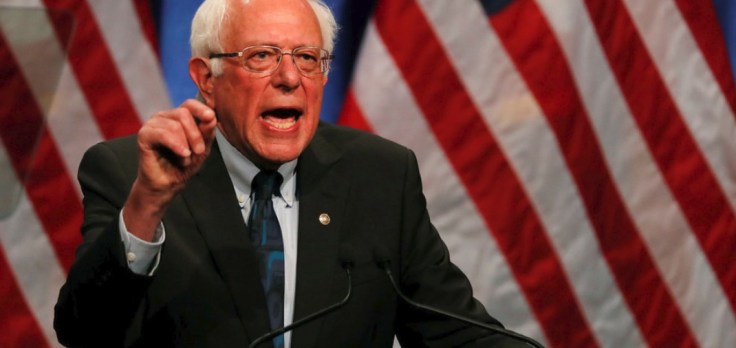
In his latest push for universal healthcare, 2020 candidate Bernie Sanders argued that Americans would be “delighted to pay more taxes” if that meant guaranteed access to treatment.

Speaking to CNN’s Anderson Cooper on Wednesday night, the socialist stalwart made the case for bringing a European-style healthcare system to the US.

“I suspect that a lot of people in the country would be delighted to pay more in taxes if they had comprehensive health care as a human right,” Sanders told Cooper.

“Your kids in many countries around the world can go to the public colleges and universities tuition-free, wages in many cases are higher,” Sanders continued. “So, there is a tradeoff, but at the end of the day, I think… most Americans will understand that is a good deal.”

Though Sanders cited Germany as an example of an ideal healthcare system, there are some key differences between the German model and the ‘Medicare for All’ plan advocated by Sanders. The German system is a multi-payer system funded by private and public sources. ‘Medicare for All,’ at least in its current iteration, is a single-payer system that would bar employers from providing competing private alternatives and could eliminate America’s $600 billion private insurance industry.

Medicare for All is a generous package that comes with a hefty price tag. The Committee for a Responsible Federal Budget – a supposedly non-partisan think tank – puts the price at $28 trillion, or nearly ten percent of the US’ GDP. Sanders’ own estimate turns out a cost of $13 trillion over ten years, still a roughly 30 percent increase in federal spending and an outlay more than 18 times larger than even the US military’s astronomical annual budget.

Americans largely support the idea of Medicare for All, with 70 percent in favor of a single-payer system, according to a Reuters poll taken last August. However, support for such a system drops off to 37 percent once they learn it would necessitate a massive tax hike to implement.

Bernie Sanders blasts Trump as ‘socialist for rich & powerful’

CAP

The sheer cost to the taxpayer of overhauling the US healthcare system has been trumpeted by conservatives to dismiss Sanders’ proposal. To date, Sanders has not managed to clarify exactly how this money would be raised. A paperreleased by his office in April suggested foisting some of the tax burden on employers, applying a premium to middle class households, increasing taxes on the wealthy, and imposing levies on financial institutions and offshore accounts.

Sanders maintains that these tax hikes would cut the country’s overall healthcare expenditure and leave the average American family “in a better financial position than they are under the current system.”

Blog at WordPress.com.

Up ↑