
Published on Jun 19, 2019


By Tom Pappert
On Black Empowerment’s website, most of its promotional materials contain the logos of the three radical groups, including on its poster advertising the slavery reparations protest.
Next to Black Empowerment’s logo on the promotional poster for the event is the logo for the Black Lawyers for Justice, a radical law firm that represented Khalid Abdul Muhammad, a radical black nationalist who called Jews “blood suckers” and the Pope a “no-good cracker”. Muhammad repeatedly denigrated Jews, Catholics, and homosexuals, and was condemned by resolutions in the House and Senate. Muhammad was considered so radical he was disavowed by Louis Farrakhan and the Nation of Islam, prompting Muhammad to become involved in the New Black Panther Party.
Interestingly, the founder of Black Lawyers for Justice is Malik Zulu Shabazz, who also lead the New Black Panther Party until 2013.
To the right of the Black Lawyers for Justice logo is the New Black Panther Party logo. The New Black Panther Party, though no longer led by Shabazz, previously used the term “a life for a life” when offering a $10,000 bounty for the citizens arrest of George Zimmerman in 2010. Party members were also accused of participating in voter intimidation and shouting racial epithets outside polling stations in 2008.
Additionally, Micah Xavier Johnson, who ambushed and shot multiple police officers in Dallas in 2016, had liked several New Black Panther Party social media presences and engaged with their content.
The Nation of Islam, a radical black nationalist organization that shares a similar ideology to neo-Nazi organizations, is seen on the bottom right corner of the poster. The Nation of Islam and its leader, Farrakhan, have repeatedly made anti-Semitic comments, with Farrakhan comparing Jews to “termites” during a public speech last year. Farrakhan has also previously praised Adolf Hitler, calling the dictator “a very fine man.”
Interestingly, Shabazz, The New Black Panther Party, and the Nation of Islam are all supposed to be separate groups with their own goals. In fact, the New Black Panther Party started after a schism with the Nation of Islam over Muhammad’s horrifically anti-Semitic, anti-Catholic, and homophobic comments, yet all three were essentially listed as sponsors of this protest group.
It should also be noted that multiple Hollywood celebrities and various Democrat presidential candidates are all calling for slavery reparations, while apparently ignoring the anti-Semitic protesters joining in their call using slogans that seem to have strikingly violent undertones.
Big League Politics contacted Black Empowerment for comment on its seemingly violent slogans and did not receive a response.
By Penny Starr
The text of the bill states:
To address the fundamental injustice, cruelty, brutality, and inhumanity of slavery in the United States and the 13 American colonies between 1619 and 1865 and to establish a commission to study and consider a national apology and proposal for reparations for the institution of slavery, its subsequent de jure and de facto racial and economic discrimination against African-Americans, and the impact of these forces on living African-Americans, to make recommendations to the Congress on appropriate remedies, and for other purposes.
The bill includes findings the commission would study:
(1) Approximately 4,000,000 Africans and their descendants were enslaved in the United States and colonies that became the United States from 1619 to 1865;
(2) The institution of slavery was constitutionally and statutorily sanctioned by the Government of the United States from 1789 through 1865;
(3) The slavery that flourished in the United States constituted an immoral and inhumane deprivation of Africans’ life, liberty, African citizenship rights, and cultural heritage, and denied them the fruits of their own labor;
(4) A preponderance of scholarly, legal, community evidentiary documentation and popular culture markers constitute the basis for inquiry into the on-going effects of the institution of slavery and its legacy of persistent systemic structures of discrimination on living African-Americans and society in the United States; and
(5) Following the abolition of slavery the United States Government, at the Federal, State, and local level, continued to perpetuate, condone and often profit from practices that continued to brutalize and disadvantage African-Americans, including sharecropping, convict leasing, Jim Crow, redlining, unequal education, and disproportionate treatment at the hands of the criminal justice system; and
(6) As a result of the historic and continued discrimination, African-Americans continue to suffer debilitating economic, educational, and health hardships including but not limited to having nearly 1,000,000 black people incarcerated; an unemployment rate more than twice the current white unemployment rate; and an average of less than 1⁄16 of the wealth of white families, a disparity which has worsened, not improved over time.
The list of witnesses includes presidential hopeful Sen. Cory Booker (D-NJ) and actor Danny Glover.
Other witnesses set to testify at the hearing at 10 a.m. EST are: Ta-Nehisi Coates, Distinguished Writer in Residence, Arthur J. Carter Journalism Institute of New York University; Katrina Browne, documentarian, Traces of the Trade; Coleman Hughes Writer, Quilette;v Burgess Owens, speaker and writer; Rev. Eugene Taylor Sutton, Episcopal Bishop of Maryland, Dr. Julianne Malveaux, economist and political commentator; and Eric Miller, professor of law, Loyola Law School, Loyola Marymount University.

JUNE 18, 2019
Asked by host Joy Reid how he would get his proposals through a Senate controlled by the GOP, Biden said, “There are certain things where it just takes a brass knuckle fight.”
The former Vice-President then appeared to walk back his rhetoric, saying it was the president’s job to “persuade the public”.
“So you go out and beat them….you make the case — you make an explicit case,” said Biden.
However, he then suggested, rather than to just “go home,” it was better to turn to more extreme methods.
“Or let’s start a real physical revolution if you’re talking about it because we have to be able to change what we’re doing within our system,” said Biden.
Given how polarized America is right now, one wonders what the reaction would have been to a Republican making similar comments.
———————————————————————————————————————
There is a war on free speech. Without your support, my voice will be silenced.
Please sign up for the free newsletter here. Donate to me on SubscribeStar here.
Support my sponsor – Turbo Force – a supercharged boost of clean energy without the comedown.

By Chris Menahan
Webber, whom the media is highlighting was an “honors student,” said on Facebook Live in a reportedly now-deleted video that police “gone have to kill me” hours before he was shot.
Webber was wanted by police for allegedly “cold-bloodedly” shooting a man 5 times on June 3 and stealing his car.
Extended video of his Facebook Live stream shows it started with Webber lighting up a blunt and ended with him talking about how the police “gonna have to kill me homie.”
“I ain’t even gonna lie, Ima do they ass so bad,” Webber added before bursting into laughter.
The pregnant girlfriend of a 20-year-old black man who was shot dead by U.S. Marshals during an attempted arrest outside his family’s home went into labor as riots broke out in the streets of the working-class Memphis neighborhood where he was killed.
Brandon Webber was shot and killed by officers on Wednesday night as they tried to arrest him for multiple warrants, including violent felony offenses, outside his home in Frayser in North Memphis.


Shortly before he was shot on Wednesday, Webber posted a live video on Facebook that showed him in a car, rapping and apparently smoking a marijuana cigarette. In the video, he looked out the window and said he saw police.
With a laugh, he looked directly into the camera and said the officers would ‘have to kill me.’ The video appeared to have been removed from his Facebook page late Thursday morning.
The Tennessee Bureau of Investigations said officers went to his home at about 7pm to look for Webber who had outstanding warrants, including the violent felony offense that occurred on June 3.
Officers said they saw Webber get into a vehicle and that he then proceeded to ram task force vehicles several times before exiting with a weapon. Marshals then opened fire on Webber. He died at the scene, according to officers.
CNN reported Thursday that 36 officers were injured after what they referred to as “demonstrators” reportedly “threw bricks at police and vandalized squad cars.”
“All those hospitalized have been released,” CNN reported. “Three people have been charged with disorderly conduct and one of them also with inciting a riot.”
According to the media, the real story here was an “honors student” with a “pregnant girlfriend” being shot by police just for being black.

By Tony Lee
“The Case for Reparations” author Ta-Nehisi Coates and actor Danny Glover are reportedly set to testify before the House Judiciary Subcommittee on the Constitution, Civil Rights and Civil Liberties, and the hearing’s stated purpose will be “to examine, through open and constructive discourse, the legacy of the Trans-Atlantic Slave Trade, its continuing impact on the community and the path to restorative justice,” according to a Thursday Associated Press report.
The June 19 hearing also “coincides with Juneteenth, a cultural holiday commemorating the emancipation of enslaved blacks in America.”
Rep. Sheila Jackson Lee (D-TX), who sits on the subcommittee, again introduced H.R. 40 earlier this year to create a reparations commission. Jackson Lee said her bill would create a commission “to study the impact of slavery and continuing discrimination against African-Americans, resulting directly and indirectly from slavery to segregation to the desegregation process and the present day.” She added in January that the “commission would also make recommendations concerning any form of apology and compensation to begin the long delayed process of atonement for slavery.”
“The impact of slavery and its vestiges continues to effect African Americans and indeed all Americans in communities throughout our nation,” Jackson Lee said. “This legislation is intended to examine the institution of slavery in the colonies and the United States from 1619 to the present, and further recommend appropriate remedies. Since the initial introduction of this legislation, its proponents have made substantial progress in elevating the discussion of reparations and reparatory justice at the national level and joining the mainstream international debate on the issues. Though some have tried to deflect the importance of these conversations by focusing on individual monetary compensation, the real issue is whether and how this nation can come to grips with the legacy of slavery that still infects current society. Through legislation, resolutions, news, and litigation, we are moving closer to making more strides in the movement toward reparations.”
Jackson Lee argued that despite the progress of African-Americans in the private sector, education, and the government in addition to “the election of the first American President of African descent, the legacy of slavery lingers heavily in this nation.”
“While we have focused on the social effects of slavery and segregation, its continuing economic implications remain largely ignored by mainstream analysis,” she continued. “These economic issues are the root cause of many critical issues in the African-American community today, such as education, healthcare and criminal justice policy, including policing practices. The call for reparations represents a commitment to entering a constructive dialogue on the role of slavery and racism in shaping present-day conditions in our community and American society.”
In the Senate, Sen. Cory Booker (D-NJ), a 2020 presidential candidate, introduced the companion legislation, saying creating a reparations committee “is a way of addressing head-on the persistence of racism, white supremacy, and implicit racial bias in our country.”
“It will bring together the best minds to study the issue and propose solutions that will finally begin to right the economic scales of past harms and make sure we are a country where all dignity and humanity is affirmed,” Booker said in April.
House Speaker Nancy Pelosi (D-CA), in addition to nearly every Democrat running for president, has endorsed Jackson Lee’s bill.
And though Coates praised Sen. Elizabeth Warren (D-CA) this week on the reparations issue, Warren, like nearly every other 2020 Democrat with the exception of former San Antonio Mayor Julian Castro, has squirrelly dodged questions about whether the United States government should make cash payments to the descendants of slaves.
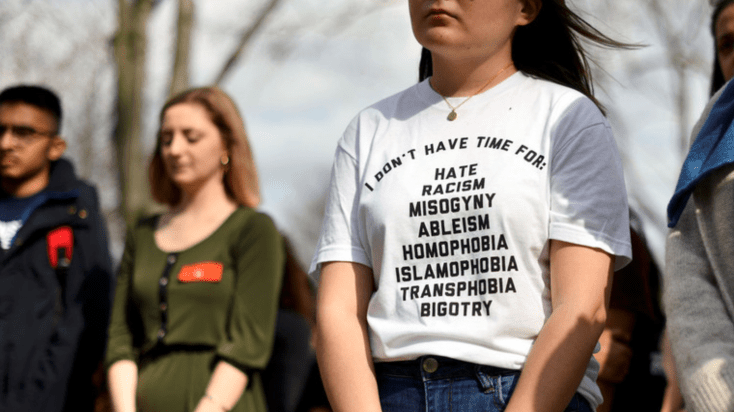
Virginia Tech may be the most extreme example, but it’s hardly alone. The school exemplifies a relatively recent trend in US higher education in which student identity groups demand and are given their own facilities, programs and (safe) spaces. While legally-mandated racial segregation under the ‘separate but equal’ doctrine was struck down in the 1954 Supreme Court decision Brown v. Board of Education, a National Association of Scholars surveyof 173 colleges published last month revealed that fully 72 percent now offer segregated graduation ceremonies, with 43 percent boasting segregated student residences.
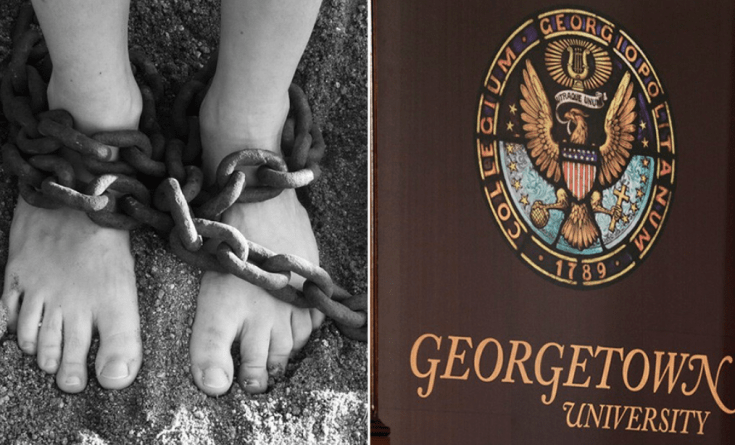
Georgetown University students vote reparations for slavery into future tuition
Unlike the enforced segregation of old, this kinder, gentler discrimination is couched in the language of empowerment, strength in diversity, and tolerance. Only there is no diversity within a single-race dorm, and no tolerance learned by mingling solely with one’s own kind. Certainly, there is nothing empowering about claiming a bottom-of-the-barrel identity like “recovering addict” because as a straight white student, you have no advocates planning a special graduation ceremony for you at Virginia Tech.
While the ‘Cultural and Community Centers’ program that runs Virginia Tech’s identity group ceremonies encourages students to attend as many as their multiplicity of identities allows, it’s physically impossible to attend the “Gesta Latina” Hispanic-Latino achievement ceremony and the Lavender Commencement Ceremony (for LGBT students), and the Recovery Community and Veterans ceremonies overlap as well in a particularly unfortunate coincidence, given that 1 in 15 vets were diagnosed as substance abusers in 2013.
The ceremonies are technically open to everyone – to watch. However, the American Indian/Indigenous ceremony invites only “indigenous students, faculty and staff” to participate, just as Aliyah is a “celebration of achievement” only for Jewish students and the Muslim event celebrates only Muslim students. Certainly, only black students can “Don the Kente,” a brightly-colored Ghanaian cloth that black VTech students have been wearing to separate themselves since 1995. Those without a designated ethnic or religious group can probably try to join the catch-all International Student Achievement Ceremony – bonus points if you can fake an accent – but for white kids, it’s the all-school impersonal graduation ceremony only – unless you’re a vet or an addict.
A 2013 Economic Policy Institute report on segregation in public schools post-Brown claims black students are “more isolated than they were 40 years ago” thanks to racial economic disparities and discriminatory policing that disproportionately locks up black men. Why, then, would universities consciously choose to perpetuate such segregation, adding the sick joke of framing it as empowering?
Reflexively mocking those who object to institutionalized identity politics as victims of “white fragility” misses the point. A university education was once about exposing young adults to new and challenging ideas, often communicated by people unlike themselves, in an effort to prepare them to make their way in the world and develop their own values. The current university model instead resembles an exorbitantly-priced adult daycare in which all rough edges have been sanded down to avoid uncomfortable learning experiences which might force the student to change, question, or develop as a person. Students emerge from safe-space chrysalises less prepared for “real life” than when they went in – and are usually saddled with hundreds of thousands of dollars in debt besides, ensuring they are both psychologically and economically crippled – pardon me, handicapable – before they even begin their journey in life.
Helen Buyniski
 Tom's Blog