
Published on Jul 8, 2019
By Ben Kew
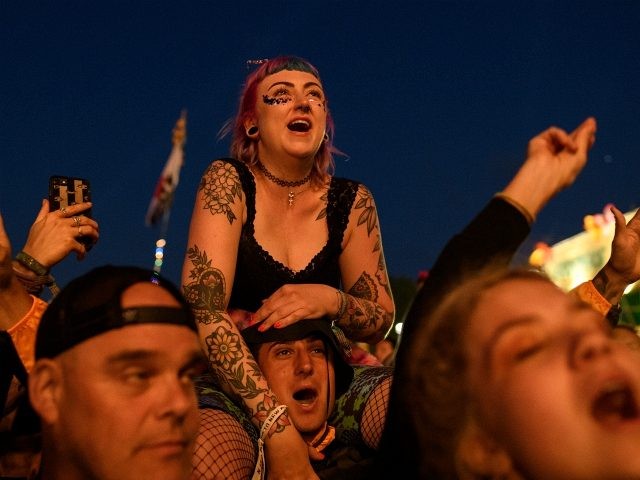
The festival, set to take place August 3rd, was initially offering different ticket prices based on the race of the attendee. For white people, or “non-persons of color,” early bird tickets cost $20, compared with $10 for people of color. For those planning on buying tickets closer to the event date, white people were asked to pay $40 compared with $20 for people of color.
The pricing structure led to a significant backlash, with critics questioning the legality and ethics of the organizers’ race-based pricing. One of the performers, a mixed race rapper named Tiny Jag, pulled out the festival in protest, describing it as a “non-progressive” and motivated by “spite.”

However, the organizers have backed down from their position, which they previously claimed would ensure that marginalized groups were given “equitable chance at enjoying events in their own community.”
In a statement provided to CNN, ticketing website Eventbrite said that the company does not “permit events that require attendees to pay different prices based on their protected characteristics such as race or ethnicity.”
“In this case, we have notified the creator of the event about this violation and requested that they alter their event accordingly,” said a company spokesperson. “We have offered them the opportunity to do this on their own accord; should they not wish to comply we will unpublish the event completely from our site.”
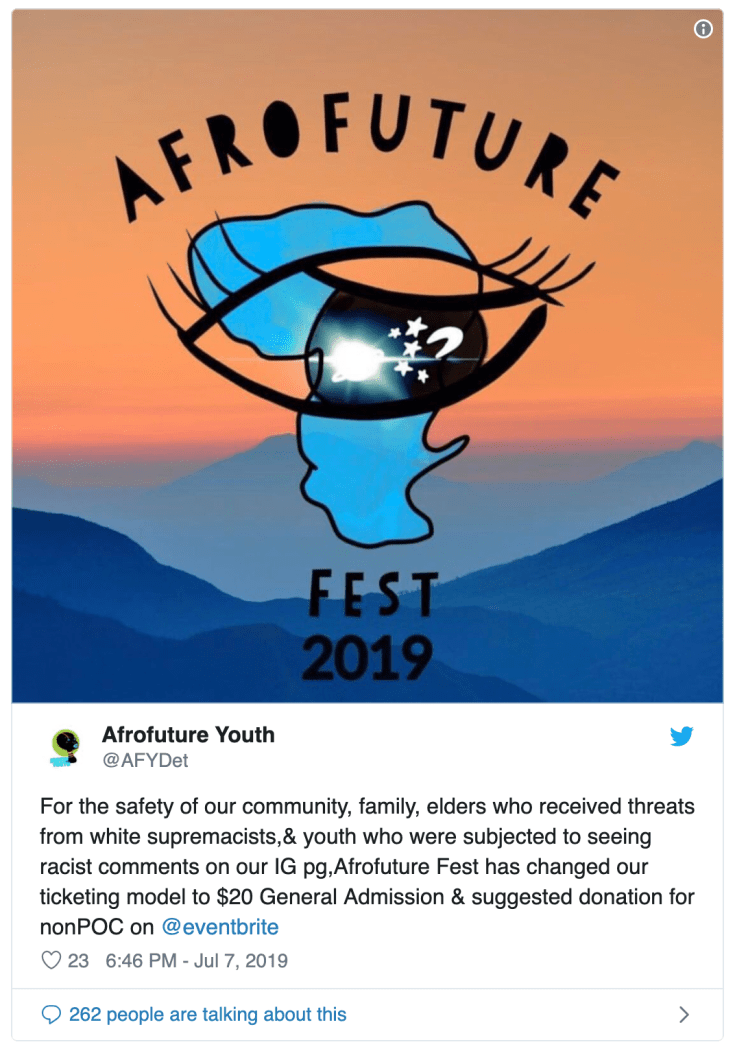
Announcing the decision, AfroFuture confirmed that they would scrap the pricing system but would still ask white attendees to pay an extra donation.
“For the safety of our community, family, elders who received threats from white supremacists, & youth who were subjected to seeing racist comments on our IG pg, Afrofuture Fest has changed our ticketing model to $20 General Admission & suggested donation for nonPOC on Eventbrite,” they wrote on Twitter.
The organizers also decided to offer free tickets for people of color, although they quickly sold out. With all $10 “Early Bird” tickets also selling out, the only ticket still on offer is a “General Admission,” priced at $20.

By Patrick Howley
Kamala Harris’ father Donald Harris wrote an essay entitled “Reflections of a Jamaican Father” for Jamaica Global Online, in which he made a startling admission (emphasis added):
“My roots go back, within my lifetime, to my paternal grandmother Miss Chrishy (née Christiana Brown, descendant of Hamilton Brown who is on record as plantation and slave owner and founder of Brown’s Town) and to my maternal grandmother Miss Iris (née Iris Finegan, farmer and educator, from Aenon Town and Inverness, ancestry unknown to me). The Harris name comes from my paternal grandfather Joseph Alexander Harris, land-owner and agricultural ‘produce’ exporter (mostly pimento or all-spice), who died in 1939 one year after I was born and is buried in the church yard of the magnificent Anglican Church which Hamilton Brown built in Brown’s Town (and where, as a child, I learned the catechism, was baptized and confirmed, and served as an acolyte).”
Harris’ father’s passage ends
Hamilton Brown was not only a slave owner, but also an engineer of mass Irish migration to Jamaica after the British empire abolished slavery in 1834.
Jamaican Family Search recorded: “Hamilton Brown owned several plantations over the years 1817 to about 1845. According to the 1818 Almanac which can be found on this site, (Jamaican Family Search) , he was the owner of Minard (128 slaves) which he must have acquired from its previous owner (John Bailie) in 1815 or later. The number of slaves on this estate approximates the number of slaves in one of the registers attributed to his ownership (124 slaves). The other register (86 slaves) cannot be assigned to any estate, although he is listed in Almanacs for subsequent years as owning several, (Antrim, Grier Park, Colliston, Little River, Retirement and Unity Valley).”
Here is a full accounting of the slaves owned by Hamilton Brown, according to the National Archives in London, as of June 28, 1817 in the parish of St. Ann in Jamaica:
| NAMESNames of all Males to precede names of females
MALES |
Colour | Age | African or creole | Remarks |
| 1 Apollo | Negro | 45 | African | – |
| 2 Jein | Negro | 40 | African | – |
| 3 Sambo | Negro | 40 | African | – |
| 4 Cicero | Negro | 30 | African | – |
| 5 St???e | Negro | 45 | African | – |
| 6 Chance | Negro | 44 | African | – |
| 7 Clendin | Negro | 42 | African | – |
| 8 Jamaica | Negro | 32 | African | – |
| 9 Apollo | Negro | 32 | African | – |
| 10 Montague | Negro | 38 | African | – |
| 11 Jack | Negro | 30 | African | – |
| 12 Mark | Negro | 32 | African | – |
| 13 Ned | Negro | 36 | African | – |
| 14 Sharper | Negro | 40 | African | – |
| 15 Ceasar | Negro | 38 | African | – |
| 16 John | Negro | 30 | African | – |
| 17 Charles | Negro | 35 | African | – |
| 18 Oxford | Negro | 35 | African | – |
| 19 Hannibal | Negro | 32 | African | – |
| 20 ??ill | Negro | 30 | African | – |
| 21 Dick | Negro | 35 | African | – |
| 22 Duke | Negro | 32 | African | – |
| 23 Nelson | Negro | 34 | African | – |
| 24 Robert | Negro | 30 | African | – |
| 25 George | Negro | 35 | African | – |
| 26 Prince | Negro | 40 | African | – |
| 27 Henry | Negro | 38 | African | – |
| 28 Hamilton | Negro | 28 | African | 4 |
| 29 Tom Jack | Negro | 40 | African | – |
| 30 Neal | Negro | 34 | African | – |
| 31 Luke | Negro | 28 | African | – |
| 32 Bel | Negro | 25 | African | – |
| 33 ????? | Negro | 33 | African | – |
| 34-39 missing | – | – | – | – |
| – | – | – | PAGE 89 | – |
| 40 Charles | Negro | 16 | Creole | – |
| 41 London | Negro | 11 | Creole | – |
| 42 Nelson | Negro | 10 | Creole | son of Juddy |
| 43 Jamaica | Negro | 10 | Creole | son of Evey |
| 44 ?Seny | Negro | 8 | Creole | son of Juddy |
| 45 Virgil | Negro | 8 | Creole | son of Love |
| 46 Tom | Negro | 4 | Creole | son of Juddy |
| 47 Joab | Negro | 3 | Creole | son of Lucky |
| 48 Harper | Negro | 3 | Creole | son of Love |
| 49 Jack | Negro | 2 | Creole | son of Lucy |
| 50 James | Negro | 2 | Creole | son of Tamer |
| 51 Sambo | Negro | 2 | Creole | son of Evey |
| 52 Dick | Negro | 1 | Creole | son of Nanny |
| 53 Charles | Negro | 1 | Creole | son of Nelly |
| 54 Hugh | Negro | 5mos | Creole | son of Maria |
| 55 Sam | Negro | 4mos | Creole | son of Gift |
| 56 George | Negro | 6mos | Creole | son of Flance |
| FEMALES | – | – | – | – |
| 1 Pheba | Negro | 50 | African | – |
| 2 Love | Negro | 42 | African | – |
| 3 Juddy | Negro | 40 | African | – |
| 4 ?Floramel ?Meromel | Negro | 40 | African | – |
| 5 Flora | Negro | 38 | African | – |
| 6 Lucy | Negro | 40 | African | – |
| 7 Maria | Negro | 40 | African | – |
| 8 Laura | Negro | 30 | African | – |
| 9 Evey | Negro | 30 | African | 5 |
| 10 Olive | Negro | African | – | |
| 11 Lucky | Negro | 28 | African | – |
| 12 Venus | Negro | 32 | African | – |
| 13 Rachel | Negro | 30 | African | – |
| 14 ?Betsy | Negro | 27 | African | – |
| 15 Juliet | Negro | 48 | African | – |
| 16 Hellen | Negro | 40 | African | – |
| 17 Nanny | Negro | 27 | African | – |
| 18 Nelly | Negro | 28 | African | – |
| 19 Gift | Negro | 25 | African | – |
| 20 Jeane | Negro | 33 | African | – |
| 21 Milly | Negro | 32 | African | – |
| 22 Industry | Negro | 13 | Creole | – |
| 23 Margaret | Negro | 10 | Creole | Daughter of Juddy |
| 24 Nancy | Negro | 4 | Creole | Daughter of Tamer |
| 25 Mary | – | 4 | Creole | Daughter of Evey |
| – | – | – | PAGE 90 | – |
| 26 Peggy | Negro | 3 | Creole | Daughter of Flora |
| 27 Sarah | Negro | 2 | Creole | Daughter of Nanny |
| 28 ? Hanna | Negro | 6mos | Creole | Daughter of Tamer |
| 29 Hellen | Negro | 5mos | Creole | Daughter of Milly |
| 30 Nelly | Negro | 2 | Creole | Daughter of ?Floramel ?Meromel |
Hamilton Brown officially swore to the authenticity of this record, stating:
“I Hamilton Brown do swear that the above list and return consisting of two sheets is a true perfect and complete list and return, to the best of my knowledge and belief in every particular therein mentioned of all and every slaves possessed by me as owner, considered as most permanently settled, worked and employed in the Parish of Saint Ann on the twenty Eight day of June One thousand Eight Hundred and Seventeen without fraud, deceit or evasion So help me God.
Sworn before me this twenty fourth day of September 1817”
Hamilton Brown’s slave owning shows up in other records, as well.
“Hamilton Brown was instrumental in the importing of several hundred labourers and their families from Ireland to Jamaica between 1835 and 1840,” according to University College London’s project “Legacies of British Slave-ownership.” The project describes Hamilton Brown as a “Major attorney and resident slave-owner in Jamaica.”
The Jamaican newspaper The Gleaner reported in July 2012 in a travel piece on Brown’s Town:
“As we struggled to stay on the narrow sidewalk, we noticed an elderly man coming our way. He had an unruly grey beard and wore spectacles with thick frames and cloudy lenses.
“Hallo! Hallo!” he said. We stopped and returned the greeting. The man gave his name as Ferly and he told us a bit about Brown’s Town.
“A good amount of Brown live here, you know,” he said. “People what name Brown pack up the place. It all coming from Hamilton Brown who the town name after. Yes man, dem teach it in school,” said Ferly, nodding.
He told us that Hamilton Brown was buried in the graveyard at the nearby Anglican Church. “But a lot of people don’t even know that. Is only long-time people like me know dem tings,” he said.”
The Gleaner passage ends
Black activist Tariq Nasheed has publicly cast doubt on Kamala Harris’ claim to being “Black.”

June 28, 2019
During Thursday night’s Democratic primary debate, Harris confronted former Vice President Joe Biden about his boasting of working with two segregationists during his career in the senate.
“I do not believe you are a racist. And I agree with you when you commit yourself to the importance of finding common ground,” Harris said. “But it was hurtful to hear you talk about the reputations of two United States senators who built their reputations and career on the segregation of race in this country.”
Harris went on to tell a story about her childhood, saying “there was little girl in California who was part of the second class to integrate her public schools, and she was bused to school every day — and that little girl was me.”
During her post-debate interview in the spin room in Miami, Matthews asked her about the story of her childhood — and how she doesn’t hate white people.
“I have a great deal of respect for Joe Biden,” Harris told MSNBC. “I do not believe he’s a racist but his perspective on those [segregationist] senators was something that was hurtful and it had consequences.”
“How did you come out of that and not have hatred towards white people, generally?” Matthews asked.
“Most Americans do not conduct themselves that way, and most parents don’t conduct themselves that way,” Harris responded. “So there was no need to create a broad application because of that one experience, but we cannot deny that there are many children, black children in America who have had that experience.”
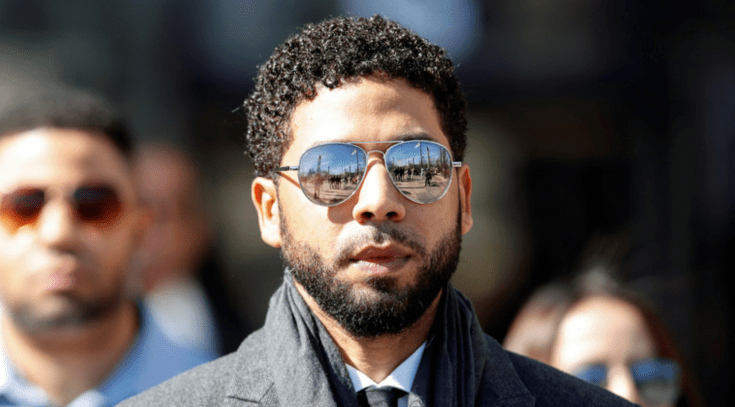
The footage was filmed in the ex-Empire actor’s Chicago home back in January at 8:45am local time, some seven hours after he was allegedly subjected to a racist and homophoic attack in a nearby street.
The bodycam captured the officers entering the home and speaking to Frank Gatson, who introduces himself as the actor’s “creative director,” while Smollett can be seen wearing a thin white rope around his neck.
“Do you want to take it off or anything?,” the police officer asks, referring to the noose. Smollet replies: “Yeah I do, I just wanted you to see it.” The officers are asked to switch off their cameras shortly after.
The video is part of hundreds of files released by the Chicago PD after a judge ordered a special prosecutor to examine the handling of Smollett’s accusation. The actor could face a fresh criminal prosecution for his role in the saga, depending upon the outcome of the investigation.
Smollett claimed he was randomly attacked, punched, and doused in bleach by two masked men who he claimed made reference to President Donald Trump’s slogan ‘Make America Great Again.’
READ MORE: Smollett sued by Chicago for ‘refusing to reimburse’ costs of ‘staged’ hate crime
The incident sparked widespread outcry amongst the LGBTQ community, African-Americans, and some Democratsas well as the Hollywood elite. However, two weeks later the tables turned when two brothers, Abel and Ola Osundairo, arrested for carrying out the attack, said the entire thing was orchestrated and paid for by Smollett.
Three weeks after the ‘attack’ Smollett himself was arrested and charged with filing a false police report. At the time Police Superintendent Eddie Johnson said Smollett “took advantage of the pain and anger of racism to promote his career.”

A month later the episode took yet another unexpected turn when all charges against the then-fired actor were unceremoniouslydropped in lieu of forfeiting his $10,000 bond and carrying out community service.
Smollett continued to maintain his innocence, but the drama didn’t end there. In March, Chicago Police ordered him to pay $130,000 to cover the cost of investigating the case. When Smollett refused, the amount was tripled in a lawsuit filed by the city in April. Smollett’s legal team is also facing litigation, this time from the Osundairo brothers, who claim their reputation was damaged in the melee.

By James Barrett
The former vice president made the reference while addressing criticism that he is too “old fashioned” for the “New Left.” In his defense of his bipartisan, “consensus”-building approach to politics, Biden “invoked two Southern segregationist senators by name as he fondly recalled the ‘civility’ of the Senate in the 1970s and 1980s,” The New York Times reports.
“At the event, Mr. Biden noted that he served with the late Senators James O. Eastland of Mississippi and Herman Talmadge of Georgia, both Democrats who were staunch opponents of desegregation,” the Times reports. “Mr. Eastland was the powerful chair of the Senate Judiciary Committee when Mr. Biden entered the chamber in 1973.”
“I was in a caucus with James O. Eastland,” said Biden. “He never called me ‘boy,’ he always called me ‘son.'” (The Times notes that a pool report says Biden briefly imitated a southern accent when he delivered the line.)
Talmadge, said Biden, was “one of the meanest guys I ever knew, you go down the list of all these guys.”
“Well guess what?” he said. “At least there was some civility. We got things done. We didn’t agree on much of anything. We got things done. We got it finished.”
Biden then attempted to drive home his point: “But today you look at the other side and you’re the enemy. Not the opposition, the enemy,” he said. “We don’t talk to each other anymore.”
Biden, 76, has found himself under fire for his calls for a return to bipartisanship from the current, more radical iteration of the Democratic Party, which repeatedly rejects compromise and vilifies Republicans. Biden argued Tuesday that the inability to achieve “consensus in our system” only “encourages and demands the abuse of power by a president.”
Related: WATCH: Students Slam Trump’s ‘Pretty Racist’ Quotes, Then Learn They’re From Biden
Biden’s reference to two anti-desegregation Democrats is a reminder of his party’s racist history, as highlighted by National Review in a 2015 piece calling out the left’s attempts to “whitewash” the party’s record. In 1956, 99 Democrats in Congress signed the “Southern Manifesto,” which “declared the signatories’ opposition to the Supreme Court’s decision in Brown v. Board of Education and their commitment to segregation forever.” Two Republicans signed it. A far higher percentage of Republicans in the House supported the Civil Rights Act of 1964 than Democrats — 80% compared to 61% — while 80% of Republicans in the Senate supported it, compared to 69% of Democrats.
“The Democrats have been sedulously rewriting history for decades,” writes Mona Charen for National Review. “Their preferred version pretends that all the Democratic racists and segregationists left their party and became Republicans starting in the 1960s. How convenient. If it were true that the South began to turn Republican due to Lyndon Johnson’s passage of the Civil Rights Act, you would expect that the Deep South, the states most associated with racism, would have been the first to move. That’s not what happened. The first southern states to trend Republican were on the periphery: North Carolina, Virginia, Texas, Tennessee, and Florida. (George Wallace lost these voters in his 1968 bid.) The voters who first migrated to the Republican party were suburban, prosperous New South types. The more Republican the South has become, the less racist.”
Vanderbilt’s Carol Swain has also addressed this “whitewashing” of the Democratic Party in a recent video for PragerU:
By Penny Starr
The text of the bill states:
To address the fundamental injustice, cruelty, brutality, and inhumanity of slavery in the United States and the 13 American colonies between 1619 and 1865 and to establish a commission to study and consider a national apology and proposal for reparations for the institution of slavery, its subsequent de jure and de facto racial and economic discrimination against African-Americans, and the impact of these forces on living African-Americans, to make recommendations to the Congress on appropriate remedies, and for other purposes.
The bill includes findings the commission would study:
(1) Approximately 4,000,000 Africans and their descendants were enslaved in the United States and colonies that became the United States from 1619 to 1865;
(2) The institution of slavery was constitutionally and statutorily sanctioned by the Government of the United States from 1789 through 1865;
(3) The slavery that flourished in the United States constituted an immoral and inhumane deprivation of Africans’ life, liberty, African citizenship rights, and cultural heritage, and denied them the fruits of their own labor;
(4) A preponderance of scholarly, legal, community evidentiary documentation and popular culture markers constitute the basis for inquiry into the on-going effects of the institution of slavery and its legacy of persistent systemic structures of discrimination on living African-Americans and society in the United States; and
(5) Following the abolition of slavery the United States Government, at the Federal, State, and local level, continued to perpetuate, condone and often profit from practices that continued to brutalize and disadvantage African-Americans, including sharecropping, convict leasing, Jim Crow, redlining, unequal education, and disproportionate treatment at the hands of the criminal justice system; and
(6) As a result of the historic and continued discrimination, African-Americans continue to suffer debilitating economic, educational, and health hardships including but not limited to having nearly 1,000,000 black people incarcerated; an unemployment rate more than twice the current white unemployment rate; and an average of less than 1⁄16 of the wealth of white families, a disparity which has worsened, not improved over time.
The list of witnesses includes presidential hopeful Sen. Cory Booker (D-NJ) and actor Danny Glover.
Other witnesses set to testify at the hearing at 10 a.m. EST are: Ta-Nehisi Coates, Distinguished Writer in Residence, Arthur J. Carter Journalism Institute of New York University; Katrina Browne, documentarian, Traces of the Trade; Coleman Hughes Writer, Quilette;v Burgess Owens, speaker and writer; Rev. Eugene Taylor Sutton, Episcopal Bishop of Maryland, Dr. Julianne Malveaux, economist and political commentator; and Eric Miller, professor of law, Loyola Law School, Loyola Marymount University.

By Chris Menahan
Webber, whom the media is highlighting was an “honors student,” said on Facebook Live in a reportedly now-deleted video that police “gone have to kill me” hours before he was shot.
Webber was wanted by police for allegedly “cold-bloodedly” shooting a man 5 times on June 3 and stealing his car.
Extended video of his Facebook Live stream shows it started with Webber lighting up a blunt and ended with him talking about how the police “gonna have to kill me homie.”
“I ain’t even gonna lie, Ima do they ass so bad,” Webber added before bursting into laughter.
The pregnant girlfriend of a 20-year-old black man who was shot dead by U.S. Marshals during an attempted arrest outside his family’s home went into labor as riots broke out in the streets of the working-class Memphis neighborhood where he was killed.
Brandon Webber was shot and killed by officers on Wednesday night as they tried to arrest him for multiple warrants, including violent felony offenses, outside his home in Frayser in North Memphis.


Shortly before he was shot on Wednesday, Webber posted a live video on Facebook that showed him in a car, rapping and apparently smoking a marijuana cigarette. In the video, he looked out the window and said he saw police.
With a laugh, he looked directly into the camera and said the officers would ‘have to kill me.’ The video appeared to have been removed from his Facebook page late Thursday morning.
The Tennessee Bureau of Investigations said officers went to his home at about 7pm to look for Webber who had outstanding warrants, including the violent felony offense that occurred on June 3.
Officers said they saw Webber get into a vehicle and that he then proceeded to ram task force vehicles several times before exiting with a weapon. Marshals then opened fire on Webber. He died at the scene, according to officers.
CNN reported Thursday that 36 officers were injured after what they referred to as “demonstrators” reportedly “threw bricks at police and vandalized squad cars.”
“All those hospitalized have been released,” CNN reported. “Three people have been charged with disorderly conduct and one of them also with inciting a riot.”
According to the media, the real story here was an “honors student” with a “pregnant girlfriend” being shot by police just for being black.

By Chris Menahan
Last month, South African activist and mom Annette Kennealy, who spoke out against the massacre of white farmers in South Africa on social media, was brutally murdered on her farm in a hammer and knife attack.
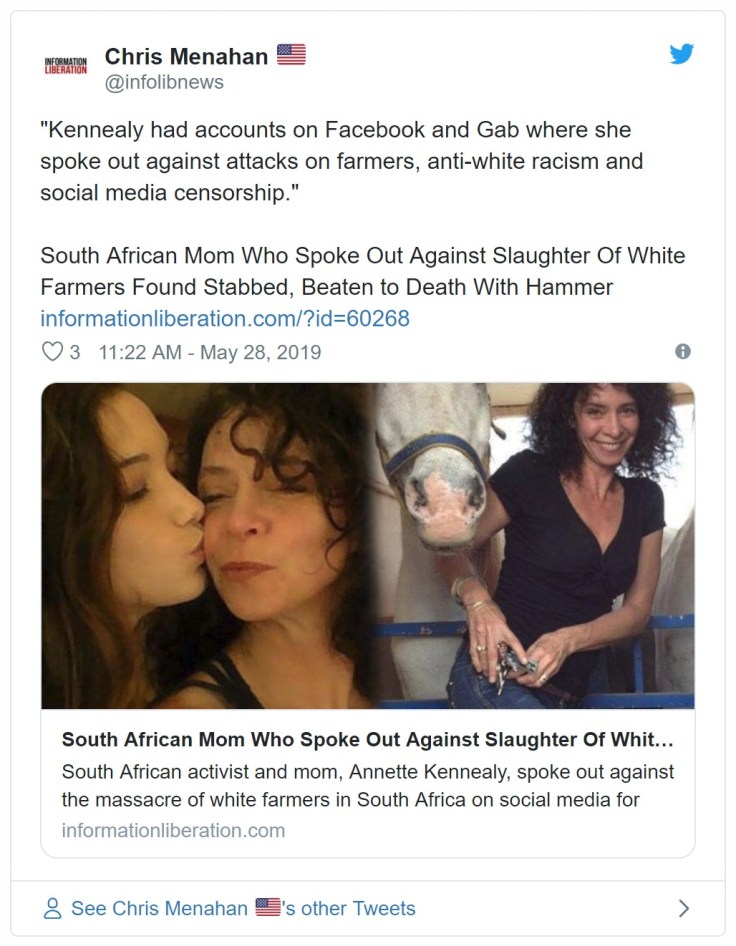
On Sunday, another white South African farmer who also spoke out against farm attacks, Stefan Smit, was murdered on his farm by four men who broke into his home and shot him in front of his family and friends:

On Wednesday, a third farm attack occurred in the same area of the Cape Winelands, which the Western Cape government said has become “a hot spot for farm attacks.”
On the same day Smit was murdered, “an elderly couple’s house was broken into on a farm nearby.”
“Three armed suspects gained entry to the house and threatened the two occupants, both aged 70. They fled with personal belongings and are yet to be arrested.”
During a separate incident on Tuesday morning, a woman was attacked by robbers in her house on a Klapmuts farm. – EWN.co.za
While the Times had interviewed Smit for a March piece about the struggle for land in the country’s wine region, the outlet — in the same article — called claims that South African farmers were being murdered in large numbers and forced off their land “false or exaggerated allegations.”
Carlson began the segment by pointing out the “hundreds” of farmers killed, “some of whom after suffering horrific tortures.” And yet, the South African government has responded not by “protecting the farmers” but by working “to change the country laws in order to seize land without compensation.”
“And skin color is a central motivation here,” said the Fox News host. “Nobody denies that. Let’s be clear about what is happening. This is racist violence, as brutal and horrifying and indefensible as anything that happened under Apartheid.”

 Tom's Blog