

Sheila Jackson-Lee Quietly Introduces Bill To BLOCK Taxpayer Money From Building The Wall
 Published 1 hour ago by
Democrat congresswoman Sheila Jackson-Lee quietly introduced a bill called the “Protect American Taxpayers and Secure Border Act.”
The bill, with a title that means the exact opposite of what it proposes, was introduced on December 19 and now sits in the House Judiciary and Homeland Security committees.
Here is the text of the bill:
SECTION 1. SHORT TITLE.
Trending: CONFIRMED: The Government CAN Build The Wall With Brian Kolfage’s GoFundMe Money
This Act may be cited as the “Protect American Taxpayers and Secure Border Act”.
SEC. 2. PROHIBITIONS AND REQUIREMENTS RELATING TO BORDER SECURITY.
(a) In General.—No taxpayer funds may be obligated or expended to build a wall or barrier intended to impede travel between Mexico and the United States.
(b) Foreign Payment Required.—Any wall or barrier described in subsection (a) that is proposed to be built shall be paid for using funds provided by the Government of Mexico.
(c) Securing The Southern Border.—The Secretary of Homeland Security shall take such actions as may be necessary to secure the southern border by making maximum effective utilization of technology and improved training of U.S. Custom and Border Protection agents and officers.
(d) Increase In Immigration Judges.—The Attorney General may appoint 100 additional immigration judges in addition to immigration judges currently serving as of the date of the enactment of this Act.
(e) Humanitarian Assistance.—The Secretary of Homeland Security shall take such actions as may be necessary to ensure that humanitarian assistance is provided to immigrants, refugees, and other displaced persons who are in need of medical assistance and aid to sustain health and life.
‘Humanity not mankind’: EU Parliament urges MEPs to adopt ‘gender-neutral’ language
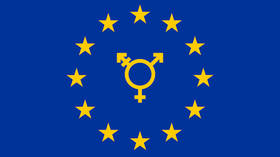
Faced with a fracturing union plagued by internal squabbles, EU Parliament has taken decisive action to solve the bloc’s numerous real-world problems, issuing a pamphlet which urges MEPs to ditch words coined with “man”.
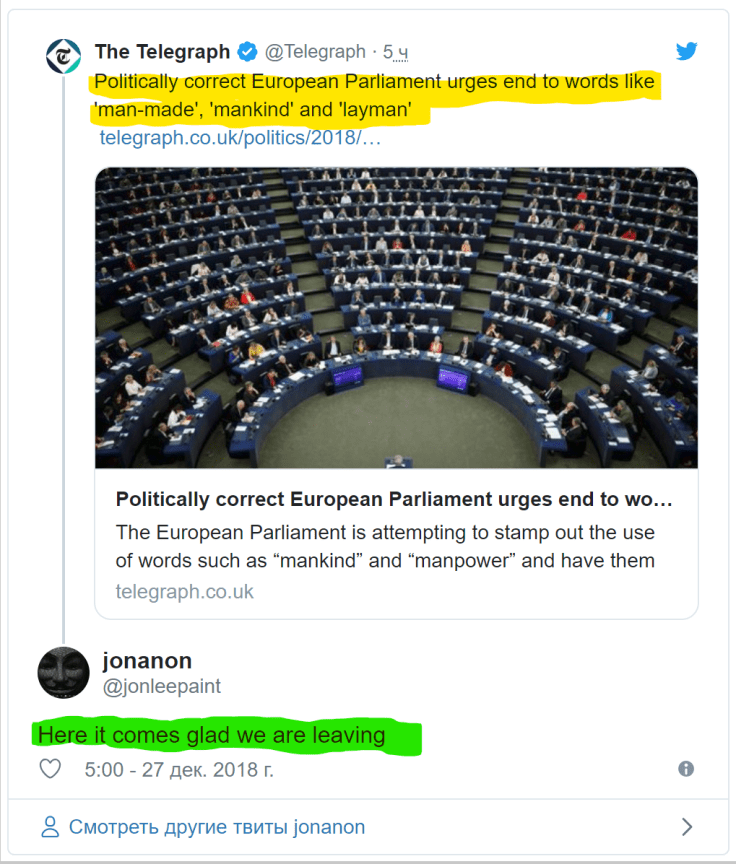
Officials and members in the parliament have been sent guidebooks on using gender-neutral language in all of their official EU-related work and communications, the Telegraph reported on Thursday. Under the new guidelines, European lawmakers will be strongly encouraged to say “chair” instead of “chairman”, “artificial” instead of “man-made”, and “humanity” instead of “mankind.”
“Gender-neutral or gender-inclusive language is more than a matter of political correctness”, the guidebook insists. “Language powerfully reflects and influences attitudes and perceptions.”
The decision has prompted reactions from the country where English originated, especially from those of its citizens who seem to support the UK leaving the bloc.
“Here it comes glad we are leaving,” one Brit on Twitter wrote.
“Thank f*** we’re leaving! What a load of old s****,” another quipped, using the gender-neutral word for “man-feces.”
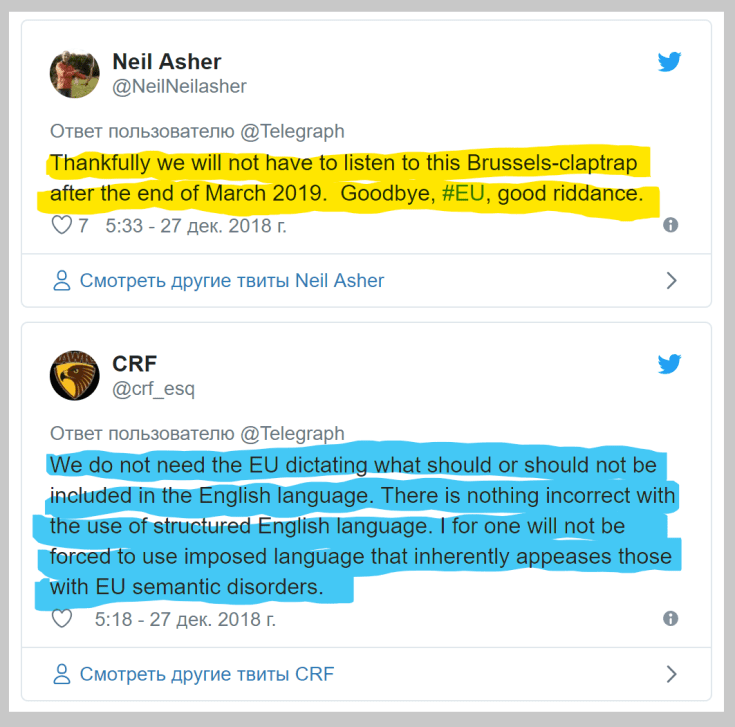
Others have argued that the guidelines are an affront to the English language, and attempt to needlessly alter the roots and meaning behind certain words.

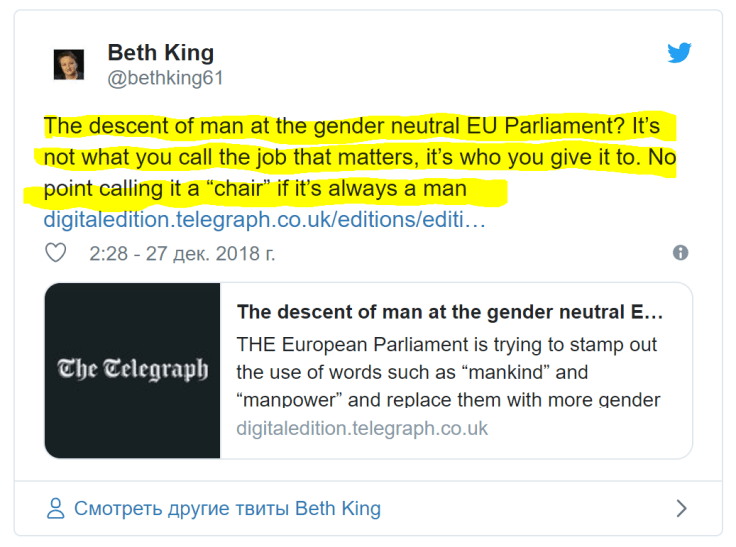
Some pointed that the words mean nothing if they are not supported by actions.
The guidelines first emerged in November but were geared more towards interpreters, who were advised to use gender-neutral terms when translating between languages.
The EU parliament is just the latest in a long line of Western institutions to strive for a completely inoffensive, neutral-everything world. Everything from Christmas songs to “anti-animal” language has been targeted by the PC police for hurting at least one person’s feelings on Twitter.
Blowback after Emannuel Macron’s wife snaps photo with ‘notorious homophobe’

France’s First Lady has found herself in the crosshairs of LGBT activists after posing for a photo with a pariah businessman known for his homophobic outbursts.
While visiting a popular Paris Christmas market, Brigitte Macron reportedly met with the holiday fair’s organizer, Marcel Campion, and congratulated him for the “very beautiful” event. The resulting photo op – showing the pair standing in front of a life-sized nutcracker – may not have been the most politically prudent decision, however. Campion is currently facing legal trouble over homophobic remarks that he directed at city leaders. The tycoon was recorded ranting about how Paris was “governed by homos” after he was forbidden by the city to host his traditional Christmas market on Champs Elysees.

In the video that went viral in September, the businessman said: “I usually say ‘queers’, but I was told that I should not say that anymore. So I don’t say queers, I say homos.” He later clarified that he doesn’t have anything “against” gay people, but that the alleged homosexuals who, in his opinion, run Paris are “perverted.”
“Beautiful, the wife of the President of the Republic who displays herself with a notorious homophobe”, said Deputy Mayor of Paris Ian Brossat.
“So, Brigitte Macron, the First Lady of France, ostensibly appears with Marcel Campion, who talks about homosexuals as ‘perverse’ ‘faggots’ who must be saved from AIDS, even though he is being sued for defamation and homophobic insults…. Shame on her!” added LGBT activist Maxime Cochard.

Her husband, president Emmanuel Macron, recently had a photo scandal of his own, when he posed for a widely mocked photo with a reported cocaine dealer and his middle finger-flipping cousin.
Think your friends would be interested? Share this story!

Finland to Start Imprisoning Illegal Migrants
By Ben Warren

Finland has created a new law allowing the imprisonment of illegal migrants.
The law specifically targets migrants who enter the country after they were given an “entry ban,” according to the Finnish Ministry of Justice.
“The President of the Republic today adopted amendments to the law by which a new provision on violation of the ban on entry is added,” said the Ministry. “To date, violation of the prohibition has generally led to fines for foreigners offenses.”
“In the future, the punishment for breach of the ban shall be fines or imprisonment for a maximum of one year.”
Additionally, the law is effective at the start of 2019 and authorities expect it to discourage further illegal movement into the country.
This legal maneuver against the surge of migrants comes after Finland’s Immigration Service (Migri) admitted they couldn’t identify almost half of the migrants applying for asylum.
“People who are fleeing do not have the possibility of leaving with the required documents in their pockets,” said a Migri official. “Some of them come from countries that don’t even have passport systems.”
Correspondingly, it is unclear if the country has enough prison space to honor the new law as Migri is on record demanding more funding to construct additional facilities for migrants.

France’s ‘yellow vests’ block borders ahead of Christmas
By AFP – 22 DEC. 2018
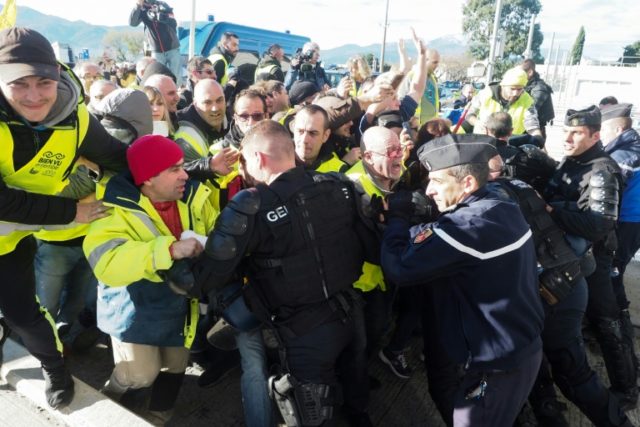
Paris (AFP) – Three days from Christmas, French “yellow vests” turned out in small numbers for a sixth Saturday of protests in cities and border points as a fatal road accident brought the death toll to 10 since the movement began last month.
Near the border between France and Spain hundreds of protesters disrupted traffic as they gathered around an autoroute toll booth.
Police fired tear gas to disperse the “yellow vests” who retreated to a bridge, throwing objects on the road, an AFP photographer at the scene said.

“The autoroute is now being cleaned to allow traffic to resume normally,” local authorities said.
France borders the Catalan region of Spain, and the French protesters were joined by dozens of Catalan pro-independence activists, also wearing yellow vests.
The separatists often block highways to protest against Madrid’s rejection of Catalonia’s independence referendum in October 2017.
Even though their goals are different, “this demonstration at the Boulou (toll booth) is symbolic, it shows the solidarity between the Spanish Catalans and the French,” said Marcel, a 49-year-old winegrower.
Roadblocks by protesters were also reported on autoroutes near the border with Italy and at a bridge in Strasbourg near the German border.
A driver died overnight when his car slammed into the back of a truck stopped at a roadblock set up by “yellow vest” protesters at an autoroute entrance in Perpignan on the Mediterranean coast, prosecutor Jean-Jacques Fagni told AFP.

There have now been 10 deaths related to the protests since they began on November 17.
– Macron effigy –
In Paris, the scene of violent clashes during previous demonstrations, around 800 protesters joined rallies scattered around the city, police said at mid-day.
But the French capital’s iconic Champs-Elysees avenue was calm, with most shops except for some luxury boutiques open for business in the busy weekend before Christmas.
David Delbruyere, 48, was one of about 20 protesters near the Arch of Triumph, the fifth time he has come to the French capital for a demonstration as he remains “disgusted” with conditions in France.
Paris police said 65 people had been arrested, including a “yellow vest” leader, Eric Drouet.
Authorities were also stationed at the Palace of Versailles outside Paris which has been closed to visitors over fears of unrest.
A Facebook event organised by Drouet had listed thousands of people “interested” in joining the Versailles demonstration but only around 60 have shown up.
Further demonstrations of several hundred “yellow vests” were reported in Lyon, Marseille, Rouen and Bordeaux.
And in Angouleme in southwest France, a puppet effigy of President Emmanuel Macron was decapitated Friday night during a “yellow vest” protest, regional authorities said Saturday.
Meanwhile, police stepped in with tear gas to disperse around 80 protesters who had gathered Saturday outside Macron’s home in the Channel coast town of Touquet.
The number of protesters has however fallen significantly since last week, when Macron, a pro-business centrist, gave in to some of their demands.
Since the peak on November 17 with 282,000 demonstrators, the turnout has fallen to 166,000 on November 24, 136,000 on the first and eighth of December and 66,000 on December 15.
The movement characterised by the high-visibility yellow vests worn by the protesters originally started as a protest about planned fuel tax hikes, but has morphed into a widespread demonstration against Macron’s policies and top-down style of governing.
On Friday evening, the French Senate approved Macron’s measures to help the working poor and pensioners — just hours after they were adopted by the lower house of parliament — which aim to quell “yellow vest” anger and should come into force early in 2019.
burs-adm-sab-ito/boc/wai
Another Saturday in Paris: Smoke & scuffles, more than 100 Yellow Vests detained
The atmosphere at the Yellow Vest protests in the heart of the French capital has become more strained as demonstrators engage in scuffles with police officers.
Tensions rose hours into the rallies and police resorted to force against the rioters near the artistic Montmartre district in the north of the capital.
Scuffles also broke out near Madeleine Church, some 2km from Montmartre. Protesters were also seen near the iconic Louvre Museum and Sacre-Coeur Basilica. More than 100 people have been detained, according to the Paris Police Prefecture.
Some 2,000 people in fluorescent vests – clothing usually worn by drivers that has now become an emblem of the rallies – were marching in the capital Saturday, according to the city’s police prefecture. The number of participants in the streets has notably diminished, however.
WATCH LIVE:
Yellow Vest protesters changed their usual meeting place. Instead of the Champs-Elysees, where violent clashes have occurred, they rallied in Montmartre. Yet, the district wasn’t the intended venue for the rallies. Initially, they were called to march towards a French symbol of power and a major tourist site – the iconic Versailles Palace. Located some 20km west of Paris, the palace was once besieged during the French Revolution.
As in previous weeks, the protests have also spread beyond the capital. Across the whole country 23,800 protesters tuned out, BFMTV reported. Some 300 demonstrators gathered in front of the city hall in Marseille. People also marched near a local police station, demanding the release of two Yellow Vests who had been detained earlier in the day.
Protesters also gathered at the A9 highway toll of Le Boulou in southern France. Waving Catalan flags and carrying a banner saying “All united” the rally was apparently a nod to Friday’s protests in Barcelona.
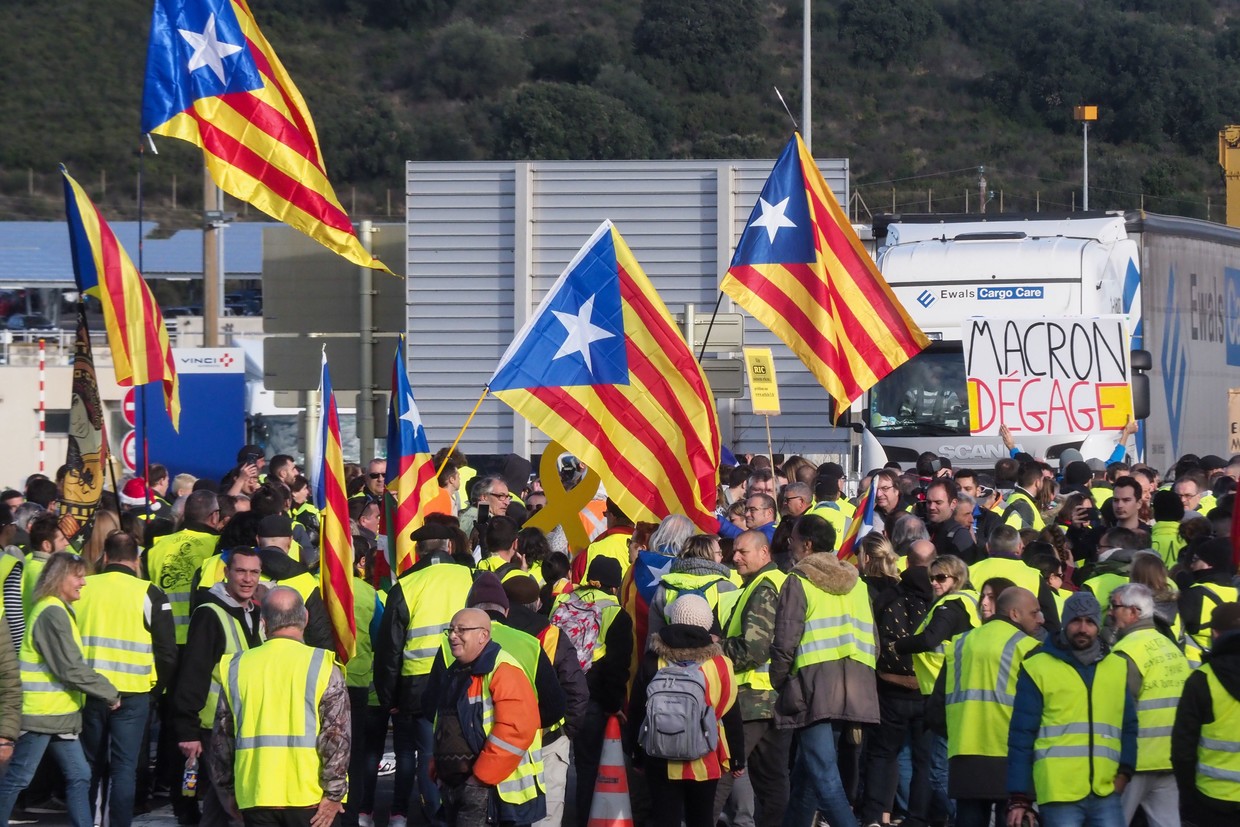
Protesters wearing “Yellow Vests” wave Catalan flags at the A9 highway toll of Le Boulou
France has been hit by a sixth consecutive weekend of Yellow Vest rallies. Previous protests turned violent, with demonstrators hurling stones and fireworks at police, while law enforcement resorted to using tear gas and water cannon. The mayhem has left almost 3,000 people, both protesters and police officers, injured. Over 4,500 have been detained and placed into custody since mid-November.
Think your friends would be interested? Share this story!
 Tom's Blog