CFR’s Martin Indyk Slams Trump: Soon He May Be Asking ‘Why Are We Giving Israel So Much Money?’

By Chris Menahan

Capture

Martin Indyk, two-time US Ambassador to Israel and current Distinguished Fellow at the Council on Foreign Relations, attacked President Trump on Twitter Wednesday for saying Israel will be okay despite the US pulling out of Syria because we give them “billions of dollars.”

“This cavalier attitude is deeply worrying,” Indyk said. “Ignores the role of US as force multiplier for Israeli deterrence. From here it’s a short step to Trump asking: why are we giving Israel so much money?”

Capture

Here’s Trump’s full comments as reported Thursday by the Times of Israel:

Speaking with reporters, Trump was asked about criticism that the move could put Israel in jeopardy by allowing Iran to expand its foothold in Syria.

“Well, I don’t see it. I spoke with Bibi,” he said, referring to Prime Minister Benjamin Netanyahu. “I told Bibi. And, you know, we give Israel $4.5 billion a year. And they’re doing very well defending themselves, if you take a look.”

“So that’s the way it is,” Trump said, according to a White House transcript.

“We’re going to take good care of Israel. Israel is going to be good. But we give Israel $4.5 billion a year. And we give them, frankly, a lot more money than that, if you look at the books — a lot more money than that. And they’ve been doing a very good job for themselves,” he added.

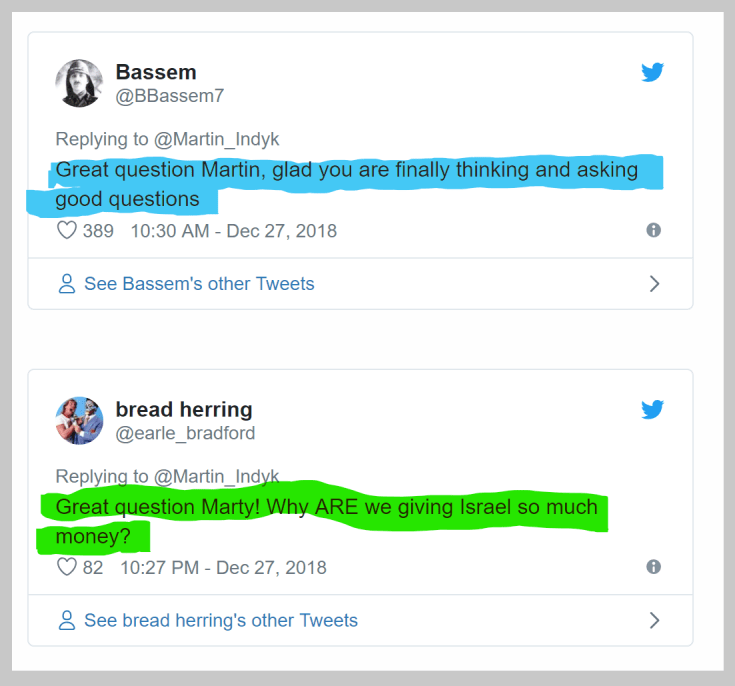
Here’s some of the top responses to Indyk’s tweet:

Capture

Capture

Indyk has a rather fascinating history according to his Wikipedia page (click through for source links):

In 1982, Indyk began working as a deputy research director for the American Israel Public Affairs Committee (AIPAC), a pro-Israel lobbying group in Washington.[4][5] From 1985 Indyk served eight years as the founding Executive Director of the Washington Institute for Near East Policy, a research institute specializing in analysis of Middle East policy.[6]

[…]He served as special assistant to President Bill Clinton and as senior director of Near East and South Asian Affairs at the United States National Security Council. While at the NSC, he served as principal adviser to the President and the National Security Advisor on Arab–Israeli issues, Iraq, Iran, and South Asia. He was a senior member of Secretary of State Warren Christopher’s Middle East peace team and served as the White House representative on the U.S. Israel Science and Technology Commission.

He served two stints as United States Ambassador to Israel, from April 1995 to September 1997, and from January 2000 to July 2001. He was the first and so far, the only, foreign-born US ambassador to Israel.

He has served on the board of the New Israel Fund.[7] Indyk currently serves on the Adivsory Board for DC based non-profit America Abroad Media.[8]

On July 29, 2013, Indyk was appointed by President Barack Obama as Washington’s special Middle East envoy for the resumption of peace talks between Israel and the Palestinian Authority.[9] Both Israeli Prime Minister Benjamin Netanyahu and Palestinian President Mahmoud Abbas favored his appointment.[10] He resigned from this position June 27, 2014, returning to the Brookings Institution as its vice president and director for foreign policy.[11][12]

Controversy

In 2000, Indyk was placed under investigation by the FBI after allegations arose that he improperly handled sensitive material by using an unclassified laptop computer on an airplane flight to prepare his memos of meetings with foreign leaders.[13][14][15] There was no indication that any classified material had been compromised, and no indication of espionage.[16]

Indyk was “apparently … the first serving U.S. ambassador to be stripped of government security clearance.”[16] The Los Angeles Times reported that “veteran diplomats complained that Indyk was being made a scapegoat for the kinds of security lapses that are rather common among envoys who take classified work home from the office.”[16] Indyk’s clearance was suspended but was reinstated the next month, “for the duration of the current crisis,” given “the continuing turmoil in Israel, the West Bank and Gaza [Strip] and for compelling national security reasons.”[16]

Criticism
Receiving donations from Qatar

In 2014, Indyk came under scrutiny when a New York Times investigation revealed that wealthy Gulf state of Qatar made a $14.8 million, four-year donation to Brookings Institution, in order to fund two Brookings initiatives,[17] the Brookings Center in Doha and the Project on U.S. Relations with the Islamic World.[18] The Times investigation found that Brookings was one of more than a dozen influential Washington think tanks and research organizations that “have received tens of millions of dollars from foreign governments in recent years while pushing United States government officials to adopt policies that often reflect the donors’ priorities.”[17] A number of scholars interviewed by the Times expressed alarm at the trend, saying that the “donations have led to implicit agreements that the research groups would refrain from criticizing the donor governments.”[17]

The revelation of the think tank’s choice to accept the payment from Qatar was especially controversial because at the time, Indyk was acting as a peace negotiator between Israel and the Palestinians, and because Qatar funds jihadist groups in the Middle East and is the main financial backer of Hamas, “the mortal enemy of both the State of Israel and Mahmoud Abbas’ Fatah party.”[19] Hamas political chief Khaled Meshaal, who directs Hamas’s operations against Israel, is also harbored by Qatar.[17] Indyk defended the arrangement with Qatar, contending that it did not influence the think tank’s work and that “to be policy-relevant, we need to engage policy makers.”[17] However, the arrangement between Qatar and Brookings caused Israeli government officials to doubt Indyk’s impartiality.[20]

Soros ‘person of the year’ indeed: In 2018 globalists pushed peoples’ patience to the edge

By Robert Bridge

Capture.PNG

Since 2015, the proponents of neoliberalism have been pushing ahead with their plans for open borders and globalist agenda without the consent of the people. The last 365 days saw that destructive agenda greatly challenged.

In light of the epic events that shaped our world in 2018, it seems the Yellow Vests – the thousands of French citizens who took to the streets of Paris to protest austerity and the rise of inequality – would have been a nice choice for the Financial Times’ ‘person of the year’ award. Instead, that title was bestowed upon the billionaire globalist, George Soros, who has arguably done more meddling in the affairs of modern democratic states than any other person on the planet.

Perhaps FT’s controversial nomination was an attempt to rally the forces of neoliberalism at a time when populism and nascent nationalism is sweeping the planet. Indeed, the shocking images coming out of France provide a grim wake-up call as to where we may be heading if the globalists continue to undermine the power of the nation-state.

See the source image

It is no secret that neoliberalism relentlessly pursues a globalized, borderless world where labor, products, and services obey the hidden hand of the free market. What is less often mentioned, however, is that this system is far more concerned with promoting the well-being of corporations and cowboy capitalists than assisting the average person on the street. Indeed, many of the world’s most powerful companies today have mutated into “stateless superpowers,” while consumers are forced to endure crippling austerity measures amid plummeting standards of living. The year 2018 could be seen as the tipping point when the grass-roots movement against these dire conditions took off.

Since 2015, when German Chancellor Angela Merkel allowed hundreds of thousands of undocumented migrants into Germany and the EU, a groundswell of animosity has been steadily building against the European Union, perhaps best exemplified by the Brexit movement. Quite simply, many people are growing weary of the globalist argument that Europe needs migrants and austerity measures to keep the wheels of the economy spinning. At the very least, luring migrants with cash incentives to move to Germany and elsewhere in the EU appears incredibly shortsighted.

Indeed, if the globalist George Soros wants to lend his Midas touch to ameliorating the migrant’s plight, why does he think that relocating them to European countries is the solution? As is becoming increasingly apparent in places like Swedenand France, efforts to assimilate people from vastly different cultures, religions and backgrounds is an extremely tricky venture, the success of which is far from guaranteed.

One worrying consequence of Europe’s season of open borders has been the rise of far-right political movements. In fact, some of the harshest criticism of the ‘Merkel plan’ originated in Hungary, where its gutsy president, Viktor Orban, hopes to build “an old-school Christian democracy, rooted in European traditions.” Orban is simply responding to the democratic will of his people, who are fiercely conservative, yet the EU parliament voted to punish him regardless. The move shows that Brussels, aside from being adverse to democratic principles, has very few tools for addressing the rise of far-right sentiment that its own misguided policies created.

Here it is necessary to mention once again that bugbear of the political right, Mr. Soros, who has received no political mandate from European voters, yet who campaigns relentlessly on behalf of globalist initiatives through his Open Society Foundations (OSF) (That campaign just got some serious clout after Soros injected $18bn dollars of his own money into OSF, making it one of the most influential NGOs in the world).

With no small amount of impudence, Soros has condemned EU countries – namely his native Hungary – for attempting to protect their territories by constructing border barriers and fences, which he believes violate the human rights of migrants (rarely if ever does the philanthropist speak about the “human rights” of the native population). In the words of the maestro of mayhem himself: “Beggar-thy-neighbor migration policies, such as building border fences, will not only further fragment the union; they also seriously damage European economies and subvert global human rights standards.”

Through a leaked network of compromised EU parliamentarians who do his bidding, Soros says the EU should spend $30 billion euros ($33bln) to accommodate “at least 300,000 refugees each year.” How will the EU pay for the resettling of migrants from the Middle East? Soros has an answer for that as well. He calls it “surge funding,” which entails “raising a substantial amount of debt backed by the EU’s relatively small budget.”

See the source image

Any guesses who will be forced to pay down the debt on this high-risk venture? If you guessed George Soros, guess again. The already heavily taxed people of Europe will be forced to shoulder that heavy burden. “To finance it, new European taxes will have to be levied sooner or later,” Soros admits. That comment is very interesting in light of the recent French protests, which were triggered by Emmanuel Macron’s plan to impose a new fuel tax. Was the French leader, a former investment banker, attempting to get back some of the funds being used to support the influx of new arrivals into his country? The question seems like a valid one, and goes far at explaining the ongoing unrest.

At this point, it is worth remembering what triggered the exodus of migrants into Europe in the first place. A large part of the answer comes down to unlawful NATO operations on the ground of sovereign states. Since 2003, the 29-member military bloc, under the direct command of Washington, has conducted illicit military operations in various places around the globe, including in Iraq, Libya and Syria. These actions, which could be best described as globalism on steroids, have opened a Pandora’s Box of global scourges, including famine, terrorism and grinding poverty. Is this what the Western states mean by ‘humanitarian activism’? If the major EU countries really want to flout their humanitarian credentials, they could have started by demanding the cessation of regime-change operations throughout the Middle East and North Africa, which created such inhumane conditions for millions of innocent people.

This failure on the part of Western capitals to speak out against belligerent US foreign policy helps to explain why a number of other European governments are experiencing major shakeups. Sebastian Kurz, 32, won over the hearts of Austrian voters by promising to tackle unchecked immigration. In super-tolerant Sweden, which has accepted more migrants per capita than any other EU state, the anti-immigrant Sweden Democrats party garnered 17.6 percent of the vote in September elections – up from 12.9 percent in the previous election. And even Angela Merkel, who is seen by many people as the de facto leader of the European Union, is watching her political star crash and burn mostly due to her bungling of the migrant crisis. In October, after her Christian Democratic Union (CDU) suffered a stinging setback in Bavaria elections, which saw CDU voters abandon ship for the anti-immigrant AfD and the Greens, Merkel announced she would resign in 2021 after her current term expires.

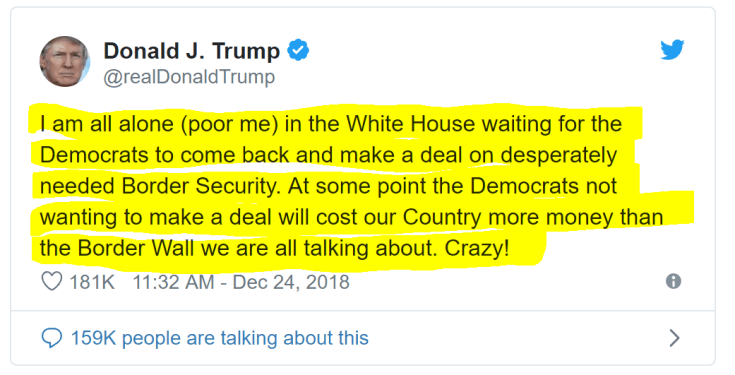
Meanwhile, back in the US, the government of President Donald Trump has been shut down as the Democrats refuse to grant the American leader the funds to build a wall on the Mexican border – despite the fact that he essentially made it to the White House on precisely that promise. Personally, I find it very hard to believe that any political party that does not support a strong and viable border can continue to be taken seriously at the polls for very long. Yet that is the very strategy that the Democrats have chosen. But I digress.

Capture

The lesson that Western governments should have learned over the last year from these developments is that there exists a definite red line that the globalists cross at risk not only to the social order, but to their own political fortunes. Eventually the people will demand solutions to their problems – many of which were caused by reckless neoliberal programs and austerity measures. This collective sense of desperation may open the door to any number of right-wing politicians only too happy to meet the demand.

Better to provide fair working conditions for the people while maintaining strong borders than have to face the wrath of the street or some political charlatan later. Whether or not Western leaders will change their neoliberal ways as a populist storm front approaches remains to be seen, but I for one am not betting on it.

@Robert_Bridge

Like this story? Share it with a friend!

Jeb Bush On Syria: ‘Donald Trump Is Bad For Israel… Hopefully Our President Will Reverse His Decision’

By Chris Menahan

Failed presidential candidate Jeb Bush said Wednesday on Twitter that he hopes President Trump will “reverse his decision to abandon Syria” because it’s “bad for Israel.”

Capture

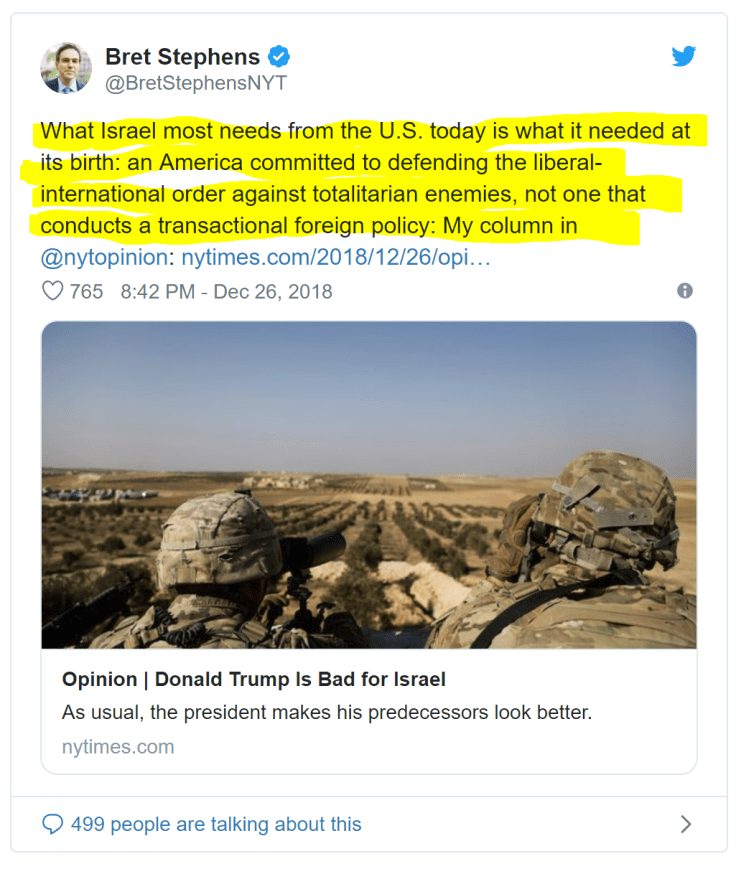
He linked to an article from the New York Times by neocon Bret Stephens which said “that the ultimate long-term threat to Israel is the resurgence of isolationism in the U.S.”

“What Israel most needs from the U.S. today is what it needed at its birth in 1948: an America committed to defending the liberal-international order against totalitarian enemies, as opposed to one that conducts a purely transactional foreign policy based on the needs of the moment or the whims of a president.”

Stephens said the idea “neoconservatives always put Israel first” is an “invidious myth”:

Contrary to the invidious myth that neoconservatives always put Israel first, the reasons for staying in Syria have everything to do with core U.S. interests. Among them: Keeping ISIS beaten, keeping faith with the Kurds, maintaining leverage in Syria and preventing Russia and Iran from consolidating their grip on the Levant.

Capture

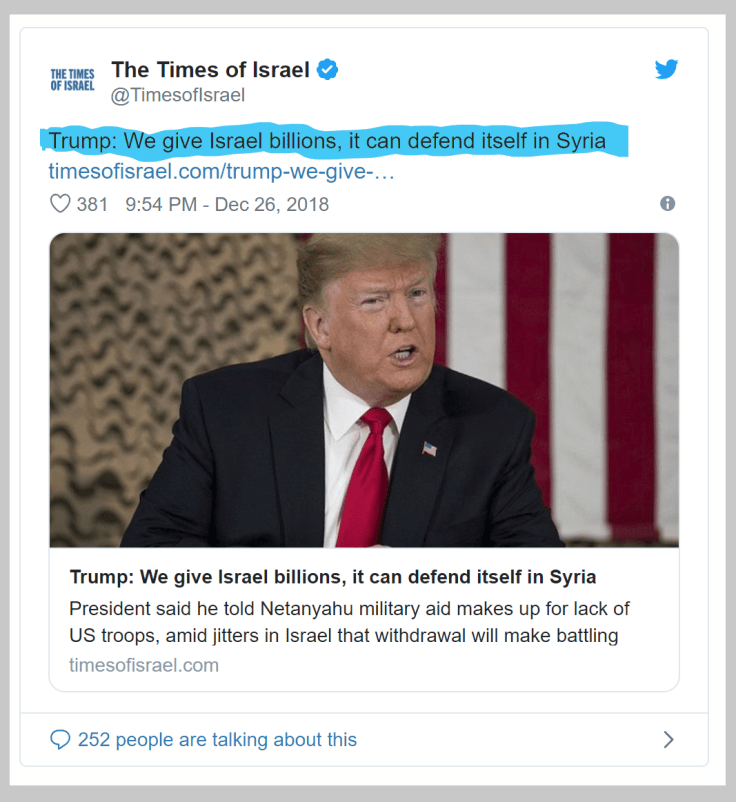
President Trump said Wednesday that we give Israel billions of dollars every year and they can defend themselves.

Capture

From the Times of Israel:

Speaking with reporters, Trump was asked about criticism that the move could put Israel in jeopardy by allowing Iran to expand its foothold in Syria.

“Well, I don’t see it. I spoke with Bibi,” he said, referring to Prime Minister Benjamin Netanyahu. “I told Bibi. And, you know, we give Israel $4.5 billion a year. And they’re doing very well defending themselves, if you take a look.”

“So that’s the way it is,” Trump said, according to a White House transcript.

“We’re going to take good care of Israel. Israel is going to be good. But we give Israel $4.5 billion a year. And we give them, frankly, a lot more money than that, if you look at the books — a lot more money than that. And they’ve been doing a very good job for themselves,” he added.

Stephens’ column made no mention of the billions in foreign aid America gives Israel every year.


Neocons and Media Unite to Attack Trump’s Syria Decision

By Mark Alan

President Trump’s decision to withdraw US troops from Syria has been met with some push back among neoconservatives and the media. Although the move seems consistent with the presidents previous statements about the conflict, that didn’t stop some from expressing shock over the decision. Undoubtedly, the two loudest voices among Republicans were Senators Lindsey Graham and Marco Rubio.

Graham called the move an “Obama-like” mistake. Rubio, apparently trying to establish himself as the leading figure of the neoconservative movement, went as far as calling the president’s decision a “retreat.” Graham and Rubio have both expressed past support for using the US military to topple Syrian President Bashar al-Assad.

The response from many in the media hasn’t been too different from that of the neocons. CNN’s Erin Burnett strongly condemned President Trump’s decision. She said the president was giving Vladimir Putin an early Christmas present by withdrawing US soldiers from Syria. However, she failed to articulate why she believes the lives of US soldiers are less valuable than the alleged disruption between the US and Russia.

Burnett wasn’t the only CNN personality to attack the president for his decision. CNN’s Fareed Zakaria also bashed the withdraw of US troops from Syria. He claimed President Trump was making an even bigger mistake than former president George W Bush’s “mission accomplished” fiasco during the Iraq War. It’s worth noting that Zakaria is one of many prominent members of the media who supported the decision to invade Iraq.

Anchors from other networks also condemned the president’s choice to withdraw troops from Syria. Fox News’ Brian Kilmeade called Trump’s decision “stunning and irresponsible.” He also suggested the president was “cutting and running.” MSNBC’s Joe Scarborough expressed similar sentiments on his show this morning.

The reaction of the neoconservatives and like minded members of the media shouldn’t come as a surprise to anyone. The two groups have united numerous times in the past, salivating at the idea of a ground war to overthrow Assad in Syria. Thankfully, peace has prevailed.

United States military forces have been in Syria for over four years. The first known instance of American troops fighting on the ground in Syria occurred in July of 2014, as part of a hostage rescue operation. The Global War on Terror has already cost US tax payers nearly 6 trillion dollars. To provide that number some context, the combined value of the entire US housing market is worth about 30 trillion dollars.

Elsewhere, President Trump’s decision has been met with praise. Senators Mike Lee and Rand Paul both applauded the president’s withdraw of troops from Syria. Senator Paul saidthe president’s decision is another example of Trump keeping his campaign promises. Paul further defended the move, saying the president’s decision in Syria illustrates why he won the 2016 election.

THE NEW YORK TIMES WAS AGAINST WAR IN SYRIA BEFORE IT WAS FOR IT

See the source image

What a difference a year can make for The New York Times

By Joe Simonson

What a difference a year can make for The New York Times.

As President Donald Trump announced his decision Wednesday to withdraw the nation’s 2,000 troops from Syria, a bipartisan cadre of opinion-havers attacked him as recklessly abandoning allies in the region and jeopardizing America’s influence over foreign affairs.

One newspaper was particularly harsh: The Times.

Quickly after Secretary of Defense James Mattis announced his resignation (in part as a protest against Trump’s decision on Syria) Thursday, America’s paper of record quickly produced a scathing editorial, proclaimingJim Mattis Was Right.”

See the source image

“Who will protect America now?” The Times asked.

The editorial frets about how American troops leaving Syria “hampers morale” of “allied forces like the Kurds.” (RELATED: Trump Explains His Decision To Withdraw From Syria)

“It could also risk getting American soldiers killed or wounded for objectives their commanders had already abandoned,” writes The Times.

Yet almost a year ago, on Jan. 19, 2018, that same editorial board raked the president over the coals for even daring to continue America’s policy of military adventurism.

The Times expressed concern that more American troops beyond the 2,000 initially deployed could soon be sent overseas in a mission without any clear goals.

“Syria is a complex problem. But this plan seems poorly conceived, too dependent on military action and fueled by wishful thinking,” The Times said.

See the source image

While on Thursday The Times worried that leaving Syria could leave the Kurds vulnerable to Turkey, at the beginning of 2018, the paper also believed that the U.S. would be setting up a clash between the minority group and a NATO ally.

“Turkey, which views the Kurds as an enemy, has threatened a cross-border assault. All of this raises the grim possibility that American troops will clash with Turkey, a NATO ally,” The Times wrote last January.

Nowhere in Thursday’s editorial does The Times ever point to an alternative timeline for withdrawal for American forces in Syria. Such an omission is quite startling, considering last January the paper’s chief criticism of sending forces to the region was setting up just another forever-war in the Middle East.

One thing is clear from these two diametrically opposed editorials: The job of The Times isn’t to provide valid criticisms of Trump, but to simply oppose him at all costs.

Blog at WordPress.com.

Up ↑