Constant surveillance: How big tech’s household devices are SPYING on you

Screen Shot 2019-07-31 at 10.33.26 AM

The expansion of home tech products to make life increasingly convenient requires consumer privacy sacrifices, the full extent of which won’t be revealed for years to come, but have been hinted at through a slew of missteps.

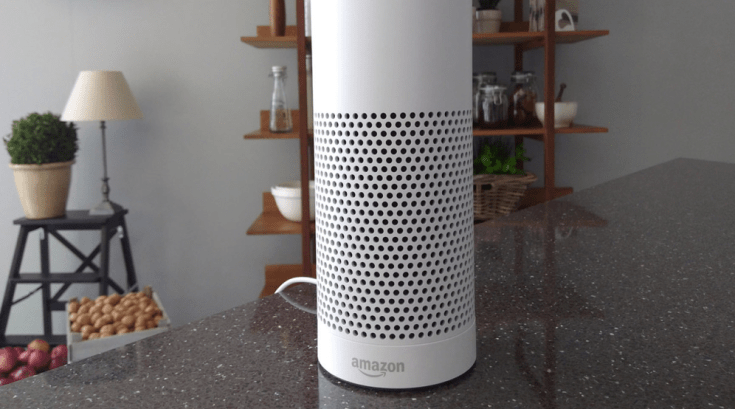
This past week Amazon hit headlines after its virtual assistant Alexa was caught passively recording couples arguing, having intimate family discussions and even having sex (apparently sex noises can trigger Alexa-activated Echo speakers).

Data is the new dominant commodity of the 21st century and the trade-off of convenience for privacy and security has been highlighted in a plethora of cases involving consumer ‘smart products’ in recent years.

Amazon Echo as murder witness?

Take the November 2015 case of James Bates, who was suspected of the murder of his friend Victor Collins at a house party in his home. Police issued multiple search warrants to Amazon in the landmark case, in an attempt to gain access to the records of Bates’ Echo device.

“I have a problem that a Christmas gift that is supposed to better your life can be used against you,” Bates’s attorney, Kimberly Weber, said at the time. Eventually, Bates himself decided to turn over the data, foregoing his right to privacy in the interest of proving his innocence and clearing his name.
Screen Shot 2019-07-31 at 10.37.20 AM

Amazon admits it keeps some Alexa recordings even when users delete them

Siri’s sensitive recordings

Much like Amazon, Apple has been found surreptitiously recording users’ sexual encounters, drug deals and medical appointments, though more worryingly, these audio recordings were sent to human ‘graders’ for evaluation, according to recent, explosive revelations from a whistleblower.

Screen Shot 2019-07-31 at 10.39.16 AM

Siri ‘regularly’ records sex encounters, sends ‘countless’ private moments to Apple contractors

Apple’s virtual assistant Siri stores users’ identifiable utterances for up to six months, before removing the unique user ID information and storing the clips elsewhere for up to two years – in the interest of improved customer experience, of course.

Google Mini & passive spying

Google’s domestic virtual assistant Google Mini has also been caught passively spying on consumers in their own homes. Worryingly, however, Google employs hundreds of so-called “language experts” to parse snippets of audio, some of which contain embarrassing or sensitive information, to better understand the nuances of human language.

In 2017, writer Artem Russakovskii went to the product’s unveiling at the SFJazz Center in San Francisco. After a couple of days he checked his voice activity log to find thousands of inadvertent entries that should never have been logged; the device had been spying on him 24/7 due to an apparent ‘hardware flaw’, as the company claimed at the time.

Hacking tech teddies

The idea for a teddy bear that allowed parents and children to share affection when long distances apart was good in theory, but ultimately proved terrifying in practice.

Screen Shot 2019-07-31 at 10.41.20 AM

‘Smart’ Teddy bears hacked, 2mn private recordings leaked, children at risk

Through Cloudpets (and various other interpretations of the idea), children could record short messages for loved ones far away that would be transmitted via bluetooth to a nearby smartphone and beamed across the country or, indeed, the world.

Alas, it didn’t take long before data belonging to some 800,000 customers, totalling roughly two million messages between children and adults, which were stored in an online database, was hacked and held for ransom.

There was no encryption or authentication between the bluetooth devices in the stuffed animals and the smartphone app, meaning unscrupulous actors could invade people’s most heartfelt moments with their children.

Backdoor Barbie
Screen Shot 2019-07-31 at 10.42.37 AM

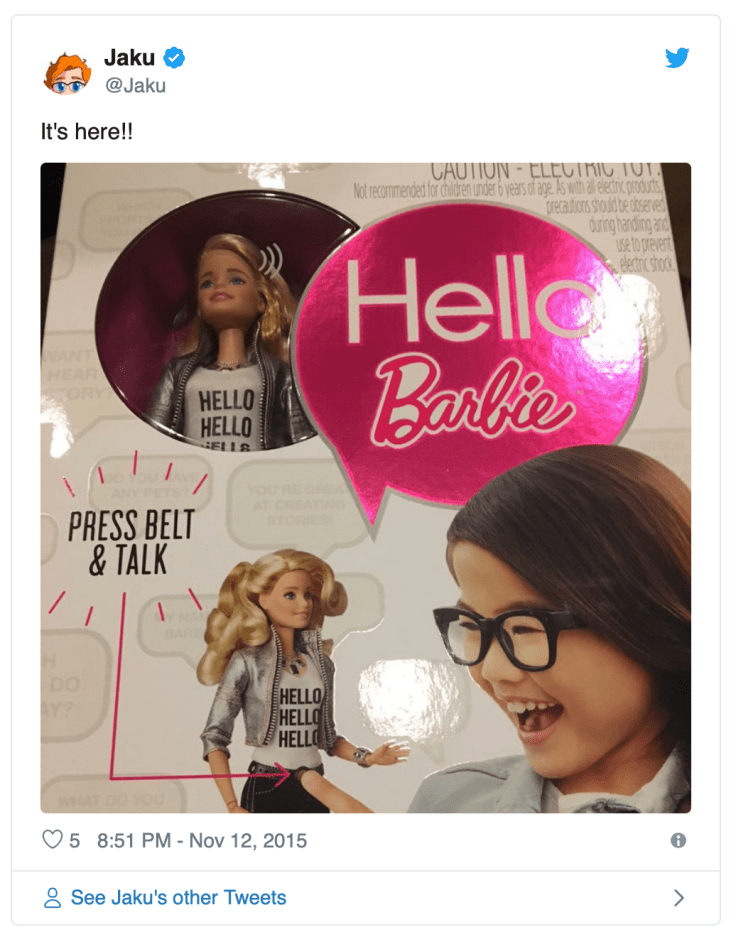
Mattel’s ‘Hello Barbie’ was billed as the world’s first “interactive doll” complete with a microphone that records children and sends the messages to third parties for processing before a response is generated.

However, security researchers quickly discovered that the wifi-connected doll was vulnerable to hacking, and those with the relevant knowhow could access the doll’s system information, account information, stored data including audio files, and the doll’s built-in microphone.

Researcher Matt Jakubowski claimed that it was just a matter of time until we are able to replace their servers with ours and have her say anything we want.”

But the ghoulish details didn’t stop there; hackers could theoretically take over a home’s wifi network via the doll and gain access to other connected devices such as laptops and phones, allowing them to pilfer a wealth of personal and financial information.

High-tech takeover

White hat hacking work by a team of researchers at China’s Zhejiang University showed how inaudible “commands” could be used to remotely trigger a potential victim’s smart device. The team used various clever strategies, including playing frequencies above 20kHz as the victim was recording, rendering the inaudible frequency as a trigger to access the device.

The researchers managed to hack the voice interfaces of Amazon, Apple, Google, Microsoft and Samsung devices and command them to, for example, visit specific malicious websites or even send emails and text messages all while dimming the screen and lowering the device volume to conceal the attack, leaving the victim completely unaware.

The team even managed to remotely place phone and video calls to listen in and observe the victim’s surroundings. They infamously also managed to hack the navigation system of an Audi SUV.
Facebook co-founder says it’s ‘time to break up’ the social media giant in scathing op-ed

CAP

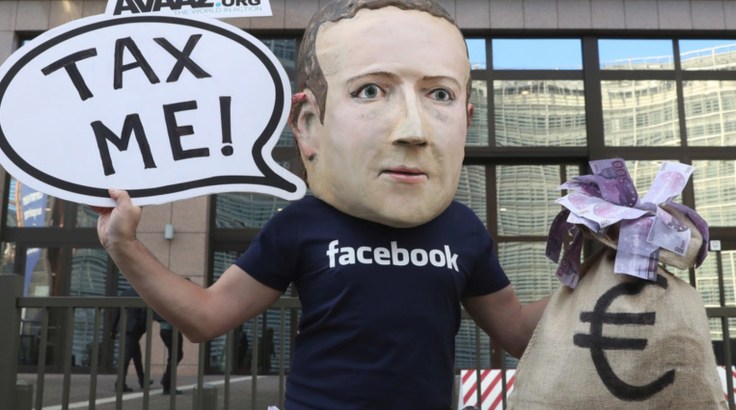
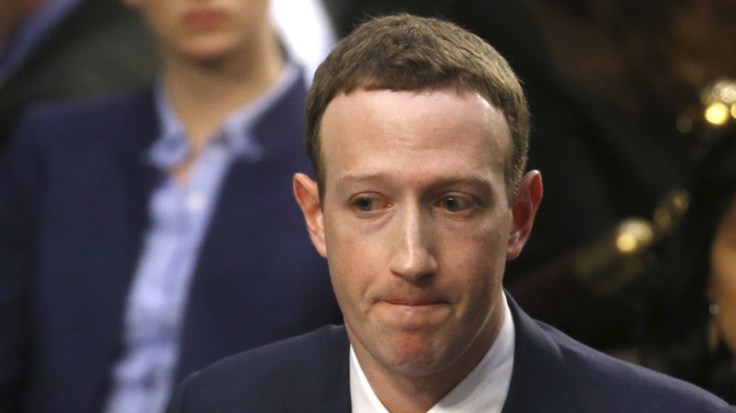
Facebook co-founder Chris Hughes has called for the break-up of the social media behemoth and lamented the “staggering” and “unchecked” power of CEO Mark Zuckerberg in a lengthy and searing oped.

Hughes co-founded Facebook with Zuckerberg in a Harvard dorm room in 2004 and watched “in awe” as the company grew over the last 15 years — but said he now feels a “sense of anger and responsibility” about how all-powerful and out-of-control the social media giant has become.

Lashing out at the company, Hughes wrote in a piece published by the New York Times that Zuckerberg’s power and influence goes “far beyond that of anyone else in the private sector or in government.”

See the source image

“There is no precedent for [Zuckerberg’s] ability to monitor, organize and even censor the conversations of two billion people.”

Hughes berates Facebook over “sloppy privacy practices,” “violent rhetoric and fake news,” and the “unbounded drive to capture ever more of our time and attention.” It’s not that Zuckerberg is a bad person, he writes, but “he’s human” and his focus on growth “led him to sacrifice security and civility for clicks.”

ALSO ON RT.COMFacebook ban on Alex Jones and others is a form of modern-day book burningHughes also bemoans the fact that the powerful CEO controls three core communications platforms (Facebook, Instagram, and WhatsApp) and says that lack of competition, market or government regulation is a major problem. If a competitor crops up, Zuckerberg can simply choose to shut it down “by acquiring, blocking or copying it” in the manner it did with the Instagram and WhatsApp mergers.

The lack of competition means that “every time Facebook messes up, we repeat an exhausting pattern: first outrage, then disappointment and, finally, resignation.”

See the source image

“Mark alone can decide how to configure Facebook’s algorithms to determine what people see in their News Feeds, what privacy settings they can use and even which messages get delivered.”

Hughes also worries that Zuckerberg has “surrounded himself with a team that reinforces his beliefs instead of challenging them.” He believes that neither Facebook’s offer to appoint a “privacy czar” or the expected Federal Trade Commission (FTC) fine of $5 billion will be enough to rein in the company.

The answer and solution lies in more government regulation and subsequent market competition, Hughes says. But Facebook isn’t afraid of just “a few more rules,” so the action needs to be more dramatic, he suggests.

“The American government needs to do two things: break up Facebook’s monopoly and regulate the company to make it more accountable to the American people.”

That will involve separating Facebook, WhatsApp, and Instagram into three individual companies and banning future acquisitions “for several years.”

The FTC should never have permitted these mergers, but it’s “not too late to act.” There is “precedent for correcting bad decisions,” he says, pointing to 2009 when Whole Foods settled antitrust complaints by selling off the Wild Oats brand and stores it had acquired years earlier.

ALSO ON RT.COMFacebook ban on Alex Jones and others is a form of modern-day book burningHe notes that time is of the essence, however, as Facebook has been working quickly to integrate the three platforms, precisely in order to make splitting them up more difficult.

“Mark’s power is unprecedented and un-American. It is time to break up Facebook.”

Hughes also suggests the creation of a new government agency specifically to empower Congress to regulate tech companies and protect user privacy.

He says the agency should “create guidelines for acceptable speech on social media” while noting that the idea might seem “un-American” at first. The standards therefore should be “subject to the review of the courts” and would be similar to already accepted rules on speech like not shouting “fire” in a theater, provoking violence or making false statements to manipulate stock prices.

Ultimately, he says, an aggressive case taken now against Facebook would persuade other behemoths like Google and Amazon to “think twice” about stifling competition out of fear that “they could be next.”

MSNBC PANEL CELEBRATES AMAZON FLEEING NYC: ‘5 YEARS AGO’ THEY WOULD HAVE BEEN WELCOME

‘Now people are like “Wait a second, we’ve seen what’s happened in other places”‘

By Grabien Staff

EXCERPT:

ALI: “The activists. Bring them to the conversation. Also, people are learning from, well, Amazon is coming. Tech has come to my hometown. Oh, look, income inequality. Can’t afford housing. So what’s going to happen to our neck of the woods here in queens? We need the jobs. But what type of jobs, right, and is this going to phase out different communities. These are the conversations people are having. The sheen of an Amazon or Facebook, 5, 10 years ago, people were like, yes, come, savvy us. Now people are like “Wait a second, we’ve seen what’s happened in other places”. Talk to us. Because our interests are at stake. You can’t just go beyond the mayor and the government.”

Netflix Buys Alexandria Ocasio-Cortez Doc ‘Knock Down the House’ for $10 Million

NetlfixAOC1

By Warner Todd Huston

Streaming giant Netflix has shelled out a whopping $10 million for the rights to broadcast a documentary that follows the primary campaign of Alexandria Ocasio-Cortez (D-NY) and three other candidates.

The film, entitled Knock Down the House, produced and directed by Rachel Lears, was a huge hit at this year’s Sundance Film Festival winning the coveted audience favorite award. The film was a hot ticket for the festival and featured a Skyped address to the crowd made by Alexandria Ocasio-Cortez herself at the film’s conclusion.

Netflix pounced quickly to pick up the film rights initially offering $6 million but upping the ante when others began taking notice of the film.

The film follows the 2018 primary challenges mounted by Amy Vilela (NV), Cori Bush (MO), and Paula Jean Swearengin (WV), as well as Ocasio-Cortez. The New Yorker was the only one of the four candidates that went on to win the primary and, hence, a seat in Congress.

Netflix was bound and determined to win the bid for the film, but the competition was hot, Deadline reported. Aside from Netflix, NEON, Focus, Hulu, and Amazon were all in the hunt for the rights to the film.

According to Deadline, the ten million price tag makes Knock Down the House the most expensive documentary sale ever brokered at Sundance.

‘Largest scam in history’: HALF of Facebook accounts fake, says Zuckerberg’s Harvard classmate

cap

As many as half of Facebook‘s two billion accounts are fake or duplicates, according to a new report from a former classmate of CEO Mark Zuckerberg. He has highlighted how the fakes defraud users, advertisers and investors alike.

Rocked by a major privacy scandal last year, Facebook has been trying to create an image of a company with high community standards, striving to curb the illicit behavior of users. But the company may be deliberately understating the amount of fake accounts, a new report says.

The firm’s own quarterly investment reports reveal that the its much-vaunted account base, which is supposedly has over 2 billion monthly active users, is packed with fake accounts communicating with just enough randomness to trick the social network’s algorithms, according to Zuckerberg’s former classmate at Harvard, Aaron Greenspan.

Greenspan claimed that he had originally come up with the idea for Facebook and worked on the future network, before Zuckerberg eventually founded the company. That claim was the basis of the trademark dispute between Facebook and Greenspan’s company, Think Computer Corporation, settled in 2009.

In a report, published by his legal data nonprofit PlainSite, Greenspan alleges that Facebook “has been lying to the public about the scale of its problem with fake accounts, which likely exceed 50 percent of its network.”

The fake accounts are particularly dangerous because they “often defraud other users on Facebook, through scams, fake news, extortion, and other forms of deception” and often “involve governments,” he writes.

He further accused the company of “selling” ads to “hundreds of millions of phantom buyers – users who do not actually exist.” 

cap

According to Greenspan, Facebook has attempted to obscure and downplay the actual number of fake accounts and their prevalence by employing “cleverly worded disclaimers” in its official reporting as well as dropping “many” of the important metrics from quarterly reports altogether.

In his report, citing the social network’s own estimates, Greenspan concludes that since the end of 2017 Facebook has deleted at least 2.8 billion fake accounts, which is more that the amount of its monthly active users and more than a half of “all accounts ever created.” 

Facebook outright denied Greenspan’s claims. “This report is completely wrong and not based on any facts or research,”the company told RT, adding that Facebook files its fake account estimates with the Securities and Exchange Commission every quarter. “This is unequivocally wrong and responsible reporting means reporting facts, even if it’s about fake accounts,” the statement continued.

Still, an entire industry has sprung up to supply convincingly “aged” fake Facebook accounts, often bundled by the hundred and boasting less than 1 percent detection rate.

Facebook attracts advertisers by flaunting the access to its billion-plus users, sorted and categorized by a marketer’s dream of individual data. However, some reports claim that in reality a sizeable amount of traffic online is generated by fake-clicking’ done by bots and humans working on specially-organized ‘click farms,’ as the company reached the market saturation or simply ‘ran out of humans.’

Small advertisers sued the social media giant last year, claiming it overstated the amount of time users spent watching videos by up to 900 percent. According to Marketing Land, the alleged fraud is far from an isolated event: Facebook misreported the reach of Facebook Page posts, the proportion of users who watch ad videos all the way through, the average time users spend reading “instant articles,” the number of referrals to external websites, and the number of mobile views, as claimed in the reports the outlet collected.

Facebook’s role in global ads is expected to grow. Digital publishing agency Polar estimated that the tech giant, together with Google and several other ‘digital goliaths’ like Amazon, will control 80 percent of all digital advertising in 2019.

In recent years, the social network had been entrenched in high-profile controversies over users’ data protection, privacy issues, and the spread of misinformation online. To make matters worse, Facebook’s market value has been slidingdownwards since July, when it lost almost $120 billion in a single day of trading – the largest-ever drop in company valuation in stock market history.

Following the Cambridge Analytica data-mining scandal, the company’s CEO Mark Zuckerberg admitted that Facebook didn’t do enough to safeguard its users’ interests and apologized. In response to mounting criticism, he vowed to step up commitments to privacy protection.

In an effort to combat disinformation, the company experimented with its algorithms to detect ‘fake news’ and broughtthird-party fact-checkers on board for help.

ALSO ON RT.COMFacebook may face a record fine over privacy lapses – reports

In the first six months of 2018 alone Facebook said it removed around 1.5 billion fake accounts. Last year, the company also reported removing fake accounts linked to either Russia or Iran, and although the numbers were minute on the overall scale, measuring from under 100 to several hundred, the news received wide coverage.

Facebook’s model of operations “can feel opaque” and be hard to understand for outsiders, Mark Zuckerberg wrote in an op-ed for Wall Street Journal on Thursday.

“Sometimes this means people assume we do things that we don’t do. For example, we don’t sell people’s data, even though it’s often reported that we do.”

The company’s CEO reiterated that the network has “strong incentive” to protect users’ data and selling off such information is against the company’s business interests.

Think your friends would be interested? Share this story!

Blog at WordPress.com.

Up ↑