Hollywood, DC Democrats Plot Trump ’Removal’ from Office

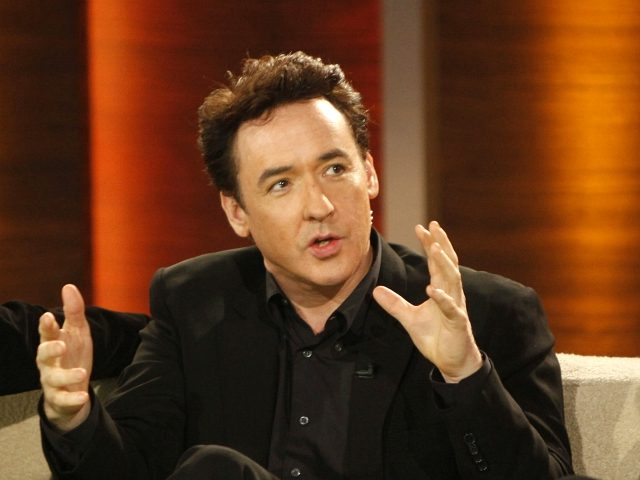
American actor John Cusack, center, director Roland Emmerich, left, and German TV show host Thomas Gottschalk talk during the German TV show "Wetten dass...?" (Bet it...?) in Braunschweig, Germany, Saturday, Nov. 7, 2009. (AP Photo/Axel Heimken, Pool)

By Robert Kraychik

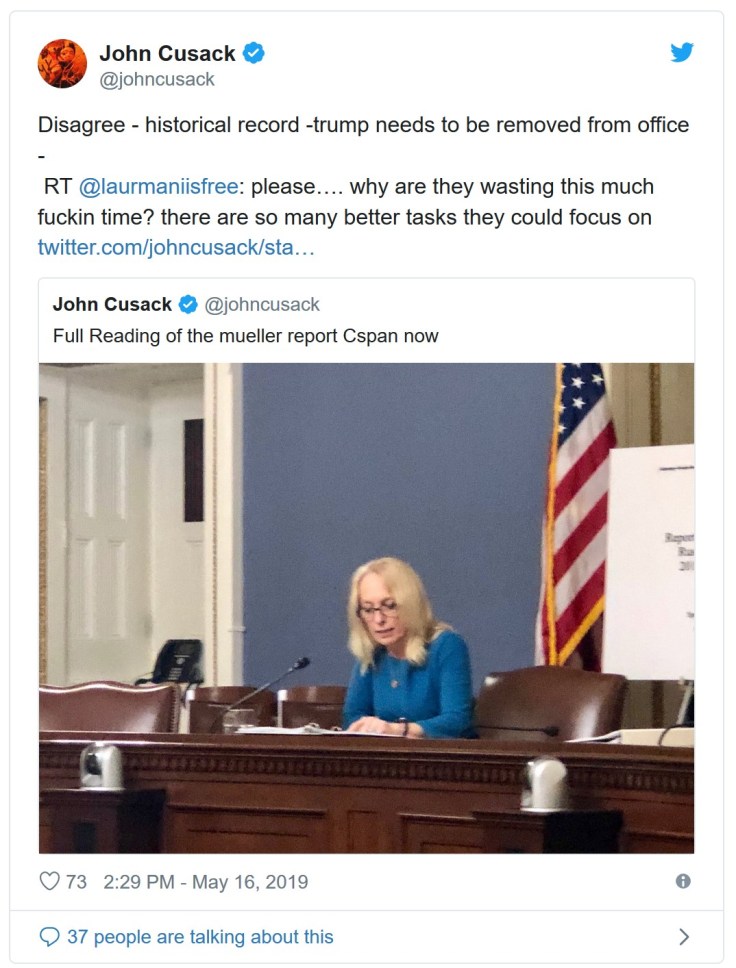
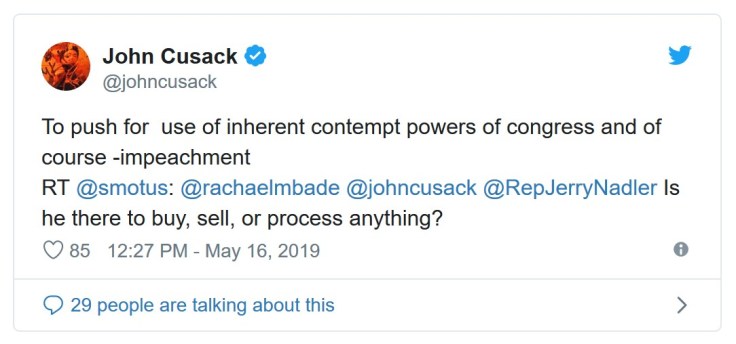
Far-left actor John Cusack met with Democrats in Washington, D.C. this week and call for President Donald Trump to be “removed from office.”

The 2012 actor attended Thursday’s “marathon public marathoning” of Special Counsel Robert Mueller’s 448-page report in the House Rules Committee meeting room.

CAP

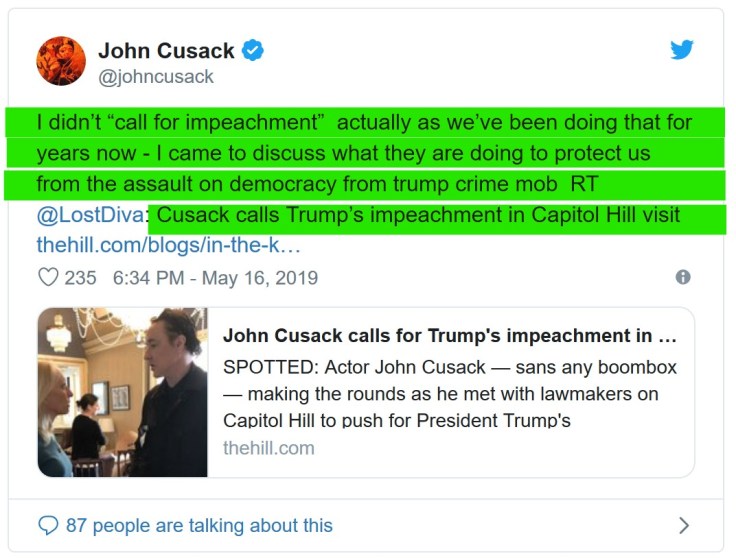
John Cusack responded to a headline from the Hill noting his calls for the impeachment of Donald Trump.

“I didn’t “call for impeachment” actually as we’ve been doing that for years now – I came to discuss what they are doing to protect us from the assault on democracy from trump crime mob,” the actor said.

CAP

Cusack aligned himself with Sen. Bernie Sanders (I-VT) and his neo-Marxist paradigm of politics as a power struggle between various arbitrarily defined demographic groups. The 52-year-old actor retweets messages invoking “white capitalist patriarchy,” “progressive” politics, and characterizing those opposing abortion as “fascists.”

CAP

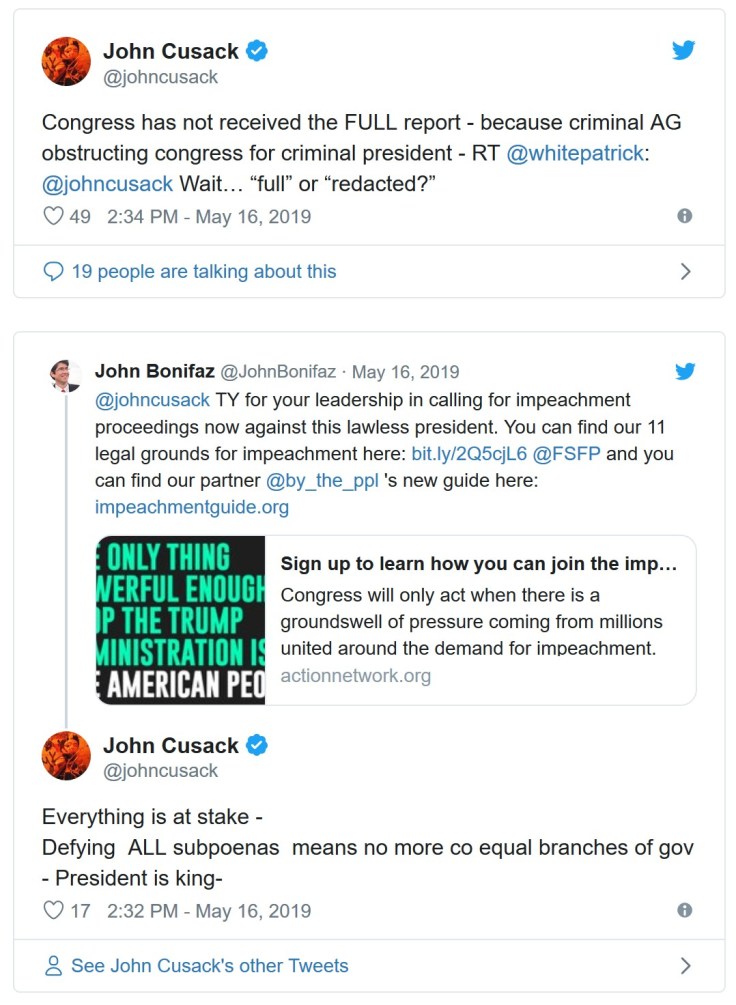
During the day, Cusack derided Attorney General William Barr as a “criminal” for adhering to federal law by redacting restricted grand jury information pertaining to Mueller’s aforementioned report.

CAP

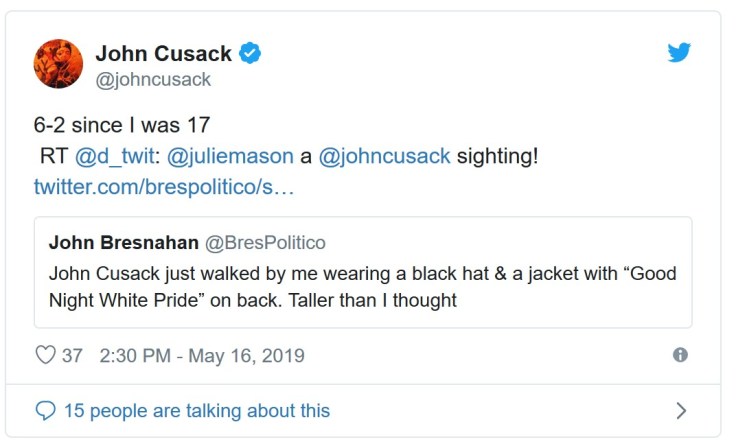
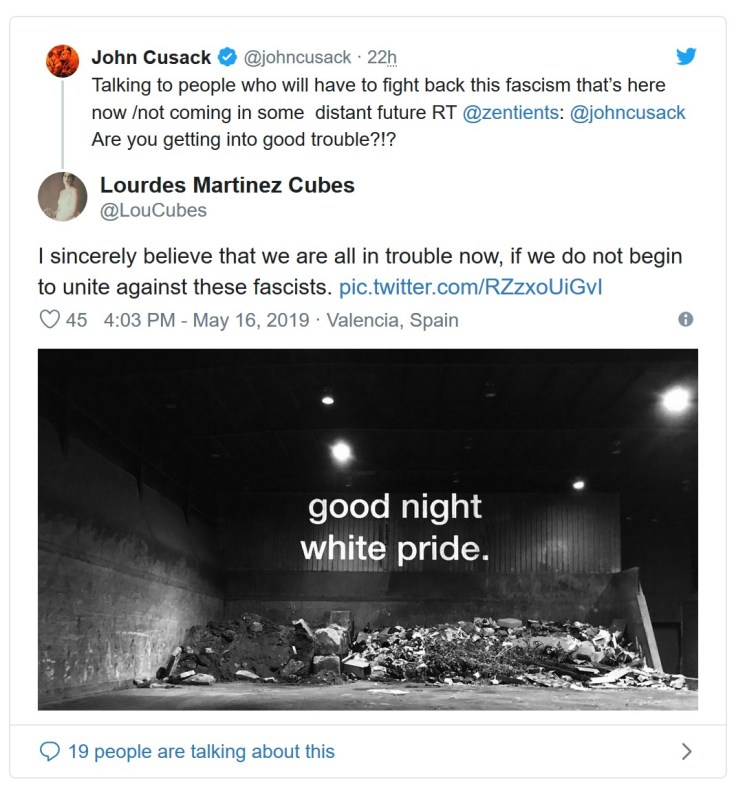
Cusack was reported as wearing a jacket with the message “Good Night White Pride” during his visit to the Capitol.

CAP

CAP

“Trump needs to be removed from office,” declared Cusack.

CAP

CAP

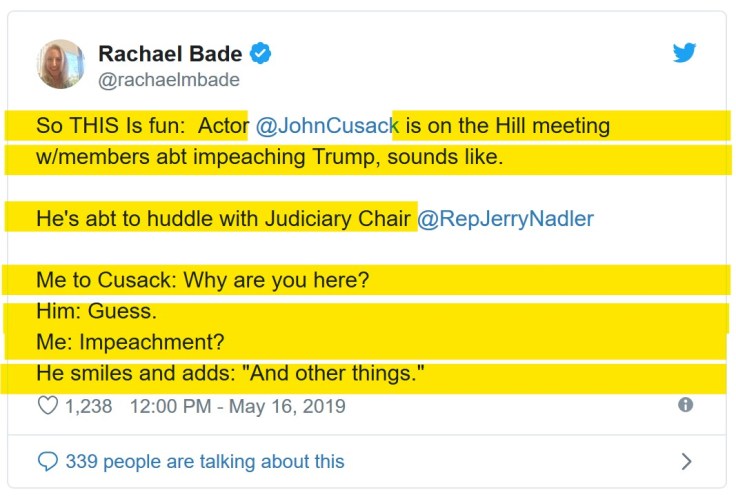
Rachel Bade of the Washington Post and CNN tweeted of an exchange of hers with Cusack:

So THIS Is fun: Actor @JohnCusack is on the Hill meeting w/members abt impeaching Trump, sounds like.

He’s abt to huddle with Judiciary Chair @RepJerryNadler

Me to Cusack: Why are you here?
Him: Guess.
Me: Impeachment?
He smiles and adds: “And other things.”

CAP

In March, Cusack echoed the Washington Post‘s Trump-era motto, “Democracy Dies in Darkness,” claiming that American democracy can only survive if Trump “rots in prison.” Days later, he predicted a violent transfer of power to a Democrat administration in the event that Trump is not reelected in 2020.

Email: Clapper Refused Trump Request to Say ‘Pee Tape’ Story Is Bogus

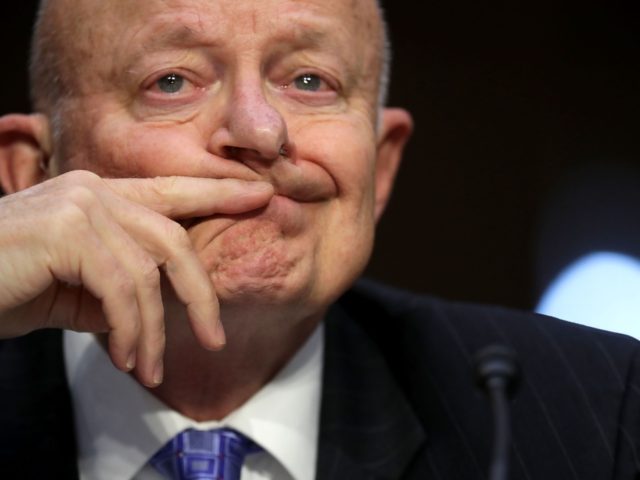
WASHINGTON, DC - MAY 08: Former Director of National Intelligence James Clapper testifies before the Senate Judiciary Committee's Subcommittee on Crime and Terrorism in the Hart Senate Office Building on Capitol Hill May 8, 2017 in Washington, DC. Before being fired by U.S. President Donald Trump, former acting U.S. Attorney …

By Aaron Klein

The text of emails buried in a footnote in Special Counsel Robert Mueller’s final report reveals that President Trump asked disgraced ex-FBI Director James Comey and former Director of National Intelligence and Trump critic James Clapper to publicly refute the infamous Steele dossier after the discredited charges were first leaked to the news media.

Clapper refused Trump’s request, the emails reveal.

Trump’s requests to Comey and Clapper were in response to media leaks about the dossier. The first leak was a CNN January 10, 2017 report exposing classified briefings to Trump and Barack Obama about the dossier. Those briefings were presented by Comey, Clapper, CIA Director John Brennan and NSA Director Admiral Mike Rogers.

Following the CNN report, the full dossier document was published hours later by BuzzFeed.

“He [Trump] asked if I could put out a statement. He would prefer of course that I say the documents are bogus, which, of course, I can’t do,” Clapper wrote to Comey in a January 11, 2017 email.

“He called me at 5 yesterday and we had a very similar conversation,” Comey wrote back to Clapper one day later.

It was not clear why Clapper would not at least put out a public statement calling into question the Steele charges related to alleged collusion or discredited claims about a “pee” tape involving Trump, none of which had been verified by the FBI. Indeed, the FBI at that time possessed information calling Steele’s claims and the origins of the dossier into question.

Comey himself previously admitted in testimony that he pushed back against a request from Trump, made during an Oval Office meeting, to possibly investigate the origins of the unsubstantiated claims made in the infamous anti-Trump dossier. Comey recounted: “I replied that he should give that careful thought because it might create a narrative that we were investigating him personally, which we weren’t, and because it was very difficult to prove a negative.”

Yet Comey did not inform Trump at the time that the FBI chief personally cited the dossier as evidence in three successful FISA applications signed by Comey himself to obtain warrants to spy on Trump campaign adviser Carter Page. The first was signed in October 2016; the second and third were renewal applications since a FISA warrant must be renewed every 90 days.

In his classified briefing to Trump on the dossier charges, there is no record indicating that Comey informed the politician that the document, authored by former British spy Christopher Steele, was produced by the controversial Fusion GPS firm.

There is also no evidence that Comey told Trump at any time that Fusion was paid for the dossier work by Trump’s main political opponents, namely Hillary Clinton’s 2016 presidential campaign and the Democratic National Committee (DNC) via the Perkins Coie law firm.

Bruce Ohr, a career Justice Department official, admitted in testimony released in March that he informed the FBI that the anti-Trump dossier was tied to Hillary Clinton’s presidential campaign. Ohr testified that he further warned his FBI superiors that the dossier information was likely “biased” against Trump and that he thought Steele was “desperate that Trump not be elected.”

Ohr revealed that he spoke to the FBI about the role of Fusion GPS in producing the dossier, and informed the agency that his wife, Nellie Ohr, worked at the time for Fusion GPS.

Critically, Ohr said that he transmitted all of that information in the time period before the FBI under Comey certified the FISA application to obtain a warrant to conduct surveillance on Carter Page, a former adviser to President Trump’s 2016 campaign. Comey signed the first FISA application in late October 2016.

The emails between Comey and Clapper, meanwhile, came on the heels of the January 10, 2017 news media leaks about the dossier.

On January 10, CNN was first to report the leaked information that the controversial contents of the dossier were presented during classified briefings inside classified documents presented one week earlier to then President Obama and President-elect Trump by Comey, Clapper, Brennan and Rogers. Comey reportedly briefed Trump alone on the most salacious charges in the dossier.

Prior to CNN’s report leaking the Comey briefing to Trump, which was picked up by news agencies worldwide, the contents of the dossier had been circulating among news media outlets, but the sensational claims were largely considered too risky to publish.

All that changed when the dossier contents were presented to Obama and Trump during the classified briefings. In other words, Comey’s briefings themselves and the subsequent leak to CNN about those briefings by “multiple US officials with direct knowledge,” seem to have given the news media the opening to report on the dossier’s existence as well as allude to the document’s unproven claims.

ollowing the CNN report, BuzzFeed published the full Steele dossier.

Deep State Blame Game: Comey, Clapper, Brennan Spar over Who Pushed ‘Pee’ Dossier as Credible Intel

The Comey-Clapper email exchange cited in the Mueller report may take on more relevance now that Comey, Brennan and Clapper are the subjects of a dispute over which top Obama administration officials advocated for the infamous Steele dossier to be utilized as evidence in the Russia collusion investigation.

The argument erupted into the open with a Brennan surrogate being quoted in the news media this week opposing Comey not long after Attorney General William Barr appointed a U.S. attorney to investigate the origins of the Russia collusion claims.

The fiasco was kicked into high gear after Fox News cited “sources familiar with the records” pointing to an email chain from late-2016 showing Comey allegedly telling FBI employees that it was Brennan who insisted that the anti-Trump dossier be included in a January 6, 2017 U.S. Intelligence Community report, known as the ICA, assessing Russian interference efforts.

A former CIA official, clearly defending Brennan, shot back at the assertion, instead claiming that it was Brennan and Clapper who opposed a purported push by Comey to include the dossier charges in the ICA.

“Former Director Brennan, along with former [Director of National Intelligence] James Clapper, are the ones who opposed James Comey’s recommendation that the Steele Dossier be included in the intelligence report,” the official told Fox News.

“They opposed this because the dossier was in no way used to develop the ICA,” the official added. “The intelligence analysts didn’t include it when they were doing their work because it wasn’t corroborated intelligence, therefore it wasn’t used and it wasn’t included. Brennan and Clapper prevented it from being added into the official assessment. James Comey then decided on his own to brief Trump about the document.”

The official was addressing the reported email from Comey fingering Brennan as insisting that the dossier be utilized in the ICA report on Russian interference.

Discussing the issue during a segment on Fox News, former GOP Rep. Trey Gowdy said on “The Story with Martha MacCallum” that “Comey has a better argument than Brennan, based on what I’ve seen.”

One day earlier, Gowdey stated on Fox News, “Whoever is looking into this, tell them to look into emails” from December 2016 concerning both Brennan and Comey.

Gowdy told Fox News, where he is now a contributor, that his comments on the matter were based on sensitive documents that he reviewed while he served as chairman of the Republican-led House Oversight Committee.

Contrary to the ex-CIA official’s assertion that the dossier was not included in the intel community’s ICA Russia report, there have been testimony and media statements involving key players saying that it was part of the overall assessment.

Last December, Comey outright contradicted Brennan’s own testimony that the anti-Trump dossier was, as Brennan put it, “not in any way used as the basis for the intelligence community’s assessment” that Russia interfered in the 2016 presidential election.

In testimony before the House Judiciary and Oversight and Government Reform committees, Comey stated that material from the Steele dossier was indeed utilized in the IC report. Internally, the FBI referred to the dossier as “crown material.”

“So do you recall whether any quote, crown material or dossier material was included in the IC assessment?” Gowdy asked Comey at the time.

“Yes,” Comey replied. “I’m going to be careful here because I’m talking about a document that’s still classified. The unclassified thing we talked about earlier today, the first paragraph you can see of exhibit A, is reflective of the fact that at least some of the material that Steele had collected was in the big thing called the intelligence community assessment in an annex called annex A.”

Annex A in the report was titled, “Russia—Kremlin’s TV Seeks To Influence Politics, Fuel Discontent in US.”

The annex, like the rest of the report, contains the following disclaimer:

This report is a declassified version of a highly classified assessment; its conclusions are identical to those in the highly classified assessment but this version does not include the full supporting information on key elements of the influence campaign.

Comey went on to describe a conversation that he said he had with Brennan about how to include the dossier material in the IC assessment:

Gowdy: Do you recall the specific conversation or back and forth with then-Director Brennan on whether or not the material should be included in the IC assessment?

Comey. Yes. I remember conversation — let me think about it for a second. I remember there was conversation about what form its presentation should take in the overarching document; that is, should it be in an annex; should it be in the body; that the intelligence community broadly found its source credible and that it was corroborative of the central thesis of the intelligence community assessment, and the discussion was should we put it in the body or put it in an attachment.

I’m hesitating because I don’t remember whether I had that conversation — I had that conversation with John Brennan, but I remember that there was conversation about how it should be treated.

Comey’s descriptions are at direct odds with a statement Brennan made during May 2017 testimony before the House Intelligence Committee in which Brennan claimed the dossier was “not in any way used as the basis for the intelligence community’s assessment” on alleged Russian interference. Brennan repeated that claim during numerous news media interviews.

Comey is not the only former top official involved in the IC report to say that the dossier played a role in the report’s conclusions.

As RealClearPolitics.com documents, former NSA Director Rogers wrote in a classified letter that the dossier played a role in the IC’s assessment and a dossier summary was included in an initial draft appendix:

In a March 5, 2018, letter to House Intelligence Committee Chairman Devin Nunes, Adm. Rogers informed the committee that a two-page summary of the dossier — described as “the Christopher Steele information” — was “added” as an “appendix to the ICA draft,” and that consideration of that appendix was “part of the overall ICA review/approval process.”

Meanwhile Clapper, who served as director of National Intelligence under the Obama administration, conceded during a previous CNN interview that the IC assessment was able to corroborate “some of the substantive content of the dossier,” implying that the dossier itself was a factor.

“I think with respect to the dossier itself, the key thing is it doesn’t matter who paid for it,” Clapper said. “It’s what the dossier said and the extent to which it was — it’s corroborated or not. We had some concerns about it from the standpoint of its sourcing which we couldn’t corroborate.”

“But at the same time, some of the substantive content, not all of it, but some of the substantive content of the dossier, we were able to corroborate in our Intelligence Community assessment which from other sources in which we had very high confidence to it,” he added.

It was Clapper’s agency that released the Intelligence Community report.

The purported inclusion of the dossier may help to explain why Rogers’ NSA assessed the conclusion that Russian President Vladimir Putin favored Trump and worked to get him elected only with a classification of “moderate confidence,” while the FBI and CIA gave it a “high confidence” rating.

The dispute comes as U.S. Attorney John Durham has been charged by Barr with conducting a probe of the origins of the Russia investigation. In addition to ICA report tactics, Durham’s probe is likely to also focus on the use of the dossier in obtaining a FISA warrant to spy on Page.
Richard Burr Walks it Back on Trump, Jr. Subpoena Agrees to Strict Limits on Scope, Length of Interview

CAP

By Matthew Boyle

Senate Intelligence Committee chairman Sen. Richard Burr (R-NC) has relented regarding the subpoena he issued of Donald Trump, Jr., which was originally open-ended in terms of scope and topics, as well as without limits on the length of time for the interview.

Now, after a sustained pressure campaign from allies of the president and the first family, Burr has agreed to limit the scope and topics of the interview, as well as the length of time the president’s eldest son will be expected to appear.

Trump, Jr., will now, sources familiar with the deal that Burr and Trump, Jr.,cut early this week appear in early June sometime before the committee for between two and four hours–but no longer, terms that Burr originally opposed limiting. The scope of topics is also going to be limited. The deal that Burr has agreed to comes after last week the matter blew up in serious public fashion in Burr’s face–where an embarrassing amount of Republicans undercut Burr, including several members of his own Senate Intelligence Committee, several other committee chairs, and his own home state colleague.

While Trump, Jr. had been signaling that he might blow off the subpoena entirely, his intent sources close to him say has always been to be helpful. He had offered to answer more questions in writing, and even to testify in person again with a time and scope limitation–something Burr and Senate Intelligence Committee officials previously opposed. Now, after allies of Trump, Jr., and Republicans party-wide rejected Burr’s original subpoena, with a fierce public backlash, Burr has cut a deal to limit the time and scope of the subpoena–which allies of Trump, Jr., say was always his intention.

“This Don Jr. ‘compromise’ is classic Art of the Deal,” Cliff Sims, a former White House official who is close with Trump, Jr., told Breitbart News. “Take a hardline position, mount a PR campaign, throw out a ‘compromise’ you know the other side won’t accept, end up getting what you actually wanted all along while the other side thinks they’re getting a win.”

The New York Times summarized it similarly, laying out how what Trump, Jr., and his team did was very similar to his father’s political playbook.

“The move by the younger Mr. Trump’s associates was straight out of his father’s playbook — set the terms of the debate at the most extreme end of the discussion by saying he would not appear, then cut a deal and look gracious,” the Times wrote in its report on the matter.

Trump, Jr., is also, sources familiar with his thinking say, very pleased with the many Republicans party-wide who stood up for him during this process, and intends to help them in future political battles to come.

So, for now, the temperature on this fight comes down–but simmering tensions between Burr and the Trump universe are unlikely to fade forever, and this may foreshadow a bigger fight to come in the future sometime between the Senate Majority Leader Mitch McConnell and Trump-world.

What’s more, it further clears Trump, Jr.–who did nothing wrong with regard to Russia, despite countless media and Democrat attacks on his character. “This compromise further proves that Don Jr. continues to be open and honest throughout this process,” another former White House official told Breitbart News. “He has nothing to hide and has graciously permitted the previous agreement to be reneged on in order to reiterate there was no collusion at all, just like the Mueller report found.”

REMINDER: EVERY BOGUS 2016 FISA REQUEST to Spy on Trump was Signed by Obama’s AG Loretta Lynch

CAP

By Joe Hoft

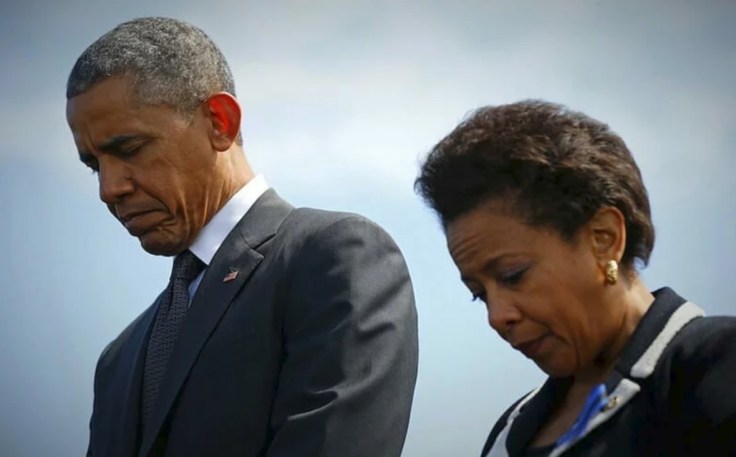
Last night on the Laura Ingraham Angle on FOX News, former Deputy Assistant Attorney General, John Yoo, noted that Obama’s Attorney General Loretta Lynch signed off on most all the FISA warrants during Obama’s last couple years in office (emphasis added) –

As somebody who’s worked on FISA applications, I can tell you how high it could go because under the FISA law itself the Attorney General has to approve the FISA application.  So if the Steele dossier, which we now know was completely made up, was used as a basis for the FISA application, then you have somebody that was high up in the FBI that had to approve that.  Somebody high up in the Justice Department had to approve that.  Ultimately the Attorney General [Loretta Lynch] has to approve that.

And then a second thing we haven’t touched on yet is that appears that the FBI attempted to send undercover informants and agents to infiltrate the Trump campaign.  There’s a whole other set of laws that are called the Attorney General guidelines which are supposed to only allow that in very, very rare circumstances.  So I assume the Attorney General and Deputy Attorney General and maybe FBI Director Comey all had to sit in on that decision and approve it…

Here’s a reminder of what we reported on February 3rd, 2018, more than a year ago –>>

On March 7th, 2017, the Gateway Pundit reported – Only 1 in 10,000 FISA Requests Was Denied in 6 Years — Obama’s First Request to Wiretap Trump Denied in 2016.

We now know that the FISA requests to spy on Carter Page were based on the discredited and bogus fake Trump dossier created by Fusion GPS and that the dossier’s origin was not reported to the court.

We also know that all of these requests were signed off on by the Obama Administration’s Attorney General Loretta Lynch and that the first request to spy on Trump was denied by the FISA Court.

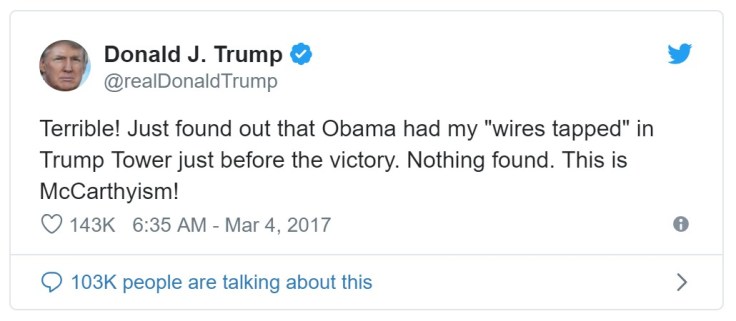
In March 2017 we reported that President Trump tweeted that former President Obama had petitioned a court [at least] twice in order to wire tap current President Trump when he was running for office.

In his first tweet President Trump tweeted:

Terrible! Just found out that Obama had my “wires tapped” in Trump Tower just before the victory. Nothing found. This is McCarthyism!

CAP

The President next tweeted:

Is it legal for a sitting President to be “wire tapping” a race for president prior to an election? Turned down by court earlier. A NEW LOW!

CAP

We also reported that according to ABC News:

More than a thousand applications for electronic surveillance, all signed by the attorney general, are submitted each year, and the vast majority are approved. From 2009 to 2015, for example, more than 10,700 applications for electronic surveillance were submitted, and only one was denied in its entirety, according to annual reports sent to Congress. Another one was denied in part, and 17 were withdrawn by the government.

A very disturbing fact about the wire tapping request of President Trump is that the FISA Court turned down President Obama’s Administration’s first request to wire tap President Trump that was evidently signed off on by Attorney General Lynch. With only two known applications denied out of 10,700 from 2009 through 2015, the fact that the Obama Administration’s application was denied by the FISA Court is very disturbing. The odds of this happening were 0.02%.

Now we know that Carter Page was spied on by the Obama Administration and the information provided to the Court to spy on him was bogus.

We now have additional evidence that the Obama Administration, its AG, FBI and DOJ were all corrupt and doing all they could, including obtaining warrants to spy on President Trump based on bogus information, to take him down before the 2016 election.

The amazing thing is … Trump still won!

Nadler opposed contempt charges against AG Eric Holder in 2012


Published on May 13, 2019

While House Judiciary Committee Chairman Jerry Nadler spearheads the campaign against Attorney General William Barr, he opposed the same charges against former Attorney General Eric Holder back in 2012. One America’s Pearson Sharp explains how Nadler’s long-standing feud with President Trump could be playing a part in his agenda against the attorney general.

Screen Shot 2019-05-13 at 2.57.14 PM


FLASHBACK: Nadler Was Outraged When Dem AG Holder Was Held In Contempt Of Congress

By Joseph Curl

House Judiciary Committee Chairman Jerry Nadler has been leading the effort to hold Attorney General Bill Barr in contempt of Congress, claiming the move is needed to stem a “constitutional crisis.”

But he felt completely differently back when Republicans held then-Attorney General Eric Holder in contempt of Congress for rejecting demands to turn over documents about the Fast and Furious gun-running scandal.

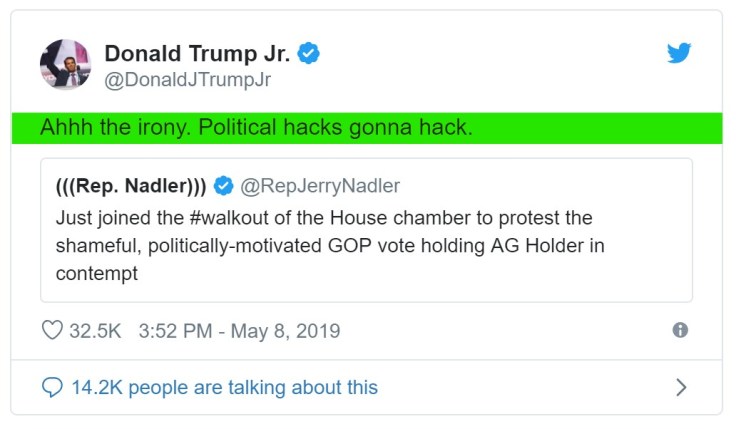
“Just joined the #walkout of the House chamber to protest the shameful, politically-motivated GOP vote holding AG [Eric] Holder in contempt,” Nadler wrote on Twitter in 2012.

CAP

The Judiciary Committee voted 24-16 on Wednesday to recommend Barr in contempt of Congress, saying he has not handed over the full, unredacted report from special counsel Robert Mueller. President Trump has asserted executive privilege to keep some sensitive parts of the report secret. Said Nadler: “We are now in a constitutional crisis.”

After the vote, Donald Trump Jr. wrote on Twitter: “Ahhh the irony. Political hacks gonna hack.”

CAP

Others quickly piled on. “Nadler now says the White House ‘stonewalling’ Congress represents an attack on ‘the essence of our democracy’ – as though stonewalling were some new phenomena,” former Rep. Jason Chaffetz, R-Utah, said in an op-ed for Fox News. “Where was Nadler’s righteous indignation when the stonewalling came from a Democratic White House?”

“America should not mistake this charade by the Democrats for a principled stand,” he wrote. “Not when the principles shift with the political fortunes of the Democratic Party.”

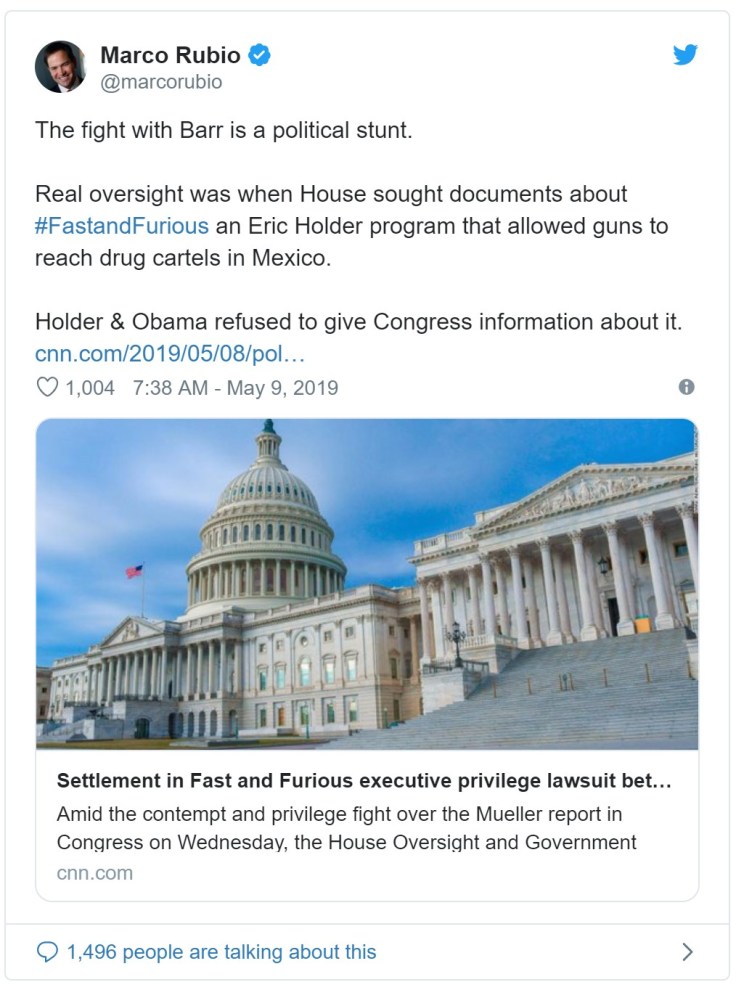
Sen. Marco Rubio of Florida also weighed in.

“The fight with Barr is a political stunt. Real oversight was when House sought documents about #FastandFuriousan Eric Holder program that allowed guns to reach drug cartels in Mexico. Holder & Obama refused to give Congress information about it,” Rubio wrote.

CAP

“Nadler was also accused of hypocrisy last month by GOP critics for his subpoena of the unredacted Mueller report, with critics pointing to video from the Clinton days showing him urging caution regarding the release of details from then-Independent Counsel Kenneth Starr’s report,” Fox News reported.

“But now a different political landscape compels the chairman to adopt new standards of fairness, ignore existing law and demand the material he once considered ‘unfair to release,’” Committee Ranking Member Doug Collins, R-Ga., said.

Back when the House held Holder in contempt, then-House Minority Leader Nancy Pelosi said Republicans the move was purely political. “What is happening here is shameful,” she said then.

So what’s it this time, Nancy?

Blog at WordPress.com.

Up ↑