
Published on Mar 21, 2019

Published on Mar 18, 2019

During an appearance on the podcast “The Axe Files,” hosted by CNN senior political commentator and former Barack Obama presidential campaign chief strategist David Axelrod, Bush said Republicans “ought to be a given a choice” in 2020.
“I think someone should run. Just because Republicans ought to be given a choice,” Bush told Axelrod, according to CNN.
Trump has a “has a strong, loyal base and it’s hard to beat a sitting president,” he noted. “But to have a conversation about what it is to be a conservative I think is important.”
“And our country needs to have competing ideologies that people — that are dynamic, that focus on the world we’re in and the world we’re moving towards rather than revert back to a nostalgic time,” Bush added.
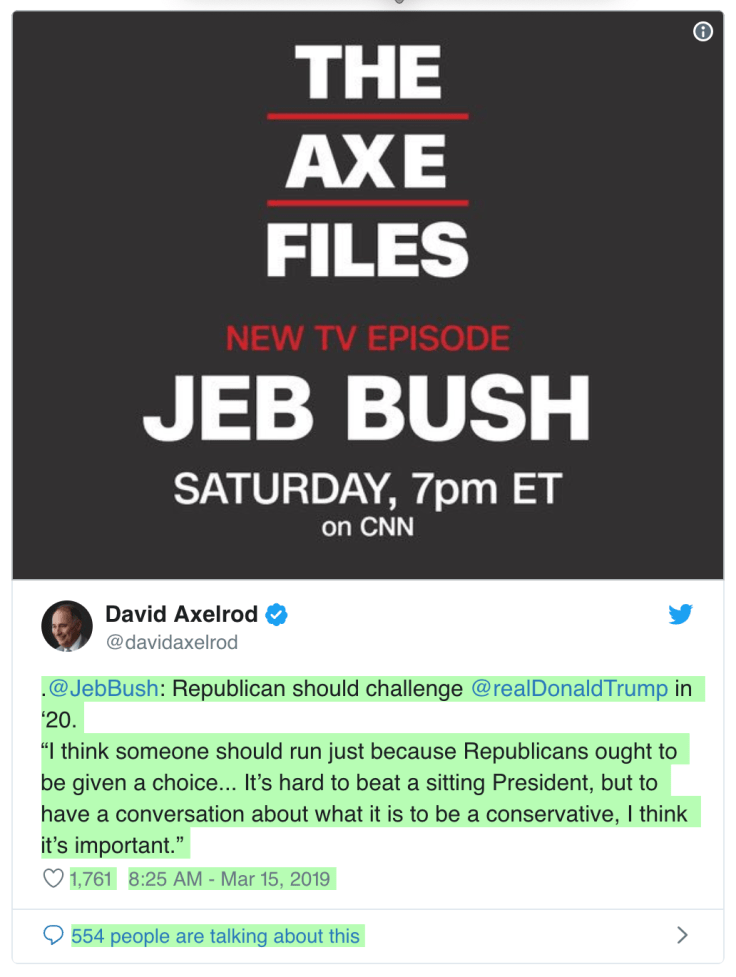
As noted by CNN, Axelrod brought up a 2020 Republican challenger to Trump in the context of Bush’s own support of Governor Larry Hogan (R-MD). The Republican’s January inauguration speech sparked reports of Hogan throwing his hat in the ring come 2020 campaign time.
Hogan is “at the top of a list of leaders that I admire today because what’s happening here in Annapolis is the antithesis of what’s happening in Washington, DC, these days,” Bush said of Hogan.
“I didn’t realize I was part of his pre-campaign,” explained the former 2016 candidate. “I kind of got a sense that maybe this was an opening, at least, for (Hogan) to consider (a presidential run).”
Hogan told CNN that he has spoken to people about potentially running in 2020. “People are talking to me about it,” he said. “I’m flattered people are saying that and including me in those discussions. My focus, my plan right now is to stay here for four years and do the best job I can in Maryland, but I’ve said, ‘You never say never.’ Who knows what’s going to happen.”
Tensions between Bush and Trump often boiled during the battle for the 2016 Republican presidential nomination.
Trump famously branded Bush as “low energy” and mocked him for getting his “mommy” involved in the race; Bush denounced Trump as an unserious bully, among other jabs between the two.
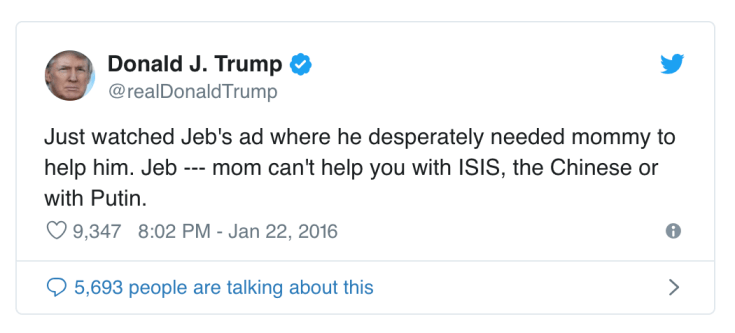
In January 2016, for example, Trump mocked Bush for having his mother Barbara Bush appear in a campaign ad for him. “Just watched Jeb’s ad where he desperately needed mommy to help him. Jeb — mom can’t help you with ISIS, the Chinese or with Putin,” Trump posted to Twitter.
Trump also tied the “low energy” descriptor to Bush as often as possible, such as this tweet from March, 2016: “Low energy Jeb Bush just endorsed a man he truly hates, Lyin’ Ted Cruz. Honestly, I can’t blame Jeb in that I drove him into oblivion!”

Bush said Trump was a “candidate of chaos,” a “bully,” and “not a serious candidate” during a 2015 CNN appearance.
Bush’s appearance on “The Axe Files” is set to air on Saturday.
WATCH:
By Sean Moran
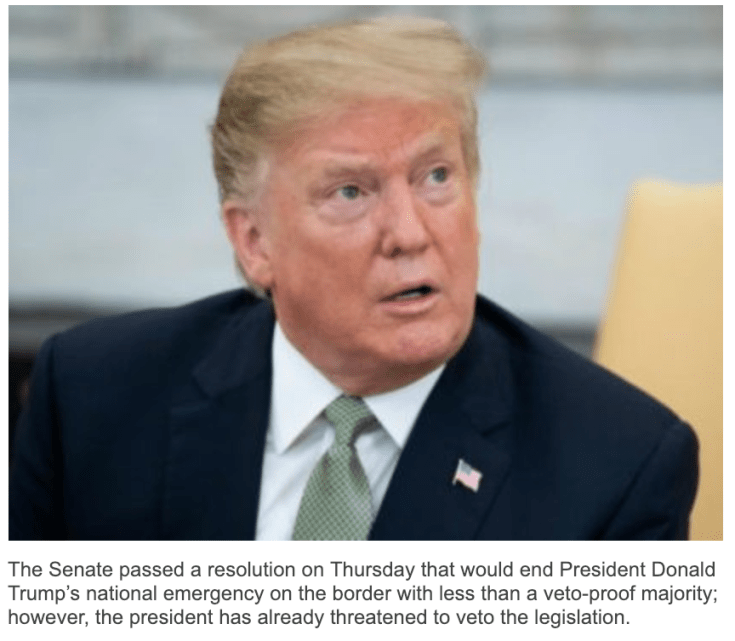
The Senate passed on a resolution Thursday, 59-41, that would end President Donald Trump’s national emergency. The vote featured strong Democrat support for the bill and a surprising amount of Republicans voting for it. The House passed its version of the resolution in February with the help of 13 Republicans.
Several Senate Republicans voted against President Trump’s national emergency.
Sen. Thom Tillis (R-NC), who previously signaled he would vote to end the emergency, said he will back Trump’s emergency after Trump said he will work with Republicans on a president’s national emergency authority. Tillis is up for re-election in 2020.
Sens. Cory Gardner (R-CO), Mike Braun (R-IN), Richard Shelby (R-AL), Shelley Moore Capito (R-WV), Lindsey Graham (R-SC), Joni Ernst (R-IA), and Pat Roberts (R-KS) voted in favor of the national emergency.
Sen. Joe Manchin (D-WV) voted against the national emergency.
Many Senate Republicans have stood by the president and have said Trump is right to take action to secure the southern border.
Sen. Graham said in a statement on Thursday, “I voted with President Trump and rejected Nancy Pelosi’s motion of disapproval regarding the emergency declaration to build a barrier on the southern border.
Sen. Marsha Blackburn (R-TN) said ahead of the vote that she will vote to keep Trump’s national emergency, stating:
Since Congress gave emergency powers to the executive branch in 1976 under the National Emergencies Act, presidents from both political parties have declared national emergencies in the United States over situations far less dire than the security and humanitarian crisis that is currently plaguing the southern border. The president and Congress must take swift action to secure our border, protect our citizens, and defend our sovereignty. I support President Trump’s declaration of a national emergency, and I reject the resolution of disapproval.
Sen. David Perdue (R-GA) told Breitbart News recently that, despite some media reports, there remains a “five-alarm crisis” at the southern border.
“There’s a five-alarm crisis going on down there. It’s not just the human traffic; it’s the drug traffic,” Perdue said in a statement to Breitbart News. “This is not just about building the wall; it’s about closing the loopholes and getting border patrol agents the resources they need.”
The Georgia conservative traveled in February to the southern border with Sen. Steve Daines (R-MT) and witnessed first-hand the border crisis. Perdue told Breitbart News that the border crisis was “staggering.” The two Republicans saw illegal crossing hotspots and received real-time briefings from border patrol agents.
Daines told Breitbart News that he backs Trump’s national emergency, contending that without a secure border, every state is a border state.
“Montana is a northern border state with a southern border problem. Our communities all over Montana are being torn apart by the flood of Mexican meth coming through the southern border,” Daines said. “We must protect our citizens and secure the border.”
Many Republican senators have said they oppose any form of executive overreach, which includes former President Barack Obama’s Deferred Action for Childhood Arrivals (DACA) illegal alien amnesty.
However, one federal district judge ruled in August 2018 that DACA was illegal, whereas many lawyers have argued that Trump has the authority under the National Emergencies Act of 1976 to reappropriate money to build the wall.
The Senate vote announcement comes as a Morning Consult/Politico poll suggests that nearly three-quarters of Republican voters would more likely vote for a candidate if they backed Trump’s national emergency on the border.
In an interview with Breitbart News this week, President Trump said he found it “hard to believe” that any Republican would vote against his efforts to secure the border.
Published on Mar 13, 2019

By
“An internal chart prepared by federal investigators working on the so-called “Midyear Exam” probe into Hillary Clinton’s emails, exclusively reviewed by Fox News, contained the words ‘NOTE: DOJ not willing to charge this’ next to a key statute on the mishandling of classified information,” the Fox report said. “The notation appeared to contradict former FBI Director James Comey’s repeated claims that his team made its decision that Clinton should not face criminal charges independently.”
What exactly was the DOJ “not willing to charge” Clinton with?
Three particular statutes were mentioned in the Fox report – crimes related to willfully retaining national defense information that could harm the United States, crimes related to gross negligence in handling classified material, and crimes related to “retaining classified materials at an ‘unauthorized location.’”
The document was called “Espionage Act Charges – Retention/Mishandling,” according to the report.
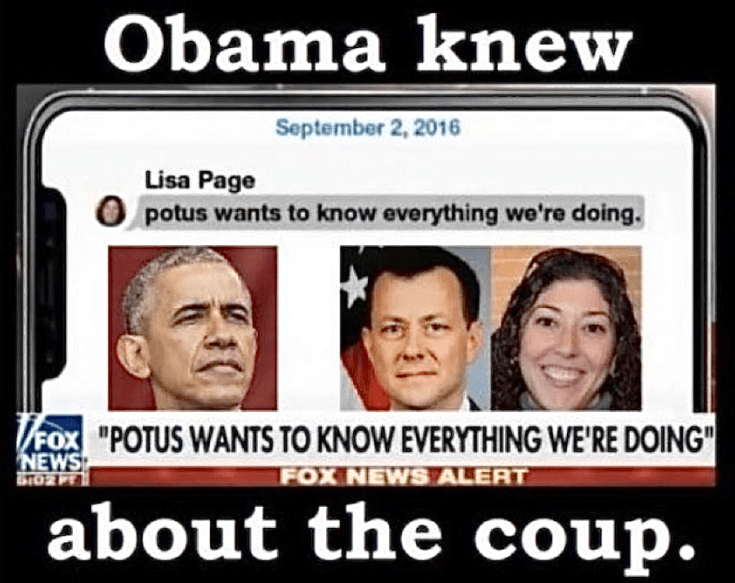
Wednesday, it was widely reported that disgraced former FBI lawyer Lisa Page revealed to the House Judiciary Committee that the Obama DOJ told the FBI not to charge Clinton in the email scandal in 2018 closed-door testimony.
Disgraced former FBI agent Lisa Page sang like a canary when questioned under oath last summer, according to the the social media account of one of the members of the House Judiciary Committee who took part in her hearing before Congress.
“Lisa Page confirmed to me under oath that the FBI was ordered by the Obama DOJ not to consider charging Hillary Clinton for gross negligence in the handling of classified information,” said Rep. John Ratcliffe (R-Texas) on Twitter, attaching a transcript of the hearing.
“So let me if I can, I know I’m testing your memory,” the transcript said. “But when you say advice you got from the Department, you’re making it sound like it was the Department that told you: You’re not going to charge gross negligence because we’re the prosecutors and we’re telling you we’re not going to —”
Page interrupted him and said “That is correct.”
Selective justice is a hallmark of any authoritarian state.
By

As the plot falls apart, it’s important for President Trump to know that Jared Kushner was the target of all this nonsense, which prolonged the plot against all of Trump’s people. That plot actually threatens to put a real American patriot — Trump’s longest adviser Roger Stone — in prison for invented process crimes.
A well-entrenched insider in the nation’s capital sends a dispatch to Big League Politics: “The Rosenstein scope memo from August 2, 2017 is now clear due to the Lisa Page Congressional Testimony. The scope memo references Manafort and to this date a second individual that is redacted. There has been speculation that it was someone close to Trump and even that it was Jared Kushner. The Page congressional testimony released today and her text to Strzok on May 9th 2017 makes it clear that they didn’t have anything of great value but needed to lock Kushner into a statement that could be nitpicked against to create a crime that would help get Trump through his son-in-law. How the public could ever trust the FBI/DOJ if no one ever goes to jail for the only coup attempt in U.S. History?”
Here are the texts clearly referring to Kushner.
Strzok “We need to open the case we’ve been waiting on now while Andy is acting.”
Page “We need to lock in *******. In a formal chargeable way. Soon.”
“Soon after the May 9th text, someone from the FBI leaks to the Washington Post that Kushner is a person of interest in the Russia investigation,” our source said.
Unbelievable.
Thanks, Jared.
By FRANK CAMP

During the segment, Tapper spoke with Castro about the issue of reparations for descendants of slavery: “This is also dividing Democrats on the trail. You’ve said that there needs to be some kind of reparations to descendants of slaves to compensate for years of slavery and discrimination against African Americans in this country.”
Tapper then played a clip in which presidential rival Sen. Bernie Sanders (I-VT) talks about Castro’s and Sen. Kamala Harris’ (D-CA) support for reparations:
What do they mean? I’m not sure anyone’s very clear. What I just said is that I think we must do everything that we can to address the massive level of disparity that exists in this country.
Tapper asked Castro: “So, what do you mean? Do you think that there should be actual monetary payments to descendants of slaves? Do support more like what Senator Sanders is talking about, policies such as child care and education that help those who are disadvantaged?”
Castro replied:
Well, you know, what I said was that I’ve long believed that this country should address slavery, the original sin of slavery, including by looking at reparations, and if I’m president, then I’m going to appoint a commission or task force to determine the best way to do that. There’s a tremendous amount of disagreement on how we would do that.
Castro then took a jab at Sanders, saying that he shouldn’t be arguing against an approach to reparations that might include “writing a big check” because that’s been the senator from Vermont’s position on health care and college tuition.
He concluded: “So, if under the Constitution, we compensate people because we take their property, why wouldn’t you compensate people who actually were property?”
The notion of somehow compensating the ancestors of American slaves has long been a topic of discussion among academics and political thinkers. However, the mechanics by which a reparations program would operate have challenged even the most diligent.
On an episode of “Point Taken” on PBS regarding reparations, libertarian commentator Kmele Foster stated bluntly: “I think the important things to consider are, who pays? How much do they pay? And who do they pay it to? These are impossibly difficult questions to actually reconcile and answer in a meaningful and just way.”
Even progressive author Ta-Nehisi Coates, in his 2014 thesis on “the case for reparations” published in The Atlantic, didn’t come to any conclusion as to how reparations should work, writing in part:
Perhaps no number can fully capture the multi-century plunder of black people in America. Perhaps the number is so large that it can’t be imagined, let alone calculated and dispensed. But I believe that wrestling publicly with these questions matters as much as—if not more than—the specific answers that might be produced. An America that asks what it owes its most vulnerable citizens is improved and humane. An America that looks away is ignoring not just the sins of the past but the sins of the present and the certain sins of the future. More important than any single check cut to any African American, the payment of reparations would represent America’s maturation out of the childhood myth of its innocence into a wisdom worthy of its founders.
Coates does refer to a bill from former Rep. John Conyers as the beginning of a potential solution: “A country curious about how reparations might actually work has an easy solution in [John] Conyers’s bill, now called HR 40, the Commission to Study Reparation Proposals for African Americans Act. We would support this bill, submit the question to study, and then assess the possible solutions.”
Former President Obama even commented on the non-feasibility of a reparations program:
As a practical matter, it is hard to think of any society in human history in which a majority population has said that as a consequence of historic wrongs, we are now going to take a big chunk of the nation’s resources over a long period of time to make that right.
Instead, Obama pointed toward progressive redistributionist programs as a means of reparations:
[I am] not so optimistic as to think you would ever be able to garner a majority of the American Congress that would make those kinds of investments above and beyond the kind of investments that could be made in a progressive program for lifting up all people.
As the Democratic presidential candidates gear up for a contentious primary season, they should be prepared to answer questions about reparations. With Julián Castro, Kamala Harris, and Elizabeth Warren already promoting the issue, it’s unlikely that it will fade silently into the night.
READ MORE: BARACK OBAMA DEMOCRATIC PARTY JULIAN CASTRO REPARATIONS SLAVERY





 Tom's Blog