Twitter erupts after NYT reveals FBI probe into Trump-Russia links that lead… nowhere

screen shot 2019-01-12 at 12.43.32 pm

Russiagate disciples are squealing with joy after the New York Times wrote about the FBI apparently probing if Trump was secretly working for the Russians. In fact, the article states there is no evidence to support the theory.

In what appears to be a last-ditch Russiagate Hail Mary, the New York Times breathlessly reported on Friday – of course, citing people ‘familiar with the investigation’ – that the FBI began looking into whether the president was a covert Kremlin agent, after Trump fired then-FBI Director James Comey in May 2017. According to the Times, “agents and senior FBI officials had grown suspicious of Mr. Trump’s ties to Russia during the 2016 campaign,” but were reluctant to launch a formal probe into the matter. This all changed, the Times tells us, after Comey got the boot.

The investigation was quickly handed over to special counsel Robert Mueller, who continues to lead a probe into alleged Russian meddling in the 2016 election and collusion with Trump’s presidential campaign.

According to the Times, counterintelligence investigators “had to consider whether the president’s own actions constituted a possible threat to national security.” Agents were also tasked with determining whether Trump “knowingly work[ed] for Russia or had unwittingly fallen under Moscow’s influence.”

The decision to secretly investigate the president for possibly threatening national security triggered a “vigorous debate” within the Justice Department. The FBI, however, apparently felt vindicated after Trump remarked that Comey’s firing had helped relieve Russia-related political pressure.

Among Russiagate’s devout faithful, the report was treated as an earth-shattering revelation that reinforced their core dogma – i.e., that Donald Trump is a Kremlin agent installed in the White House by Vladimir Putin to destroy democracy.

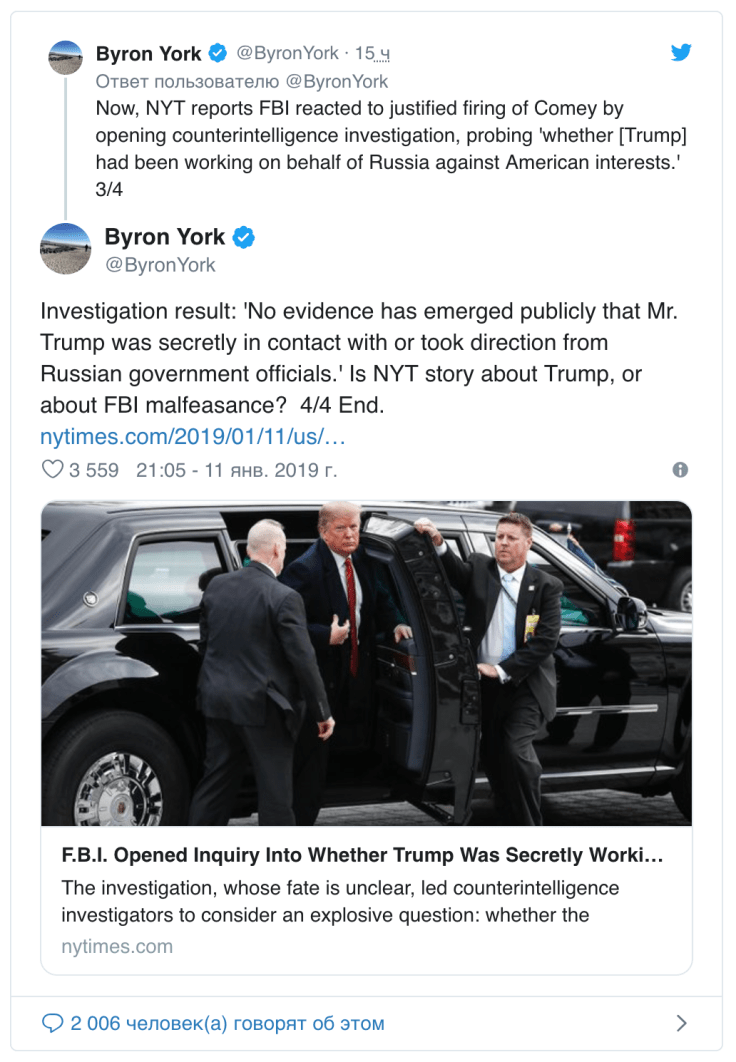
Unfortunately, even the Times begrudgingly admitted – albeit buried in the ninth paragraph – that “no evidence has emerged publicly that Mr. Trump was secretly in contact with or took direction from Russian government officials.”

Indeed, Twitter was swamped with indignant comments accusing the paper of cooking up a massive nothingburger. One observant netizen pointed out that in October 2016, the New York Times even ran a headline that stated unequivocally: “Investigating Donald Trump, the FBI sees no clear links to Russia.”

screen shot 2019-01-12 at 12.46.09 pm

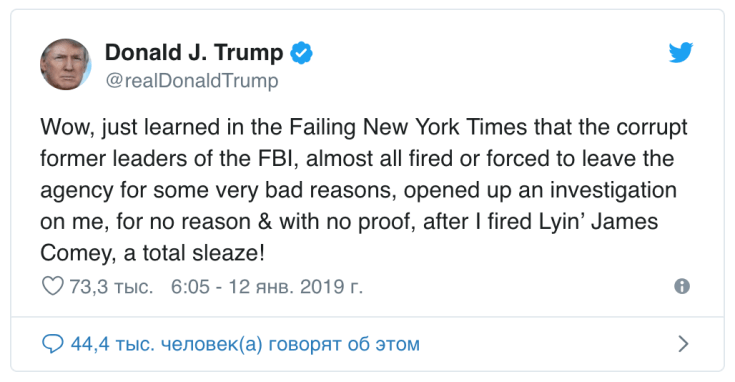
Trump himself took to Twitter to mock the report.

“Wow, just learned in the Failing New York Times that the corrupt former leaders of the FBI, almost all fired or forced to leave the agency for some very bad reasons, opened up an investigation on me, for no reason & with no proof, after I fired Lyin’ James Comey, a total sleaze!” he wrote.

screen shot 2019-01-12 at 12.47.03 pm

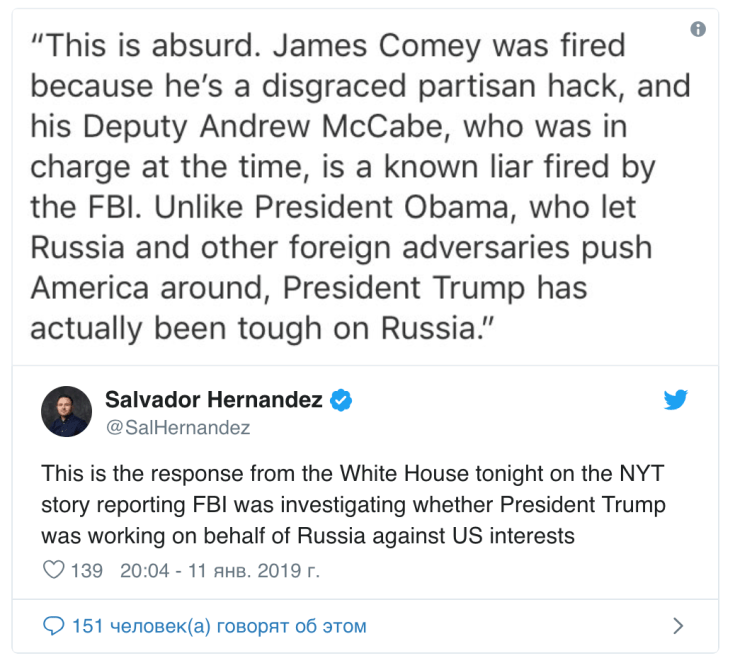
The White House said in a statement that the notion that Trump was in bed with Russia makes little sense, given the administration’s hardline policies directed at Moscow.
“Unlike President Obama, who let Russia and other foreign adversaries push America around, President Trump has actually been tough on Russia.”

screen shot 2019-01-12 at 12.47.58 pm

The report also raises questions about whether Comey was being entirely truthful when he testified to Congress in December that Trump wasn’t among the “four Americans” targeted by the FBI counterintelligence probe into Russian meddling.

As one political pundit observed, the Times’ story raises more questions about the FBI than it does about Trump and his still unproven ties to Russia.

“Is NYT story about Trump, or about FBI malfeasance?” Fox News contributor Byron York asked in a tweet.

screen shot 2019-01-12 at 12.49.08 pm

Obama Declared 13 National Emergencies — 11 Are Still Active

By Patrick Howley

There are a lot of national emergencies going on. In fact, there are 31 active national emergencies declared under the National Emergencies Act.

Bill Clinton used this authority 17 times. President Trump has only used it three times so far.

Sorry Democrats, this “national emergency” business is not quite the work of “dictators.”

Conservative Tribune reports: “Of Obama’s 11 continuing national emergencies, nine of them were focused exclusively on foreign nations, while only one seemed focused on protecting America — a declaration aimed at punishing individuals “engaging in significant malicious cyber-enabled activities.”

Trending: Change.Org Petition To Impeach Rashida Tlaib Is Gaining Momentum

All of the rest of Obama’s national emergencies were focused on blocking property or prohibiting transactions/travel for individuals engaged in various activities in — by order of the date of enactment — Somalia, Libya, transnational criminal organizations, Yemen, Ukraine, South Sudan, Central African Republic, Venezuela and Burundi.

Conservative Tribune passage ends

The American people stand with President Trump following his amazing Oval Office address explaining the human cost of illegal immigration.

Here’s why President Trump should not have to fear legal fights over his expected upcoming national emergency declaration. Jonathon Moseley reports:

If President Donald Trump uses the U.S. military to build the border wall along the United States’ international with Mexico by declaring a national emergency, won’t liberals simply run to a Federal judge whom they believe to be left-wing within the Ninth Circuit and block Trump? Can Congress vote to overturn Trump’s declaration of an emergency?

No. If the federal courts actually follow the law, President Trump cannot be prevented from “reprogramming” funds appropriated for the U.S. Department of Defense and actually using the military (such as the U.S. Army Corps of Engineers) to build the border wall.

See the source image

As noted in the first installment on this topic, Congress has given a president the power to declare a national emergency by 50 U.S.C. 1621 and  50 U.S.C. 1622.  A declaration of an emergency allows the President to reprogram funds in the military budget.  See 33 U.S. Code § 2293 “Reprogramming during national emergencies.”

Trump could reprogram funds from other parts of the Department of Defense budget — including from other DoD construction projects such as on bases, military housing, etc. — and engage in construction in areas of need for the national defense.  The statute says that explicitly (although statutes are never easy reading).

But Democrats are threatening and commentators are warning that such an action would be challenged in court and in Congress immediately.  Can such a plan be blocked?

First, 50 U.S.C. §1622 allows the Congress to over-turn a president’s declaration of an emergency.  If both the Senate and the House each pass s resolution terminating the President’s declaration of an emergency, than the emergency status terminates under 50 U.S.C. §1622.  But clearly the Republican-controlled U.S. Senate would not join the Democrat-controlled U.S. House of Representatives.  Unless a significant number of Republican Senators vote against a border wall built by the U.S. Army Corps of Engineers or contractors with military funds, Congress could not block Trump’s efforts.

(Note, although I argue in the next section that this power has been invalidated by the U.S. Supreme Court, if a court disagrees on that, a legislative veto power should block a lawsuit.  Where Congress has provided a specific method for challenging a declaration of an emergency, the federal courts would normally hold that that method becomes the exclusive remedy.  A lawsuit would be blocked by the fact that Congress provided a non-litigation remedy.)

Second, however, the Congressional veto process described above has been ruled unconstitutional by the U.S. Supreme Court, in INS v. Chadha, 462 U.S. 919 (1983), finding a legislative veto of Executive Branch action unconstitutional.  Congress passed many laws which specifically enabled Congress to veto regulations or actions under that law.  The U.S. Supreme Court found a legislative veto violates the structure or architecture of the Constitutional system.

Laws go to the President for signature or veto.  Congress cannot reach over and pull a law back.  Congress must pass a new law and present it to the President for signature if dissatisfied with how the law is working out.  The U.S. Supreme Court had no hesitation finding that the Congress had over-reached, based only on the implied architecture of the Constitution.

In Chadha50 U.S.C. 1622 was one of the laws explicitly discussed.  The dissenting opinion specifically warned that the Chadha decision invalidated Congress’s ability to overturn a presidential declaration of a national emergency.

Therefore, Congress cannot overturn a declaration by President Trump that the open border is a national emergency.  Even if the U.S. Senate were to side with the Democrats, Chadha explicitly ruled the Congressional veto (termination) of a presidential declaration to be an unconstitutional distortion of the familiar “Schoolhouse Rock” means by which laws are passed and signed by presidents.  Once a law is signed, there is no “claw back” right by Congress.

Third, of course, critics are discussing whether Trump’s actions would be constitutional.  Here, however, Congress passed a specific statute, in fact a series of statutes.  So there is no question about the President’s power to do what the Congressional statute has explicitly empowered him to do.

Some even point to a rather famous Constitutional landmark case — Youngstown Sheet & Tube Co. v. Sawyer, 343 U.S. 579 (1952) — in which the U.S. Supreme Court explicitly ruled that President Dwight D. Eisenhower did not have the power to temporarily nationalize the U.S. steel industry to avert a strike for national defense.  However, Youngstown was not that simple.  Youngstown analyzed the inherent powers of Commander in Chief as modified by Congressional agreement by statute.

The U.S. Supreme Court explicitly analyzed that the President’s powers are at their greatest (zenith) when he acts not only by his inherent powers as President but also by the agreement of a statute passed by Congress.  In Youngstown, Eisenhower did not have any statute supporting his action and the Court reasoned that he was actually acting in conflict with relevant statutes.

Here, the Congress has already enacted and President George W. Bush signed into law, the Secure Fence Act of 2006.  It is already the law of the land that a border wall shall be built along the United States’ Southern border.  Neither Congress nor any private plaintiff can challenge the official determination that a border wall or barrier shall built.  That is the law.  That is the official determination of both the U.S. Congress and the Commander in Chief.

The Secure Fence Act of 2006 was never implemented (other than a few miles) because Congress did not appropriate the funds to pay for it.  There are two steps:  Authorization and Appropriation of funds.  The decision to build a border wall is final.  The only question is applying funds to make it happen.

Building of a border wall under the 2006 Act was also not completed because the Swamp and Deep State sabotaged it.  Using classic bureaucratic games, the bureaucracy and open borders legislators followed “designed to fail” steps that ground the construction to a halt.

Note that in spite of the word “fence” in the title, the law does not actually mandate a “fence” in particular.  The wording of the Act is not about a “fence” but about any kind of barrier customized to the particular terrain in each location to the extent necessary to “the prevention of all unlawful entries into the United States, including entries by terrorists, other unlawful aliens, instruments of terrorism, narcotics, and other contraband.”   That is “all.”  As in “all.”

So the Secure Fence Act of 2006 requires building “whatever it takes” — not a “fence” per se.  The Act does require specific enhanced barriers and lights, cameras, and sensors, in some named locations.

Fourth, could liberals run to the courts to block Trump from using the military to build a border wall?  No.  Only those with “standing” can bring a lawsuit.  How is anyone harmed?

The federal courts have been waging Jihad against citizens bringing lawsuits for decades.  The federal courts have been raising the bar higher and higher to make it nearly impossible for anyone to challenge the actions of government agencies or public officials.  Specifically a complaint that is shared generally by much of the population cannot establish standing.

Contrary to strongly-held popular belief, the U.S. Supreme Court has clearly ruled that taxpayers do not have standing to challenge government spending, revenue, or action merely because they are taxpayers.  See, Daimlerchrysler Corp. v. Cuno, 126 S.Ct. 1854, 164 L.Ed.2d 589, 547 U.S. 332 (2006).  So the Left cannot block Trump’s plans by suing as taxpayers.  (The only exceptions involve use of funds to establish a religion or local government taxpayers.)

Similarly, Members of Congress do not have standing either.  Certainly individual Members of Congress do not.  See Raines v. Byrd, 521 U.S. 811 (1997).

To bring a lawsuit, one must show that they are tangibly harmed, personally, not just in disagreement with a policy.  If Trump uses some of the $700 billion in the omnibus bill to build a border wall, everyone will be more safe.  How is anyone harmed?

Fifth, can private landowners, some of whom will be liberals, go to court and stop the use of private land as an easement taken by eminent domain?  No.

There is absolutely no defense available to taking land by eminent domain.  How much compensation is owed for taking an easement as a strip of land could take years to fight out in court.  But the actual right to use the land cannot be contested.  The government can take an easement immediately and then fight later over how much money should be paid to the landowner.  Remember that this was the legal holding of the over-the-top, controversial U.S. Supreme Court precedent Kelo v. City of New London, Connecticut, 545 U.S. 469, 125 S. Ct. 2655; 162 L. Ed. 2d 439 (2005).  (Kelo ruled that it is not even necessary to show a “public purpose” for eminent domain, which goes too far.)

Legal challenges will not stop construction, even it takes years to reach agreement on the compensation payable to landowners.   To finance payment of compensation, Trump should consider offering a land swap of federally-owned tracts of land or selling such public lands.

Sixth, opponents of Trump’s agenda will try to find individual landowners along the border, who might be liberal, to object in general to the reprogramming of military funds to build the border wall.  But those landowners should not be considered to have standing, for several reasons:

(A)  It would be speculation as to whether the government will take any action at their particular section of the border.  How would a landowner know that his or her part of the border is a stretch where the planners believe an actual wall is truly needed, as opposed to other natural or physical barriers?  It would be — under standard doctrines of standing — insufficient to speculate that that particular landowner’s land is going to be affected at all.

(B)  There is a concept called “exhaustion of administrative remedies.”  If an individual landowner doesn’t want a border fence along their particular stretch of the border, they would first have to tell the government that they object.  The courts would traditionally wait until the government can try to find agreement with the landowner before allowing a lawsuit.  A lawsuit would be invalid as not yet being “ripe.”  Traditionally the courts would require a plaintiff to actually talk to the government agency first to see if their stretch of land is actually going to be affected or not, whether a compromise can be worked out, etc.  Those are the currently-existing standard rules that always govern. (In fact, on policy, one could argue if a landowner doesn’t want a wall along their property, fine. Let all the trespassers funnel through that person’s land, trampling the ground, leaving trash everywhere, and frightening their family in their home at all hours.  If they don’t want a border wall on their property, fine.  Check back with us later and tell us how that worked out for you.)

Seventh, open border advocates of course will also find some would-be gate-crashers from another country to say that they want to break the law and cross the border in the unmanned frontier and the border wall will stop them from breaking the law.  That should be laughed out of court, because one does not have a “right” to break the law.  Similarly, they will try to find immigrants in the U.S. who want to bring family members into the U.S.A.  But they have legal avenues for doing that, by sponsoring their family members to come in legally.  Those ideas may impress an individual federal trial judge for a short time, but it should not survive on appeal.

(Note:  Trump does need to get changes in the law through Congress or perhaps just issue clarifying regulations from DHS that a foreigner can apply for asylum at a U.S. consulate without entering the United States.)

As an attorney in Virginia for 21 years, who has worked for both Judicial Watch and more recently Freedom Watch created by Larry Klayman, I often have to explain the concept of “standing” to clients who want to bring “good government” lawsuits or hold the government accountable to its rules.

When Sheriff Joe Arpaio sued to challenge Barack Obama’s amnesty by executive order, the U.S. Court of Appeals for the District of Columbia ruled that Arpaio did not have standing, even though illegal immigration cost him actual money in (then) running the jails of Maricopa County.  I worked on that legal case, from helping write the original complaint (with an eye toward establishing standing from word one) to legal memoranda in the U.S. District Court for the District of Columbia, filed by Larry Klayman, to the appeal by Larry Klayman to the U.S. Court of Appeals for the District of Columbia.  Arpaio’s legal pleadings established standing as strong as one could imagine, an iron lock on showing standing.

Didn’t matter.  The courts completely contradicted other precedents, as powerfully demonstrated by the dissenting opinion of the Honorable Janice Rogers Brown, an African-American appeals judge with more intellect and intellectual integrity in her little finger than the U.S. Congress combined.

In deadly seriousness and a straight face, I honestly have to explain the law of standing in federal courts as follows:  If you want to encourage the expansion of government and government intervention in the economy or society or prevent the streamlining of government, you have standing.  If you want to hold government accountable to staying within its rules or you want to block left-wing policies, you don’t have standing.  it’s pretty much that simple.  Are you a liberal?  You have standing.  Are you a conservative?  You don’t have standing.  Having studied hundreds of precedents on standing, I must say that with absolutely no humor, exaggeration or hyperbole.  I could not truthfully say anything different.

However, the federal courts have established some very strong precedents ruling that almost no one has standing to challenge anything that the government wants to do — unless the government action directly  harms the plaintiff personally and individually.

Therefore, it will be extremely awkward for the federal courts to ignore and contradict their past precedents and claim that anyone has standing to object to the building of a border wall by the U.S military.

Finally, President Trump’s Administration under incoming Attorney General William Barr has got to stop this foolishness with lawsuits brought before a cherry-picked judge in the Ninth Circuit whom the plaintiffs believe will be unusually sympathetic to them and hostile to Trump’s policies.

The Department of Justice under Bill Barr must always   file a motion for a change of venue to the U.S. District Court for the District of Columbia.  Readers will be familiar with changes of venue requests in famous criminal cases.  But this is different.   This is not about whether a criminal defendant can get a fair trial due to pre-trial publicity.

A change of venue in a civil dispute is based upon other considerations:  Where are all the witnesses?  Where are the records and evidence kept?  Where was the decision made?  Where are the decision-makers to be affected by the lawsuit located?  Those venue rules strongly if not conclusively favor moving any such lawsuit to the District of Columbia, where the decisions were made, where the officials and witnesses reside, and where all the evidence is located.

Again, those are the standard, currently-existing, non-controversial rules.  None of these lawsuits should be tolerated out in the Ninth Circuit on the Left Coast.  There is no valid reason to have such lawsuits spread around the country instead of being held in Washington, D.C., where the action is — and where the action took place.


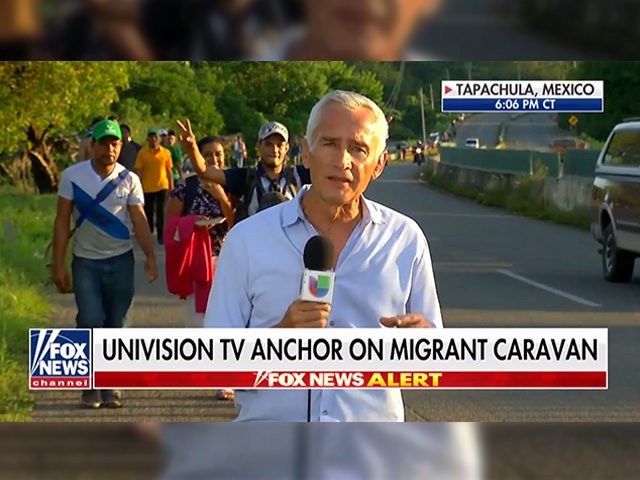
Jorge Ramos: Border Wall ‘Symbol of Hate and Racism’ for ‘Those Who Want to Make America White Again’

jorge-ramos-fox-news

By Tony Lee

Univision anchor Jorge Ramos thinks President Donald Trump’s border wall would be nothing more than a “symbol of hate and racism” for “those who want make America white again.”

In a Wednesday New York Times op-ed, Ramos notes that Trump “is not the first president to ask for money for a wall.” He points out that former Presidents George H.W. Bush, Bill Clinton, and George W. Bush “built fences and walls along the southern border” while former President Barack Obama “maintained the resulting system of roughly 700 miles of physical barriers.”

“So why don’t we want Mr. Trump to build his wall? What is different?” Ramos asks. “The difference is that Mr. Trump’s wall is a symbol of hate and racism, it would be completely useless, and it does not address any national emergency.”

Ramos, who said the United States has a responsibility to “absorb” caravan migrants, says the fight against the border wall “is about more than just a wall.”

“The wall has become a metaphor to Mr. Trump and his millions of supporters,” he writes. “It represents a divide between ‘us’ and ‘them,’ a physical demarcation for those who refuse to accept that in just a few decades, a majority of the country will be people of color.”

Ramos accuses Trump of trying to “exploit the anxiety and resentment of voters in an increasingly multicultural, multiethnic society” with his promise of a border wall, which Ramos says is nothing more than “a symbol for those who want to make America white again.”

The chant ‘Build that wall, build that wall’ became his hymn — and an insult not just to Latinos but also to all people who do not share his xenophobic ideals,” Ramos continues. “The wall went from a campaign promise to a monument built on bigoted ideas. That is why most Americans cannot say yes to it. Every country has a right to protect its borders. But not to a wall that represents hate, discrimination and fear.”

He concludes by arguing that Trump “is the wall” because “the concept of America as an unwelcoming country to immigrants and uncomfortable for minorities is already here.”

Tweet Delete: Rep. Steve Cohen Implies Trump’s ‘Audience’ Is ‘Similar’ to KKK Dems Go Low for Open Borders

screen shot 2019-01-09 at 11.02.06 am

By Robert Kraychik

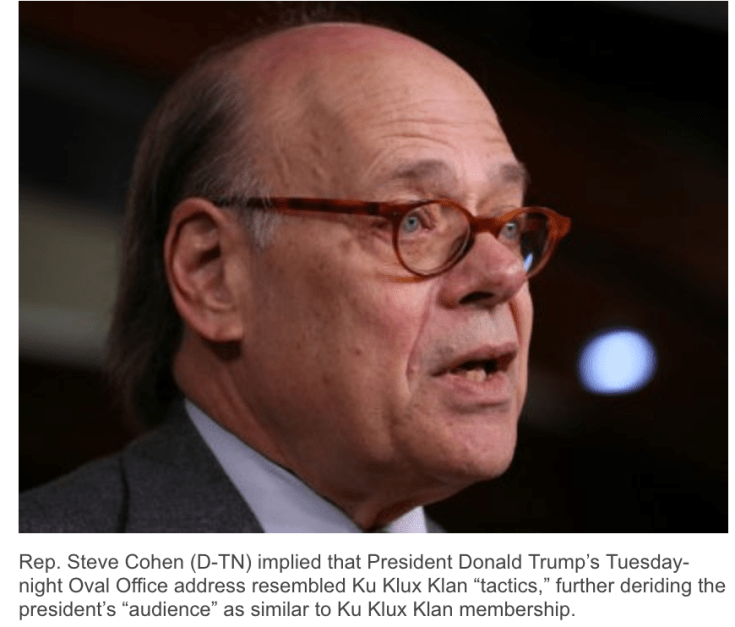
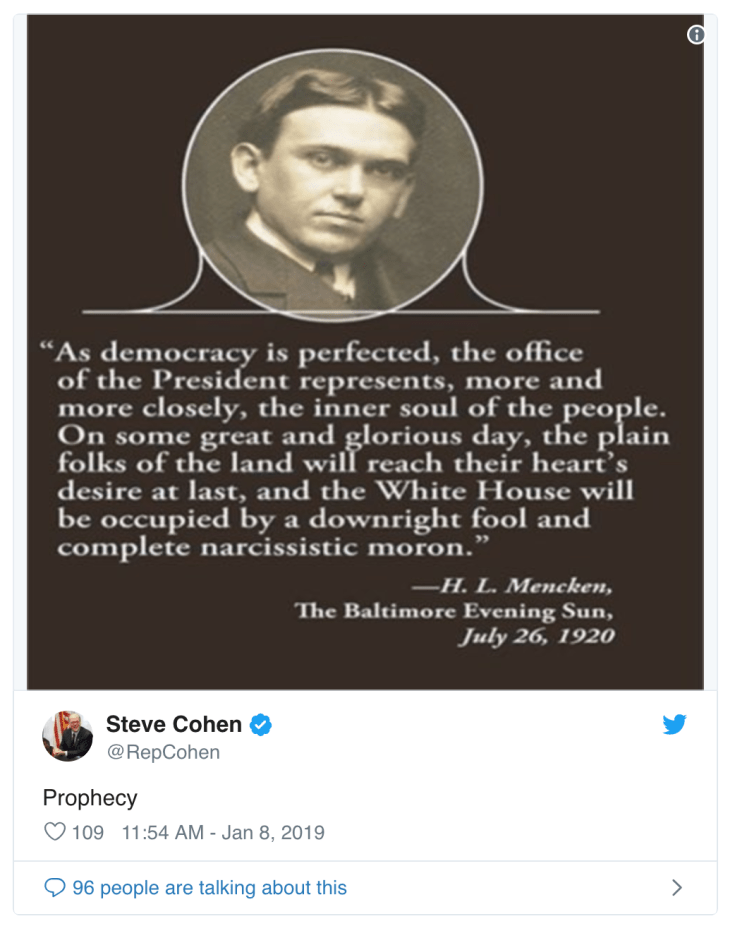
Rep. Steve Cohen (D-TN) implied that President Donald Trump’s Tuesday-night Oval Office address resembled Ku Klux Klan “tactics,” further deriding the president’s “audience” as similar to Ku Klux Klan membership.

Cohen tweeted — then soon deleted — a response to presidential biographer Jon Meacham shortly after Trump’s video address to the nation:

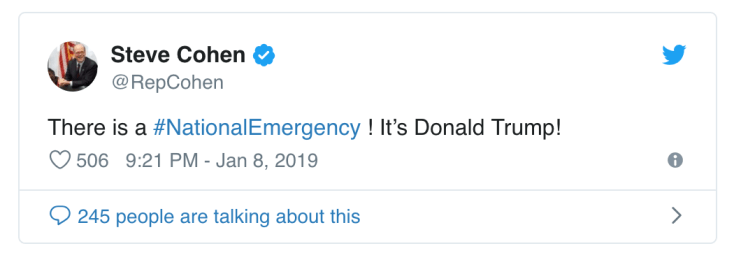
screen shot 2019-01-09 at 11.04.31 amCohen further described Trump as a “national emergency”:

screen shot 2019-01-09 at 11.05.36 am

Cohen also derided Americans as “plain folks of the land” whose inner souls are embodied by “a downright and complete narcissistic moron” like Trump:

screen shot 2019-01-09 at 11.06.31 am

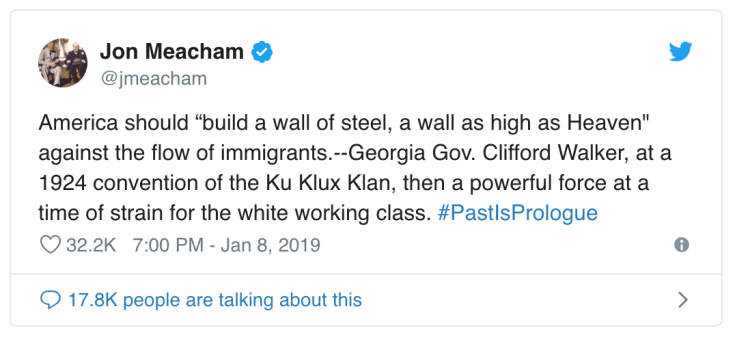
Cohen’s now-deleted post was a response to one from Jon Meacham, who, hours before Trump’s address to the nation regarding border security, linked calls for a border wall to the Ku Klux Klan:

screen shot 2019-01-09 at 11.07.22 am

During a discussion panel with former President Barack Obama and former Secretary of State James Baker in November, Meacham refused to state Trump’s name in a discussion of the president’s policies.

Breitbart News reported at the time:

Both Meacham and Obama refused to say Trump’s name, despite both referring to him implicitly. “He’s Voldemort. I’m not going to say his name,” Meacham said of Trump while asking Obama a question about Trump’s presidency.

Also in November, Meacham said Chief Justice John Roberts had a “moral obligation” to speak out against Trump.

Meacham is regularly featured across cable and network television news as a non-partisan and politically objective analyst.


Democrats Preview Response to Trump Oval Office Speech: ‘There Is No National Emergency on the Southern Border’

Nancy Pelosi and Chuck Schumer (Aaron P. Bernstein / Getty)

By Joel B. Pollak

Democrats have already dropped hints of what their response to President Donald Trump’s address Tuesday evening from the Oval Office on the border crisis will be.

The networks have granted Speaker of the House Nancy Pelosi (D-CA) and Senate Minority Leader Chuck Schumer (D-NY) airtime to respond. Their message will be that there is no crisis that merits building a barrier on the border. The only crisis, to them, is the partial government shutdown.

As Sen. Patrick Leahy (D-VT) said last week, responding to the suggestion Trump may declare an emergency so he can order the military to build the barrier: “There is no national emergency on the southern border.” He described the idea as “stealing resources from the Defense Department.”

The real solution to what he called the “complex issues at our southern border” — which are not an emergency, mind you — is “comprehensive immigration reform.”

The idea that there is no crisis at the border will be a tough sell, especially as Democrats and the media described the situation as a crisis last summer, when the Trump administration started enforcing its “zero tolerance” policy toward illegal crossings that resulted — thanks to existing rules dating to the Obama administration — in children being separated from adults. Pelosi even questioned “why there aren’t uprisings all over the country” about it.

To Democrats, the only “crisis” — aside from the government being partially closed for two weeks — results from the enforcement of existing laws at the border. To resolve that “crisis,” they want to pass more laws — which, they insist, include provisions for “border security,” though they do not want to enforce the laws already on the books.

Here are some other arguments Democrats will likely use, based on their statements over the past several days.

See the source image

1. Trump is a liar. “I expect the president to lie to the American people,” said Rep. Jerrold Nadler (D-NY), the new chair of the House Judiciary Committee, during a visit to the border yesterday. (Nadler added: “There’s no security crisis at the border.”) Nadler echoed the CNN line, which is that the president’s speeches should not enjoy live coverage because he might say inaccurate things — a problem journalists never had with President Barack Obama.

2. Border walls and fences do not work. This is another weak argument, since many House and Senate Democrats — including Schumer — voted for the Secure Fence Act of 2006. Other variants of this argument is that a wall would be immoral (Pelosi) and racist (Rep. Alexandria Ocasio-Cortez (D-NY)). However, given examples of walls or fences to stop migrants in the European UnionIsrael, and even Botswana, these arguments are also easily defeated.

3. Trump’s $5 billion proposal is wasteful. This is a tough argument to sustain after Democrats’ own proposals to end the partial shutdown and re-open the government. Democrats want “over $12 billion more in foreign aid than the Trump administration requested,” according to Breitbart News’ Rebecca Mansour. Democrats also asked for a combined $10 billion in extra funding for the United Nations and other supposed priorities. $5 billion is nothing.

4. Mexico should be paying for it. Democrats have been taking potshots at the president for months by reminding him of his refrain from the campaign trail in 2016. Trump has argued that Mexico is paying for the wall through its concessions on trade. But the U.S. could also tax remittances Mexican workers in the U.S. send home, or raise fees for crossing the border. There are many ways to collect in future, if needed; what the wall needs is a down payment.

5. Government shutdowns are wrong. This used to be a winning argument for Democrats — until they shut down the government themselves last year in an effort to force President Trump and the Republicans to legalize the so-called “Dreamers,” i.e. illegal aliens brought to the country as minors. The contrast also works in favor of Trump: Democrats shut down the government to protect illegal aliens, while the president is doing so to protect Americans.

The fact is that the Democrats’ best and only case against the border wall is that Trump proposed it. They know if he fails to deliver on his core campaign promise, he will lose his voter base. And they know if he buckles and re-opens the government without the funding he wants, they can walk all over him for the next two years.

What they may not realize is those reasons also make him stronger: he cannot compromise, therefore he has the advantage.

See the source image

REPORT: ZUCKERBERG HOSPITAL GOUGES PAYING PATIENTS TO PAY FOR ILLEGALS

Report: Zuckerberg Hospital Gouges Paying Patients to Pay For Illegals

Bike rider with private insurance charged over $20K for broken arm

 | Infowars.com – JANUARY 8, 2019

A San Francisco hospital named after Mark Zuckerberg is offsetting its public healthcare costs by sending expensive bills to privately-insured patients, according to a media report.

Zuckerberg San Francisco General reportedly billed a bike rider over $20,000 for a broken arm after her private insurance paid nearly $4000 to the hospital, an amount the insurer thought was reasonable for an arm splint.

capture

“A spokesperson for the hospital confirmed that ZSFG does not accept any private health insurance, describing this as a normal billing practice,” according to a report by left-leaning Vox News. “He said the hospital’s focus is on serving those with public health coverage — even if that means offsetting those costs with high bills for the privately insured.”

On its web site, ZSFG declares that “everyone is welcome here” regardless of their financial situation or immigration status:

Everyone is welcome here, no matter your ability to pay, lack of insurance, or immigration status. We’re much more than a medical facility; we’re a health care community promoting good health for all San Franciscans.

We’re part of a large group of neighborhood clinics and healthcare providers, the San Francisco Health Network. In partnership, we provide primary care for all ages, specialty care, dentistry, emergency and trauma care, and acute care for the people of San Francisco.

Because the Zuckerberg hospital doesn’t participate in the negotiated-cost networks of private health insurers, privately-insured patients are charged tens of thousands more for services that are significantly less at other hospitals.

“Our mission is to serve people who are underserved because of their financial needs,” the spokesperson also stated. “We have to be attuned to that population.”

Unfortunately for the bike rider, she didn’t have much choice in what hospital to go to while riding semi-conscious in the back of an ambulance.

Mark Zuckerberg donated $75 million to the hospital in 2015.

WATCH: This Likely 2020 Dem Presidential Candidate Ups The Ante: Speaks Of 90% Tax Rate

Apparently unsatisfied with the suggestion of fellow Democrat Alexandria Ocasio-Cortez that wealthy Americans should be forced into a 60-70% tax rate, likely 2020 presidential candidate Julian Castro, who served as the Obama Administration’s Housing and Urban Development secretary, seemed to speculate on Sunday about the possibility of raising Ocasio-Cortez’s bid to 90%.

Appearing on ABC News’ “This Week,” Castro remarked that he could support Ocasio-Cortez’s suggestion, adding, “Oh, I can support folks at the top paying their fair share … There was a time in this country where the top marginal tax rate was over 90%, even during Reagan’s era in the 1980s it was around 50%.”

Castro, the former mayor of San Antonio, Texas, urged “that we get more serious about making sure the corporations pay their fair share. He continued, “During this campaign, if I run, I’m going to be very up front with the American people on how we would do that because I think that they are owed that, but it is worth it. It is worth it in this country for us to do that,” he said, vowing not to be “a single issue candidate.”

In 2015, Democratic presidential candidate Bernie Sanders, never averse to raising taxes, also brought up the Eisenhower tax rates during the Iowa presidential debate. Sanders was asked about tax rates, “Well, let’s get specific, how high would you go? You’ve said before you’d go above 50 percent. How high?” He responded, “We haven’t come up with an exact number yet, but it will not be as high as the number under Dwight D. Eisenhower, which was 90%.”

But as the Tax Foundation explained in 2017, it is true that the top federal income tax rate was 91% for most of the the 1950’s, but the top 1% of taxpayers in the 1950s only paid about 42% of their income in taxes. The Tax Foundation explains that the 91% bracket of 1950 only applied to households with income over $200,000, the equivalent of roughly $2 million today. Additionally, the high tax rate only applied to income above $200,000, not to every single dollar earned.

Alexandria Ocasio-Cortez Proposes 70% Taxation to Pay for ‘Green New Deal’

See the source image

By Joel B. Pollak

Newly-installed Rep. Alexandria Ocasio-Cortez (D-NY) is calling for 70% taxation on the wealthy as a way to pay for her “Green New Deal,” which proposes to use government to create new jobs by investing in renewable energy.

In an interview set to air Sunday on CBS News’ 60 Minutes, Ocasio-Cortez — who has begun referring to herself by the nickname, “AOC” — told Anderson Cooper that the “Green New Deal” would “require a lot of rapid change that we don’t even conceive as possible right now,” including raising taxes to a marginal rate of 70%, as in the 1960s.

AOC referred to the 70% rate on people at the “tippy-tops” as the rich merely paying their “fair share” of the tax burden.

See the source image

She compared the “Green New Deal” to other “radical” policies like President Abraham Lincoln signing the Emancipation Proclamation, and President Franklin Delano Roosevelt launching Social Security in the New Deal.

As Breitbart News has noted, the “Green New Deal” is in fact an old idea, first championed by President Barack Obama’s “green jobs” czar, Van Jones. It seeks to implement classic socialist policies of state-run enterprises, using the pretext of an environmental crisis.

To that end, proponents often exaggerate the threat of climate change and other environmental challenges. AOC herself has warned of “cataclysmic climate disaster” unless the United States moves to 100% renewable energy sources in the next ten years.

In comparison, California — the most ambitious state in “green” energy policy — has merely set itself a goal of 100% renewables by 2045, more than 25 years away.

Obama’s “green jobs” program was a notable failure, with many investments failing to pay off — most notoriously the solar panel company Solyndra, which failed after Obama, Vice President Joe Biden, and others held it up as a model.

Blog at WordPress.com.

Up ↑