

DEM 2020 CANDIDATES TO ADDRESS ‘LGBTQ ISSUES’ AT SPECIAL FORUM

UCLA to host identity politics debate
MARCH 19, 2019
Expect to see Bernie Sanders, Kamala Harris, Elizabeth Warren, Cory Booker, Beto O’Rourke — and probably Joe Biden and Pete Buttigieg — when L.A. hosts the discussion on Oct. 10.
As Beto O’Rourke throws his hat into an already crowded field — and boasts $6.1 million in donations in the first 24 hours — Democratic debate season draws ever closer.
And Los Angeles will play host for at least one of those showdowns when UCLA and the Human Rights Campaign present a forum for 2020 presidential candidates in the fall.
It will focus specifically on lesbian, gay, bisexual and transgender issues, offering candidates “an opportunity to speak about their policy platforms and plans to move LGBTQ equality forward,” according to a statement.
No media partner has yet been announced, but the forum will be televised.
The event is scheduled for Oct. 10 at Royce Hall, on the eve of National Coming Out Day, and will be held in addition to an already-announced Democratic Primary Debate that month.
Unlike that event, candidates at the UCLA/HRC forum will fully outline their platforms one at a time.
Democratic candidates can qualify for the event by receiving 1 percent or more of the vote in three separate national polls or by receiving donations from 65,000 different people in 20 different states.
According to the most recent polling data, that would mean places at the podium for Bernie Sanders, Kamala Harris, Elizabeth Warren, Cory Booker, Beto O’Rourke, Amy Klobuchar and John Hickenlooper. Should he announce as expected, Joe Biden will be there, too.
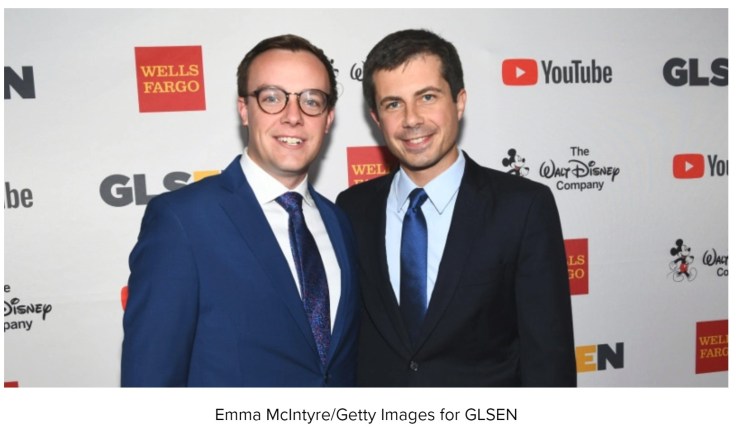
But so far only one LGBT candidate has expressed an interest in running: Pete Buttigieg, the mayor of South Bend, Indiana. Having reached 65,000 donors, Buttigieg has qualified for inclusion in the debates, should his exploratory run become an official one. And if that happens, expect Buttigieg to be a breakout star of the LGBTQ forum.
This is the first such HRC-hosted forum since 2007, when Barack Obama appeared alongside Hillary Clinton, John Edwards and others. Like the announced forum in October, that discussion, broadcast on Logo and attended by an LGBTQ-leaning crowd, centered around gay rights.
Twelve years has made a world of difference in that arena. Back then, a majority of candidates felt any advancements in LGBTQ rights should stop short of legalizing same-sex marriage, then only legal in Massachusetts.
Then Sen. Obama argued for a “strong version” of civil unions, saying, “My view is that we should try to disentangle what has historically been the issue of the word ‘marriage,’ which has religious connotations to some people, from the civil rights that are given to couples.”
In 2012, while campaigning for a second term in office, Obama came around to backing same-sex marriage.
Clinton, then a New York senator, took a similar stand, calling her opposition to same-sex marriage a “personal position” but insisting she believed “in equality.” She added: “How we get to full equality is the debate we’re having.”
After a decade opposing it, Clinton eventually voiced her support for same-sex marriage in 2013.
Only two long-shot candidates — Dennis Kucinich, then an Ohio congressman, and Mike Gravel, an Alaska senator from 1969 to 1981 — offered full-throated endorsements of same-sex marriage.
“When you understand what real equality is, you understand that people who love each other must have the opportunity to be able to express that in a way that’s meaningful,” Kucinich said to cheers.
Gravel, meanwhile, said the front runners were “playing it safe” and predicted same-sex marriage “will be a nonissue in the next presidential campaign in 2012.” In fact, it would remain hotly debated until the Supreme Court’s ruling on June 26, 2015, which held all state same-sex marriage bans to be unconstitutional.
LGBTQ issues were largely ignored or de-emphasized by Donald Trump in his 2016 presidential campaign — though Trump did make history by becoming the first Republican presidential nominee to mention LGBTQ rights in his acceptance speech.
Earlier that same year, however, after meeting with the anti-LGBTQ conservative think tank the Heritage Foundation, Trump voiced opposition to same-sex marriage and pledged to appoint justices to the Supreme Court who would reverse the “shocking” Obergefell v. Hodges decision that legalized it.
Since taking office, Trump — who chose Mike Pence, a strident opponent of civil liberties for LGBTQ citizens, as his vice president — is widely seen as having significantly set back LGBTQ rights and advancements in the U.S.
His administration has rolled back workplace protections for LGBTQ workers, scrapped census plans to study the LGBT population, eliminated AIDS research and treatment funding from the federal budget, and announced a ban on transgender personnel in the armed forces.
“Millions of LGBTQ people will have their rights on the ballot in 2020,” HRC president Chad Griffin said in a statement announcing the planned fall forum. “But today we are also a powerful voting bloc that will help determine the outcome. We’re excited to partner with UCLA Luskin and create an opportunity to hear candidates’ agendas for moving equality forward.”
Elizabeth Warren Pledges To Get Rid Of The Electoral College

By EMILY ZANOTT
At a town hall event in Mississippi, Sen. Elizabeth Warren (D-MA) pledged to avenge her predecessor candidate, Hillary Clinton, and do away with the Electoral College if she is elected President.
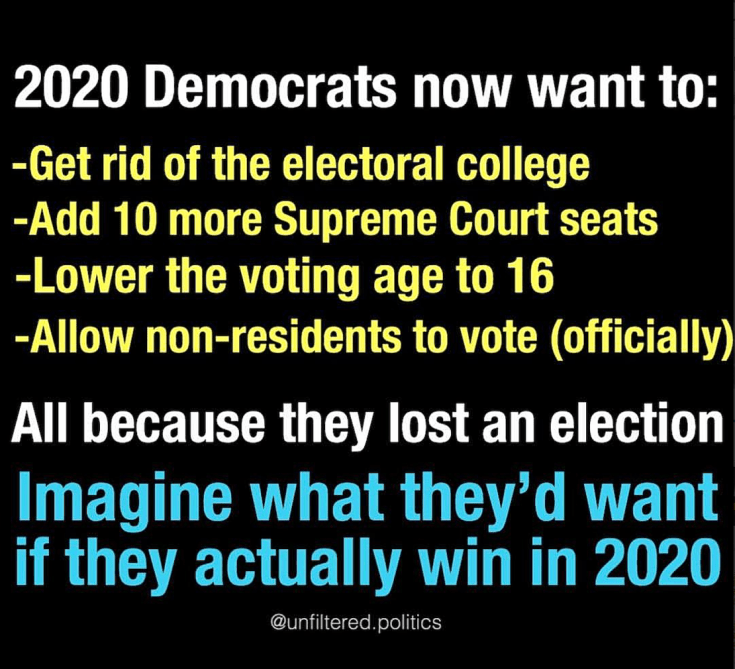
The plan to eliminate the Electoral College has caught fire among Democratic presidential hopefuls, and Warren is just the latest in a line of prospective nominees who want to replace the age-old system of allowing each state a certain number of votes proportional to their size and population with a “national popular vote” that will, of course, favor Democrats.
Warren, however, may have been the first to announce her plan in a state that would be cut out of the presidential process almost completely were the “national popular vote” system adopted.
Ironically, CNN reports, Warren announced her plan by suggesting that a national popular vote would make sure all Americans count equally in the process of electing a President.
“Come a general election, presidential candidates don’t come to places like Mississippi. They also don’t come to places like California or Massachusetts, because we’re not the battleground states,” she said. My view is that every vote matters and the way we can make that happen is that we can have national voting and that means get rid of the Electoral College — and every vote counts.”
Warren is right on one count: around 90% of electioneering takes place in 10 or 11 major battleground and swing states. But eliminating the Electoral College wouldn’t necessarily change the plan to win the presidency; it would merely change the select destinations.
Presidential candidates still would not go to “places like Mississippi” in the event of a national popular vote. Places like California (which Democrats do, in fact, visit, if only to collect checks from Hollywood bigwigs), New York, and Virginia would more than dominate electoral politics — they would, essentially, be able to exercise near-imperial rule over most other states.
That’s fine for Democrats, but not exactly fine for the people of Mississippi.
Warren’s plan also has other problems. Like a handful of more extreme Democratic proposals, promising to abolish the Electoral College is a bit like a fifth grader promising to make every day pizza day in the cafeteria as part of his platform for heading up the student council: it just isn’t going to happen without a major change in how party politics operates.
The Electoral College is enshrined in the Constitution and would require an amendment to alter, and an amendment involves calling a Constitutional convention (difficult), or obtaining 2/3 of the vote in both houses of Congress (nearly impossible). And although a handful of states have pledged to buck the Electoral College system and assign their Electors to the winner of the national popular vote, acting on those votes could trigger a firestorm of litigation and a potential Constitutional crisis.
Warren, though, seems pretty much willing to commit to any proposal that earns her even a fraction of a percent at this point. Trailing far behind the leaders, and unable to move her numbers above 7%, it looks as if her bid to become president is over just weeks after it started. In addition to the Electoral College, Warren has proposed support for reparations (though she isn’t sure what that looks like), and has tacitly endorsed packing the Supreme Court with additional judges.
And yet, none of these three extreme proposals has moved her any further up in the polls.
READ MORE: CONSTITUTION ELECTORAL COLLEGE ELIZABETH WARREN HILLARY CLINTON


REPORT: Beto Wrote A Weird Poem… ‘Oh, Sacred Cow, I Thirst For You, Provide Milk’
By

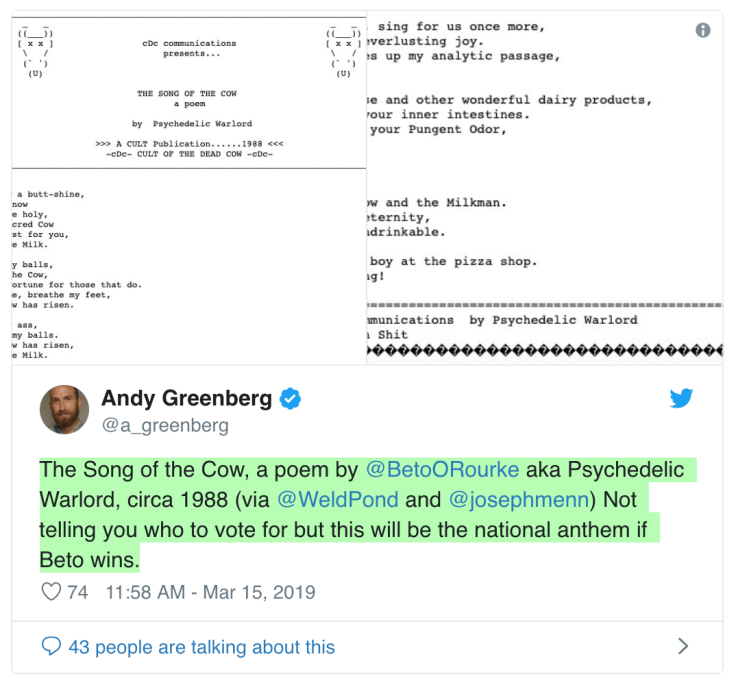
Democrat candidate Beto O’Rourke, formerly known by the moniker Psychedelic Warlord, is under fire for his role in the hacking group Cult of the Dead Cow. Now, some of his poetry is reportedly coming to light, including the poem, “The Song of the Cow.”
Beto’s team has not responded to our request for comment on the content of O’Rourke’s poem “The Song of the Cow.”
Reuters reported: “In an exclusive interview with this reporter for a forthcoming book about the group, the former U.S. congressman from Texas confirmed that as a youth in El Paso, he belonged to the hacking group known as the Cult of the Dead Cow. He also acknowledged that, during those teenage years, he stole long-distance phone service to participate in electronic discussions. Others in the group committed the same offense and got off with warnings; the statute of limitations ran out long ago. In the group, O’Rourke wrote online essays under the pseudonym “Psychedelic Warlord” that could provide fodder for political supporters and foes alike. One mocked a neo-Nazi, while another was a short piece of fiction from a killer’s point of view.”
Big League Politics reported: “Democrat Texas Senate candidate Beto O’Rourke played bass in a punk rock band called Foss with Cedric Bixler-Zavala, who went on to a career in rock music with other bands.
Bixler-Zavala recalls that Foss intentionally played badly in one gig to stick it to a host who “was a little on the Republican Christian side.” The host allegedly wanted to start an “all-white dude ranch.”
While the “all-white dude ranch” idea would be legitimately racist, assuming it happened, the fact that Bixler-Zavala pointed out the host’s “Republican Christian” viewpoint suggests that O’Rourke’s band was not a fan of these attributes. O’Rourke supports abortion, but the mainstream media is trying to push the narrative that numerous Christians will vote for him.
“A side effect of the GOP’s tweets is the renewed attention on the congressman’s old punk band, Foss. The spotlight on the band led many to dig up an old performance of theirs – one of their only publicly available – on a local El Paso cable access show called Let’s Get Real. The clip shows the young band – which included Bixler-Zavala on drums – stalling to start their set, then seemingly fumbling through what can best be described as an art-rock onslaught of distorted noise, much to the chagrin of the buttoned-up host. “We were just taking the piss out of the host,” Bixler-Zavala tells Remezcla over the phone. “The host was a little on the Republican Christian side, and he pulled us aside before taping and told us he wanted to start an all-white dude ranch,” he says, explaining the kind of bigotry they felt from the host and why the band ultimately decided to play around on stage rather than perform one of their actual songs.”
Remezcla passage ends
Here is video of the gig:
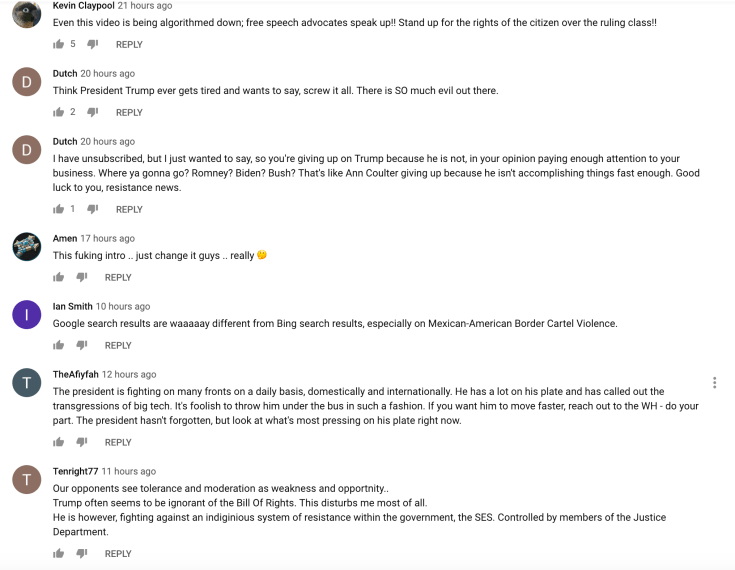
Independent Media Warns President Trump About Consequences Of Big Tech Censorship
Published on Mar 13, 2019
Mike Adams issues his own warning to President Trump about the consequences of idleness, ignorance, and apathy toward the MASSIVE issue of big tech’s coordinated censorship campaign against conservatives in the U.S., especially in relation to campaigning, voting, and political dialogues in general.
 Tom's Blog