Facebook, Google Pour Big Money into Lobbying Congress While Blacklisting Conservatives

CAP

By Sean Moran

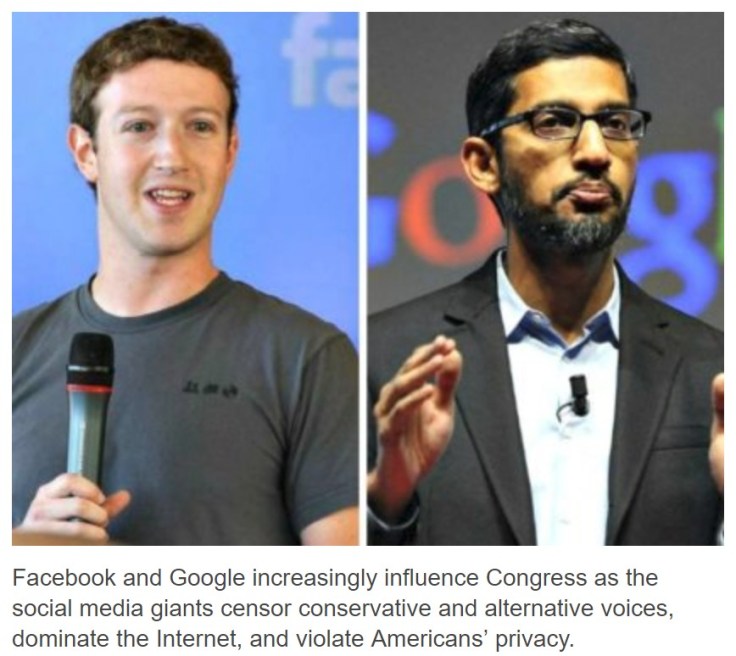
Facebook and Google increasingly influence Congress as the social media giants censor conservative and alternative voices, dominate the Internet, and violate Americans’ privacy.

Facebook announced on Thursday that they have banned several conservative personalities such as Infowars host Alex Jones, Infowars contributor and YouTube personality Paul Joseph Watson, journalist and activist Laura Loomer, and Milo Yiannopoulus. The social media giant also banned Louis Farrakhan from its platforms.

Facebook said that they banned these personalities because they were “dangerous.”

Amid calls for greater regulation of social media companies’ potential anticompetitive behavior, censorship of conservative and alternative voices, and privacy violations, Facebook and Google have remained at the top of Open Secret’s database of top spenders lobbying Congress.

So far in 2019, Facebook spent $3,400,000 and Google’s parent company, Alphabet, $3,530,00 in lobbying Congress. Alphabet also ranked as the eighth total highest spender in lobbying in 2018, spending $21,740,000, while Facebook spent $12,620,000.

Facebook’s influence has continued to rise over the years. In the early years of President Barack Obama, Facebook spent below one million dollars in 2008 and 2009. From 2011 to 2018, Facebook’s lobbying spending skyrocketed and reached historic highs in 2018, when they spent $12.6 million.

In 2019, Facebook lobbied heavily on H.R. 1644, the Save the Internet Act, a Democrat bill which would restore the Obama-era Federal Communications Commission (FCC) net neutrality regulations, which arose as the result of Google’s heavy lobbying of the Obama administration. In 2019, Google also lobbied on the Save the Internet Act.

See the source image

In 2018, one of Facebook’s bills on which they lobbied Congress was H.R. 2520, the Browser Act, sponsored by then Rep. and now Sen. Marsha Blackburn (R-TN), which would require social media companies such as Facebook and Google to obtain explicit permission from users for collecting their private data. The Browser Act would also stipulate that these social media companies cannot deny services to users who do not opt-in to these companies’ collection of their private data. In 2017, the Browser Act was the most important issue on Capitol Hill.

Sen. Blackburn said that her legislation would establish one set of rules that would balance the relationship between ISPs and Facebook and Google. The legislation would also prevent the social media giants from unfairly profiting off of Americans’ private data without their explicit consent.

“We need one set of rules for the entire internet ecosystem with the FTC [Federal Trade Commission] as the cop on the beat,” said Senator Blackburn. “The FTC has the flexibility to keep up with changes in technology and its principal mission is consumer protection. The BROWSER Act will enable consumers to make more educated decisions regarding the nature of their relationship with tech companies.”

In contrast, Alphabet’s most prominent issues in Congress in 2019 and 2018 related to labor and antitrust, as well as telecommunications and technology.

Facebook and Google’s dominance on the Internet has become increasingly apparent as Google has approximately 90 percent of web search traffic, whereas in digital advertising, Google and Facebook amount to nearly two-thirds of American digital ad spending, with Amazon at a “distant third” at under nine percent.

In 2018, Google lobbied Congress fourteen separate times on multiple pieces of legislation that would have increased liability for companies that enabled sex trafficking.

Facebook and Google’s influence in Congress extends to its trade group, the Internet Association. In the fourth quarter of 2018, the Internet Association spent $840,000. In total, the social media giants spent $2.6 million in 2018 for lobbying. In 2019, the association has spent $690,000 so far. Over the last two years, the Internet Association has focused on the Save the Internet Act as well as on legislation that would increase edge providers’ liability for hosting content that enables sex trafficking.

Facebook and Google influence political elections as well. During the 2018 election cycle, Alphabet donated:

  1. $223,269 to former Rep. Beto O’Rourke’s (D-TX) Senate campaign to unseat Sen. Ted Cruz (R-TX), a prominent critic of Silicon Valley censorship.

  2. $149,741 to Rep. Jacky Rosen’s Senate campaign (D-NV) to unseat Sen. Dean Heller (R-NV).

  3. $135,625 to Rep. Josh Harder’s congressional campaign.

  4. $124,508 to former Sen. Heidi Heitkamp’s unsuccessful re-election campaign.

  5. $97, 364 to former Sen. Claire McCaskill’s failed re-election campaign.

During the 2018 midterm elections, Facebook donated:

  1. $75,005 to O’Rourke’s Senate campaign.

  2. $37,954 to Sen. Doug Jones (D-AL) 2017 special Senate election against former Alabama judge Roy Moore.

  3. $34,534 to Heitkamp’s Senate election.

  4. $31,326 to McCaskill’s Senate campaign.

  5. $29,387 to Rosen’s successful campaign to unseat Heller.

As Facebook and Google and other social media giants continue to increasingly censor and blacklist conservative and alternative voices, more and more conservative voices have called for addressing the social media giants’ dominance of the Internet. Facebook and Google’s influence in Congress also relates to political confrontations; during a hearing in December 2018, the then-ranking member of the House Judiciary Committee delivered a sharp rebuke of Republican accusations of Google’s political bias affecting its search engines, even though Google was his top donor.

During a Senate Judiciary Committee hearing in April, Sen. Ted Cruz (R-TX) said  he envisions three potential remedies for big tech’s violation of free speech and dominance on the Internet.

Cruz’s three solutions include:

  1. Amending Section 230 of the Communications Decency Act
  2. Antitrust measures to address big tech’s dominant status on the Internet.
  3. Addressing potential cases of fraud and deception.

“No one wants to see the federal government regulating what is allowed to be said, but there are at least three potential remedies that can be considered by Congress or the administration or both,” Cruz said.
See the source image

NYC’s Nanny State Strikes Again, This Time They Are Coming For Hamburgers and Hot Dogs

By Jose Nino

According to Breitbart News, New York City’s recently passed “Green New Deal” will reduce the amount of red meat served in city-run facilities by half.

This program is being conducted in the name of battling climate change.

This “Green New Deal” is different from Alexandria Ocasio-Cortez’s proposal at the federal level.

This local Green New Deal will slowly reduce the purchase of red meat in public schools, hospitals, and correctional facilities by 2040. The end goal is to cut meat purchases by 50 percent. The total costs of this program are estimated to be around $14 billion.

Through its passage of this iteration of the Green New Deal, New York is the first city in the world to enact this kind of measure.

The municipal Green New Deal comes right after New York City’s announcement to expand “Meatless Monday” to all public schools in the area starting in the 2019-2020 school year.

Despite being separate legislation from Ocasio-Cortez’s Green New Deal, both proposals share an emphasis on reducing meat consumption.

A divided Congress and a Republican controlled White House makes it next to impossible to pass the Green New Deal at the federal level for the time being.

As a result, climate change alarmists are now taking a page from the gun control movement’s playbook.

They recognize that they can’t get their legislation passed at the federal level, so they’ll work from the bottom up in municipalities and state legislatures.

However, the conversation on the Green New Deal is far from finished.

BLP covered Robert Francis ‘Beto’ O’ Rourke’s recent endorsement of the Green New Deal, in which he urged Americans to make sacrifices that were reminiscent to those of WWII.

As the Democratic Party goes further Left, the Green New Deal will likely be a major litmus test issue for future candidates.

WATCH: SELF-LOATHING DEMOCRATS TRIGGERED TOP CANDIDATES ARE WHITE MALES

Watch: Self-Loathing Democrats Triggered Top Candidates Are White Males

‘Why do you think white, male candidates are doing better than any of the women candidates?’

Infowars.com – APRIL 26, 2019

This compilation video highlights mainstream media’s outrage over the Democratic Party’s overwhelming masculine whiteness, as four of the top seven 2020 Democrat presidential candidates are white males.

“Women have become somewhat overshadowed by white, male candidates,” said one MSNBC anchor.

Another MSNBC host added, “It bothers me a little bit that those are three white males, we need to talk about more diversity.”

https://www.infowars.com/watch-self-loathing-democrats-triggered-top-candidates-are-white-males/

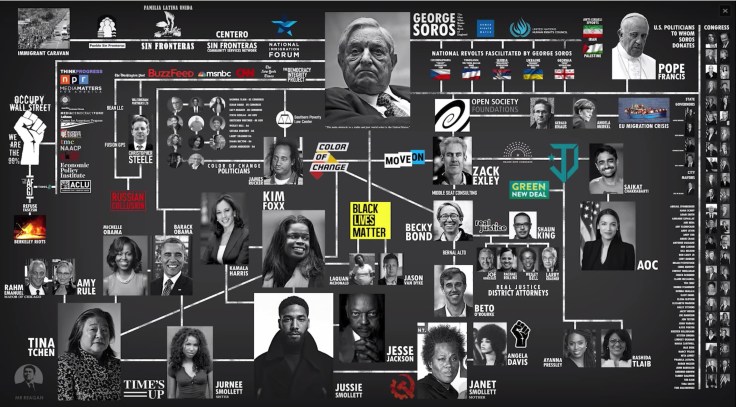
MUST WATCH: THE SOROS-SMOLLETT-AOC NETWORK EXPLAINED

CAP

Mr. Reagan is back with hard-hitting analysis deconstructing the anti-American Soros machine

Infowars.com – APRIL 16, 2019

YouTube commentator Mr. Reagan breaks down the intricate web of treachery, corruption, propaganda, and race-baiting helmed by none other than billionaire globalist and Nazi collaborator George Soros.


CAP

POLL SHOCK: BERNIE TAKES LEAD!

Screen Shot 2019-04-15 at 11.35.13 AM

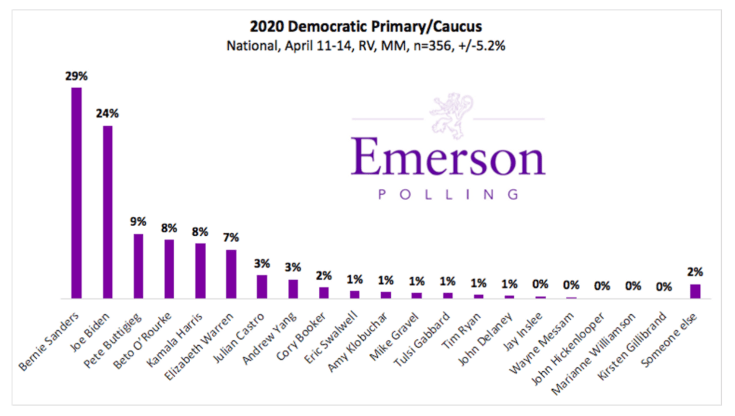
A new national Emerson poll, including 20 Democratic candidates for President, found Senator Bernie Sanders ahead of the pack with 29%, followed by former Vice President Joe Biden at 24%. They were followed by Mayor Pete Buttigieg at 9%, former Rep. Beto O’Rourke and Senator Kamala Harris at 8%, and Senator Elizabeth Warren at 7%.

Entrepreneur Andrew Yang and former HUD secretary Julian Castro were at 3%. The poll was conducted April 11-14 of Democratic Primary voters with a subset of n=356, +/- 5.2%.

Spencer Kimball, Director of Emerson Polling, said “while still early in the nominating process, it looks like Mayor Pete is the candidate capturing voters’ imagination; the numbers had him at 0% in mid-February, 3% in March and now at 9% in April.”

Kimball also noted that “Biden has seen his support drop. In February, he led Sanders 27% to 17%, and in March the two were tied at 26%. Now, Sanders has a 5 point lead, 29% to 24%.”

Screen Shot 2019-04-15 at 11.36.40 AM

If Joe Biden decides not to run, Bernie Sanders looks to be the early beneficiary, picking up 31% of Bidens’ voters. Mayor Pete Buttigieg gets 17% of the Biden vote, followed by Beto O’Rourke at 13%.

President Trump has seen his approval numbers nationally stay consistent in 2019 and is currently at 43% approval and 49% disapproval among voters (n=914, +/-3.2%), similar to last month’s numbers (43% to 50%). However, among Republican primary voters, Trump remains very popular and leads potential challenger, former Massachusetts Governor Bill Weld, 85% to 15% (n=324, +/-5.4%).

Screen Shot 2019-04-15 at 11.37.44 AM

In a head to head ballot test, Joe Biden appears the strongest opponent against Trump of the major Democratic candidates with a 53% to 47% advantage. This result is down 4 points from Emerson’s March poll, where Biden led Trump 55% to 45%. This general tightening is seen in the other head-to heads against other potential opponents: (n=914, +/-3.2%)

  • Biden 53%, Trump 47%
  • Sanders 51%, Trump 48%
  • O’Rourke 51%, Trump 49%
  • Harris 50%, Trump 50%
  • Buttigieg 49%, Trump 51%
  • Warren 48%, Trump 52%

Taxes

As of April 14, 2019, 73% of voters said they had filed their federal income tax returns, 17% plan to get them in on time and 4% have asked for an extension. 6% do not plan on filing returns.

36% of those who have filed their taxes say they are paying more compared to last year, with 29% saying they are paying less, and 35% saying they are paying about the same.

Of those who said they were receiving a tax return this year, 41% said they plan to use it to pay off debt, 31% plan to save it, and 13% will spend the money on enjoyment.

Campaign Issues

  • 47% of voters support building a wall on the US-Mexico Border, 45% oppose, 8% are undecided.
  • 41% of voters do not think large tech giants like Apple, Amazon, Facebook and Google should be broken up, 29% think they should be broken up, and 31% are undecided.
  • 43% of voters do not support American intervention in Venezuela to overthrow the Maduro Regime, 27% do support American intervention, 31% were unsure.
  • 55% of voters do not think individuals currently incarcerated should have the right to vote, 30% believe those incarcerated should be able to vote , and 15% are undecided on this issue.
  • 65% of voters think that felons who completed their prison sentences should have the right to vote, 23% do not, and 12% are undecided.

Unlikely Voter

Voters who did not plan to vote in either party primary/caucus were asked why they were not planning on voting, 16% said lack of interest, 12% said they don’t like any of the candidates, 11% said it was too hard to vote, 6% said a lack of time, and 55% responded that it was for some other reason that they do not plan to vote in the primaries.

Caller ID

The national Emerson College poll was conducted April 11-14, 2019 under the Supervision of Professor Spencer Kimball. The sample consisted of registered voters, n=914, with a Credibility Interval (CI) similar to a poll’s margin of error (MOE) of +/- 3.2 percentage points. The data was weighted based on a 2016 voter model of gender, age, party affiliation, region and ethnicity. It is important to remember that subsets based on gender, age, party breakdown, ethnicity and region carry with them higher margins of error, as the sample size is reduced. Data was collected using both an Interactive Voice Response (IVR) system of landlines only (n=599) and an online panel provided by Amazon Turk (n=315). Visit our website at ​www.emersonpolling.com​.

Follow us on Twitter ​@EmersonPolling

Blog at WordPress.com.

Up ↑