Anti-Defamation League Admits Colluding with Tech Giants to Facilitate Big Brother Censorship

CAP

This organization that foments hate against conservatives is doing everything in its power to manifest the Orwellian Nightmare.

By 

With pro-Trump voices being booted from Facebook and the social media crackdown ramping up before 2020, the Anti-Defamation League (ADL) is bragging about the legwork they have done to build up to this moment.

The ADL, once considered an admirable pro-Jewish organization that combated anti-Semitism, has turned into a partisan political censor facilitating Big Brother and trying to stifle President Donald Trump’s ‘America First’ agenda.

They admitted as much during a summit with the uber-globalist Council on Foreign Relations earlier this year where the organization’s leader bragged about enabling the tech giants’ push for extreme Draconian censorship.

“We work with Google on using AI to try and interrupt cyber-hate before it happens,” said Jonathan A. Greenblatt, Chief Executive Officer and National Director of the ADL, about his organization’s trailblazing work in the field of Orwellian pre-crime.

“We work with YouTube to get them to change their algorithms so it lessens the likelihood that a young person is going to run into some of these anti-Semitic conspiratorial videos,” he added.

Greenblatt brought up Facebook specifically and how the ADL enables the tech giant’s ability to manipulate information for the purposes of combating alleged hate. He deployed double-speak to justify his organization’s anti-constitutional push.

“So there are different ways [Facebook] can tweak their algorithms and adjust their products so they think not only about free speech… but protect the user’s right to not be harassed or hated,” he said.

He was particularly laudatory toward Facebook in how they were a front-runner in leading the charge toward Big Brother.

“They have done some good things to deal with very specific cases by taking swifter action when people perpetrate online bullying or online harassment,” Greenblatt said.

He feels that legislators should take further action in passing bills that would further destroy freedom of expression and other core liberties.

“There is a gap in the legal regime. There are techniques that extremists have used online to terrorize Jews and other people like doxing, and swatting and different forms of cyberbullying that are not covered by existing laws and need to be,” Greenblatt said.

He doesn’t seem particularly considered with left-wing terror groups like ANTIFA deploying these harmful tactics though. Democratic leaders like Reps. Ilhan Omar (D-MN) and Rashida Tlaib (D-MI) do not seem to be on his organization’s radar. Instead, his focus is entirely on restricting the speech of conservative and right-wing voices.

Greenblatt concluded by saying that “the abuse online can be far, far worse than anything physical” and that “we need legislators to catch up and fill some of the gaps.”

While the fake news media likes to ballyhoo about the Rooskies, it is organizations like the ADL that pose the real threat to the integrity of our democracy.

(CENSORSHIP) – Poynter Wants 515 Outlets Blacklisted, Including Breitbart Leaves Out All Corporate Media Behind Dangerous Hoaxes… …Vast Majority of Blacklist Compiled by One Assistant Prof

Screen Shot 2019-05-01 at 10.13.07 AM

By John Nolte

Poynter Institute claims on its About page that “it champions freedom of expression.” And yet, on another page, Poynter published a list of 515 media sites, including Breitbart News, that it wants blacklisted and shut down.

Poynter calls this list an “index of unreliable news sites” and is openly calling for advertisers to stop sponsoring these sites, to pull their sponsorship, to put these sites out of business.

If that’s not a blacklist, tell me what is [emphasis added]:

Advertisers don’t want to support publishers that might tar their brand with hate speech, falsehoods or some kinds of political messaging — but too often, they have little choice in the matter.

Most ad-tech dashboards make it hard for businesses to prevent their ads from appearing on (and funding) disreputable sites. Marketers can create blacklists, but many of those lists have been out-of-date or incomplete.

Aside from journalists, researchers and news consumers, we hope that the UnNews index will be useful for advertisers that want to stop funding misinformation.

This is straight-up McCarthyism. This is nothing less than the return of the 1950s’ blacklisting crusade against those who hold inappropriate, unacceptable, and unapproved opinions.

And what’s more, the lion’s share of the list cites a single source — “OpenSources,” a list curated by a single Assistant Professor from Merrimack College, Melissa Zimdars (pictured). She is the author of academic papers such as “Watching Our Weights: The Consequences and Contradictions of Televising Fatness in the ‘Obesity Epidemic’” and “Having It Both Ways: ‘Two and a Half Men,’ ‘Entourage’ and the Televising of Juvenile Postfeminist Masculinity.”

What is Zimdars’s methodology? Can’t say, exactly, as the OpenSources official site is totally blank. About two years ago, she gave an interview where she said that one of her criteria for blacklisting a site is “hate” — that is, she still believes the far-left SPLC is a credible organization whose “hate” labels should get you kicked out of public discourse.

Those of you who suddenly approve of blacklisting will argue, “Hey, this is how democracy works! A private company has the right to do or not do business with whoever they want!”

Well, how the hell do you think the 1950s’ blacklist worked? That was nothing more than private companies (movie studios, advertising sponsors) and private individuals (studio heads, producers) deciding all on their own whom they did and did not want to do business with.

Nevertheless, we rightly look back on this dark era with disgust, as an un-American era where people were persecuted and silenced (by private corporations and private individuals) for holding ideas and opinions the powerful establishment did not want shared or discussed.

And now, the 1950s’ blacklist has returned with a vengeance because the establishment media are fighting for advertising dollars and have lost their moral authority and ability to influence public opinion due to outlets like this one and the Media Research Center, Pajamas Media, Washington Examiner, The Daily Wire, The Blaze, Red State, Project Veritas, Newsmax, Zero Hedge, LifeSite, Judicial Watch, Frontpage, The Washington Free Beacon, The Daily Caller, and the Drudge Report — all of which are on Poynter’s blacklist — exposing their lies and biases, and…

Just as the blacklisters did during the McCarthy era, they are trying to silence us by targeting our advertising sponsors.

Sure, just as some of those people targeted in the 1950s were actual communists looking to do our country harm, there are some legitimate bad faith players on Poynter’s blacklist. But here’s where Poynter’s blacklist gets especially sinister…

There is no one on Poynter’s list of “unreliable news outlets” responsible for spreading the biggest, most irresponsible and dangerous lies of the last half-decade — lies that have caused race riots and destroyed innocent lives.

In other words, the outlets Poynter does not want blacklisted are every bit as revealing as those Poynter does want blacklisted.

There is simply no question that for over five years, CNN, the New York Times, the Washington Post, NPR, ABC, CBS, PBS, NBC, MSNBC, Politico, BuzzFeed, etc., have relentlessly and deliberately misled the American people on the biggest stories of the day…

  • The Trayvon Martin Hoax

  • The Hands Up, Don’t Shoot Hoax

  • Donald Trump Can’t Win

  • The Russia Collusion Hoax

  • The Brett Kavanaugh Serial Rapist Hoax

  • The Covington High School Boys Hoax

And yet, every outlet I listed above that are part of Poynter’s blacklist either got these stories 100 percent correct, as Breitbart News did, or was at least skeptical of them.

But we are the ones these so-called “champions of free expression” are openly calling to be blacklisted, not those who have relentlessly and deliberately lied to the public for more than a half-decade.

Which proves this is not a blacklist targeting the unreliable, but a blacklist targeting those who hold ideas the un-American Poynter finds inappropriate and unacceptable.

How else to explain why Poynter wants the Media Research Center blacklisted for bias but not Media Matters?

The Poynter Institute is nothing less than a non-profit version of Joseph McCarthy, Father Coughlin, and Big Brother.

Project Veritas Slams Twitter Execs’ Spying Claims

See the source image

Jack Dorsey, Vijaya Gadde claim direct messages aren’t monitored

Thursday, March 07, 2019

Twitter founder Jack Dorsey and chief legal officer Vijaya Gadde told podcast host Joe Rogan that direct messages on the social media site are not monitored — a claim challenged by investigative journalist James O’Keefe of Project Veritas.

When asked by Rogan if company employees “read direct messages,” Dorsey replied, “We don’t read direct messages.”

Gadde followed up, explaining that the only direct messages read by employees are those which have been reported to Twitter support.

Rogan pressed further, asking if it was possible for Twitter employees to intentionally peruse a user’s direct messages.

“I don’t think so,” Gadde replied.

However, according to multiple Twitter engineers who discussed the subject of direct messages with undercover Project Veritas journalists, Dorsey and Gadde may have been misleading with their answers, at best.

“There’s teams dedicated to it [reading direct messages],” said Clay Haynes, a senior network security engineer at Twitter. “I mean, we’re talking… at least three or four hundred people… they’re paid to look at dick pics.”

“It is creepy Big Brother.”

Pranay Singh, a direct messaging engineer, revealed that all content shared on the platform — including private messages — are stored on Twitter servers for analytical and advertising purposes.

“So all your sex messages and your dick pics are on my server now,” Singh said. “Everything. Anything you post online.”

“A machine is going to look at it. An algorithm will look at it, and they’ll make a virtual profile about you.”

Watch the full exchange here.

MAJOR AIRLINES ADMITTING INFLIGHT DISPLAYS HAVE CAMERAS

Major Airlines Admitting Inflight Displays Have Cameras

Eye-level camera gazes at passenger during flight

 | Infowars.com – FEBRUARY 26, 2019

Cameras facing passengers are embedded in inflight entertainment (IFE) screens, three major airlines are confirming.

However, United, American, and Singapore Airlines also claim they have no plans to use the camera that is reportedly a standard feature of the IFE manufacturer, but a privacy watchdog says it shouldn’t be there.

“If airlines aren’t using the cameras, they shouldn’t be there,” said the director of Big Brother Watch. “Passengers shouldn’t have to worry about whether secret cameras are on or off, whether they’re being recorded, or whether the cameras could be hacked.”

“It appears that these airlines haven’t considered the privacy and security risks to their customers, or justified the presence of these cameras.”

The outcry began a week ago after a Singapore Airlines passenger noticed the eye-level lens and asked the carrier what it was doing there.

Screen Shot 2019-02-27 at 10.07.09 AM

Responding to the tweet, the airline said the camera is part of a new system provided by the manufacturer and there are “no plans to enable or develop any features using the cameras.”

Correspondingly, American and United Airlines issued separate but similar statements on the matter.

“This is a standard feature that manufacturers of the system have included for possible future purposes such as video conferencing,” said a United spokesperson. “However, our cameras have never been activated on United aircraft and we have no plans to use them in the future.”

The maker of the IFE system, Panasonic Avionics, acknowledged the outrage by saying they were in compliance with the EU’s data protection law called General Data Protection Regulation (GDPR).

“Prior to the use of any camera on a Panasonic Avionics system that would affect passenger privacy, Panasonic Avionics would work closely with its airline customer to educate passengers about how the system works and to certify compliance with all appropriate privacy laws and regulations, such as GDPR,” said a spokesperson.

Interestingly, Panasonic is tied to the creation of a floor lamp that sparked privacy concerns due to the security camera it possesses.


Ooops! Google admits it forgot to tell users about its hidden spy microphone

Screen Shot 2019-02-20 at 2.46.18 PM

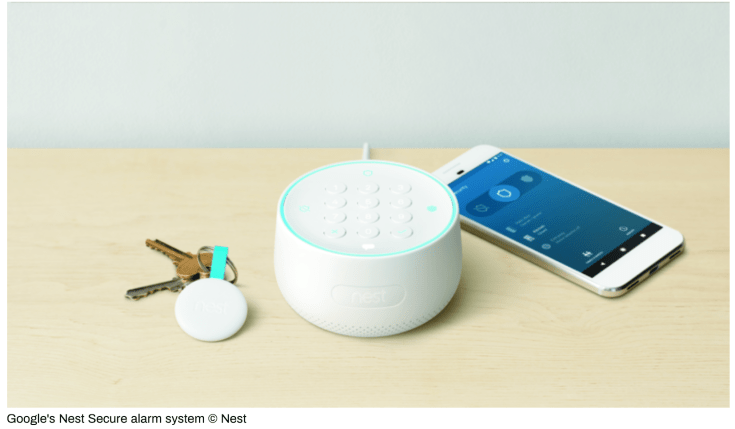
All-powerful tech giant Google has apologized for forgetting to tell users that it’s Nest Secure home security system had a built-in microphone. Nothing to see here, guys!

Google’s Nest Secure system allows users to connect dozens of motion detectors, magnetic door alarms and security cameras to a centralized control unit. The unit monitors the user’s home, sending alerts if anything is amiss. Its initial tech specifications mentioned nothing about the potential spy devices hidden inside.

Naturally, Google caused a stir when it announced earlier this month that owners could use their Nest Secure hub to ask Google Assistant questions like “activate my alarm,” “do I need an umbrella today?,” or “are you spying on my every move?”

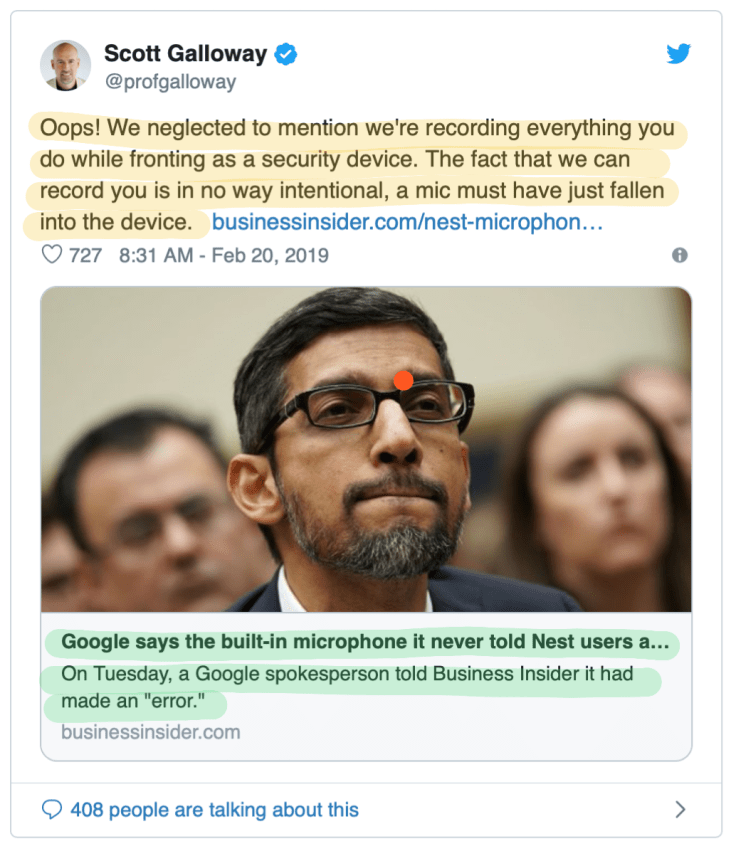
Even after announcing the Google Assistant integration, the company didn’t mention the hidden microphone. Only after an outcry from suspicious users and privacy advocates did Google admit that, yes, Nest Secure had a built-in microphone all along, and no, it’s not a big deal.

“The on-device microphone was never intended to be a secret and should have been listed in the tech specs. That was an error on our part. The microphone has never been on and is only activated when users specifically enable the option,”Google said.

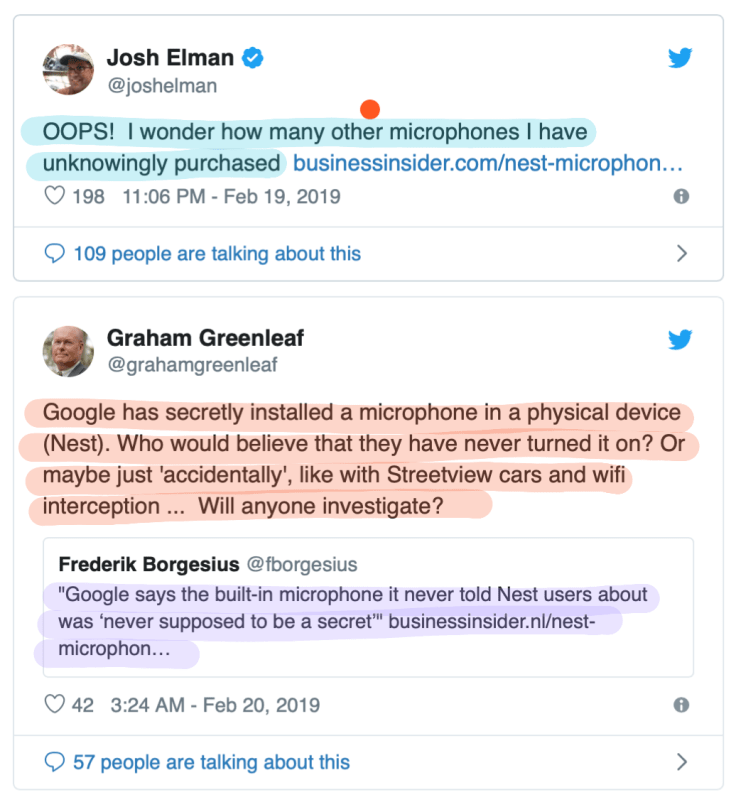
The tech giant has since amended the device’s tech specs to include the mic. However, privacy advocates and those afraid of inviting Big Brother into their bedrooms weren’t buying Google’s explanation.

Screen Shot 2019-02-20 at 2.55.29 PM

Screen Shot 2019-02-20 at 2.58.40 PM

Even if neglecting to tell users about the microphone before enabling it with an online update were somehow totally cool, who would trust Google with that kind of access to their homes?

After all, this is the same Google whose Street View cars “accidentally” stored data from WiFi networks they drove past between 2007 and 2010. It’s also the same Google whose sister company installed thousands of free WiFi kiosks throughout New York City that potentially tracked users’ movements; and the same Google that uses facial recognitiontech on users without consent.

Perhaps most terrifying is an internal video leaked from Google last year, describing a future in which Google hoards user data and uses it to push those users towards behavior that “reflects Google’s values.”

Google claimed the video –which the public was never intended to see– was designed to “provoke discussion and debate,” and was “not related to any current or future products.”  

But they were totally going to tell you about the microphone some day, swear.

Think your friends would be interested? Share this story!

Blog at WordPress.com.

Up ↑