
Premiered 3 hours ago

HighImpactFlix
Published on Jan 21, 2019
By Finian Cunningham
Spearheading the media effort to defenestrate Trump are the New York Times and Washington Post. Both have been prominent purveyors of the “Russiagate” narrative over the past two years, claiming that Republican candidate colluded with Russian state intelligence, or at least was a beneficiary of alleged Russian interference, to win the presidency against Democratic rival Hillary Clinton.
Congressional investigations and a probe by a Special Counsel Robert Mueller, along with relentless media innuendo, have failed to produce any evidence to support the Russiagate narrative.
Now, the anti-Trump media in alliance with the Democratic leadership, the foreign policy establishment and senior ranks of the state intelligence agencies appear to have come up with a new angle on President Trump – he is a national security risk.
Ingeniously, the latest media effort lessens the burden of proof required against Trump. No longer has it to be proven that he deliberately collaborated with Russian President Vladimir Putin. Trump could have done it “unwittingly,” the media are now claiming, because he is a buffoon and reckless. But the upshot, for them, is he’s still a national security risk. The only conclusion, therefore, is that he should be removed from office. In short, a coup.
Over the past couple of weeks, the supposed media bastions have been full of it against Trump. An op-ed in the New York Times on January 5 by David Leonhardt could not have made more plain the absolute disdain. “He is demonstrably unfit for office. What are we waiting for?”
Follow-up editorials and reports have piled on the pressure. The Times reported how the Federal Bureau of Investigation – the state’s internal security agency – opened a counterintelligence file on Trump back in 2017 out of concern that he was “working for Russia against US interests.”

That unprecedented move was prompted partly because of Trump’s comments during the election campaign in 2016 when he jokingly called on Russia to release Hillary Clinton’s incriminating emails. Never mind the fact that Russian hackers were not the culprits for Clinton’s email breach.
Then the Washington Post reported former US officials were concerned about what they said was Trump’s “extraordinary lengths” to keep secret his private conversations with Russia’s Putin when the pair met on the sidelines of conferences or during their one-on-one summit in Helsinki last July.
The Post claimed that Trump confiscated the notes of his interpreter after one meeting with Putin, allegedly admonishing the aide to not tell other officials in the administration about the notes being sequestered. The inference is Trump was allegedly in cahoots with the Kremlin.
This week, in response to the media speculation, Trump was obliged to strenuously deny such claims, saying: “I have never worked for Russia… it’s a big fat hoax.”
What’s going on here is a staggering abuse of power by the US’ top internal state intelligence agency to fatally undermine a sitting president based on the flimsiest of pretexts. Moreover, the nation’s most prominent news media outlets – supposedly the Fourth Estate defenders of democracy – are complacently giving their assent, indeed encouragement, to this abuse of power.
The Times in the above report admitted, in a buried one-line disclaimer, that there was no evidence linking Trump to Russia.
Nevertheless, the media campaign doubled down to paint Trump as a national security risk.
The Times reported on January 14 about deep “concerns” among Pentagon officials over Trump’s repeated threats to withdraw the US from the North Atlantic Treaty Organization (NATO). The reporting portrays Trump as incompetent, ignorant of policy details and habitually rude to American allies. His capricious temper tantrums could result in the US walking away from NATO at any time, the newspaper contends.
Such a move would collapse the transatlantic partnership between the US and Europe which has “deterred Soviet and Russian aggression for 70 years,” claimed the Times.
The paper quotes US Admiral James Stavridis, the former supreme allied commander of NATO, calling Trump’s withdrawal whims “a geopolitical mistake of epic proportion.”
“Even discussing the idea of leaving NATO — let alone actually doing so — would be the gift of the century for Putin,” added Stavridis.
The Times goes on to divulge the media campaign coordination when it editorialized: “Now, the president’s repeatedly stated desire to withdraw from NATO is raising new worries among national security officials amid growing concern about Mr Trump’s efforts to keep his meetings with Mr Putin secret from even his own aides, and an FBI investigation into the administration’s Russia ties.”
Still another Times report this week reinforced the theme of Trump being a national security risk when it claimed that the president’s Middle East policy of pulling troops out of Syria was “losing leverage” in the region. It again quoted Pentagon officials “voicing deepening fears” that Trump and his hawkish National Security Advisor John Bolton “could precipitate a conflict with Iran”.
That’s a bit hard to stomach: the Pentagon being presented as a voice of sanity and peace, keeping vigilance over a wrecking-ball president and his administration.
READ MORE: Twitter erupts after NYT reveals FBI probe into Trump-Russia links that lead… nowhere
But the New York Times, Washington Post and other anti-Trump corporate media have long been extolling the military generals who were formerly in the administration as “the adults in the room.”
Generals H.R. McMaster, the former national security adviser, John Kelly, Trump’s ex-chief of staff, and James Mattis, the former defense secretary until he was elbowed out last month by the president, were continually valorized in the US media as being a constraining force on Trump’s infantile and impetuous behavior.
The absence of “the adults” seems to have prompted the US media to intensify their efforts to delegitimize Trump’s presidency.
A new House of Representatives controlled by the Democratic Party has also invigorated calls for impeachment of Trump over a range of unsubstantiated accusations, Russian collusion being prime among them. But any impeachment process promises to be long and uncertain of success, according to several US legal and political authorities.
Such a tactic is fraught with risk of failing, no doubt due to the lack of evidence against Trump’s alleged wrongdoing. A failed impeachment effort could backfire politically, increase his popularity, and return him to the White House in 2020.

Given the uncertainty of impeaching Trump, his political enemies, including large sections of the media establishment, seem to be opting for the tactic of characterizing him as a danger to national security, primarily regarding Russia. Trump doesn’t have to be a proven agent of the Kremlin – a preposterous idea. Repeated portrayal of him as an incompetent unwitting president is calculated to be sufficient grounds for his ouster.
When the Washington Post editorial board urges a state of emergency to be invoked because of “Russian meddling in US elections”, then the national mood is being fomented to accept a coup against Trump. The media’s fawning over the Pentagon and state intelligence agencies as some kind of virtuous bastion of democracy is a sinister signal for a military-police state.
Think your friends would be interested? Share this story!
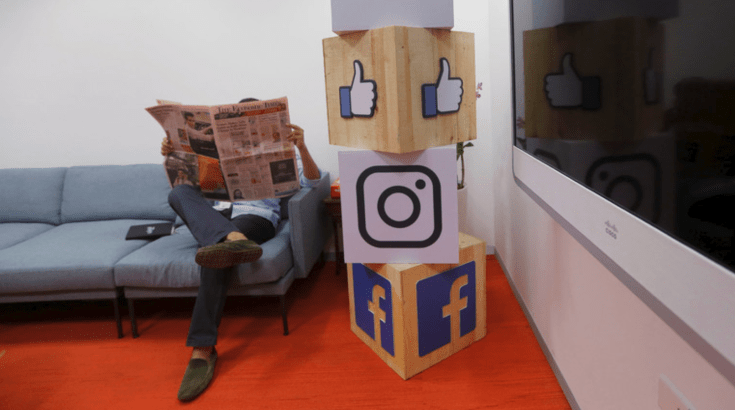
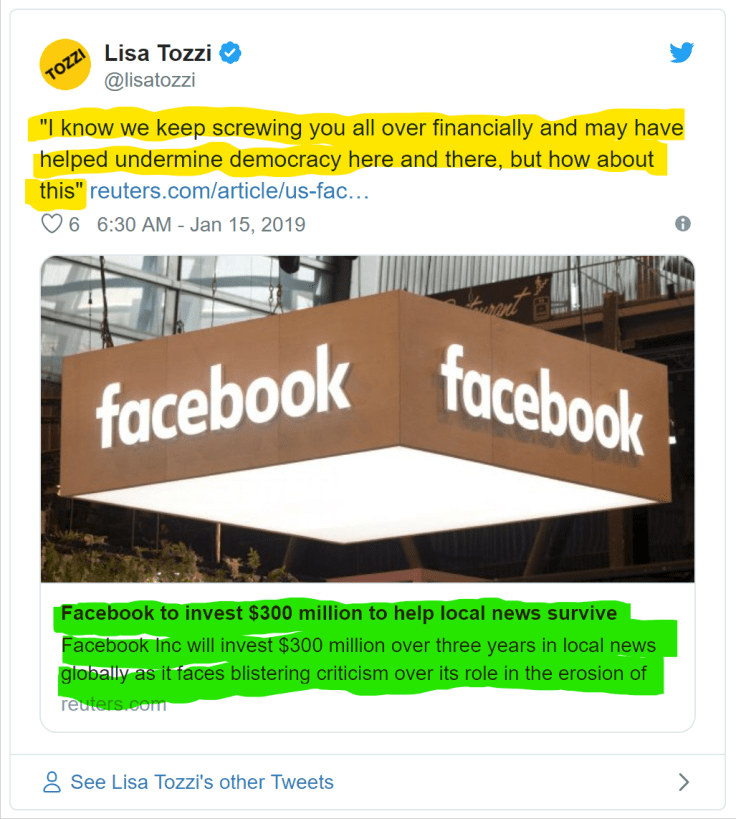
With print newspapers’ advertising revenues in freefall for almost two decades, and local newspapers conglomerating and laying off staff to survive, the industry will take any help it can get. Facebook – with its mountains of fake news, clickbait, and a tricky environment for digital publishers to make money in – has in no small way contributed to the precarious state of modern journalism, but the company now wants to give the fourth estate a booster shot.
The company decided to focus specifically on local news. Vice President of Global News Partnerships Campbell Brown said in a blog post that after examining what kind of news people want to see on Facebook, the company “heard one consistent answer: people want more local news, and local newsrooms are looking for more support.”
Facebook’s support for the new industry has thus far been limited to funding a small selection of news programs from CNN, Fox News, and a handful of others. The social media giant has been far more keen to play policeman, partnering up with an array of third-party “fact checkers”last year to filter out “false narratives” and “intentionally divisive headlines and language that exploit disagreements and sow conflict”from users’ timelines.
Troublingly, even Facebook’s own staff could not explain what exactly the term “false narratives” meant. Additionally, Facebook CEO Mark Zuckerberg met with a consortium of media executives shortly afterwards to talk about his company’s use of algorithms to promote ‘reputable news’ and suppress other content, all to ensure that “people can get trustworthy news on our platform.”
Drawn from CNN, the New York Times, Buzzfeed and others, the overwhelmingly liberal makeup of the panel of executives did little to persuade conservatives – who have long accused the platform of bias – that Facebook would act impartially.
Neither did Facebook’s announcement in August that it would partner up with the aggressively pro-NATO think tank, the Atlantic Council. The Atlantic Council vowed to serve as Facebook’s “eyes and ears” in the fight against fake news, but that fight resulted in hundreds of alternative news pages being purged from the platform in October. The 800 pages spanned the political spectrum, and their removal triggered cries of censorship and accusations that Facebook was waging “a wider war on dissident narratives.”
One banned cartoonist declared Facebook to be “land of the censorship and home of the fake,” while anti-war journalist Caitlin Johnstone called the purge the “latest escalation of corporate censorship used as state censorship in the West.”
Can Facebook then be trusted to fund local journalism?
The answer is unclear. The $300 million will be given to a number of organizations to distribute further. Some of these organizations, like the Pulitzer Center, are household names. Others, like Report for America, are less well known. The Pulitzer Center will receive $5 million to award as grants to local newsrooms around the country, and social justice non-profit Report for America will get $2 million to go towards the hiring of 1,000 journalists over the next five years.
Pulitzer Center founder and executive director Jon Sawyer welcomed the funding, and took time to “applaud Facebook’s commitment to the editorial independence that is absolutely essential to our success.”
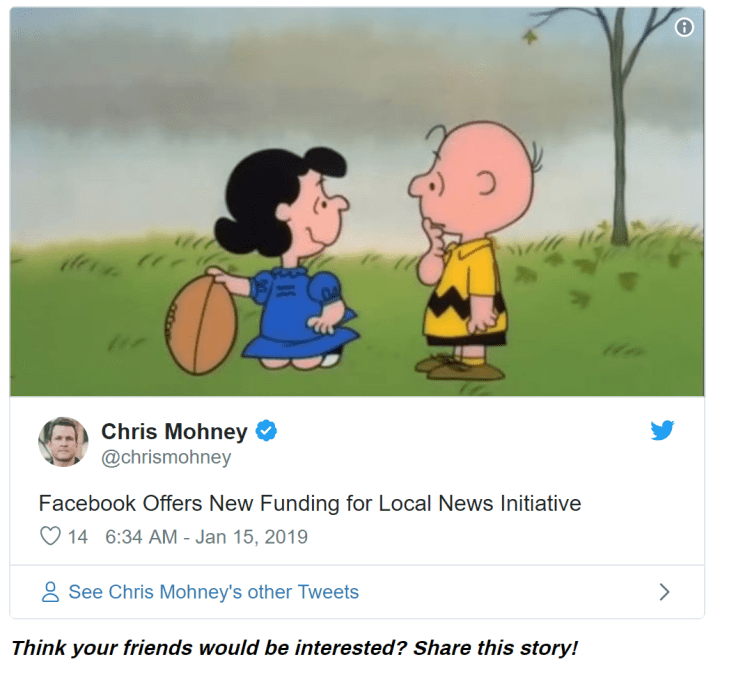
No matter how hands-off Facebook stays, some commentators were angered by the company’s new-found role as champion of the local press. After contributing in a large way to the decline of print media, Facebook’s $300 million investment in the industry is, as one cartoon implied, “peanuts.”

By Katherine Rodriguez
House Minority Leader Kevin McCarthy (R-CA) announced Monday that the Republican Steering Committee voted not to give King any committee assignments in the current session of Congress.
McCarthy, in his statement announcing the decision, called King’s comments “beneath the dignity of the Party of Lincoln and the United States of America.”
“Steve’s remarks are beneath the dignity of the Party of Lincoln and the United States of America. His comments call into question whether he will treat all Americans equally, without regard for race and ethnicity,” McCarthy said in a statement.
“House Republicans are clear: We are all in this together, as fellow citizens equal before God and the law. As Congressman King’s fellow citizens, let us hope and pray earnestly that this action will lead to greater reflection and ultimately change on his part,” McCarthy added.
In the previous session of Congress, King had served on the House Agriculture, Judiciary, and Small Business committees. He also chaired the House Judiciary Subcommittee on the Constitution and Civil Justice and was on his way to becoming a ranking member of that committee in the current session before the Steering Committee’s vote.
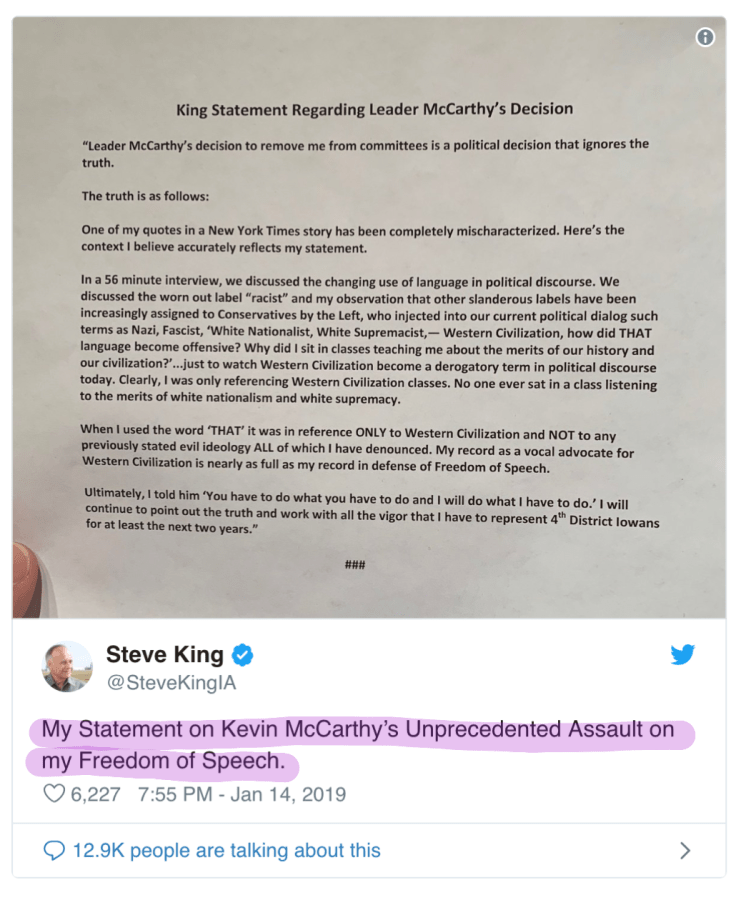
The Iowa Republican decried the committee’s decision as a “political decision that ignores the truth,” adding that the committee misinterpreted his remarks:
King faced pushback on Thursday after he told the Times that he raised questions about why the terms “white nationalist” and “white supremacist” are considered offensive.
His comments caused an uproar, prompting Senate Majority Leader Mitch McConnell (R-KY) to call his remarks “unworthy” of the office he holds.
“If he doesn’t understand why ‘white supremacy’ is offensive, he should find another line of work,” McConnell said.
King released a statement clarifying his comments soon after the Times article went live, stating that the Times‘ assumption that he was “an advocate for white nationalism” was incorrect.

King also “condemned” people who support bigotry and rejected “those labels and the evil ideology that they define.
The lawsuit, filed on Thursday in California, claims that the board failed in its duty to shareholders by approving big severance payouts to executives who left the company, while keeping details of their alleged sexual misconduct under wraps.
Among the defendants named in the lawsuit by shareholder James Martin are Google’s co-founders Larry Page and Sergey Brin, as well as former CEO Eric Schmidt, who were all on the board’s audit and compensation committees that approved the payouts.

Last October, Google revealed to its employees that it had dismissed 48 people for sexual harassment over the past two years, without payouts. Martin’s lawsuit, however, focuses on millions paid to two executives – Andy Rubin and Amit Singhal – who were both accused of sexual misconduct.
Rubin left Alphabet in 2014 with a four-year $90 million payout. He was the creator of the Android mobile operating system and ran the company’s mobile division. The reasons for his departure were a mystery until a New York Times report in October accused him of sexual misconduct with a female staff member, which the paper said was covered up by Google.
ALSO ON RT.COMGoogle CEO sends out sex harassment damage control memoAnother executive, Amit Singhal, left Alphabet in 2016 in a similar fashion, also amid sexual harassment claims, the lawsuit says.
The Times report caused widespread anger among Alphabet staff, with thousands of employees staging walkouts at Google offices around the world. Commenting on Martin’s lawsuit, some of the staff involved in organizing the October walkout released a statement Thursday, slamming the Google board for not having the employees’ “best interests at heart.”
“Google’s culture of racism, discrimination, and sexual harassment is not the result of a few individual bad actors — it’s built into how the system works, and won’t be fixed without structural change,” they wrote.
Any damages Martin is seeking will be directed back to Google, as his objective is to reform Alphabet’s corporate governance, his attorney Louise Renne told Bloomberg.
Like this story? Share it with a friend!

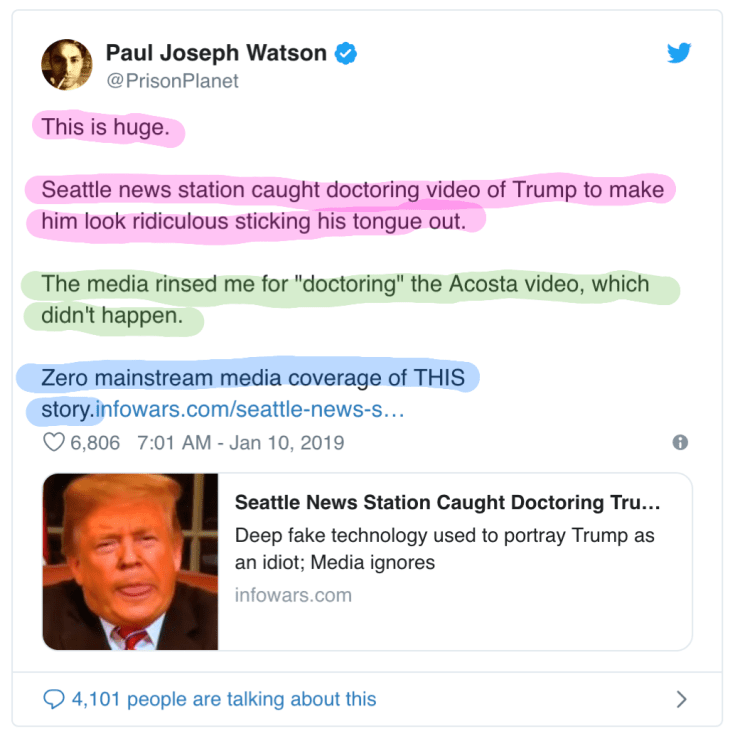
In a side-by-side comparison, Q13 Fox in Seattle appears to have edited its coverage of Trump’s address, turning the president’s skin color a ludicrous shade of orange. In between sentences, the station seems to have doctored the footage to show Trump sticking out his tongue and licking his lips.
“We are investigating this to determine what happened,” said Q13’s news director. “This does not meet our editorial standards and we regret if it is seen as portraying the President in a negative light. The editor responsible for editing the footage is being placed on leave while we investigate further.”
Faking video footage has become easy in recent years, thanks to the widespread availability of video editing software. A combative press conference debate between CNN anchor Jim Acosta and President Trump in November put the issue in the spotlight, after internet detectives accused Infowars editor Paul Joseph Watson of editing video footage of Acosta pushing a White House intern to make the anchor look bad. The ‘edited’ video was shared by the White House, Watson denied the accusation, and eventually the debate was forgotten about.
Slowing down video footage is one thing, but so-called ‘deepfake’ videos – real and fake footage spliced together with the help of artificial intelligence – are becoming increasingly harder to spot and can be put to a limitless array of malicious uses.
Deepfake technology has been used by the porn industry to superimpose celebrity faces onto porn actors’ bodies. One company, Naughty America, is launching a service to allow users to place their own likenesses – or those of their friends – onto performers’ bodies.
ALSO ON RT.COMFace swap porn: Naughty America to superimpose viewers heads onto actors’ bodies
In political circles, concern has been raised that ‘deepfakes’ can be used to doctor footage of politicians and leaders, making them appear to do or say just about anything. As Russian hysteria gripped the nation following the 2016 election, news outlets and commentators repeatedly warned that ‘Russian trolls’ were planning on using deepfake videos to disrupt the 2018 midterm elections.
The predictions never came to pass. However, as the footage from Seattle this week shows, AI-enhanced meddling is a legitimate concern, and is being put to use at home in the US.
By Justin Caruso
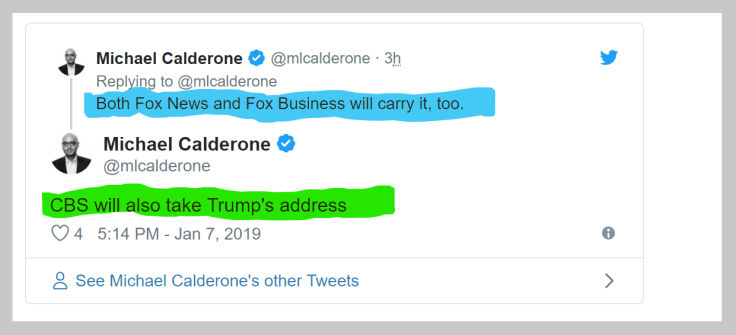
According to The Hill, CNN and Fox News Channel are planning to air Trump’s address on border security, while the basic cable networks CBS, NBC, and ABC have not committed one way or the other.
MSNBC has not made a public comment one way or the other, and the network has repeatedly opted not to air Trump events before.

Trump plans to address the nation for the first time from the Oval Office Tuesday night on “the humanitarian and national security crisis on our Southern Border.”

The government shutdown over Democrats’ refusal to pass spending for border security is now in its third week.
Many media figures weighed in on social media Monday over the decision.
CNN’s Brian Stelter tweeted that a “TV exec” told him he was torn on what to do about the address.
“TV exec texts: ‘He calls us fake news all the time, but needs access to airwaves… If we give him the time, he’ll deliver a fact-free screed without rebuttal. And if we don’t give him the time, he’ll call every network partisan. So we are damned if we do and damned if we don’t,’” Stelter posted.

Last week, Stelter used his newsletter to promote the idea of not airing presidential events live because of Trump’s “lies.”
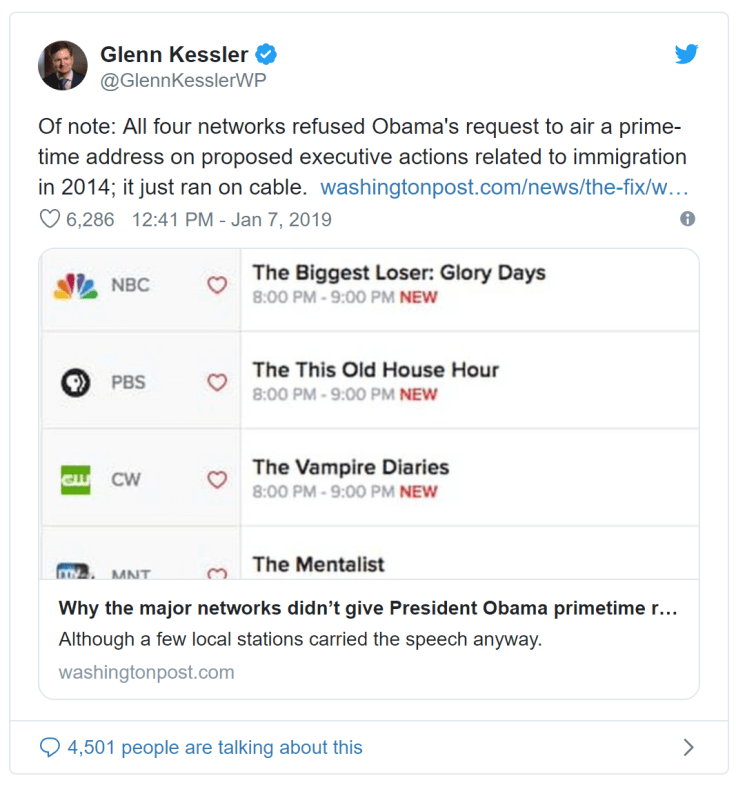
Glenn Kessler of the Washington Post, among others, pointed out that when former president Obama gave an address on immigration in 2014, networks did not run it because it was thought of as too political.
Others called for outright censorship, with Vox Media’s Matt Yglesias saying, “Don’t give Trump free airtime to lie about the shutdown with no interruptions, context, or fact-checking.”

CBS confirmed Monday evening that it plans to air Trump’s address, but will reportedly only run the address for eight minutes.






 Tom's Blog