Propaganda 101: The New York Times pumps another ‘evil Russia’ plot

CAP

By Finian Cunningham

The “newspaper of record” New York Times arguably holds the record for peddling anti-Russia scare stories. This week the NY Times delivered yet another classic spook tale dressed as serious news.

Among its splash articles, under the headline ‘Top Secret Russian Unit Seeks to Destabilize Europe, Security Officials Say’, readers were told of an elite Russian spy team which has, allegedly, only recently been discovered.

It’s called “Unit 29155” and purportedly directed by the Kremlin to “destabilize Europe” with “subversion, sabotage and assassination.”

According to the NY Times, this crack squad of Russia’s most ruthless military intelligence agents were involved in an attempted assassination of an arms dealer in Bulgaria in 2015; the destabilization of Moldova; a failed coup against the Montenegrin government; and the alleged poisoning of former double agent Sergei Skripal in England last year.

The article states: “Western security officials have now concluded that these operations, and potentially many others, are part of a coordinated and ongoing campaign to destabilize Europe, executed by an elite unit inside the Russian intelligence system skilled in subversion, sabotage and assassination.”

The NY Times adds: “The purpose of Unit 29155, which has not been previously reported, underscores the degree to which the Russian president, Vladimir V. Putin, is actively fighting the West with his brand of so-called hybrid warfare — a blend of propaganda, hacking attacks and disinformation — as well as open military confrontation.”

This is all because, the readers are told, “The Kremlin sees Russia as being at war with a Western liberal order that it views as an existential threat.”

In response, Kremlin spokesman Dmitry Peskov dismissed it as more of the “pulp fiction category” which Western news media have manufactured with seeming increasing intensity over recent years. Peskov pointed out that Moscow has repeatedly stated its desire to normalize relations with Western states and the European Union in particular, contradicting the theme of the NY Times’ piece.

Indeed, the Russian Embassy in Britain recently published a compilation of false articles peddled by Western media over the past four years. The NY Times features prominently as one of the main purveyors of scare stories about alleged malign Russian activities, from hacking into presidential elections, to targeting American power grids, to covert collusion with President Donald Trump.

For students of Propaganda 101, this week’s tale makes a case study of how disinformation is disseminated in the guise of “news reporting.”

First of all, the NY Times reporter, Michael Schwirtz, gives a meandering account of lurid dirty deeds performed in various international locations allegedly carried out by the supposed “elite” Kremlin hybrid warriors. But tellingly, there are no details evidencing Russian involvement. It’s all lurid speculation spiced with fear-mongering, which reads like a pallid John le Carré spy novel.

Then, the usual giveaway that the NY Times is engaging in disinformation, it quotes anonymous security officials for apparent verification of its claims about “Unit 29155”. This is tacit admission of who the real authors are: Western spooks.

READ MORE: Problem of NYT 1619 Project isn’t that it sees America through slavery, it’s that it tells untruths

Next, a neat effort to give the lame story some legs is to quote named public figures. But these sources don’t confirm the existence of the alleged Kremlin unit; they are merely invited to speculate on its existence and presumed malign purpose. One of those named sources is MI6 chief Alex Younger. Yes, that’s right, the paper of record is quoting British military intelligence as a reliable source for public information. Another named source is Peter Zwack, who is described as a former US military intelligence officer who worked at the American Embassy in Moscow. Zwack is quoted as describing Russians as “organically ruthless” (whatever that means), while the paper actually admits that “he was not aware of the unit’s existence.”

The purpose of throwing a few names into the reporting mix is to lend a veneer of credibility to the nebulous, unverifiable, scary stuff that the anonymous spooks feed the reporter.

A special mention must be given to a third named source quoted by the NY Times. He is Eerik-Niiles Kross, an Estonian lawmaker and former military intelligence chief in Tallinn. He styles himself as “Estonia’s James Bond,” and is known for his salacious Russophobic warnings of “imminent invasion of the Baltic states” – over the past three decades. Kross is quoted to speculate on the existence of the alleged Kremlin hybrid warfare unit. Of course, he dutifully serves up his notorious anti-Russian fear-mongering. But he is not confirming. His speculation is pseudo-validation of information that is essentially fictional.

All in all, the latest installment of anti-Russia propaganda from the NY Times this week is a damp squib among many previous baseless reports of alleged Kremlin malign activity. If it serves any purpose, it is perhaps a choice illustration of how disinformation is sneakily, insidiously presented as ‘news’. The fact that this should appear in a Pulitzer Prize-winning, supposedly premier, American newspaper is the disturbing part.

But it is no surprise to those who have long studied how the US corporate media has been under the control of state intelligence agencies for many decades, especially after the Second World War and during the subsequent Cold War against the Soviet Union.

In a seminal essay in 1977 for Rolling Stone magazine, award-winning journalist Carl Bernstein documented how the CIA systematically cultivated hundreds of reporters, columnists, editors, publishing executives and broadcast networks to function as conduits for disinformation – much of it directed at demonizing the Soviet Union.

“From the outset, the use of journalists was among the CIA’s most sensitive undertakings,” writes Bernstein.

He added: “By far the most valuable of these associations, according to CIA officials, have been with the New York Times, CBS and Time Inc.”

How the CIA goes about planting false stories in the American and European media is outlined in this candid interview by John Stockwell, who was former National Security Council coordinator for the agency during the 1970s. Stockwell also added: “Enemies are necessary for the wheels of the US military machine to turn.”

You may wonder, if the Cold War ended nearly 30 years ago when the Soviet Union dissolved, why then do the NY Times and other Western media outlets continue to pump out anti-Russian propaganda? But that assumes the Cold War was primarily about the US opposing the ideology of communism. It wasn’t. It was, and still is, all about imposing control over the masses so they don’t ever challenge the power structure that deprives them of full democratic rights and decent livelihoods.

In a recent interview, philosopher André Vitchek makes the point that Western politicians and media like the NY Times keep harping on Cold War scare stories about evil foreigners in order “to distract their citizens from thinking about their increasingly limited freedoms and diminishing standards of living.”

The Cold War continues, and anti-Russia hysteria is but a distraction, as was the anti-Soviet hysteria. The aim is to distract the public from the real Cold War which is a war by the elites against democracy ever being actually realized among the masses.

 

BOTH COMEY AND BRENNAN VOTED COMMUNIST WHILE COLD WAR WAS RAGING

Both Comey And Brennan Voted Communist While Cold War Was Raging

Both voted for Communist Party candidates

Zero Hedge – MAY 16, 2019

The heads of Obama’s FBI and CIA both voted for communists during the Cold War, yet were somehow able to move up the ranks within the same US intelligence community that had spent decades fighting that very ideology.

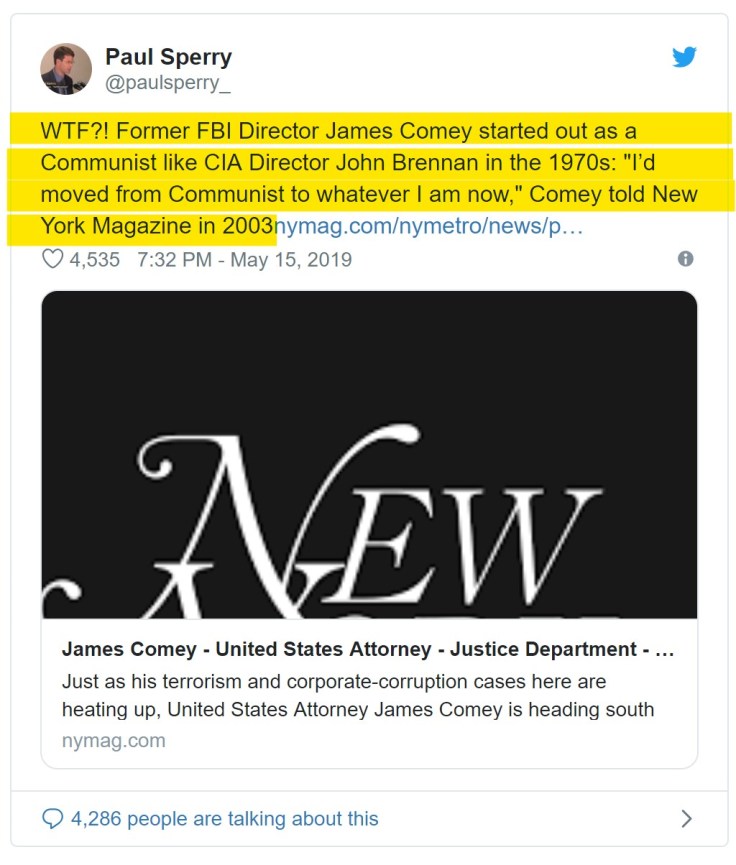
Journalist Paul Sperry noted on Wednesday that former FBI Director James Comey admitted in a 2003 interview to having voted communist before casting his ballot for Jimmy Carter in 1980.

CAP

“In college, I was left of center,” Comey told New York Magazine, and through a gradual process I found myself more comfortable with a lot of the ideas and approaches the Republicans were using.” He voted for Carter in 1980, but in ’84, “I voted for Reagan—I’d moved from communist to whatever I am now. I’m not even sure how to characterize myself politically. Maybe at some point, I’ll have to figure it out.”

Of note, Comey’s wife and four daughters were all giant Hillary Clinton supporters who wanted her to win “really badly.”

Former CIA Director John Brennan, meanwhile, admitted in 2016 to voting communist in the 1970s. When asked at the Congressional Black Caucus Foundation’s annual conference whether past activism would create a barrier for diverse candidates who want to enter the intelligence community, Brennan said that he was forced to admit to voting for communist Gus Hall for president in 1976, according to CNN.

“I froze, because I was getting so close to coming into CIA and said, ‘OK, here’s the choice, John. You can deny that, and the machine is probably going to go, you know, wacko, or I can acknowledge it and see what happens,” CNN quoted Brennan as saying.

Brennan (who was sworn in as CIA director on a draft of the US Constitution, without the Bill of Rights, instead of a Bible) said that while he had voted Communist, he wasn’t an official member of the Communist Party – and was relieved that he had been accepted into the CIA.

“I said I was neither Democratic or Republican, but it was my way, as I was going to college, of signaling my unhappiness with the system, and the need for change. I said I’m not a member of the Communist Party, so the polygrapher looked at me and said, ‘OK,’ and when I was finished with the polygraph and I left and said, ‘Well, I’m screwed.‘”

“So if back in 1980, John Brennan was allowed to say, ‘I voted for the Communist Party with Gus Hall‘ … and still got through, rest assured that your rights and your expressions and your freedom of speech as Americans is something that’s not going to be disqualifying of you as you pursue a career in government,” the former CIA Director concluded.

So two of President Obama’s spy chiefs voted communist, while Obama was influenced by the likes of radicals Bill Ayers, Saul Alinsky and his pastor – Jeremiah ‘God damn America’ Wright. Weeks before he died of a sudden heart attack at the age of 43, journalist Andrew Breitbart claimed to have a videos that would expose Obama as a communist radical.

None of the above sounds very “America First”

Gabbard says calling Trump a Putin puppet is dangerous & stupid, Twitter calls her a Putin puppet

CAP

Democratic candidate for president and establishment-punching bag Tulsi Gabbard is taking heat on Twitter for daring to suggest that the Russiagate scandal could be pushing the US and Russia toward a dangerous new Cold War.

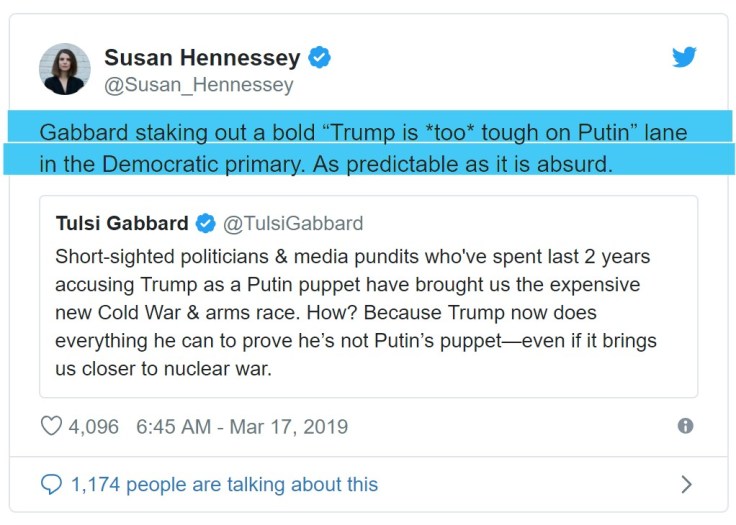
Gabbard tweeted that “short-sighted” politicians and media pundits who spend their time accusing Donald Trump of being in cahoots with Russia were helping bring about a new arms race because the accusations have led Trump to do“everything he can to prove he’s not [Russian President Vladimir] Putin’s puppet — even if it brings us closer to nuclear war.”

In a sane world, journalists, pundits and even Gabbard’s fellow Democrats all understood exactly what she meant and took her point on board. Except, this is Twitter we’re talking about, so of course, she was eviscerated.

CAP

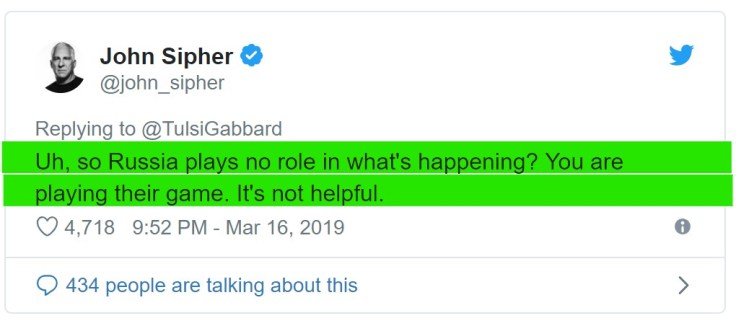
One of the first to pop in with a response was former CIA agent John Sipher who accused the Hawaii congresswoman of helping Russia and “playing their game.” Sipher himself once had his own moment of Twitter fame, back when he tweeted the classic question“How can one not be a Russophobe?


CAP

Some media folk got in on the action, too. CNN National Security analyst Susan Hennessey bravely stepped up with the bold take that Gabbard’s call for calm and better relations was “absurd.”

CAP

Washington Post columnist and fellow CNN analyst Josh Rogin accused Gabbard of blaming only Democrats and journalists for bad relations with Russia, while Bloomberg columnist Eli Lake had an interesting spin on things, suggesting Trump was playing “seven dimensional collusion.”

CAP

Then there were those that questioned Gabbard’s status as a Democrat, because she “doesn’t sound like” one. Presumably, in the age of Russiagate, Democrats are all supposed to be advocating for nuclear war?

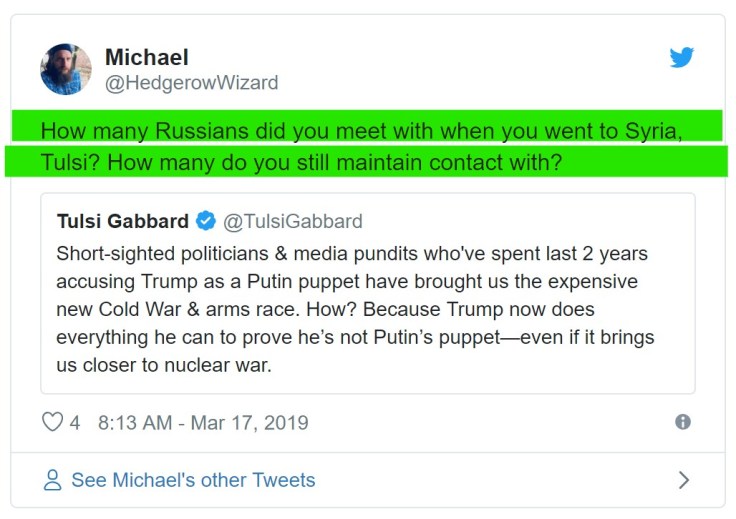
Some were interested in the candidate’s contact with Russian nationals, asking the all-important questions like, how many Russians has she met on her trips abroad — and crucially, how many does she “still maintain contact” with today?

CAP

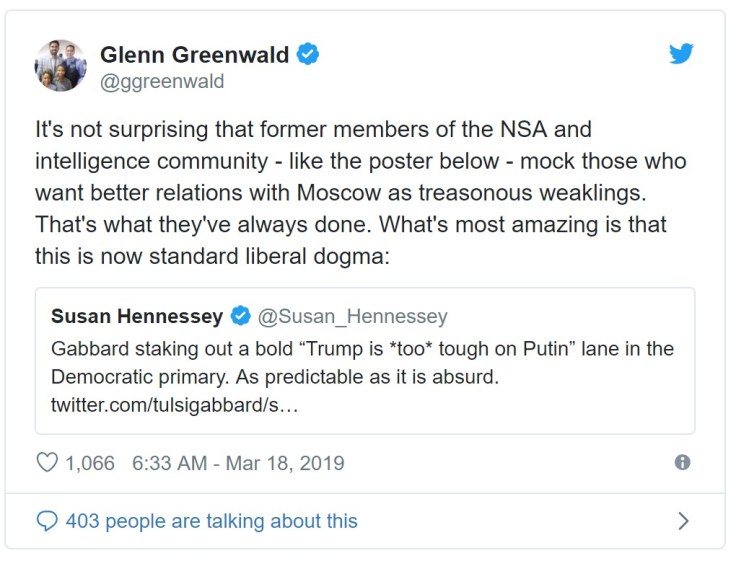
Some tweeters did take Gabbard’s side, however. Journalist Glenn Greenwald took aim at the likes of Hennessey who“mock” those who want to avoid heightening tensions with Russia as “treasonous weaklings.”

CAP

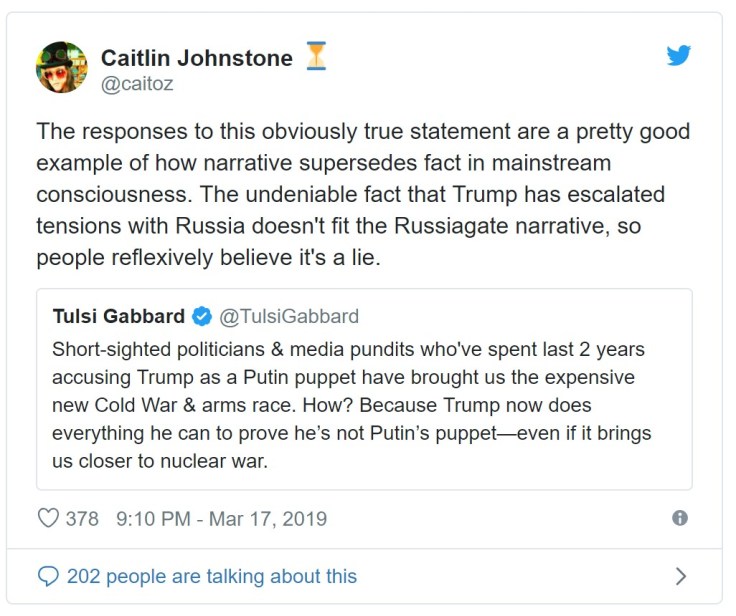
Independent journalist Caitlin Johnstone tweeted that the negative reaction to Gabbard’s tweet was a good example of how “narrative supersedes fact” and that while it was “undeniable” that Trump has escalated Russia tensions, pundits and Democrats who cling to the collusion story are still unwilling to believe it.

CAP

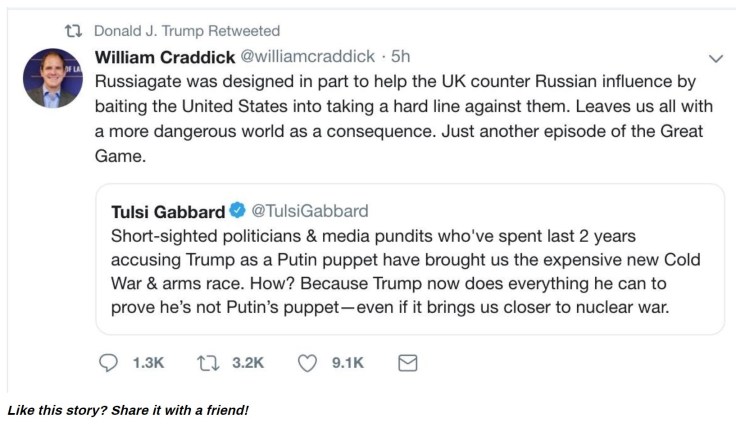
In an ironic twist, Trump himself retweeted a comment which seemed to be in support of Gabbard’s point, suggesting that Russiagate was designed to “bait” the US into taking a tougher line against Russia and created “a more dangerous world as a consequence.”

CAP

Tulsi Gabbard presents bill to stop Trump from pulling out of INF treaty

CAP

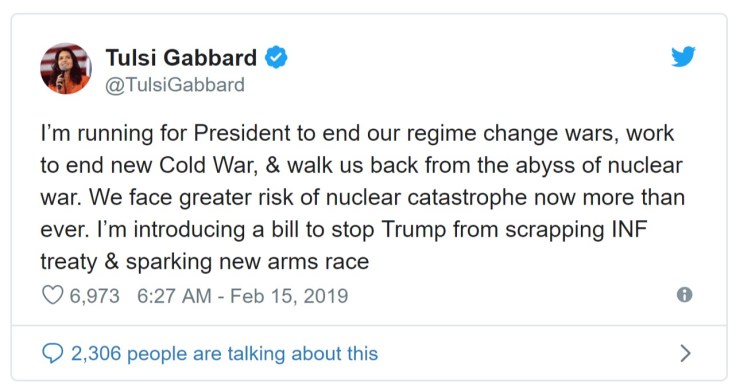
Democratic presidential candidate Tulsi Gabbard has introduced a bill to Congress which would prevent President Donald Trump from withdrawing the US from the Intermediate-Range Nuclear Forces Treaty (INF).

Speaking at a press conference on Friday morning, Gabbard said that Trump’s decision to pull out of the 1988 treaty was“reckless,” was “exacerbating a new Cold War” with Russia, and could spark another arms race.

“Walking away from this agreement doesn’t solve our problems, it makes them worse. It doesn’t bring us closer to peace, it moves us closer to war,” she said.

Gabbard said she was introducing the bill, called the “INF Treaty Compliance Act,” not only to prevent the escalation of a new Cold War, but to “stop more American taxpayer dollars from being wasted on military adventurism that makes our people and our country less safe.”

She said that rather than scrapping the treaty, the US should be working to expand it and bring in other countries, including China.

CAP


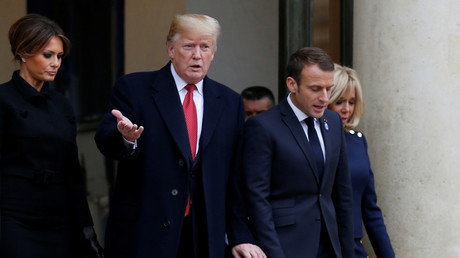
‘They were starting to learn German in Paris before US came along’ – Trump taunts Macron

'They were starting to learn German in Paris before US came along' – Trump taunts Macron

President Trump continued his verbal spat with French leader Emmanuel Macron, taunting the French leader for his country’s losses to Germany in two world wars, and suggesting that Europe needs the US as a saviour.

After returning from Armistice Day commemorations in Paris over the weekend, Trump took to Twitter on Monday to savage the US’ European allies for failing to meet their defense spending targets and leaving America to foot much of NATO’s bill. On Tuesday, the president vented his frustrations again.

“Emmanuel Macron suggests building its own army to protect Europe against the U.S., China and Russia,” Trump tweeted.

Capture

In a radio interview a week before the commemorations in Paris, Macron called for the establishment of an EU army that can defend the continent “without relying only on the United States.”

While Macron once enjoyed a close bond with president Trump, the leaders’ relationship has soured as of late. In a speech on Sunday, Macron emphatically denounced Trump’s brand of nationalism, comparing it to the forces that plunged Europe into conflict in the 20th Century.

“Old demons are resurfacing,” the French president warned. “History sometimes threatens to take its tragic course again and compromise our hope of peace. Let us vow to prioritise peace over everything.”

Macron also stuck close to German Chancellor Angela Merkel – herself a vocal Trump critic – throughout the weekend, with the pair posing in an embrace at the unveiling of a plaque near Compiegne, where Germany officially surrendered 100 years previously.

French President Emmanuel Macron and German Chancellor Angela Merkel hold hands in Compiegne, France on November 10, 2018. © Reuters / Philippe Wojazer

Whether Trump’s Tuesday tweet was meant as a jibe at Merkel and Macron’s closeness or not is unclear, but the president’s insistence that Europe pays its NATO dues is a call that he has voiced since he hit the campaign trail three years ago.

At present, only five NATO member states – the US, UK, Greece, Estonia, and Poland – allocate two percent of their GDP to defense spending, a requirement for membership. In 2017, the US spent $686 billion on defense, over double the expenditure of all 28 other states combined.

While Macron is now in Trump’s firing line over defense spending, the US president had singled out Germany in the runup to a NATO summit in Brussels in July. As well as savaging Merkel’s government for spending just over 1.2 percent of its GDP on defense, Trump said that Germany is “totally captive to Russia,” referring to its reliance on Russian gas.

While the US underwrites most of Europe’s defense bill, more EU leaders than Macron have expressed discomfort at relying on Trump in recent months. Liberal MEP Guy Verhofstadt – a long-time advocate for a federal Europe – echoed Macron’s comments on Saturday, when he tweeted that Europe cannot be “unprepared for the America First Policy.”

The idea of an integrated EU army might make Macron and Merkel excited, but it has been criticized by more people than just Trump. NATO Secretary General Jens Stoltenberg responded to Macron’s radio interview by warning the French president not to take over NATO’s job.

“Two World Wars and a Cold War taught us the importance of doing things together,” he said at a conference in Berlin on Monday. “The reality is that we need one strong and capable command structure, we can’t divide those resources in two.”


Blog at WordPress.com.

Up ↑