
Published on Feb 22, 2019
By Joel B. Pollak
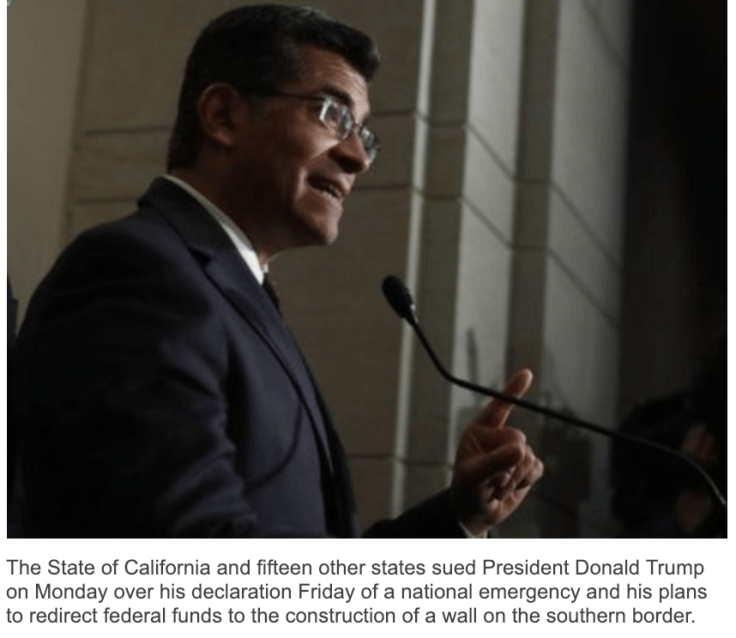
The lawsuit, as expected, was filed by California Attorney General Xavier Becerra, and was joined by attorneys general from “Colorado, Connecticut, Delaware, Hawaii, Illinois, Maine, Maryland, Michigan, Minnesota, Nevada, New Jersey, New Mexico, New York, Oregon and Virginia — all of which have Democratic attorneys general and all but one of which are led by Democratic governors,” the Wall Street Journal noted Monday.
However, ten of the 26 Democrat attorneys general have not joined the lawsuit — at least not yet, as of Tuesday.
The complaint, filed in federal court in the Northern District of California, decries what it calls “President Donald J. Trump’s flagrant disregard of fundamental separation of powers principles engrained in the United States Constitution.” It adds:
Contrary to the will of Congress, the President has used the pretext of a manufactured “crisis” of unlawful immigration to declare a national emergency and redirect federal dollars appropriated for drug interdiction, military construction, and law enforcement initiatives toward building a wall on the United States-Mexico border. This includes the diversion of funding that each of the Plaintiff States receive.
The complaint continues through several familiar talking points from the Democratic Party:
The federal government’s own data prove there is no national emergency at the southern border that warrants construction of a wall. Customs and Border Protection (“CBP”) data show that unlawful entries are near 45-year lows. The State Department recognizes there is a lack of credible evidence that terrorists are using the southern border to enter the United States. Federal data confirm that immigrants are less likely to commit crimes than are native-born Americans. CBP data demonstrate that dangerous drugs are much more likely to be smuggled through, not between, official ports of entry—rendering a border wall ineffectual at preventing their entry into this country.
Later in the complaint, the states claim that the border wall is not only unnecessary, but that it will also cause environmental damage. The complaint also claims a border barrier will not block “drug smuggling corridors.”
President Trump said Friday that, following earlier patterns, he expected a legal challenge in California, to lose there and in the liberal Ninth Circuit, and then to prevail at the Supreme Court, where conservatives hold a 5-4 majority.
Unlike President Barack Obama’s invocation of executive powers to declare the Deferred Action for Childhood Arrivals (DACA) and Deferred Action for Parents of Americans (DAPA) programs, Trump’s use of emergency powers is arguably within the powers assigned to him by the Constitution and delegated to him by Congress under the National Emergencies Act of 1976, according to analysis by Breitbart News legal editor Ken Klukowski.
Many experts agree. The Journal notes that “courts have been reluctant to second-guess the president on national-security matters,” and quotes liberal constitutional law professor Mark Tushnet of Harvard as saying that the case is “not a slam dunk” for the states, though he added he believes there is a “decent chance” that they could prevail.
The case is State of California et al v. Trump et al, number 3:19-cv-00872, Northern District of California.

By John Binder
While the United States-Mexico border received only $1.3 billion for construction of a border wall at the overwhelmed southern border with soaring illegal immigration, foreign countries are getting help from American taxpayers to secure their borders.
The Republican-Democrat spending bill signed by Trump last week provides Pakistan with at least $15 million in U.S. taxpayer money for “border security programs” as well as funding for “cross border stabilization” between Afghanistan and Pakistan.
In total, the spending bill provides about $6 billion in American taxpayer money to finance foreign militaries, some of which can be used by Lebanon to “strengthen border security and combat terrorism.”
The spending bill provides about $112.5 million in U.S. taxpayer money for economic support for Egypt, including $10 million for scholarships for Egyptian students. Egypt’s military receives about $1.3 billion in the spending bill, some of which can be for border security programs.
Additionally, the spending bill includes:
Meanwhile, illegal immigration at the U.S.-Mexico border has swelled in recent months. In December 2018, the last month for illegal border crossing totals, there were close to 51,000 border crossings. The month before, there were nearly 52,000 border crossings. Experts project there to be at least 606,000 crossings this year at the southern border, a level of illegal immigration that surpasses nearly every year of illegal immigration under President Obama.

By
“Concocting a fake emergency to build a needless wall goes against the Constitution and the values America was built on,” said Mark Herring in a statement according to WUSA9.
“President Trump’s ill-advised plan could divert critical funds from actual national security priorities, including military construction projects at bases and facilities throughout Virginia,” the statement continued.
After Big League Politics exposed Gov. Ralph Northam as a racist and Lt. Gov. Justin Fairfax as an alleged serial rapist, Herring decided to admit that he, too, had partaken in racist activities to get ahead of any potential negative press.
Trending: Trump is Ready to Exercise Veto Power Against Globalist Congress
Now, he’s asserting some feigned moral authority and lecturing the 63 million plus Americans who voted for a border wall – most of whom have never worn blackface – about America’s “values.” What are those values exactly?

Further evidence that Herring is an obvious hypocrite is the fact that he called on Northam to resign over Northam’s blackface scandal, but backed off that position when Fairfax’s job was jeopardized.
Sixteen states are throwing a petulant hissy fit over President Donald J. Trump’s National Emergency declaration, which will use Department of Defense funds to build a wall on the southern border.
California is leading the suit (surprise!), and is joined by Colorado, Connecticut, Delaware, Hawaii, Illinois, Maine, Maryland, Michigan, Minnesota, Nevada, New Jersey, New Mexico, New York, Oregon, and Virginia.
Says knifing as normal as breakfast in UK capital
Friday, February 15, 2019
Robert Bragg, 26, told Radio 1 Newsbeat that stabbing people was an integral part of his way of life in London prior to serving a six-year prison sentence.
“I started carrying a knife when I was 12 because everyone was doing it at the time,” Bragg said. “To fit in more you had to do certain things so I started to stab people. I didn’t do it because I wanted to be bad.”
“To be honest with you, I’ve stabbed quite a lot of people.”
“If I was to sit here and count I wouldn’t be able to. People remind me, to this day, about people I’ve stabbed that I don’t remember,” Bragg continued. “It’s just one of them things: you wake up, you have your breakfast, you stab someone. It’s mad because we’re not actually thinking about damaging a life.”
Fatal stabbings in England are now at their highest levels since the government began keeping records in 1946.
Some 285 homicides were carried out via knife or sharp object in a single year ending March, 2018 — far outpacing any other type of killing, according to government statistics.
Victims and suspects in stabbing deaths are predominantly young men.
Bragg asserts he has found redemption through church and a search for God.
“I said to myself before I kill myself I’m going to try God and see if God has a plan for my life,” he said. “I went to church one day and I lifted my hands and said: ‘God if you’re real, help me.’”
“I was desperate enough to cry for help.”

By
Bill Clinton used this authority 17 times. President Trump has only used it three times so far.
Sorry Democrats, this “national emergency” business is not quite the work of “dictators.”
Conservative Tribune reports: “Of Obama’s 11 continuing national emergencies, nine of them were focused exclusively on foreign nations, while only one seemed focused on protecting America — a declaration aimed at punishing individuals “engaging in significant malicious cyber-enabled activities.”
All of the rest of Obama’s national emergencies were focused on blocking property or prohibiting transactions/travel for individuals engaged in various activities in — by order of the date of enactment — Somalia, Libya, transnational criminal organizations, Yemen, Ukraine, South Sudan, Central African Republic, Venezuela and Burundi.
Conservative Tribune passage ends
The American people stand with President Trump following his amazing Oval Office address explaining the human cost of illegal immigration.
If President Donald Trump uses the U.S. military to build the border wall along the United States’ international with Mexico by declaring a national emergency, won’t liberals simply run to a Federal judge whom they believe to be left-wing within the Ninth Circuit and block Trump? Can Congress vote to overturn Trump’s declaration of an emergency?
No. If the federal courts actually follow the law, President Trump cannot be prevented from “reprogramming” funds appropriated for the U.S. Department of Defense and actually using the military (such as the U.S. Army Corps of Engineers) to build the border wall.
There are a lot of national emergencies going on. In fact, there are 31 active national emergencies declared under the National Emergencies Act.
Bill Clinton used this authority 17 times. President Trump has only used it three times so far.
Sorry Democrats, this “national emergency” business is not quite the work of “dictators.”
Conservative Tribune reports: “Of Obama’s 11 continuing national emergencies, nine of them were focused exclusively on foreign nations, while only one seemed focused on protecting America — a declaration aimed at punishing individuals “engaging in significant malicious cyber-enabled activities.”
All of the rest of Obama’s national emergencies were focused on blocking property or prohibiting transactions/travel for individuals engaged in various activities in — by order of the date of enactment — Somalia, Libya, transnational criminal organizations, Yemen, Ukraine, South Sudan, Central African Republic, Venezuela and Burundi.
Conservative Tribune passage ends
The American people stand with President Trump following his amazing Oval Office address explaining the human cost of illegal immigration.
If President Donald Trump uses the U.S. military to build the border wall along the United States’ international with Mexico by declaring a national emergency, won’t liberals simply run to a Federal judge whom they believe to be left-wing within the Ninth Circuit and block Trump? Can Congress vote to overturn Trump’s declaration of an emergency?
No. If the federal courts actually follow the law, President Trump cannot be prevented from “reprogramming” funds appropriated for the U.S. Department of Defense and actually using the military (such as the U.S. Army Corps of Engineers) to build the border wall.
As noted in the first installment on this topic, Congress has given a president the power to declare a national emergency by 50 U.S.C. 1621 and 50 U.S.C. 1622. A declaration of an emergency allows the President to reprogram funds in the military budget. See 33 U.S. Code § 2293 “Reprogramming during national emergencies.”
Trump could reprogram funds from other parts of the Department of Defense budget — including from other DoD construction projects such as on bases, military housing, etc. — and engage in construction in areas of need for the national defense. The statute says that explicitly (although statutes are never easy reading).
But Democrats are threatening and commentators are warning that such an action would be challenged in court and in Congress immediately. Can such a plan be blocked?
First, 50 U.S.C. §1622 allows the Congress to over-turn a president’s declaration of an emergency. If both the Senate and the House each pass s resolution terminating the President’s declaration of an emergency, than the emergency status terminates under 50 U.S.C. §1622. But clearly the Republican-controlled U.S. Senate would not join the Democrat-controlled U.S. House of Representatives. Unless a significant number of Republican Senators vote against a border wall built by the U.S. Army Corps of Engineers or contractors with military funds, Congress could not block Trump’s efforts.
(Note, although I argue in the next section that this power has been invalidated by the U.S. Supreme Court, if a court disagrees on that, a legislative veto power should block a lawsuit. Where Congress has provided a specific method for challenging a declaration of an emergency, the federal courts would normally hold that that method becomes the exclusive remedy. A lawsuit would be blocked by the fact that Congress provided a non-litigation remedy.)
Second, however, the Congressional veto process described above has been ruled unconstitutional by the U.S. Supreme Court, in INS v. Chadha, 462 U.S. 919 (1983), finding a legislative veto of Executive Branch action unconstitutional. Congress passed many laws which specifically enabled Congress to veto regulations or actions under that law. The U.S. Supreme Court found a legislative veto violates the structure or architecture of the Constitutional system.
Laws go to the President for signature or veto. Congress cannot reach over and pull a law back. Congress must pass a new law and present it to the President for signature if dissatisfied with how the law is working out. The U.S. Supreme Court had no hesitation finding that the Congress had over-reached, based only on the implied architecture of the Constitution.
In Chadha, 50 U.S.C. 1622 was one of the laws explicitly discussed. The dissenting opinion specifically warned that the Chadha decision invalidated Congress’s ability to overturn a presidential declaration of a national emergency.
Therefore, Congress cannot overturn a declaration by President Trump that the open border is a national emergency. Even if the U.S. Senate were to side with the Democrats, Chadha explicitly ruled the Congressional veto (termination) of a presidential declaration to be an unconstitutional distortion of the familiar “Schoolhouse Rock” means by which laws are passed and signed by presidents. Once a law is signed, there is no “claw back” right by Congress.
Third, of course, critics are discussing whether Trump’s actions would be constitutional. Here, however, Congress passed a specific statute, in fact a series of statutes. So there is no question about the President’s power to do what the Congressional statute has explicitly empowered him to do.
Some even point to a rather famous Constitutional landmark case — Youngstown Sheet & Tube Co. v. Sawyer, 343 U.S. 579 (1952) — in which the U.S. Supreme Court explicitly ruled that President Dwight D. Eisenhower did not have the power to temporarily nationalize the U.S. steel industry to avert a strike for national defense. However, Youngstown was not that simple. Youngstown analyzed the inherent powers of Commander in Chief as modified by Congressional agreement by statute.
The U.S. Supreme Court explicitly analyzed that the President’s powers are at their greatest (zenith) when he acts not only by his inherent powers as President but also by the agreement of a statute passed by Congress. In Youngstown, Eisenhower did not have any statute supporting his action and the Court reasoned that he was actually acting in conflict with relevant statutes.
Here, the Congress has already enacted and President George W. Bush signed into law, the Secure Fence Act of 2006. It is already the law of the land that a border wall shall be built along the United States’ Southern border. Neither Congress nor any private plaintiff can challenge the official determination that a border wall or barrier shall built. That is the law. That is the official determination of both the U.S. Congress and the Commander in Chief.
The Secure Fence Act of 2006 was never implemented (other than a few miles) because Congress did not appropriate the funds to pay for it. There are two steps: Authorization and Appropriation of funds. The decision to build a border wall is final. The only question is applying funds to make it happen.
Building of a border wall under the 2006 Act was also not completed because the Swamp and Deep State sabotaged it. Using classic bureaucratic games, the bureaucracy and open borders legislators followed “designed to fail” steps that ground the construction to a halt.
Note that in spite of the word “fence” in the title, the law does not actually mandate a “fence” in particular. The wording of the Act is not about a “fence” but about any kind of barrier customized to the particular terrain in each location to the extent necessary to “the prevention of all unlawful entries into the United States, including entries by terrorists, other unlawful aliens, instruments of terrorism, narcotics, and other contraband.” That is “all.” As in “all.”
So the Secure Fence Act of 2006 requires building “whatever it takes” — not a “fence” per se. The Act does require specific enhanced barriers and lights, cameras, and sensors, in some named locations.
Fourth, could liberals run to the courts to block Trump from using the military to build a border wall? No. Only those with “standing” can bring a lawsuit. How is anyone harmed?
The federal courts have been waging Jihad against citizens bringing lawsuits for decades. The federal courts have been raising the bar higher and higher to make it nearly impossible for anyone to challenge the actions of government agencies or public officials. Specifically a complaint that is shared generally by much of the population cannot establish standing.
Contrary to strongly-held popular belief, the U.S. Supreme Court has clearly ruled that taxpayers do not have standing to challenge government spending, revenue, or action merely because they are taxpayers. See, Daimlerchrysler Corp. v. Cuno, 126 S.Ct. 1854, 164 L.Ed.2d 589, 547 U.S. 332 (2006). So the Left cannot block Trump’s plans by suing as taxpayers. (The only exceptions involve use of funds to establish a religion or local government taxpayers.)
Similarly, Members of Congress do not have standing either. Certainly individual Members of Congress do not. See Raines v. Byrd, 521 U.S. 811 (1997).
To bring a lawsuit, one must show that they are tangibly harmed, personally, not just in disagreement with a policy. If Trump uses some of the $700 billion in the omnibus bill to build a border wall, everyone will be more safe. How is anyone harmed?
Fifth, can private landowners, some of whom will be liberals, go to court and stop the use of private land as an easement taken by eminent domain? No.
There is absolutely no defense available to taking land by eminent domain. How much compensation is owed for taking an easement as a strip of land could take years to fight out in court. But the actual right to use the land cannot be contested. The government can take an easement immediately and then fight later over how much money should be paid to the landowner. Remember that this was the legal holding of the over-the-top, controversial U.S. Supreme Court precedent Kelo v. City of New London, Connecticut, 545 U.S. 469, 125 S. Ct. 2655; 162 L. Ed. 2d 439 (2005). (Kelo ruled that it is not even necessary to show a “public purpose” for eminent domain, which goes too far.)
Legal challenges will not stop construction, even it takes years to reach agreement on the compensation payable to landowners. To finance payment of compensation, Trump should consider offering a land swap of federally-owned tracts of land or selling such public lands.
Sixth, opponents of Trump’s agenda will try to find individual landowners along the border, who might be liberal, to object in general to the reprogramming of military funds to build the border wall. But those landowners should not be considered to have standing, for several reasons:
(A) It would be speculation as to whether the government will take any action at their particular section of the border. How would a landowner know that his or her part of the border is a stretch where the planners believe an actual wall is truly needed, as opposed to other natural or physical barriers? It would be — under standard doctrines of standing — insufficient to speculate that that particular landowner’s land is going to be affected at all.
(B) There is a concept called “exhaustion of administrative remedies.” If an individual landowner doesn’t want a border fence along their particular stretch of the border, they would first have to tell the government that they object. The courts would traditionally wait until the government can try to find agreement with the landowner before allowing a lawsuit. A lawsuit would be invalid as not yet being “ripe.” Traditionally the courts would require a plaintiff to actually talk to the government agency first to see if their stretch of land is actually going to be affected or not, whether a compromise can be worked out, etc. Those are the currently-existing standard rules that always govern. (In fact, on policy, one could argue if a landowner doesn’t want a wall along their property, fine. Let all the trespassers funnel through that person’s land, trampling the ground, leaving trash everywhere, and frightening their family in their home at all hours. If they don’t want a border wall on their property, fine. Check back with us later and tell us how that worked out for you.)
Seventh, open border advocates of course will also find some would-be gate-crashers from another country to say that they want to break the law and cross the border in the unmanned frontier and the border wall will stop them from breaking the law. That should be laughed out of court, because one does not have a “right” to break the law. Similarly, they will try to find immigrants in the U.S. who want to bring family members into the U.S.A. But they have legal avenues for doing that, by sponsoring their family members to come in legally. Those ideas may impress an individual federal trial judge for a short time, but it should not survive on appeal.
(Note: Trump does need to get changes in the law through Congress or perhaps just issue clarifying regulations from DHS that a foreigner can apply for asylum at a U.S. consulate without entering the United States.)
As an attorney in Virginia for 21 years, who has worked for both Judicial Watch and more recently Freedom Watch created by Larry Klayman, I often have to explain the concept of “standing” to clients who want to bring “good government” lawsuits or hold the government accountable to its rules.
When Sheriff Joe Arpaio sued to challenge Barack Obama’s amnesty by executive order, the U.S. Court of Appeals for the District of Columbia ruled that Arpaio did not have standing, even though illegal immigration cost him actual money in (then) running the jails of Maricopa County. I worked on that legal case, from helping write the original complaint (with an eye toward establishing standing from word one) to legal memoranda in the U.S. District Court for the District of Columbia, filed by Larry Klayman, to the appeal by Larry Klayman to the U.S. Court of Appeals for the District of Columbia. Arpaio’s legal pleadings established standing as strong as one could imagine, an iron lock on showing standing.
Didn’t matter. The courts completely contradicted other precedents, as powerfully demonstrated by the dissenting opinion of the Honorable Janice Rogers Brown, an African-American appeals judge with more intellect and intellectual integrity in her little finger than the U.S. Congress combined.
In deadly seriousness and a straight face, I honestly have to explain the law of standing in federal courts as follows: If you want to encourage the expansion of government and government intervention in the economy or society or prevent the streamlining of government, you have standing. If you want to hold government accountable to staying within its rules or you want to block left-wing policies, you don’t have standing. it’s pretty much that simple. Are you a liberal? You have standing. Are you a conservative? You don’t have standing. Having studied hundreds of precedents on standing, I must say that with absolutely no humor, exaggeration or hyperbole. I could not truthfully say anything different.
However, the federal courts have established some very strong precedents ruling that almost no one has standing to challenge anything that the government wants to do — unless the government action directly harms the plaintiff personally and individually.
Therefore, it will be extremely awkward for the federal courts to ignore and contradict their past precedents and claim that anyone has standing to object to the building of a border wall by the U.S military.
Finally, President Trump’s Administration under incoming Attorney General William Barr has got to stop this foolishness with lawsuits brought before a cherry-picked judge in the Ninth Circuit whom the plaintiffs believe will be unusually sympathetic to them and hostile to Trump’s policies.
The Department of Justice under Bill Barr must always file a motion for a change of venue to the U.S. District Court for the District of Columbia. Readers will be familiar with changes of venue requests in famous criminal cases. But this is different. This is not about whether a criminal defendant can get a fair trial due to pre-trial publicity.
A change of venue in a civil dispute is based upon other considerations: Where are all the witnesses? Where are the records and evidence kept? Where was the decision made? Where are the decision-makers to be affected by the lawsuit located? Those venue rules strongly if not conclusively favor moving any such lawsuit to the District of Columbia, where the decisions were made, where the officials and witnesses reside, and where all the evidence is located.
Again, those are the standard, currently-existing, non-controversial rules. None of these lawsuits should be tolerated out in the Ninth Circuit on the Left Coast. There is no valid reason to have such lawsuits spread around the country instead of being held in Washington, D.C., where the action is — and where the action took place.
by Jim Hoft February 14, 2019

The agreement was announced by a group of lawmakers led by Republican Sen. Richard Shelby and Democratic Rep. Nita Lowey, after a closed-door meeting on Capitol Hill.
On Wednesday FOX News announced Democrats slipped a “poison pill” into the deal that will prevent the 55 miles of wall from being built.
But the agreement is even worse than what is being reported.
The areas Trump cannot build any wall.

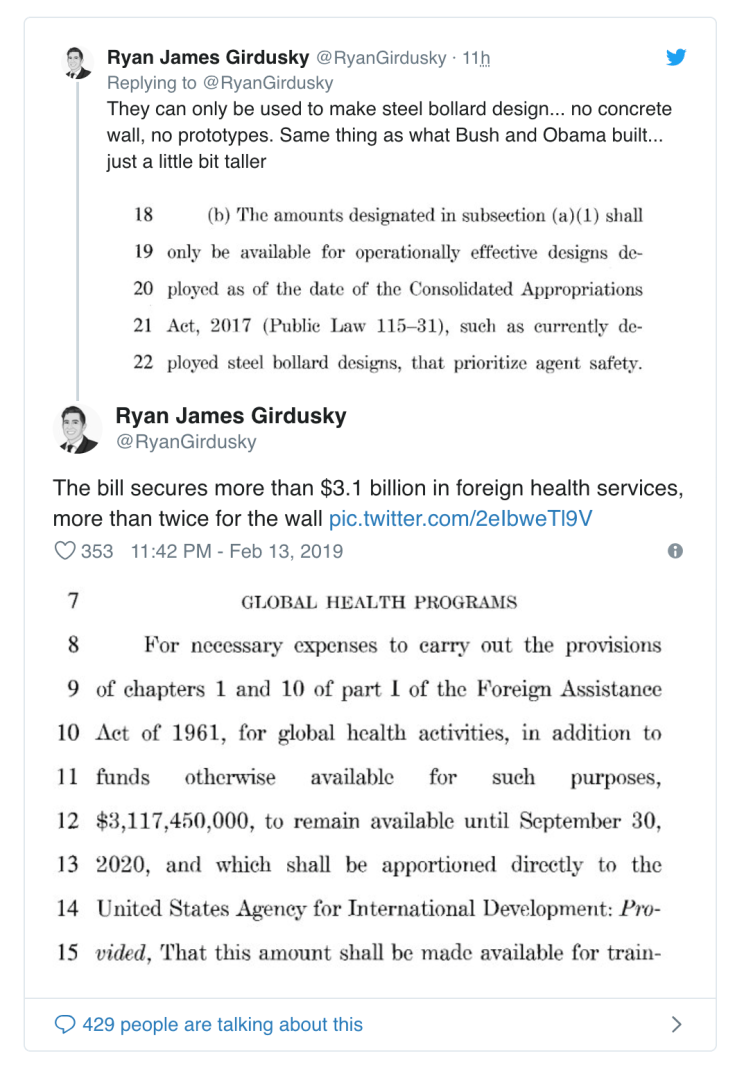
Funds can only be used to make steel bollard design… no concrete wall, no prototypes. Same thing as what Bush and Obama built… just a little bit taller.
VOTE: Are You Still In Favor Of The Border Wall?
The bill secures more than $3.1 billion in foreign health services, more than twice for the wall.
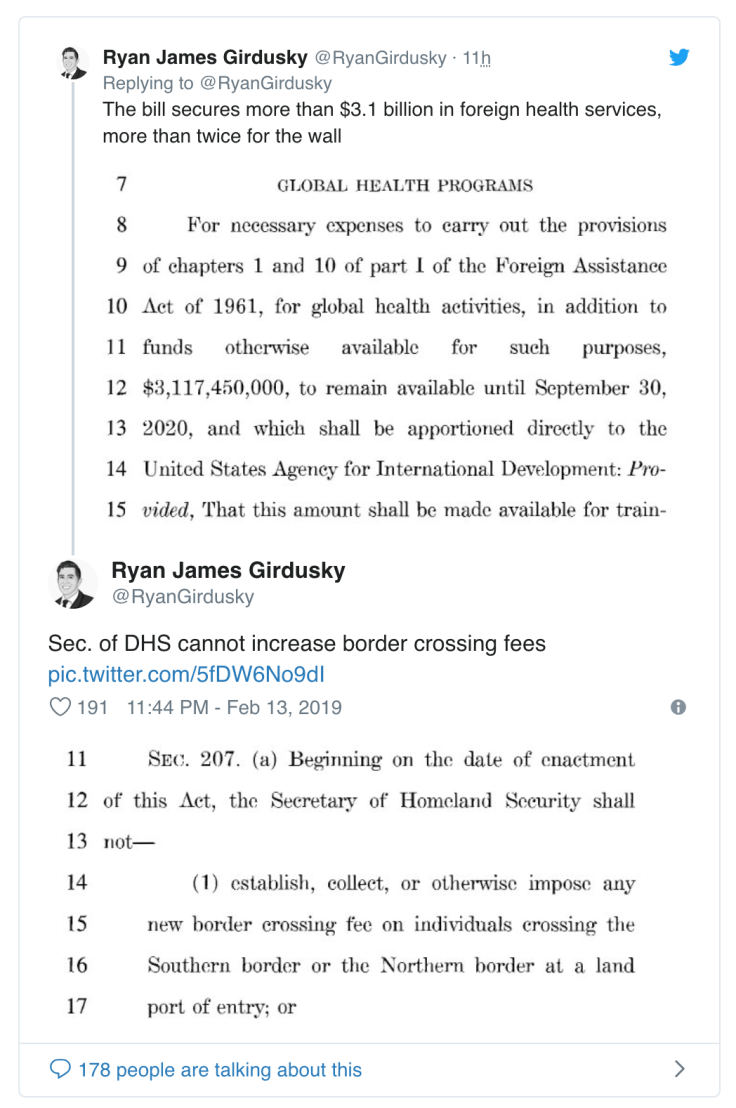
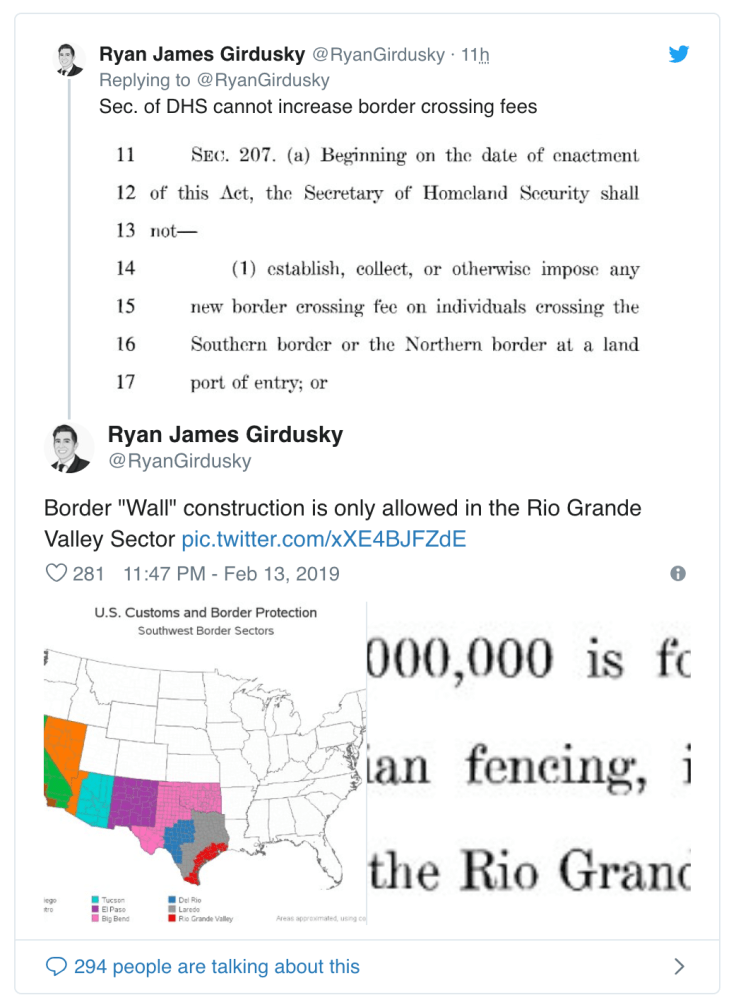
Sec. of DHS cannot increase border crossing fees.
Border “Wall” construction is only allowed in the Rio Grande Valley Sector.
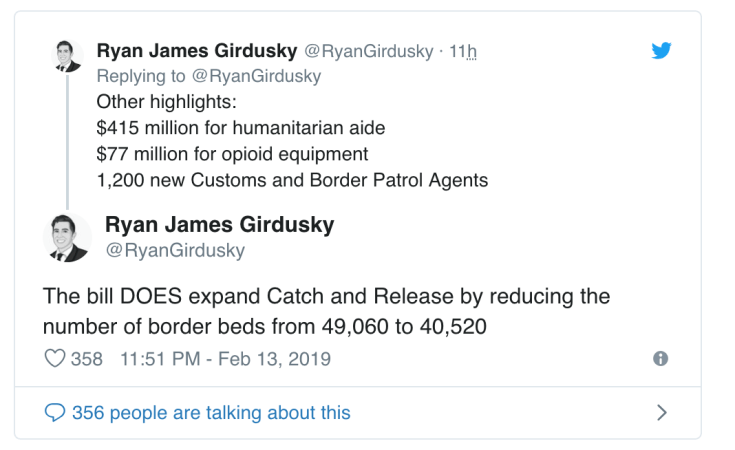
The bill DOES expand Catch and Release by reducing the number of border beds from 49,060 to 40,520.
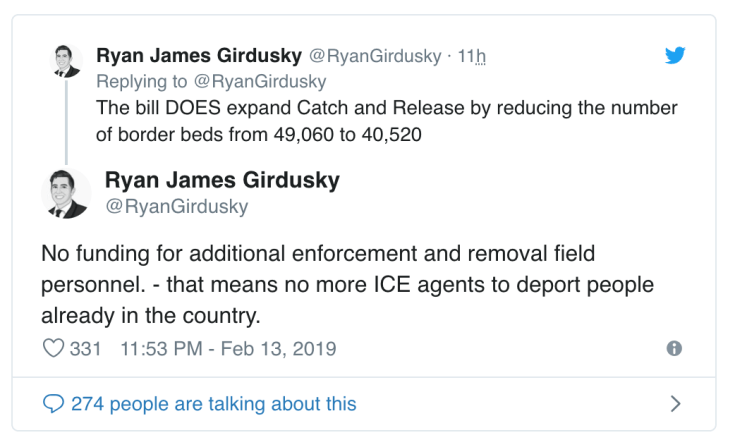
No funding for additional enforcement and removal field personnel. – that means no more ICE agents to deport people already in the country.
Expands the Alternatives to Detention program from 82,000 to 100,000… so instead of housing family units at the border- they get moved into the interior where they almost always stay in the country permanently.

Provides $40 million for additional ICE staffing dedicated to overall ATD case management, particularly for asylum seekers… so no new ICE agents, but money to ICE to help illegal aliens settle in a non-detention center in the country.

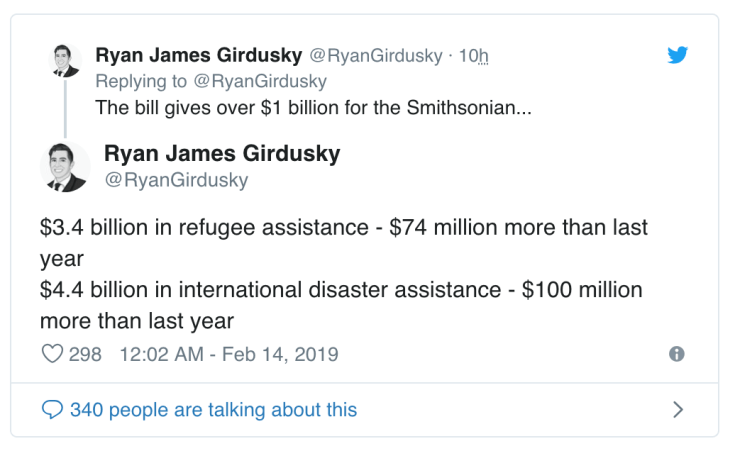
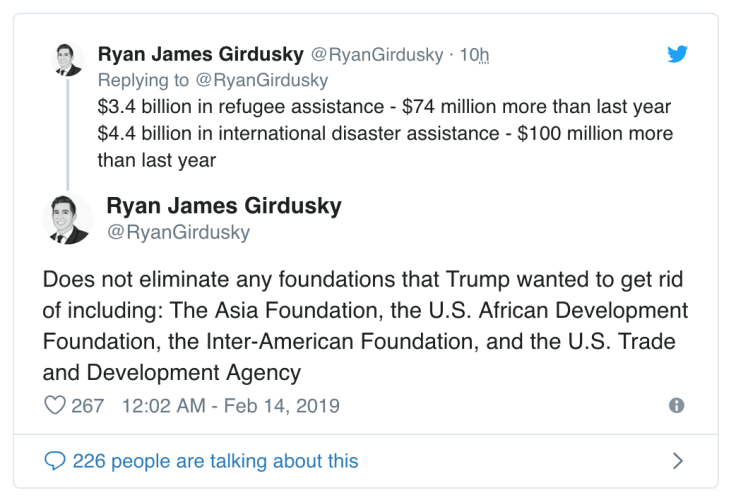
$3.4 billion in refugee assistance – $74 million more than last year
$4.4 billion in international disaster assistance – $100 million more than last year
Does not eliminate any foundations that Trump wanted to get rid of including: The Asia Foundation, the U.S. African Development Foundation, the Inter-American Foundation, and the U.S. Trade and Development Agency

By Bob Price
During Fiscal Year 2019, which began on October 1, 2018, El Centro Sector Border Patrol agents apprehended eight previously deported illegal aliens with histories of being removed from the U.S. after convictions for sexual offenses — often against children, according to U.S. Customs and Border Protection.
Recent examples include one who crossed the border 25 miles east of the Calexico Port of Entry on Monday. During a biometric background investigation, agents learned that a California court convicted the 37-year-old Mexican national, Salvador Toribio-Gonzalez, in 2002 for Sex with a Minor, officials stated. Immigration officers removed the man in 2004 after he served one year in state prison. He also received three years of probation as part of his sentencing agreement.
The apprehension of previously deported sex offenders is not unique to the El Centro Sector.
Rio Grande Valley Sector Border Patrol agents also recently arrested previously deported illegal immigrants with criminal histories that include sex crimes. On February 7, Rio Grande City Station agents arrested a Salvadoran man who illegally crossed the border near Roma, Texas. A records check revealed that a court in Conroe, Texas, convicted the Salvadoran national for Sexual Intercourse with a minor. The man received a sentence of six months in jail and three years probation.
The following day, Rio Grande City agents apprehended another previously deported migrant while patrolling near Cuevitas, Texas. During a background investigation, agents learned that a court in Centralia, Washington, convicted the Salvadoran national for Rape of a Child in the 2nd Degree. The court sentenced the violent sex offender to 41 months in state prison before immigration officers removed him to El Salvador.

On Saturday, Rio Grande City Station agents apprehended a Mexican man who illegally crossed the border near Roma, Texas. Court records revealed a conviction in Georgia for Child Molestation that carried a five-year prison sentence.
Breitbart News reports extensively on previously deported sex offenders and other criminal aliens who are stopped by Border Patrol agents from successfully re-entering the United States.



 Tom's Blog