By Mark Dice – 10/3/2019
Can’t wait for Trump to be our “illegitimate President” again in 2020!

Breaking up Big Tech firms like Facebook “is not actually going to solve the issues,” Zuckerberg complained during a July open question-and-answer meeting with employees, a recording of which was obtained by The Verge. Instead, he warned, it’ll make them worse.
It doesn’t make election interference less likely. It makes it more likely because now the companies can’t coordinate and work together.
Why broken-up Facebooklets would refuse to coordinate to quash “election interference,” one can only wonder. The statement, which could be easily interpreted as a veiled threat, comes in response to widespread concern that Facebook is a monopoly with too much power over what information people see online. Facebook previously threatened the journalism industry with extinction if publishers refused to cooperate with the social media behemoth (“I’ll be holding hands with your dying business like in a hospice,” his deputy Campbell Brown warned publishers in a meeting last year, adding that Zuckerberg “doesn’t care” about what happens to them if they scorn Facebook’s olive branch), and Zuckerberg is very much aware of the amount of political power his company wields, especially heading into an election year.
An offer they can’t refuse? Facebook offers mainstream news millions in licensing fees

But Facebook being broken up isn’t even a concern, as the CEO said the company would “win the legal challenge” should Democratic presidential candidate Elizabeth Warren or any other candidate calling for the break up of the Big Tech monopolies actually follow through on that campaign promise. The court battle would “still suck for us,” though, since “I don’t want to have a major lawsuit against our own government.”
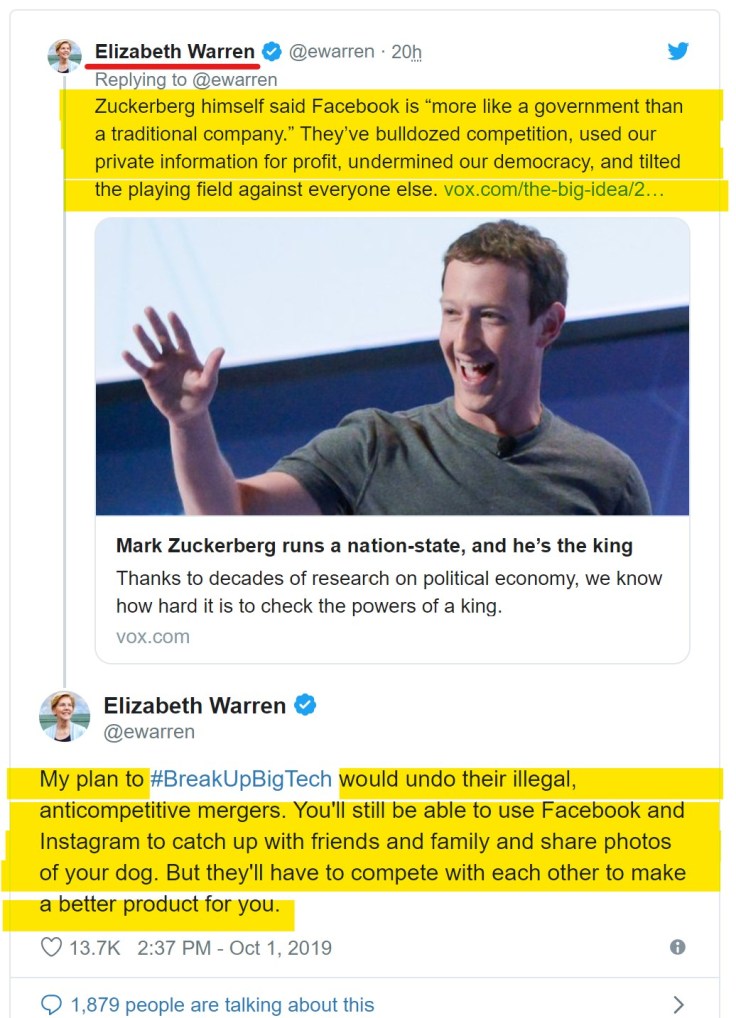
“We care about our country and want to work with our government to do good things. But look, at the end of the day, if someone’s going to try to threaten something that existential, you go to the mat and you fight.” Translation: we care about our country, as long as it doesn’t get in our way. And other countries? Asked about skipping hearings where he was expected to testify in Canada and the UK, Zuckerberg indicated he didn’t care so much about those: “It just doesn’t really make sense for me to go to hearings in every single country that wants to have me show up,” he explained, sounding genuinely bewildered that such a thing might be expected of him.
One particularly interesting employee question concerned how to improve Facebook’s “self-image” – what to tell friends and family who hate or fear the social network. Zuckerberg’s answer was elusive and vague – tell critics that “you care about the problems and acknowledge that there are issues and that you’re working through them.”
And Zuckerberg insisted – despite that boilerplate answer – that caring is genuine. He “really cares” about “making sure that our products promote positive well-being,” he said, adding that this concern was behind the company’s decision to more prominently feature content from “friends and family” in newsfeeds, deemphasizing political and viral content. That decision hurt both the producers of such content and the company itself, which lost $100 billion of market cap in one day as the number of users fell dramatically – a historic record for a single-day drop, according to Zuckerberg, who laughed it off.
He also tried to smooth over the rough rollout of Libra, Facebook’s digital currency that has been panned by governments worldwide, claiming that “the public things” – presumably meaning politicians’ calls for extreme scrutiny of the project owing to Facebook’s history of privacy abuses – “tend to be a little more dramatic” but private meetings with regulators have been much easier.
While Zuckerberg doesn’t seem to be a fan of regulations targeting Libra, he is very supportive of regulation of social media – and it has more to do with dodging the pitchforks of angry users than innate virtue. Without regulation, “people are just going to keep on getting angrier and angrier … demand more extreme measures, and eventually people just say ‘Screw it, take a hammer to the whole thing.’”

October 2, 2019
The 2020 candidate had two stents inserted to address a blockage in an artery, his campaign announced.
“During a campaign event yesterday evening, Sen. Sanders experienced some chest discomfort. Following medical evaluation and testing he was found to have a blockage in one artery and two stents were successfully inserted,” said Sanders’ senior adviser Jeff Weaver on Wednesday in a statement.
Sanders, 78, remains hospitalized in Las Vegas, Nevada.
“Sen. Sanders is conversing and in good spirits. He will be resting up over the next few days,” Weaver said. “We are canceling his events and appearances until further notice, and we will continue to provide appropriate updates.”
By Tyler Durden
Authored by Patrick Buchanan via Buchanan.org,
“This is a very sad time for our country. There is no joy in this,” said Nancy Pelosi Saturday.
“We must be somber. We must be prayerful. … I’m heartbroken about it.”
Thus did the speaker profess her anguish — just four days after announcing that her Democratic House would conduct an impeachment inquiry of President Donald Trump.
But is this how it really went down? Is this how Pelosi came to authorize an impeachment inquiry before she read the transcript of the conversation between Trump and Ukrainian President Volodymyr Zelensky?
Another explanation, based on the actual events, suggests itself.
By late September, Pelosi was under constant fire from the House “resistance” that wanted Trump impeached and whose numbers were slowly growing. What was the speaker to do?
The judiciary committee is the body historically authorized by a vote of the full House to conduct impeachment inquiries. But to Pelosi this was looking like a loser, a dead end, a formula for failure followed by a backlash against House Democrats and her own removal as speaker in January 2021, if not before.
How so? Her judiciary committee chairman, Jerrold Nadler, in his investigation of Trump, had presided over a debacle of a hearing where Trump ally Corey Lewandowski mocked the members. House Budget Committee Chair John Yarmuth called the hearing a “fiasco.”
Thus, when news broke of a July 25 conversation between Trump and the president of Ukraine, during which Trump allegedly urged Zelensky “eight times” to investigate Joe Biden and son Hunter Biden’s connections to corrupt oligarchs, Pelosi seized upon it to solve all her problems.
To satisfy the red-hots in her Democratic caucus, she announced an impeachment inquiry on her own. To spare her moderates the pain of having to vote for or against an inquiry, she skipped the floor vote.
To ensure the investigation was done swiftly, she took the franchise from Nadler and his judiciary committee and handed it to Adam Schiff and the intelligence committee. Now she is urging a narrowing of the articles of impeachment to just one — Trump’s request of Ukraine’s president to look into the Bidens.
Pelosi’s hope: Have one House vote on a single article of impeachment by year end; then send it on to the Senate for trial and be done with it.
This is Nancy Pelosi’s fast track to impeachment of Trump and ruination of his presidency. But, to be sure, she is “heartbroken” about all this.
For three years, the media-deep state axis has sought to overturn the election of 2016 and bring down Trump, starting with Russia-gate. Now it appears to have tailored and weaponized the impeachment process.
That is what this is all about. It always is. Then-editor Ben Bradlee of The Washington Post, when it looked like the Iran-Contra matter might break Ronald Reagan’s presidency, after his 49-state landslide, chortled, “We haven’t had this much fun since Watergate.”
This is what the deep state does to outsiders Middle America sends to Washington to challenge or dispossess it.
How should the Republican Party and Trump’s base respond?
Recognize reality. Whether or not Trump was ill-advised to suggest to the president of Ukraine that passing on the fruits of the investigation of Joe and Hunter Biden, the end game is bringing down Trump, democracy’s equivalent of regicide.
While the “whistleblower,” whose memo is the basis of these impeachment hearings, is well on his way to Beltway beatification, no campaign to depose the president can be allowed to cloak itself in anonymity indefinitely, for one man’s whistleblower is another man’s seditionist.
Whom did the whistleblower collaborate with to produce his memo? What is his background? What are his biases? The people have a right to know. And democracy dies in darkness, does it not?
Not until 30 years after Watergate did we learn the “whistleblower” known as “Deep Throat” was a corrupt FBI veteran agent who leaked grand jury secrets to The Washington Post to discredit acting Director Pat Gray and thereby become FBI director himself.
His identity was sheltered for three decades. For whose benefit?
Republicans should not allow Democrats to fast-track this process but should give their troops time to recognize the stakes involved, organize a defense and repel this latest establishment attempt to overthrow a president elected to come to the capital to corral that establishment.
Force all the Democratic candidates for president to take a stand on removing Trump for high crimes — over a nebulous phone call to Kiev.
And the U.S. Senate should refuse to take up and should return to the House any bill of impeachment done in a short-circuited and savagely partisan manner, as this one is being done. There should be no rush to judgment.
If the election of 2020 is going to be about President Trump, tell the nation that the people will decide his political fate in November 2020, and that of Joe Biden if Democrats believe he is as pure as the driven snow and choose to nominate him.
By Mark Dice
9/27/2019
By Hannah Bleau
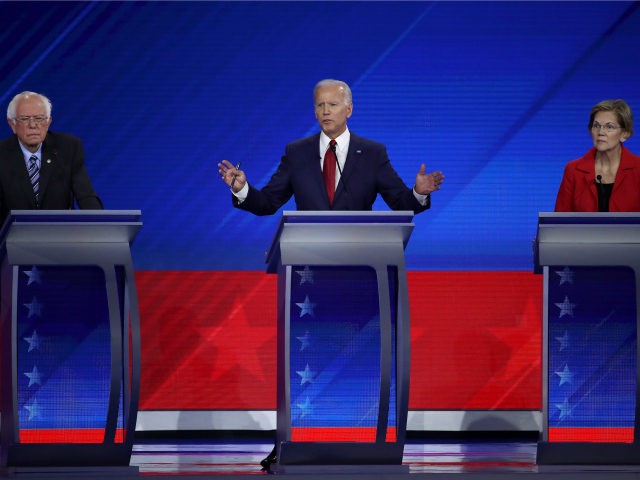
There were a few tense matchups between the ten candidates on the debate stage – Joe Biden (D), Sen. Bernie Sanders (I-VT), Warren, Sen. Kamala Harris (D-CA), Mayor Pete Buttigieg (D), Beto O’Rourke (D), Sen. Cory Booker (D-NJ), Sen. Amy Klobuchar (D-MN), Andrew Yang (D), and Julián Castro (D). Early on, Castro questioned Biden’s memory during a heated discussion on health care.
“Are you forgetting what you said already just two minutes ago?” Castro asked after Biden said his healthcare plan would cause Americans to lose their employee health insurance and “automatically … buy into” his plan. Minutes later, he said they would not have to.
“I mean, I can’t believe that you said two minutes ago that they had to buy in, and now, you’re saying they don’t. … You’re forgetting that,” Castro said.
Other notable moments include O’Rourke’s vowing to enact mandatory gun confiscation, Warren’s refusing to say if she would raise taxes on middle class Americans to pay for Medicare for All, and Sanders’ urging the U.S. to focus less on military expenditures and more on bringing the world “together” on climate change.
However, three hot topics were notably absent from the evening’s discussions: impeachment, abortion, and Warren’s false ancestry claims.
Impeachment: Impeachment has been a contentious topic on Capitol Hill. On Thursday, the House Judiciary Committee passed a resolution outlining the impeachment inquiry rules, even though the full House has yet to vote. While Democrats are more than 80 votes short of a pro-impeachment majority in the House, chairman Jerry Nadler (D-NY) said a vote will transpire before Democrats choose a Democrat nominee to face President Trump.
“Candidates for the president are going to run on whatever they run on,” Nadler told the Washington Examiner. “By the time of the campaign, the president will or will not have been impeached.”
Despite the buzz on the Capitol and House Speaker Nancy Pelosi (D-CA) constantly fielding questions on her position on the committee’s move, impeachment was not mentioned during the debate.
Abortion: Women’s issues – abortion, specifically – have been a massive talking point for many of the Democrat candidates. The subject became even more prominent following the slew of states enacting pro-life laws this year, and tensions increased as Democrats repeatedly stiff-armed the Born-Alive Abortion Survivors Protection Act.
Some candidates have been under fire in recent weeks for their hardline stance on abortion. Buttigieg – who considers himself a Christian – made waves last week after suggesting that Scriptures indicate that a baby’s life does not begin until a physical first breath. Sanders also came under fire last week after CNN’s climate change town hall during which he floated population control – via worldwide abortion – as a viable solution to combat the climate change “crisis.”
Despite that, abortion was not mentioned during the three-hour event.
Warren’s ancestry: Warren’s ancestry failed to come up in the third presidential debate, as moderators and candidates refused to grill her on the subject. While Warren mentioned her past – waitressing, going to college, and becoming a special needs teacher – she failed to mention the role her false claims of Native American heritage played.
The presidential hopeful identified as a minority in the Association of American Law Schools (AALS) deskbook for years and listed herself as a Native American on her Texas Bar registration card. Ultimately, a DNA test found that she had between 1/64th to 1/1,024 Native American ancestry. Even so, her possible connections were not associated with tribal nations in America. Additionally, as Breitbart News reported, Warren has significant ancestral ties to Indian fighters. Specifically, her great-great-great-grandfather, Jonathan Crawford, “served in Major William Lauderdale’s Battalion of Tennessee Volunteer Militia from November 1837 to May 1838, a six month time period during which it fought two battles in Florida against the Seminoles.”
While Warren has apologized for making “mistakes,” she has yet to elaborate on her false claims of Native American heritage, particularly on a debate stage.

The prosecutors will check whether Facebook “stifled competition and put users at risk,” said New York Attorney General Letitia James who is leading the probe.
Even the largest social media platform in the world must follow the law and respect consumers.
The attorneys general of Colorado, Florida, Iowa, Nebraska, North Carolina, Ohio, Tennessee, and the District of Columbia are also taking part in the probe.
In recent years Facebook has greatly expanded its business ventures, acquiring Instagram and WhatsApp Messenger which unlike their parent company are growing fast.
Facebook allows massive data leaks with no rules in US to prevent it – expert to Boom Bust

Meanwhile the social media behemoth is facing a litany of accusations for violating users’ privacy and misusing their data. In July, the Justice Department (DoJ) launched a probe into whether the big tech firms are complying with antitrust laws. The officials did not explicitly call out Mark Zuckerberg’s company but hinted that they will be going after the major players.
Congress also started an investigation into Facebook and other IT giants. The House Judiciary Committee head, Rep. Jerrold Nadler (D-NY), voiced concern that “a handful” of companies have taken control over the vast sectors of online commerce and communications. The issue even came up in the 2020 presidential race with Democratic nomination hopefuls, like Senators Elizabeth Warren and Bernie Sanders, arguing that Facebook is too powerful and needs to be “broken up.”
Facebook, of course, denies it violated any antitrust rules, and said it is eager to work with lawmakers to come up with regulations to “protect” users.
 Tom's Blog