Suspected ISIS Terrorist Arrested In Hungary Held Prepaid EU Debit Card

By Dan Lyman

A Syrian man arrested by Hungarian authorities under suspicion of terrorist activities was in possession of a prepaid debit card issued by the E.U., according to a government spokesman.

F. Hassan was recently detained in Budapest by officers of the Hungarian Counterterrorism Centre (TEK), suspected of being a high-ranking ISIS operative who had carried out attacks and executions in his homeland.

Reports now indicate that Hassan was holding one of the many “anonymous” debit cards issued to migrants by the E.U. and U.N. – a scheme that was recently unearthedand confirmed by the European Commission following a public information campaign initiated by the Hungarian government.

“The Hungarian government had warned that these anonymous, prepaid debit cards posed a security risk,” writes Zoltan Kovacs, Secretary of State for International Communication and Relations. “After initial denials, the Commission finally admitted that the United Nations and the European Union have been distributing these cards to migrants who have reached the territory of the E.U. Some 64,000 debit cards were distributed to migrants in January alone.”

“Reports say that he received a monthly payment of 500 EUR on his debit card. That’s well over today’s gross minimum wage in Hungary.”

Hungarian officials are now demanding an “urgent answer” from the E.U. regarding whether it knew if Hassan had been issued one of the debit cards in question and how many other potential terrorists may have received them, according to Hungary Today.

“It is a lie that the 64,000 migrant cards issued so far are not anonymous, cannot be used to withdraw cash or that they can only be used in Greece,” MEP Tamas Deutsch told reporters.

Deutsch warned that “thousands” of jihadists may be pouring into Europe, hidden among the waves of migrants.

“Despite that fact, Brussels is enthusiastically distributing anonymous cards credited with hundreds of euros,” Deutsch said.

In November, 2018, Infowars Europe helped bring to light revelations that migrants were using preloaded MasterCard debit cards bearing insignias of the E.U. and U.N. to pay for goods and services along their journeys.

There is also evidence that the project is traceable to infamous Hungarian billionaire George Soros.

In Infowars’ original report, we detailed Soros’ likely ties to the scheme upon discovery of a 2017 MasterCard press release publicizing the launch of a partnership program with Soros called “Humanity Ventures,” which aimed to “catalyze and accelerate economic and social development for vulnerable communities around the world, especially refugees and migrants.”

Incredibly, the E.U. has claimed the program “does not encourage migration.”

HUNGARY OFFICIAL: “SOROS PULLS THE STRINGS IN BRUSSELS”

Hungary Official: "Soros Pulls the Strings in Brussels"

MEP demands an explanation

Hungary Journal – JANUARY 14, 2019

Fidesz believes George Soros’s people “are pulling the strings of the European Commission’s leading politicians” and demands an explanation, Fidesz MEP Tamas Deutsch said at a press conference on an unrelated topic in Budapest on Saturday.

Deutsch noted that daily Magyar Idok learned that U.S. billionaire Soros had met for talks with the EU leaders on at least 20 occasions. Soros held talks with Jean-Claude Juncker, Frans Timmermans, Emmanuel Macron and Dimitris Avramopoulos, he added.

A poster slamming George Soros in Szekesfehervar, Hungary (Photo by Attila Kisbenedek / Contributor via Getty Images)

Deutsch said it was “absurd” that a person claiming to be a philanthropist who represents the official viewpoint of not a single country can meet with EU leaders more frequently than the prime minister or head of state of any EU member state.

Fidesz will ask for explanations, in writing, on the subject matter of all of these meetings, he added.

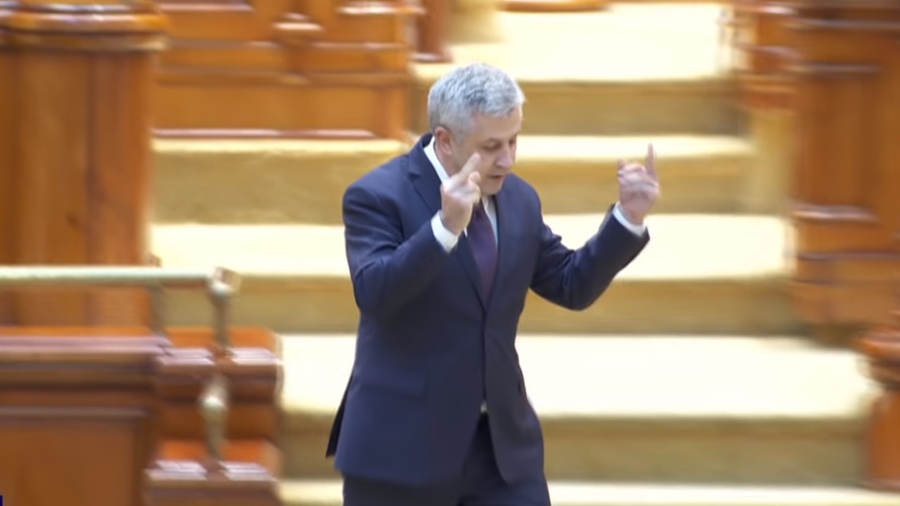
Double middle finger…to EU? Top Romanian official slams union, makes ‘offensive gestures’ (VIDEO)

Double middle finger…to EU? Top Romanian official slams union, makes ‘offensive gestures’ (VIDEO)

Things got obscene at the Romanian parliament as its deputy speaker vowed to resist pressure from the EU and go on with a controversial judiciary reform. The politician reinforced his statement by producing a double middle finger.

The fiery speech from the top official came in response to a damning report from the bloc, which accused the country of backsliding in the fight against corruption. Deputy Speaker Florin Iordache, who also leads the parliamentary commission discussing the judiciary reform, said that the government will carry on with its plans despite the mounting external pressure.

READ MORE: US Coast Guard ‘removed’ after making ‘white power’ hand signal on live TV (VIDEO)

“We’ll go on despite all the opposition from the European Commission,” Iordache told the parliament on Wednesday. “We want to be independent, we want to make the decisions according to our constitution and not because of the pressure coming from other quarters.”

The politician then rushed off the podium while extending the central digits of both of his hands. It remained unclear whether the apparent obscene gesture was addressed to the EU or not.

The opposition lawmakers, however, took offense, since Iordache appeared to be pointing at their direction. The official refused to apologize over the incident, claiming that he merely had a “spasm” following the speech and did not make any obscene gestures, according to lawmaker from the Save Romania Union (USR), Iulian Bulai.

On Tuesday, the European Commission released its annual report on the administration of justice in Romania, voicing concerns that the ongoing judiciary reform might jeopardize “the progress” it has made since joining the bloc. Brussels called upon the country’s government to “suspend immediately” its judiciary reform and criminal code overhaul, appointing an “anti-corruption prosecutor” instead.

“I regret that Romania has not only stalled its reform process, but also reopened and backtracked on issues where progress was made over the past 10 years,” the First Vice-President of the Commission Frans Timmermans told reporters.

The reform, launched by the ruling Social Democrats party and its allies early in 2017, has attracted much scrutiny from the EU, which expressed fears that it might undermine independence of the country’s judiciary system and make it highly politicized. Critics of the reform accuse the government of pushing it through to help politicians accused of corruption and to weaken the country’s judiciary. The controversial reform also sparked mass protests across the country, forcing Iordache, who briefly held the minister of justice post early in 2017, to resign.

If you like this story, share it with a friend!

Blog at WordPress.com.

Up ↑