‘Largest scam in history’: HALF of Facebook accounts fake, says Zuckerberg’s Harvard classmate

cap

As many as half of Facebook‘s two billion accounts are fake or duplicates, according to a new report from a former classmate of CEO Mark Zuckerberg. He has highlighted how the fakes defraud users, advertisers and investors alike.

Rocked by a major privacy scandal last year, Facebook has been trying to create an image of a company with high community standards, striving to curb the illicit behavior of users. But the company may be deliberately understating the amount of fake accounts, a new report says.

The firm’s own quarterly investment reports reveal that the its much-vaunted account base, which is supposedly has over 2 billion monthly active users, is packed with fake accounts communicating with just enough randomness to trick the social network’s algorithms, according to Zuckerberg’s former classmate at Harvard, Aaron Greenspan.

Greenspan claimed that he had originally come up with the idea for Facebook and worked on the future network, before Zuckerberg eventually founded the company. That claim was the basis of the trademark dispute between Facebook and Greenspan’s company, Think Computer Corporation, settled in 2009.

In a report, published by his legal data nonprofit PlainSite, Greenspan alleges that Facebook “has been lying to the public about the scale of its problem with fake accounts, which likely exceed 50 percent of its network.”

The fake accounts are particularly dangerous because they “often defraud other users on Facebook, through scams, fake news, extortion, and other forms of deception” and often “involve governments,” he writes.

He further accused the company of “selling” ads to “hundreds of millions of phantom buyers – users who do not actually exist.” 

cap

According to Greenspan, Facebook has attempted to obscure and downplay the actual number of fake accounts and their prevalence by employing “cleverly worded disclaimers” in its official reporting as well as dropping “many” of the important metrics from quarterly reports altogether.

In his report, citing the social network’s own estimates, Greenspan concludes that since the end of 2017 Facebook has deleted at least 2.8 billion fake accounts, which is more that the amount of its monthly active users and more than a half of “all accounts ever created.” 

Facebook outright denied Greenspan’s claims. “This report is completely wrong and not based on any facts or research,”the company told RT, adding that Facebook files its fake account estimates with the Securities and Exchange Commission every quarter. “This is unequivocally wrong and responsible reporting means reporting facts, even if it’s about fake accounts,” the statement continued.

Still, an entire industry has sprung up to supply convincingly “aged” fake Facebook accounts, often bundled by the hundred and boasting less than 1 percent detection rate.

Facebook attracts advertisers by flaunting the access to its billion-plus users, sorted and categorized by a marketer’s dream of individual data. However, some reports claim that in reality a sizeable amount of traffic online is generated by fake-clicking’ done by bots and humans working on specially-organized ‘click farms,’ as the company reached the market saturation or simply ‘ran out of humans.’

Small advertisers sued the social media giant last year, claiming it overstated the amount of time users spent watching videos by up to 900 percent. According to Marketing Land, the alleged fraud is far from an isolated event: Facebook misreported the reach of Facebook Page posts, the proportion of users who watch ad videos all the way through, the average time users spend reading “instant articles,” the number of referrals to external websites, and the number of mobile views, as claimed in the reports the outlet collected.

Facebook’s role in global ads is expected to grow. Digital publishing agency Polar estimated that the tech giant, together with Google and several other ‘digital goliaths’ like Amazon, will control 80 percent of all digital advertising in 2019.

In recent years, the social network had been entrenched in high-profile controversies over users’ data protection, privacy issues, and the spread of misinformation online. To make matters worse, Facebook’s market value has been slidingdownwards since July, when it lost almost $120 billion in a single day of trading – the largest-ever drop in company valuation in stock market history.

Following the Cambridge Analytica data-mining scandal, the company’s CEO Mark Zuckerberg admitted that Facebook didn’t do enough to safeguard its users’ interests and apologized. In response to mounting criticism, he vowed to step up commitments to privacy protection.

In an effort to combat disinformation, the company experimented with its algorithms to detect ‘fake news’ and broughtthird-party fact-checkers on board for help.

ALSO ON RT.COMFacebook may face a record fine over privacy lapses – reports

In the first six months of 2018 alone Facebook said it removed around 1.5 billion fake accounts. Last year, the company also reported removing fake accounts linked to either Russia or Iran, and although the numbers were minute on the overall scale, measuring from under 100 to several hundred, the news received wide coverage.

Facebook’s model of operations “can feel opaque” and be hard to understand for outsiders, Mark Zuckerberg wrote in an op-ed for Wall Street Journal on Thursday.

“Sometimes this means people assume we do things that we don’t do. For example, we don’t sell people’s data, even though it’s often reported that we do.”

The company’s CEO reiterated that the network has “strong incentive” to protect users’ data and selling off such information is against the company’s business interests.

Think your friends would be interested? Share this story!

No need to install: Microsoft has controversial fake news filter NewsGuard built into mobile browser

cap

Corporate and neocon-backed startup NewsGuard is one step closer to its vision of bringing its “unreliable” news rater to every screen after Microsoft makes it an integral part of its Edge mobile browser.

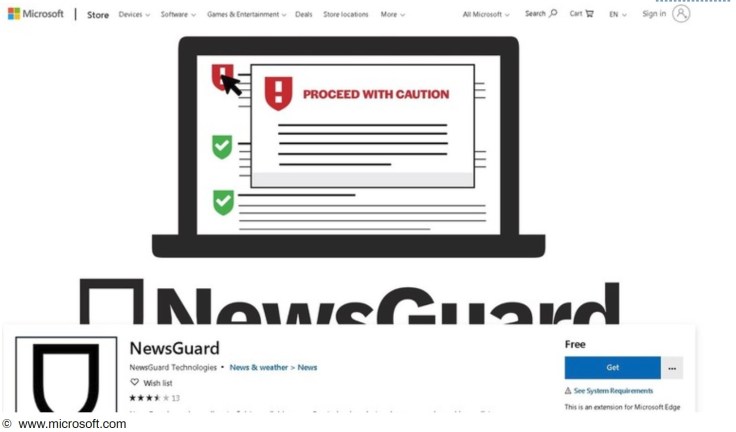
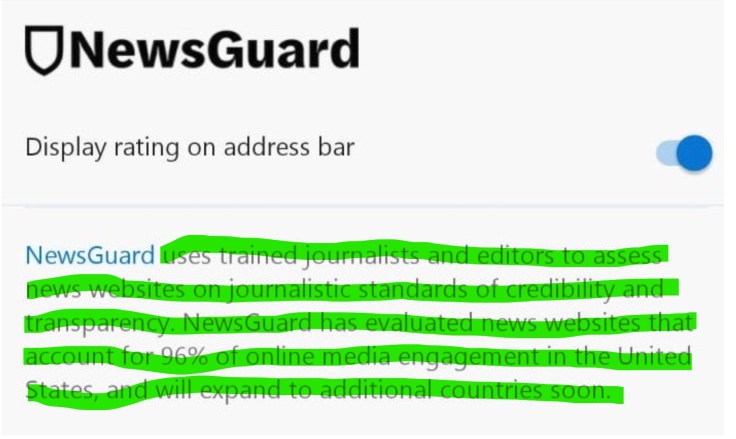
Rather than having to download an app as before, Edge users on Android and Apple devices can now just click one button to enable its “green-red rating signal if a website is trying to get it right or instead has a hidden agenda or knowingly publishes falsehoods or propaganda.”

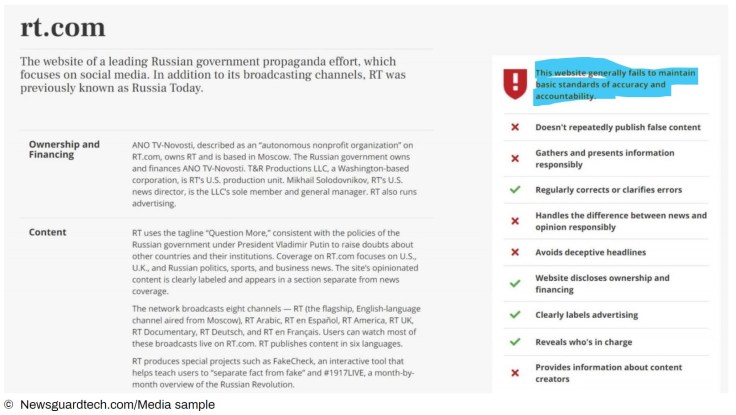
Among the green-rated websites: Voice of America, CNN, Buzzfeed, the Guardian, New York Times and the Washington Post, as well as left-leaning upstarts such as Vice News and Refinery 29. Ones that are given the red warning label of “failing to maintain basic standards of accuracy and accountability”: RT and Sputnik (obviously enough) and the right-wing Daily Mail, Breitbart and the Drudge Report, in addition to hundreds of other non-mainstream news websites such as Wikileaks.

cap

Not only does the integration ensure that NewsGuard is present on every browser, and is easier to use than to ignore, but by making it a fundamental Microsoft-provided feature, the company gives it inherent level of trustworthiness, something akin to a bundled anti-virus feature, only this time the virus targets your brain, not your computer or iPod.

‘Totally transparent’

None of this is the slightest bit alarming if you believe that NewsGuard is an absolutely fair arbiter of what constitutes real news or propaganda.

Its pride of place is its “Nutrition Labels” which ape the precision of a list of calories, carbs, and saturated fats to give a supposedly scientific assessment of media reliability on nine different criteria. Among them: doesn’t repeatedly publish false content, avoids deceptive headlines, gathers and presents information responsibly, handles the difference between news and opinion responsibly.

cap

The green-listed media outlets above apparently do not ever engage in these practices, or at least not knowingly. So CNN never misleads with its headlines, the Guardian never dresses up its agendas as news, and Buzzfeed stories are always accurate. One literally doesn’t have to go back three days to find dozens of examples to the contrary, but this would be too mind-numbingly pedantic a task.

Even regular readers of the green-tick media must be able to see these are judgment calls. What is even “presenting information responsibly”?

Perhaps realizing that their pseudo-scientific fancy diagram is insufficient, NewsGuard has stressed that they are not using shadowy methods like tech companies and are open to two-way communication.

“We want people to game our system. We are totally transparent. We are not an algorithm,” company co-founder Steve Brill told the Guardian.

This is how he explained the Daily Mail red warning.

“We spell out fairly clearly in the label exactly how many times we have attempted to contact them. The analyst that wrote this writeup got someone on the phone who, as soon he heard who she was and where she was calling from, hung up. As of now, we would love to hear if they have a complaint or if they change anything.”

On the other hand, RT did answer NewsGuard’s queries in detail. You can guess how much difference that made.

From anthrax scares to Russia fears

But who are these people that the Daily Mail or RT have to impress and why?

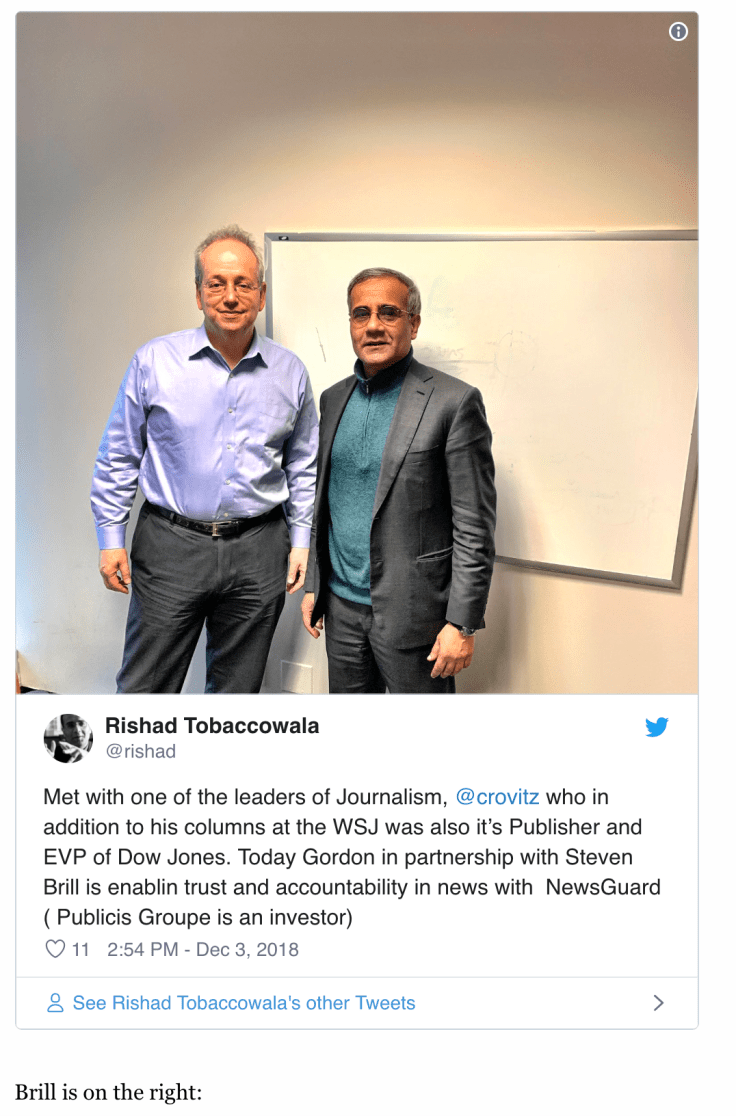
Brill himself is a veteran centrist journalist and author, his co-CEO Gordon Crovitz is a former Wall Street Journal columnist. After Brill, its second-biggest investor, along with his father, is Nick Penniman, the liberal publisher, and the third-biggest is Publicis Group, a multinational advertising agency.

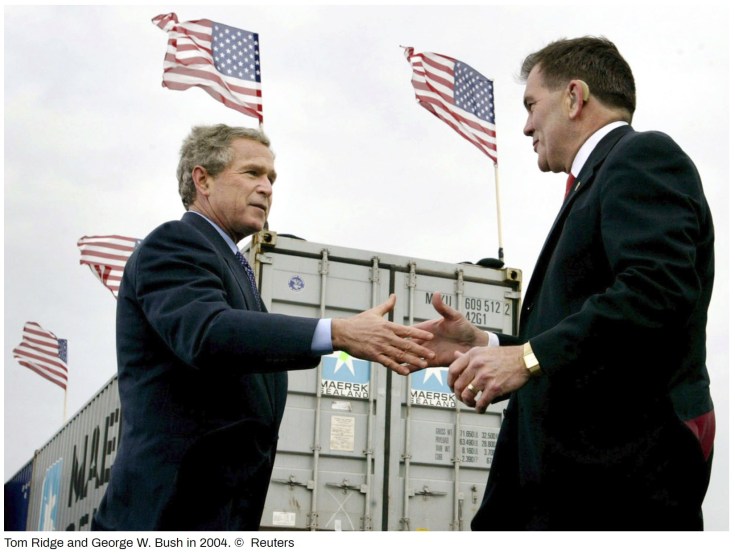
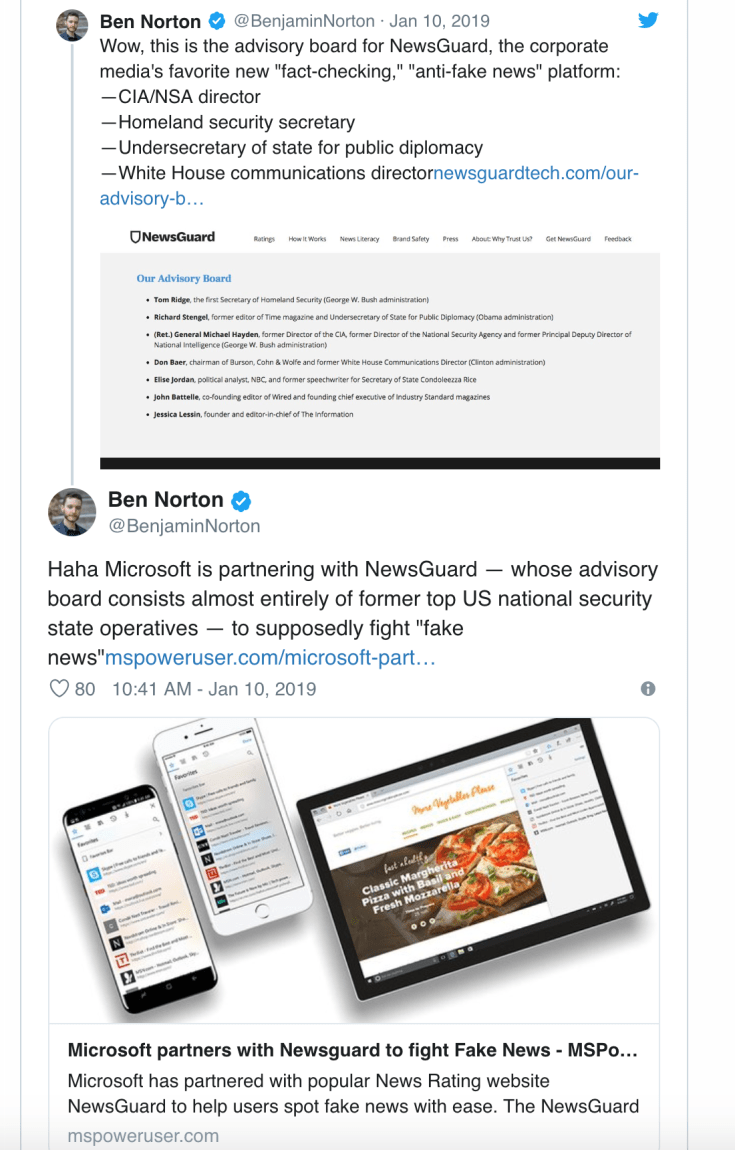
Meanwhile, its advisory board includes Tom Ridge, the first-ever Homeland Security chief, and developer of another famous color-coded system, the terror alert, and Michael Hayden, the CIA director, also under George W. Bush. There are also several Obama and Clinton-era figures.

cap

The overall picture emerges of a mix of establishment journalists, hawkish old-school Washington insiders, and so-called ethical businessmen.

They may all be experts in their fields, but if you believe that these are selfless neutral adjudicators you are probably beyond being helped by color charts. And this is not some one-off initiative either: NewsGuard is part of Microsoft’s Defending Democracy program, which combats purported election meddling, presumably primarily from Russia. The frontline of the information war is not customarily the place for impartial news judgment.

But I wasn’t an Edge user…

However much respectability NewsGuard enjoys through Microsoft, Edge has a laughably small – a fraction of a percent – market share on mobiles. In practical terms, even an increase of popularity of several thousand percent will only mean several thousand new users, and other browsers are available.

This would be that, if not for newsGuard’s self-proclaimed ambition “to expand to serve the billions of people globally who get news online.” This is just a beginning: there is an overarching plan where all public computers, from the school to the university to the library, are automatically equipped with the same “safe browsing” system.

And rather than as an individual warning, NewsGuard plans to make its designations work as an effective financial tool. The company, which has received $6 million in backing, also plans to soon work with advertisers, “keeping ads off unreliable news websites” to ensure “brand safety.” Fall foul of the green ticks, no money for you. Advertising managers are already demonetizing programs with alternative or controversial viewpoints elsewhere, and soon the process can be automated, and Brill is boasting that he is “happy to be blamed – doing the dirty work for the platforms. No wonder alternative outlets in the US are openly opposed.

So, just like the use of NewsGuard in all public libraries in the faraway state of Hawaii (no money charged), it is best to look at the Edge integration is more of a test, a pilot project, a dry run. Latching NewsGuard onto a popular browser like Chrome, or a social network like Facebook, would stir tremors of public debate, as it has done in the past when similar initiatives have been tried. Instead, first they came for the Edge users.

UNIVERSITY OF GEORGIA LECTURER SAYS “FIGHTING WHITE PEOPLE IS A SKILL”

University of Georgia Lecturer Says "Fighting White People is a Skill"

“You have to get used to fighting white people”

 | Infowars.com – JANUARY 17, 2019

A philosophy lecturer at the University of Georgia was accused of advocating racial violence after he tweeted “fighting white people is a skill”.

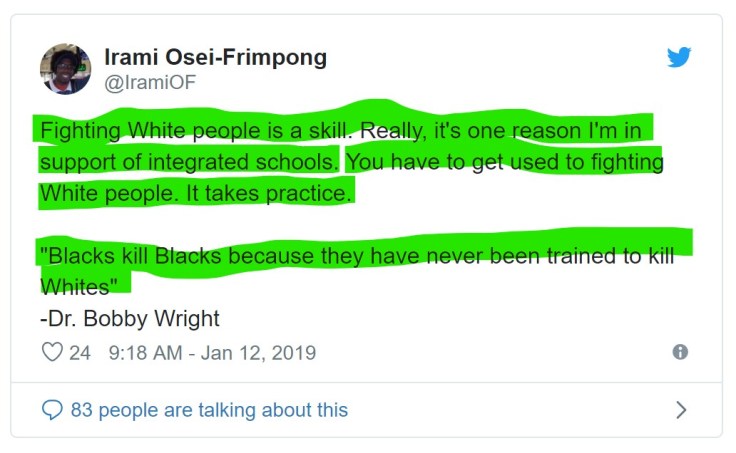
“Fighting White people is a skill. Really, it’s one reason I’m in support of integrated schools. You have to get used to fighting White people. It takes practice,” tweeted Irami Osei-Frimpong, who is listed on the official University of Georgia website under the Department of Philosophy.

cap

Osei-Frimpong, who goes by the name ‘The Funky Academic’, also quoted Bobby E. Wright, a political activist who once said, “Blacks kill Blacks because they have never been trained to kill Whites.”

One respondent on Twitter accused of “advocating racial violence against whites”.

cap

“It is interesting that you believe this. Black people in white neighborhoods tend assimilate with white people, and despise people who think like you,” commented another user.

It is unclear why Osei-Frimpong advocates “fighting white people,” but a review of his teaching style on the RateMyProfessors website reveals one student’s opinion that, “If you are sensitive to criticism of white people, you will not enjoy his lectures.”

Osei-Frimpong’s blog features writing in support of the Black Lives Matter movement, while one entry also discusses how he was suspended by Facebook for 30 days for a post in which he called for a “political revolution” and said he was a fan of “white people writing checks out of guilt.”

Osei-Frimpong’s Facebook page also reveals his support for Democrats like Alexandria Ocasio-Cortez and Bernie Sanders.

Over 770 million email addresses shared online in largest data breach in history

screen shot 2019-01-17 at 11.09.50 am

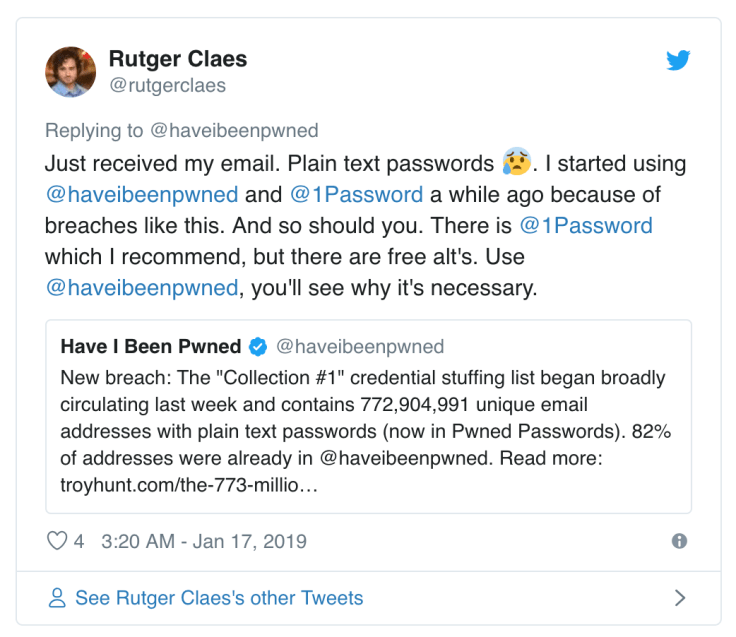
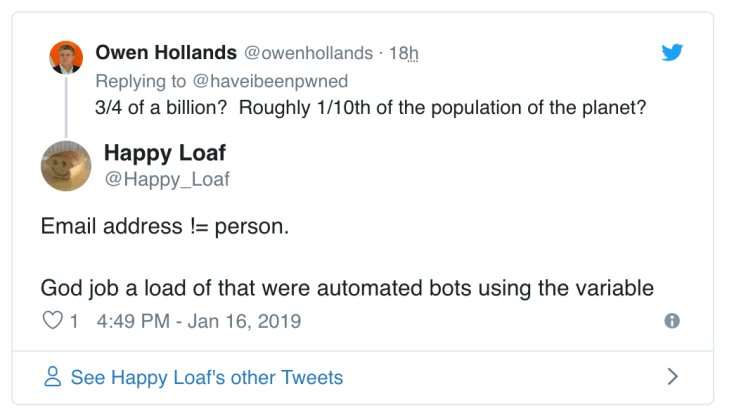
A security researcher has blown the lid off the largest data breach in history as over 770 million emails and 21 million unique passwords have been exposed, eclipsing the Equifax and Yahoo hacks by a significant margin.

The breach is being dubbed ‘Collection #1’ and contains a raw data set of email addresses and passwords totalling 2,692,818,238 rows from potentially thousands of different sources, according to digital security expert Troy Hunt.

screen shot 2019-01-17 at 11.12.07 am

In terms of sheer volume, it is being considered the largest data breach in history, second only to Yahoo’s high profile cyber security gaffes which affected billions of users, though it is an aggregate of potentially hundreds if not thousands of breaches.

“It just looks like a completely random collection of sites purely to maximize the number of credentials available to hackers,” Hunt told WIRED“There’s no obvious patterns, just maximum exposure.”

screen shot 2019-01-17 at 11.14.24 am

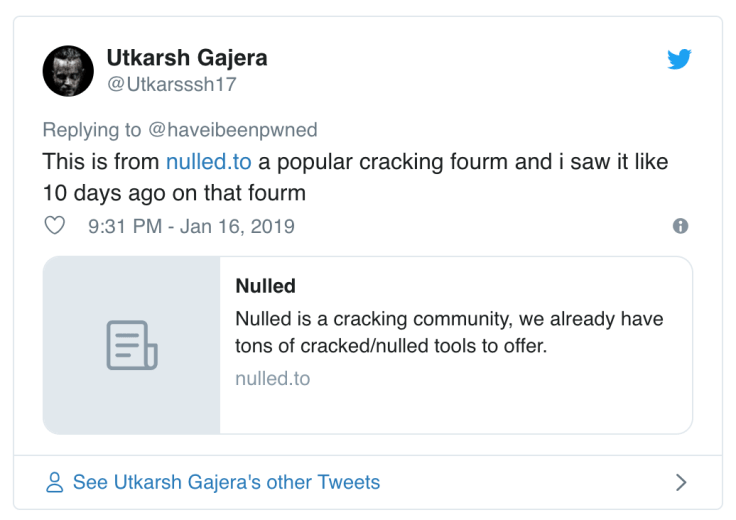
The breach contains previously encrypted passwords that have been “dehashed” or cracked and converted back to plain text and includes files allegedly from as early as 2008. The information wasn’t even for sale but was merely dumped on MEGA and subsequently on a popular hacking forum, free for anyone with scroll and click capabilities to review.  

screen shot 2019-01-17 at 11.15.30 am

As a result, there is a greatly increased risk of so-called credential-stuffing attacks in which hackers spam websites with various combinations of emails and passwords, including – but not limited to – services like Netflix, Facebook or other social media accounts, and online services. The breach doesn’t appear to contain social security or credit card data.

screen shot 2019-01-17 at 11.16.40 am

Hunt recommends checking your email addresses on the free service provided by Have I Been Pwned.

If you are included in the breach, which is extremely likely, he recommends using a password manager or even going old school and employing *gasp* a pen and paper to store your passwords offline. Hack that!

screen shot 2019-01-17 at 11.18.21 am

“It might be contrary to traditional thinking, but writing unique passwords down in a book and keeping them inside your physically locked house is a damn sight better than reusing the same one all over the web,” Hunt wrote in his blog post on the breach.

A lucky few are claiming to have escaped the breach, but the odds are not in your favor.

‘Land of censorship & home of the fake’ Facebook is getting into the local news business

capture

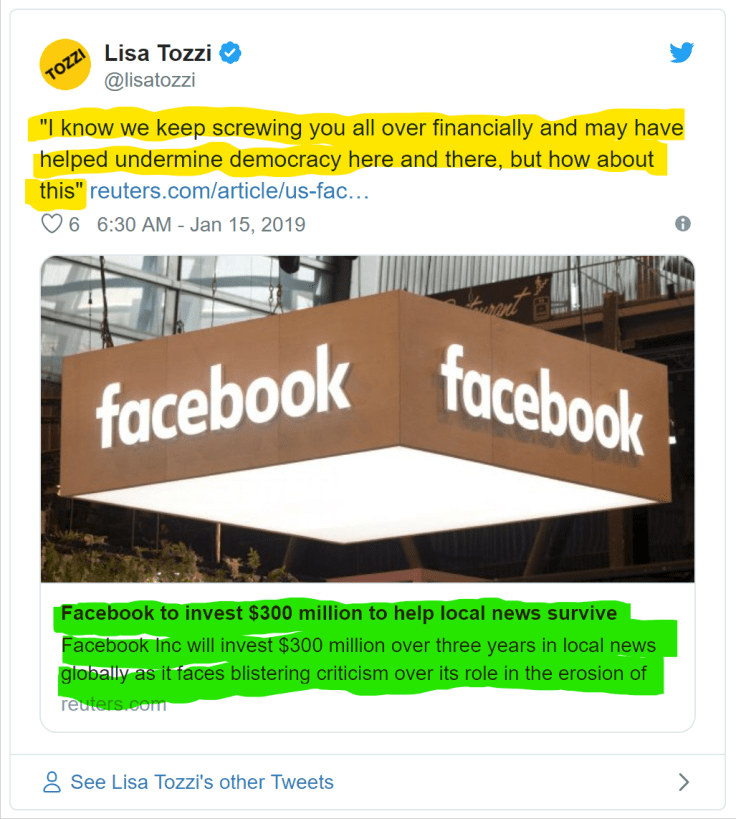
Facebook is investing $300 million in local newsrooms and training initiatives for regional journalists over the next three years. But can Mark Zuckerberg be trusted to keep the press free?

With print newspapers’ advertising revenues in freefall for almost two decades, and local newspapers conglomerating and laying off staff to survive, the industry will take any help it can get. Facebook – with its mountains of fake news, clickbait, and a tricky environment for digital publishers to make money in – has in no small way contributed to the precarious state of modern journalism, but the company now wants to give the fourth estate a booster shot.

The company decided to focus specifically on local news. Vice President of Global News Partnerships Campbell Brown said in a blog post that after examining what kind of news people want to see on Facebook, the company “heard one consistent answer: people want more local news, and local newsrooms are looking for more support.”

Facebook’s support for the new industry has thus far been limited to funding a small selection of news programs from CNN, Fox News, and a handful of others. The social media giant has been far more keen to play policeman, partnering up with an array of third-party “fact checkers”last year to filter out “false narratives” and “intentionally divisive headlines and language that exploit disagreements and sow conflict”from users’ timelines.

Troublingly, even Facebook’s own staff could not explain what exactly the term “false narratives” meant. Additionally, Facebook CEO Mark Zuckerberg met with a consortium of media executives shortly afterwards to talk about his company’s use of algorithms to promote ‘reputable news’ and suppress other content, all to ensure that “people can get trustworthy news on our platform.”

Drawn from CNN, the New York Times, Buzzfeed and others, the overwhelmingly liberal makeup of the panel of executives did little to persuade conservatives – who have long accused the platform of bias – that Facebook would act impartially.

Neither did Facebook’s announcement in August that it would partner up with the aggressively pro-NATO think tank, the Atlantic Council. The Atlantic Council vowed to serve as Facebook’s “eyes and ears” in the fight against fake news, but that fight resulted in hundreds of alternative news pages being purged from the platform in October. The 800 pages spanned the political spectrum, and their removal triggered cries of censorship and accusations that Facebook was waging “a wider war on dissident narratives.”

One banned cartoonist declared Facebook to be “land of the censorship and home of the fake,” while anti-war journalist Caitlin Johnstone called the purge the “latest escalation of corporate censorship used as state censorship in the West.”

Can Facebook then be trusted to fund local journalism?

The answer is unclear. The $300 million will be given to a number of organizations to distribute further. Some of these organizations, like the Pulitzer Center, are household names. Others, like Report for America, are less well known. The Pulitzer Center will receive $5 million to award as grants to local newsrooms around the country, and social justice non-profit Report for America will get $2 million to go towards the hiring of 1,000 journalists over the next five years.

Pulitzer Center founder and executive director Jon Sawyer welcomed the funding, and took time to “applaud Facebook’s commitment to the editorial independence that is absolutely essential to our success.”

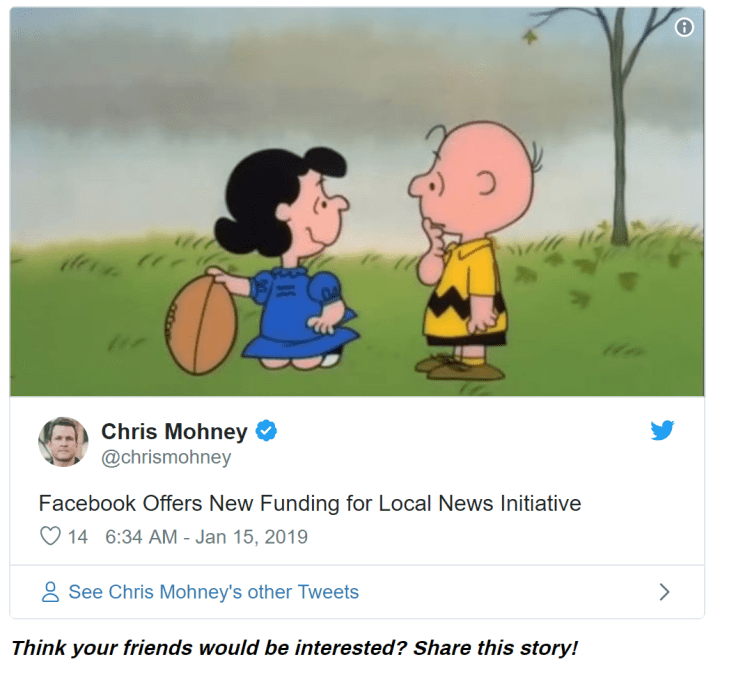
No matter how hands-off Facebook stays, some commentators were angered by the company’s new-found role as champion of the local press. After contributing in a large way to the decline of print media, Facebook’s $300 million investment in the industry is, as one cartoon implied, “peanuts.”

capture

capture

Microsoft Partners With Neocon-Backed ‘Fact Checker’ Seeking To ‘Wage War On Independent Media’

by Chris Menahan

Microsoft has partnered with a shoddy Neocon-backed “fact checker” called NewsGuard which rates websites’ “credibility” in-browser and NewsGuard’s CEO says their goal is to have their software on all smartphones and computers by default. 

From MintPressNews:

How a NeoCon-Backed “Fact Checker” Plans to Wage War on Independent Media

As Newsguard’s project advances, it will soon become almost impossible to avoid this neocon-approved news site’s ranking systems on any technological device sold in the United States.
by Whitney Webb
January 09th, 2019

Soon after the social media “purge” of independent media sites and pages this past October, a top neoconservative insider — Jamie Fly — was caught stating that the mass deletion of anti-establishment and anti-war pages on Facebook and Twitter was “just the beginning” of a concerted effort by the U.S. government and powerful corporations to silence online dissent within the United States and beyond.

While a few, relatively uneventful months in the online news sphere have come and gone since Fly made this ominous warning, it appears that the neoconservatives and other standard bearers of the military-industrial complex and the U.S. oligarchy are now poised to let loose their latest digital offensive against independent media outlets that seek to expose wrongdoing in both the private and public sectors.

As MintPress News Editor-in-Chief Mnar Muhawesh recently wrote, MintPress was informed that it was under review by an organization called Newsguard Technologies, which described itself to MintPress as simply a “news rating agency” and asked Muhawesh to comment on a series of allegations, several of which were blatantly untrue. However, further examination of this organization reveals that it is funded by and deeply connected to the U.S. government, neo-conservatives, and powerful monied interests, all of whom have been working overtime since the 2016 election to silence dissent to American forever-wars and corporate-led oligarchy.

More troubling still, Newsguard — by virtue of its deep connections to government and Silicon Valley — is lobbying to have its rankings of news sites installed by default on computers in U.S. public libraries, schools, and universities as well as on all smartphones and computers sold in the United States.

In other words, as Newsguard’s project advances, it will soon become almost impossible to avoid this neocon-approved news site’s ranking systems on any technological device sold in the United States. Worse still, if its efforts to quash dissenting voices in the U.S. are successful, Newsguard promises that its next move will be to take its system global.

Red light, green light . . .

Newsguard has received considerable attention in the mainstream media of late, having been the subject of a slew of articles in the Washington Post, the Hill, the Boston Globe, Politico, Bloomberg, Wired, and many others just over the past few months. Those articles portray Newsguard as using “old-school journalism” to fight “fake news” through its reliance on nine criteria allegedly intended to separate the wheat from the chaff when it comes to online news.

Newsguard separates sites it deems worthy and sites it considers unreliable by using a color-coded rating — green, yellow, or red — and more detailed “nutrition labels” regarding a site’s credibility or lack thereof. Rankings are created by Newsguard’s team of “trained analysts.” The color-coding system may remind some readers of the color-coded terror threat-level warning system that was created after 9/11, making it worth noting that Tom Ridge, the former secretary of Homeland Security who oversaw the implementation of that system under George W. Bush, is on Newsguard’s advisory board.

As Newsguard releases a new rating of a site, that rating automatically spreads to all computers that have installed its news ranking browser plug-in. That plug-in is currently available for free for the most commonly used internet browsers. NewsGuard directly markets the browser plug-in to libraries, schools and internet users in general.

According to its website, Newsguard has rated more than 2,000 news and information sites. However, it plans to take its ranking efforts much farther by eventually reviewing “the 7,500 most-read news and information websites in the U.S.—about 98 percent of news and information people read and share online” in the United States in English.

[…]

According to local media, Newsguard “now works with library systems representing public libraries across the country, and is also partnering with middle schools, high schools, universities, and educational organizations to support their news literacy efforts,” suggesting that these Newsguard services targeting libraries and schools are soon to become a compulsory component of the American library and education system, despite Newsguard’s glaring conflicts of interest with massive multinational corporations and powerful government power-brokers.

Notably, Newsguard has a powerful partner that has allowed it to start finding its way into public library and school computers throughout the country. As part of its new “Defending Democracy” initiative, Microsoft announced last August that it would be partnering with Newsguard to actively market the company’s ranking app and other services to libraries and schools throughout the country. Microsoft’s press release regarding the partnership states that Newsguard “will empower voters by providing them with high-quality information about the integrity and transparency of online news sites.”

Since then, Microsoft has now added the Newsguard app as a built-in feature of Microsoft Edge, its browser for iOS and Android mobile devices, and is unlikely to stop there. Indeed, as a recent report in favor of Microsoft’s partnership with Newsguard noted, “we could hope that this new partnership will allow Microsoft to add NewsGuard to Edge on Windows 10 [operating system for computers] as well.”

Newsguard, for its part, seems confident that its app will soon be added by default to all mobile devices. On its website, the organization notes that “NewsGuard will be available on mobile devices when the digital platforms such as social media sites and search engines or mobile operating systems add our ratings and Nutrition Labels directly.” This shows that Newsguard isn’t expecting its rating systems to be offered as a downloadable application for mobile devices but something that social media sites like Facebook, search engines like Google, and mobile device operating systems that are dominated by Apple and Google will “directly” integrate into nearly every smartphone and tablet sold in the United States.

A Boston Globe article on Newsguard from this past October makes this plan even more clear. The Globe wrote at the time:
Microsoft has already agreed to make NewsGuard a built-in feature in future products, and [Newsguard co-CEO] Brill said he’s in talks with other online titans. The goal is to have NewsGuard running by default on our computers and phones whenever we scan the Web for news.”
This eventuality is made all the more likely given the fact that, in addition to Microsoft, Newsguard is also closely connected to Google, as Google has been a partner of the Publicis Groupe since 2014, when the two massive companies joined Condé Nast to create a new marketing service called La Maison that is “focused on producing engaging content for marketers in the luxury space.” Given Google’s power in the digital sphere as the dominant search engine, the creator of the Android mobile operating system, and the owner of YouTube, its partnership with Publicis means that Newsguard’s rating system will soon see itself being promoted by yet another of Silicon Valley’s most powerful companies.

Furthermore, there is an effort underway to integrate Newsguard into social media sites like Facebook and Twitter. Indeed, as Newsguard was launched, co-CEO Brill stated that he planned to sell the company’s ratings of news sites to Facebook and Twitter. Last March, Brill told CNN that “We’re asking them [Facebook, Twitter, Microsoft and Google] to pay a fraction of what they pay their P.R. people and their lobbyists to talk about the problem.”

[…]

Notably, Newsguard has a powerful partner that has allowed it to start finding its way into public library and school computers throughout the country. As part of its new “Defending Democracy” initiative, Microsoft announced last August that it would be partnering with Newsguard to actively market the company’s ranking app and other services to libraries and schools throughout the country. Microsoft’s press release regarding the partnership states that Newsguard “will empower voters by providing them with high-quality information about the integrity and transparency of online news sites.”

Since then, Microsoft has now added the Newsguard app as a built-in feature of Microsoft Edge, its browser for iOS and Android mobile devices, and is unlikely to stop there. Indeed, as a recent report in favor of Microsoft’s partnership with Newsguard noted, “we could hope that this new partnership will allow Microsoft to add NewsGuard to Edge on Windows 10 [operating system for computers] as well.”

Newsguard, for its part, seems confident that its app will soon be added by default to all mobile devices. On its website, the organization notes that “NewsGuard will be available on mobile devices when the digital platforms such as social media sites and search engines or mobile operating systems add our ratings and Nutrition Labels directly.” This shows that Newsguard isn’t expecting its rating systems to be offered as a downloadable application for mobile devices but something that social media sites like Facebook, search engines like Google, and mobile device operating systems that are dominated by Apple and Google will “directly” integrate into nearly every smartphone and tablet sold in the United States.

A Boston Globe article on Newsguard from this past October makes this plan even more clear. The Globe wrote at the time:
Microsoft has already agreed to make NewsGuard a built-in feature in future products, and [Newsguard co-CEO] Brill said he’s in talks with other online titans. The goal is to have NewsGuard running by default on our computers and phones whenever we scan the Web for news.”
This eventuality is made all the more likely given the fact that, in addition to Microsoft, Newsguard is also closely connected to Google, as Google has been a partner of the Publicis Groupe since 2014, when the two massive companies joined Conde Nast to create a new marketing service called La Maison that is “focused on producing engaging content for marketers in the luxury space.” Given Google’s power in the digital sphere as the dominant search engine, the creator of the Android mobile operating system, and the owner of YouTube, its partnership with Publicis means that Newsguard’s rating system will soon see itself being promoted by yet another of Silicon Valley’s most powerful companies.

Furthermore, there is an effort underway to integrate Newsguard into social media sites like Facebook and Twitter. Indeed, as Newsguard was launched, co-CEO Brill stated that he planned to sell the company’s ratings of news sites to Facebook and Twitter. Last March, Brill told CNN that “We’re asking them [Facebook, Twitter, Microsoft and Google] to pay a fraction of what they pay their P.R. people and their lobbyists to talk about the problem.”

[…]

Financial censorship

Another Newsguard service shows that this organization is also seeking to harm independent media financially by targeting online revenue. Through a service called “Brandguard,” which it describes as a “brand safety tool aimed at helping advertisers keep their brands off of unreliable news and information sites while giving them the assurance they need to support thousands of Green-rated [i.e., Newsguard-approved] news and information sites, big and small.”

At the time the service was announced last November, Newsguard co-CEO Brill stated that the company was “in discussions with the ad tech firms, leading agencies, and major advertisers” eager to adopt a blacklist of news sites deemed “unreliable” by Newsguard. This is unsurprising given the leading role of the Publicis Groupe, one of the world’s largest advertising and PR firms, has in funding Newsguard. As a consequence, it seems likely that many, if not all, of Publicis’ client companies will choose to adopt this blacklist to help crush many of the news sites that are unafraid to hold them accountable.

It is also important to note here that Google’s connection to Publicis and thus Newsguard could spell trouble for independent news pages that rely on Google Adsense for some or all of their ad-based revenue. Google Adsense has long been targeting sites like MintPress by demonetizing articles for information or photographs it deemed controversial, including demonetizing one article for including a photo showing U.S. soldiers involved in torturing Iraqi detainees at the infamous Abu Ghraib prison.

Since then, Google — a U.S. military contractor — has repeatedly tried to shutter ad access to MintPress articles that involve reporting that is critical of U.S. empire and military expansion. One article that has been repeatedly flagged by Google details how many African-Americans have questioned whether the Women’s March has aided or harmed the advancement of African-Americans in the United States. Google has repeatedly claimed that the article, which was written by African-American author and former Washington Post bureau chief Jon Jeter, contains “dangerous content.”

Given Google’s already established practice of targeting factual reporting it deemed controversial through Adsense, Brandguard will likely offer the tech giant just the excuse it needs to cut off sites like MintPress, and other pages equally critical of empire, altogether.
Read their full report.
screen shot 2019-01-14 at 3.08.56 pm

screen shot 2019-01-14 at 3.10.02 pm

screen shot 2019-01-14 at 3.10.49 pm

This has been a dream of the establishment for over a decade.

One of these NewsGuard “journalists” contacted yours truly with a review of Information Liberation that was so shoddy I didn’t even bother to respond as almost everything he said was wrong and his reading comprehension was terrible.

I figured it’s a waste of time to respond as I would be doing the reporter’s job for him by correcting him and I would only be improving his shoddy work.

It’s blatantly obvious their goal is not to create an honest assessment of any of our websites but instead to compile whatever slander they can throw together to suit their pre-ordained narrative.

JihadWatch’s Robert Spencer has also written an excellent article exposing NewsGuard titled, “Steven Brill’s NewsGuard and the ‘fact-checking’ scam.”

Just look at the guys behind this:
screen shot 2019-01-14 at 3.12.47 pm

screen shot 2019-01-14 at 3.13.53 pm

Would you trust those men to walk your dog?

The reason no one ever bothered implementing any scheme like this is because it’s so obviously a fraud and an affront to people’s intelligence that it is more likely to have the opposite effect — negative rated sites are going to be viewed as more credible as evidenced by the fact they’re being slandered by these establishment hacks.

REPORT: ZUCKERBERG HOSPITAL GOUGES PAYING PATIENTS TO PAY FOR ILLEGALS

Report: Zuckerberg Hospital Gouges Paying Patients to Pay For Illegals

Bike rider with private insurance charged over $20K for broken arm

 | Infowars.com – JANUARY 8, 2019

A San Francisco hospital named after Mark Zuckerberg is offsetting its public healthcare costs by sending expensive bills to privately-insured patients, according to a media report.

Zuckerberg San Francisco General reportedly billed a bike rider over $20,000 for a broken arm after her private insurance paid nearly $4000 to the hospital, an amount the insurer thought was reasonable for an arm splint.

capture

“A spokesperson for the hospital confirmed that ZSFG does not accept any private health insurance, describing this as a normal billing practice,” according to a report by left-leaning Vox News. “He said the hospital’s focus is on serving those with public health coverage — even if that means offsetting those costs with high bills for the privately insured.”

On its web site, ZSFG declares that “everyone is welcome here” regardless of their financial situation or immigration status:

Everyone is welcome here, no matter your ability to pay, lack of insurance, or immigration status. We’re much more than a medical facility; we’re a health care community promoting good health for all San Franciscans.

We’re part of a large group of neighborhood clinics and healthcare providers, the San Francisco Health Network. In partnership, we provide primary care for all ages, specialty care, dentistry, emergency and trauma care, and acute care for the people of San Francisco.

Because the Zuckerberg hospital doesn’t participate in the negotiated-cost networks of private health insurers, privately-insured patients are charged tens of thousands more for services that are significantly less at other hospitals.

“Our mission is to serve people who are underserved because of their financial needs,” the spokesperson also stated. “We have to be attuned to that population.”

Unfortunately for the bike rider, she didn’t have much choice in what hospital to go to while riding semi-conscious in the back of an ambulance.

Mark Zuckerberg donated $75 million to the hospital in 2015.

YOUNG TURKS DELETE MULTIPLE VIDEOS AFTER CLAIMING BLACK SHOOTER WAS ‘WHITE SUPREMACIST’ MOTIVATED BY TRUMP

Young Turks Delete Multiple Videos After Claiming Black Shooter Was 'White Supremacist' Motivated by Trump

Left-wing news outlet tries to hide evidence of pushing fake narrative

 | Infowars.com – JANUARY 7, 2019

The Young Turks were forced to delete numerous videos from their YouTube channel after helping to whip up the fake narrative that the murder of a 7-year-old black girl in Houston was a racist hate crime when in fact the gunman was black.

As we reported yesterday, for almost a week left-wing activists and the media fueled the story that the tragic killing of Jazmine Barnes was a white supremacist attack and indicative of a larger trend in America of black people being indiscriminately targeted by whites.

This narrative collapsed after it was revealed that the two suspects in the murder were both African-American and the white bearded man who authorities claimed (after pressure from civil rights activists) was behind the murder was completely innocent of the crime.

The murder was likely a result of the killer targeting the wrong vehicle after a drug deal gone wrong. Citing claims that the mother was friends with the killer on Facebook, others have speculated that she was attempting to steal the drugs and merely blamed a white suspect because she feared for her own life.

capture

Black Lives Matter activist Shaun King, who offered a $100,000 reward for the killer to caught, still appeared to be pushing the white supremacist narrative even after he personally knew the killer was black, according to a Daily Caller report.

It has now emerged that the Young Turks deleted at least four videos from their YouTube channel which had promulgated the fake narrative.

One video that was re-uploaded by another user and originally titled ‘The CRIME Every Outlet in America Should Be Talking About’ features Young Turks contributor Francis Maxwell complaining about why President Trump didn’t draw attention to the murder.

At one point in the clip, Maxwell asserts that Trump wouldn’t pay any attention to the issue unless “there were murmurs of the suspect being a Muslim or an immigrant.”

Maxwell also chided Fox News for not affording the story enough coverage while demanding that the (later proven false) drawing of the suspect be tweeted out by Trump while also drawing comparisons to Charlottesville.

Another video deleted by the Young Turks was entitled ‘Manhunt For White Man Who Murdered 7-Year-Old Black Girl’ featured host Cenk Uygur asserting that the murder was an act of terrorism and that the shooter may have been emboldened by Trump

null

Another video featured a panel discussion of the story while a fourth video featured Hasan Piker again pushing the narrative that the shooting was a racist hate crime.

Instead of issuing a retraction video or a clarification, the Young Turks appear to have just deleted all of the videos in the hope that no one would notice in an attempt to avoid accusations that they exploited the entire tragedy for race baiting and anti-Trump political points scoring.

Whoops.

Irony alert: Firm that warned Americans of Russian bots…was running an army of fake Russian bots

See the source image

By Danielle Ryan

The co-founders of cybersecurity firm New Knowledge warned Americans in November to “remain vigilant” in the face of “Russian efforts” to meddle in US elections. This month, they have been exposed for doing just that themselves.

Ryan Fox and Jonathan Morgan, who run the New Knowledge cybersecurity company which claims to “monitor disinformation” online, penned a foreboding op-ed in the New York Times on November 6, about “the Russians” and their nefarious efforts to influence American elections.

At the time, it struck me that Fox and Morgan’s reasoning seemed a little far-fetched. For example, one of the pieces of evidence presented to prove that Russia had targeted American elections was that lots of people had posted links to RT’s content online. Hardly a smoking gun worthy of a Times oped.

ALSO ON RT.COMThe only ‘Russian bots’ to meddle in US elections belonged to Democrat-linked ‘experts’Morgan and Fox, intrepid cyber sleuths that they are, claimed in the article they had detected more “overall activity” from ongoing Russian influence campaigns than social media companies like Facebook and Twitter had yet revealed — or that other researchers had been able to identify.

See the source image

The New Knowledge guys even authored a Senate Intelligence Committee report on Russia’s alleged efforts to mess with American democracy. They called it a “propaganda war against American citizens.” Impressive stuff. They must be really good at their job, right?

This week, however, we learned that New Knowledge was running its own disinformation campaign (or “propaganda war against Americans,”you could say), complete with fake Russian bots designed to discredit Republican candidate Roy Moore as a Russia-preferred candidate when he was running for the US senate in Alabama in 2017.

The scheme was exposed by the New York Times — the paper that just over a month earlier published that aforementioned oped, in which Fox and Morgan pontificated about Russian interference online.

New Knowledge created a mini-army of fake Russian bots and fake Facebook groups. The accounts, which had Russian names, were made to follow Moore. An internal company memo boasted that New Knowledge had “orchestrated an elaborate ‘false flag’ operation that planted the idea that the Moore campaign was amplified on social media by a Russian botnet.”

Moore lost the race by 1.5 percent. To be fair, accusations published by the Washington Post that he pursued underage girls back in the 1980s may have had something to do with it as well, but that’s a different story.

Of course, New Knowledge and even the New York Times, which blew the lid of the operation, are trying to spin this as some kind of “small experiment” during which they “imitated Russian tactics” online to see how they worked. Just for research, of course. They have also both claimed that the scheme, dubbed ‘Project Birmingham’ had almost no effect on the outcome of the race.

The money for the so-called research project came from Reid Hoffman, the billionaire co-founder of LinkedIn, who contributed $750,000 to American Engagement Technologies (AET), which then spent $100,000 on the New Knowledge experiment. After the scheme was exposed, Hoffman offered a public apology, saying he didn’t know exactly how the money had been used and admitting that the tactics were “highly disturbing.”

ALSO ON RT.COMLinkedIn billionaire ‘sorry’ for funding ‘Russian bot’ disinformation campaign against Roy MooreIf people like Fox and Morgan actually cared about so-called Russian meddling or the integrity of American elections, they would not have run the deceptive campaign against Moore, no matter how undesirable he was as a candidate. Their sneaky and deceitful methods are in total contrast to the public profile they have cultivated for themselves as a firm fighting the good fight for the public good. But is it really that much of a surprise?

You would think that a newspaper like the New York Times would have cottoned on to the fact that guys like Fox and Morgan, with their histories in the US military and intelligence agencies, have clear agendas and are not exactly squeaky clean or the most credible sources of information when it comes to anything to do with Russia. But that kind of insight or circumspection might be too much to ask for in the age of Russiagate.

Facebook removed Morgan’s account on Saturday for “engaging in coordinated inauthentic behavior” around the Alabama election. Three days after publishing its initial article on the scandal (the one in which it played down the effects of New Knowledge’s disinfo campaign), the New York Times published a follow-up piece about the Facebook removal, in which it admitted that the controversy would be a “stinging embarrassment” for the social media researcher, noting that he had been a “leading voice” against supposed Russian disinformation campaigns.

In Fox and Morgan’s original NYT oped, they warned of the ubiquitous “Russia-linked social media accounts” and estimated that “at least hundreds of thousands, and perhaps even millions” of US citizens had engaged with them online. One must now wonder, were they including their own fake Russian bots in that count, or were they leaving those ones out?

It’s nearly two years into the Trump presidency and still we have no solid evidence that the Russian “collusion” theory is anything more than a fantasy concocted by Democrats desperate to provide a more palatable reason for Hillary Clinton’s loss than the fact that she simply ran a bad campaign.

In fact, at this point, we actually have more solid and irrefutable evidence of election meddling from the likes of dodgy American and British companies like Cambridge Analytica and New Knowledge than we do of any meddling orchestrated by Russia.

Like this story? Share it with a friend!

Blog at WordPress.com.

Up ↑