POLL SHOCK: BERNIE TAKES LEAD!

Screen Shot 2019-04-15 at 11.35.13 AM

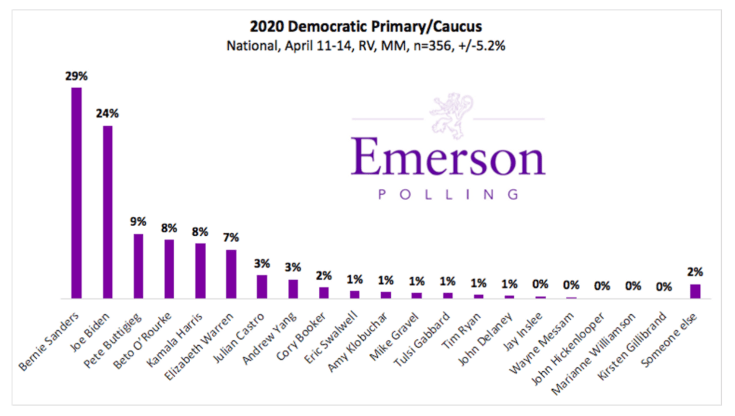
A new national Emerson poll, including 20 Democratic candidates for President, found Senator Bernie Sanders ahead of the pack with 29%, followed by former Vice President Joe Biden at 24%. They were followed by Mayor Pete Buttigieg at 9%, former Rep. Beto O’Rourke and Senator Kamala Harris at 8%, and Senator Elizabeth Warren at 7%.

Entrepreneur Andrew Yang and former HUD secretary Julian Castro were at 3%. The poll was conducted April 11-14 of Democratic Primary voters with a subset of n=356, +/- 5.2%.

Spencer Kimball, Director of Emerson Polling, said “while still early in the nominating process, it looks like Mayor Pete is the candidate capturing voters’ imagination; the numbers had him at 0% in mid-February, 3% in March and now at 9% in April.”

Kimball also noted that “Biden has seen his support drop. In February, he led Sanders 27% to 17%, and in March the two were tied at 26%. Now, Sanders has a 5 point lead, 29% to 24%.”
Screen Shot 2019-04-15 at 11.36.40 AM

If Joe Biden decides not to run, Bernie Sanders looks to be the early beneficiary, picking up 31% of Bidens’ voters. Mayor Pete Buttigieg gets 17% of the Biden vote, followed by Beto O’Rourke at 13%.

President Trump has seen his approval numbers nationally stay consistent in 2019 and is currently at 43% approval and 49% disapproval among voters (n=914, +/-3.2%), similar to last month’s numbers (43% to 50%). However, among Republican primary voters, Trump remains very popular and leads potential challenger, former Massachusetts Governor Bill Weld, 85% to 15% (n=324, +/-5.4%).

Screen Shot 2019-04-15 at 11.37.44 AM

In a head to head ballot test, Joe Biden appears the strongest opponent against Trump of the major Democratic candidates with a 53% to 47% advantage. This result is down 4 points from Emerson’s March poll, where Biden led Trump 55% to 45%. This general tightening is seen in the other head-to heads against other potential opponents: (n=914, +/-3.2%)

  • Biden 53%, Trump 47%
  • Sanders 51%, Trump 48%
  • O’Rourke 51%, Trump 49%
  • Harris 50%, Trump 50%
  • Buttigieg 49%, Trump 51%
  • Warren 48%, Trump 52%

Taxes

As of April 14, 2019, 73% of voters said they had filed their federal income tax returns, 17% plan to get them in on time and 4% have asked for an extension. 6% do not plan on filing returns.

36% of those who have filed their taxes say they are paying more compared to last year, with 29% saying they are paying less, and 35% saying they are paying about the same.

Of those who said they were receiving a tax return this year, 41% said they plan to use it to pay off debt, 31% plan to save it, and 13% will spend the money on enjoyment.

Campaign Issues

  • 47% of voters support building a wall on the US-Mexico Border, 45% oppose, 8% are undecided.
  • 41% of voters do not think large tech giants like Apple, Amazon, Facebook and Google should be broken up, 29% think they should be broken up, and 31% are undecided.
  • 43% of voters do not support American intervention in Venezuela to overthrow the Maduro Regime, 27% do support American intervention, 31% were unsure.
  • 55% of voters do not think individuals currently incarcerated should have the right to vote, 30% believe those incarcerated should be able to vote , and 15% are undecided on this issue.
  • 65% of voters think that felons who completed their prison sentences should have the right to vote, 23% do not, and 12% are undecided.

Unlikely Voter

Voters who did not plan to vote in either party primary/caucus were asked why they were not planning on voting, 16% said lack of interest, 12% said they don’t like any of the candidates, 11% said it was too hard to vote, 6% said a lack of time, and 55% responded that it was for some other reason that they do not plan to vote in the primaries.

Caller ID

The national Emerson College poll was conducted April 11-14, 2019 under the Supervision of Professor Spencer Kimball. The sample consisted of registered voters, n=914, with a Credibility Interval (CI) similar to a poll’s margin of error (MOE) of +/- 3.2 percentage points. The data was weighted based on a 2016 voter model of gender, age, party affiliation, region and ethnicity. It is important to remember that subsets based on gender, age, party breakdown, ethnicity and region carry with them higher margins of error, as the sample size is reduced. Data was collected using both an Interactive Voice Response (IVR) system of landlines only (n=599) and an online panel provided by Amazon Turk (n=315). Visit our website at ​www.emersonpolling.com​.

Follow us on Twitter ​@EmersonPolling

FACEBOOK REMOVES PAGE OF ECUADOR’S FORMER PRESIDENT ON SAME DAY AS ASSANGE’S ARREST

Facebook Removes Page Of Ecuador's Former President On Same Day As Assange's Arrest

Prior to the removal of the page, Correa lambasted his successor in a series of posts

Zero Hedge – APRIL 12, 2019

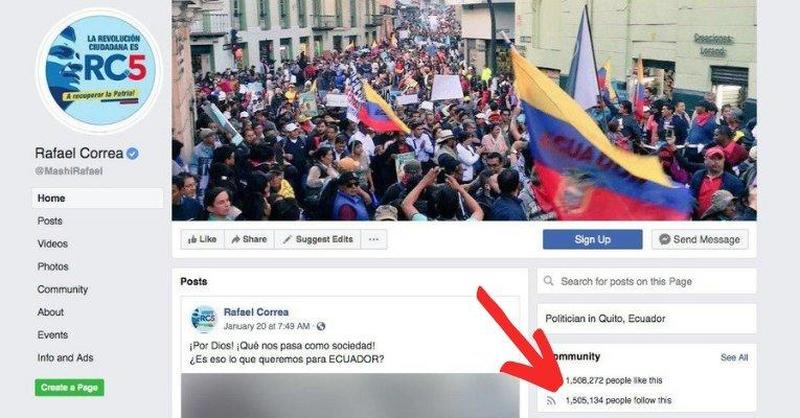
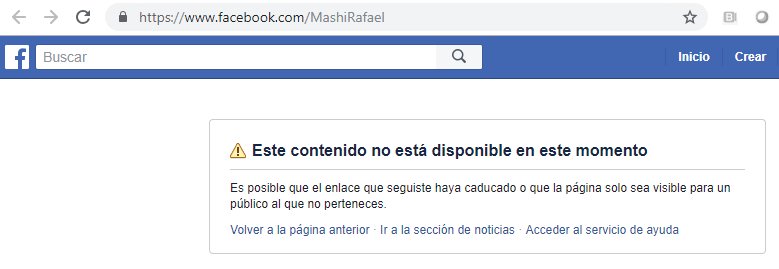
Facebook has unpublished the page of Ecuador’s former president, Rafael Correa, the social media giant confirmed on Thursday, claiming that the popular leftist leader violated the company’s security policies.

In a statement republished by Ecuadorean newspaper El Comercio, a company spokesperson said:

“Protecting the privacy and security of people is central to Facebook [and] we have clear policies that do not allow the disclosure of personal information such as phone numbers, addresses, bank account data, cards, or any record or data that could compromise the integrity physical or financial of the people in our community.”

The move comes on the same day that Ecuador’s government allowed British security personnel to enter their embassy in London to arrest journalist and WikiLeaks founder Julian Assange, who has been sought by U.S. officials for years due to his role in releasing scandalous information implicating Washington in a range of crimes, including war crimes.

𝓤𝓼𝓾𝓪𝓻𝓲𝓸𝓼 𝓓𝓲𝓰𝓲𝓽𝓪𝓵𝓮𝓼@usuariosdigital

Página en Facebook del exPresidente @MashiRafael no puede ser accesada, se desconocen motivos – link https://www.facebook.com/MashiRafael 

23 people are talking about this

Assange, 47, had been living at the Embassy of Ecuador in London since 2012, when then-President Correa granted political asylum to the Australian amid the British government’s attempts to detain him. At the time, Correa called Eduador’s actions an act of sovereign “duty.”

Ecuador’s current leader, Lenin Moreno, was openly opposed to Assange, whom he referred to on various occasions as a “miserable hacker,” an “irritant,” and a “stone in the shoe” of his government. Moreno’s distancing from the asylee came following a 2017 meeting with Trump campaign confidant and political “fixer” Paul Manafort, where the two discussed Ecuador’s handover of Assange to U.K. and U.S. authorities.

In March, WikiLeaks published a tranche of documents dubbed the INA Papers linking President Lenin Moreno to the INA Investment Corporation, an offshore shell company used by Moreno to procure furniture, property, and various luxury items.

The account number for the offshore account allegedly used by the president to launder money was shared across Ecuadorean social networks by netizens of all political stripes, including by Correa – who had about 1.5 million followers and whose Facebook page enjoyed more interactions and attention than that of President Moreno himself.

The account number was also shared alongside personal photos of President Moreno enjoying lavish breakfasts and dinners of lobster—imagery considered especially damning for the people of Ecuador given Moreno’s previous boasting of an austere poverty diet consisting of eggs and white rice.

It also came amid attempts by the neoliberal Ecuadorean government to curry favor with financiers in Europe and the United States amid the continuing debt crisis. In March, the IMF finally bailed out Moreno’s government to the tune of $4.2 billion.

Prior to the removal of the page, Correa lambasted his successor in a series of posts that still remain on Twitter at the time of this writing.

Rafael Correa

@MashiRafael

Christine:
I do not know what to tell you. I only ask forgiveness from me and my people. A traitor and corrupt like Moreno does not represent us. I promise not to rest until I see him in jail, where he deserves to be.

Mrs. Christine Assange@AssangeMrs

Shame on you @Lenin #Moreno!

May the Ecuadorean people seek vengeance upon you, you dirty, deceitful, rotten traitor!

May the face of my suffering son haunt your sleepless nights..

And may your soul writhe forever in torturous Purgatory as you have tortured my beloved son! https://twitter.com/SkyNews/status/1116283158943666176 

1,965 people are talking about this

Since 2015, Correa—who lives with his family in Brussels, Belgium—had used the social platform to great effect, using strongly-worded posts, video interviews, and live-streams as a platform amid the Ecuadorean media’s de facto blackout of the former leader, who remains reviled by the center-right former opposition and sections of the country’s left.

Former President Correa minced no words in his assessment of Moreno, denouncing him in an English-language tweet as “the greatest traitor in Ecuadorian and Latin American history … Moreno is a corrupt man, but what he has done is a crime that humanity will never forget.”

Rafael Correa

@MashiRafael

The greatest traitor in Ecuadorian and Latin American history, Lenin Moreno, allowed the British police to enter our embassy in London to arrest Assange.
Moreno is a corrupt man, but what he has done is a crime that humanity will never forget.

Barnaby Nerberka@barnabynerberka

BREAK: Full @Ruptly video of WikiLeaks founder Julian Assange’s arrest by British police this morning

Embedded video

9,806 people are talking about this

In a separate tweet responding to Moreno’s announcement of the handover, Correa further tore into what he called “one of the most atrocious acts [and the] fruit of servility, villainy and revenge.”

“From now on worldwide, the scoundrel and betrayal can be summarized in two words: Lenin Moreno,” the popular former president added.

The removal of Correa’s page for violating Facebook’s “community standards” is an unprecedented move, and the former statesman is the most high-profile public political figure to ever be removed from the social platform–placing the economist and icon of Latin American “socialism of the 21st century” in the same unlikely category as right-wing conspiracy theorist and broadcaster Alex Jones.


Matt Bracken gives his take on the social media unpersoning epidemic sweeping across the internet.


ANALYST SUES FACEBOOK FOR ‘SUBVERTING’ ELECTION WITH SELECTIVE CENSORSHIP

Analyst Sues Facebook For ‘Subverting’ Election With Selective Censorship

Tech giant deleted thousands of accounts ahead of Indian elections

RT – APRIL 11, 2019

While Facebook claims to have deleted thousands of pages to prevent meddling in the Indian elections, the American company’s selective deletions have led at least one man to ask: Who is watching the election watchers?

A little over a week ahead of the beginning of elections in India this Thursday, Facebook raised some eyebrows when it announced that it had removed a number of politically oriented pages as a part of its “election integrity” efforts.

The social media giant removed 138 pro-opposition pages that had over 200,000 followers for “coordinated inauthentic behavior.” While they only removed 15 pro-government pages, as it turned out, those pages had a far wider reach with millions of likes.

Given the apparent imbalance, it is all the more concerning that the purge was conducted with assistance from the US-based Atlantic Council, a think tank that receives millions of dollars in funding from the US State Department and NATO allies.

Indian defense analyst and security expert Abhijit Iyer-Mitra is one of the people extremely concerned with the impact the American private company could have on India’s elections. He has even filed a criminal complaint with police in New Delhi, describing Facebook’s actions as an act of war, and an attack on the country’s sovereignty.

Speaking to RT, Iyer-Mitra blasted the social network for their glaring double standards: while making extensive efforts to protect American elections from foreign actors in the wake of the alleged “Russian meddling” scandal, the company seemingly had no qualms about letting a state-department-linked think tank act in place of Indian election officials.

“The point is they are an American company, this is an Indian election,” said Iyer-Mitra. “We are not willing to cede our sovereignty to other countries like this. I think they are making a big mistake and I intend to pursue this to the end.”

Facebook Sends Enforcer to Indian Man’s House, Asks If He Really Posted Political Content

Facebook Sends Enforcer To Residence India

By

An Indian man says Facebook sent representatives to his physical home to verify whether he posted certain political content on the platform, highlighting more concerns about privacy and freedom of speech.

A man living in New Delhi, India, who says he made political posts on the platform, claims he had a representative from Facebook show up at his residence to ask questions about the post. It is believed the company took this action as part of its ongoing fight against “fake news,” and that it is the first known instance of Facebook appearing at someone’s physical address to determine the veracity of posts.

Top legal experts in India seem to consider the possible invasion of privacy unprecedented, and believe it could open Facebook to legal recourse.

News 18 reported:

“This action, if true, clearly infringes upon the privacy of a user. Sending a representative to physically verify a user is a blatant invasion of his or her privacy space. Only the state can act like this under proper laws,” Pavan Duggal, the country’s top cyber law expert and a senior Supreme Court advocate, told IANS.

Facebook, Duggal said, can at best discontinue a Page, Group or delete the post, or remove the user from its platform as it has done so in the past. When it comes to those who wants to run political ads on Facebook, the company verifies residency of advertisers either by physical verification (by sending someone to the address provided) or by sending a code in the post.

The article also notes that Duggal considers the move a “gross violation,” and “unwarranted under the ambit of the Information Technology Act, 2000,” quoting Duggal as saying “In such a scenario, the user can sue Facebook and even the government for allowing such activities under its nose that infringes on the privacy of a user.”

As Facebook attempts to stamp out fake news in India, which is the world’s largest democracy, the country quickly approaches an important election on April 11.

(NO, IT’S NOT AN APRIL FOOL’S JOKE.) – Facebook plans to curate ‘high quality’ news for its users from ‘trusted outlets’

Screen Shot 2019-04-02 at 10.40.40 AM

Mark Zuckerberg is considering hiring human “editors” to hand-pick “high-quality news” to show Facebook users in an effort to combat fake news — and no, it’s not an April Fool’s joke.

In his ongoing quest to satisfy the political censorship demands of Western governments, Zuckerberg told German publishing house Axel Springer that he is considering the introduction of a dedicated news section for the social media platform, which would potentially use humans to curate the news from “broadly trusted” outlets. Zuckerberg said Facebook might also start paying news publishers to include their articles in this dedicated news section in an effort to reward “high-quality, trustworthy content.”

With social media censorship already at worryingly high levels, who will decide which outlets are “broadly trusted” and which are untrustworthy? What qualifies one outlet as more “trusted” than another? Will Zuckerberg make the criteria public?

Collective punishment? Zuckerberg’s call for internet regulation is aimed at competitors – analyst

Fresh from the anti-climactic Russiagate saga and long-awaited Mueller report, will Facebook penalize all the outlets that incessantly pushed the Trump/Russia “collusion” narrative and hyped fake “bombshells” for more than two years sans evidence, or will the likes of MSNBC and Rachel Maddow automatically earn “trusted status? The answer to that question is blindingly obvious.

Facebook’s efforts to combat fake news are reminiscent of other recent efforts from apps like NewsGuard, the US government-linked app which rates news websites according to their “trustworthiness” and, unsurprisingly, targets alternative media sites which do not strictly adhere to establishment narratives. If recent history is any indicator, Facebook’s own efforts to rate news will also fall directly in line with US government objectives.

The social media giant has been rightly accused of blatant censorship on multiple occasions in recent memory — and there doesn’t seem a way that a group of Facebook-hired editors could be trusted to curate the news for anyone, unless it took some serious steps to address its various biases. In fact, even if it did that, isn’t hiring human editors with their own political biases and preferences to sift through all the available news and select the stories deemed fit for public consumption just an Orwellian idea in the first place?

Facebook should probably already be aware of the pitfalls when it comes to hiring human editors for such purposes. During the 2016 US presidential election, the company’s solution to political bias in its trending news section was to fire the human editors responsible for it. Maybe Zuckerberg thinks this time it will be different? Or maybe, and more likely, this is just another PR effort to placate the pro-censorship crowd on Capitol Hill.

There is no shortage of examples of Facebook censorship at this point. Last year, the platform inexplicably took down the English-language page belonging to left-leaning, Venezuela-based news network Telesur — and deleted the page belonging to Venezuela Analysis, another left-leaning outlet offering commentary critical of Washington’s foreign policy in Latin America. The pages were later restored, but Facebook was not forthcoming with an explanation.

Changes made to Facebook algorithms to combat “fake news” in 2017, saw traffic to multiple socialist and government accountability websites plummeting — including Police the Police (a page exposing US police brutality) and the Free Thought Project (which promotes government transparency). Alternative news websites like Truth-out.org, Democracy Now and Alternet also suffered as a result of those algorithm changes.

More recently, Facebook suspended popular pages run by Maffick Media, which is 51 percent owned by RT’s video agency Ruptly. Coincidentally, the content on those pages is also highly critical of the US government. Funnily enough, Facebook isn’t often caught censoring popular pages whose content is Washington-friendly. The Maffick pages were later restored, but Facebook forced them to include more explicit information about their funding, which in itself is no big deal, but it is a requirement curiously not demanded of US government-funded or linked pages.

ALSO ON RT.COMZuckerberg asks governments for more internet regulation in self-flagellation exercise

Not only has Facebook been accused of censorship, however, it has also been found to be working at the behest of certain governments — but again, only Washington-friendly ones, of course.

The Intercept reported last year that Facebook met with Israeli government officials and complied with orders to delete the accounts belonging to certain Palestinian activists. Facebook quickly bowed to Israel’s demands after threats that it would be forced into complying with the deletion orders by law if it failed to do so voluntarily.

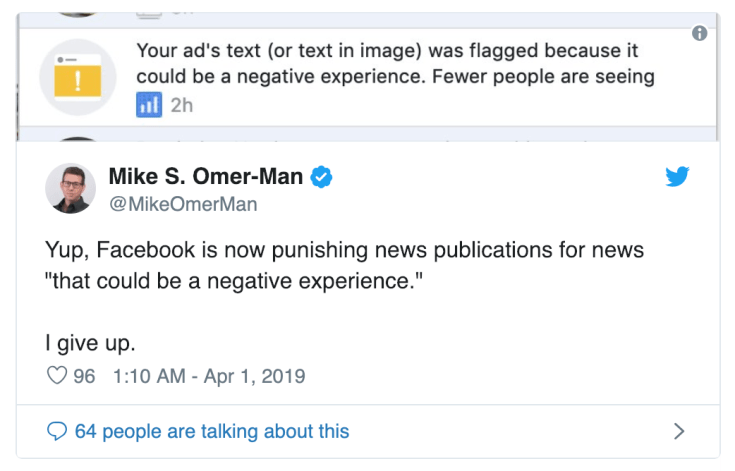
But things don’t look to be getting any better on the Facebook censorship front since then. A journalist for Israeli news outlet +972 Magazine tweeted on Monday that Facebook was now punishing news sites (in the form of lower views) for publishing content that “could be a negative experience” for users — whatever that means. The content in question was an article by the magazine about Gaza’s Great Return march and the casualties inflicted on protesters by the Israeli army.

Screen Shot 2019-04-02 at 10.42.59 AM

With such a terrible track record when it comes to political bias and willingness to censor news and information, don’t be surprised if Facebook’s planned “dedicated news section” of “high-quality” information turns out to be a failure.

Danielle Ryan

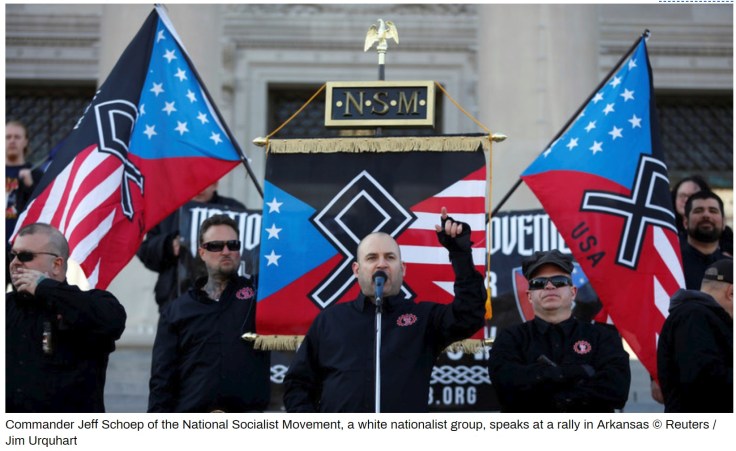
Facebook bans all praise of ‘white nationalism’ & ‘white separatism’

CAP

Facebook has announced that it will ban content relating to ‘white nationalism’ and ‘white separatism’ from its platform. The nature of the content that will be banned raises some free speech concerns.

Facebook’s hate speech policies already forbid any content praising or promoting “white supremacy.” The company has, until now, drawn a distinction between this content and “white nationalism” and “white separatism,” much to the ire of civil rights activists, who argue that the terms are interchangeable.

“Going forward,” the company announced in a blog post on Wednesday, “while people will still be able to demonstrate pride in their ethnic heritage, we will not tolerate praise or support for white nationalism and separatism.”

As of next week, users attempting to post such content will be redirected to Life After Hate, a nonprofit staffed by former extremists that seek to turn young people away from white supremacy. The new policy will apply to both Facebook and Instagram.

White nationalism and white separatism are hazy concepts. Facebook initially considered them in the same category of Basque separatism in Spain, the Zionist movement, or Malcolm X-style black separatism. However, the latest decision seems to place explicitly white movements into a category of their own.

Enforcing the ban will likely prove controversial, especially in the United States where Facebook has been accused of a pervasive anti-conservative bias. Phrases like “I am a proud white nationalist” and “Immigration is tearing this country apart; white separatism is the only answer” will now be banned, the company told Motherboard. Less explicit and “coded”references will be removed on a case-by-case basis, an opaque policy that will surely draw accusations of misuse.

Behind the scenes, most of the content sifting will be done using artificial intelligence and machine learning, Facebook said on Wednesday.

Facebook’s clampdown on the extreme right comes less than two weeks after gunman Brenton Tarrant murdered 50 worshippers at two mosques in Christchurch, New Zealand. Tarrant livestreamed his rampage on Facebook, and the social media giant was criticized for failing to take down reposts of the video quick enough in the days afterward.

Tarrant’s murder spree, inspired by a blend of white supremacist and fascist ideologies, prompted New Zealand’s Prime Minister Jacinda Arden to issue a “global call” to fight the “ideology” of racism, particularly online.

Think your friends would be interested? Share this story!

Facebook stored 7 years of passwords in plaintext, but it’s OK, they’re trustworthy!

CAP

Over half a billion Facebook users’ passwords sat unsecured on the company’s servers for years, the tech giant admitted, after an investigation uncovered the egregious bug – but it’s OK, only Facebook employees could access them.

Facebook acknowledged the glaring oversight after an anonymous employee blew the whistle to Krebs on Security, admitting “hundreds of millions of Facebook Lite users, tens of millions of other Facebook users, and tens of thousands of Instagram users” had been affected, then adding insult to injury with a casual admission that they’d discovered the security flaw “as part of a routine security review in January.”

The scandal-plagued social media giant hastened to assure users that “no passwords were exposed externally and we didn’t find any evidence of abuse to date,” but their post was cold comfort from the company whose CEO has explicitly called the users who trust him “dumb f***s.”

As many as 600 million users – anyone who created their password after 2012 – had their login credentials stored in a plaintext, unencrypted database where they could be searched by any one of 20,000 Facebook employees, according to the leaker.

Passwords – especially high-value passwords like Facebook’s – are normally “hashed,” or cryptographically scrambled to prevent hackers from using them even if they are able to break into a company’s servers. Storing this data in unsecured plaintext is the cyber-security equivalent of allowing guards to walk in and out of a bank vault without passing through a metal detector.

Facebook says it has fixed the bug and promised to notify all users whose passwords were stored unencrypted. The vulnerability is only the latest in a seemingly endless string of outrages. Earlier this month, it emerged that Facebook had made users’ ostensibly private phone numbers – given for security purposes only – into just another searchable attribute, with no option to opt out and the added indignity of those numbers being targeted with ads. In September, data from some 30 million accounts was stolen via compromised access tokens and, in December, seven million users learned that third-party app developers could access their private photos – even those they’d never uploaded to the platform.

While it had their attention, Facebook took the opportunity on Thursday to notify users about a cool new “physical security key” they could login with – a “small hardware device that goes in the USB drive of your computer” ideal for “high-risk users including journalists, activists, political campaigns and public figures.”

“There is nothing more important to us than protecting people’s information,” said Pedro Canahuati, vice president of engineering, security and privacy for Facebook – while presumably hiding a smirk.

Like this story? Share it with a friend!

Trump to ‘look into’ Facebook censorship after site gags his social media chief

President Donald Trump has promised to look into accusations of anti-conservative bias on Facebook, after the social media giant apparently blocked his social media chief Dan Scavino from commenting.

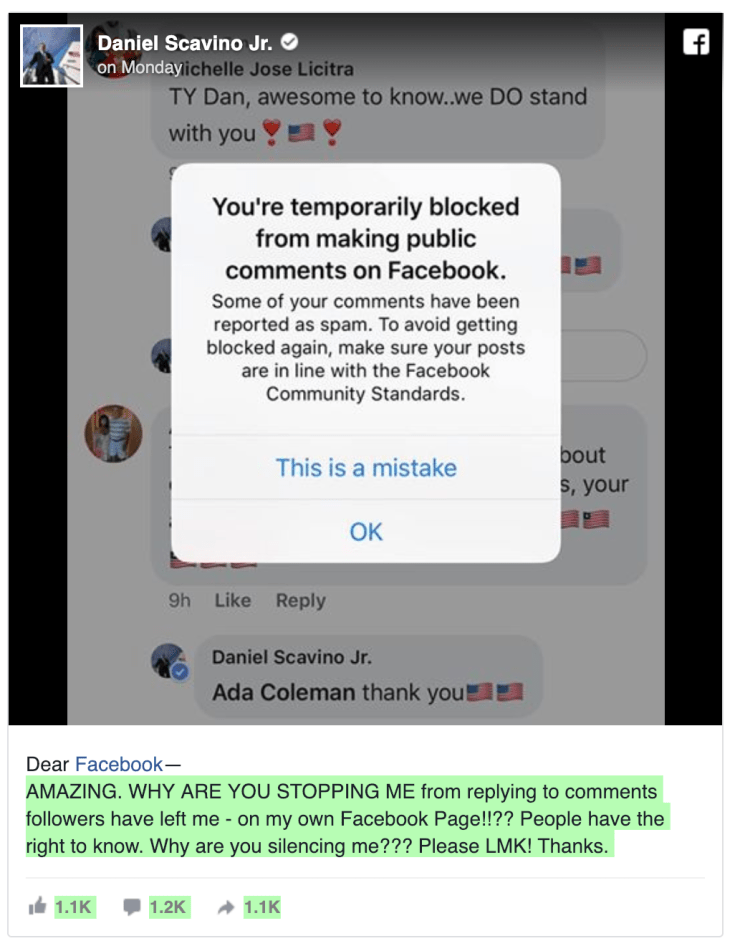
Scavino complained on Monday that Facebook had abruptly blocked him from replying to his followers, with the company claiming his comments had been reported as spam.

“AMAZING. WHY ARE YOU STOPPING ME from replying to comments,” he wrote. “People have the right to know. Why are you silencing me???”

Screen Shot 2019-03-20 at 11.29.08 AM

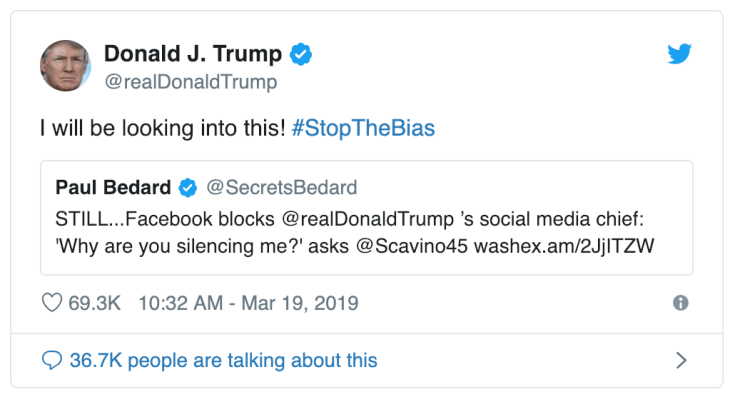
“I will be looking into this!” Trump tweeted in response. The president has often accused Silicon Valley tech companies of discriminating against conservative users, and did so again on Tuesday. “Facebook, Google and Twitter, not to mention the Corrupt Media, are sooo on the side of the Radical Left Democrats,” he tweeted. “But fear not, we will win anyway, just like we did before!”

Screen Shot 2019-03-20 at 11.30.03 AM

Facebook CEO Mark Zuckerberg has repeatedly dismissed accusations of liberal bias directed at the company. Grilled by Republican lawmakers on the topic last year, Zuckerberg claimed that their examples of censorship were once-off mistakes, but did admit that most of his employees probably lean left politically.

These accusations have come from within the company too. An anonymous whistleblower told conservative watchdog Project Veritas last month that Facebook actively developed and uses “deboosting” tools to suppress and delete right-wing content. Last year, a Facebook employee called the company a liberal “monoculture that’s intolerant of different views,”and savaged Facebook’s workforce for being “quick to attack – often in mobs – anyone who presents a view that appears to be in opposition to left-leaning ideology.”

The employee’s rant, posted on an internal message board, attracted the support of more than 100 other workers, who formed a group called ‘FB’ers for Political Diversity.’

Blog at WordPress.com.

Up ↑