Published on Aug 15, 2019
By Neil Clark
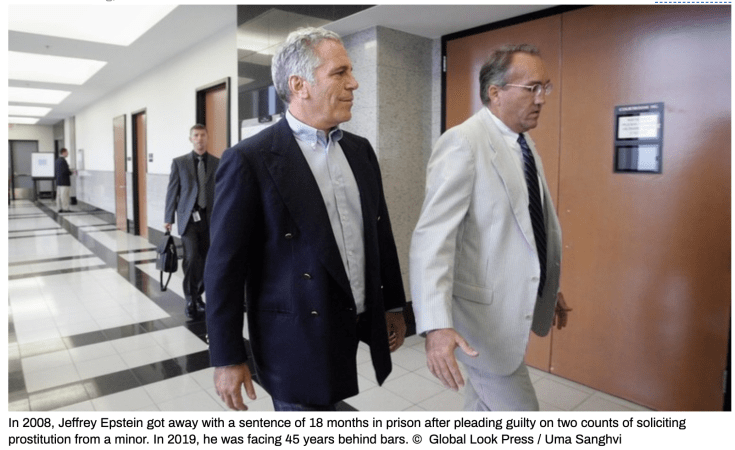
On Saturday morning, I was discussing Jeffrey Epstein with a friend. “He’ll be bumped off and found dead in his cell,”was my friend’s prediction. “It won’t come to court.”
A few hours later, I went on Twitter to see what was happening in the world and I saw #EpsteinMurder trending.
The whole thing was quite uncanny.
Let’s be honest: has there been a death of a high-profile prisoner whose expiration has been so unsurprising?
Suicide (non-)watch: What we know about Jeffrey Epstein’s death…and what we don’t
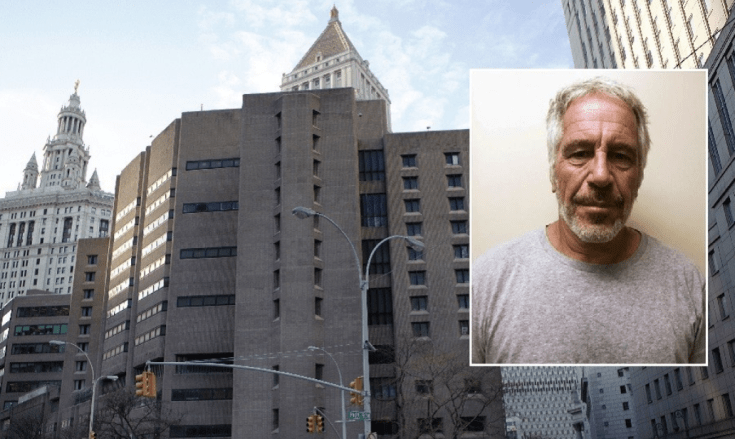
Anyone claiming this time last week that Epstein wouldn’t make it to trial because too many very rich and very important people would be dragged in would of course have been dismissed as a “conspiracy theorist.”
But this morning, it’s the “don’t be so stupid, of course he’ll make it to the courtroom” brigade who are looking rather silly – and you could also argue, quite naive.
If this means we get more open discussion on “conspiracy theories,” it can only be a good thing. Here’s why. When it comes to conspiracy theories, there are three types of people. There are well-paid, establishment gatekeepers who routinely use the CT term to gaslight people and close down legitimate debate. At the same time, these gatekeepers are themselves often the biggest pushers of conspiracy theories – but only when it comes to “official enemies.” Let’s not forget that the deadliest conspiracy theory of this century so far was the one suggesting that Iraq possessed WMDs in 2003. It was, by and large, peddled by those who routinely scoff at conspiracy theorists and label them“cranks.” The same people are also very quick to blame Russia for just about everything, regardless of the lack of hard evidence.
The second category are those who seem to believe everything – or at least almost everything – is a conspiracy. The Moon landings were faked. Elvis never died. Sandy Hook never happened. Every terrorist attack is a “false-flag.” I was once accused by someone at a public meeting of being a member of ‘Agenda 21.’ The fact that I didn’t know what she was on about was proof that I was really an ‘Agenda 21 agent.’
The third category – and this is where surely all sensible people are – accept that while not everything is a conspiracy, it’s actually quite daft to think conspiracies never occur, especially when people involved are very wealthy and very powerful and the stakes are extremely high.
Put another way, did you really think, deep down, given who he was, the people who he was associated with – and the nature of the allegations – that Epstein’s case would ever get to court? Be honest. I’d reckon about 90 percent, even though they might not publicly admit it, would entertain serious doubts.

You really don’t have to be overly suspicious – or be a permanent tin-foil hat wearer to smell a rat in this one.
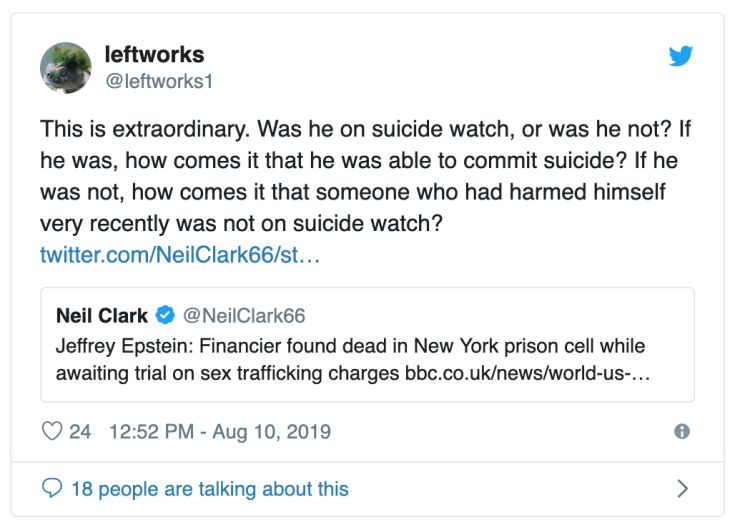
If, as was reported, Epstein did try to kill himself about three weeks ago, why was he taken off suicide watch just six days later? Who made that seemingly baffling decision? If he was still on suicide watch – and the source cited in the New York Times was wrong, why wasn’t his death prevented?
These are only a few of the many questions that need to be answered. What is particularly interesting is the kind of people demanding answers. It’s not just the “usual” suspects who are routinely labeled cranks by the gatekeepers. New York Mayor Bill de Blasio has called Epstein’s death “way too convenient.”
“How many other millionaires and billionaires were part of the illegal activities that he was engaged in?” he asked. Even the BBC website has as its heading of a news story today “Jeffrey Epstein: Questions raised over financier’s death.”
The FBI is investigating the case and who knows, we may get some answers. Perhaps Epstein did after all, kill himself – prisoners facing the prospect of 45 years in jail are quite likely to be depressed; moreover the sociopathic billionaire might even have relished evading justice and depriving his accusers of their days in court. But until more evidence of his suicide comes to light, (and we really do need to see some camera footage), it is reasonable to think that some other explanation is, on balance, more likely.
Taking that line doesn’t make you barmy – just someone who very sensibly breaks with the binary when it comes to“conspiracy theories.”
JONATHON MORGAN
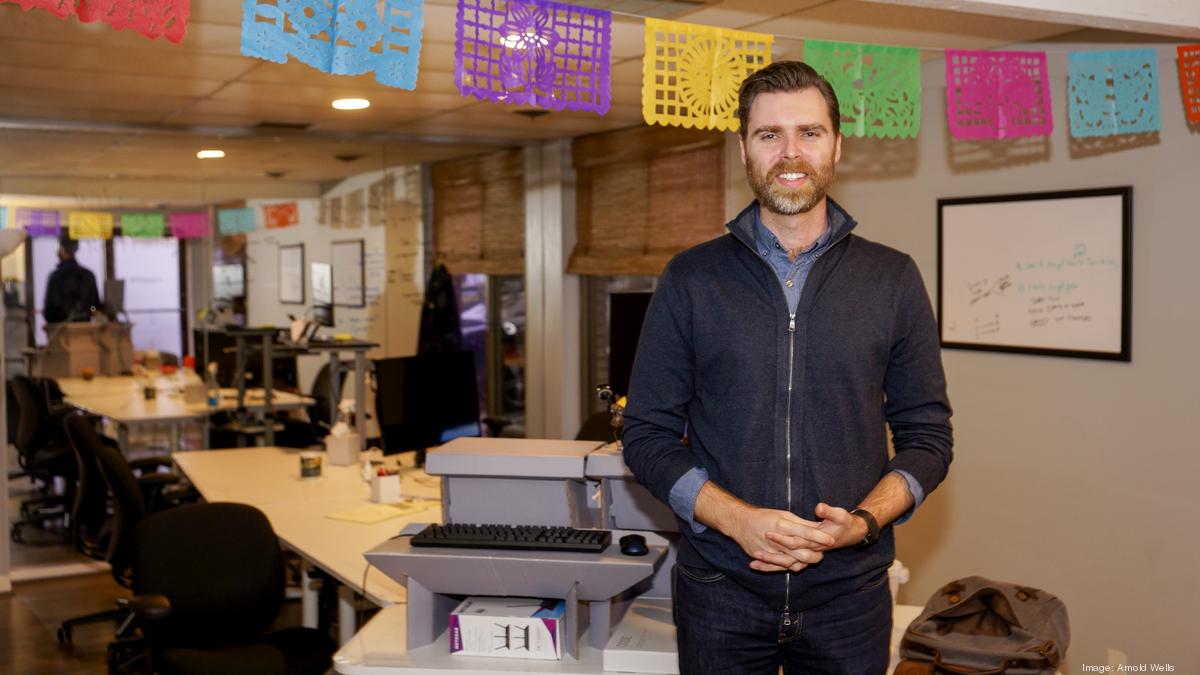
Jonathon Morgan, CEO, and co-founder of “Democratic-leaning” private intelligence firm New Knowledge, was reportedly part of a secretive campaign to discredit Republican candidate, Roy Moore, during the Alabama election. According to an internal report obtained by the New York Times, Morgan and his accomplices boasted about how they had “orchestrated an elaborate ‘false flag’ operation that planted the idea that the Moore campaign was amplified on social media by a Russian botnet.” Moore ended up losing the race by a hair to his Democratic opponent Doug Jones – who became the first Democrat in 25 years to serve Alabama in the Senate.
READ MORE: The only ‘Russian bots’ to meddle in US elections belonged to Democrat-linked ‘experts’
Morgan adamantly denied these accusations in a statement posted on New Knowledge’s blog, insisting that his company used the election to conduct “research” and “did not engage or operate a botnet.” In fact, according to Morgan, New Knowledge believed from the beginning that the “Russian bots” purportedly aligned with Moore were fake. The hundreds of Cyrillic-sporting accounts that followed Moore on Twitter “seemed to us to be the work of internet trolls, not Russian activity,” Morgan wrote. He acknowledged that the media presented the bots as a genuine Russian influence campaign, but asserted that “to this day, we have no idea where these followers came from or what their purpose was.”
Morgan, it appears, felt differently during the actual election. Citing his much-admired “Russian bot” dashboard, Hamilton 68, Morgan tweeted in November 2017 that Moore was conspicuously popular among “Russian trolls.”
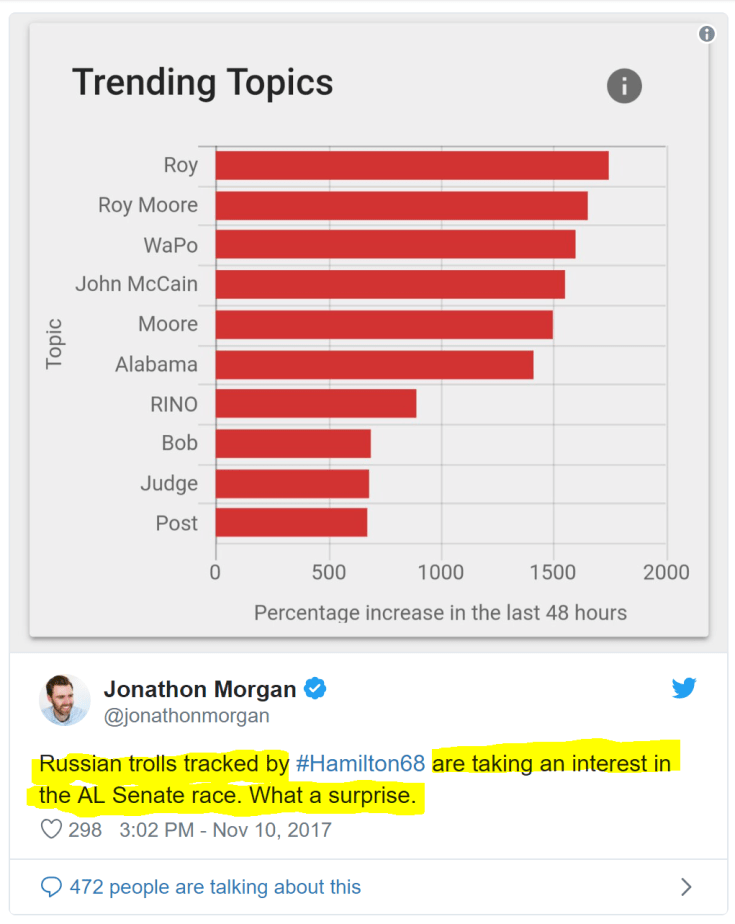
In other words: In November 2017 – when Moore and his Democratic opponent were in a bitter fight to win over voters – Morgan openly promoted the theory that Russian bots were supporting Moore’s campaign. A year later – after being caught red-handed orchestrating a self-described “false flag” operation – Morgan now says that his team never thought that the bots were Russian and have no idea what their purpose was. Did he think no one would notice?

Tellingly, Morgan publicized during the election that New Knowledge had invested time and resources into unmasking the owner of a pro-Moore Twitter account. True to form, Morgan suggested that the Twitter user was a Russian bot – an accusation that was found to be baseless after the Daily Beast conducted a thorough investigation into the matter.

This is just one of several painfully apparent inconsistencies with Morgan’s “research” story. He insists that his company’s activities were limited to the creation of a benign Facebook page aimed at Alabama conservatives, which was used to gauge how political audiences responded to “mainstream, moderate” journalism.
None of this adds up. According to the New York Times, which broke the story, Morgan “acknowledged his role in the secret Alabama operation on Facebook and Twitter.” Why is he now denying any role – and why is there no mention of Twitter activities in his statement? Morgan’s obstinate denial insists that he was only involved in setting up a harmless Facebook page.
Morgan ends his statement by declaring that New Knowledge “is in the integrity business.” This is why, as the Times reported, the company “intended to help Mr. Jones and hurt Mr. Moore and that its operators believed it had succeeded in doing so.”
Think your friends would be interested? Share this story!

Doug Jones & Roy Moore © Reuters / Reuters Photographer
The primarily social-media-based campaign to bolster the candidacy of Democrat Doug Jones and smear Republican Roy Moore implemented many of the divisive techniques outlined in the reports released earlier this week on Russian social media influence operations, according to an internal report on the effort acquired by the New York Times. Such resemblance is not surprising, given that one of the Alabama effort’s ringleaders was Jonathon Morgan, whose company New Knowledge produced one of those reports.
ALSO ON RT.COMRacist ‘Russians’ targeted African-Americans in 2016 election ploy, reports claimThe campaign was clearly meant to remain classified – the Times’ attempts to interview participants were as often as not met with claims of “I don’t remember” or pleading the Fifth. Others downplay the effect of their actions, or claim they were just meddling in the name of research. But, as much as they claim their actions had no consequences, they succeeded in electing the first Democrat to represent Alabama in the Senate for over 25 years.
In order to paint Roy Moore as the Kremlin candidate, the manipulators linked his campaign to thousands of Russian Twitter accounts that all started following him at once – drawing the attention and suspicion of the media, which obediently published rumors that his support numbers were artificially bolstered by Russian bots.
Morgan claims the botnet “false flag” – a term that actually appears in the report – “does not ring a bell,” dismissing the project as “a small experiment” in tactics that were not meant to sway the election. He pleads the Fifth on the report’s claims that the Alabama project intended to “enrage and energize Democrats” and “depress turnout” among Republicans, weaponizing accusations that Moore had tried to seduce teen girls while in his 30s. Morgan also claims to forget the names of the Twitter and Facebook accounts he set up to manipulate Moore voters.
Backed into a corner, Morgan finally opted to lie to the Times, claiming that while the project did create a generic Facebook page to lure conservative Alabamans, and was in contact with write-in candidate (and Moore rival) Mac Watson, its influence efforts stopped there. The report tells a different story: the Facebook page “boosted” Watson’s campaign, getting him interviews with major media outlets, and swelling the ranks of his Twitter followers. Watson confirms he received media assistance from a Facebook page with no human face to it – the only page that replied to his contact.
“The research project was intended to help us understand how these kind of campaigns operated,” Morgan told the Times. “We thought it was useful to work in the context of a real election but design it to have almost no impact.”
It’s a truism that so-called “coastal elites” have only disdain for Middle America, but the way Morgan describes the Alabama special election as an inconsequential throwaway contest fit only for a science experiment is eye-opening.
Morgan, it’s worth noting, was one of the developers of the infamous “Hamilton68” dashboard, beloved by Western media for its ability to link any troublesome narrative to “Russian bots.” Morgan’s co-developer, Clint Watts, has since distanced himself from the bot crusade, admitting he’s “not convinced on this bot thing.”
Everyone the Times spoke with was careful to shunt blame elsewhere. Renee diResta, who works with Morgan at New Knowledge and was the lead author of the group’s Russian report, said: “I know there were people who believed the Democrats needed to fight fire with fire,” emphasizing that she was not one of these people.
Moore campaign operatives remain frustrated at their narrow margin of loss – just 21,924 votes, less than the number of write-in ballots that were cast. They complained to Facebook about possible interference but were brushed off. Presented with incontrovertible evidence of wrongdoing by their opponents, Moore campaign manager Rich Hobson acknowledged that “any and all of these things could make a difference.”
“We still kick ourselves that Judge Moore didn’t win,” he said.
 Tom's Blog