YouTube to cough up $170mn in fines over charge of grabbing kids’ data

Screen Shot 2019-09-04 at 10.54.00 AM

Google’s video platform YouTube has been fined $170 million, settling allegations that it gathered children’s data online without the consent of their parents, in violation of federal law.

The fines include $136 million for the most recent charges, while the company will pay another $34 million to settle similar claims brought previously by New York state’s attorney general, the Federal Trade Commission (FTC) announced on Wednesday. The settlement is the largest since a law prohibiting the collection of information on children under 13 years came into effect in 1998, known by its acronym, COPPA.

The company is accused of collecting web data on children’s YouTube channels in order to deliver millions of dollars in targeted advertisements to viewers.

“YouTube touted its popularity with children to prospective corporate clients,” said FTC Chairman Joe Simons. “Yet when it came to complying with COPPA, the company refused to acknowledge that portions of its platform were clearly directed to kids. There’s no excuse for YouTube’s violations of the law.”

Though YouTube says its platform is intended for people aged 13 and older, the FTC found that “some of YouTube’s individual channels – such as those operated by toy companies – are child-directed and therefore must comply with COPPA.”

Outcry after study shows Google’s Android collects ten times more data than Apple’s iOS

Screen Shot 2019-09-04 at 10.57.38 AM

FTC commissioners Rebecca Slaughter and Rohit Chopa also issued dissenting statements insisting the penalties did “not go far enough” for YouTube’s “extremely serious” privacy violations.

In addition to the historic fines – which now have to be approved in the courts – going forward YouTube will also be required to notify channel owners about their obligation under federal law to obtain parental consent before grabbing any data on children’s browsing habits.

Google has not yet addressed the FTC’s findings.

The Silicon Valley titan has previously come under fire for aggressive data-collection and poor privacy protections for customers across a number of its devices and applications, while YouTube has been criticized in recent years for arbitrary and draconian enforcement of “community standards,” which has resulted in perma-bans and demonetized videos for thousands of creators.


Facebook, Google Pour Big Money into Lobbying Congress While Blacklisting Conservatives

CAP

By Sean Moran

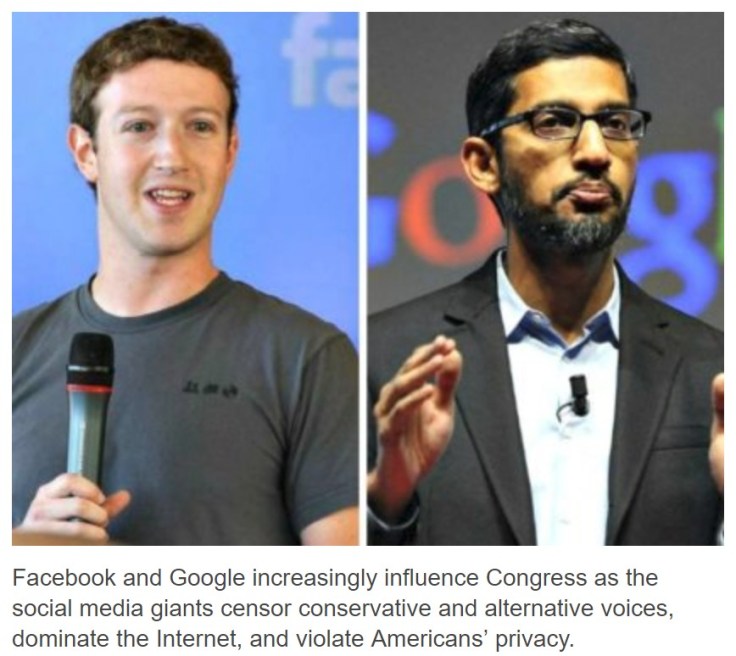
Facebook and Google increasingly influence Congress as the social media giants censor conservative and alternative voices, dominate the Internet, and violate Americans’ privacy.

Facebook announced on Thursday that they have banned several conservative personalities such as Infowars host Alex Jones, Infowars contributor and YouTube personality Paul Joseph Watson, journalist and activist Laura Loomer, and Milo Yiannopoulus. The social media giant also banned Louis Farrakhan from its platforms.

Facebook said that they banned these personalities because they were “dangerous.”

Amid calls for greater regulation of social media companies’ potential anticompetitive behavior, censorship of conservative and alternative voices, and privacy violations, Facebook and Google have remained at the top of Open Secret’s database of top spenders lobbying Congress.

So far in 2019, Facebook spent $3,400,000 and Google’s parent company, Alphabet, $3,530,00 in lobbying Congress. Alphabet also ranked as the eighth total highest spender in lobbying in 2018, spending $21,740,000, while Facebook spent $12,620,000.

Facebook’s influence has continued to rise over the years. In the early years of President Barack Obama, Facebook spent below one million dollars in 2008 and 2009. From 2011 to 2018, Facebook’s lobbying spending skyrocketed and reached historic highs in 2018, when they spent $12.6 million.

In 2019, Facebook lobbied heavily on H.R. 1644, the Save the Internet Act, a Democrat bill which would restore the Obama-era Federal Communications Commission (FCC) net neutrality regulations, which arose as the result of Google’s heavy lobbying of the Obama administration. In 2019, Google also lobbied on the Save the Internet Act.

See the source image

In 2018, one of Facebook’s bills on which they lobbied Congress was H.R. 2520, the Browser Act, sponsored by then Rep. and now Sen. Marsha Blackburn (R-TN), which would require social media companies such as Facebook and Google to obtain explicit permission from users for collecting their private data. The Browser Act would also stipulate that these social media companies cannot deny services to users who do not opt-in to these companies’ collection of their private data. In 2017, the Browser Act was the most important issue on Capitol Hill.

Sen. Blackburn said that her legislation would establish one set of rules that would balance the relationship between ISPs and Facebook and Google. The legislation would also prevent the social media giants from unfairly profiting off of Americans’ private data without their explicit consent.

“We need one set of rules for the entire internet ecosystem with the FTC [Federal Trade Commission] as the cop on the beat,” said Senator Blackburn. “The FTC has the flexibility to keep up with changes in technology and its principal mission is consumer protection. The BROWSER Act will enable consumers to make more educated decisions regarding the nature of their relationship with tech companies.”

In contrast, Alphabet’s most prominent issues in Congress in 2019 and 2018 related to labor and antitrust, as well as telecommunications and technology.

Facebook and Google’s dominance on the Internet has become increasingly apparent as Google has approximately 90 percent of web search traffic, whereas in digital advertising, Google and Facebook amount to nearly two-thirds of American digital ad spending, with Amazon at a “distant third” at under nine percent.

In 2018, Google lobbied Congress fourteen separate times on multiple pieces of legislation that would have increased liability for companies that enabled sex trafficking.

Facebook and Google’s influence in Congress extends to its trade group, the Internet Association. In the fourth quarter of 2018, the Internet Association spent $840,000. In total, the social media giants spent $2.6 million in 2018 for lobbying. In 2019, the association has spent $690,000 so far. Over the last two years, the Internet Association has focused on the Save the Internet Act as well as on legislation that would increase edge providers’ liability for hosting content that enables sex trafficking.

Facebook and Google influence political elections as well. During the 2018 election cycle, Alphabet donated:

  1. $223,269 to former Rep. Beto O’Rourke’s (D-TX) Senate campaign to unseat Sen. Ted Cruz (R-TX), a prominent critic of Silicon Valley censorship.

  2. $149,741 to Rep. Jacky Rosen’s Senate campaign (D-NV) to unseat Sen. Dean Heller (R-NV).

  3. $135,625 to Rep. Josh Harder’s congressional campaign.

  4. $124,508 to former Sen. Heidi Heitkamp’s unsuccessful re-election campaign.

  5. $97, 364 to former Sen. Claire McCaskill’s failed re-election campaign.

During the 2018 midterm elections, Facebook donated:

  1. $75,005 to O’Rourke’s Senate campaign.

  2. $37,954 to Sen. Doug Jones (D-AL) 2017 special Senate election against former Alabama judge Roy Moore.

  3. $34,534 to Heitkamp’s Senate election.

  4. $31,326 to McCaskill’s Senate campaign.

  5. $29,387 to Rosen’s successful campaign to unseat Heller.

As Facebook and Google and other social media giants continue to increasingly censor and blacklist conservative and alternative voices, more and more conservative voices have called for addressing the social media giants’ dominance of the Internet. Facebook and Google’s influence in Congress also relates to political confrontations; during a hearing in December 2018, the then-ranking member of the House Judiciary Committee delivered a sharp rebuke of Republican accusations of Google’s political bias affecting its search engines, even though Google was his top donor.

During a Senate Judiciary Committee hearing in April, Sen. Ted Cruz (R-TX) said  he envisions three potential remedies for big tech’s violation of free speech and dominance on the Internet.

Cruz’s three solutions include:

  1. Amending Section 230 of the Communications Decency Act
  2. Antitrust measures to address big tech’s dominant status on the Internet.
  3. Addressing potential cases of fraud and deception.

“No one wants to see the federal government regulating what is allowed to be said, but there are at least three potential remedies that can be considered by Congress or the administration or both,” Cruz said.

See the source image

GOOGLE’S ALWAYS LISTENING: NEST SECURITY SYSTEM HAS A SECRET EMBEDDED MICROPHONE

Google's Always Listening: Nest Security System Has A Secret Embedded Microphone

No surprise

Zero Hedge – FEBRUARY 25, 2019

Surprise! Another smart home device has the ability to spy on people.

I doubt anyone who is reading this will be shocked by this news, but here we go.

Back in early February, tech giant Google announced that Nest Secure, its home security and alarm system, was now compatible with the company’s Home Assistant voice-control function.

Here is an excerpt from that announcement:

Nest Secure has supported Google Assistant integration for quite some time, but with this most recent update, the product is taking that to a new level by turning itself into a Google Assistant speaker. This is just like what the Nest Cam IQ did last year. With the flip of a switch in the Nest app, you can set the Secure as an always-listening Assistant speaker. (source)

The problem?

Nest users didn’t know a microphone existed on their security device, to begin with.

In order to be compatible with a voice control feature, the device would need to have a microphone.

BUT GOOGLE NEVER MENTIONED THERE WAS A MICROPHONE EMBEDDED IN THE DEVICE.

That important detail was never disclosed in any of the product material for the device, which has been on the market since 2017.

“As recently as January, the product specs for the device made no mention of a microphone,” the Associated Press reports.

A Google spokesperson told Business Insider this was an “error.”

“The on-device microphone was never intended to be a secret and should have been listed in the tech specs. That was an error on our part. The microphone has never been on, and is only activated when users specifically enable the option.

Security systems often use microphones to provide features that rely on sound sensing. We included the mic on the device so that we can potentially offer additional features to our users in the future, such as the ability to detect broken glass.” (source)

THIS IS THE SECOND TIME NEST MADE THE NEWS THIS MONTH.

On February 6, owners of Nest security cameras received an email from Google, warning them to secure their login credentials with things like two-factor identification and stronger passwords.

The reason?

The routine security reminder comes after an uptick in Nest camera hacks and even the occasional hoax, many of which have been downright bizarre and creepy: An Illinois family recently had its device breached by a hacker who spewed abusive epithets through the camera’s microphone into their living room, while another criminal peered into a baby’s room in Houston, Texas, for example. (source)

Google claimed the email was sent as a reminder and said there hadn’t been a breach of the broader Nest user base. As of February 2018, Nest had at sold 11 million of the devices.

This excerpt from the email was published by Popular Mechanics:

For context, even though Nest was not breached, customers may be vulnerable because their email addresses and passwords are freely available on the internet. If a website is compromised, it’s possible for someone to gain access to user email addresses and passwords, and from there, gain access to any accounts that use the same login credentials. For example, if you use your Nest password for a shopping site account and the site is breached, your login information could end up in the wrong hands. From there, people with access to your credentials can cause the kind of issues we’ve seen recently. (source)

Google has faced criticism in the past for its location data-tracking practices, along with allowing third-party developers to read people’s emails on Gmail, reports CNET.

And, Business Insider reminds us that in 2010, Google acknowledged that its fleet of Street View cars “accidentally” collected personal data transmitted over consumers’ unsecured WiFi networks, including emails.

GOOGLE CAN APOLOGIZE AND MAKE EXCUSES ALL IT WANTS, BUT MORE AND MORE PEOPLE AREN’T BUYING IT.

“Nest’s failure to disclose the onboard microphone included in its secure home security system is a massive oversight,” said Ray Walsh, a digital privacy expert at BestVPN.com. “Despite Google’s assurances, the fact is that the device has a microphone which could potentially have been hacked or accessed by Google to perform covert corporate surveillance.”

The Register asked Google if any Nest microphones had been activated prior to the company’s announcement of their existence and whether the company could confirm that no audio data was collected during that period. “Google claims that the mics were never used prior to disclosure, which would preclude the possibility of covert data collection,” the tech site reports.

The Electronic Privacy Information Center (EPIC) has asked the Federal Trade Commission (FTC) to force Google to sell its Nest division and surrender any data that was collected from Nest customers.

In a brief statement on its website, the nonprofit privacy and civil liberties advocacy group said:

Following reports that Google installed secret listening devices in the homes security product Nest, EPIC asked the Federal Trade Commission to require Google to spin-off Nest and to disgorge the data obtained from Nest users. It is a federal crime to intercept private communications or to plant a listening device in a private residence. (source)

GOOGLE ISN’T EXACTLY KNOWN FOR BEING AN ETHICAL COMPANY.

Last year, Google came under fire for its participation in a controversial Pentagon program called Project Maven, which would use AI and machines to track and identify objects using drones for the Department of Defense.

Even Google employees objected to the company’s involvement in that program. In a letter signed by more than 3,100 Google employees, the workers stated: “We believe that Google should not be in the business of war… We cannot outsource the moral responsibility of our technologies to third parties.” It was reported that about a dozen employees resigned in protest over the project.

The Intercept reported that Google was forced to shut down the project after members of the company’s privacy team raised internal complaints that it had been kept secret from them.

In late 2018, more than 1,400 Google staff, many journalists, and human rights organizations called on Google to halt a controversial project called Dragonfly, a highly censored Chinese search engine:

Dragonfly is a search engine specially built for China. It would unleash more censorship on a mass scale by selectively blocking certain search terms, apparently at the behest of China’s government. Human rights groups are blasting the company for aiding and abetting China’s mass surveillance and rights violations which could result in potential imprisonment. (source)

Google used to have an iconic clause in its code of conduct that said, “Don’t be evil.” Last year, that clause was removed.

FACEBOOK ADMITS GIVING OUT ACCESS TO YOUR PRIVATE MESSAGES

Facebook Admits Giving Out Access to Your Private Messages

Another privacy scandal erupts

Infowars.com – DECEMBER 19, 2018

Facebook says it gave other companies, such as Spotify and Netflix, access to millions of people’s private messages.

The social media giant admitted to the practice in response to a report that Facebook shares private data to partner companies as part of its third-party integration, which allowed users to use their Facebook credentials to login to other web sites and apps.

Facebook CEO, Mark Zuckerberg (R), and Joel Kaplan (L), Vice President, Global Public Policy at Facebook, leave the Elysee Palace after a meeting with the French President on May 23, 2018 in Paris, France. On the eve of VivaTech, French President Emmanuel Macron brought together some of the world’s leading technology names for the Tech for Good event. (Photo by Aurelien Morissard/IP3/Getty Images)

Facebook wrote in a blog post:

Did partners get access to messages? Yes. But people had to explicitly sign in to Facebook first to use a partner’s messaging feature. Take Spotify for example. After signing in to your Facebook account in Spotify’s desktop app, you could then send and receive messages without ever leaving the app. Our API provided partners with access to the person’s messages in order to power this type of feature.

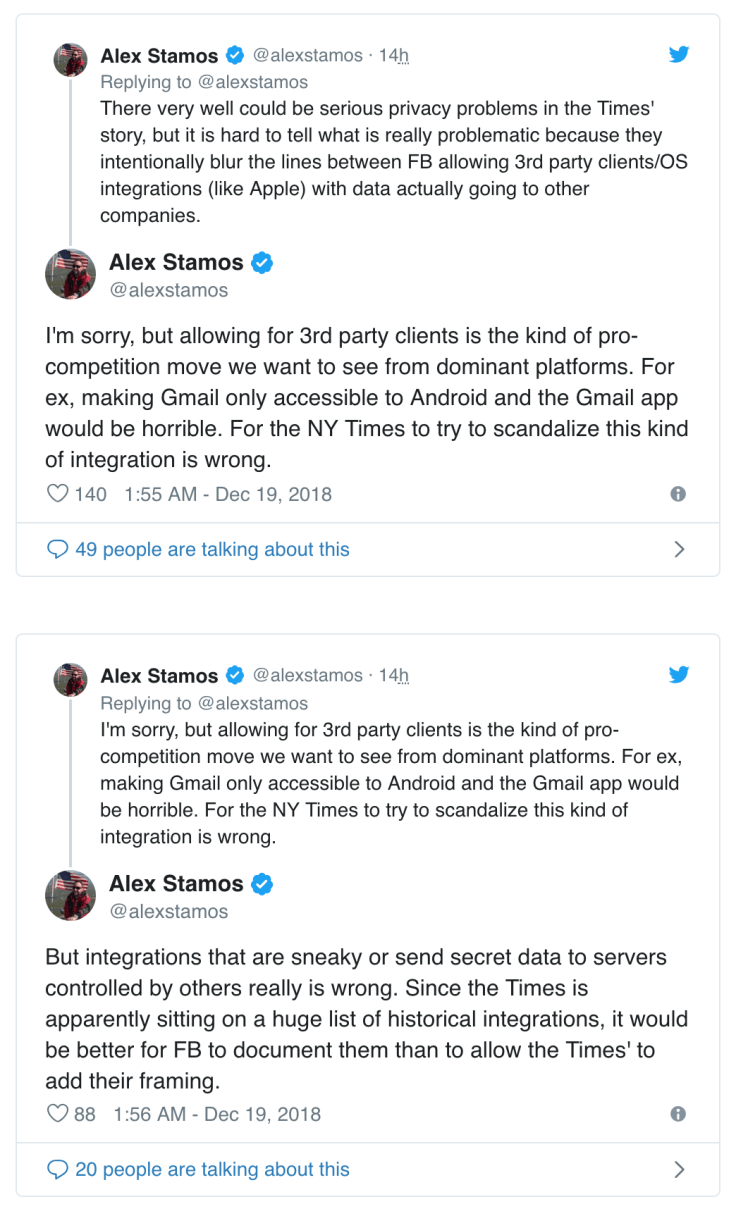
This practice, however, triggered a firestorm over the definition of consent, especially after Facebook’s former privacy chief Alex Stamos said that integration wasn’t to blame:

Screen Shot 2018-12-19 at 4.33.43 PM

Screen Shot 2018-12-19 at 4.34.33 PM

Interestingly, according to Business Insider:

According to internal Facebook documents seen by the Times, Spotify could see the messages of more than 70 million Facebook users a month. The Times reported that Spotify, Netflix, and the Royal Bank of Canada could read, write, and even delete people’s messages.

Importantly, both Spotify and Netflix told the Times they were unaware they had this kind of broad access. Facebook told the New York Times it found no evidence of abuse.

Zero Hedge also reported:

Amazon was granted access to users’ names and contact information through their friends, while Yahoo! was able to view streams of friends’ posts as recently as this summer despite Facebook promising that it had stopped this type of sharing years earlier.

What’s more? China’s Huawei and Russian search giant Yandex – accused last year by Ukraine of funneling user data to the Kremlin – had access to Facebook’s unique user IDs.

[…]

Facebook was able to circumvent a 2011 consent agreement with the Federal Trade Commission (FTC) which barred the company from sharing user data without explicit permission, because Facebook considered the partners extensions of itself – “service providers that allowed users to interact with their Facebook friends.” This allowed the company to grant such unprecedented access to everyone’s information. The partners were reportedly prohibited from using the personal information from purposes outside the scope of their agreement, however there has been little to no oversight.

Yesterday, Infowars reported that the NAACP was joining a long list of ideologically-diverse groups that were boycotting or otherwise moving away from Facebook.

“Over the last year, NAACP has expressed concerns about the numerous data breaches and privacy mishaps in which Facebook has been implicated,” wrote NAACP President Derrick Johnson. “And since the onset of the Silicon Valley boom, we have been openly critical about the lack of employee diversity among the top technology firms in the country.”

“Now, the time has come for our collective actions to emulate the severity of mistrust we have in Facebook.”

Blog at WordPress.com.

Up ↑