Rabobank: Our Coronavirus Base Case Is Rapidly Shifting From “Bad” To “Ugly”

See the source image

Profile picture for user Tyler Durden

Submitted by Michael Every of Rabobank

Regular readers will know that our four projected COVID-19 scenarios were “Bad, Worse, Ugly, and Unthinkable”. Current news today suggests risks that the base case is rapidly shifting from “Bad”, meaning only China is impacted, to “Ugly”, where both emerging Asia and developed economies see soaring infection rates and deaths.

After all, following Vietnam, Iran now has eight deaths and an uncertain number of cases, prompting schools and universities to closed and the borders with Afghanistan and Pakistan to be sealed from the other side. For an economy already being crushed by sanctions, this is all that it needed. More worrying for markets, South Korea (with a GDP of over USD1 trillion) has also been swamped by hundreds of new cases, a 20-fold leap in just five days, and, as in China, is seeing the highest-level emergency declared, cities on lock-down, gatherings and travel bans in place, and the national assembly additionally suspended. Samsung has had to shutter at least one factory, in the city of Gumi. The Asian economy, already reeling, it about to suffer another major kick.

Worse, in Europe there also are over 160 cases in a cluster in northern Italy, with three deaths so far, and the regions of Lombardy and Veneto, the industrial and financial heartlands, in both panic and lockdown. Venice’s Carnival has been cancelled, and so was a recent fashion show. Italy is 11% of Eurozone GDP, and those two regions are 30% of Italy’s GDP. For a Eurozone already close to recession, that shock could well be more than enough to generate a downturn. Once again, we also see what we said we would in our recent virus special report: a “China-style” response: yesterday a train from Venice to Munich was stopped at the Austrian border because of fears that two passengers on board may have had the virus. So much for Schengen? Recall that the origins of the world “quarantine” come from Venice in an earlier phase of globalisation, and refer to the *40* days sailors had to stay on a visiting ship to prove they were not carrying an infectious disease. No just-in-time supply chains in those days though.

See the source image

Meanwhile, China is saying the virus may not have started in the seafood market; hot-headed Chinese social media is saying it might have been America who started it; experts are saying COVID-19 can linger on surfaces for nine days, and is airborne, and can be passively carried with no symptoms for up to *27* days, nearly double the 14 days previously thought; and other reports show that false negative tests are a serious issue, with at least one confirmed case of a patient being tested negative twice and then switching to positive. As the WHO, which has urged us all to travel as normal until now, “because markets”, wails, the window to stop this becoming a global pandemic is closing.

By contrast, China is doing its best to say that all is well. Unsurprisingly, since Party Chairman Xi Jinping placed his hand-picked people in charge, new cases have dropped sharply. Optimists see this means the lockdowns have worked – which means more global lockdowns must now be priced in, however; pessimists suggest data goal-seeking is playing a role here. However, deaths have not fallen yet, with another 97 yesterday raising the overall fatality rate worryingly (and one study of 53 Wuhan patients suggests a 61.5% fatality rate for those with any co-morbidity factor such as diabetes and/or heart or lung disease).

Just as unsurprisingly, Xi has publicly promised China will have beaten the virus by the end of March, and that the overall economic goals for 2020 are still in place, even as right now we are still basically flat-lining as shown by traffic congestion, pollution, and property sales. As we have already covered in recent weeks, the only way for BAU to return ASAP is for everyone to start travelling and gathering and working again: which is exactly how the virus will spread, especially after we have been told there is a 27-day latent period, as well as a clear tendency of asymptomatic carriers, and even more so now it has legs outside China too. Even so, people are being urged back to work as eagerly as they were being told to lock themselves in at home just two weeks ago.

See the source image

Equally unsurprisingly, the PBOC, who have already lowered rates 10bp, are making clear that COVID-19 “will be short-lived and will not change the country’s sound economic fundamentals”. With several reports suggesting up to 85% of China’s small business are going to run out of cash within three months, and many within weeks, its banks riddled with bad loans and already under-capitalised, and the state clearly about to embark on another massive debt-splurge to build more infrastructure to keep to a set GDP number regardless, even when China does re-emerge from COVID-19 it will be sagging under an even more unsustainable debt load, and the state will be playing an even larger economic role. It’s also unclear if foreign firms will be as willing to be embedded in a long, China-centric supply chain regardless, making USD inflows less likely; and all of those issues above will mean the weaker CNY we have referred to for years. It is no surprise we are through 7 again; the larger surprise is that we are not closer to 7.20.

More broadly, of course, the “Ugly” scenario is seeing US Treasury yields test critical support levels. The 10-year is now at 1.47% and another leg down will see us in whole new territory. Likewise, the USD is on a roll upwards and threatening to push higher: imagine if European virus cases spread, the same happens in Japan, and China cannot reopen as planned. And imagine what a stronger USD on top of this virus backdrop will mean for emerging-market USD borrowers. Ugly indeed.

Such is the news-flow that I hardly have time to relate that Bernie Sanders handily won the Nevada Democratic caucus, leaving Joe “White Walker” Biden in a poor second place and Mike Bloomberg looking as user-friendly as his terminals are. That makes Bernie the clear presidential nominee front-runner at this stage – and makes many Never-Trumpers into Rather-Trumpers, I would imagine. And imagine if Bernie’s plans for free healthcare for all intersect with a virus outbreak in the US….(on which note, please see our recent Through The Looking Glass report imagining a Sanders presidency).
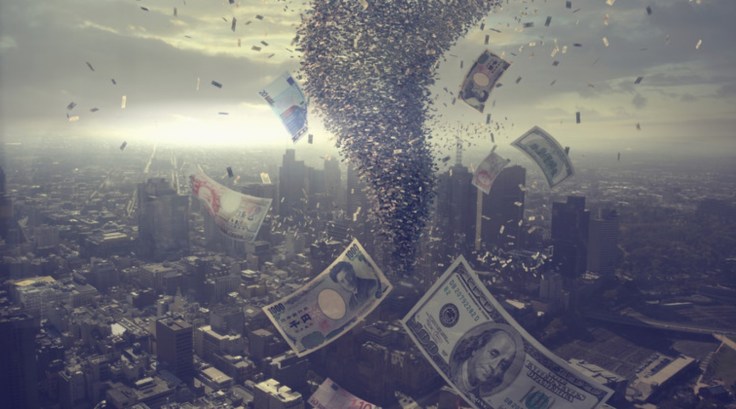
Coronavirus pandemic could wipe $1.1 TRILLION off global economy — Oxford Economics

CAP

China’s GDP growth is expected to fall from six percent last year to 5.4 percent in 2020 due to the spread of the COVID-19 virus, said the latest report by Oxford Economics.

It has modeled two scenarios on the coronavirus outbreak morphing into pandemic. Under the first scenario, if it spreads more widely in Asia, world GDP would fall by $400 billion this year, or 0.5 percent. The second scenario foresees the global GDP dropping $1.1 trillion or 1.3 percent, if the virus outbreak becomes a pandemic and a disruption to manufacturing in Asia spreads worldwide. Such a decline would be the same as losing the entire annual output of Indonesia, which is the world’s 16th largest economy.

CAP

“Our scenarios see world GDP hit as a result of declines in discretionary consumption and travel and tourism, with some knock-on financial market effects and weaker investment,” wrote the analysts.

Oxford Economics said it still expected the impact of the virus to be limited to China and to have a significant, but short-term impact, bringing world GDP growth just 0.2 percent lower than January at 2.3 percent.

The growth of new confirmed cases of the deadly coronavirus has slowed down this week, but experts warn it is too early to call the all-clear for the risk of a pandemic. So far, there are over 75,500 confirmed cases and more than 2,100 deaths.

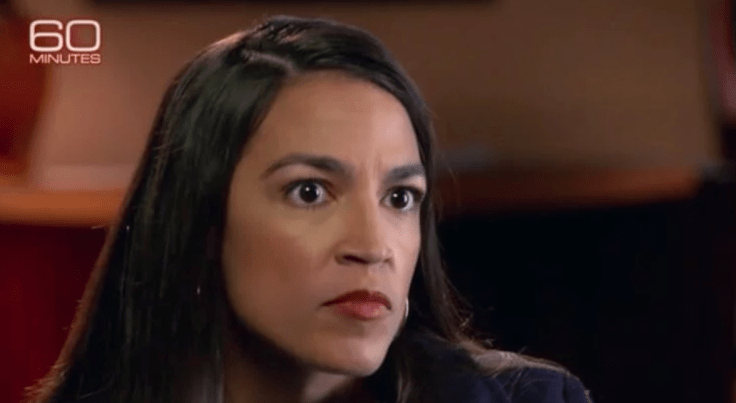
INSANE VIDEO! Democratic Socialism In AOC’s Own Words: We Don’t Want To Take Over EVERY Form Of Production – We Just Want To Tell Every Workplace How To Operate

by Nan and Byron McKeeby

Screen Shot 2019-02-25 at 4.16.21 PM

Rep Alexandria Ocasio-Cortez retweeted herself again, and this one is for the record books.

Watch as she explains Democratic Socialism. I’ve taken the liberty of transcribing it below for closer examination.

Ocasio-Cortez: Ya know just as there’s all this fear mongering that government is going to take over every corporation and government is going to take over every business or every form of production, um, we should be scared right now because corporations have taken over our government.

And in my opinion, we should be weary of any entity in which both of those things are combined, whether it’s through one way or the other. Um, and that’s why the emphasis in Democratic Socialism is on duhmocracy. And it’s not about, you know, it, it’s, it’s just as much a transformation about bringing duhmocracy to the workplace so that we have a say, and that we don’t check all of our rights at the door every time we cross the threshold into our workplace. Because at the end of the day as workers and as people in society, we’re the ones creating wealth. Not a corporate CEO. It’s not a CEO that’s actually creating four billion dollars a year. It is the millions of workers in this country that’s creating billions of dollars of economic productivity a year. And our system should reflect that.

Let’s deconstruct this–

Right out of the gate, she describes opposition to Democratic Socialism as “fear mongering” and without skipping a beat, tells us “we should be scared right now because corporations have taken over out government.” Who’s the fear monger again?

Like a broken clock, AOC gets something right when she says, “We should be weary of any entity in which both of those things (corporations and government) are combined” but then she pulls an immediate u-turn with this bit of insanity, “it’s just as much a transformation about bringing duhmocracy to the workplace.”

There should be exactly as much “duhmocracy” in the workplace as the owners decide they want/need in order to foster the environment they – as OWNERS OF PRIVATE PROPERTY, GOODS, AND SERVICES – deem necessary to remain profitable. What AOC is describing is literally the very definition of a marriage between the govt and corporations in order to regulate what people can and can’t do with their private property/business/investments. I’m certain there’s a name for that style of government but it escapes me at the moment.

LAST – AOC takes credit for “billions of dollars of economic productivity a year” on behalf of “workers” (as though CEOs don’t work).

She must be unaware that America’s GDP is just a bit higher than that.

CAP

That’s okay. She was only off by $20.5 trillion give or take. She’s still learning. Representing is hard.

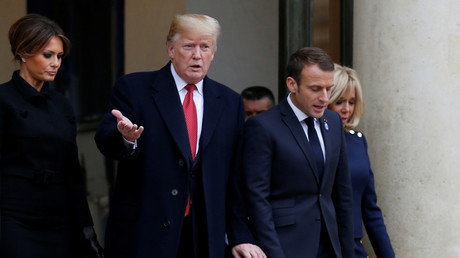
‘They were starting to learn German in Paris before US came along’ – Trump taunts Macron

'They were starting to learn German in Paris before US came along' – Trump taunts Macron

President Trump continued his verbal spat with French leader Emmanuel Macron, taunting the French leader for his country’s losses to Germany in two world wars, and suggesting that Europe needs the US as a saviour.

After returning from Armistice Day commemorations in Paris over the weekend, Trump took to Twitter on Monday to savage the US’ European allies for failing to meet their defense spending targets and leaving America to foot much of NATO’s bill. On Tuesday, the president vented his frustrations again.

“Emmanuel Macron suggests building its own army to protect Europe against the U.S., China and Russia,” Trump tweeted.

Capture

In a radio interview a week before the commemorations in Paris, Macron called for the establishment of an EU army that can defend the continent “without relying only on the United States.”

While Macron once enjoyed a close bond with president Trump, the leaders’ relationship has soured as of late. In a speech on Sunday, Macron emphatically denounced Trump’s brand of nationalism, comparing it to the forces that plunged Europe into conflict in the 20th Century.

“Old demons are resurfacing,” the French president warned. “History sometimes threatens to take its tragic course again and compromise our hope of peace. Let us vow to prioritise peace over everything.”

Macron also stuck close to German Chancellor Angela Merkel – herself a vocal Trump critic – throughout the weekend, with the pair posing in an embrace at the unveiling of a plaque near Compiegne, where Germany officially surrendered 100 years previously.

French President Emmanuel Macron and German Chancellor Angela Merkel hold hands in Compiegne, France on November 10, 2018. © Reuters / Philippe Wojazer

Whether Trump’s Tuesday tweet was meant as a jibe at Merkel and Macron’s closeness or not is unclear, but the president’s insistence that Europe pays its NATO dues is a call that he has voiced since he hit the campaign trail three years ago.

At present, only five NATO member states – the US, UK, Greece, Estonia, and Poland – allocate two percent of their GDP to defense spending, a requirement for membership. In 2017, the US spent $686 billion on defense, over double the expenditure of all 28 other states combined.

While Macron is now in Trump’s firing line over defense spending, the US president had singled out Germany in the runup to a NATO summit in Brussels in July. As well as savaging Merkel’s government for spending just over 1.2 percent of its GDP on defense, Trump said that Germany is “totally captive to Russia,” referring to its reliance on Russian gas.

While the US underwrites most of Europe’s defense bill, more EU leaders than Macron have expressed discomfort at relying on Trump in recent months. Liberal MEP Guy Verhofstadt – a long-time advocate for a federal Europe – echoed Macron’s comments on Saturday, when he tweeted that Europe cannot be “unprepared for the America First Policy.”

The idea of an integrated EU army might make Macron and Merkel excited, but it has been criticized by more people than just Trump. NATO Secretary General Jens Stoltenberg responded to Macron’s radio interview by warning the French president not to take over NATO’s job.

“Two World Wars and a Cold War taught us the importance of doing things together,” he said at a conference in Berlin on Monday. “The reality is that we need one strong and capable command structure, we can’t divide those resources in two.”


Blog at WordPress.com.

Up ↑