No need to install: Microsoft has controversial fake news filter NewsGuard built into mobile browser

cap

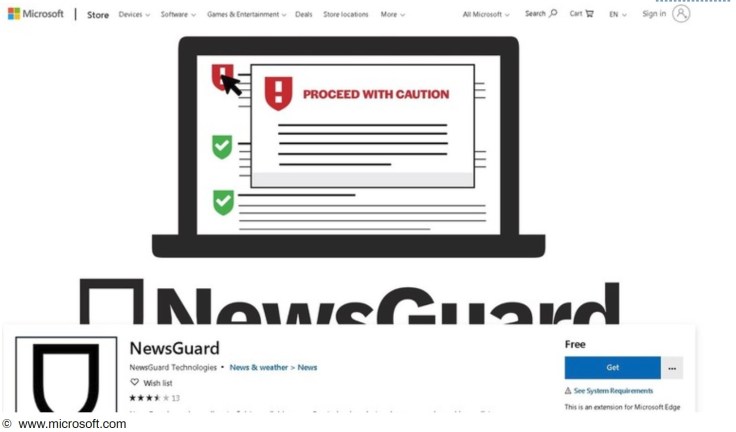
Corporate and neocon-backed startup NewsGuard is one step closer to its vision of bringing its “unreliable” news rater to every screen after Microsoft makes it an integral part of its Edge mobile browser.

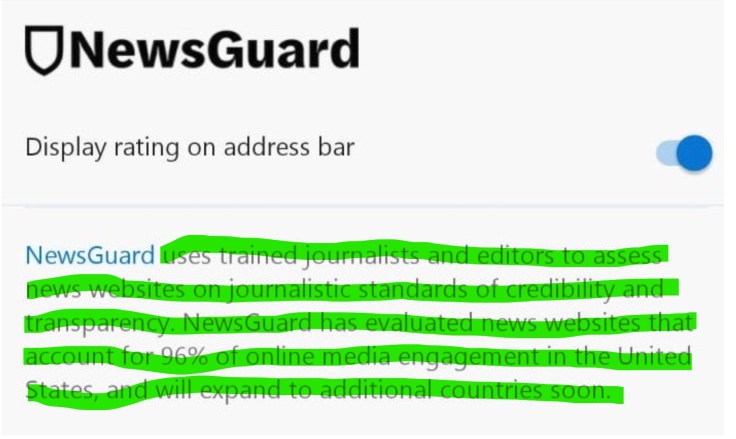
Rather than having to download an app as before, Edge users on Android and Apple devices can now just click one button to enable its “green-red rating signal if a website is trying to get it right or instead has a hidden agenda or knowingly publishes falsehoods or propaganda.”

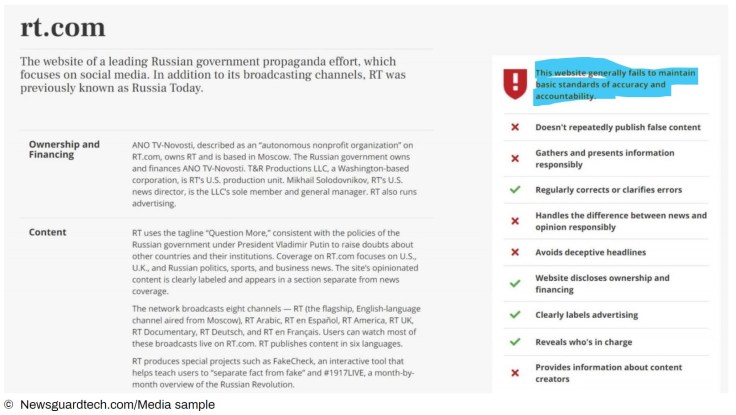
Among the green-rated websites: Voice of America, CNN, Buzzfeed, the Guardian, New York Times and the Washington Post, as well as left-leaning upstarts such as Vice News and Refinery 29. Ones that are given the red warning label of “failing to maintain basic standards of accuracy and accountability”: RT and Sputnik (obviously enough) and the right-wing Daily Mail, Breitbart and the Drudge Report, in addition to hundreds of other non-mainstream news websites such as Wikileaks.
cap

Not only does the integration ensure that NewsGuard is present on every browser, and is easier to use than to ignore, but by making it a fundamental Microsoft-provided feature, the company gives it inherent level of trustworthiness, something akin to a bundled anti-virus feature, only this time the virus targets your brain, not your computer or iPod.

‘Totally transparent’

None of this is the slightest bit alarming if you believe that NewsGuard is an absolutely fair arbiter of what constitutes real news or propaganda.

Its pride of place is its “Nutrition Labels” which ape the precision of a list of calories, carbs, and saturated fats to give a supposedly scientific assessment of media reliability on nine different criteria. Among them: doesn’t repeatedly publish false content, avoids deceptive headlines, gathers and presents information responsibly, handles the difference between news and opinion responsibly.
cap

The green-listed media outlets above apparently do not ever engage in these practices, or at least not knowingly. So CNN never misleads with its headlines, the Guardian never dresses up its agendas as news, and Buzzfeed stories are always accurate. One literally doesn’t have to go back three days to find dozens of examples to the contrary, but this would be too mind-numbingly pedantic a task.

Even regular readers of the green-tick media must be able to see these are judgment calls. What is even “presenting information responsibly”?

Perhaps realizing that their pseudo-scientific fancy diagram is insufficient, NewsGuard has stressed that they are not using shadowy methods like tech companies and are open to two-way communication.

“We want people to game our system. We are totally transparent. We are not an algorithm,” company co-founder Steve Brill told the Guardian.

This is how he explained the Daily Mail red warning.

“We spell out fairly clearly in the label exactly how many times we have attempted to contact them. The analyst that wrote this writeup got someone on the phone who, as soon he heard who she was and where she was calling from, hung up. As of now, we would love to hear if they have a complaint or if they change anything.”

On the other hand, RT did answer NewsGuard’s queries in detail. You can guess how much difference that made.

From anthrax scares to Russia fears

But who are these people that the Daily Mail or RT have to impress and why?

Brill himself is a veteran centrist journalist and author, his co-CEO Gordon Crovitz is a former Wall Street Journal columnist. After Brill, its second-biggest investor, along with his father, is Nick Penniman, the liberal publisher, and the third-biggest is Publicis Group, a multinational advertising agency.

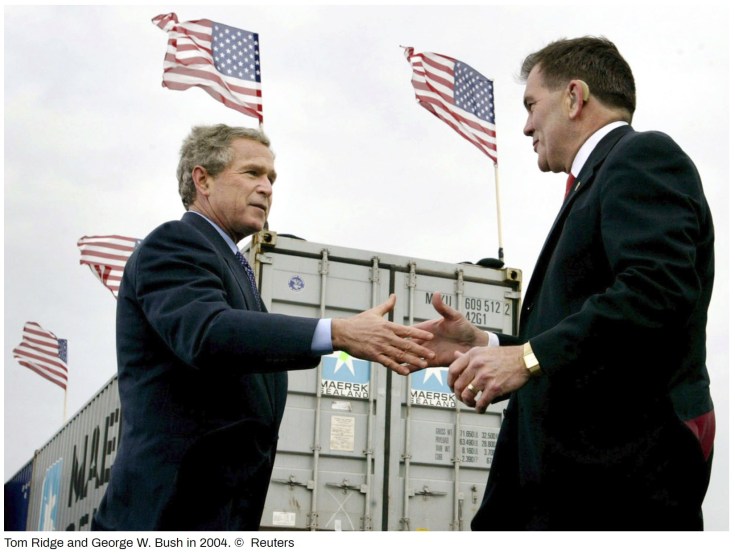
Meanwhile, its advisory board includes Tom Ridge, the first-ever Homeland Security chief, and developer of another famous color-coded system, the terror alert, and Michael Hayden, the CIA director, also under George W. Bush. There are also several Obama and Clinton-era figures.
cap

The overall picture emerges of a mix of establishment journalists, hawkish old-school Washington insiders, and so-called ethical businessmen.

They may all be experts in their fields, but if you believe that these are selfless neutral adjudicators you are probably beyond being helped by color charts. And this is not some one-off initiative either: NewsGuard is part of Microsoft’s Defending Democracy program, which combats purported election meddling, presumably primarily from Russia. The frontline of the information war is not customarily the place for impartial news judgment.

But I wasn’t an Edge user…

However much respectability NewsGuard enjoys through Microsoft, Edge has a laughably small – a fraction of a percent – market share on mobiles. In practical terms, even an increase of popularity of several thousand percent will only mean several thousand new users, and other browsers are available.

This would be that, if not for newsGuard’s self-proclaimed ambition “to expand to serve the billions of people globally who get news online.” This is just a beginning: there is an overarching plan where all public computers, from the school to the university to the library, are automatically equipped with the same “safe browsing” system.

And rather than as an individual warning, NewsGuard plans to make its designations work as an effective financial tool. The company, which has received $6 million in backing, also plans to soon work with advertisers, “keeping ads off unreliable news websites” to ensure “brand safety.” Fall foul of the green ticks, no money for you. Advertising managers are already demonetizing programs with alternative or controversial viewpoints elsewhere, and soon the process can be automated, and Brill is boasting that he is “happy to be blamed – doing the dirty work for the platforms. No wonder alternative outlets in the US are openly opposed.

So, just like the use of NewsGuard in all public libraries in the faraway state of Hawaii (no money charged), it is best to look at the Edge integration is more of a test, a pilot project, a dry run. Latching NewsGuard onto a popular browser like Chrome, or a social network like Facebook, would stir tremors of public debate, as it has done in the past when similar initiatives have been tried. Instead, first they came for the Edge users.
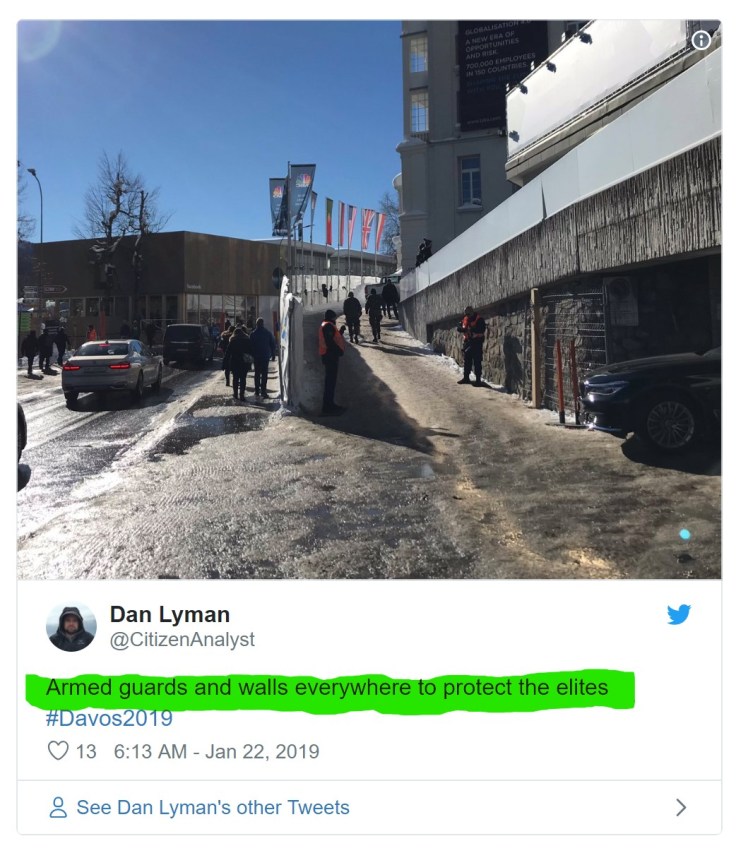
Walls, Armed Guards Protect Davos Elite

The global elite meeting in Davos, Switzerland, are relying on walls and armed guards to protect them, hinting at their effectiveness; meanwhile, Democratic lawmakers refuse to fund President Trump’s proposed border wall.

cap

World leaders are soon to meet behind walls and tight security at the World Economic Forum held annually in the Swiss Alps.

This, of course, begs the question: if walls don’t provide security, then why else are Democratic lawmakers refusing to fund President Trump’s proposed border wall as the government shutdown enters its 32nd day?

Last week, House Speaker Nancy Pelsoi (D-Calif.) tried to soften Democratic oppositionby pushing for a virtual, technological wall in lieu of a physical barrier requested by President Trump.


The ‘Gilets Jaunes’ Are Unstoppable: “Now, The Elites Are Afraid”

By Tyler Durden

screen shot 2019-01-21 at 3.45.05 pm

Authored by Christophe Guilluy via Spiked-Online.com,

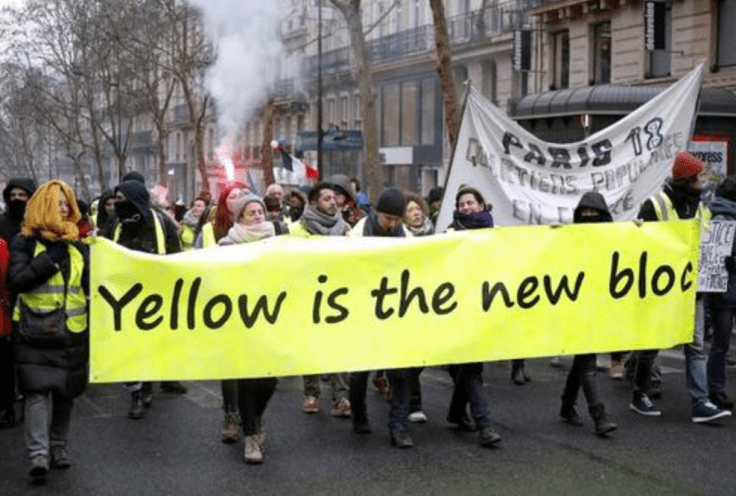
The gilets jaunes (yellow vest) movement has rattled the French establishment. For several months, crowds ranging from tens of thousands to hundreds of thousands have been taking to the streets every weekend across the whole of France. They have had enormous success, extracting major concessions from the government. They continue to march.

Back in 2014, geographer Christopher Guilluy’s study of la France périphérique (peripheral France) caused a media sensation. It drew attention to the economic, cultural and political exclusion of the working classes, most of whom now live outside the major cities. It highlighted the conditions that would later give rise to the yellow-vest phenomenon. Guilluy has developed on these themes in his recent books, No Society and The Twilight of the Elite: Prosperity, the Periphery and the Future of Francespiked caught up with Guilluy to get his view on the causes and consequences of the yellow-vest movement.

spiked: What exactly do you mean by ‘peripheral France’?

Christophe Guilluy: ‘Peripheral France’ is about the geographic distribution of the working classes across France. Fifteen years ago, I noticed that the majority of working-class people actually live very far away from the major globalised cities – far from Paris, Lyon and Toulouse, and also very far from London and New York.

Technically, our globalised economic model performs well. It produces a lot of wealth. But it doesn’t need the majority of the population to function. It has no real need for the manual workers, labourers and even small-business owners outside of the big cities. Paris creates enough wealth for the whole of France, and London does the same in Britain. But you cannot build a society around this. The gilets jaunes is a revolt of the working classes who live in these places.

They tend to be people in work, but who don’t earn very much, between 1000€ and 2000€ per month. Some of them are very poor if they are unemployed. Others were once middle-class. What they all have in common is that they live in areas where there is hardly any work left. They know that even if they have a job today, they could lose it tomorrow and they won’t find anything else.

spiked: What is the role of culture in the yellow-vest movement?

Guilluy: Not only does peripheral France fare badly in the modern economy, it is also culturally misunderstood by the elite. The yellow-vest movement is a truly 21st-century movement in that it is cultural as well as political. Cultural validation is extremely important in our era.

One illustration of this cultural divide is that most modern, progressive social movements and protests are quickly endorsed by celebrities, actors, the media and the intellectuals. But none of them approve of the gilets jaunes. Their emergence has caused a kind of psychological shock to the cultural establishment. It is exactly the same shock that the British elites experienced with the Brexit vote and that they are still experiencing now, three years later.

The Brexit vote had a lot to do with culture, too, I think. It was more than just the question of leaving the EU. Many voters wanted to remind the political class that they exist. That’s what French people are using the gilets jaunes for – to say we exist. We are seeing the same phenomenon in populist revolts across the world.

spiked: How have the working-classes come to be excluded?

Guilluy: All the growth and dynamism is in the major cities, but people cannot just move there. The cities are inaccessible, particularly thanks to mounting housing costs. The big cities today are like medieval citadels. It is like we are going back to the city-states of the Middle Ages. Funnily enough, Paris is going to start charging people for entry, just like the excise duties you used to have to pay to enter a town in the Middle Ages.

The cities themselves have become very unequal, too. The Parisian economy needs executives and qualified professionals. It also needs workers, predominantly immigrants, for the construction industry and catering et cetera. Business relies on this very specific demographic mix. The problem is that ‘the people’ outside of this still exist. In fact, ‘Peripheral France’ actually encompasses the majority of French people.

spiked: What role has the liberal metropolitan elite played in this?

Guilluy: We have a new bourgeoisie, but because they are very cool and progressive, it creates the impression that there is no class conflict anymore. It is really difficult to oppose the hipsters when they say they care about the poor and about minorities.

But actually, they are very much complicit in relegating the working classes to the sidelines. Not only do they benefit enormously from the globalised economy, but they have also produced a dominant cultural discourse which ostracises working-class people. Think of the ‘deplorables’ evoked by Hillary Clinton. There is a similar view of the working class in France and Britain. They are looked upon as if they are some kind of Amazonian tribe. The problem for the elites is that it is a very big tribe.

The middle-class reaction to the yellow vests has been telling. Immediately, the protesters were denounced as xenophobes, anti-Semites and homophobes. The elites present themselves as anti-fascist and anti-racist but this is merely a way of defending their class interests. It is the only argument they can muster to defend their status, but it is not working anymore.

Now the elites are afraid. For the first time, there is a movement which cannot be controlled through the normal political mechanisms. The gilets jaunes didn’t emerge from the trade unions or the political parties. It cannot be stopped. There is no ‘off’ button. Either the intelligentsia will be forced to properly acknowledge the existence of these people, or they will have to opt for a kind of soft totalitarianism.

A lot has been made of the fact that the yellow vests’ demands vary a great deal. But above all, it’s a demand for democracy. Fundamentally, they are democrats – they want to be taken seriously and they want to be integrated into the economic order.

spiked: How can we begin to address these demands?

Guilluy: First of all, the bourgeoisie needs a cultural revolution, particularly in universities and in the media. They need to stop insulting the working class, to stop thinking of all the gilets jaunes as imbeciles.

Cultural respect is fundamental: there will be no economic or political integration until there is cultural integration. Then, of course, we need to think differently about the economy. That means dispensing with neoliberal dogma. We need to think beyond Paris, London and New York.

1000s of police on guard as Yellow Vests hit streets in France for 10th week in a row

For the 10th week in a row, Yellow Vest protesters filled the streets of Paris and other cities in France, with thousands of police standing guard. Earlier, President Emmanuel Macron launched his “national debates” on the crisis.

Around 84,000 people had joined the protests across the country on Saturday, the Interior Ministry said. The turnout was comparable to that of last week, meaning that the nation-wide debate on the crisis announced by President Emmanuel Macron so far did little to change the people’s moods.

In Paris, the Yellow Vest occupied the Champs-Elysees and the Esplanade des Invalides near the nation’s parliament. People were seen waving national flags and setting off firecrackers.

Some protesters brought cardboard coffins, in memory of the people who have died since the beginning of the protests (the majority was killed in traffic accidents during road blockades). They marched under a large banner reading “Citizens in danger.”

The law enforcers used water cannons and tear gas to disperse some of the protesters in Paris.

“Over in the distance, you might see a water cannon. They’re trying to disperse the protestors,” RT’s Charlotte Dubenskij reported from the heat of the action in Paris. “We did see the protestors trying to break down some of the traffic lights. We’ve also seen tear gas being dispersed… The protestors were trying to throw back the tear gas pellets back at the police.”

After the officers used force, there were people lying on the ground, who “potentially could’ve been injured,” Dubenskij said.

42 protestors were arrested in the capital for carrying illegal items and other violations, the police said.

The demonstrators have denounced Macron’s open letter to the country, in which he announced the launch of the nation-wide debate to defuse the tensions, as nothing but a “huge scam.”

“It contradicts everything he [Macron] says and does,” one of the protestors told RT, with the other saying that he’ll gladly send the letter back to the president.

“We hear a lot of fine words, but see very few decisions that somehow improve the wellbeing of the people. There must be a least a slight increase in living standard after we’ve been crying for help for the past ten weeks. We work hard, but we still have an empty fridge. That’s how we live,” a female demonstrator said.

The Yellow Vest processions took place in Caen and Rouen, both in northern France. The rallies were also held in Strasbourg, Bordeaux, Toulon, Dijon, Beziers, Avignon, among other places.

The authorities deployed 5,000 police officers in Paris, and 80,000 nationwide, according to local media.

Armored police cars were filmed moving through the southern city of Toulouse where 10,000 people took to the streets. There were scuffles between the police and the Yellow Vests, with at least ten people detained.

A major rally also took place in Bordeaux, with the attendance between 4,000 to 6,000 demonstrators.

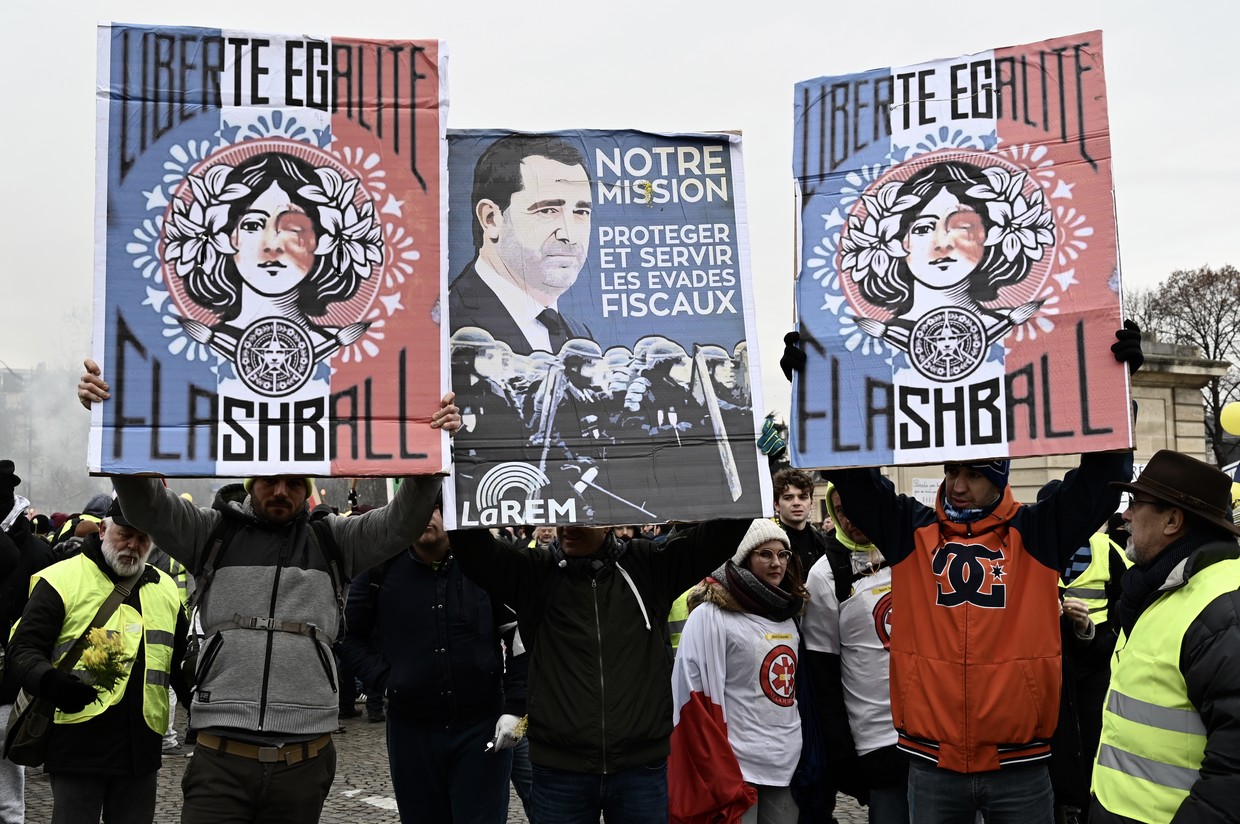
Some French protesters carried placards, reading “Freedom, Equality, Flash-Ball,” referring to the type of ‘less-lethal’ guns used by law enforcement to quell the protests. The placards also contained pictures of Marianne – a national symbol of liberty – with an injured eye. That was apparently an allusion to a high-publicized incident in December when a young woman was hit in the eye by a projectile the activists say was fired from a Flash-Ball.

In Avignon, the protestors attempted to set the city hall on fire by gathering burning waste materials in front of the wooden doors to the building.

The Yellow Vest protests began in November as a movement against planned fuel tax hikes, but eventually grew to include wider demands, including the resignation of President Emmanuel Macron and his government.

Previous rallies have seen violent clashes with police. There have been injuries on both sides, and over 1,000 people have been detained in connection to the unrest, which has at times spilled out into street battles.

Saturday’s rallies take place days after President Emmanuel Macron launched“grand national debates,” a series of public discussions about the government’s policies. He hopes the debates will help in reaching a compromise with the protesters, but many have expressed skepticism regarding the format and intentions. As a result, some protesters appeared with placards denouncing the debates as a “scam.”


WESTERN EUROPE “Der Spiegel” associates US Ambassador in Germany with Neo-Nazis

By 

The German magazine “Der Spiegel” launched an unprecedented attack on the chief representative of the United States, Ambassador Richard Grenell, associating him with Neo-Nazis.

In the wake of the scandal  surrounding Fake News reporting by “Der Spiegel”, the US Ambassador to Germany Richard Grenell charged Germany’s leading newsweekly with anti-American bias and requested an independent inquiry into the magazine’s editorial practices in December.

Instead of an apology and self-critical introspection, the “Spiegel” has now launched an unprecedented attack on the chief representative of the United States, the nation that has guaranteed Germany’s security and defense for 70 years.

Petr Bystron, the AfD spokesman on the foreign policy committee of the German Bundestag, commented: “Richard Grenell is a cancer survivor, the first openly gay US Ambassador, and the intellectual thought leader of the current US administration in Europe,  who actively speaks out for citizens, for a strong German-American partnership, for the values of Western democracy, for Israel and against Iranian terror. If such a remarkable personality were left-wing, “Der Spiegel” and the entire German media would be fawning over him like a rock star.”

“However, since he unfortunately has a different opinion than these supposedly neutral, objective journalists, they instead have to attack him with barely concealed hatred and unprofessional vitriol. “Der Spiegel” should really be doing its utmost to restore its tarnished reputation internationally, but instead seems to be doing everything it can to  undermine the last vestiges of its journalistic integrity by associating the US Ambassador with Neo-Nazis, of all things.”

“With this kind of obviously biased reporting, it’s no wonder “Der Spiegel” had to announce in October it would no longer be releasing its plummeting circulation numbers anymore. When the quarterly circulation figures are released, we’ll see how the Spiegelgate scandal has affected their already-falling sales. I’m afraid it won’t be good news for “Der Spiegel”. Readers are simply sick of all this fake news and hateful, manipulative reporting.“

Remember the Caravan? Leader Faces 15 Years in Prison for Child Rape

By Tom Pappert

One of the leaders behind the latest migrant caravan to depart from Central America has been arrested by local authorities, who discovered he had been convicted of raping his child cousin, and had been fleeing justice.

Honduran media reports that migrant caravan coordinator Juan Carlos Molina was arrested by Honduran Border Police after they realized he matched the description they had for a man convicted of child rape in 2015.

Molina either did not carry identification with him, or carried fake paperwork, causing the police to fingerprint him and discover that he was a convicted child predator meant to be serving 15 years in prison.

The man was able to be convicted while remaining a fugitive was made possible due to the fact that the victim, his minor cousin, produced a child from the assault who shares his DNA.

Trending: 30 Democrats Party in Puerto Rico During Government Shutdown

Honduras’s La Tribuna reported:

The Criminal Enforcement Court of the Judicial Section of San Pedro Sula confirmed that the detainee is a convicted person and was a fugitive from justice. He faces 15 years in prison. The court issued the arrest warrant on August 31, 2015.

On April 23, 2015, Chamber 5 of the Sentencing Court sentenced Juan Carlos Molina, who was found to be criminally liable for the crime of special violation against a minor and was found to be civilly liable to respond with compensation for the moral damages caused to the victim.

According to the facts, in September 2010, when the child under 12 was in the house, at night, she left the door ajar for her mother to enter and who arrived was Juan Carlos Molina, who took advantage of the minor, who was his cousin, covering his mouth raped her.

Big League Politics has followed the progress of the latest caravan to depart from Central America since its inception. We now know that the caravan is being encouraged by an organization that receives money from globalist financier George Soros, and that Congress has received information suggesting terrorists may have embedded themselves in the latest caravan.

Tensions at the U.S.-Mexico border continue to mount, as Democrats seek to deny President Donald J. Trump the ability to construct a wall of steel or concrete to stem the tide of violent crime coming across the border. Just last week, a pile of 20 or more corpses was found near the border, justifying Americans’ increasing desire to see the wall constructed.

‘Land of censorship & home of the fake’ Facebook is getting into the local news business

capture

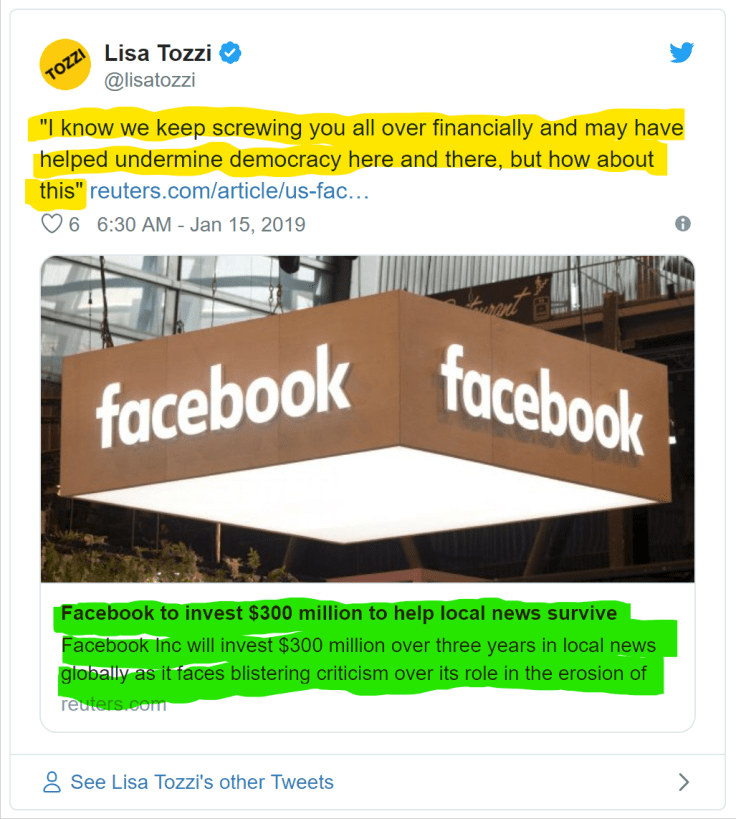
Facebook is investing $300 million in local newsrooms and training initiatives for regional journalists over the next three years. But can Mark Zuckerberg be trusted to keep the press free?

With print newspapers’ advertising revenues in freefall for almost two decades, and local newspapers conglomerating and laying off staff to survive, the industry will take any help it can get. Facebook – with its mountains of fake news, clickbait, and a tricky environment for digital publishers to make money in – has in no small way contributed to the precarious state of modern journalism, but the company now wants to give the fourth estate a booster shot.

The company decided to focus specifically on local news. Vice President of Global News Partnerships Campbell Brown said in a blog post that after examining what kind of news people want to see on Facebook, the company “heard one consistent answer: people want more local news, and local newsrooms are looking for more support.”

Facebook’s support for the new industry has thus far been limited to funding a small selection of news programs from CNN, Fox News, and a handful of others. The social media giant has been far more keen to play policeman, partnering up with an array of third-party “fact checkers”last year to filter out “false narratives” and “intentionally divisive headlines and language that exploit disagreements and sow conflict”from users’ timelines.

Troublingly, even Facebook’s own staff could not explain what exactly the term “false narratives” meant. Additionally, Facebook CEO Mark Zuckerberg met with a consortium of media executives shortly afterwards to talk about his company’s use of algorithms to promote ‘reputable news’ and suppress other content, all to ensure that “people can get trustworthy news on our platform.”

Drawn from CNN, the New York Times, Buzzfeed and others, the overwhelmingly liberal makeup of the panel of executives did little to persuade conservatives – who have long accused the platform of bias – that Facebook would act impartially.

Neither did Facebook’s announcement in August that it would partner up with the aggressively pro-NATO think tank, the Atlantic Council. The Atlantic Council vowed to serve as Facebook’s “eyes and ears” in the fight against fake news, but that fight resulted in hundreds of alternative news pages being purged from the platform in October. The 800 pages spanned the political spectrum, and their removal triggered cries of censorship and accusations that Facebook was waging “a wider war on dissident narratives.”

One banned cartoonist declared Facebook to be “land of the censorship and home of the fake,” while anti-war journalist Caitlin Johnstone called the purge the “latest escalation of corporate censorship used as state censorship in the West.”

Can Facebook then be trusted to fund local journalism?

The answer is unclear. The $300 million will be given to a number of organizations to distribute further. Some of these organizations, like the Pulitzer Center, are household names. Others, like Report for America, are less well known. The Pulitzer Center will receive $5 million to award as grants to local newsrooms around the country, and social justice non-profit Report for America will get $2 million to go towards the hiring of 1,000 journalists over the next five years.

Pulitzer Center founder and executive director Jon Sawyer welcomed the funding, and took time to “applaud Facebook’s commitment to the editorial independence that is absolutely essential to our success.”

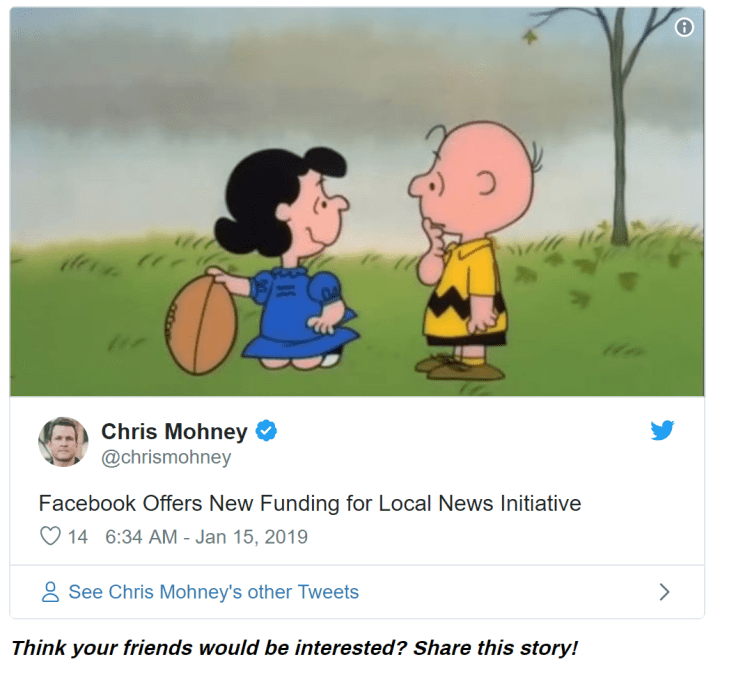
No matter how hands-off Facebook stays, some commentators were angered by the company’s new-found role as champion of the local press. After contributing in a large way to the decline of print media, Facebook’s $300 million investment in the industry is, as one cartoon implied, “peanuts.”

capture

capture

HUNGARY OFFICIAL: “SOROS PULLS THE STRINGS IN BRUSSELS”

Hungary Official: "Soros Pulls the Strings in Brussels"

MEP demands an explanation

Hungary Journal – JANUARY 14, 2019

Fidesz believes George Soros’s people “are pulling the strings of the European Commission’s leading politicians” and demands an explanation, Fidesz MEP Tamas Deutsch said at a press conference on an unrelated topic in Budapest on Saturday.

Deutsch noted that daily Magyar Idok learned that U.S. billionaire Soros had met for talks with the EU leaders on at least 20 occasions. Soros held talks with Jean-Claude Juncker, Frans Timmermans, Emmanuel Macron and Dimitris Avramopoulos, he added.

A poster slamming George Soros in Szekesfehervar, Hungary (Photo by Attila Kisbenedek / Contributor via Getty Images)

Deutsch said it was “absurd” that a person claiming to be a philanthropist who represents the official viewpoint of not a single country can meet with EU leaders more frequently than the prime minister or head of state of any EU member state.

Fidesz will ask for explanations, in writing, on the subject matter of all of these meetings, he added.

Police employ tear gas & water cannons as Yellow Vest protests enter 9th week (VIDEO)

screen shot 2019-01-12 at 12.23.15 pm

Yellow Vest demonstrators returned to the streets of Paris and other French cities on Saturday, and some were met by police with tear gas and water cannons as the authorities pledged zero tolerance to violence.

More than 32,000 people took part in the protests in Paris, Marseille, Bordeaux, Lyon, Strasbourg, and other cities, according to Interior Ministry data.

Around 8,000 demonstrators, both locals and those coming from other parts of the country, were rallying in the French capital. Some 5,000 riot police with special equipment and armored vehicles oversaw the protests.

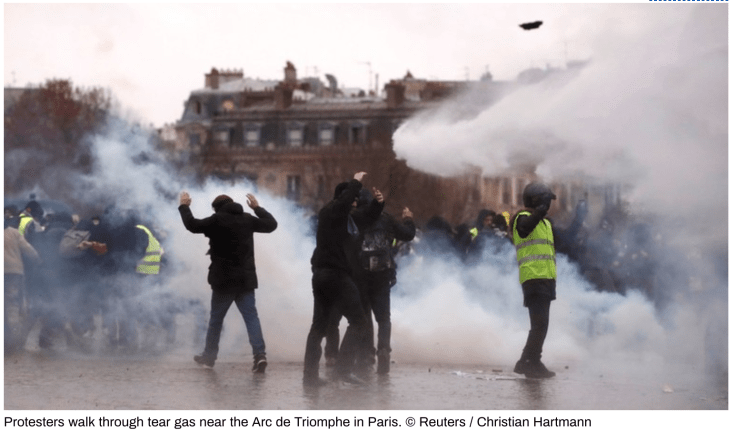
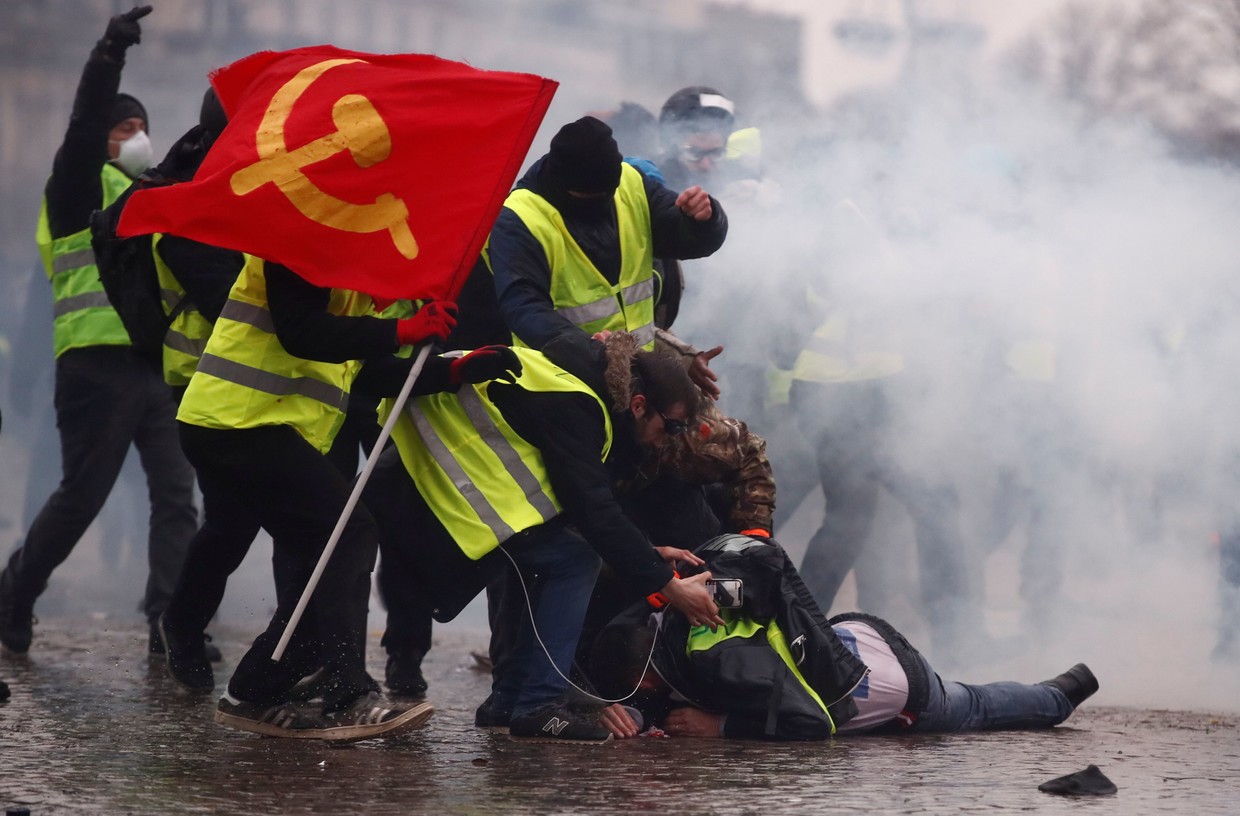
Clashes eventually erupted at the iconic Champs Elysees and Arc de Triomphe, with police using tear gas and water cannons to calm the angry crowds. Hundreds of people were arrested during the standoff, with most of them put in custody, the law enforcers said.

“We’ve come to Paris to make ourselves heard, and we wanted to see for ourselves at least once what’s going on here,” a man, who travelled to Paris from western France to attend the protest, told AFP.


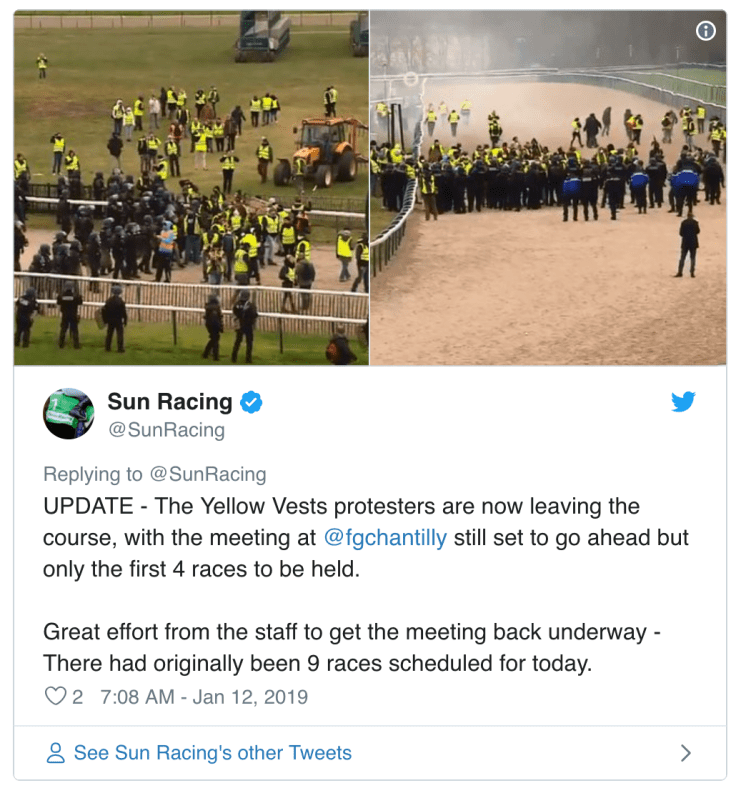
Around 1,000 demonstrators also made their way to the hippodrome and caused a delay of races in the horseracing town of Chantilly, north of Paris.

screen shot 2019-01-12 at 12.28.19 pm

In Nimes, police deployed tear gas against protesters after a tense standoff in the downtown.

17 people were also arrested during clashes in Bourges in central France, where the local authorities said that 5,000 were rallying.

screen shot 2019-01-12 at 12.30.14 pm
The French government earlier vowed zero tolerance for violence at the protests, with 80,000 security personnel deployed across France on the weekend.

The Yellow Vest movement, which took its name from the high-visibility jackets worn by the demonstrators, kicked off in November over a government-proposed hike in fuel taxes. As the weekend protests saw more people participating and started turning violent, the government dropped the planned increase.

But the demonstrations continued as the movement morphed into wider discontent with President Emmanuel Macron’s pro-business agenda, a decline in living standards, and growing inequality.

Think your friends would be interested? Share this story!


Blog at WordPress.com.

Up ↑