Chief Border Patrol agent of the San Diego sector Rodney Scott says the situation at the border is ‘getting worse.’
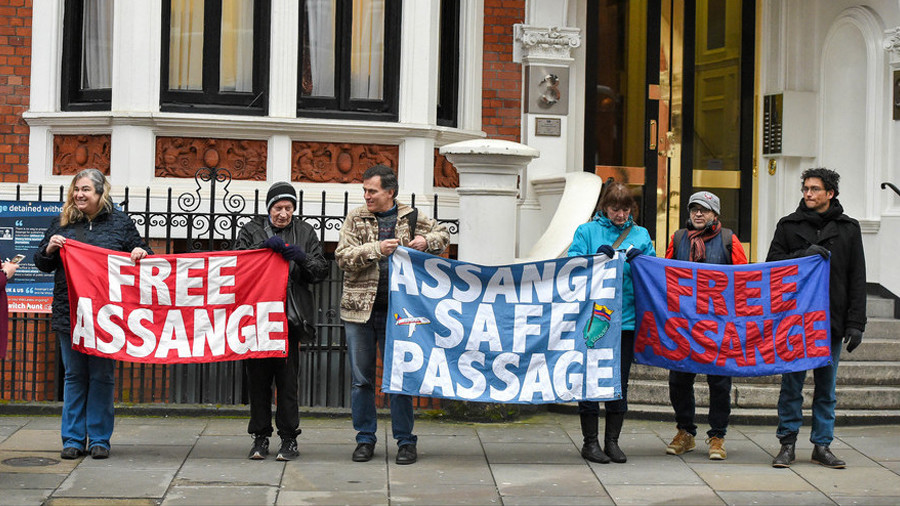
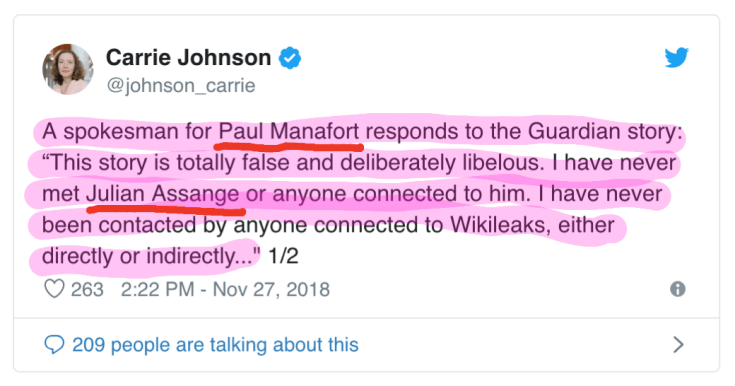
WikiLeaks is ready to sue Britain’s Guardian newspaper for a “fabricated Manafort story” that accused Julian Assange of secretly meeting President Donald Trump‘s former election campaign chairman Paul Manafort.
Manafort agreed to take part in the Mueller probe over Russia’s alleged meddling into the 2016 US election but he denies co-operating with Russia or ever meeting Assange.
The author of the report, Luke Harding, based his claim on “sources” and a document “written by Ecuador’s Senain intelligence agency and seen by the Guardian,” which the newspaper didn’t publish.
Investigative journalist Max Blumenthal asks why they didn’t provide actual “evidence from the visitor logs of the Ecuadorian Embassy which are closely watched.”
“Why not show CCTV? London is the most heavily surveilled places on Earth. Why not show that? Why rely on a single Ecuadorian source who appears to be an Ecuadorian intelligence source with the MI6 on the other hand of the line and the US on the other?” he said in a comment to RT.
He believes that it is a fabrication of a story to lay the case for the arrest and extradition of Julian Assange “by tying him to a figure who is hatching out a plea deal with Robert Mueller, by tying him to the Russiagate scandal in the US.”
Blumenthal noted that this story was being met with more skepticism than usual – “even in official circles in Washington” – and that “it might have failed.”
However, he added, “once the allegation is made, the damage is done.”
“Many people might have read this story and seen some commentary about it and news on CNN and judge that Assange did meet with Paul Manafort,” he pointed out.
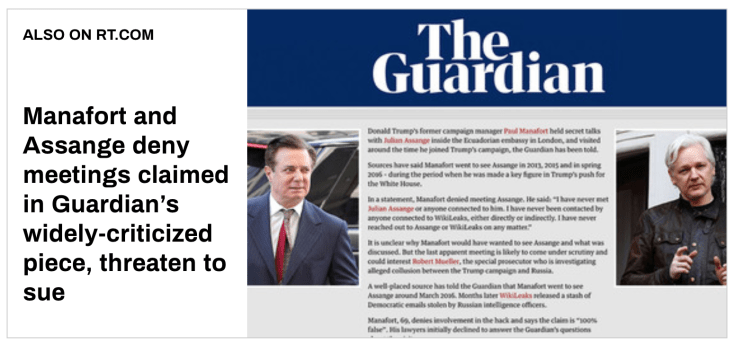
Although WikiLeaks is going to sue over this story and both WikiLeaks and Paul Manafort deny the allegations, the article is still on The Guardian’s website.
“It is a sad commentary on what The Guardian has become – basically a bulletin board for fabricated national security state propaganda,” Blumenthal said.
According to the journalist, this story brings together the Russiagate scandal in Washington with the plot to extradite Assange.
“We know that there is an indictment of Julian Assange, it may be made public tomorrow,” he said. US Secretary of State Mike Pompeo met with the Ecuadorian foreign minister earlier in the week, which might be a sign that it could be made public, Blumenthal explained.
Recalling that Paul Manafort is working out a plea deal with Robert Mueller, Blumenthal argued that the report may have been “an attempt to put the squeeze on Manafort because he is not providing enough information.”
“This apparently fabricated story was planted through Luke Harding… in order to lay the case for the arrest and extradition of Julian Assange,” he said.
If arrested and extradited, Blumenthal explains, Assange would be the first journalist who published classified information in the US to be tried under the Espionage Act. That, he noted, would basically deprive the WikiLeaks founder of “any real legal defense or an ability to mount a defense and would see him put on trial in a district court in Northern Virginia where the conviction rate on national security prosecutions is close to 100 percent.”
ALSO ON RT.COMAll the Kremlin’s men: Farage, Moscow and six degrees of Kevin Bacon
Former MI5 intelligence officer Annie Machon thinks the US will go to any lengths to fix charges against Assange.
“It has been an open secret for many years that there has been a secret grand jury convened in Virginia trying to find any charge or probably make up a new law just to prosecute Julian Assange as a revenge for the fact that he shone a very bright light on some very murky and dark details of what the American state was doing,” she explained.
According to Machon, it is useful for the American establishment and the Democrats “to conflate everything with one big mess: Paul Manafort, the Mueller probe, Donald Trump, WikiLeaks as all part of big Russiagate-type thing.” She added that when you actually “pick the details, none of that hangs together whatsoever.”
In her opinion, Julian Assange is becoming a pawn in “a very high stakes game within American Washington politics.”
Like this story? Share it with a friend!
By Jim Hoft

Epstein abused dozens, if not hundreds, of teen girls.
It is well documented that former President Bill Clinton flew on convicted child sex offender Jeffrey Epstein’s private jet.
And Robert Mueller was FBI director when Epstein was given a lenient 13 month jail stint for his years of child sex abuse.
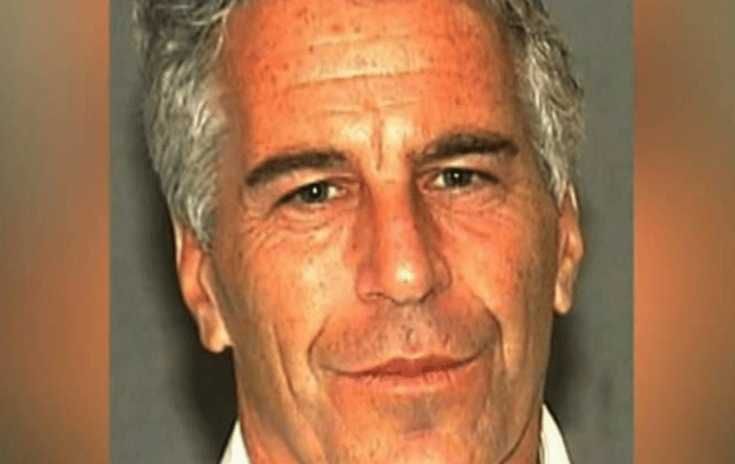
In June 2016 TGP reported that Bill Clinton visited the infamous Orgy Island (as reported by ZeroHedge) –
If you can name it — it has likely taken place this the lavish private island off the coast of Puerto Rico which boasts a beautifully landscaped plush luxury estate complete with its own helipad, privy only to certain members of the global elite.
Owned by Jeffery Epstein, a wealthy American financier and convicted sex offender, Little St. James Island appears to be somewhat of a gathering place and is a well desired hangout among key figureheads, actors and royalty to the likes of former U.S. President Bill Clinton, Kevin Spacey and even Prince Andrew.
However, the people attending the lavish residence are likely do not go there to discuss “cutting edge scientific and medical research” as the Epstein VI Foundation would like you to believe, but rather go there to experience full-on sexual encounters with underage girls as young as fourteen.
That’s right, just like a scene out of the Hollywood blockbuster film Eyes Wide Shut, starring Tom Cruise, from wild parties to prostitution, orgies and even underage sex, Little St. James reportedly has it all and is seemingly a gathering point frequented by prominent jet-setters, and it is all being exposed. The cat is out of the bag so to speak…
Back in 2005 police conducted an 11-month-long undercover investigation on Jeffery Epstein and his estate after the mother of a 14-year-old girl went to police after suspecting her daughter was paid $300 for at least one sexual act on the island in which she was ordered to strip, leaving on just her panties while giving Epstein a massage.
Although police found tons of photos of young women on the island and even interviewed eyewitnesses, Epstein was hit with a mere slap on the wrist after “pleading to a single charge of prostitution.” Epstein later served 13-months of his 18-month service in jail.
In 2008 Epstein was hit again, this time with a $50 million civil suit after another victim, a woman, made a filing in a federal court claiming that she was “recruited” by Epstein to give him a “massage” but was essentially forced into having sexual intercourse with him for $200, which was payable upon completion.
Additionally it is important to point out that Bill Clinton has been mentioned by the press often over the years — and not just for his controversial relationship with Monica Lewinsky, but rather his friendship with Jeffery Epstein.
In fact, flight records indicate that ol’ Billy-boy would frequent the island paradise around the 2002 and 2005 era, while Hillary, Bill’s wife, was a Senator in New York.
Nothing to see here, folks. Move along.
It looks like Mueller was even involved in the case.
The Epstein case was run out of DC:
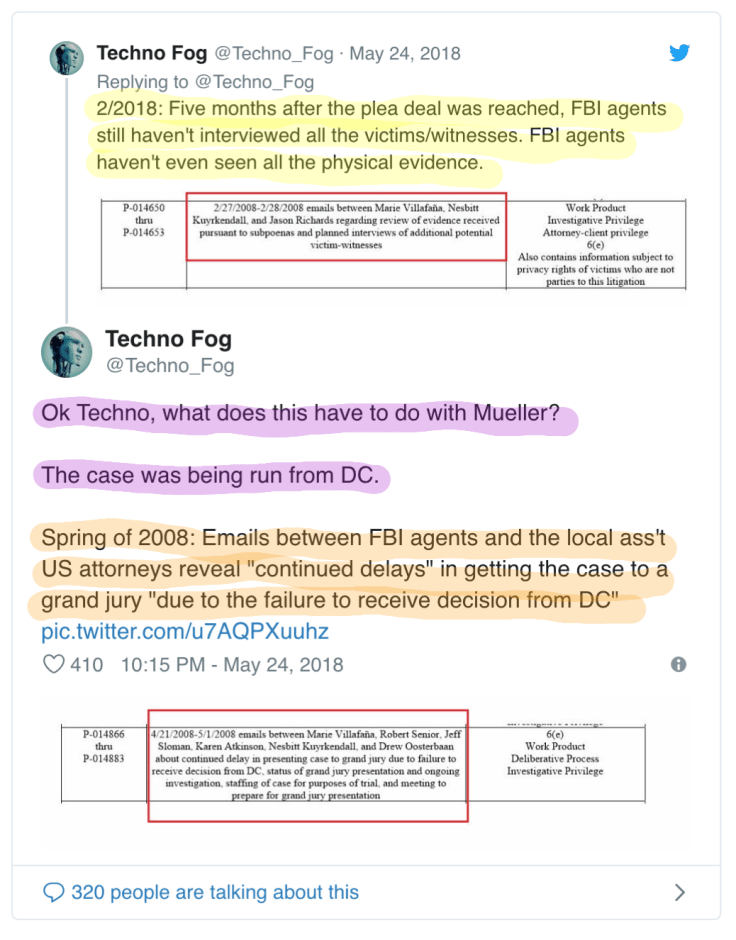
Five months after the plea deal was reached, FBI agents still haven’t interviewed all the victims/witnesses. FBI agents haven’t even seen all the physical evidence.

More support on Mueller corruption – his FBI never interviewed all the victims.

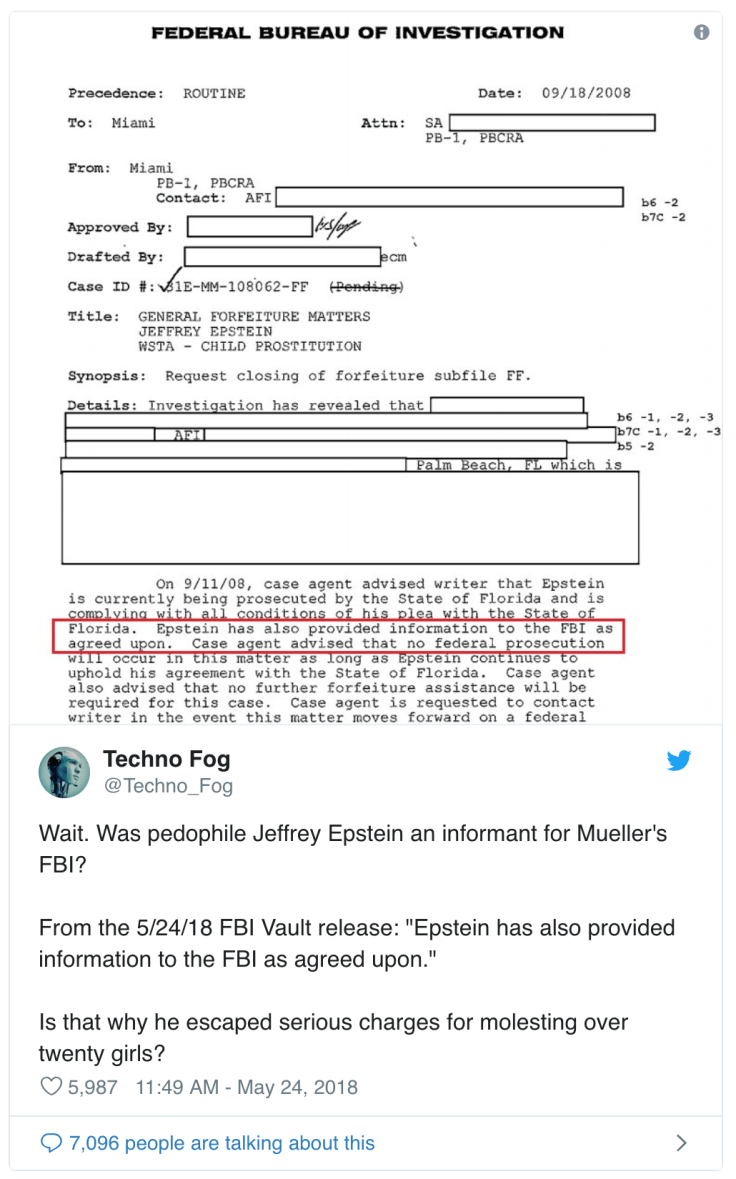
Mueller’s FBI required Epstein to provide information to the FBI –

Now there are questions whether Epstein was an informant for the FBI –


By Tyler Durden

After retweeting a tweet from a Trump fan account Wednesday morning, Mnuchin has deleted the retweet and would like the world to know that this wasn’t an “authorized” tweeting.
The tweet was retweeted from Mnuchin’s account this morning, but the original was sent last night, which probably accounts for the incorrect timing given in the Treasury Secretary’s follow up.
* * *
President Trump made his frustration with GM abundantly clear on Tuesday when he threatened to cut all EV subsidies to the Detroit carmaker. But on Wednesday both the president, this time joined by Treasury Secretary Steven Mnuchin, took the administration’s attacks on GM to their next logical endpoint: Demanding that the federal bailout recipient return the $11.2 billion loss eaten by taxpayers from the federal bailout that the company received during the depths of the financial crisis.

“If GM doesn’t want to keep their jobs in the United States, they should pay back the $11.2 billion bailout that was funded by the American taxpayer,” read a tweet from a Trump fan account that the president and Mnuchin retweeted. Trump also retweeted two tweets about illegal immigration.
GM shares slid after Trump’s tweets Tuesday afternoon, but GM stock futures showed little immediate reaction to Trump’s threat. GM received billions in bailout money to shore up its troubled financial arm GMAC in 2008. After spinning off the subsidiary (which now trades as Ally Financial), GM saddled the Treasury with a more than $11 billion loss.

After meeting with GM CEO Mary Barra, Larry Kudlow told reporters on Tuesday that he had conveyed the president’s anger to Barra, and explained that Trump feels betrayed by GM, and that he believes the carmaker “turned their back on him” by announcing the layoffs and plant closures, particularly after the Trump tax cuts handed billions of dollars back to corporations and allowed them to repatriate overseas cash.
Politicians on both sides of the US-Canada border were outraged by GM’s Monday announcement that it would close 5 North American plants (and two foreign plants) and fire nearly 15,000 workers in the US alone. Trump blasted the company for opting for layoffs and closures in the US while plants in Mexico and China remained open.
While we await a response from GM management, shareholders are a little nervous:


Zero Hedge – NOVEMBER 27, 2018
According to the Guardian, Soros’ Open Society Foundation is formally withdrawing from Turkey after the founder of its Turkey organization was arrested and charged with supporting an opposition figure accused of trying to overthrow the government of Turkish President Recep Tayyip Erdogan.

The organization announced its decision to withdraw from Turkey amid an interior ministry investigation seeking to uncover links between the organization and protests at Gezi Park in Istanbul in 2013. One of the founders of the Turkish OS branch, Hakan Altinay, was arrested along with 12 others two weeks ago and accused of supporting jailed Osman Kavala, an opposition activist accused of trying to overthrow the Hungarian government with mass protests. Kavala has been accused of supporting terrorism within Turkey, and Open Society has been accused of supporting Kavala.
Back in May, OS closed its Budapest Office and moved its operations to Berlin after the country passed an “Stop Soros” law aimed at making it more difficult for foreign NGOs to operate in the country.
In a speech last week, Erdogan accused Soros of trying to sow instability and discord in Turkish society, and of organizing destabilizing protests.
One of its founders in Turkey, Hakan Altinay, was among 13 people detained 10 days ago. They were accused of supporting jailed rights activist Osman Kavala in trying to overthrow the government through mass protests.
In a speech last week, Erdoğan linked those arrests to Soros. “The person [Kavala] who financed terrorists during the Gezi incidents is already in prison,” he told a meeting of local administrators.
“And who is behind him? The famous Hungarian Jew Soros. This is a man who assigns people to divide nations and shatter them. He has so much money and he spends it this way.”
Though it denied links to the protests, Open Society told the Guardian that it would nevertheless seek to close its office in Istanbul and liquidate its Turkish operations as swiftly as possible. The organization added that it was unsure whether it will be able to continue its Turkish operations.

The foundation said that “new investigations” were trying to link it to the Gezi protests. “These efforts are not new and they are outside reality,” it said
The foundation said it would apply for the legal liquidation of its operations as soon as possible.
According to the New York Times, a representative for Open Society said maintaining the organization’s operations in Istanbul had become “completely untenable.”
“We are deeply dismayed and disappointed that the foundation had to close,” an Open Society spokeswoman, Laura Silber, said on Monday. But, she said, “it became completely untenable.”
Open Society purports to support “justice and human rights” in more than 100 countries; but in more recent years, it has primarily focused on Soros’ liberal agenda of open borders and free trade while resisting the wave of populist sentiment that has swept across Europe and the US.
Russian authorities are planning to amend the current legislation to implement the measure, according to unnamed sources and a copy of the document reportedly seen by Reuters.
Under the current regulations, Russian authorities may impose fines of just a few thousand dollars or block the online services that violate the rules. This option is sometimes fraught with technical difficulties. Under current legislation the maximum fine Google may face in Russia is 700,000 rubles ($10,595). If the proposal is pushed through, Russian telecoms watchdog will be able to impose fines of at least $7 million.
Apart from the bulky fines, the pending measure will reportedly retain the state power to block the company’s websites. The new legislation also allows the Russian government to impose several fines on the same company over various violations.
In 2017, Google’s Russian subsidiary reportedly earned 45.2 billion rubles ($687 million).
“For a foreign company, that’s already a significant amount,” a source at one of the foreign tech firms working in Russia said, stressing that it was still unclear how the fines would be collected from companies with no legal entity in Russia.
Facebook is reportedly negotiating the issue with Russian authorities, as the social networking giant hasn’t moved servers storing its Russian users’ data to Russia, as is required by the current legislation which obliges companies to keep data on Russian users in the country.
Last year, business social network website LinkedIn was blocked in Russia after the company failed to comply with the law. Apart from not moving servers to Russia, LinkedIn reportedly collected and sent information about people who are not users of the network without their consent. In 2017, Russia also banned several messaging apps, including BlackBerry, Line, and Imo messengers, as well as Vchat video service.
In April, a district court in Moscow ordered access to popular internet messenger Telegram to be blocked after the company repeatedly refused to hand over encryption keys to its messages to Russia’s Federal Security Service (FSB). However, the procedure of blocking became stalled due to technical issues. The company replied with a counter-suit that was rejected.
 Tom's Blog