The ‘Gilets Jaunes’ Are Unstoppable: “Now, The Elites Are Afraid”

By Tyler Durden

screen shot 2019-01-21 at 3.45.05 pm

Authored by Christophe Guilluy via Spiked-Online.com,

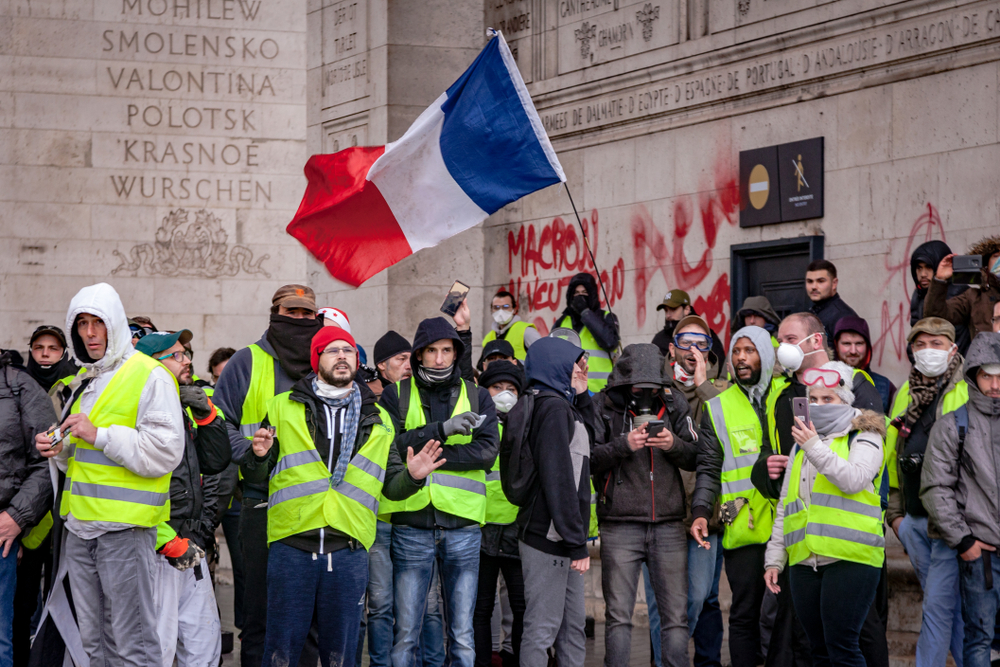
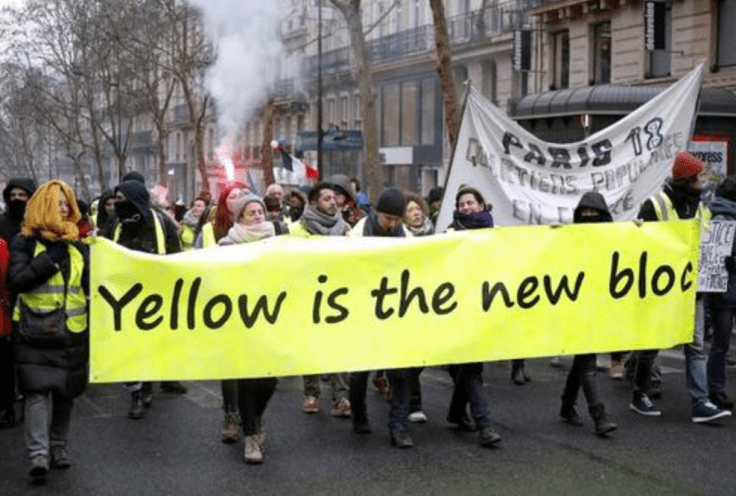
The gilets jaunes (yellow vest) movement has rattled the French establishment. For several months, crowds ranging from tens of thousands to hundreds of thousands have been taking to the streets every weekend across the whole of France. They have had enormous success, extracting major concessions from the government. They continue to march.

Back in 2014, geographer Christopher Guilluy’s study of la France périphérique (peripheral France) caused a media sensation. It drew attention to the economic, cultural and political exclusion of the working classes, most of whom now live outside the major cities. It highlighted the conditions that would later give rise to the yellow-vest phenomenon. Guilluy has developed on these themes in his recent books, No Society and The Twilight of the Elite: Prosperity, the Periphery and the Future of Francespiked caught up with Guilluy to get his view on the causes and consequences of the yellow-vest movement.

spiked: What exactly do you mean by ‘peripheral France’?

Christophe Guilluy: ‘Peripheral France’ is about the geographic distribution of the working classes across France. Fifteen years ago, I noticed that the majority of working-class people actually live very far away from the major globalised cities – far from Paris, Lyon and Toulouse, and also very far from London and New York.

Technically, our globalised economic model performs well. It produces a lot of wealth. But it doesn’t need the majority of the population to function. It has no real need for the manual workers, labourers and even small-business owners outside of the big cities. Paris creates enough wealth for the whole of France, and London does the same in Britain. But you cannot build a society around this. The gilets jaunes is a revolt of the working classes who live in these places.

They tend to be people in work, but who don’t earn very much, between 1000€ and 2000€ per month. Some of them are very poor if they are unemployed. Others were once middle-class. What they all have in common is that they live in areas where there is hardly any work left. They know that even if they have a job today, they could lose it tomorrow and they won’t find anything else.

spiked: What is the role of culture in the yellow-vest movement?

Guilluy: Not only does peripheral France fare badly in the modern economy, it is also culturally misunderstood by the elite. The yellow-vest movement is a truly 21st-century movement in that it is cultural as well as political. Cultural validation is extremely important in our era.

One illustration of this cultural divide is that most modern, progressive social movements and protests are quickly endorsed by celebrities, actors, the media and the intellectuals. But none of them approve of the gilets jaunes. Their emergence has caused a kind of psychological shock to the cultural establishment. It is exactly the same shock that the British elites experienced with the Brexit vote and that they are still experiencing now, three years later.

The Brexit vote had a lot to do with culture, too, I think. It was more than just the question of leaving the EU. Many voters wanted to remind the political class that they exist. That’s what French people are using the gilets jaunes for – to say we exist. We are seeing the same phenomenon in populist revolts across the world.

spiked: How have the working-classes come to be excluded?

Guilluy: All the growth and dynamism is in the major cities, but people cannot just move there. The cities are inaccessible, particularly thanks to mounting housing costs. The big cities today are like medieval citadels. It is like we are going back to the city-states of the Middle Ages. Funnily enough, Paris is going to start charging people for entry, just like the excise duties you used to have to pay to enter a town in the Middle Ages.

The cities themselves have become very unequal, too. The Parisian economy needs executives and qualified professionals. It also needs workers, predominantly immigrants, for the construction industry and catering et cetera. Business relies on this very specific demographic mix. The problem is that ‘the people’ outside of this still exist. In fact, ‘Peripheral France’ actually encompasses the majority of French people.

spiked: What role has the liberal metropolitan elite played in this?

Guilluy: We have a new bourgeoisie, but because they are very cool and progressive, it creates the impression that there is no class conflict anymore. It is really difficult to oppose the hipsters when they say they care about the poor and about minorities.

But actually, they are very much complicit in relegating the working classes to the sidelines. Not only do they benefit enormously from the globalised economy, but they have also produced a dominant cultural discourse which ostracises working-class people. Think of the ‘deplorables’ evoked by Hillary Clinton. There is a similar view of the working class in France and Britain. They are looked upon as if they are some kind of Amazonian tribe. The problem for the elites is that it is a very big tribe.

The middle-class reaction to the yellow vests has been telling. Immediately, the protesters were denounced as xenophobes, anti-Semites and homophobes. The elites present themselves as anti-fascist and anti-racist but this is merely a way of defending their class interests. It is the only argument they can muster to defend their status, but it is not working anymore.

Now the elites are afraid. For the first time, there is a movement which cannot be controlled through the normal political mechanisms. The gilets jaunes didn’t emerge from the trade unions or the political parties. It cannot be stopped. There is no ‘off’ button. Either the intelligentsia will be forced to properly acknowledge the existence of these people, or they will have to opt for a kind of soft totalitarianism.

A lot has been made of the fact that the yellow vests’ demands vary a great deal. But above all, it’s a demand for democracy. Fundamentally, they are democrats – they want to be taken seriously and they want to be integrated into the economic order.

spiked: How can we begin to address these demands?

Guilluy: First of all, the bourgeoisie needs a cultural revolution, particularly in universities and in the media. They need to stop insulting the working class, to stop thinking of all the gilets jaunes as imbeciles.

Cultural respect is fundamental: there will be no economic or political integration until there is cultural integration. Then, of course, we need to think differently about the economy. That means dispensing with neoliberal dogma. We need to think beyond Paris, London and New York.
1000s of police on guard as Yellow Vests hit streets in France for 10th week in a row

For the 10th week in a row, Yellow Vest protesters filled the streets of Paris and other cities in France, with thousands of police standing guard. Earlier, President Emmanuel Macron launched his “national debates” on the crisis.

Around 84,000 people had joined the protests across the country on Saturday, the Interior Ministry said. The turnout was comparable to that of last week, meaning that the nation-wide debate on the crisis announced by President Emmanuel Macron so far did little to change the people’s moods.

In Paris, the Yellow Vest occupied the Champs-Elysees and the Esplanade des Invalides near the nation’s parliament. People were seen waving national flags and setting off firecrackers.

Some protesters brought cardboard coffins, in memory of the people who have died since the beginning of the protests (the majority was killed in traffic accidents during road blockades). They marched under a large banner reading “Citizens in danger.”

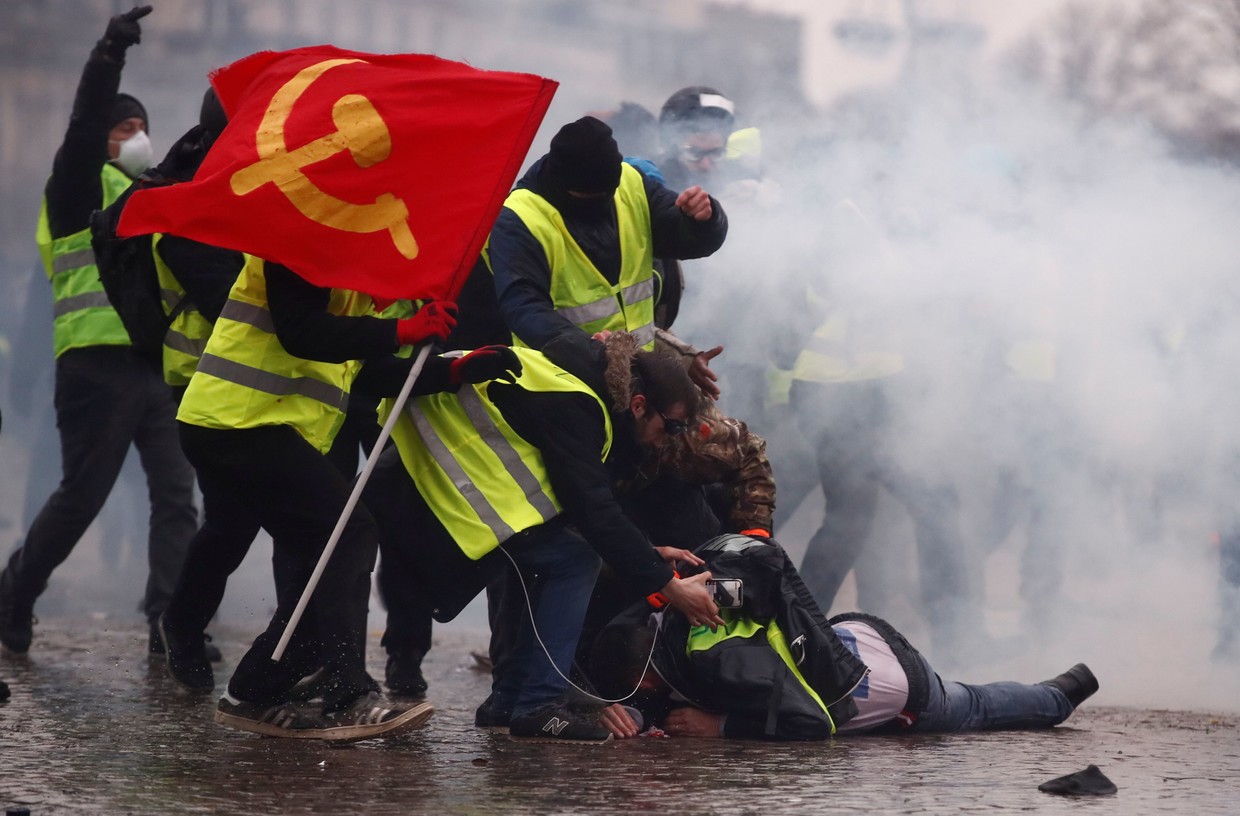
The law enforcers used water cannons and tear gas to disperse some of the protesters in Paris.

“Over in the distance, you might see a water cannon. They’re trying to disperse the protestors,” RT’s Charlotte Dubenskij reported from the heat of the action in Paris. “We did see the protestors trying to break down some of the traffic lights. We’ve also seen tear gas being dispersed… The protestors were trying to throw back the tear gas pellets back at the police.”

After the officers used force, there were people lying on the ground, who “potentially could’ve been injured,” Dubenskij said.

42 protestors were arrested in the capital for carrying illegal items and other violations, the police said.

The demonstrators have denounced Macron’s open letter to the country, in which he announced the launch of the nation-wide debate to defuse the tensions, as nothing but a “huge scam.”

“It contradicts everything he [Macron] says and does,” one of the protestors told RT, with the other saying that he’ll gladly send the letter back to the president.

“We hear a lot of fine words, but see very few decisions that somehow improve the wellbeing of the people. There must be a least a slight increase in living standard after we’ve been crying for help for the past ten weeks. We work hard, but we still have an empty fridge. That’s how we live,” a female demonstrator said.

The Yellow Vest processions took place in Caen and Rouen, both in northern France. The rallies were also held in Strasbourg, Bordeaux, Toulon, Dijon, Beziers, Avignon, among other places.

The authorities deployed 5,000 police officers in Paris, and 80,000 nationwide, according to local media.

Armored police cars were filmed moving through the southern city of Toulouse where 10,000 people took to the streets. There were scuffles between the police and the Yellow Vests, with at least ten people detained.

A major rally also took place in Bordeaux, with the attendance between 4,000 to 6,000 demonstrators.

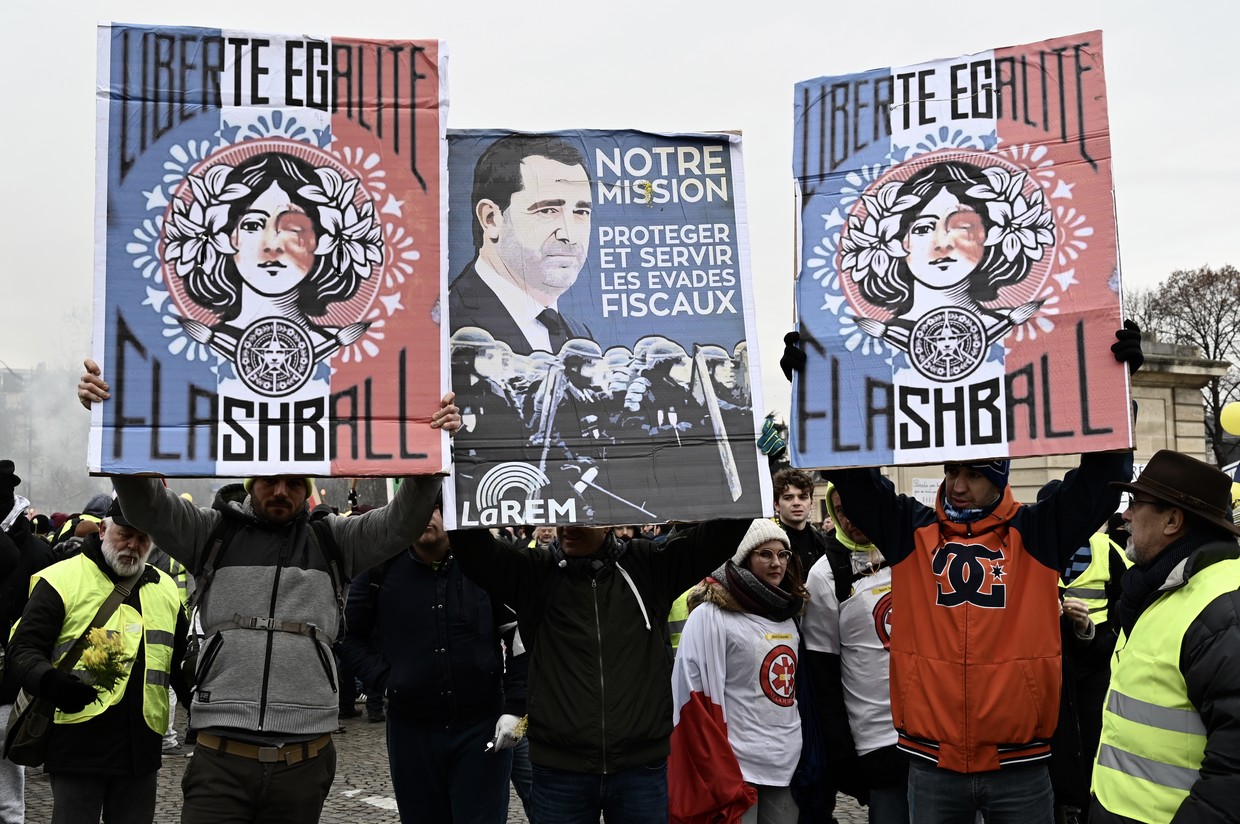
Some French protesters carried placards, reading “Freedom, Equality, Flash-Ball,” referring to the type of ‘less-lethal’ guns used by law enforcement to quell the protests. The placards also contained pictures of Marianne – a national symbol of liberty – with an injured eye. That was apparently an allusion to a high-publicized incident in December when a young woman was hit in the eye by a projectile the activists say was fired from a Flash-Ball.

In Avignon, the protestors attempted to set the city hall on fire by gathering burning waste materials in front of the wooden doors to the building.

The Yellow Vest protests began in November as a movement against planned fuel tax hikes, but eventually grew to include wider demands, including the resignation of President Emmanuel Macron and his government.

Previous rallies have seen violent clashes with police. There have been injuries on both sides, and over 1,000 people have been detained in connection to the unrest, which has at times spilled out into street battles.

Saturday’s rallies take place days after President Emmanuel Macron launched“grand national debates,” a series of public discussions about the government’s policies. He hopes the debates will help in reaching a compromise with the protesters, but many have expressed skepticism regarding the format and intentions. As a result, some protesters appeared with placards denouncing the debates as a “scam.”


FRENCH POLICE DEPLOY RIFLES WITH LIVE AMMUNITION TO YELLOW VEST PROTESTS

French Police Deploy Rifles with Live Ammunition to Yellow Vest Protests

French officers were caught on video brandishing what appeared to be Heckler & Koch G36 assault rifles

by Chris Tomlinson

French riot police (CRS) are alleged to have begun deploying assault rifles with live ammunition for the first time during the ninth weekend of protest in a row by the Gilets Jaunes (Yellow Vest) movement.

French officers were caught on video brandishing what appeared to be Heckler & Koch G36 assault rifles on the streets of the French capital near the Arc de Triomphe on Saturday, the Daily Mail reports.

Several users on Twitter posted other pictures of officers armed with rifles, with one user claiming he had counted at least a dozen armed officers at around 3 p.m. near the famous monument.

Only a week prior to the “Act IX” protest, former French Minister of Education Luc Ferry had seemingly endorsed the use of live ammunition on Yellow Vest protestors in an interview with French media.

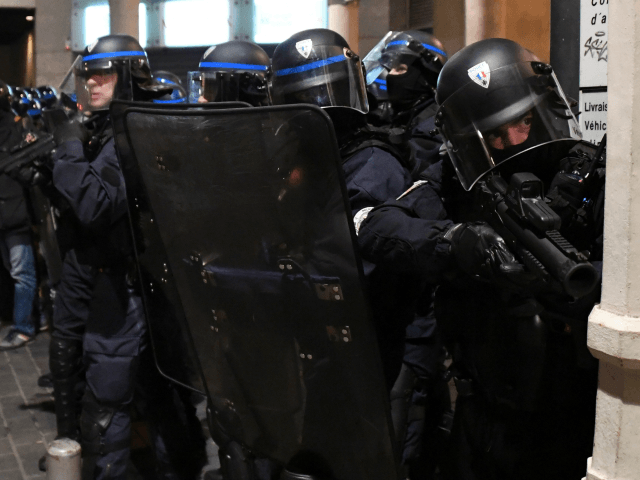
A police officer points a non-lethal hand-held weapon at protesters in front of the Cathedral of Bordeaux, southwestern France, during an anti-government demonstration called by the 'Yellow Vest' (Gilets Jaunes) movement on January 12, 2019. - Thousands of anti-government demonstrators marched in cities across France on January 12 in a …

“When you see guys beating up an unfortunate policeman on the ground, let them use their weapons once and for all, that’s enough, these kinds of thugs, these bastards of far right and extreme left or the suburbs that come to beat police officers, we have the fourth-largest army in the world, it is capable of putting an end to this crap,” he said.

screen shot 2019-01-15 at 11.31.05 am

Ferry later clarified his statement, saying: “I have obviously never called to shoot the Yellow Vests of which I defended the movement from the beginning. I am simply asking that the police be able to use their NON-lethal weapons… when some people are trying to kill them.”

Yellow Vest activist Gilles Caron commented on the display of the weapons by the officers, saying: “[T]he CRS with the guns were wearing riot control helmets and body armour – they were not a specialised firearms unit.”

He added: “Their job was simply to threaten us with lethal weapons in a manner which is very troubling. We deserve some explanations.”

The Act IX protest saw a return in momentum for the Yellow Vests and once again saw incidents of violence, including several activists attacking a group of journalists in the northern city of Rouen.

Police employ tear gas & water cannons as Yellow Vest protests enter 9th week (VIDEO)

screen shot 2019-01-12 at 12.23.15 pm

Yellow Vest demonstrators returned to the streets of Paris and other French cities on Saturday, and some were met by police with tear gas and water cannons as the authorities pledged zero tolerance to violence.

More than 32,000 people took part in the protests in Paris, Marseille, Bordeaux, Lyon, Strasbourg, and other cities, according to Interior Ministry data.

Around 8,000 demonstrators, both locals and those coming from other parts of the country, were rallying in the French capital. Some 5,000 riot police with special equipment and armored vehicles oversaw the protests.

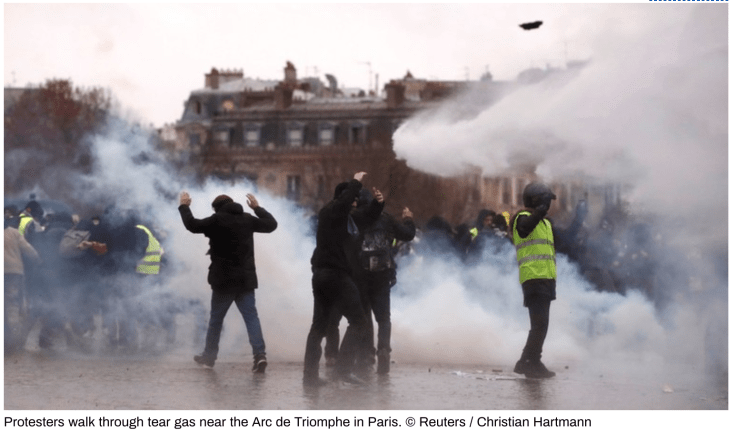
Clashes eventually erupted at the iconic Champs Elysees and Arc de Triomphe, with police using tear gas and water cannons to calm the angry crowds. Hundreds of people were arrested during the standoff, with most of them put in custody, the law enforcers said.

“We’ve come to Paris to make ourselves heard, and we wanted to see for ourselves at least once what’s going on here,” a man, who travelled to Paris from western France to attend the protest, told AFP.


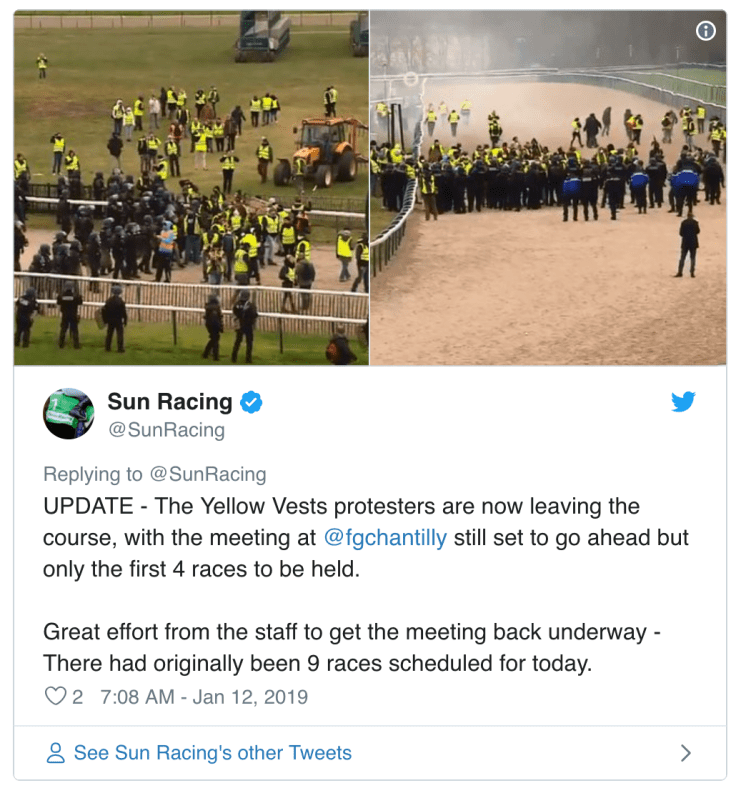
Around 1,000 demonstrators also made their way to the hippodrome and caused a delay of races in the horseracing town of Chantilly, north of Paris.

screen shot 2019-01-12 at 12.28.19 pm

In Nimes, police deployed tear gas against protesters after a tense standoff in the downtown.

17 people were also arrested during clashes in Bourges in central France, where the local authorities said that 5,000 were rallying.

screen shot 2019-01-12 at 12.30.14 pm
The French government earlier vowed zero tolerance for violence at the protests, with 80,000 security personnel deployed across France on the weekend.

The Yellow Vest movement, which took its name from the high-visibility jackets worn by the demonstrators, kicked off in November over a government-proposed hike in fuel taxes. As the weekend protests saw more people participating and started turning violent, the government dropped the planned increase.

But the demonstrations continued as the movement morphed into wider discontent with President Emmanuel Macron’s pro-business agenda, a decline in living standards, and growing inequality.

Think your friends would be interested? Share this story!


Yellow vests Acte 9: Gloves on both sides are definitely off

By   

French interior minister Castaner and the yellow vest movement are on the warpath.

The French yellow vest (‘gilet jaunes’) movement is entering its ninth edition Saturday 12 januari. And instead of cooling down things seem to be heating up and spreading.

While the gilets jaunes are calling for a massive bankrun, in an effort to damage or even collapse the French- and eventually the EU banking system, the government dispatches 80 thousand police and army personnel to try and contain the protests.

See the source image

French Interior Minister Castaner today even heightened the tension by saying that protesters will be held accountable for acts committed by fellow gilets jaunes during Saturday’s protests.

Earlier this week there where some tensions between the Italian and French government. Italy’s support for the yellow vest movement was not appreciated by the French.


Yellow Vests Plan Protest Outside Rothschild Bank In France

By Tom Pappert

Yellow Vests Protest Rothschild Bank

Yellow Vest protesters are planning another demonstration, this time outside the Rothschild Bank of Lyon, France.

A Facebook event reveals over 3,000 French Yellow Vest protesters have expressed interest in attending a protest at the Rothschild Bank of Lyon, France, due in part to a 40-year-old grievance with France’s private banking system.

The event description explains that The [French] state borrows from private banks, digs debt,” allowing the private banks to make money from interest loans made to the French government.

In 1973, after intense lobbying from the Rothschild Bank of France, French President George Pompidou signed legislation preventing the government from taking 0 percent interest loans from the Bank of France, the country’s central bank. Instead, the Bank of France is required to loan money to private banks, such as the Rothschild Bank of France, which can then lend money to the French government with interest.

Trending: Change.Org Petition To Impeach Rashida Tlaib Is Gaining Momentum

Rothschild's Paris office - Rothschild - Paris (France)

Rothschild office

The Huffington Post reported in 2012:

In 1973, France did not have a debt problem and the national budget was balanced. Indeed, the state could borrow directly from the Bank of France to finance the building of schools, road infrastructure, ports, airlines, hospitals and cultural centers, something that it was possible to do without being required to pay an exorbitant interest rate. Thus, the government rarely found itself in debt. Nonetheless, on January 3, 1973, the government of President George Pompidou — Pompidou was himself a former general director of the Rothschild Bank — influenced by the financial sector, adopted Law no.73/7 focusing on the Bank of France. It was nicknamed the “Rothschild law” because of the intense lobbying by the banking sector which favored its adoption. Formulated by Olivier Wormser, Governor of the Bank of France, and Valéry Giscard d’Estaing, then Minister of the Economy and Finance, it stipulates in Article 25, that “the State can no longer demand discounted loans from the Bank of France.”

Many of the Yellow Vest protesters point to this legislation as the cause of France’s swelling public debt. Since 1980, France’s public debt expanded from a historic low of 56.17 percent of France’s Gross Domestic Product to 97 percent in 2017.

“Very good initiative,” one protester wrote on Facebook, “Finally we protest the real debt managers and not their puppets.”

The protest, titled “Les Gilets Jaune Bloque La Banque Rothschild de Lyon”, is scheduled for Tuesday, January 9.


CRACKDOWN: France Announces New Measures To Curb Yellow Vest Protests

Following sustained anti-government protests the French government has announced plans to strictly control what it calls ‘unsanctioned’ protests.

Wearing masks on demonstrations will also be prohibited.

Speaking on French TV channel TF1, Prime Minister Philippe said the government would support a “new law punishing those who do not respect the requirement to declare [protests], those who take part in unauthorised demonstrations and those who arrive at demonstrations wearing face masks”.

See the source image

Protest leaders have begun to be arrested. A truck  driver, Eric Drouet, was arrested last week for organising an ‘unsanctioned’ protest.

Some politicians want to go further.  Laurent Wauquiez, leader of the Republican party, tweeted that the move was not enough because it would not take “immediate effect”. He said his party had previously proposed a state of emergency, adding: “Why not listen to us, at the risk of seeing the situation worsen Saturday after Saturday?”

French President Emmanuel Macron is deeply unpopular with 75% of voters disapproving of his Presidency.

Italian Leaders Endorse French ‘Yellow Vest’ Movement

See the source image

By Dan Lyman

Italy’s co-deputy prime ministers, Matteo Salvini and Luigi Di Maio, have both voiced their support for the ‘Yellow Vest’ protest movement in France in a stunning blow to the European establishment.

Following the eighth week of high-intensity demonstrations across France, Salvini slammed French President Emmanuel Macron while Di Maio encouraged the Yellow Vests to stay the course.

“I support honest citizens who protest against a governing president [who is] against his people,” Salvini said, according to RT.

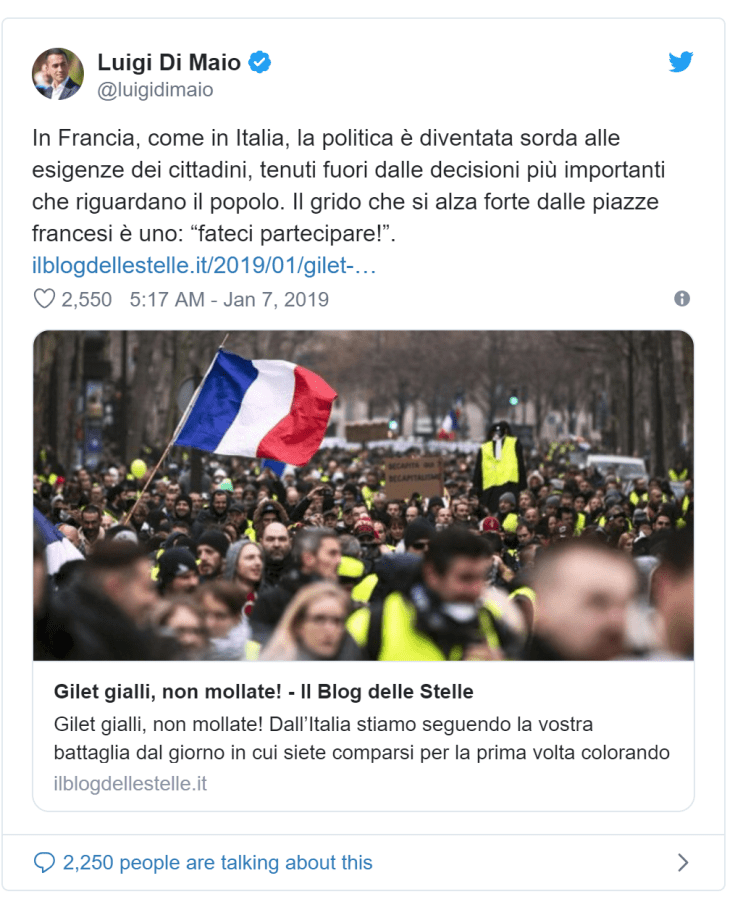
At the same time, Di Maio urged the Yellow Vests to “not give up” in a blog post on his party website.

“From Italy we have been following your battle from the day you appeared for the first time, coloring the streets of Paris and other French cities in yellow,” Di Maio wrote. “We know what animates your spirit and why you decided to take to the streets.”

“In France, as in Italy, politics has become deaf to the needs of citizens who have been kept out of the most important decisions affecting the people. The cry that rises strongly from the French squares is ultimately one: ‘let us participate!’”

Di Maio accused Macron and other European elites of implementing policies that hurt all of Europe, especially those pertaining to immigration and economics.

capture

Salvini, a nationalist-populist and most prominent face of Italian leadership, and Macron, a diehard globalist, embody the opposing forces battling for the future of Europe.

As France now burns on a weekly basis and Macron’s disapproval rating has hit 75 percent, Salvini enjoys massive support in Italy and beyond, as does Di Maio’s 5 Star Movement.

“History will probably show that if [Macron] had focused more on the French and less on Salvini and Italy, he would have a few less problems today,” Salvini said weeks ago. “Do people in Italy want scenes like we’ve seen in Paris? No. I want to prevent this.”

See the source image

KEY YELLOW VEST FIGURE ARRESTED BY POLICE AT PARIS DEMONSTRATION

Key Yellow Vest Figure Arrested by Police at Paris Demonstration

Mr Drouet, who has been one of the leading figures of the Yellow Vests and has appeared frequently on French media, was taken into custody on Wednesday

By Chris Tomlinson

Eric Drouet, one of the key figures in the French Gilets Jaunes (Yellow Vest) movement, has been arrested for organising an event without prior declaration.

Mr Drouet, who has been one of the leading figures of the Yellow Vests and has appeared frequently on French media, was taken into custody on Wednesday while heading for the Champs-Élysées after calling for a spontaneous demonstration online, according to a Paris prosecutor, Le Figaro reports.

The arrest is not the first for Drouet who was also taken into custody at the “Act VI” demonstration on December 22nd for being in possession of an illegal weapon when he was caught carrying a baton.

The Yellow Vest activist came to national prominence in France after an appearance on broadcaster BFMTV in which he suggested the protesters mobilise and enter the Élysées Palace, the seat of French President Emmanuel Macron.

This picture taken on December 23, 2018 shows Eric Drouet, a leader of the 'Yellow vests' (Gilets jaunes) movement, next to his lawyer Kheops Lara (R) as he leaves Paris' courthouse at the end of his custody after being detained by the police during a yellow vests demonstration in Paris. …


Critics slammed Drouet, claiming he had called for the overthrow of the French leader, and although Drouet denied the allegations he received a visit from police following the broadcast of the programme.

The prominent activist was not the only Yellow Vest member to be arrested this week. In Vesoul, a 51-year-old man was arrested after mentioning the word “guillotine” to a member of President Macron’s La Republique En Marche! (LREM) twice. He was charged with “threats against an elected member of the nation,” according to prosecutors.

capture

So far there have been a total of 216 Yellow Vest activists taken to jail either having been sentenced or awaiting trial, the largest number of incarcerations for a social movement in modern France. Between the period of November 17th to December 17th, police arrested 4,570 individuals connected to the protest movement.

The Yellow Vest protests show little sign of stopping despite several concessions from the Macron government. Currently, the protesters are pushing for the approval of the Citizen Initiated Referendum (RIC), a direct democracy tool that would allow laws to be voted on or repealed by popular referendum.

RICs could also be used to strip politicians of office and make potential changes to the French constitution. In a recent poll, 80 per cent of French said they approved of the RIC proposal.


Blog at WordPress.com.

Up ↑