Published on Apr 14, 2019

APRIL 12, 2019
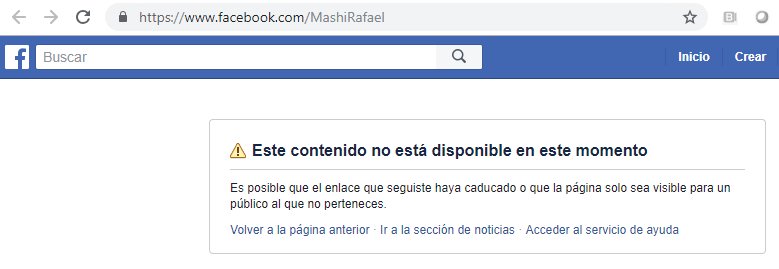
“Protecting the privacy and security of people is central to Facebook [and] we have clear policies that do not allow the disclosure of personal information such as phone numbers, addresses, bank account data, cards, or any record or data that could compromise the integrity physical or financial of the people in our community.”
The move comes on the same day that Ecuador’s government allowed British security personnel to enter their embassy in London to arrest journalist and WikiLeaks founder Julian Assange, who has been sought by U.S. officials for years due to his role in releasing scandalous information implicating Washington in a range of crimes, including war crimes.
 𝓤𝓼𝓾𝓪𝓻𝓲𝓸𝓼 𝓓𝓲𝓰𝓲𝓽𝓪𝓵𝓮𝓼@usuariosdigital
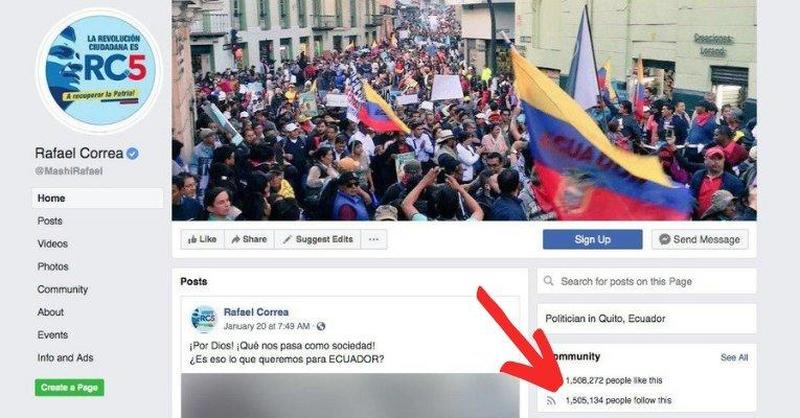
#AlertaDigitalEC Página en Facebook del exPresidente @MashiRafael no puede ser accesada, se desconocen motivos – link https://www.facebook.com/MashiRafael
Assange, 47, had been living at the Embassy of Ecuador in London since 2012, when then-President Correa granted political asylum to the Australian amid the British government’s attempts to detain him. At the time, Correa called Eduador’s actions an act of sovereign “duty.”
Ecuador’s current leader, Lenin Moreno, was openly opposed to Assange, whom he referred to on various occasions as a “miserable hacker,” an “irritant,” and a “stone in the shoe” of his government. Moreno’s distancing from the asylee came following a 2017 meeting with Trump campaign confidant and political “fixer” Paul Manafort, where the two discussed Ecuador’s handover of Assange to U.K. and U.S. authorities.
In March, WikiLeaks published a tranche of documents dubbed the INA Papers linking President Lenin Moreno to the INA Investment Corporation, an offshore shell company used by Moreno to procure furniture, property, and various luxury items.
The account number for the offshore account allegedly used by the president to launder money was shared across Ecuadorean social networks by netizens of all political stripes, including by Correa – who had about 1.5 million followers and whose Facebook page enjoyed more interactions and attention than that of President Moreno himself.
The account number was also shared alongside personal photos of President Moreno enjoying lavish breakfasts and dinners of lobster—imagery considered especially damning for the people of Ecuador given Moreno’s previous boasting of an austere poverty diet consisting of eggs and white rice.
It also came amid attempts by the neoliberal Ecuadorean government to curry favor with financiers in Europe and the United States amid the continuing debt crisis. In March, the IMF finally bailed out Moreno’s government to the tune of $4.2 billion.
Prior to the removal of the page, Correa lambasted his successor in a series of posts that still remain on Twitter at the time of this writing.
 Rafael Correa
✔@MashiRafael
Christine:
I do not know what to tell you. I only ask forgiveness from me and my people. A traitor and corrupt like Moreno does not represent us. I promise not to rest until I see him in jail, where he deserves to be.Mrs. Christine Assange@AssangeMrsShame on you @Lenin #Moreno!
May the Ecuadorean people seek vengeance upon you, you dirty, deceitful, rotten traitor!
May the face of my suffering son haunt your sleepless nights..
And may your soul writhe forever in torturous Purgatory as you have tortured my beloved son! https://twitter.com/SkyNews/status/1116283158943666176 …
Since 2015, Correa—who lives with his family in Brussels, Belgium—had used the social platform to great effect, using strongly-worded posts, video interviews, and live-streams as a platform amid the Ecuadorean media’s de facto blackout of the former leader, who remains reviled by the center-right former opposition and sections of the country’s left.
Former President Correa minced no words in his assessment of Moreno, denouncing him in an English-language tweet as “the greatest traitor in Ecuadorian and Latin American history … Moreno is a corrupt man, but what he has done is a crime that humanity will never forget.”
Rafael Correa✔@MashiRafael
The greatest traitor in Ecuadorian and Latin American history, Lenin Moreno, allowed the British police to enter our embassy in London to arrest Assange.
Moreno is a corrupt man, but what he has done is a crime that humanity will never forget.Barnaby Nerberka@barnabynerberkaBREAK: Full @Ruptly video of WikiLeaks founder Julian Assange’s arrest by British police this morning
In a separate tweet responding to Moreno’s announcement of the handover, Correa further tore into what he called “one of the most atrocious acts [and the] fruit of servility, villainy and revenge.”
“From now on worldwide, the scoundrel and betrayal can be summarized in two words: Lenin Moreno,” the popular former president added.
The removal of Correa’s page for violating Facebook’s “community standards” is an unprecedented move, and the former statesman is the most high-profile public political figure to ever be removed from the social platform–placing the economist and icon of Latin American “socialism of the 21st century” in the same unlikely category as right-wing conspiracy theorist and broadcaster Alex Jones.
Matt Bracken gives his take on the social media unpersoning epidemic sweeping across the internet.

APRIL 12, 2019
“The arrest of #JulianAssange is meant to send a message to all Americans and journalists: be quiet, behave, toe the line. Or you will pay the price,” Gabbard said on Twitter.
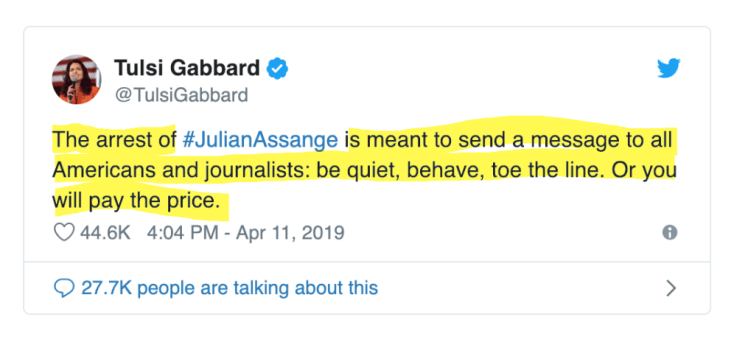
“The purpose of arresting #JulianAssange is to send a message to the people, especially journalists, to be quiet and don’t get out of line. If we, the people, allow the government to control us through fear, we are no longer free, we are no longer America,” Gabbard said in a follow-up tweet, sharing video of her appearance on CNN Thursday afternoon.
On Tuesday, Gabbard released a video saying, “Netenyahu and Saudi Arabia want to drag the United States into war against Iran and Trump is submitting to their wishes.”
“The cost in lives and money will be beyond our imagination.”
Tulsi Gabbard successfully qualified for the Democratic debates on Wednesday after getting over 65,000 individual donors for her campaign.
APRIL 11, 2019
AG Bill Barr announced he is going to launch an investigation into the spying campaign started by the Obama deep state.
UPDATE: Assange pleads not guilty to failing to surrender to bail
Journalist flocked to the white police van carrying the whistleblower into the courthouse. With his hair tied back and sporting a full-length white beard, Assange offered cameras a hardy thumbs up with a wink.

Assange stepped into the courtroom wearing a dark polo shirt and quietly read his Gore Vidal book while he waited for his lawyers to arrive.
READ MORE: Assange arrest final step in character assassination campaign – Slavoj Zizek

Earlier, Metropolitan Police said in a statement that they arrested Assange on a warrant issued by the Westminster Magistrates’ Court in June 2012, for failing to surrender to the court. The police were “invited into the embassy by the Ambassador,” it said.

Published on Apr 9, 2019
Published on Apr 9, 2019

APRIL 5, 2019
Sarah’s new book, Evening Draws Near and the Day is Nearly Over, is causing controversy in Europe because it explicitly identifies Muslim migration as a harbinger of the continent’s collapse.
“If the West continues in this fatal way, there is a great risk that, due to a lack of birth, it will disappear, invaded by foreigners, just as Rome has been invaded by barbarians,” said Sarah, adding, “My country is predominantly Muslim. I think I know what reality I’m talking about.”
The Cardinal also blamed the European Union for its “desire to globalize the world, ridding it of nations with their distinctive characteristics,” labeling the move “sheer madness”.
“The Brussels Commission thinks only about building a free market in the service of the great financial powers,” he continued. “The European Union no longer protects the peoples within it. It protects the banks.”
In a previous video interview, Sarah warned that Europe had lost its roots and was dying because of fewer European natives having children.
In recent interviews he has gone even further, noting that priests, bishops and cardinals within the Catholic Church have betrayed the teachings of Christ by pursuing political activism.
Sarah’s comments put him at odds with the Pope, who has relentlessly promoted migration from African and Middle Eastern countries into Europe.
According to the Cardinal, it is wrong to “use the word of God to promote migration,” and it is better “to help people flourish in their culture than to encourage them to come to Europe.”
Sarah slammed mass migration as a “new form of slavery” because migrants end up “without work or dignity”.
“Is that what the Church wants?” he asked.
Sarah remained hopeful of the situation being reversed, asserting, “This is not the end of the world, the Church will rise.”

By Dan Lyman
F. Hassan was recently detained in Budapest by officers of the Hungarian Counterterrorism Centre (TEK), suspected of being a high-ranking ISIS operative who had carried out attacks and executions in his homeland.
Reports now indicate that Hassan was holding one of the many “anonymous” debit cards issued to migrants by the E.U. and U.N. – a scheme that was recently unearthedand confirmed by the European Commission following a public information campaign initiated by the Hungarian government.
“The Hungarian government had warned that these anonymous, prepaid debit cards posed a security risk,” writes Zoltan Kovacs, Secretary of State for International Communication and Relations. “After initial denials, the Commission finally admitted that the United Nations and the European Union have been distributing these cards to migrants who have reached the territory of the E.U. Some 64,000 debit cards were distributed to migrants in January alone.”
“Reports say that he received a monthly payment of 500 EUR on his debit card. That’s well over today’s gross minimum wage in Hungary.”
Hungarian officials are now demanding an “urgent answer” from the E.U. regarding whether it knew if Hassan had been issued one of the debit cards in question and how many other potential terrorists may have received them, according to Hungary Today.
“It is a lie that the 64,000 migrant cards issued so far are not anonymous, cannot be used to withdraw cash or that they can only be used in Greece,” MEP Tamas Deutsch told reporters.
Deutsch warned that “thousands” of jihadists may be pouring into Europe, hidden among the waves of migrants.
“Despite that fact, Brussels is enthusiastically distributing anonymous cards credited with hundreds of euros,” Deutsch said.
In November, 2018, Infowars Europe helped bring to light revelations that migrants were using preloaded MasterCard debit cards bearing insignias of the E.U. and U.N. to pay for goods and services along their journeys.
There is also evidence that the project is traceable to infamous Hungarian billionaire George Soros.
In Infowars’ original report, we detailed Soros’ likely ties to the scheme upon discovery of a 2017 MasterCard press release publicizing the launch of a partnership program with Soros called “Humanity Ventures,” which aimed to “catalyze and accelerate economic and social development for vulnerable communities around the world, especially refugees and migrants.”
Incredibly, the E.U. has claimed the program “does not encourage migration.”

 Tom's Blog