
Published on Mar 19, 2019

MARCH 19, 2019
As Beto O’Rourke throws his hat into an already crowded field — and boasts $6.1 million in donations in the first 24 hours — Democratic debate season draws ever closer.
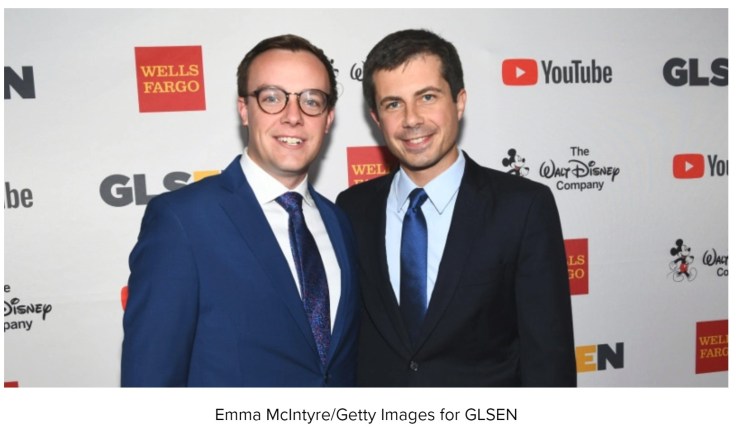
And Los Angeles will play host for at least one of those showdowns when UCLA and the Human Rights Campaign present a forum for 2020 presidential candidates in the fall.
It will focus specifically on lesbian, gay, bisexual and transgender issues, offering candidates “an opportunity to speak about their policy platforms and plans to move LGBTQ equality forward,” according to a statement.
No media partner has yet been announced, but the forum will be televised.
The event is scheduled for Oct. 10 at Royce Hall, on the eve of National Coming Out Day, and will be held in addition to an already-announced Democratic Primary Debate that month.
Unlike that event, candidates at the UCLA/HRC forum will fully outline their platforms one at a time.
Democratic candidates can qualify for the event by receiving 1 percent or more of the vote in three separate national polls or by receiving donations from 65,000 different people in 20 different states.
According to the most recent polling data, that would mean places at the podium for Bernie Sanders, Kamala Harris, Elizabeth Warren, Cory Booker, Beto O’Rourke, Amy Klobuchar and John Hickenlooper. Should he announce as expected, Joe Biden will be there, too.
But so far only one LGBT candidate has expressed an interest in running: Pete Buttigieg, the mayor of South Bend, Indiana. Having reached 65,000 donors, Buttigieg has qualified for inclusion in the debates, should his exploratory run become an official one. And if that happens, expect Buttigieg to be a breakout star of the LGBTQ forum.
This is the first such HRC-hosted forum since 2007, when Barack Obama appeared alongside Hillary Clinton, John Edwards and others. Like the announced forum in October, that discussion, broadcast on Logo and attended by an LGBTQ-leaning crowd, centered around gay rights.
Twelve years has made a world of difference in that arena. Back then, a majority of candidates felt any advancements in LGBTQ rights should stop short of legalizing same-sex marriage, then only legal in Massachusetts.
Then Sen. Obama argued for a “strong version” of civil unions, saying, “My view is that we should try to disentangle what has historically been the issue of the word ‘marriage,’ which has religious connotations to some people, from the civil rights that are given to couples.”
In 2012, while campaigning for a second term in office, Obama came around to backing same-sex marriage.
Clinton, then a New York senator, took a similar stand, calling her opposition to same-sex marriage a “personal position” but insisting she believed “in equality.” She added: “How we get to full equality is the debate we’re having.”
After a decade opposing it, Clinton eventually voiced her support for same-sex marriage in 2013.
Only two long-shot candidates — Dennis Kucinich, then an Ohio congressman, and Mike Gravel, an Alaska senator from 1969 to 1981 — offered full-throated endorsements of same-sex marriage.
“When you understand what real equality is, you understand that people who love each other must have the opportunity to be able to express that in a way that’s meaningful,” Kucinich said to cheers.
Gravel, meanwhile, said the front runners were “playing it safe” and predicted same-sex marriage “will be a nonissue in the next presidential campaign in 2012.” In fact, it would remain hotly debated until the Supreme Court’s ruling on June 26, 2015, which held all state same-sex marriage bans to be unconstitutional.
LGBTQ issues were largely ignored or de-emphasized by Donald Trump in his 2016 presidential campaign — though Trump did make history by becoming the first Republican presidential nominee to mention LGBTQ rights in his acceptance speech.
Earlier that same year, however, after meeting with the anti-LGBTQ conservative think tank the Heritage Foundation, Trump voiced opposition to same-sex marriage and pledged to appoint justices to the Supreme Court who would reverse the “shocking” Obergefell v. Hodges decision that legalized it.
Since taking office, Trump — who chose Mike Pence, a strident opponent of civil liberties for LGBTQ citizens, as his vice president — is widely seen as having significantly set back LGBTQ rights and advancements in the U.S.
His administration has rolled back workplace protections for LGBTQ workers, scrapped census plans to study the LGBT population, eliminated AIDS research and treatment funding from the federal budget, and announced a ban on transgender personnel in the armed forces.
“Millions of LGBTQ people will have their rights on the ballot in 2020,” HRC president Chad Griffin said in a statement announcing the planned fall forum. “But today we are also a powerful voting bloc that will help determine the outcome. We’re excited to partner with UCLA Luskin and create an opportunity to hear candidates’ agendas for moving equality forward.”
March 19, 2019
Arevalo has a long criminal record of arrests for violent crimes, but the State of California refused to turn him over to ICE because California is a far-left “Sanctuary State” for criminal illegal aliens.
For more information on this convicted criminal illegal alien, click here.

MARCH 19, 2019
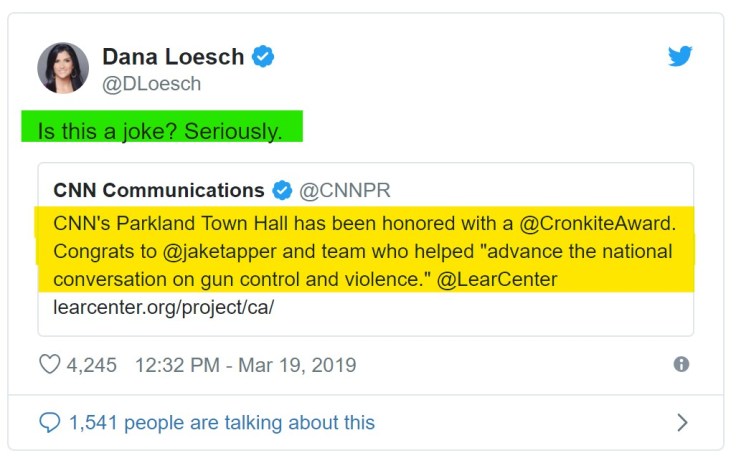
The University of Southern California held the 10th biennial Walter Cronkite Awards for Excellence in Television Political Journalism on Wednesday, honoring CNN for its Parkland Town Hall last year for “helping advance the national conversation on gun control and violence.”
Loesch attended the event to defend the Second Amendment following the left’s calls for gun control over the deadly school shooting in Parkland, Florida, but the audience ended up hurling insults and threats of violence against her.
“Is this a joke? Seriously,” she tweeted Tuesday, before releasing several video clips of the event while it wasn’t televised.
“Here is some footage where people were yelling to burn me at CNN’s award-winning townhall where they ‘advanced the conversation on gun control,’” she said.
“Shame on you! Shame on you! Shame on you! Shame on you!” the audience chanted as Loesch was escorted from the event.
Some conversation.
Here’s more of the “conversation.”
“This is what happened when the cameras turned off at @CNNPR ’s award-winning townhall. They’re proud of it,” Loesch continued.
In the mainstream media bizarro world, CNN is given awards for “advancing the conversation on gun control and violence” for hosting an event that demonizes the Second Amendment and threatens violence against detractors.
Even CNN CEO Jeff Zucker was given a First Amendment award after lobbying to censor his competition online.

Omar is, of course, well known to moderate Democrats and Republicans for her recent series of anti-Semitic and anti-Israel remarks, often accusing her Jewish colleagues of “dual loyalty” to both the United States and Israel, and implying that pro-Israel organizations like AIPAC are compromising Congress on behalf of the Israeli government.
The comments have divided her Democratic colleagues, who have waffled between censuring her for relying on anti-Semitic smears, and watering down their criticism out of fear they will alienate younger, more progressive aspects of their base.
Over the weekend, Omar penned an op-ed in the Washington Post, attempting to bridge the divide, explaining, in detail, her position on foreign policy as it applies to Israel and the Palestinians. In it, Omar unexpectedly advocated for a “two-state solution” rather than the complete destruction of the Jewish state, something her colleagues in the BDS (or “boycott-divest-sanction”) movement openly support.
The op-ed drew skepticism from moderate Democrats and most Republicans, but in a strange twist, it drew open scorn from anti-Israel activists and anti-Semites on Twitter, who had come to believe Omar was one of their own, only to be “betrayed” by her embrace of the only slightly less radical “two-state solution.”
When she tweeted out her op-ed, things got really hairy.
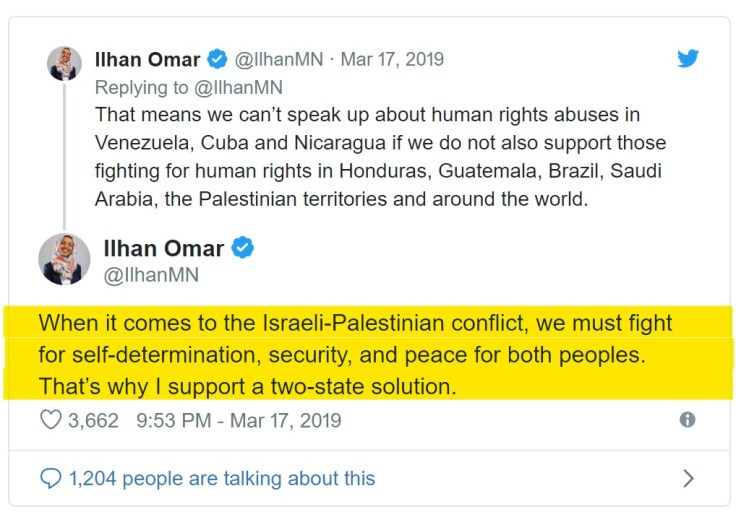
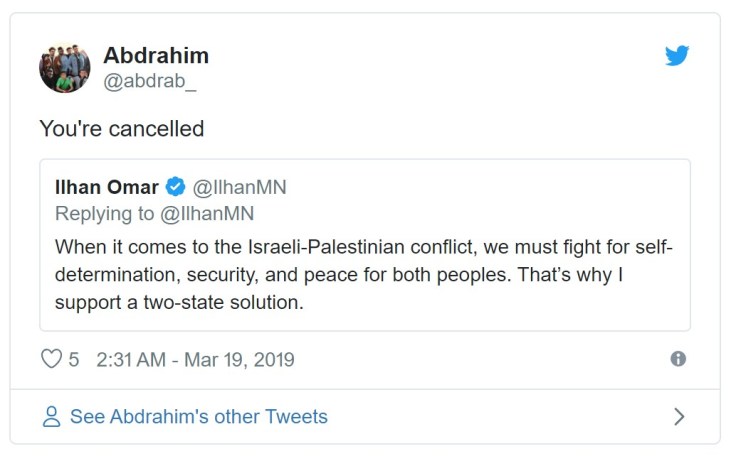
“When it comes to the Israeli-Palestinian conflict, we must fight for self-determination, security, and peace for both peoples. That’s why I support a two-state solution,” she tweeted.
Things only went downhill from there.
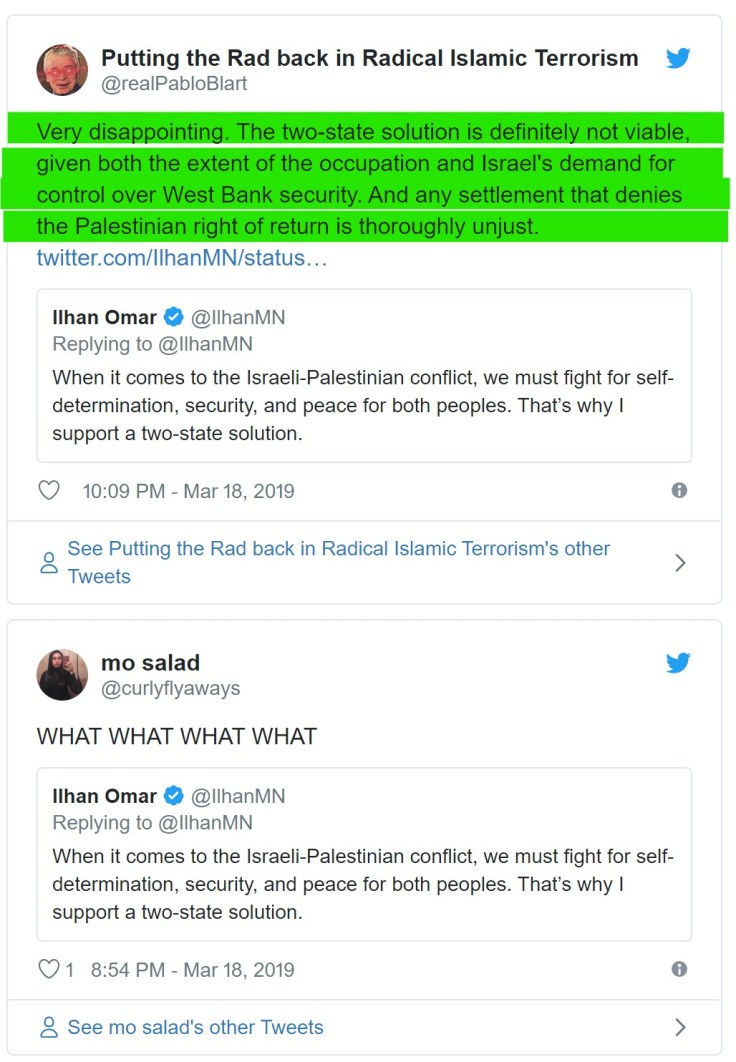
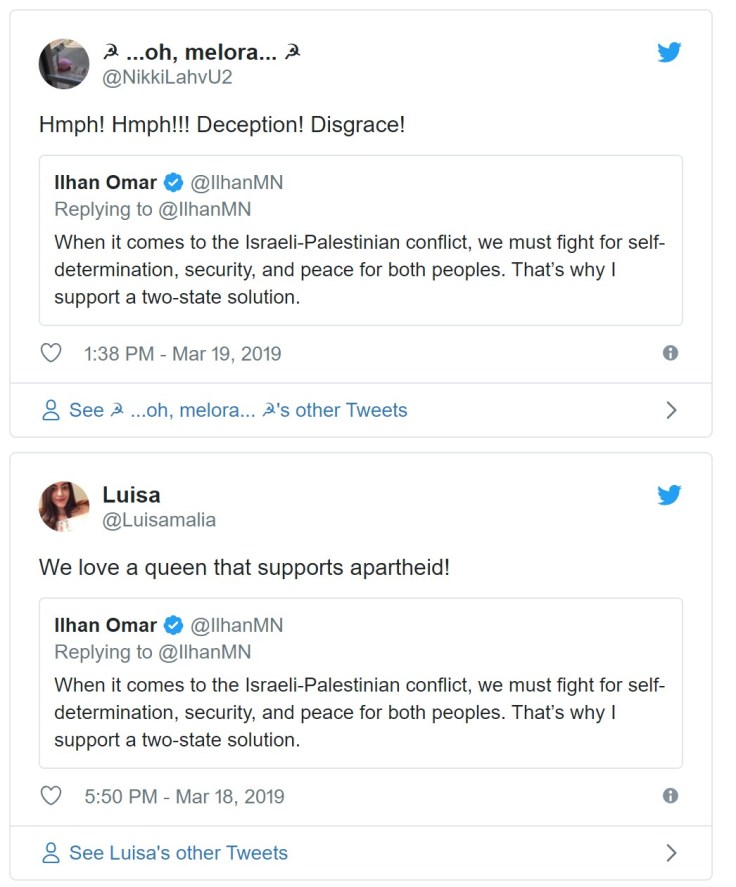
At least one angry supporter even declared Omar, “cancelled.”
Others accused the outspoken Muslim Congresswoman of stepping on the toes of Palestinians, who should be allowed to determine their own form of “liberation,” not be dictated to by an “imperialist.”

The replies to Omar’s Tweet are even worse.
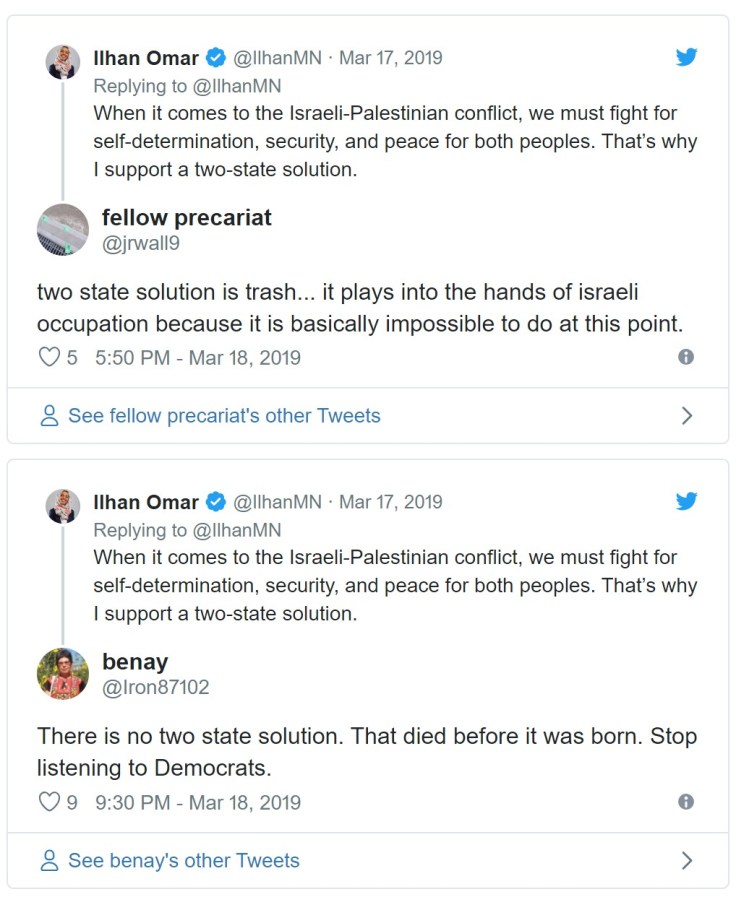
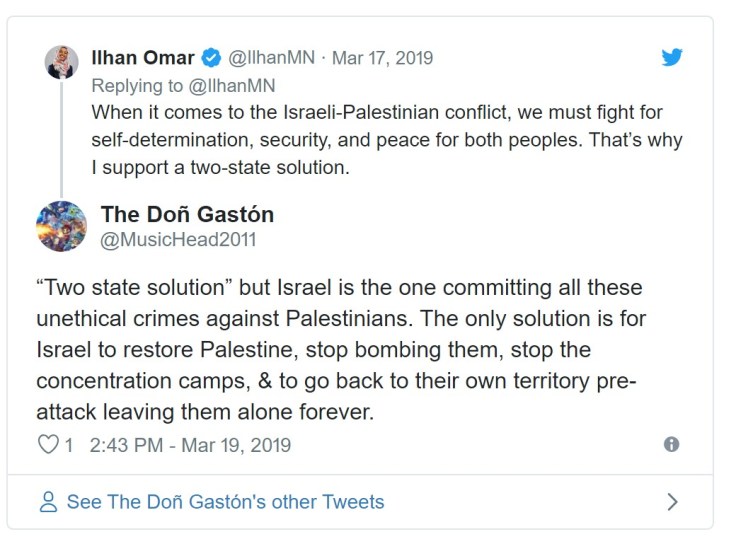
That’s a pretty tough break for Ilhan’s supporters, but they can take comfort in knowing she probably doesn’t really mean it.

By EMILY ZANOTT
The plan to eliminate the Electoral College has caught fire among Democratic presidential hopefuls, and Warren is just the latest in a line of prospective nominees who want to replace the age-old system of allowing each state a certain number of votes proportional to their size and population with a “national popular vote” that will, of course, favor Democrats.
Warren, however, may have been the first to announce her plan in a state that would be cut out of the presidential process almost completely were the “national popular vote” system adopted.
Ironically, CNN reports, Warren announced her plan by suggesting that a national popular vote would make sure all Americans count equally in the process of electing a President.
“Come a general election, presidential candidates don’t come to places like Mississippi. They also don’t come to places like California or Massachusetts, because we’re not the battleground states,” she said. My view is that every vote matters and the way we can make that happen is that we can have national voting and that means get rid of the Electoral College — and every vote counts.”
Warren is right on one count: around 90% of electioneering takes place in 10 or 11 major battleground and swing states. But eliminating the Electoral College wouldn’t necessarily change the plan to win the presidency; it would merely change the select destinations.
Presidential candidates still would not go to “places like Mississippi” in the event of a national popular vote. Places like California (which Democrats do, in fact, visit, if only to collect checks from Hollywood bigwigs), New York, and Virginia would more than dominate electoral politics — they would, essentially, be able to exercise near-imperial rule over most other states.
That’s fine for Democrats, but not exactly fine for the people of Mississippi.
Warren’s plan also has other problems. Like a handful of more extreme Democratic proposals, promising to abolish the Electoral College is a bit like a fifth grader promising to make every day pizza day in the cafeteria as part of his platform for heading up the student council: it just isn’t going to happen without a major change in how party politics operates.
The Electoral College is enshrined in the Constitution and would require an amendment to alter, and an amendment involves calling a Constitutional convention (difficult), or obtaining 2/3 of the vote in both houses of Congress (nearly impossible). And although a handful of states have pledged to buck the Electoral College system and assign their Electors to the winner of the national popular vote, acting on those votes could trigger a firestorm of litigation and a potential Constitutional crisis.
Warren, though, seems pretty much willing to commit to any proposal that earns her even a fraction of a percent at this point. Trailing far behind the leaders, and unable to move her numbers above 7%, it looks as if her bid to become president is over just weeks after it started. In addition to the Electoral College, Warren has proposed support for reparations (though she isn’t sure what that looks like), and has tacitly endorsed packing the Supreme Court with additional judges.
And yet, none of these three extreme proposals has moved her any further up in the polls.
READ MORE: CONSTITUTION ELECTORAL COLLEGE ELIZABETH WARREN HILLARY CLINTON

MARCH 19, 2019
Tweeting a passage last week from former FBI attorney Lisa Page’s Congressional testimony discussing the FBI’s rush to find connections between the Trump campaign and Russia, Davis pointed out the irony of Hillary Clinton’s campaign employing former UK spy Christopher Steele, a foreign national, “working with Russians to obtain damaging information about Donald Trump.”
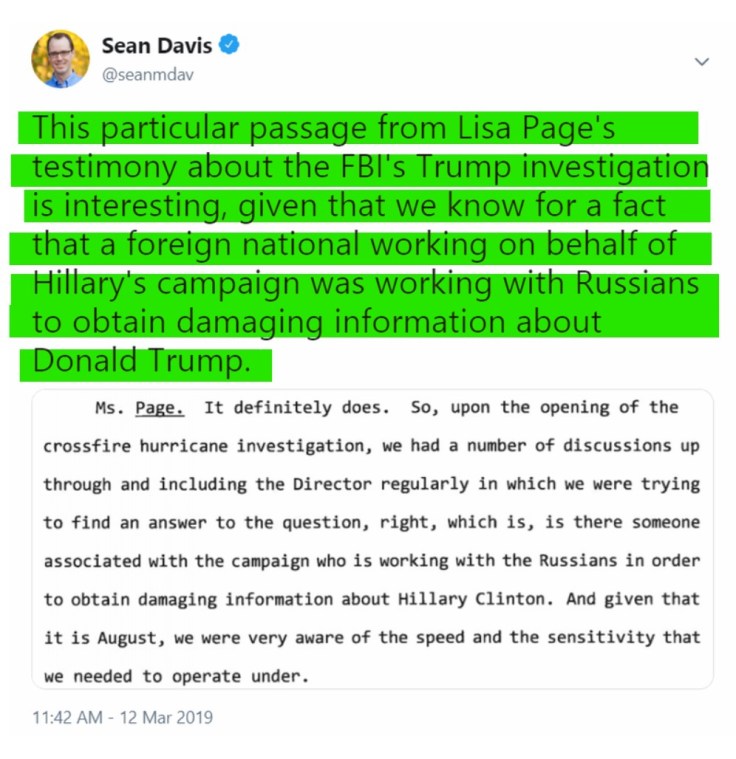
Of note, the dossier Steele compiled which was subsequently used to obtain a warrant to spy on a Trump adviser (and later smear Trump) relied on a “senior Russian Foreign Ministry figure” and “a former top level intelligence officer still active in the Kremlin,” according to Vanity Fair.

Following his March 12 tweet, Davis wondered if Twitter was experimenting with “shadow bans” – as he could only see his tweet if he was logged in, meaning nobody else could see it.
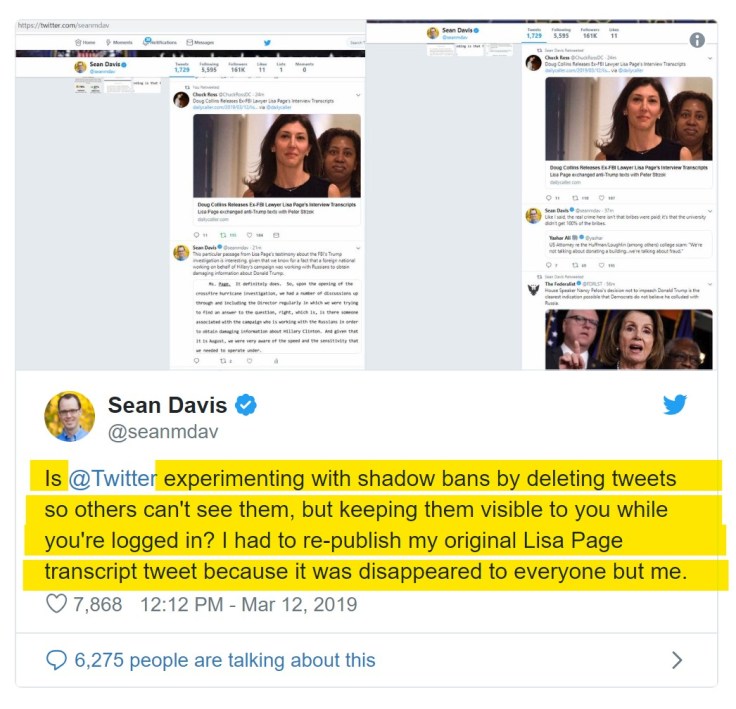
Six days later, Twitter confirmed with Davis that they had deliberately shadow-banned his tweet in order to “keep people safe.”
Twitter confirmed to me today via e-mail that it did shadowban one of my tweets about Lisa Page's congressional tes… twitter.com/i/web/status/1…—
Sean Davis (@seanmdav) March 18, 2019
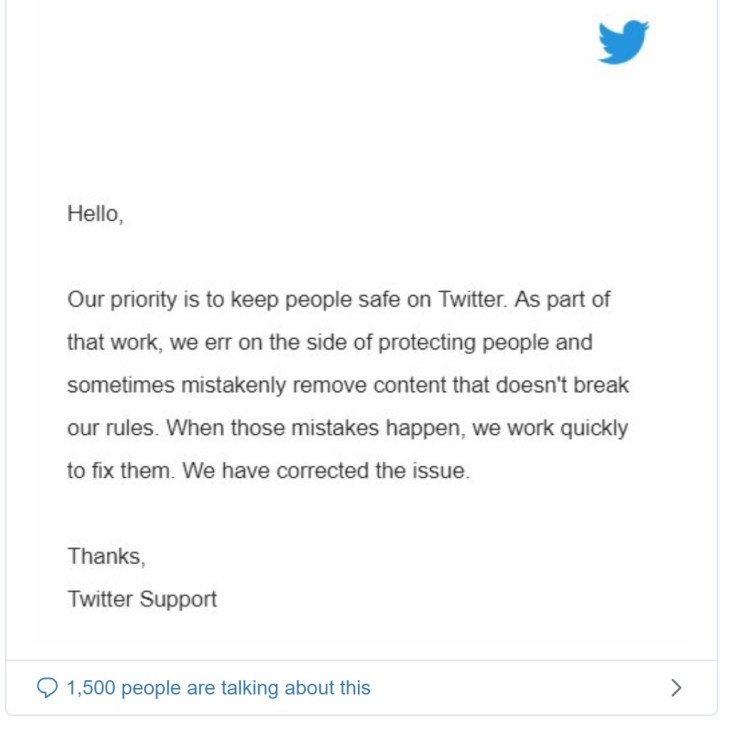
“Twitter gave me no notice or explanation when it shadowbanned one of my Tweets about Russian interference in our elections,” wrote Davis, adding “But what’s worse is how Twitter apparently gives its users the fraudulent impression that their tweets, which Twitter secretly bans, are still public.”
Titter claimed in its e-mail to me that it "mistakenly remove[d]" a completely anodyne tweet about public congressi… twitter.com/i/web/status/1…—
Sean Davis (@seanmdav) March 18, 2019
In short, Twitter did not want the public to consider the irony of Hillary Clinton’s campaign paying for a foreign national to collude with Russians against Donald Trump, while the FBI scrambled to prove the Trump campaign did.
Unreal.
In other censorship news, ZeroHedge is now banned in New Zealand and much of Australiafollowing our reporting on the Christchurch terror attacks.
Sorry citizen, some facts are just too dangerous for your own good.


 Tom's Blog