By Paul Joseph Watson – 4/6/2020
Great Job! 😂
By Mark Dice – Apr 4, 2020
It’s funny how every one of these people get a pass! Yet trump is getting bashed as usual
Tucker: The New York Times’ coronavirus coverage can be explained in 4 steps
4/4/2020
Yet another reminder this country’s worst enemies aren’t overseas…

WHOA! Dr. Fauci in 2017: President Trump Will Be Challenged By a “Surprise Global Disease Outbreak” (VIDEO)

By Jim Hoft – April 4, 2020
Come again?
Back in 2017 at forum on pandemic preparedness at Georgetown University Dr. Fauci made an interesting statement. Fauci told the audience the Trump administration will not only be challenged by ongoing global health threats such as influenza and HIV, but also a surprise disease outbreak.
That was quite a prediction considering it was back in 2017!
Via Ned Nikolav, Ph.D. and Healio.

This is the same guy who told Americans not to worry about the coronavirus back in January.
He completely missed it.
Here is the video—
Google Unveils Orwellian Location Tracking Data for Wuhan Virus Lockdown

By Jose Nino – Apr 4, 2020
According to a report from CBS News, Google will be using its massive compilation of data to track the movements of people around the world.
From there, it will provide this data to policymakers and researchers in order to combat the Wuhan Virus.
The Big Tech titan published the so-called Community Mobility Reports for 131 countries. These reports feature localized data on how to travel to places like stores and parks and has been changed during the last month. In the United States’ case, Google’s data is divided on a county by county basis, which shows a massive reduction in people’s movement in urban and suburban communities —in some cases there are drops of 80 percent — with modest declines in rural areas in comparison.
Take for example, New York. According to Google’s mobility tracking data for New York witnessed a 62% decline for retail and recreation venues, 68% decline for public transit hubs like subways, buses, and train stations, 46% decline for workplaces, and 32% decline for grocery stores and pharmacies as of March 29.
In New York County, the reduction is even more dramatic. Movement dropped 86% for retail and recreation, 78% for transit, 57% for workplaces, and 51% for groceries and pharmacies.
The reports “aim to provide insights into what has changed in response to policies aimed at combating COVID-19,” the company stated on the website where the reports are published. “The reports chart movement trends over time by geography, across different categories of places such as retail and recreation, groceries and pharmacies, parks, transit stations, workplaces, and residential.”
The company plans on updating its figures regularly. It claims that the data is designed in a manner that protects people’s anonymity.
Damian Collins, a British Parliament member who has spearheaded efforts to investigate Google’s data practices, revealed in an email to CBS News that the reports indicate social distancing’s potential to limit the Wuhan Virus’ impact. However, he advised that people be cautious about in letting Google have the power to track people’s daily lives.
“This certainly shows the impact that the social restrictions are having on daily life, and helps policy makers determine the effectiveness of these strategies,” stated Collins. “It also illustrates the level of background surveillance that has become commonplace, without people really being aware of it.”
Jason Kint, the CEO of Digital Content Next, a trade group that represents digital publishers, agreed with Collins and is skeptical of Google’s underlying motives.
“While it’s a noble effort and the anonymous presentation is interesting, it’s asking a lot to trust a company who’s entire business model is about surveillance and monetization of as much personal data across our lives as they can collect,” Kint stated.
Collins believes that Google’s tracking data may be useful for policymakers, there are still questions about potential privacy violations and future mass surveillance abuses.
“In a crisis people may consent to this, but there has never really been a public debate about whether we agree to it in principle. The aftermath of this crisis may start such a debate,” Collins remarked.
Big Tech’s influence has been the source of public discussion since Trump got elected.
It has been instrumental in suppressing dissident voices and will now likely be greatly empowered by this new crisis.Conservatives would be wise to be skeptical of both corporations and government.
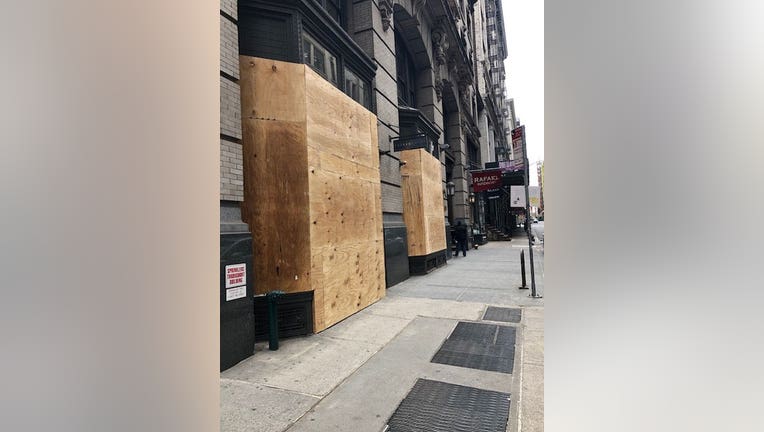
Store owners boarding up buildings across Manhattan
by Luke Funk – 4/4/2020
NEW YORK – A growing scene for those who venture out into the streets of Manhattan these days is boarded up storefronts. From luxury retailers to small bars, establishments that have no idea when they are going to be allowed to reopen are putting up protection over their glass doors and windows.
The businesses have taken the unsightly measure in an effort to defend against the potential for civil unrest caused by the coronavirus and a lack of officers on the streets.
Mayor Bill de Blasio ordered bars and restaurants closed except for takeout service in mid-March. Most stores were also ordered to shut down.
Now, from Lower Manhattan to the Upper East Side, outlets are boarded up. At least a few have offered makeshift messages of hope.
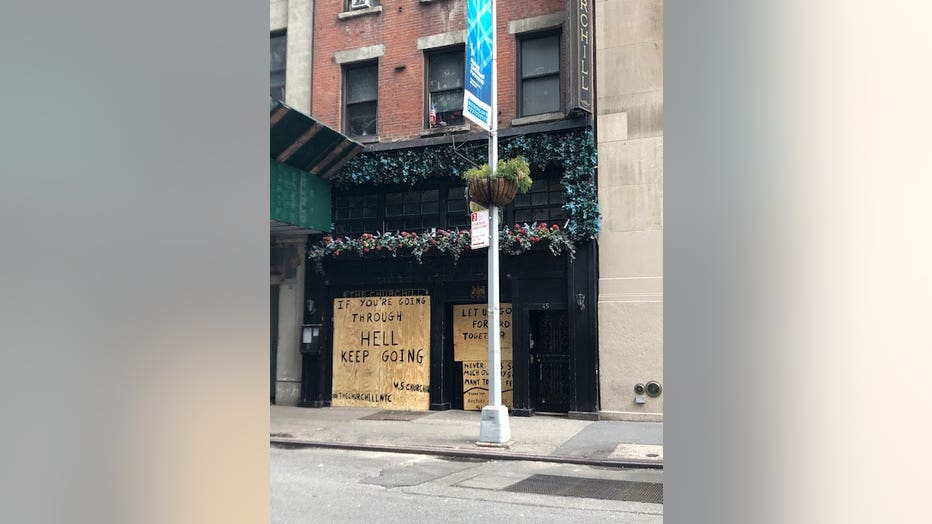
Posted on a pub at 28th and Park the message “let us go forward together” is painted on some of the plywood. Another message is painted next to it saying, “if you’re going through hell keep going.”
Typically bustling Soho sidewalks are marred by boarded-up windows at designer brand stores, including Louis Vuitton, Dior, Coach, and Dolce & Gabbana.
The NYPD has reported that crime in the city has actually dropped since the coronavirus outbreak has limited people on the streets.
As the number of NYPD officers are added to the sick list or test positive to coronavirus, there are questions on the ability to effectively fight crime.
On Thursday, 6,498 uniformed members of the NYPD were on the sick report which accounts for 18% of the Department’s uniformed workforce. 1,354 uniformed members and 169 civilian members have tested positive for the coronavirus.
In New York, Gov. Andrew Cuomo said the Empire State will do “whatever we have to do” in response to a growing number of city police officers who have called out sick.
Coronavirus patients ordered to wear GPS ankle monitors…Louisville is forcing unwilling coronavirus patients to self-isolate. Is it right?

By Kala Kachmar and Darcy Costello – 4/3/2020
Two Louisville coronavirus patients and a family member have been ordered by circuit judges to isolate and wear tracking devices after health officials learned they’d been in public against medical advice.
Issuing health-related civil orders is new territory for the courts, according to Judge Charles Cunningham, who issued two Friday. The third was issued earlier this month when a South End resident who tested positive for coronavirus refused to self-isolate.
But the orders are essential for keeping the community safe when infected patients refuse to self-quarantine, officials said during Mayor Greg Fischer’s Facebook Live briefing Tuesday.
[This story is being provided for free to our readers during the coronavirus outbreak. Consider supporting local journalism by subscribing to The Courier Journal at courier-journal.com/subscribe. ]
As of Tuesday, seven people have died of the virus in Jefferson County and 18 across Kentucky.
“The home incarceration program is well-suited for this,” said Amy Hess, the city’s chief of public services, which includes oversight of Metro Corrections and Emergency Services. “It provides us with the proper amount of distancing. We can monitor activity after (the monitoring device) gets affixed to them … to make sure they’re not further affecting the community.
“We would prefer not to have to do it at all,” she said.
Also: How a church revival in a small Kentucky town led to a deadly coronavirus outbreak
Cunningham told The Courier Journal on Tuesday the two individuals he ordered isolated were living together, but only one had tested positive for coronavirus.
The city’s health department submitted a request for the order, which indicated one of the individuals was “walking around” and the other, based on a phone call, was thought to be out of the house, Cunningham said.
Not enough Louisvillians are taking pandemic guidelines seriously, Fischer stressed again Tuesday. In addition to closing libraries, community centers, the zoo and even some parks over the past few weeks, he’s instructed police to cut back on the types of calls for service officers respond to.
And, in response to a lack of respect for his orders, he even had basketball rims taken off backboards in parks.
Both Hess and Louisville Metro Police Chief Steve Conrad said the biggest fear is the spread of the virus among first responders such as police officers, firefighters and ambulance workers, especially when “the surge” of coronavirus patients that’s expected starts to overwhelm local hospitals.
So far, one police officer and two firefighters have tested positive for COVID-19, city officials have said. At least eight additional firefighters went into self-quarantine in connection to Louisville Fire’s two positive cases.
Dr. Sarah Moyer: These new symptoms may mean you have or are spreading the coronavirus
Too. Cute: Kentucky nursing home posts ‘thank you’ video to health care workers fighting COVID-19
A Metro Corrections officer who was sent to attach ankle monitors following Friday’s isolation order has a 101-degree fever and is being tested for COVID-19, said Tracy Dotson, spokesman for the Fraternal Order of Police Lodge 77, which represents the workers.
Dotson said corrections officers haven’t received the same protective equipment as LMPD officers or Jefferson County Sheriff’s deputies also sent to confirmed coronavirus patients’ homes.
“If we’re going to be doing this, fine. That’s what we signed up for,” Dotson said. “But we’d like to be adequately protected, as our sister agencies are. We don’t think that’s too big of an ask. If nothing else, just for peace of mind for those officers.
“It would make me nervous if I showed up in a paper mask and some safety goggles and I saw the two guys there to work with me from different agencies in full respirators,” he added.
Steve Durham, spokesman for Metro Corrections, declined to confirm whether an officer is being tested. He also said first responders wear personal protective equipment recommended by medical professionals, which includes a gown, goggles, gloves and a mask.
‘Feeling our way through’
The first judge to issue an order requiring self-isolation was in Nelson County March 15, when a 53-year-old checked himself out of the University of Louisville Hospital against medical advice after testing positive.
Cunningham said the state’s Administrative Office of Courts put out a 200-page document over a decade ago that gives emergency guidance to circuit judges on topics like public health.
“It’s something we’re all feeling our way through,” he said. “We’re trying to figure out how this should be done.”
Jefferson Circuit Chief Judge Angela McCormick Bisig’s March 21 order required the first Jefferson County individual stay in his home for 14 days. Any violations, it said, may result in his arrest and criminal charges.
It said the Jefferson County Sheriff’s Department would serve the order and Metro Corrections would fit him with a global-positioning device. The order said he’d be constantly monitored to ensure he stays home.
What to do: 10 steps to follow if you think you may have the coronavirus
Dotson, spokesman for the union that represents Metro Corrections workers, questioned the ethics of using tracking devices on Louisville residents who have not been charged with a crime.
It is a judge’s order, he acknowledged, but “our mandate is once people are charged with a crime, we’re to do whatever it is we do with them.”
“These people aren’t charged with a crime,” he said.
“For my people on the ground, that’s a concern for them.”
Kentucky law gives county health departments the clear power to isolate infected patients who refuse to stay home. Isolation separates sick people with a communicable disease, while quarantine separates and restricts the movement of people potentially exposed.
Nelson County Judge-Executive Dean Watts said the involuntary isolation of the county resident was permitted after he declared a county emergency.
In most states, breaking a quarantine order is a misdemeanor, according to the Centers for Disease Control, although Kentucky law does not provide a penalty.
Courier Journal reporter Andrew Wolfson contributed to this report.
 Tom's Blog