Research: Google Search Bias Flipped Seats for Democrats in Midterms

By Allum Bokhari

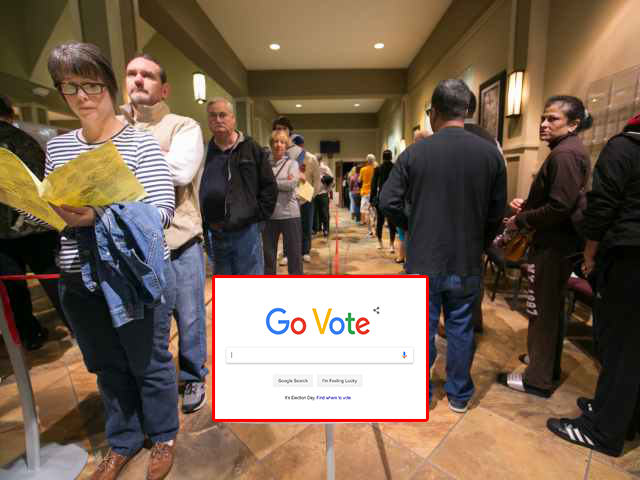
Google encourages users to "go vote"

New research from psychologist and search engine expert Dr. Robert Epstein shows that biased Google searches had a measurable impact on the 2018 midterm elections, pushing tens of thousands of votes towards the Democrat candidates in three key congressional races, and potentially millions more in races across the country.

The study, from Epstein and a team at the American Institute for Behavioral Research and Technology (AIBRT)analyzed Google searches related to three highly competitive congressional races in Southern California. In all three races, the Democrat won — and Epstein’s research suggests that Google search bias may have tipped them over the edge.

The research follows a previous study conducted in 2016 which showed that biased Google results pushed votes to Hillary Clinton in the presidential election. Democrats and Google executives have disputed these findings.

Epstein says that in the days leading up to the 2018 midterms, he was able to preserve “more than 47,000 election-related searches on Google, Bing, and Yahoo, along with the nearly 400,000 web pages to which the search results linked.”

Analysis of this data showed a clear pro-Democrat bias in election-related Google search results as compared to competing search engines. Users performing Google searches related to the three congressional races the study focused on were significantly more likely to see pro-Democrat stories and links at the top of their results.

As Epstein’s previous studies have shown, this can have a huge impact on the decisions of undecided voters, who often assume that their search results are unbiased. Epstein has called this the Search Engine Manipulation Effect (SEME).

According to Epstein’s study, at least 35,455 undecided voters in the three districts may have been persuaded to vote for a Democrat candidate because of slanted Google search results. Considering that each vote gained by a Democrat is potentially a vote lost by a Republican, this means more than 70,910 votes may have been lost by Republicans in the three districts due to Google bias. In one of these districts, CA 45, the Democrat margin of victory was just over 12,000 votes.

The total Democrat win margin across all three districts was 71,337, meaning that bias Google searches could account for the vast majority of Democrat votes. Extrapolated to elections around the country, Epstein says that bias Google results could have influenced 4.6 million undecided voters to support Democrat candidates.

Moreover, Epstein’s findings are based on modest assumptions, such as the assumption that voters conduct one election-related search per week. According to Epstein, marketing research shows that people typically conduct 4-5 searches per day, not one per week. In other words, the true impact of biased search results could be much higher.

Epstein’s study may also understate the level of liberal bias in Google search results, due to its use of a 2017 study from Harvard’s Berkman Klein Center to rank sources by their bias. The study assigns conservative sources like Breitbart News a far higher bias rating than ostensibly centrist but in fact highly liberal sources like the New York Times. The study also gives online encyclopedia Wikipedia a non-liberal bias rating, despite the fact that its most controversial pages are typically hijacked by its cabal of left-wing editors to push partisan liberal narratives.

As the Los Angeles Times notes, Epstein is not a Republican and publicly supported Hillary Clinton in 2016. Nevertheless, Democrats and liberals continue to ignore or doubt his findings. House Judiciary Committee chairman Rep. Jerry Nadler (D-NY) has repeatedly called claims of big tech bias a “conspiracy theory,” as have other congressional Democrats. And left-wing academics interviewed by the Los Angeles Times also heaped doubt on Epstein’s work.

Dr. Robert Epstein is featured in the 2018 documentary The Creepy Line, which was produced by Breitbart News editor-at-large Peter Schweizer and explores the bias amongst the Masters of the Universe in Silicon Valley.

Breitbart News continues to expose left-wing bias at Google. Recent reports reveal that company managers have told employees that the tech giant must stop “fake news” because “that’s how Trump won,” that Google-owned YouTube adjusted its algorithms to push pro-life content off its top search results, and that the company’s own internal researchers describe the company’s changes in policy since 2016 as a “shift towards censorship.”

Ex-CIA Chief John Brennan Threatens Trump: Mueller Will Soon Likely Put Your Political and Financial Future in Jeopardy


CAP

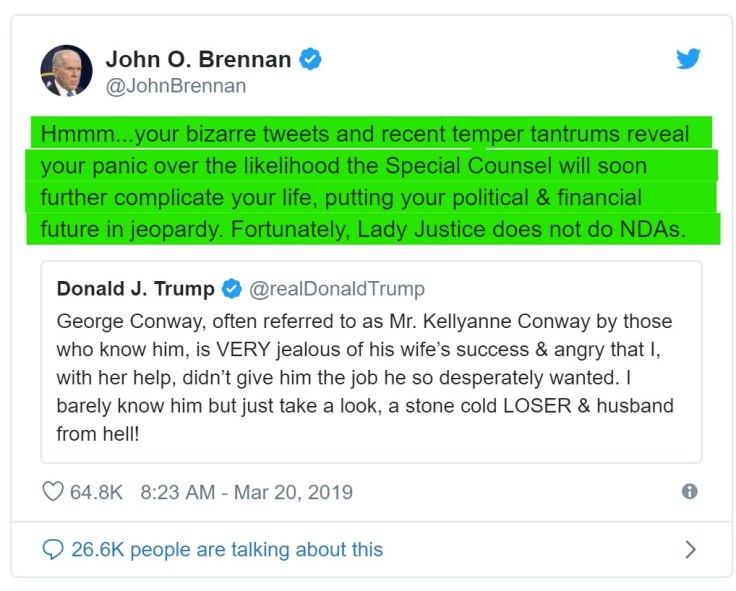
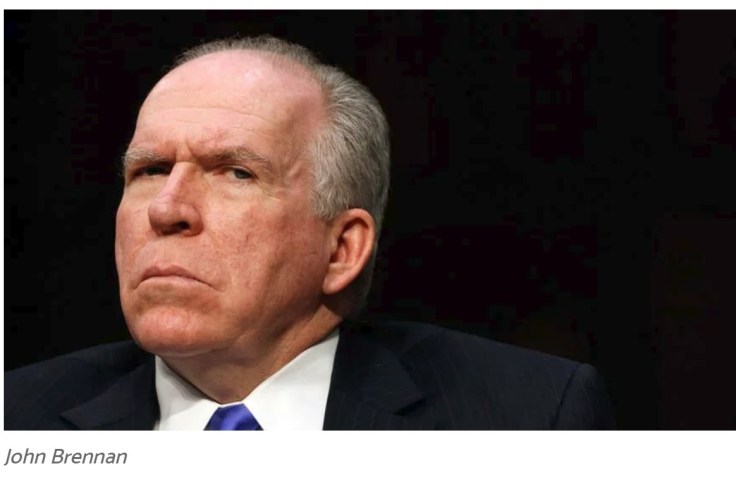
Former CIA Chief-turned-Twitter-troll John Brennan warned the President on Wednesday that Special Counsel Mueller will soon put Trump’s political and financial future in jeopardy.

The President fired off an incendiary tweet directed towards Kellyanne Conway’s cruel, Trump-hating “husband from hell,” George Conway on Wednesday.

“George Conway, often referred to as Mr. Kellyanne Conway by those who know him, is VERY jealous of his wife’s success & angry that I, with her help, didn’t give him the job he so desperately wanted. I barely know him but just take a look, a stone cold LOSER & husband from hell!” Trump said in a tweet Wednesday after a nasty exchange between the two took place on Tuesday.

In response to Trump’s tweets to George Conway, John Brennan, one of the architects of Russiagate, accused President Trump of throwing temper tantrums because he is panicking over Mueller’s impending report.

What does John Brennan know about Mueller’s report?

Brennan is admitting Mueller’s report will complicate Trump’s life and cripple him financially and politically in the future.

BRENNAN: Hmmm…your bizarre tweets and recent temper tantrums reveal your panic over the likelihood the Special Counsel will soon further complicate your life, putting your political & financial future in jeopardy. Fortunately, Lady Justice does not do NDAs.

CAP

Brennan often issues President Trump thinly veiled threats from his Twitter account.

Last year, John Brennan warned President Trump about Mueller’s investigation. “Stay tuned,” Brennan said in an ominous Twitter post.

A few months later, President Trump pulled John Brennan’s security clearance.

Elizabeth Warren Pledges To Get Rid Of The Electoral College

By EMILY ZANOTT

At a town hall event in Mississippi, Sen. Elizabeth Warren (D-MA) pledged to avenge her predecessor candidate, Hillary Clinton, and do away with the Electoral College if she is elected President.

The plan to eliminate the Electoral College has caught fire among Democratic presidential hopefuls, and Warren is just the latest in a line of prospective nominees who want to replace the age-old system of allowing each state a certain number of votes proportional to their size and population with a “national popular vote” that will, of course, favor Democrats.

Warren, however, may have been the first to announce her plan in a state that would be cut out of the presidential process almost completely were the “national popular vote” system adopted.

Ironically, CNN reports, Warren announced her plan by suggesting that a national popular vote would make sure all Americans count equally in the process of electing a President.

“Come a general election, presidential candidates don’t come to places like Mississippi. They also don’t come to places like California or Massachusetts, because we’re not the battleground states,” she said. My view is that every vote matters and the way we can make that happen is that we can have national voting and that means get rid of the Electoral College — and every vote counts.”

Warren is right on one count: around 90% of electioneering takes place in 10 or 11 major battleground and swing states. But eliminating the Electoral College wouldn’t necessarily change the plan to win the presidency; it would merely change the select destinations.

Presidential candidates still would not go to “places like Mississippi” in the event of a national popular vote. Places like California (which Democrats do, in fact, visit, if only to collect checks from Hollywood bigwigs), New York, and Virginia would more than dominate electoral politics — they would, essentially, be able to exercise near-imperial rule over most other states.

That’s fine for Democrats, but not exactly fine for the people of Mississippi.

Warren’s plan also has other problems. Like a handful of more extreme Democratic proposals, promising to abolish the Electoral College is a bit like a fifth grader promising to make every day pizza day in the cafeteria as part of his platform for heading up the student council: it just isn’t going to happen without a major change in how party politics operates.

The Electoral College is enshrined in the Constitution and would require an amendment to alter, and an amendment involves calling a Constitutional convention (difficult), or obtaining 2/3 of the vote in both houses of Congress (nearly impossible). And although a handful of states have pledged to buck the Electoral College system and assign their Electors to the winner of the national popular vote, acting on those votes could trigger a firestorm of litigation and a potential Constitutional crisis.

Warren, though, seems pretty much willing to commit to any proposal that earns her even a fraction of a percent at this point. Trailing far behind the leaders, and unable to move her numbers above 7%, it looks as if her bid to become president is over just weeks after it started. In addition to the Electoral College, Warren has proposed support for reparations (though she isn’t sure what that looks like), and has tacitly endorsed packing the Supreme Court with additional judges.

And yet, none of these three extreme proposals has moved her any further up in the polls.

READ MORE: CONSTITUTION  ELECTORAL COLLEGE  ELIZABETH WARREN  HILLARY CLINTON

TWITTER ADMITS SHADOWBANNING LISA PAGE TWEET BY FEDERALIST CO-FOUNDER “TO KEEP PEOPLE SAFE”

Twitter Admits Shadowbanning Lisa Page Tweet By Federalist Co-Founder "To Keep People Safe"

Sorry citizen, some facts are just too dangerous for your own good

Zero Hedge – MARCH 19, 2019

Twitter has admitted to shadowbanning a tweet by The Federalist co-founder Sean Davis in order to “keep people safe.” 

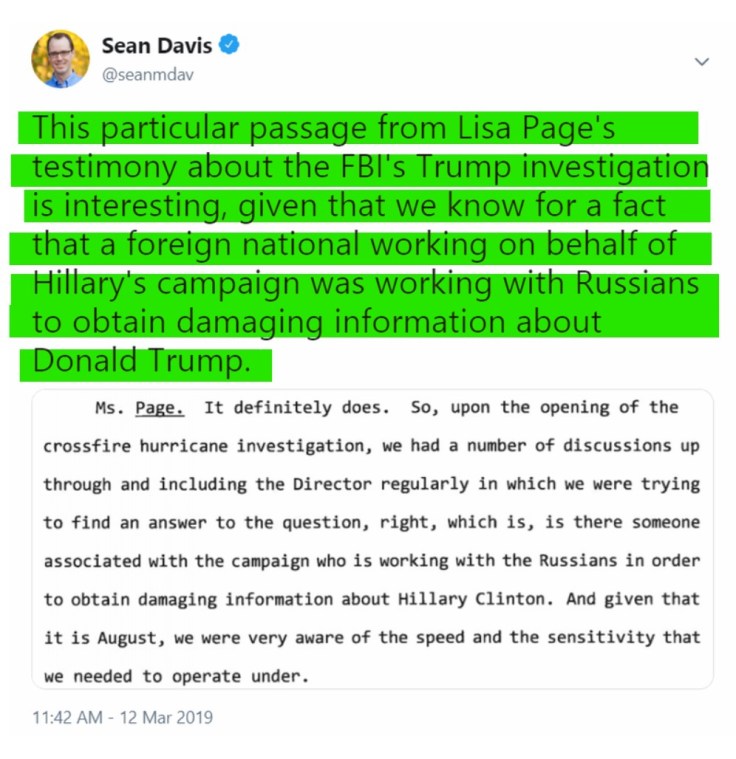
Tweeting a passage last week from former FBI attorney Lisa Page’s Congressional testimony discussing the FBI’s rush to find connections between the Trump campaign and Russia, Davis pointed out the irony of Hillary Clinton’s campaign employing former UK spy Christopher Steele, a foreign national, “working with Russians to obtain damaging information about Donald Trump.” 

CAP

Of note, the dossier Steele compiled which was subsequently used to obtain a warrant to spy on a Trump adviser (and later smear Trump) relied on a “senior Russian Foreign Ministry figure” and “a former top level intelligence officer still active in the Kremlin,” according to Vanity Fair.

CAP

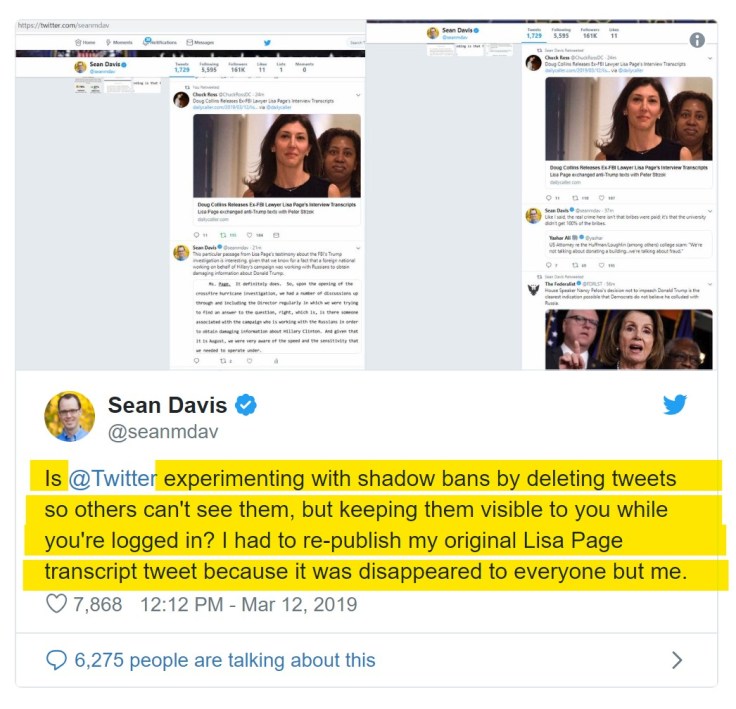
Following his March 12 tweet, Davis wondered if Twitter was experimenting with “shadow bans” – as he could only see his tweet if he was logged in, meaning nobody else could see it.

CAP

Six days later, Twitter confirmed with Davis that they had deliberately shadow-banned his tweet in order to “keep people safe.”

CAP

“Twitter gave me no notice or explanation when it shadowbanned one of my Tweets about Russian interference in our elections,” wrote Davis, adding “But what’s worse is how Twitter apparently gives its users the fraudulent impression that their tweets, which Twitter secretly bans, are still public.”

In short, Twitter did not want the public to consider the irony of Hillary Clinton’s campaign paying for a foreign national to collude with Russians against Donald Trump, while the FBI scrambled to prove the Trump campaign did.

Unreal.

In other censorship news, ZeroHedge is now banned in New Zealand and much of Australiafollowing our reporting on the Christchurch terror attacks.

Sorry citizen, some facts are just too dangerous for your own good.

GOP Congressman Releasing Transcripts From Closed-Door Testimonies Of Russia Probe Investigators

By ASHE SCHOW

U.S. Rep. Doug Collins (R-GA) speaks during a House Rules Committee meeting at the U.S. Capitol February 25, 2019 in Washington, DC.

For the past two weeks, one GOP congressman has been on a mission to release transcripts of government officials who testified to Congress behind closed doors regarding the investigation into alleged collusion between the Trump campaign and the Russian government.

Rep. Doug Collins (R-GA), ranking member on the House Judiciary Committee, began releasing transcripts into the congressional record on March 8, starting with the closed-door testimony of Department of Justice official Bruce Ohr. Collins took to the House floor to explain his decision to release the transcripts, asking, is “the only ‘collusion’ among agency personnel who hated the president and started this investigation?”

See the source image

Collins said that the transcripts were “pertinent to a congressional investigation,” but the investigation was ended after Republicans lost control of the House of Representatives. Collins said further that the committee had given the DOJ time to review and redact information related to national security, but received little response from the department, so they made minor redactions and released the transcripts.

The 268-page transcript from Ohr’s testimony revealed that Fusion GPS founder Glenn Simpson and ex-British Spy Christopher Steele used Ohr to get their salacious claims about Russia collusion into the federal government. Ohr also revealed that, contrary to what House Intel Chairman Adam Schiff has said, the FBI had received reports from Steele as early as July 2016, not September 2016, as Schiff claimed.

Further, Ohr testified that Steele continued to feed him information after the ex-spy was no longer a credible source for the FBI. The FBI would interview Ohr as a backdoor to Steele’s intel.

Four days after releasing Ohr’s testimony, Collins returned to the House floor to publicly release former FBI lawyer Lisa Page’s testimony.

“The American people deserve to know what transpired in the highest echelons of the FBI during that tumultuous time for the bureau,” Collins said at the time.

The Page testimony was explosive, as she had not been publicly interviewed by the committee or anyone else after her text messages with then-fellow FBI agent Peter Strzok, with whom she was having an affair, were revealed.

In her testimony, Page revealed that the FBI’s Russia investigation really was an “insurance policy” in the unlikely event that Donald Trump was elected president, and that investigators had only a “paucity” of evidence in the beginning, which they still used to launch investigations into the president. Page also suggested that it was President Barack Obama’s Justice Department that essentially told the FBI not to find Hillary Clinton responsible for “gross negligence” in regard to classified information being sent over her unsecured, private email server.

See the source image

Two days after releasing Page’s testimony, Collins released Strzok’s. In his testimony, Strzok revealed that he deleted communications between himself and his mistress, Page, prior to being removed from Special Counsel Robert Mueller’s investigation, but did so for “personal” reasons. He claimed to have deleted personal communications regarding his affair, but some of those messages showed anti-Trump sentiments and discussed the “insurance policy” of investigating “collusion” if Trump won the election.

On Sunday, Collins told Fox News host Maria Baritomo that he was planning to release more transcripts. Baritomo asked if Jim Baker, the former FBI lawyer who is now under criminal investigation for leaking to the media, was on the list for future transcript releases.

“There will be more transcripts released. Baker will be one that we’re looking at releasing,” Collins responded.


Why did Kamala let HERBALIFE off hook?

By Alexander Nazaryan

National Correspondent
CAP

WASHINGTON — At a rally in late January in her native Oakland, Calif., U.S. Sen. Kamala Harris announced her intention to seek the presidential nomination by casting herself as a tireless advocate of men and women who lack power and wealth. The former attorney general of California — who since 2017 has been the state’s junior senator — described her first appearance in the courtroom, as a young San Francisco district attorney. “I knew I wanted to protect people,” Harris told the crowd of 20,000. “And I knew that the people in our society who are most often targeted by predators are also most often the voiceless and vulnerable.”

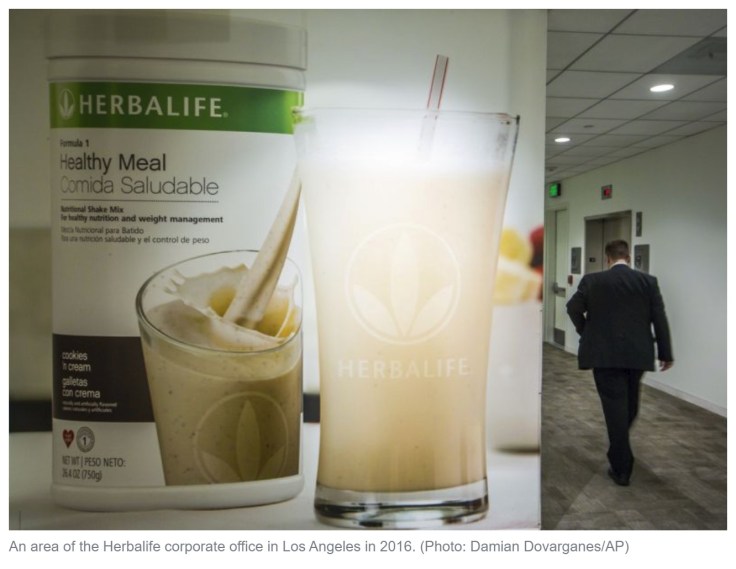
But as the attorney general of the nation’s largest state — and therefore one of the most powerful law enforcement officials in the nation — Harris declined to investigate Herbalife, the nutritional supplement company that has been accused of fraudulent marketing practices. Documents exclusively obtained by Yahoo News show that in 2015, prosecutors in the San Diego office of the California attorney general sent Harris a lengthy memorandum that argued for an investigation into Herbalife and requested resources in order to undertake such an investigation. Similar investigations into Herbalife were already taking place elsewhere.

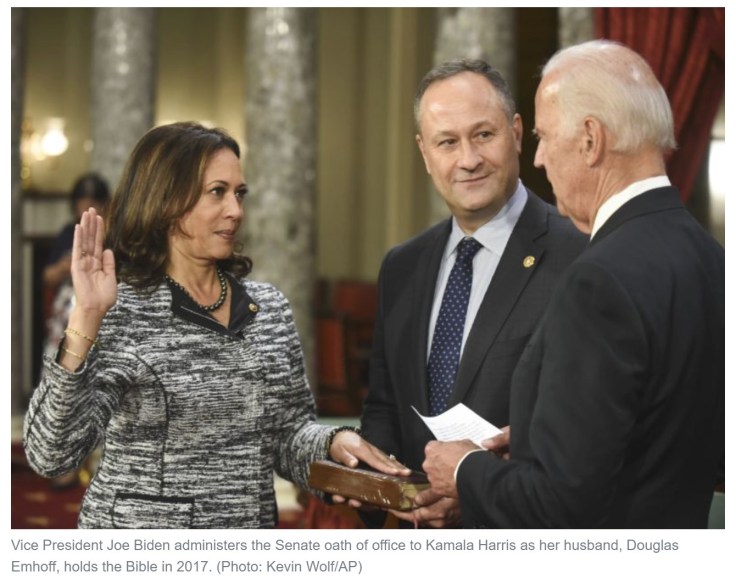
About three weeks after the San Diego letter was sent, Harris received the first of three donations to her campaign for the U.S. Senate from Heather Podesta, the powerful Washington lobbyist whose ex-husband Tony’s firm, then called the Podesta Group, had worked for Herbalife since 2013. Heather Podesta’s own lobbying firm, Heather Podesta and Partners, would soon be hired by Herbalife, too.

Harris did not pursue an investigation, even as the Federal Trade Commission proceeded with an investigation of its own, which had been opened the previous March and which suggested that sufficient grounds for such scrutiny did exist. In fact, the San Diego letter had meticulously laid out those grounds, pointing out that Herbalife presented itself to the public as a lawful enterprise, but that it could nevertheless be “engaged in less obvious conduct” that potentially harmed both Herbalife distributors and Herbalife customers. Allegations of such conduct, by 2015, had become commonplace in media reports.

Harris never gave a reason for declining to investigate Herbalife, but the decision stands in contrast to her oft-expressed promise to fight for ordinary Americans for whom the 21st century economy seems to hold little promise. Those are the very same Americans, critics say, that Herbalife recruited — and exploited.
CAP

Harris’s presidential campaign said it was not accurate to see in her treatment of Herbalife a hesitation about aggressively pursuing corporations. Harris “has a long record of going after bad corporate actors engaging in fraudulent behavior and delivering results for people who have been taken advantage of,” said campaign spokesman Ian Sams.

He noted that as California’s attorney general, Harris “got $20 billion for California homeowners after taking on mortgage fraud by the big banks, secured a billion-dollar judgment against for-profit Corinthian Colleges for scamming students, and put Ponzi and pyramid schemers in prison.”

Founded in 1980, Herbalife calls itself a “global nutrition company whose purpose is to make the world healthier and happier.” It is a multilevel marketing operation — MLM, for short — meaning that instead of selling its weight-loss shakes and pills through proprietary outlets, it relies on distributors who make a commission when they sell the products, which they can do out of their own homes or through “nutrition clubs” that cannot feature Herbalife branding, even though they sell Herbalife products. Such clubs have recently proliferated in Latino communities across the United States, where Herbalife’s hold is strongest.

CAP

Critics believe that MLMs, including Herbalife, are pyramid schemes because their profits stem from recruitment of new salespeople, rather than sales to end customers (the pyramid is the shape of such a company’s growing distributor base). Other than Herbalife, the most well-known American corporation to stand accused of running a pyramid scheme is Amway, the home products company founded 60 years ago in Michigan. In 1979, Amway won a crucial case in which the FTC called it a pyramid scheme, but the allegations persisted, both against Amway and other MLMs. In 2010, Amway paid out $56 million in the settlement of a class action suit that revived the pyramid scheme charges. Yet the company survived. (The current federal education secretary, Betsy DeVos, is married to the heir of the Amway fortune.)

Herbalife attracted scrutiny almost from the start. In 1986, the state of California imposed a consent decree on Herbalife that said the company could not make “false or misleading representations” about how much money distributors could expect to make. The company also had to stop making allegedly false or exaggerated claims about its products.

But that did little to stop the company’s growth, and it continued to rapidly expand both in the United States and around the world. In 2003, Herbalife hired Disney executive Michael O. Johnson, who brought management sophistication to its operations. A tanned triathlete, he seemed a living embodiment of the company’s promises. (The company’s founder, Mark Hughes, had died of a drug overdose three years before.) The company went public the following year; a 2005 annual report declared its market capitalization to be $359.8 million.

But despite Johnson’s efforts to add corporate sheen, critics maintained that Herbalife’s profits came not from sales of its weight loss products, but in the aggressive recruitment of new members, each of whom was expected to buy large amounts of inventory from the company. The new recruits quickly realized, according to Herbalife’s detractors, that the inventory of pills and powders itself was largely worthless and that the only way to make money was to attract new recruits.

Herbalife has long denied such accusations, portraying itself as a company that provides access to wealth to people who, for one reason or another, are unable to find success in traditional employment. The company declined to speak on the record for this story.

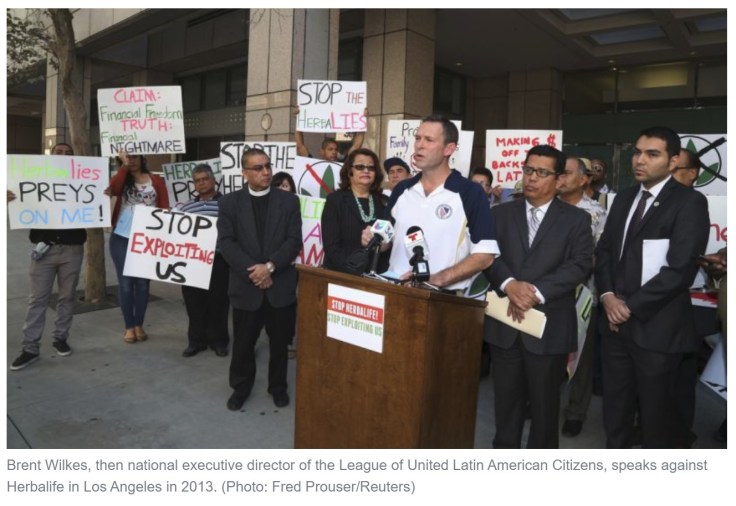
Harris was first asked publicly to look into Herbalife’s alleged wrongdoing in 2013, when the company held its Extravaganza Latina in Los Angeles. Protesters picketed the event, urging Harris to investigate Herbalife. “We are asking Attorney General Harris to help us protect vulnerable, low income Latinos and other minorities from these schemes that have cost people their life savings,” one of the protest’s organizers said.

At the time, Herbalife was fending off another existential challenge, from Manhattan hedge fund Pershing Square Capital Management, whose founder, Bill Ackman, had become convinced that though the company was worth $8.1 billion at the time, that valuation was predicated on illusion. He declared war on Herbalife with the public presentation of a 334-page PowerPoint dossier, the 64th page of which contained his central argument: “Herbalife is a Pyramid Scheme.”
CAP

Ackman eventually came to take an astonishingly bold $1 billion short position on Herbalife, meaning that he borrowed stock in the company with the expectation that the price of the stock would fall dramatically. If that happened, Ackman’s short would provide him with a massive windfall, not to mention a validation of his beliefs about the company. Ackman and Pershing Square declined to comment for this article.

Ackman’s public quest to take down Herbalife — he was explicit about that goal — brought newfound scrutiny to the company, pressuring regulators to act. The FTC opened an investigation into Herbalife in March 2014, with Lisa Madigan, attorney general of Illinois, and Eric Schneiderman, attorney general of New York, doing the same the following month. That meant that what were at the time the country’s fourth and fifth most populous states had now joined the fight. The FBI started an investigation in April 2014 as well.

Harris remained silent. That January, activists met with members of her office. “The concerns were clearly articulated to her staff,” says Brent Wilkes, who at the time was executive director of the League of United Latin American Citizens, one of the groups asking Harris to investigate Herbalife. “They heard us, asked interesting questions,” Wilkes recalls. He says he was “hopeful” that Harris “would come around,” but the activism failed to make a sufficient impact on her.

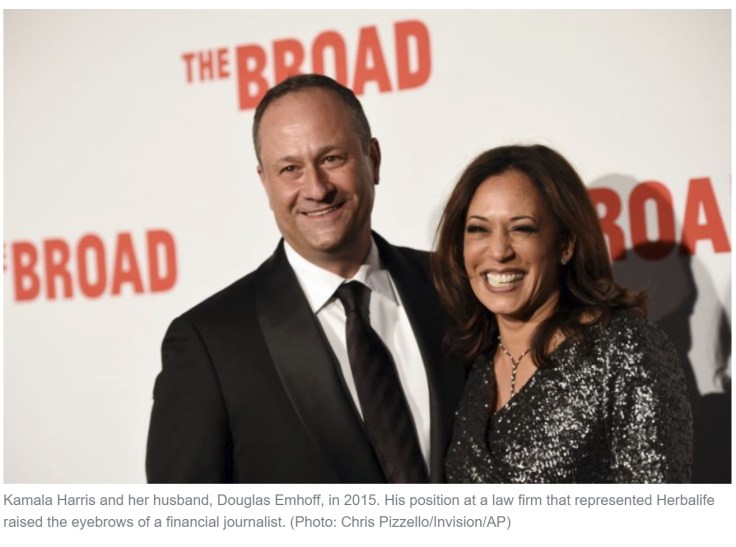
Wilkes did not know that at the time, Herbalife was represented by Venable, which also employed Harris’s husband, Douglas Emhoff. Emhoff does not appear to have been involved in Herbalife’s affairs, but his work at the firm came to the attention of Christopher Irons, a financial journalist who first reported on the Emhoff-Herbalife connection. “Surely this would seem like some sort of enormous conflict of interest, no?” he wrote in 2015.

The activists asking Harris to investigate Herbalife did not seem to know that she had a personal connection to the the law firm representing the corporation. “That’s news to me,” Wilkes said when told by Yahoo News about Emhoff’s law firm.

The letter to Harris from Judith Fiorentini, the supervising deputy attorney general in the San Diego office, was sent on March 3, 2015. It was signed by two other deputy attorneys general, Sanna Singer and Jinsook Ohta, who like Fiorentini were in the consumer law department of the attorney general’s office. Their memo asked for a “ delegation of investigative authority,” which was to include “the authority to issue and enforce investigative subpoenas.”

Fiorentini wrote that “while Herbalife has outwardly complied with the 1986 injunction … we believe that it may be directing or enabling the acts of its distributors in ways that violate” that order “and/or consumer laws in general.” She explained that there was reason to believe that Herbalife was empowering its distributors to make false claims about the benefits of becoming a Herbalife distributor. “Herbalife can be liable for consumer violations by its distributors to the extent Herbalife enabled the distributors’ actions,” Fiorentini wrote.

The letter went on to cite precedent for conducting such a probe, and noted that a preliminary investigation had already taken place. That investigation “revealed that Herbalife, at least in publicly available documents, has carefully drawn its corporate policies and conducted itself in a manner that is outwardly consistent with the 1986 Injunction.” Fiorentini thought it was nevertheless necessary to “delve behind what is publicly available to determine if Herbalife is directing or enabling its distributors” to act illegally.

Fiorentini requested two full-time attorneys, three or four legal assistants and, potentially, officers to conduct undercover operations. The letter ended with the pros and cons of such an investigation. Fiorentini was frank about the energy and resources required while also anticipating a “rigorous legal defense” from the company. At the same time, she said that an investigation would “send the message that this office takes continued monitoring and enforcement of its existing judgments very seriously. In addition, it will ensure that Herbalife is held accountable for the acts of its distributors.”
CAP

The contents of the memorandum, or its existence, have not been published before. But it suggests that Harris was made directly aware of the dangers Herbalife may have posed to the people of California. No investigation was opened into Herbalife in response to the memorandum from Fiorentini, who did not respond to repeated requests for comment from Yahoo News. Nor has Harris publicly said why she chose not to investigate Herbalife, a step that would necessarily lead to prosecution.

A person familiar with deliberations at the attorney general’s office at the time disputes suggestions of inaction by Harris. The person — who requested anonymity in order to speak frankly — said that the California attorney general’s office did help the FTC with its investigation, namely through its corporate fraud division. And the person said that Harris was hesitant to join a fight between billionaires: In response to Ackman’s $1 billion Herbalife short, investor Carl Icahn bet heavily on the company, and the two men began to attack each other sharply on television.

Podesta, the Washington lobbyist whose ex-husband represented Herbalife, donated $1,000 to Harris’s campaign for the U.S. Senate on March 31, 2015, at the end of the same month that had seen the arrival of the letter from the San Diego office, asking for an Herbalife investigation. She donated $4,400 to Harris’s senate campaign the following year. (Podesta had made smaller donations, of $100 and $500, to Harris in 2010 and 2014, respectively. She did not respond to requests for comment.)

That July, Herbalife hired a top Podesta deputy, Eric Rosen, to serve as its top government relations official. The following year, Herbalife paid Heather Podesta $250,000 for her lobbying work.

Harris moved on from her duties as a prosecutor in 2016 when, on the same day that Trump became president, she was elected to serve as California’s junior senator. She was sworn in the following January, and exactly two years later she announced she was running to oust Trump from the Oval Office.

The FTC won a $200 million settlement from Herbalife in July 2016. Related to that settlement was one with Madigan, the Illinois attorney general, for $3 million. California, which often leads the nation in consumer and environmental regulations, remained on the sidelines.
CAP

“I wouldn’t limit my disappointment to her,” says Wilkes, the former chief executive of the League of United Latin American Citizens, of Harris. “At least Kamala listened.” Still, he wonders why Madigan could wrest a settlement from Herbalife but Harris could not. “Kamala,” he says with audible disappointment, “should have had that too.”

Since then, however, she has faced questions about whether her progressivism is genuine or only a matter of political expediency. She has yet to explain why she declined to pursue a corporation accused of exploiting her Latino constituents.

Harris was replaced as California’s attorney general by Xavier Becerra, who had formerly represented Los Angeles in the U.S. House of Representatives. Becerra has formerly received significant political donations from Herbalife’s political action group. His office would not say how, if at all, this complicated considerations about opening an investigation into Herbalife.

The attorney general’s press office declined to comment in response to repeated calls and emails from Yahoo News.

Contreras, the Chicago activist, has watched the Harris presidential campaign with skepticism. For her, the decision to go easy on Herbalife is indicative of where Harris’s sympathies lie, and it is not with the downtrodden. Contreras has a simple message for the presidential candidate: “Kamala Harris, shame on you.”

Editors’ note: This article has been updated to clarify the relationship between Heather Podesta and Herbalife, as well as to include the political affiliation of activist Julie Contreras.
Blog at WordPress.com.

Up ↑