
Published on Mar 8, 2019

Thursday, March 07, 2019
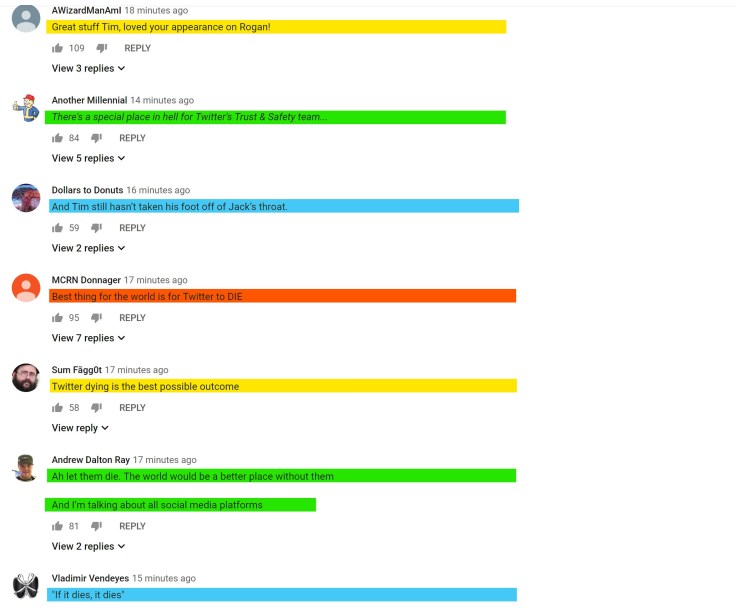
When asked by Rogan if company employees “read direct messages,” Dorsey replied, “We don’t read direct messages.”
Gadde followed up, explaining that the only direct messages read by employees are those which have been reported to Twitter support.
Rogan pressed further, asking if it was possible for Twitter employees to intentionally peruse a user’s direct messages.
“I don’t think so,” Gadde replied.
However, according to multiple Twitter engineers who discussed the subject of direct messages with undercover Project Veritas journalists, Dorsey and Gadde may have been misleading with their answers, at best.
“There’s teams dedicated to it [reading direct messages],” said Clay Haynes, a senior network security engineer at Twitter. “I mean, we’re talking… at least three or four hundred people… they’re paid to look at dick pics.”
“It is creepy Big Brother.”
Pranay Singh, a direct messaging engineer, revealed that all content shared on the platform — including private messages — are stored on Twitter servers for analytical and advertising purposes.
“So all your sex messages and your dick pics are on my server now,” Singh said. “Everything. Anything you post online.”
“A machine is going to look at it. An algorithm will look at it, and they’ll make a virtual profile about you.”
Watch the full exchange here.
Published on Mar 7, 2019

/cdn.vox-cdn.com/uploads/chorus_image/image/63188116/acastro_180720_1777_facebook_0001.0.jpg)
By Nick Statt
In addition to Yelp and Duolingo, PI found that two Muslim prayer apps, as well as a bible app and a job search app called Indeed, also sent similar data to Facebook that could be used to help identify users for ad targeting purposes when they browse the social network. It’s not clear exactly what type of data is being sent in this case, other than that a user opened the app at a given time, but PI’s report says this transmission may also reveal custom identifiers that help Facebook track that user across its network of services and when that person opens Facebook on a mobile device.
The report builds on a similar investigation from PI last December that first revealed that big-name Android apps were sending data to Facebook without a user’s consent and without proper disclosure. It also highlights that this problem is universal across both iOS and Android; last month, The Wall Street Journal revealed that these same set of developer tools that scrape data when you use a mobile app and send it to Facebook are employed on iPhone apps, despite Apple’s much more stringent privacy rules and protections.
“This is hugely problematic, not just for privacy, but also for competition. The data that apps send to Facebook typically includes information such as the fact that a specific app, such as a Muslim prayer app, was opened or closed,” reads PI’s report, published earlier today. “This sounds fairly basic, but it really isn’t. Since the data is sent with a unique identifier, a user’s Google advertising ID, it would be easy to link this data into a profile and paint a fine-grained picture of someone’s interests, identities and daily routines.”
As Facebook’s privacy practices come under even greater scrutiny in the aftermath of last year’s Cambridge Analytica data privacy scandal, a spotlight is being shone on the lesser-known arrangements between large advertising companies and the smaller app makers that use those platforms to reach new users and target existing ones with ads. As revealed by the WSJ last month, a number of prominent iOS app makers use a Facebook analytics tool known as “custom app events” that, in this case, was sharing sensitive health, fitness, and financial data with the social network for ad targeting purposes.
On Android, Facebook has long collected sensitive user data such as contact logs, call histories, SMS data, and real-time location data, for the purpose of informing its ad targeting and improving features like friend suggestions. Yet the practices have caused vocal outcry from privacy advocates and users concerned Facebook is amassing far too much data about their personal lives and online and offline behaviors. Following reports about Facebook using its location-tracking capabilities to catch company interns skipping work, it said it would allow Android users the ability to explicitly disable the feature.
In this case, PI is underscoring one of Facebook’s longstanding indirect data collection policies, one that relies on third-party apps to autonomously collect and send information about app usage to the social network without telling users about the arrangement.
“Facebook routinely tracks users, non-users, and logged-out users outside its platform through Facebook Business Tools. App developers share data with Facebook through the Facebook Software Development Kit (SDK), a set of software development tools that help developers build apps for a specific operating system,” PI explained in the initial December 2018 report. The report found that nearly two thirds of the 34 Android apps PI tested — including big names like Spotify and Kayak and all of which had between 10 and 500 million installs — sent information to Facebook without informing users or gaining express consent.
PI says that a number of apps stopped the practice following its December report. Similarly, most of the operators of the iOS apps highlighted in the WSJ report also ceased using Facebook’s analytics and developer tools to collect sensitive user data. However, it appears some apps, like Yelp’s and Duolingo’s, continue to do so. PI says it’s in contact with Duolingo, and the company has agreed to suspend the practice, but it’s not clear how many other apps in the Android or iOS ecosystem may be skirting Apple and Google’s data-collection and user privacy policies to improve Facebook’s ad targeting tools.
In these situations, Facebook puts the onus on app makers not to break platform rules or misuse its developer tools by collecting sensitive information. The company has also claimed not to use a majority of this sensitive data and, in some extreme cases like credit card numbers and Social Security numbers, automatically deletes it. But it’s not clear why the data is being collected in the first place and what ways it’s been put to use in the past, either by the apps collecting it or by Facebook.
“Apps relay on the Facebook SDK to integrate their product with Facebook services, like Facebook’s login and ad tracking tools. However, Facebook places all responsibility on apps to ensure that the data they send to Facebook has been collected lawfully,” reads PI’s report. Facebook not immediately available for comment.

MARCH 7, 2019
In a description of Duke’s podcast Thursday, Omar was credited for defying what he referred to as “Z.O.G.”
“By Defiance to Z.O.G. Ilhan Omar is NOW the most important Member of the US Congress!” screamed a headline at Duke’s website.
A Thursday show description reads:
“Today Dr. Duke and Eric Striker of the Public Space had the kind of fun and informative show we have come to expect from our Thunder and Lightning Thor’s Day broadcasts. In particular, they heaped praise on Ilhan Omar (D-New Somalia) for being the one person in Congress willing to notice AIPAC and the “dual” loyalty of many (((members of Congresss))).”
The headline was accompanied by an image featuring a heart eyes emoji and Rep. Omar (D-Minn.), which was also shared on Twitter.

Duke’s endorsement comes as Dems, including fellow freshmen congresswomen Alexandria Ocasio-Cortez (D-NY) and Rashida Tlaib (D-Mich), have come to Omar’s defense after recent comments criticizing Israel were largely deemed anti-Semitic.
House Speaker Nancy Pelosi on Thursday also dismissed the controversy over Omar’s comments, saying “I do not believe that she understood the full weight of the words.”
NPR lays out Omar’s troubles which stem from a tweet made last month.
In February, Omar responded to a tweet from journalist Glenn Greenwald, who posted about House GOP Leader Kevin McCarthy threatening to punish Omar and another congresswoman for being critical of Israel.
Omar wrote back, “It’s all about the Benjamins baby,” a line about $100 bills from a Puff Daddy song. Critics jumped on the tweet and said Omar was calling up a negative and harmful stereotype of Jewish Americans.
In another tweet soon after, Omar named the American Israel Public Affairs Committee, or AIPAC, saying it was funding Republican support for Israel.
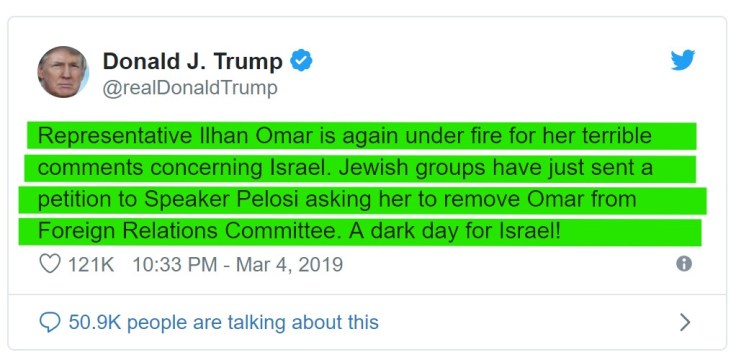
President Donald Trump on Monday added to the pressure on Dems to address Omar’s remarks in a tweet calling their inaction a “dark day for Israel.”
During the 2016 presidential campaign, mainstream media outlets incessantly demonized then candidate Trump for his loose affiliation with Duke during his flirt with a presidential bid in 2000 when he was part of the Reform party.
It is doubtful Omar will receive the same treatment.
H/t: TheGatewayPundit.com
By Tyler Durden

When asked if Omar should apologize for saying that supporters of Israel have an “allegiance to a foreign country,” Pelosi gave a pass to the freshman Rep, telling reporters: “I do not believe she understood the full weight” of her words, adding that Omar’s comments “were not based on any anti-Semitic attitude.”
If true, some have suggested that Omar is tone-deaf and not fit to serve on the House Foreign Affairs Committee, which has jurisdiction of the relationship between the United States and Israel.

Meanwhile, House Majority Whip Steny Hoyer (D-MD) said that the House hopes to vote on Thursday on a resolution condemning all forms of hate, saying the message would be “we are against bigotry, we are against prejudice and against hate.” – which just happens to echo commonly used Democrat talking points about conservatives.

***
As we noted on Wednesday, Pelosi’s 180 comes after chaos broke out Wednesday during a closed-door meeting of House Democrats.
Inside the meeting, according to multiple people present, House Speaker Nancy Pelosi (D-Calif.) tried to keep her caucus focused on a planned Friday vote on a sweeping campaign and elections reform bill. She acknowledged “internal issues,” according to notes taken by a Democratic aide present, and urged members not to “question the motivations of our colleagues.”
…
But moments later, multiple House members stood up to challenge the decision — endorsed by Pelosi and the rest of the House Democratic leadership — to move forward with a resolution condemning religious hatred. Initially the measure targeted only anti-Semitism, with some Democrats pushing for a direct rebuke of Omar, but by Tuesday night — facing backlash from members not on board with the plan — leaders decided to expand it to include anti-Muslim bias. –Washington Post
Several Democrats those who took issue with the measure were members of the Congressional Black Caucus, who opposed even an indirect rebuke of Rep. Omar when they should be focusing on how to attack President Trump.
“I think there’s a big rise in anti-Semitism and racism, and that’s a bigger conversation we need to be having.” said Rep. Cedric L. Richmond (D-LA). “But it starts at 1600 Pennsylvania. It doesn’t start with one member out of 435 members of Congress.”
“Why are we doing this?” asked Rep. Bonnie Watson Coleman (D-NJ), who said that a resolution would be “redundant and unnecessary,” likely referring to the January 11 rebuke of Omar after she accused the American Israel Public Affairs Committee (AIPAC) of contributing to pro-Israel politicians.
In the end, Rep. Omar seems to have won the day.

By ASHE SCHOW
Clyburn, in an interview with the Hill’s Mike Ellis, basically told descendants of Holocaust survivors and those who were put in Franklin Delano Roosevelt’s Japanese internment camps to “check their privilege” (h/t Seth Mandel).
The Hill described Clyburn’s comments thusly:
Clyburn came to Omar’s defense Wednesday, lamenting that many of the media reports surrounding the recent controversy have omitted mentioning that Omar, who was born in Somalia, had to flee the country to escape violence and spent four years in a Kenyan refugee camp before coming to the United States.
Her experience, Clyburn argued, is much more empirical — and powerful — than that of people who are generations removed from the Holocaust, Japanese internment camps during World War II and the other violent episodes that have marked history.
In case one suspects this is an uncharitable paraphrase, here’s what Clyburn said right after:
“I’m serious about that. There are people who tell me, ‘Well, my parents are Holocaust survivors.’ ‘My parents did this.’ It’s more personal with her,” Clyburn said. “I’ve talked to her, and I can tell you she is living through a lot of pain.”
But Clyburn wasn’t done. The Hill reports that Clyburn claimed to have a special appreciation for Omar’s experience after talking with Rep. Norman Mineta (D-CA), who was in an internment camp during World War II. Basically, he has a formerly interned friend, so he totally can’t be a bigot.
Further, Clyburn suggested Omar is the real victim in all this and that he would try to target a digital billboard in Pennsylvania he claimed is racist.
“She won’t be targeted. We’re going to target those people who had her picture on the Twin Towers,” Clyburn told the Hill. “This resolution is going to be inclusive; it’s going to be expansive; and I might just try to add something to deal with that billboard that’s up in Pennsylvania this morning calling John Lewis and other members of the Congressional Black Caucus racists.”
So, Omar won’t be targeted for anti-Semitic remarks, but a random guy in Pennsylvania who put up billboards will be? The billboards take shots at “Empire” actor Jussie Smollett’s alleged hate crime hoax, and calls multiple black Democrats, including Lewis and Omar, “racists.” Another billboard says “whites have rights.” The man who put up the billboards denied he was trying to be racist, saying he was trying to start a conversation that it’s not just whites who can be racist.
“Racism is misunderstood in America and I want to have the conversation,” the man told WPXI. “We need to get over: I’m black. You’re white. You’re Hispanic. Who cares? I don’t care about that. I do care about how you act and how you stand for my flag, our flag.”
Clyburn’s comments may be the most outrageous, but he is not the only one now defending Omar and anti-Semitism. Those vying for the 2020 Democrat presidential nomination have rushed to defend Omar as well.
READ MORE: ANTI-SEMITISM DEMOCRATIC PARTY ILHAN OMAR RACISM


 Tom's Blog