Chief Border Patrol agent of the San Diego sector Rodney Scott says the situation at the border is ‘getting worse.’
By EMMA R. 28 November 2018

Saint Lucia Day in Sweden
According to preschool manager Anna Karmskog, they want to avoid discrimination, offensive treatment and do not want to “exclude” anyone.

It is also seen from an “equality perspective”. Many people buy Lucia costumes for one occasion. It does not feel right to force the parents to buy these, she says.
Furthermore, many children are reported to be anxious and sad in a large crowd, and the “gender perspective” as the children “walk in a row” is questioned. The school has not discussed the cancellation with the parents.
In Mellerud, Åsen’s school decided to boycott the Lucia celebrations altogether, at both primary and middle school. A parent at the school, Ingrid Stewart, believes the ban has to do with religion.
“I suspect it. Everyone does not feel comfortable with Lucia celebrations according to the school. But last week, the school celebrated Muhammad’s journey to heaven without even informing us.”, she says.
Some now say that the cancelled Lucia celebration is a prelude to tone down Christmas to adapt to Islam. Recently, to prevent terror attacks, barriers have also been set up at Christmas Markets in Malmö.

By Dan Lyman
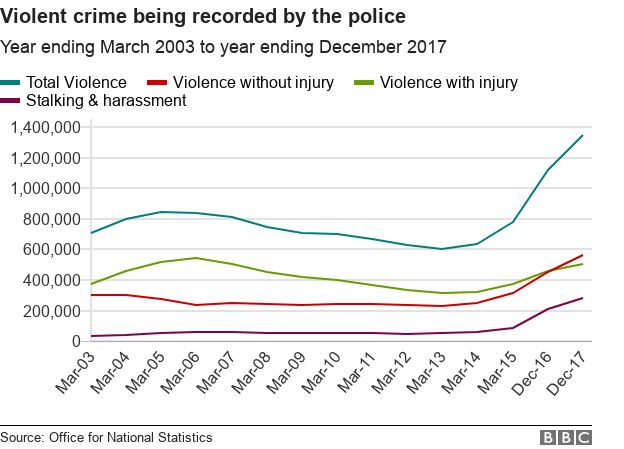
More than 2,800 emergency medical personnel were attacked while on duty in 2017, up 36 percent in the last five years, latest data reveals.
“Paramedics are being stabbed, throttled, and sexually assaulted as shameful new figures show assaults on crew members have risen by a third,” the Mirror reports.

“About eight serious attacks a day take place on NHS ambulance crews and more than 1,400 homes in England are now red-flagged as ‘no-go’ areas without police protection.”
A list of injuries suffered by paramedics in London includes dislocations, fractures, asphyxiation, severe burns, concussions, and even spinal cord damage.
Union leaders are blaming politicians for cutbacks in funding, leading to a severe shortage of personnel, as well as police support.
“These terrifying figures underline that ambulance workers, along with all those who work in the emergency services, are forced to work under an increased threat of violence,” said GMB union national secretary Rehana Azam.
“Cuts in funding mean our ambulance workers are more likely to be working alone. Cuts to police services mean back-up isn’t always there.”
Incredibly, the vast majority of perpetrators reportedly do not face legal consequences for assaults upon EMTs.
The crisis facing British emergency services highlights the effects mass immigration can have upon safety, security, and infrastructure as crime continues to rise while the government’s capacity to properly enforce the law and tend to the needs of its citizens diminishes.

President Trump meets young black Republicans at an event in October © Reuters / Cathal MacNaughton
In a failed attempt to understand life outside the morally superior left coast, New York Times columnist Michelle Goldberg argues that many Trump supporters are simply “bad people,” of two kinds: “the immoral and the amoral.”

Goldberg wasn’t writing about the MAGA-hat wearing middle-Americans who turn out in droves for Trump’s rallies, nor the conservative-leaning average Joe who would have voted for a kick in the head before Hillary Clinton. Instead, she was talking about the revolving cast of aides, officials, and lawmakers who’ve worked for the Trump administration or lent political support to his policies.
They’re the Steve Bannons (a “quasi-fascist with delusions of grandeur”), and the Anthony Scaramuccis ( a “political cipher who likes to be on TV”), the Ivanka Trumps and the Lindsey Grahams. Out of them all, Goldberg finds the apolitical figures, the ones only in it for the paycheck, the worst.
“Trump is unique as a magnet for grifters, climbers and self-promoters,” she wrote. “In part because decent people won’t associate with him.”
Of course, all of this is predicated on the belief that ‘Orange Man Bad,’ a belief that many of the New York Times’ readers likely share with Goldberg. The columnist ponders out loud how these people could work for Trump without feeling “shame or remorse” at his “belligerent nationalism and racist conspiracy theories.” What exactly these conspiracy theories are, however, Goldberg does not explain. Instead, we’re expected to know instinctively that Trump is, for whatever reason, bad.

The idea that anyone who works for Trump is “bad” by association is simplistic and no doubt appealing to many in the media and the #Resistance. However, reality is more complicated. Trump aides and officials have their own careers to advance, their own dreams and ambitions, and their own car payments to make. The institutions of Washington, DC will endure long after Trump leaves office, and many of these bureaucrats will still need work.
Take Mary Kissel, named this month as Secretary of State Mike Pompeo’s new foreign policy adviser. Kissel is a former Wall Street Journal reporter who has been sharply critical of and even openly hostile to Trump’s policies before. Is Kissel’s move to the State Department a surrender of her anti-Trump media credentials, or simply a career upgrade?
What about the officials who served in past administrations? Surely the New York Times fretted over the 29 Google employees who took up jobs in the Obama White House? After all, Obama presided over the largest expansion of mass surveillance in history, and defended the National Security Agency even after it emerged that it gathered vast amounts of call, email and internet data from millions of Americans.
Some moves through the revolving door that existed between Google and the Obama White House were reported, but the morals of the employees themselves were never questioned. Because, while these moves raised questions about the cosy relationship between Washington, DC and the tech industry, they were at an individual level, career moves. Besides, they were working for Obama, who came with a tacit seal of approval from much of the mainstream media.
Things are different in 2018, however. Trump (who Goldberg actually called “the orange emperor” in her previous column) is bad, and anyone who works for him is bad and should feel bad. Life sure is black and white on the pages of the Gray Lady.
Think your friends would be interested? Share this story!

By Tyler Durden

After retweeting a tweet from a Trump fan account Wednesday morning, Mnuchin has deleted the retweet and would like the world to know that this wasn’t an “authorized” tweeting.
The tweet was retweeted from Mnuchin’s account this morning, but the original was sent last night, which probably accounts for the incorrect timing given in the Treasury Secretary’s follow up.
* * *
President Trump made his frustration with GM abundantly clear on Tuesday when he threatened to cut all EV subsidies to the Detroit carmaker. But on Wednesday both the president, this time joined by Treasury Secretary Steven Mnuchin, took the administration’s attacks on GM to their next logical endpoint: Demanding that the federal bailout recipient return the $11.2 billion loss eaten by taxpayers from the federal bailout that the company received during the depths of the financial crisis.

“If GM doesn’t want to keep their jobs in the United States, they should pay back the $11.2 billion bailout that was funded by the American taxpayer,” read a tweet from a Trump fan account that the president and Mnuchin retweeted. Trump also retweeted two tweets about illegal immigration.
GM shares slid after Trump’s tweets Tuesday afternoon, but GM stock futures showed little immediate reaction to Trump’s threat. GM received billions in bailout money to shore up its troubled financial arm GMAC in 2008. After spinning off the subsidiary (which now trades as Ally Financial), GM saddled the Treasury with a more than $11 billion loss.

After meeting with GM CEO Mary Barra, Larry Kudlow told reporters on Tuesday that he had conveyed the president’s anger to Barra, and explained that Trump feels betrayed by GM, and that he believes the carmaker “turned their back on him” by announcing the layoffs and plant closures, particularly after the Trump tax cuts handed billions of dollars back to corporations and allowed them to repatriate overseas cash.
Politicians on both sides of the US-Canada border were outraged by GM’s Monday announcement that it would close 5 North American plants (and two foreign plants) and fire nearly 15,000 workers in the US alone. Trump blasted the company for opting for layoffs and closures in the US while plants in Mexico and China remained open.
While we await a response from GM management, shareholders are a little nervous:

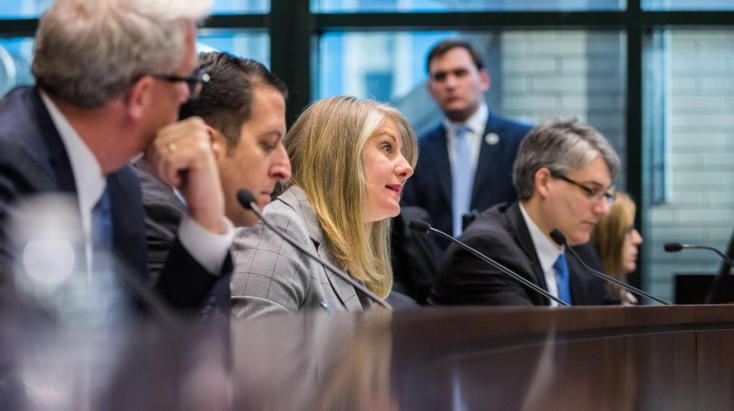
Democratic Rep. Stephanie Kifowit, shown earlier this year during a committee hearing about deadly Legionnaires’ outbreaks at a state-run veterans home, criticized a Republican colleage Nov. 27, 2018, over his stance on a bill aimed at helping the victims’ families. (Zbigniew Bzdak/Chicago Tribune)
By Mike Riopell and Rick Pearson
The bill would raise limits on damages in some state Court of Claims cases from $100,000 to $2 million, which could affect the victims’ families, who allege the state was negligent in the deaths that resulted from outbreaks at the veterans home over the past three years. Gov. Bruce Rauner rewrote the proposal over the summer to reduce such caps on damage awards to $300,000, but lawmakers voted Tuesday to override him.

During the House floor debate over the proposal, Republican state Rep. Peter Breen of Lombard questioned some of the plan’s details, contending the state doesn’t know how much it will cost. Breen, the outgoing House GOP floor leader, noted that multiple tort claims could be paid out for the same incident.
“And, yes, we know the personal injury lawyers are going to make out like bandits, which they tend to do anytime they come to the General Assembly,” Breen said.
Minutes later, Democratic state Rep. Stephanie Kifowit of Oswego, a co-sponsor of the legislation, stood up to attack Breen.
“I would like to make him a broth of Legionella and pump it into the water system of his loved one, so that they can be infected, they can be mistreated, they can sit and suffer by getting aspirin instead of being properly treated and ultimately die. And we are talking about our nation’s heroes,” said Kifowit, a Marine veteran.
Kifowit recounted questions over the Rauner administration’s handling of repeated outbreaks at the home, which are the subject of a grand jury investigation by Attorney General Lisa Madigan, and, in closing, said, “I respectfully ask for you to support this bill.”
Lawmakers voted 71-36 to raise the cap on lawsuit damages, the bare minimum number of votes they needed to override Rauner. The bill passed in May with 79 House votes. The Senate voted two weeks ago to override Rauner.

Breen yelled off microphone after Kifowit’s speech and Republican state Rep. Keith Wheeler of Oswego urged the chamber to reflect on the scale of the rhetoric.
“We lost our way today. I cannot fathom the idea that any one of us would ever publicly make a statement that is effectively a wish for a family member of one of our colleagues to die. That is what was said today. I think that’s despicable,” Wheeler said. “We shouldn’t stand for that.”
Later, after the vote, Kifowit said her words were misheard, misrepresented, misinterpreted and mischaracterized.
“Quite clearly what I said was ‘imagine if it was your family,’ ” she said, though she didn’t use those words. “So if it was misheard, I’ll apologize for the misheard, but my words were clearly, ‘Imagine if it was your family.’ ” Kifowitz acknowledged that her remarks “are all transcribed, and my words will be clear.”
On Twitter, she later said, “My words were twisted and misrepresented.” She added in another tweet, “I never stated anything to wish his family death.”
The deaths at the Quincy veterans home dogged Rauner’s re-election campaign. The post-Civil War-era facility is where 14 people have died and nearly 70 others have been sickened by Legionnaires’ disease outbreaks since 2015. At least a dozen lawsuits have been filed since the initial outbreak, claiming negligence by the state.
In its legal filings, the state has denied any negligence and Rauner has said the state has followed all recommendations of federal experts at the Quincy home. In April, Rauner’s veterans affairs director resigned.
Rauner’s veterans affairs director resigns in wake of 13 Legionnaires’ deaths at Quincy home »
In his amendatory veto, Rauner wrote that raising the $100,000 cap on damages to $2 million through the state Court of Claims was “effectively ignoring the impact of vastly expanded future litigation on the fiscal position of the state and its taxpayers.”
“I recognize that the current law is outdated and in need of adjustment,” he wrote. “However, this adjustment should reflect regional and national averages in order to properly compensate those who, once properly adjudicated, were found harmed by the state of Illinois.”
The $100,000 cap was established in 1972.
The vote to override Rauner’s veto on Tuesday came as lawmakers returned to Springfield for what could be their last clash with him, as they consider overriding dozens of the governor’s vetoes less than two months before he leaves office.
Rauner hasn’t made many appearances since losing his re-election bid to Democratic Gov.-elect J.B. Pritzker and hasn’t been publicly defending his vetoes. That’s in contrast to his high-profile four years fighting Democrats who control the General Assembly.