
Published on Mar 19, 2019

MARCH 19, 2019
As Beto O’Rourke throws his hat into an already crowded field — and boasts $6.1 million in donations in the first 24 hours — Democratic debate season draws ever closer.
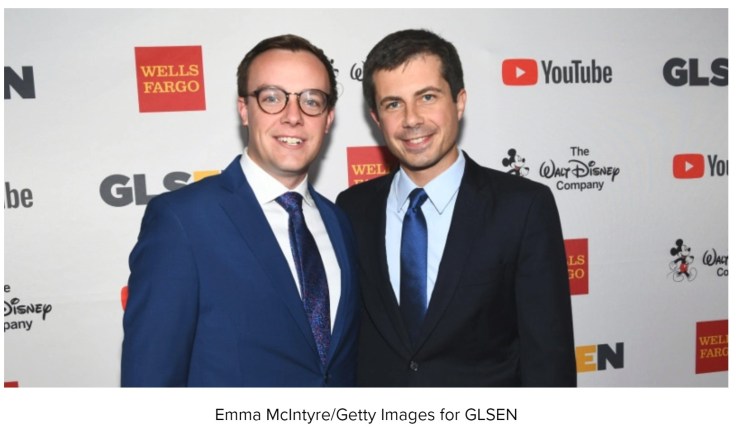
And Los Angeles will play host for at least one of those showdowns when UCLA and the Human Rights Campaign present a forum for 2020 presidential candidates in the fall.
It will focus specifically on lesbian, gay, bisexual and transgender issues, offering candidates “an opportunity to speak about their policy platforms and plans to move LGBTQ equality forward,” according to a statement.
No media partner has yet been announced, but the forum will be televised.
The event is scheduled for Oct. 10 at Royce Hall, on the eve of National Coming Out Day, and will be held in addition to an already-announced Democratic Primary Debate that month.
Unlike that event, candidates at the UCLA/HRC forum will fully outline their platforms one at a time.
Democratic candidates can qualify for the event by receiving 1 percent or more of the vote in three separate national polls or by receiving donations from 65,000 different people in 20 different states.
According to the most recent polling data, that would mean places at the podium for Bernie Sanders, Kamala Harris, Elizabeth Warren, Cory Booker, Beto O’Rourke, Amy Klobuchar and John Hickenlooper. Should he announce as expected, Joe Biden will be there, too.
But so far only one LGBT candidate has expressed an interest in running: Pete Buttigieg, the mayor of South Bend, Indiana. Having reached 65,000 donors, Buttigieg has qualified for inclusion in the debates, should his exploratory run become an official one. And if that happens, expect Buttigieg to be a breakout star of the LGBTQ forum.
This is the first such HRC-hosted forum since 2007, when Barack Obama appeared alongside Hillary Clinton, John Edwards and others. Like the announced forum in October, that discussion, broadcast on Logo and attended by an LGBTQ-leaning crowd, centered around gay rights.
Twelve years has made a world of difference in that arena. Back then, a majority of candidates felt any advancements in LGBTQ rights should stop short of legalizing same-sex marriage, then only legal in Massachusetts.
Then Sen. Obama argued for a “strong version” of civil unions, saying, “My view is that we should try to disentangle what has historically been the issue of the word ‘marriage,’ which has religious connotations to some people, from the civil rights that are given to couples.”
In 2012, while campaigning for a second term in office, Obama came around to backing same-sex marriage.
Clinton, then a New York senator, took a similar stand, calling her opposition to same-sex marriage a “personal position” but insisting she believed “in equality.” She added: “How we get to full equality is the debate we’re having.”
After a decade opposing it, Clinton eventually voiced her support for same-sex marriage in 2013.
Only two long-shot candidates — Dennis Kucinich, then an Ohio congressman, and Mike Gravel, an Alaska senator from 1969 to 1981 — offered full-throated endorsements of same-sex marriage.
“When you understand what real equality is, you understand that people who love each other must have the opportunity to be able to express that in a way that’s meaningful,” Kucinich said to cheers.
Gravel, meanwhile, said the front runners were “playing it safe” and predicted same-sex marriage “will be a nonissue in the next presidential campaign in 2012.” In fact, it would remain hotly debated until the Supreme Court’s ruling on June 26, 2015, which held all state same-sex marriage bans to be unconstitutional.
LGBTQ issues were largely ignored or de-emphasized by Donald Trump in his 2016 presidential campaign — though Trump did make history by becoming the first Republican presidential nominee to mention LGBTQ rights in his acceptance speech.
Earlier that same year, however, after meeting with the anti-LGBTQ conservative think tank the Heritage Foundation, Trump voiced opposition to same-sex marriage and pledged to appoint justices to the Supreme Court who would reverse the “shocking” Obergefell v. Hodges decision that legalized it.
Since taking office, Trump — who chose Mike Pence, a strident opponent of civil liberties for LGBTQ citizens, as his vice president — is widely seen as having significantly set back LGBTQ rights and advancements in the U.S.
His administration has rolled back workplace protections for LGBTQ workers, scrapped census plans to study the LGBT population, eliminated AIDS research and treatment funding from the federal budget, and announced a ban on transgender personnel in the armed forces.
“Millions of LGBTQ people will have their rights on the ballot in 2020,” HRC president Chad Griffin said in a statement announcing the planned fall forum. “But today we are also a powerful voting bloc that will help determine the outcome. We’re excited to partner with UCLA Luskin and create an opportunity to hear candidates’ agendas for moving equality forward.”


But as the attorney general of the nation’s largest state — and therefore one of the most powerful law enforcement officials in the nation — Harris declined to investigate Herbalife, the nutritional supplement company that has been accused of fraudulent marketing practices. Documents exclusively obtained by Yahoo News show that in 2015, prosecutors in the San Diego office of the California attorney general sent Harris a lengthy memorandum that argued for an investigation into Herbalife and requested resources in order to undertake such an investigation. Similar investigations into Herbalife were already taking place elsewhere.
About three weeks after the San Diego letter was sent, Harris received the first of three donations to her campaign for the U.S. Senate from Heather Podesta, the powerful Washington lobbyist whose ex-husband Tony’s firm, then called the Podesta Group, had worked for Herbalife since 2013. Heather Podesta’s own lobbying firm, Heather Podesta and Partners, would soon be hired by Herbalife, too.
Harris did not pursue an investigation, even as the Federal Trade Commission proceeded with an investigation of its own, which had been opened the previous March and which suggested that sufficient grounds for such scrutiny did exist. In fact, the San Diego letter had meticulously laid out those grounds, pointing out that Herbalife presented itself to the public as a lawful enterprise, but that it could nevertheless be “engaged in less obvious conduct” that potentially harmed both Herbalife distributors and Herbalife customers. Allegations of such conduct, by 2015, had become commonplace in media reports.
Harris never gave a reason for declining to investigate Herbalife, but the decision stands in contrast to her oft-expressed promise to fight for ordinary Americans for whom the 21st century economy seems to hold little promise. Those are the very same Americans, critics say, that Herbalife recruited — and exploited.
Harris’s presidential campaign said it was not accurate to see in her treatment of Herbalife a hesitation about aggressively pursuing corporations. Harris “has a long record of going after bad corporate actors engaging in fraudulent behavior and delivering results for people who have been taken advantage of,” said campaign spokesman Ian Sams.
He noted that as California’s attorney general, Harris “got $20 billion for California homeowners after taking on mortgage fraud by the big banks, secured a billion-dollar judgment against for-profit Corinthian Colleges for scamming students, and put Ponzi and pyramid schemers in prison.”
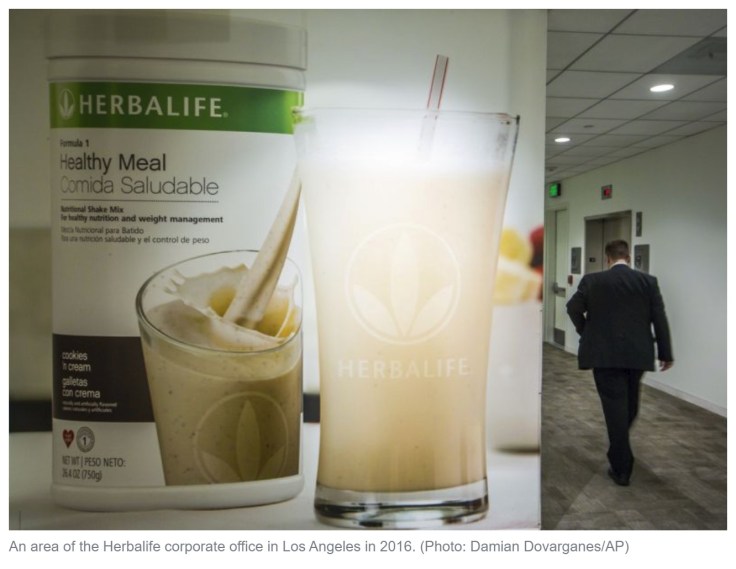
Founded in 1980, Herbalife calls itself a “global nutrition company whose purpose is to make the world healthier and happier.” It is a multilevel marketing operation — MLM, for short — meaning that instead of selling its weight-loss shakes and pills through proprietary outlets, it relies on distributors who make a commission when they sell the products, which they can do out of their own homes or through “nutrition clubs” that cannot feature Herbalife branding, even though they sell Herbalife products. Such clubs have recently proliferated in Latino communities across the United States, where Herbalife’s hold is strongest.

Critics believe that MLMs, including Herbalife, are pyramid schemes because their profits stem from recruitment of new salespeople, rather than sales to end customers (the pyramid is the shape of such a company’s growing distributor base). Other than Herbalife, the most well-known American corporation to stand accused of running a pyramid scheme is Amway, the home products company founded 60 years ago in Michigan. In 1979, Amway won a crucial case in which the FTC called it a pyramid scheme, but the allegations persisted, both against Amway and other MLMs. In 2010, Amway paid out $56 million in the settlement of a class action suit that revived the pyramid scheme charges. Yet the company survived. (The current federal education secretary, Betsy DeVos, is married to the heir of the Amway fortune.)
Herbalife attracted scrutiny almost from the start. In 1986, the state of California imposed a consent decree on Herbalife that said the company could not make “false or misleading representations” about how much money distributors could expect to make. The company also had to stop making allegedly false or exaggerated claims about its products.
But that did little to stop the company’s growth, and it continued to rapidly expand both in the United States and around the world. In 2003, Herbalife hired Disney executive Michael O. Johnson, who brought management sophistication to its operations. A tanned triathlete, he seemed a living embodiment of the company’s promises. (The company’s founder, Mark Hughes, had died of a drug overdose three years before.) The company went public the following year; a 2005 annual report declared its market capitalization to be $359.8 million.
But despite Johnson’s efforts to add corporate sheen, critics maintained that Herbalife’s profits came not from sales of its weight loss products, but in the aggressive recruitment of new members, each of whom was expected to buy large amounts of inventory from the company. The new recruits quickly realized, according to Herbalife’s detractors, that the inventory of pills and powders itself was largely worthless and that the only way to make money was to attract new recruits.
Herbalife has long denied such accusations, portraying itself as a company that provides access to wealth to people who, for one reason or another, are unable to find success in traditional employment. The company declined to speak on the record for this story.
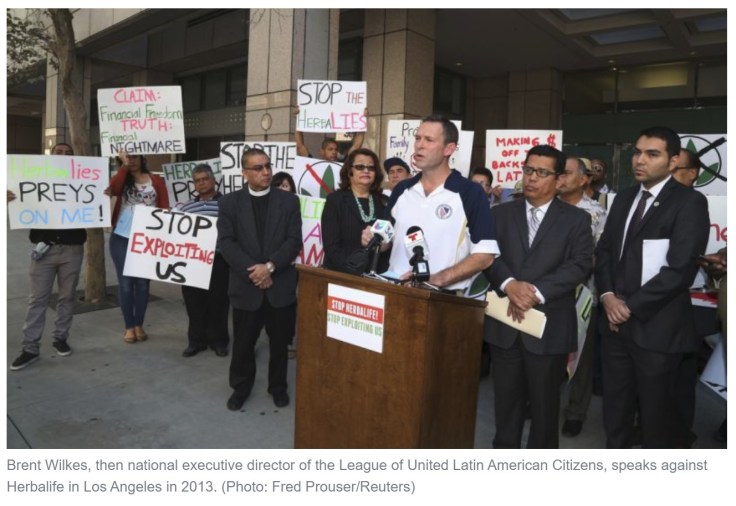
Harris was first asked publicly to look into Herbalife’s alleged wrongdoing in 2013, when the company held its Extravaganza Latina in Los Angeles. Protesters picketed the event, urging Harris to investigate Herbalife. “We are asking Attorney General Harris to help us protect vulnerable, low income Latinos and other minorities from these schemes that have cost people their life savings,” one of the protest’s organizers said.
At the time, Herbalife was fending off another existential challenge, from Manhattan hedge fund Pershing Square Capital Management, whose founder, Bill Ackman, had become convinced that though the company was worth $8.1 billion at the time, that valuation was predicated on illusion. He declared war on Herbalife with the public presentation of a 334-page PowerPoint dossier, the 64th page of which contained his central argument: “Herbalife is a Pyramid Scheme.”
Ackman eventually came to take an astonishingly bold $1 billion short position on Herbalife, meaning that he borrowed stock in the company with the expectation that the price of the stock would fall dramatically. If that happened, Ackman’s short would provide him with a massive windfall, not to mention a validation of his beliefs about the company. Ackman and Pershing Square declined to comment for this article.
Ackman’s public quest to take down Herbalife — he was explicit about that goal — brought newfound scrutiny to the company, pressuring regulators to act. The FTC opened an investigation into Herbalife in March 2014, with Lisa Madigan, attorney general of Illinois, and Eric Schneiderman, attorney general of New York, doing the same the following month. That meant that what were at the time the country’s fourth and fifth most populous states had now joined the fight. The FBI started an investigation in April 2014 as well.
Harris remained silent. That January, activists met with members of her office. “The concerns were clearly articulated to her staff,” says Brent Wilkes, who at the time was executive director of the League of United Latin American Citizens, one of the groups asking Harris to investigate Herbalife. “They heard us, asked interesting questions,” Wilkes recalls. He says he was “hopeful” that Harris “would come around,” but the activism failed to make a sufficient impact on her.
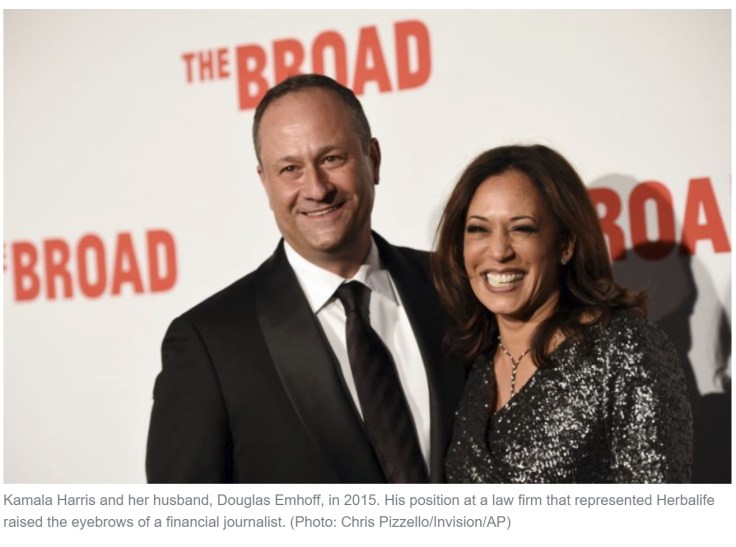
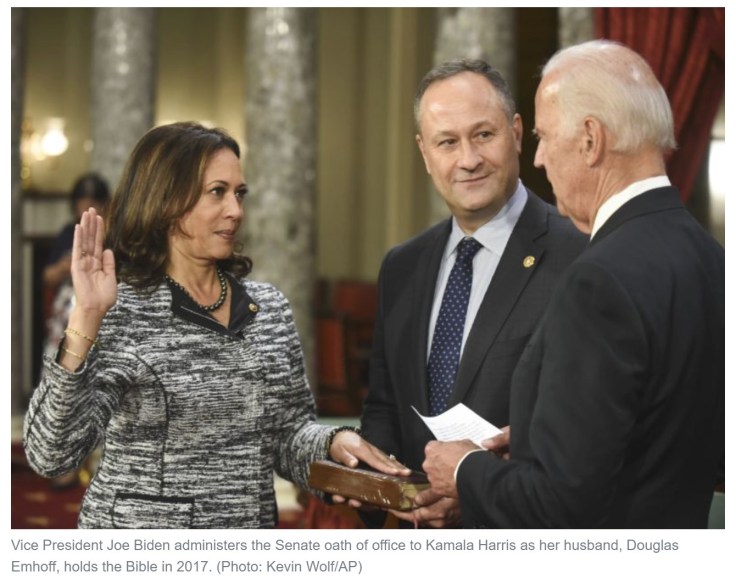
Wilkes did not know that at the time, Herbalife was represented by Venable, which also employed Harris’s husband, Douglas Emhoff. Emhoff does not appear to have been involved in Herbalife’s affairs, but his work at the firm came to the attention of Christopher Irons, a financial journalist who first reported on the Emhoff-Herbalife connection. “Surely this would seem like some sort of enormous conflict of interest, no?” he wrote in 2015.
The activists asking Harris to investigate Herbalife did not seem to know that she had a personal connection to the the law firm representing the corporation. “That’s news to me,” Wilkes said when told by Yahoo News about Emhoff’s law firm.
The letter to Harris from Judith Fiorentini, the supervising deputy attorney general in the San Diego office, was sent on March 3, 2015. It was signed by two other deputy attorneys general, Sanna Singer and Jinsook Ohta, who like Fiorentini were in the consumer law department of the attorney general’s office. Their memo asked for a “ delegation of investigative authority,” which was to include “the authority to issue and enforce investigative subpoenas.”
Fiorentini wrote that “while Herbalife has outwardly complied with the 1986 injunction … we believe that it may be directing or enabling the acts of its distributors in ways that violate” that order “and/or consumer laws in general.” She explained that there was reason to believe that Herbalife was empowering its distributors to make false claims about the benefits of becoming a Herbalife distributor. “Herbalife can be liable for consumer violations by its distributors to the extent Herbalife enabled the distributors’ actions,” Fiorentini wrote.
The letter went on to cite precedent for conducting such a probe, and noted that a preliminary investigation had already taken place. That investigation “revealed that Herbalife, at least in publicly available documents, has carefully drawn its corporate policies and conducted itself in a manner that is outwardly consistent with the 1986 Injunction.” Fiorentini thought it was nevertheless necessary to “delve behind what is publicly available to determine if Herbalife is directing or enabling its distributors” to act illegally.
Fiorentini requested two full-time attorneys, three or four legal assistants and, potentially, officers to conduct undercover operations. The letter ended with the pros and cons of such an investigation. Fiorentini was frank about the energy and resources required while also anticipating a “rigorous legal defense” from the company. At the same time, she said that an investigation would “send the message that this office takes continued monitoring and enforcement of its existing judgments very seriously. In addition, it will ensure that Herbalife is held accountable for the acts of its distributors.”
The contents of the memorandum, or its existence, have not been published before. But it suggests that Harris was made directly aware of the dangers Herbalife may have posed to the people of California. No investigation was opened into Herbalife in response to the memorandum from Fiorentini, who did not respond to repeated requests for comment from Yahoo News. Nor has Harris publicly said why she chose not to investigate Herbalife, a step that would necessarily lead to prosecution.
A person familiar with deliberations at the attorney general’s office at the time disputes suggestions of inaction by Harris. The person — who requested anonymity in order to speak frankly — said that the California attorney general’s office did help the FTC with its investigation, namely through its corporate fraud division. And the person said that Harris was hesitant to join a fight between billionaires: In response to Ackman’s $1 billion Herbalife short, investor Carl Icahn bet heavily on the company, and the two men began to attack each other sharply on television.
Podesta, the Washington lobbyist whose ex-husband represented Herbalife, donated $1,000 to Harris’s campaign for the U.S. Senate on March 31, 2015, at the end of the same month that had seen the arrival of the letter from the San Diego office, asking for an Herbalife investigation. She donated $4,400 to Harris’s senate campaign the following year. (Podesta had made smaller donations, of $100 and $500, to Harris in 2010 and 2014, respectively. She did not respond to requests for comment.)
That July, Herbalife hired a top Podesta deputy, Eric Rosen, to serve as its top government relations official. The following year, Herbalife paid Heather Podesta $250,000 for her lobbying work.
Harris moved on from her duties as a prosecutor in 2016 when, on the same day that Trump became president, she was elected to serve as California’s junior senator. She was sworn in the following January, and exactly two years later she announced she was running to oust Trump from the Oval Office.
The FTC won a $200 million settlement from Herbalife in July 2016. Related to that settlement was one with Madigan, the Illinois attorney general, for $3 million. California, which often leads the nation in consumer and environmental regulations, remained on the sidelines.
“I wouldn’t limit my disappointment to her,” says Wilkes, the former chief executive of the League of United Latin American Citizens, of Harris. “At least Kamala listened.” Still, he wonders why Madigan could wrest a settlement from Herbalife but Harris could not. “Kamala,” he says with audible disappointment, “should have had that too.”
Since then, however, she has faced questions about whether her progressivism is genuine or only a matter of political expediency. She has yet to explain why she declined to pursue a corporation accused of exploiting her Latino constituents.
Harris was replaced as California’s attorney general by Xavier Becerra, who had formerly represented Los Angeles in the U.S. House of Representatives. Becerra has formerly received significant political donations from Herbalife’s political action group. His office would not say how, if at all, this complicated considerations about opening an investigation into Herbalife.
The attorney general’s press office declined to comment in response to repeated calls and emails from Yahoo News.
Contreras, the Chicago activist, has watched the Harris presidential campaign with skepticism. For her, the decision to go easy on Herbalife is indicative of where Harris’s sympathies lie, and it is not with the downtrodden. Contreras has a simple message for the presidential candidate: “Kamala Harris, shame on you.”
Editors’ note: This article has been updated to clarify the relationship between Heather Podesta and Herbalife, as well as to include the political affiliation of activist Julie Contreras.
By

Beto’s team has not responded to our request for comment on the content of O’Rourke’s poem “The Song of the Cow.”

Reuters reported: “In an exclusive interview with this reporter for a forthcoming book about the group, the former U.S. congressman from Texas confirmed that as a youth in El Paso, he belonged to the hacking group known as the Cult of the Dead Cow. He also acknowledged that, during those teenage years, he stole long-distance phone service to participate in electronic discussions. Others in the group committed the same offense and got off with warnings; the statute of limitations ran out long ago. In the group, O’Rourke wrote online essays under the pseudonym “Psychedelic Warlord” that could provide fodder for political supporters and foes alike. One mocked a neo-Nazi, while another was a short piece of fiction from a killer’s point of view.”
Big League Politics reported: “Democrat Texas Senate candidate Beto O’Rourke played bass in a punk rock band called Foss with Cedric Bixler-Zavala, who went on to a career in rock music with other bands.
Bixler-Zavala recalls that Foss intentionally played badly in one gig to stick it to a host who “was a little on the Republican Christian side.” The host allegedly wanted to start an “all-white dude ranch.”
While the “all-white dude ranch” idea would be legitimately racist, assuming it happened, the fact that Bixler-Zavala pointed out the host’s “Republican Christian” viewpoint suggests that O’Rourke’s band was not a fan of these attributes. O’Rourke supports abortion, but the mainstream media is trying to push the narrative that numerous Christians will vote for him.
“A side effect of the GOP’s tweets is the renewed attention on the congressman’s old punk band, Foss. The spotlight on the band led many to dig up an old performance of theirs – one of their only publicly available – on a local El Paso cable access show called Let’s Get Real. The clip shows the young band – which included Bixler-Zavala on drums – stalling to start their set, then seemingly fumbling through what can best be described as an art-rock onslaught of distorted noise, much to the chagrin of the buttoned-up host. “We were just taking the piss out of the host,” Bixler-Zavala tells Remezcla over the phone. “The host was a little on the Republican Christian side, and he pulled us aside before taping and told us he wanted to start an all-white dude ranch,” he says, explaining the kind of bigotry they felt from the host and why the band ultimately decided to play around on stage rather than perform one of their actual songs.”
Remezcla passage ends
Here is video of the gig:
Published on Mar 12, 2019
By FRANK CAMP

During the segment, Tapper spoke with Castro about the issue of reparations for descendants of slavery: “This is also dividing Democrats on the trail. You’ve said that there needs to be some kind of reparations to descendants of slaves to compensate for years of slavery and discrimination against African Americans in this country.”
Tapper then played a clip in which presidential rival Sen. Bernie Sanders (I-VT) talks about Castro’s and Sen. Kamala Harris’ (D-CA) support for reparations:
What do they mean? I’m not sure anyone’s very clear. What I just said is that I think we must do everything that we can to address the massive level of disparity that exists in this country.
Tapper asked Castro: “So, what do you mean? Do you think that there should be actual monetary payments to descendants of slaves? Do support more like what Senator Sanders is talking about, policies such as child care and education that help those who are disadvantaged?”
Castro replied:
Well, you know, what I said was that I’ve long believed that this country should address slavery, the original sin of slavery, including by looking at reparations, and if I’m president, then I’m going to appoint a commission or task force to determine the best way to do that. There’s a tremendous amount of disagreement on how we would do that.
Castro then took a jab at Sanders, saying that he shouldn’t be arguing against an approach to reparations that might include “writing a big check” because that’s been the senator from Vermont’s position on health care and college tuition.
He concluded: “So, if under the Constitution, we compensate people because we take their property, why wouldn’t you compensate people who actually were property?”
The notion of somehow compensating the ancestors of American slaves has long been a topic of discussion among academics and political thinkers. However, the mechanics by which a reparations program would operate have challenged even the most diligent.
On an episode of “Point Taken” on PBS regarding reparations, libertarian commentator Kmele Foster stated bluntly: “I think the important things to consider are, who pays? How much do they pay? And who do they pay it to? These are impossibly difficult questions to actually reconcile and answer in a meaningful and just way.”
Even progressive author Ta-Nehisi Coates, in his 2014 thesis on “the case for reparations” published in The Atlantic, didn’t come to any conclusion as to how reparations should work, writing in part:
Perhaps no number can fully capture the multi-century plunder of black people in America. Perhaps the number is so large that it can’t be imagined, let alone calculated and dispensed. But I believe that wrestling publicly with these questions matters as much as—if not more than—the specific answers that might be produced. An America that asks what it owes its most vulnerable citizens is improved and humane. An America that looks away is ignoring not just the sins of the past but the sins of the present and the certain sins of the future. More important than any single check cut to any African American, the payment of reparations would represent America’s maturation out of the childhood myth of its innocence into a wisdom worthy of its founders.
Coates does refer to a bill from former Rep. John Conyers as the beginning of a potential solution: “A country curious about how reparations might actually work has an easy solution in [John] Conyers’s bill, now called HR 40, the Commission to Study Reparation Proposals for African Americans Act. We would support this bill, submit the question to study, and then assess the possible solutions.”
Former President Obama even commented on the non-feasibility of a reparations program:
As a practical matter, it is hard to think of any society in human history in which a majority population has said that as a consequence of historic wrongs, we are now going to take a big chunk of the nation’s resources over a long period of time to make that right.
Instead, Obama pointed toward progressive redistributionist programs as a means of reparations:
[I am] not so optimistic as to think you would ever be able to garner a majority of the American Congress that would make those kinds of investments above and beyond the kind of investments that could be made in a progressive program for lifting up all people.
As the Democratic presidential candidates gear up for a contentious primary season, they should be prepared to answer questions about reparations. With Julián Castro, Kamala Harris, and Elizabeth Warren already promoting the issue, it’s unlikely that it will fade silently into the night.
READ MORE: BARACK OBAMA DEMOCRATIC PARTY JULIAN CASTRO REPARATIONS SLAVERY





 Tom's Blog