Russiagate eats itself: Democrat ‘tech experts’ try their hands at election meddling, report reveals

Russiagate eats itself: Democrat 'tech experts' try their hands at election meddling, report reveals

Doug Jones & Roy Moore © Reuters / Reuters Photographer

A group of Democrats working in secret replicated the deceptive social media tactics they claim Russians used to steal the 2016 election in order to win the 2017 Alabama Senate race, according to an explosive NYT report.

The primarily social-media-based campaign to bolster the candidacy of Democrat Doug Jones and smear Republican Roy Moore implemented many of the divisive techniques outlined in the reports released earlier this week on Russian social media influence operations, according to an internal report on the effort acquired by the New York Times. Such resemblance is not surprising, given that one of the Alabama effort’s ringleaders was Jonathon Morgan, whose company New Knowledge produced one of those reports.

ALSO ON RT.COMRacist ‘Russians’ targeted African-Americans in 2016 election ploy, reports claimThe campaign was clearly meant to remain classified – the Times’ attempts to interview participants were as often as not met with claims of “I don’t remember” or pleading the Fifth. Others downplay the effect of their actions, or claim they were just meddling in the name of research. But, as much as they claim their actions had no consequences, they succeeded in electing the first Democrat to represent Alabama in the Senate for over 25 years.

In order to paint Roy Moore as the Kremlin candidate, the manipulators linked his campaign to thousands of Russian Twitter accounts that all started following him at once – drawing the attention and suspicion of the media, which obediently published rumors that his support numbers were artificially bolstered by Russian bots.

Morgan claims the botnet “false flag” – a term that actually appears in the report – “does not ring a bell,” dismissing the project as “a small experiment” in tactics that were not meant to sway the election. He pleads the Fifth on the report’s claims that the Alabama project intended to “enrage and energize Democrats” and “depress turnout” among Republicans, weaponizing accusations that Moore had tried to seduce teen girls while in his 30s. Morgan also claims to forget the names of the Twitter and Facebook accounts he set up to manipulate Moore voters.

Backed into a corner, Morgan finally opted to lie to the Times, claiming that while the project did create a generic Facebook page to lure conservative Alabamans, and was in contact with write-in candidate (and Moore rival) Mac Watson, its influence efforts stopped there. The report tells a different story: the Facebook page “boosted” Watson’s campaign, getting him interviews with major media outlets, and swelling the ranks of his Twitter followers. Watson confirms he received media assistance from a Facebook page with no human face to it – the only page that replied to his contact.
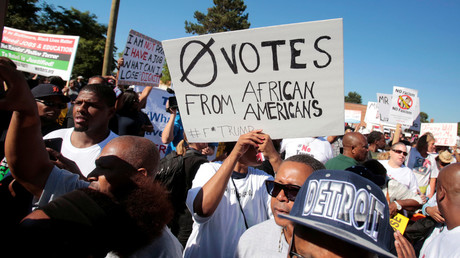
“The research project was intended to help us understand how these kind of campaigns operated,” Morgan told the Times. “We thought it was useful to work in the context of a real election but design it to have almost no impact.”

It’s a truism that so-called “coastal elites” have only disdain for Middle America, but the way Morgan describes the Alabama special election as an inconsequential throwaway contest fit only for a science experiment is eye-opening.

Morgan, it’s worth noting, was one of the developers of the infamous “Hamilton68” dashboard, beloved by Western media for its ability to link any troublesome narrative to “Russian bots.” Morgan’s co-developer, Clint Watts, has since distanced himself from the bot crusade, admitting he’s “not convinced on this bot thing.”

Everyone the Times spoke with was careful to shunt blame elsewhere. Renee diResta, who works with Morgan at New Knowledge and was the lead author of the group’s Russian report, said: “I know there were people who believed the Democrats needed to fight fire with fire,” emphasizing that she was not one of these people.

Moore campaign operatives remain frustrated at their narrow margin of loss – just 21,924 votes, less than the number of write-in ballots that were cast. They complained to Facebook about possible interference but were brushed off. Presented with incontrovertible evidence of wrongdoing by their opponents, Moore campaign manager Rich Hobson acknowledged that “any and all of these things could make a difference.”

“We still kick ourselves that Judge Moore didn’t win,” he said.

FACEBOOK ADMITS GIVING OUT ACCESS TO YOUR PRIVATE MESSAGES

Facebook Admits Giving Out Access to Your Private Messages

Another privacy scandal erupts

Infowars.com – DECEMBER 19, 2018

Facebook says it gave other companies, such as Spotify and Netflix, access to millions of people’s private messages.

The social media giant admitted to the practice in response to a report that Facebook shares private data to partner companies as part of its third-party integration, which allowed users to use their Facebook credentials to login to other web sites and apps.

Facebook CEO, Mark Zuckerberg (R), and Joel Kaplan (L), Vice President, Global Public Policy at Facebook, leave the Elysee Palace after a meeting with the French President on May 23, 2018 in Paris, France. On the eve of VivaTech, French President Emmanuel Macron brought together some of the world’s leading technology names for the Tech for Good event. (Photo by Aurelien Morissard/IP3/Getty Images)

Facebook wrote in a blog post:

Did partners get access to messages? Yes. But people had to explicitly sign in to Facebook first to use a partner’s messaging feature. Take Spotify for example. After signing in to your Facebook account in Spotify’s desktop app, you could then send and receive messages without ever leaving the app. Our API provided partners with access to the person’s messages in order to power this type of feature.

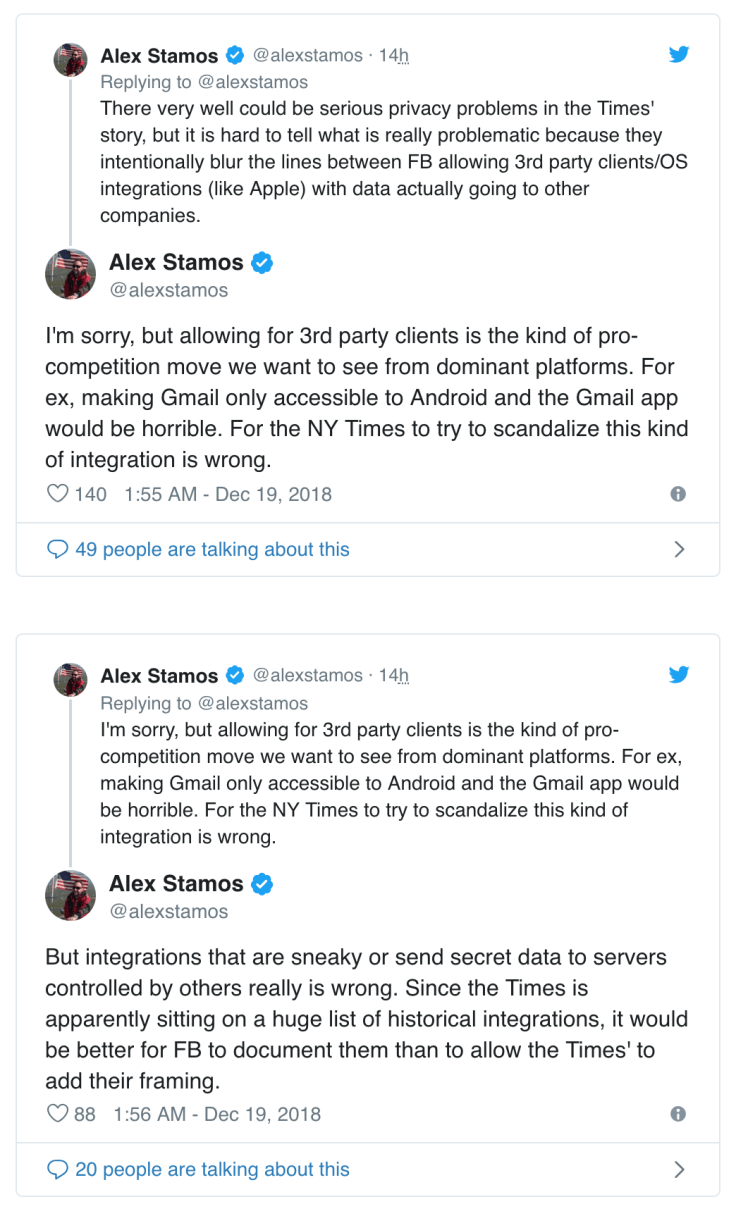
This practice, however, triggered a firestorm over the definition of consent, especially after Facebook’s former privacy chief Alex Stamos said that integration wasn’t to blame:

Screen Shot 2018-12-19 at 4.33.43 PM

Screen Shot 2018-12-19 at 4.34.33 PM

Interestingly, according to Business Insider:

According to internal Facebook documents seen by the Times, Spotify could see the messages of more than 70 million Facebook users a month. The Times reported that Spotify, Netflix, and the Royal Bank of Canada could read, write, and even delete people’s messages.

Importantly, both Spotify and Netflix told the Times they were unaware they had this kind of broad access. Facebook told the New York Times it found no evidence of abuse.

Zero Hedge also reported:

Amazon was granted access to users’ names and contact information through their friends, while Yahoo! was able to view streams of friends’ posts as recently as this summer despite Facebook promising that it had stopped this type of sharing years earlier.

What’s more? China’s Huawei and Russian search giant Yandex – accused last year by Ukraine of funneling user data to the Kremlin – had access to Facebook’s unique user IDs.

[…]

Facebook was able to circumvent a 2011 consent agreement with the Federal Trade Commission (FTC) which barred the company from sharing user data without explicit permission, because Facebook considered the partners extensions of itself – “service providers that allowed users to interact with their Facebook friends.” This allowed the company to grant such unprecedented access to everyone’s information. The partners were reportedly prohibited from using the personal information from purposes outside the scope of their agreement, however there has been little to no oversight.

Yesterday, Infowars reported that the NAACP was joining a long list of ideologically-diverse groups that were boycotting or otherwise moving away from Facebook.

“Over the last year, NAACP has expressed concerns about the numerous data breaches and privacy mishaps in which Facebook has been implicated,” wrote NAACP President Derrick Johnson. “And since the onset of the Silicon Valley boom, we have been openly critical about the lack of employee diversity among the top technology firms in the country.”

“Now, the time has come for our collective actions to emulate the severity of mistrust we have in Facebook.”

MSNBC’s Russia ‘expert’: Moscow terrorizing US with meme-filled ‘cruise missiles’ (VIDEO)

MSNBC’s Russia 'expert': Moscow terrorizing US with meme-filled ‘cruise missiles’ (VIDEO)

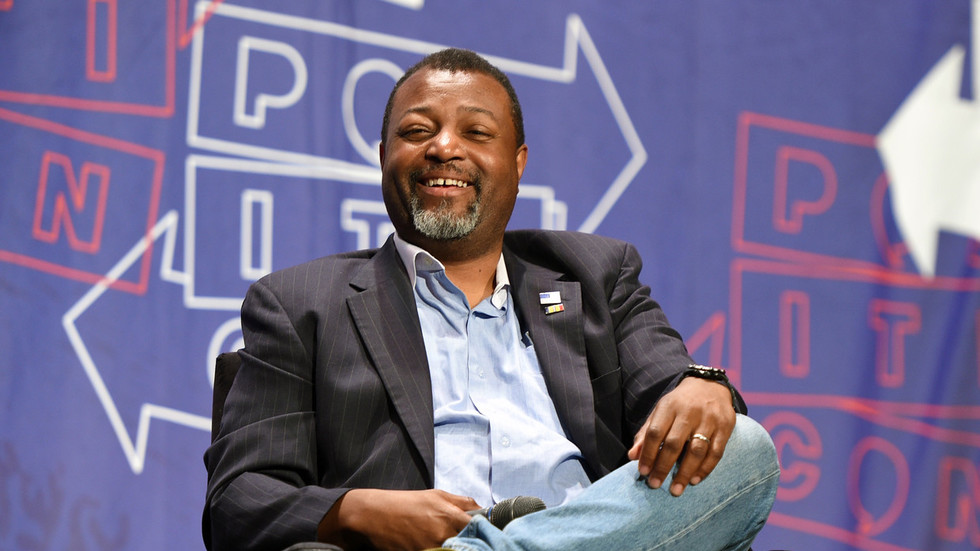
Malcolm Nance

Millions of impressionable American minds are being corrupted by Russian-linked memes, “the cruise missiles of fake news”, according to MSNBC’s self-anointed Russia expert. Everyone agrees that this is a reasonable observation.

Malcolm Nance, a former Navy cryptologist who studied Arabic and served in the Middle East, makes regular appearances on MSNBC, where he is given generous amounts of airtime to share his thoughts on all things Russia related. In his latest appearance on the network, Nance described how the destructive power of Russian-linked internet memes have apparently devastated America.


“The Internet Research agency built all these memes and tropes which became the cruise missiles of fake news and disinformation,” Nance said. He claimed that these nefarious meme-bombs have ravaged the mental faculties of “one third of the United States population,” leaving them unable to “believe what they see before their very eyes.” And of course, these JPEG-rockets “may have elected a president in the process.”

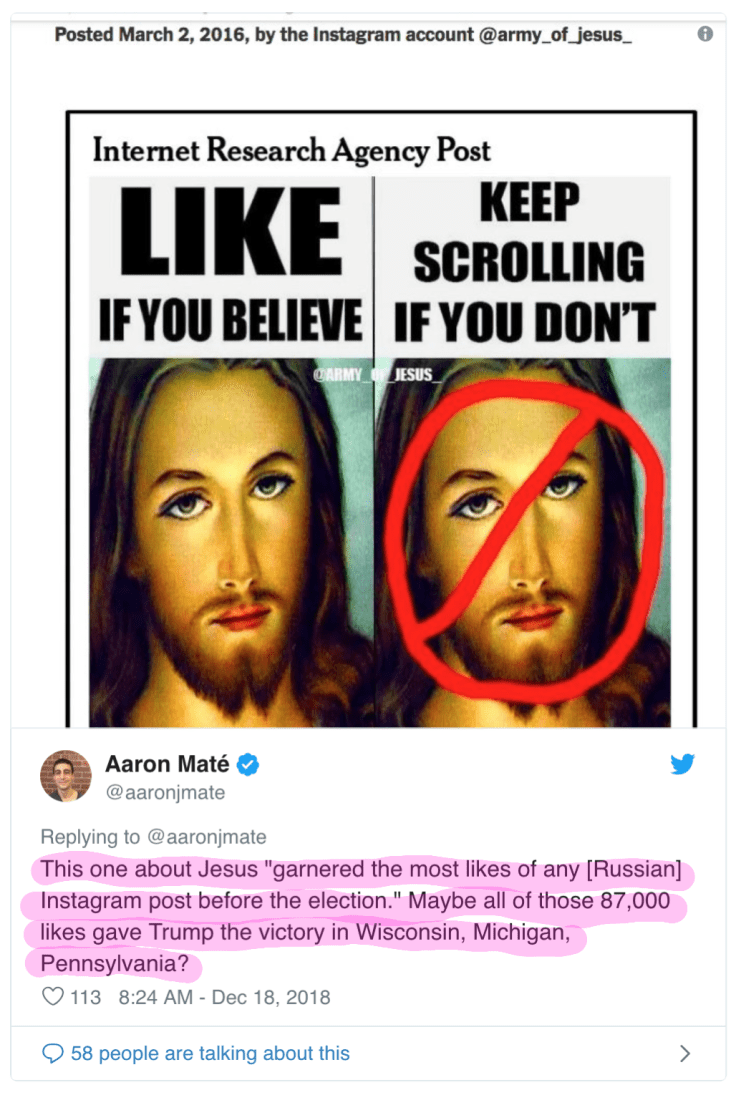
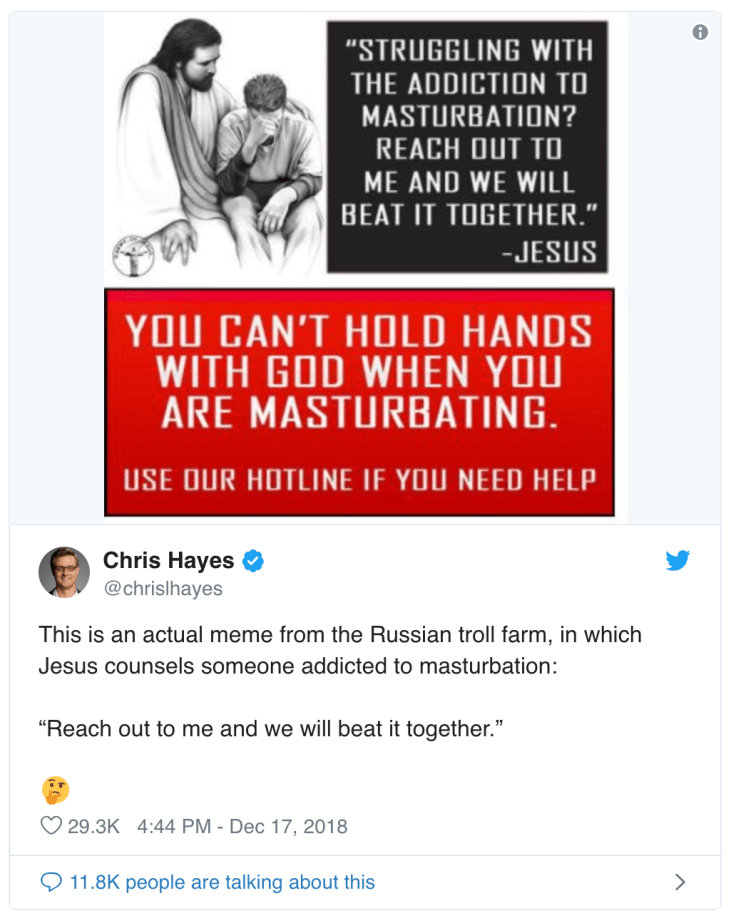
Photographs of these ghastly cruise missiles have been floating around on the internet in recent days, with many noting their astonishing level of sophistication.

Screen Shot 2018-12-19 at 11.02.11 AM

Screen Shot 2018-12-19 at 11.03.26 AM

Screen Shot 2018-12-19 at 11.05.19 AM

This is not the first time that Nance has deployed terrifying images of Russian meme missiles to warn Americans about the new Moscow menace: In a July interview he declared that, “As an information war, the payloads in the information cruise missiles that Russia launched at this country were propaganda products which had their origins in 1917, in the Bolshevik revolution.”

Months before that outburst, in March, Nance was quoted by the Washington Post as thoughtfully asking: “What happens if 100s of millions of progressives worldwide abandon Facebook because they think it’s a tool of Trump, Russia authoritarians and neo-Nazis? Facebook needs to own up and do damage control to ensure they are not 2018’s information cruise missile of choice.”

Nance really has a knack for inventive Russia commentary. He previously demonstrated his vast knowledge about the country by falsely claiming that Russian President Vladimir Putin was a “former director of the KGB.”

The “intelligence analyst” is also a savvy media observer, describing journalist Glenn Greenwald as “an agent of Trump & Moscow” after the Intercept editor attended a conference in Moscow.

When it comes to comparing GIFs to airstrikes, the MSNBC talking head keeps good company: Guardian writer Carole Cadwalladr once famously suggested that the UK was now at “war” with Russia. The reason? Russia’s Foreign Ministry changed its Twitter profile picture to a photograph of Maria Butina.

Trump-Russia dossier was created so Clinton could challenge 2016 election results – Steele

See the source image

The British ex-spy who authored the infamous dossier alleging collusion between President Donald Trump and the Kremlin said one of his goals was to give Hillary Clinton legal basis to challenge the 2016 election results.

Christopher Steele’s salacious 17-page report was commissioned by Fusion GPS, a firm connected to Clinton’s campaign.

“Based on that advice, parties such as the Democratic National Committee and HFACC Inc. (also known as ‘Hillary for America’) could consider steps they would be legally entitled to take to challenge the validity of the outcome of that election,” Steele wrote in recently unsealed declaration that was published by the Washington Times.

ALSO ON RT.COMComey admits FBI failed to verify Steele Dossier it used to obtain a spy warrant on Trump’s aide

See the source image

His statement is part of a series of answers which Steele provided in a defamation suit brought by three Russians who head Alfa Bank, who were named in the dossier as part of the alleged collusion conspiracy between Trump and the Kremlin.

The court challenge never came. Instead, the unsubstantiated dossier was leaked to news outlets such as BuzzFeed, fuelling Russiagate hysteria and serving as the backbone of a two-year probe that has yet to corroborate any of the document’s core claims. The document was also used by the FBI to obtain a warrant to spy on former Trump aide Carter Page, who was accused by Steele of meeting secretly with Kremlin insiders in Moscow. Incredibly, former FBI Director James Comey admitted that his agency had not verified the dossier’s contents before using it to justify the warrant.
The dossier itself has apparently fallen out of favor with many of its early champions: One of the first journalists to report on Steele’s research has stated that many of Steele’s central claims have yet to be substantiated and are “likely false.”

ALSO ON RT.COMSteele dossier’s main claims ‘likely false,’ admits journalist who helped launch RussiagateThe defamation case against Steele was dismissed by a DC Superior Court judge, but lawyers representing the Russian bankers have launched an appeal in US District court, attaching Steele’s revelatory statements as part of their filing. Steele claimed that internet traffic data had been observed between Alfa Bank and a computer served linked to the Trump Organization. The allegation has yet to be proven, with some reports suggesting that the flagged data actually originated from an internet spam farm based outside Philadelphia.

Steele faces similar legal trouble in London, where he is being sued for defamation by Russian entrepreneur Aleksej Gubarev. In one of his memos, Steele accused Gubarev of personally hacking DNC computers. Gubarev has also sued BuzzFeed for publishing the unverified claim as part of its uncritical coverage of the dossier.

Like this story? Share it with a friend!

Russia! The gift that keeps giving for the BBC, even on the streets of France

Russia! The gift that keeps giving for the BBC, even on the streets of France

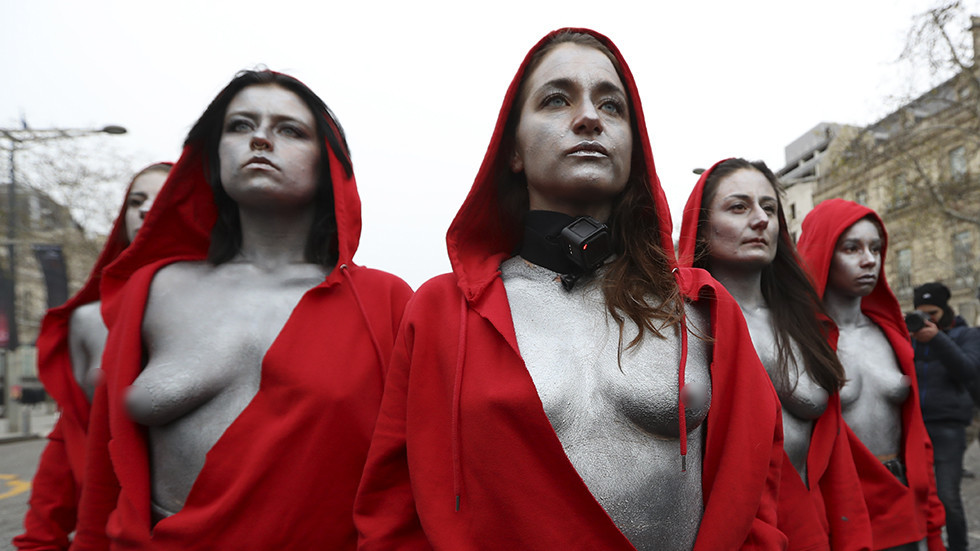
Luxembourg’s artist Deborah de Rebortis (C) and a group of women dressed as “Marianne”, December 15, 2018 © AFP / Valery Hache

By Robert Bridge

Given the rash of conspiracy theories leveled against Russia of late, it is no surprise that the BBC is deep-sea fishing for a Kremlin angle to explain the protests against the government of French President Emmanuel Macron.

Dear failing leaders of France, are basement-level ratings getting you down? Are violent riots spooking the tourists? Are running street protests at the height of the holiday season placing a drag on consumer spending? Have no fear because the BBC is here with a one-size fits all bogeyman to explain virtually everything. Please have a seat because the name alone will send shock waves of bone-chilling fear surging through your entire body.

This new and improved beast of burden to explain every uprising, lost election, accident and wart, popularly known as ‘Russia’ – a strategy rebuked by none other than President Putin as “the new anti-Semitism” – provides craven political leaders with a ready-made alibi when the proverbial poo hits the fan. Yes! It can even rescue Emmanuel Macron, who just experienced his fifth consecutive weekend of protests in the French capital and beyond.

Here is the real beauty of this new media product, which may just outsell Chanel No.5 this holiday season. Reporting on ‘Russia’ does not require any modicum of journalistic ethics, standards or even proof to peddle it like snake oil to an unsuspecting public.

Simply uttering the name ‘Russia’ is usually all it takes for the fairytale to grow wings, spreading its whimsical lies around the world. ‘Russia’ is truly the gift that keeps on giving!

Allow me to demonstrate how easy it is to apply. Just this weekend, BBC journalist Olga Ivshina was engaged in correspondence with a stringer in France. In an effort to explain what has sparked the French protests, Ivshina gratuitously tossed out some live ‘blame Russia’ bait.

“And maybe some Russian business is making big bucks on it,” the BBC journalist solicited in an effort to conjure up fake news out of thin air. “Maybe they are eating cutlets out there en masse, for example. Or maybe the far-right are the main troublemakers?”

ALSO ON RT.COMBBC endorses reporter’s actions seeking to find Russian influence in Yellow Vest protestsWhen the question only managed to elicit an uncomfortable laugh from the stringer, the nonplussed BBC journalist exposed more trade secrets than was probably advisable. In fact, what followed seems to have been the only nugget of truth to emerge from the discussion.

Ivshina confided that she was looking for various angles” since the broadcaster, like a modern day Dracula flick, was “out for blood.

When RT reached out to BBC for some explanation, the British broadcaster reasoned that since the French Foreign Minister Jean-Yves Le Drian had “spoken publicly about media reports of a possible Russian influence in the protests, it was perfectly reasonable for our correspondent to raise the subject.”

It also said the finished report did not mention a “possible connection with Russia at all.”

At this point, it is only natural to ask if such a knee-jerk anti-Russia bias in other news events – for example, the Skripal affair – demands that the BBC mindlessly toe the government line instead of, oh, I don’t know, pursuing the truth. A naïve question, of course, but please humor me.

Suffice it to recall that before any evidence was presented to the public in the poisoning of ex-spy Sergei Skripal and his daughter Yulia in Salisbury, British Prime Minister Theresa May declared it was “highly likely” that Russia was to blame.

That reckless comment was then launched around Planet Google by the Western leaders and their laptop media without further ado, not to mention a little thing called evidence. At the very least, you would expect the British people to demand much more for their tax pounds which fund the BBC.

Do you see how easy and effective this type of journalism is? The basis for the claims of ‘Russian interference’ by the French foreign minister should sound very familiar. Echoing claims of ‘Russian meddling’ in the 2016 US presidential elections through the use of social media, the minister pulled the very same rabbit out of his hat to suggest why hundreds of thousands of French citizens were suddenly out on the street, protesting against the unpopular policies of a former investment banker turned president.

As Bloomberg reported: “France opened a probe into possible Russian interference in the Yellow Vest protests, after… about 600 Twitter accounts known to promote Kremlin views began focusing on France, boosting their use of the hashtag #giletsjaunes.”

Keep in mind that the purchase of a few hundred Facebook ads is how the US Democratic Party – itself the focus of a number of potentially-criminal activities, as revealed by WikiLeaks – has attempted to explain the failure of Hillary Clinton to beat the Republican maverick Donald Trump in the race to the White House, as well as conceal its many wrongdoings.

Never mind that a Facebook executive admitted that Russia-linked posts had negligible impact on that part of the US brain that is responsible for pulling levers and making independent choices on election day.

Meanwhile, the recent and very explosive comment by Google CEO, Sundar Pichai, further confirms that the claim of Russian interference in the US political system was a well-done nothing burger.

“We undertook a very thorough investigation, and… we now know that there were two main ad accounts linked to Russia which advertised on Google for about $4,700 in advertising,” Pichai told a stone-faced US congressional probe last week.

Screen Shot 2018-12-17 at 4.56.02 PM

Back to the French streets, with some unavoidable sarcasm.

Of course, the French would never think of protesting against Emmanuel Macron’s aggressive neo-liberal policies, which have subjected the French people to painful austerity measures at the same time that the French government has embraced an open door immigration policy.

The only explanation that makes any sense – at least for those whose careers depend upon it, that is – is that the Russians monkeyed with the French mentality, causing Macron’s popularity rating to plunge, while at the same time inducing the French to take to the streets en masse.

The problem with that media narrative, first tossed out by a French minister without any evidence and then regurgitated by an obedient media, is that so many people are willing to accept it at face value. Or perhaps I underestimate the intelligence of the average news consumer and such a comment actually helped spur the French protesters into action for being taken as fools. We can always dream.

@Robert_Bridge

Like this story? Share it with a friend!

Blog at WordPress.com.

Up ↑