According to statistics published by the Federal Criminal Police Office, Germans are significantly more likely to become victims of a crime committed by an immigrant than vice versa.
*
Its 2018 report “Crime in the Context of Immigration” analysed statistics of murders, homicides, assaults, robberies and offences against sexual self-determination and personal freedom.
*
The research set out to determine how many crimes involved “asylum seekers and refugees”, as well as people who are awaiting deportation or already have a residence permit.
*
230 Germans were killed, which is twice as many as in 2017.
The number of Germans sexually assaulted by asylum seekers and refugees also spiked to 3,260.
*
In total, almost half of victims of serious crimes by foreign perpetrators (46,336 out of 101,956) were Germans. This is 19 percent more than in 2017.
Data relating to crimes against asylum seekers or refugees allegedly assaulted by a German suspect showed that 8,455 foreigners were victims (24 per cent more than in 2017).
*
Notably, in 2018, only 18% of foreign victims were hurt or killed by a German suspect. Which means that people seeking asylum are mainly attacked by those with a similar background.
*
The refugee policy and “open borders” approach, in particular, have prompted criticism against Angela Merkel’s government.
European countries have been experiencing a severe migration crisis since 2015 due to an influx of thousands of migrants and refugees fleeing the Middle East and North Africa.
*
Germany has accepted hundreds of thousands of migrants. However, over the years, the number of newcomers has dropped. According to the police, there were 300,000 asylum seekers and 697,000 refugees in Germany in December 2018.
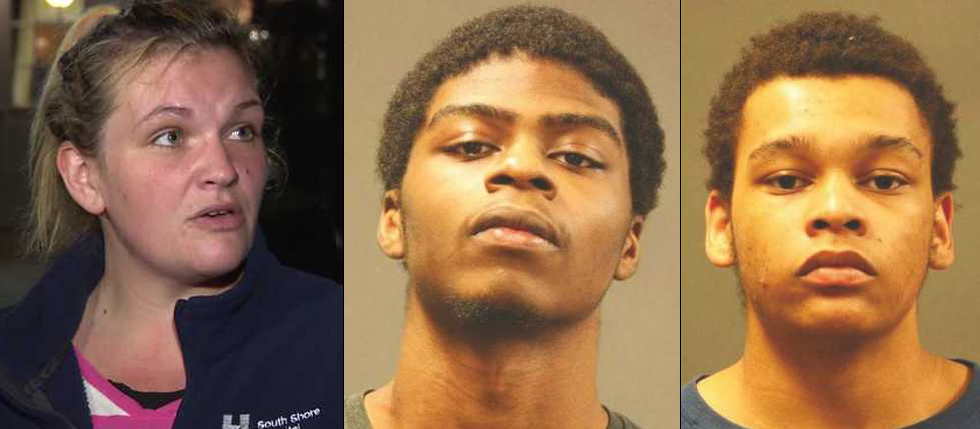
Shocking video showing a pregnant woman being “randomly attacked” by a group of teenagers is getting little to no coverage in the national media, for unknown reasons.
A pregnant woman’s pained screams could be heard in a Quincy courtroom Thursday as Judge Mark Coven watched a video that prosecutors say shows the woman being beaten by two Quincy teenagers outside a downtown post office.
The Patriot Ledger reported that after watching the video, Coven ruled that the two defendants, Tyrese D. Johnson-Nurse, 19, and David D. Russell, 18, could pose a danger to the public and ordered that they adhere to additional conditions, including wearing a GPS monitor, if released. The two had been held behind bars since their arrest Tuesday on charges of aggravated assault and battery on a pregnant woman and assault and battery.
[…] “This is two guys involved in a very brutal incident,” Coven said from the bench. ”(Russell) was beating the hell out of this poor pregnant woman.”
WATCH:
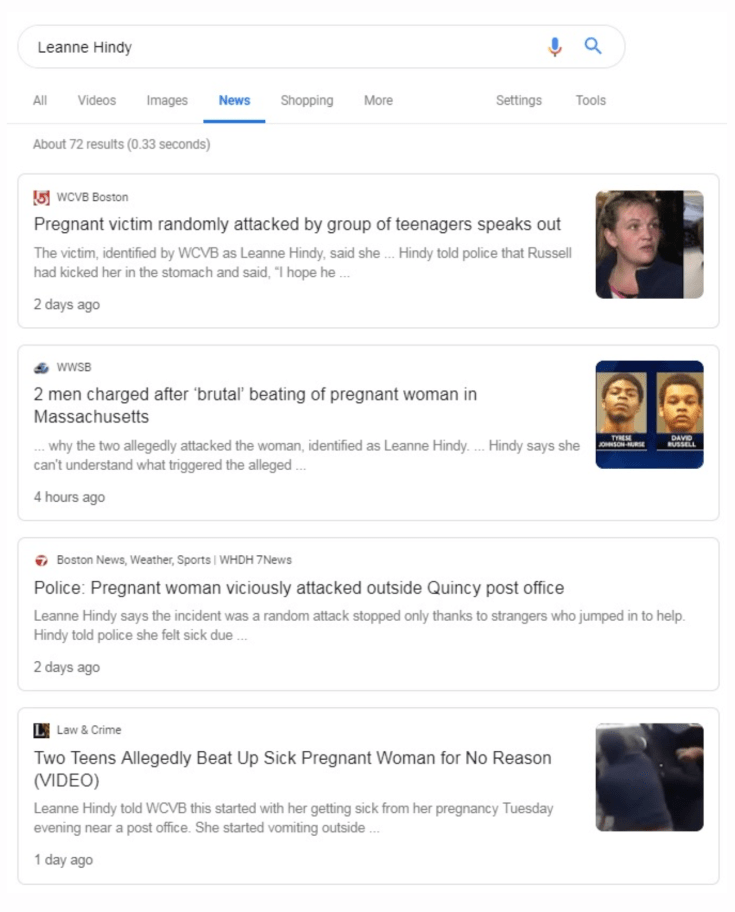
A search of Google News shows the story was ignored by all the biggest media outlets and only covered by local news as well as the online-only website Law and Crime:
According to a Politico list, Italian Deputy Prime Minister Matteo Salvini and Brexit Party leader Nigel Farage were ranked as the two most important Members of European Parliament (MEP) during the 2014-2019 parliamentary term.
This list of “40 MEPs who mattered” ranks MEPs who “set the agenda and stood out from their peers, driving trends both within the legislative arena and in the wider EU political debate.”
Politico pointed to Salvini’s “talent for plain speaking and using social media (not to mention the Euroscepticism) that propelled him to his current position as Italy’s de facto leader, where he has been driving the European debate from the right ever since.”
Salvini has taken his political rise to another level by rolling out a political supergroup of populist parties across the EU, notably made up of the Alternative for Germany (AfD), the Austrian Freedom Party (FPÖ), and the French National Rally.
The young populist leader aims to form the biggest coalition in the European Parliament by outing the centrist European People’s Party and “change the rules of Europe.” Salvini and his populist coalition wants to roadblock the progressive, centralized project of the EU and revert to a union of European nations.
Controversial policies like mass migration and the negative social effects they have brought about have spurred the rise of populism throughout Europe.
BLP reported how Salvini’s La Lega (League) party is set to make big gains in the European Parliament.
Politico also placed former UKIP leader current Brexit Party leader Nigel Farage in the second spot in this ranking. Farage was described as “the star speechmaker of the 2014-2019 Parliament.”
After the British government announced that it would be participating in the European Parliament elections, Farage declared that his Brexit Party would be participating as well to defeat the establishment and “fight back against the betrayal of democracy.”
An Open Europe poll found that the Brexit Party was in third place behind Labour and Conservatives.
Over the past few weeks BLP has found that populism is a growing movement across the West and is here to stay.
A recent poll shows that immigration is still the #1 issue for Republican voters in the 2020 elections.
Given Trump latest success in securing $1 billion in wall funding and his proposal of sending illegal aliens to sanctuary cities, Trump looks to poised to win a second term.
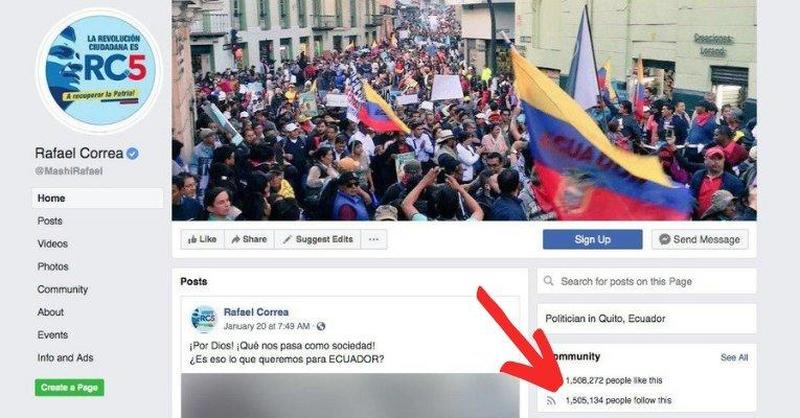
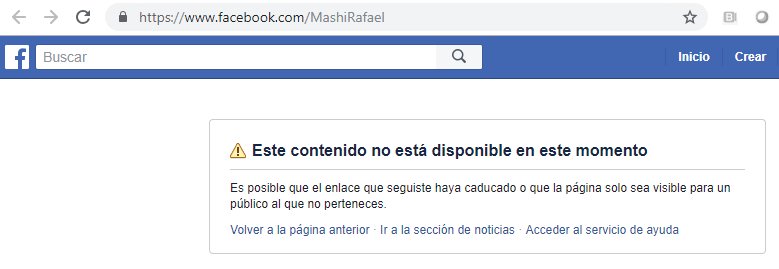
Facebook has unpublished the page of Ecuador’s former president, Rafael Correa, the social media giant confirmed on Thursday, claiming that the popular leftist leader violated the company’s security policies.
In a statement republished by Ecuadorean newspaper El Comercio, a company spokesperson said:
“Protecting the privacy and security of people is central to Facebook [and] we have clear policies that do not allow the disclosure of personal information such as phone numbers, addresses, bank account data, cards, or any record or data that could compromise the integrity physical or financial of the people in our community.”
The move comes on the same day that Ecuador’s government allowed British security personnel to enter their embassy in London to arrest journalist and WikiLeaks founder Julian Assange, who has been sought by U.S. officials for years due to his role in releasing scandalous information implicating Washington in a range of crimes, including war crimes.
Assange, 47, had been living at the Embassy of Ecuador in London since 2012, when then-President Correa granted political asylum to the Australian amid the British government’s attempts to detain him. At the time, Correa called Eduador’s actions an act of sovereign “duty.”
Ecuador’s current leader, Lenin Moreno, was openly opposed to Assange, whom he referred to on various occasions as a “miserable hacker,” an “irritant,” and a “stone in the shoe” of his government. Moreno’s distancing from the asylee came following a 2017 meeting with Trump campaign confidant and political “fixer” Paul Manafort, where the two discussed Ecuador’s handover of Assange to U.K. and U.S. authorities.
In March, WikiLeaks published a tranche of documents dubbed the INA Papers linking President Lenin Moreno to the INA Investment Corporation, an offshore shell company used by Moreno to procure furniture, property, and various luxury items.
The account number for the offshore account allegedly used by the president to launder money was shared across Ecuadorean social networks by netizens of all political stripes, including by Correa – who had about 1.5 million followers and whose Facebook page enjoyed more interactions and attention than that of President Moreno himself.
The account number was also shared alongside personal photos of President Moreno enjoying lavish breakfasts and dinners of lobster—imagery considered especially damning for the people of Ecuador given Moreno’s previous boasting of an austere poverty diet consisting of eggs and white rice.
It also came amid attempts by the neoliberal Ecuadorean government to curry favor with financiers in Europe and the United States amid the continuing debt crisis. In March, the IMF finally bailed out Moreno’s government to the tune of $4.2 billion.
Prior to the removal of the page, Correa lambasted his successor in a series of posts that still remain on Twitter at the time of this writing.
Rafael Correa
✔@MashiRafael
Christine:
I do not know what to tell you. I only ask forgiveness from me and my people. A traitor and corrupt like Moreno does not represent us. I promise not to rest until I see him in jail, where he deserves to be.
Mrs. Christine Assange@AssangeMrs
Shame on you @Lenin#Moreno!
May the Ecuadorean people seek vengeance upon you, you dirty, deceitful, rotten traitor!
May the face of my suffering son haunt your sleepless nights..
And may your soul writhe forever in torturous Purgatory as you have tortured my beloved son! https://twitter.com/SkyNews/status/1116283158943666176 …
Since 2015, Correa—who lives with his family in Brussels, Belgium—had used the social platform to great effect, using strongly-worded posts, video interviews, and live-streams as a platform amid the Ecuadorean media’s de facto blackout of the former leader, who remains reviled by the center-right former opposition and sections of the country’s left.
Former President Correa minced no words in his assessment of Moreno, denouncing him in an English-language tweet as “the greatest traitor in Ecuadorian and Latin American history … Moreno is a corrupt man, but what he has done is a crime that humanity will never forget.”
Rafael Correa
✔@MashiRafael
The greatest traitor in Ecuadorian and Latin American history, Lenin Moreno, allowed the British police to enter our embassy in London to arrest Assange.
Moreno is a corrupt man, but what he has done is a crime that humanity will never forget.
Barnaby Nerberka@barnabynerberka
BREAK: Full @Ruptly video of WikiLeaks founder Julian Assange’s arrest by British police this morning
In a separate tweet responding to Moreno’s announcement of the handover, Correa further tore into what he called “one of the most atrocious acts [and the] fruit of servility, villainy and revenge.”
“From now on worldwide, the scoundrel and betrayal can be summarized in two words: Lenin Moreno,” the popular former president added.
The removal of Correa’s page for violating Facebook’s “community standards” is an unprecedented move, and the former statesman is the most high-profile public political figure to ever be removed from the social platform–placing the economist and icon of Latin American “socialism of the 21st century” in the same unlikely category as right-wing conspiracy theorist and broadcaster Alex Jones.
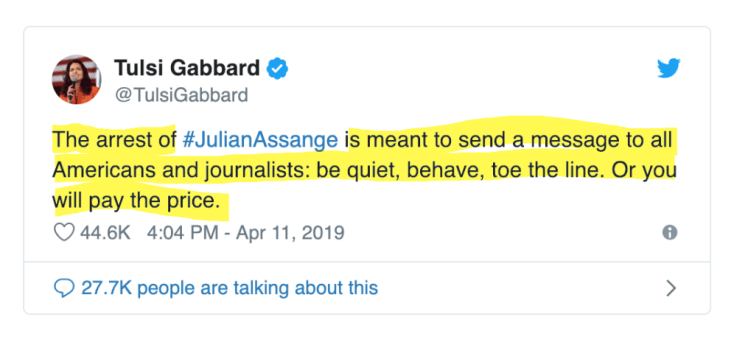
Democrat 2020 presidential candidate Rep Tulsi Gabbard on Thursday forcefully condemned the arrest of Wikileaks publisher Julian Assange saying it was “meant to send a message” to Americans to “be quiet, behave [and] toe the line” or “you will pay the price.”
“The arrest of #JulianAssange is meant to send a message to all Americans and journalists: be quiet, behave, toe the line. Or you will pay the price,” Gabbard said on Twitter.
“The purpose of arresting #JulianAssange is to send a message to the people, especially journalists, to be quiet and don’t get out of line. If we, the people, allow the government to control us through fear, we are no longer free, we are no longer America,” Gabbard said in a follow-up tweet, sharing video of her appearance on CNN Thursday afternoon.
The purpose of arresting #JulianAssange is to send a message to the people, especially journalists, to be quiet and don’t get out of line. If we, the people, allow the government to control us through fear, we are no longer free, we are no longer America. pic.twitter.com/2sedynREP9
On Tuesday, Gabbard released a video saying, “Netenyahu and Saudi Arabia want to drag the United States into war against Iran and Trump is submitting to their wishes.”
“The cost in lives and money will be beyond our imagination.”
Netanyahu and Saudi Arabia want to drag the United States into war with Iran, and Trump is submitting to their wishes. The cost in money and lives will be catastrophic. pic.twitter.com/7GbO92sE3h
Tulsi Gabbard successfully qualified for the Democratic debates on Wednesday after getting over 65,000 individual donors for her campaign.
Thank you! I’m extremely grateful that over 65,000 of you have now donated to our campaign, ensuring our voice will be heard in the upcoming debates. For a small campaign that doesn’t accept PAC money, I knew we had to rely fully on the power of the people. Aloha & Mahalo! pic.twitter.com/Uw303e2JUh
Watch as Dems and MSM talking heads freak out over AG Barr saying he will launch an investigation in Obama's Deep State spying activities against @realDonaldTrump#Spygate#Witchhunt#Spying
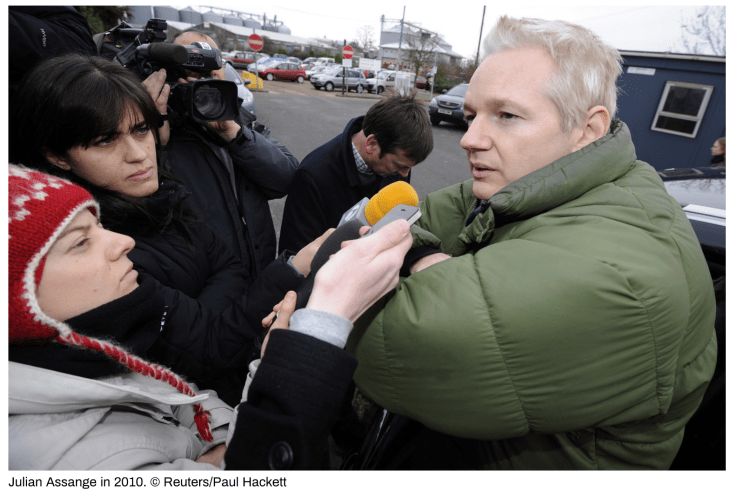
WikiLeaks founder Julian Assange has been taken to Westminster Magistrates Court after his arrest at the Ecuadorian Embassy in London. Photos of the whistleblower defiantly gesturing in a police van have emerged in the media.
Journalist flocked to the white police van carrying the whistleblower into the courthouse. With his hair tied back and sporting a full-length white beard, Assange offered cameras a hardy thumbs up with a wink.
Assange stepped into the courtroom wearing a dark polo shirt and quietly read his Gore Vidal book while he waited for his lawyers to arrive.
Earlier, Metropolitan Police said in a statement that they arrested Assange on a warrant issued by the Westminster Magistrates’ Court in June 2012, for failing to surrender to the court. The police were“invited into the embassy by the Ambassador,” it said.
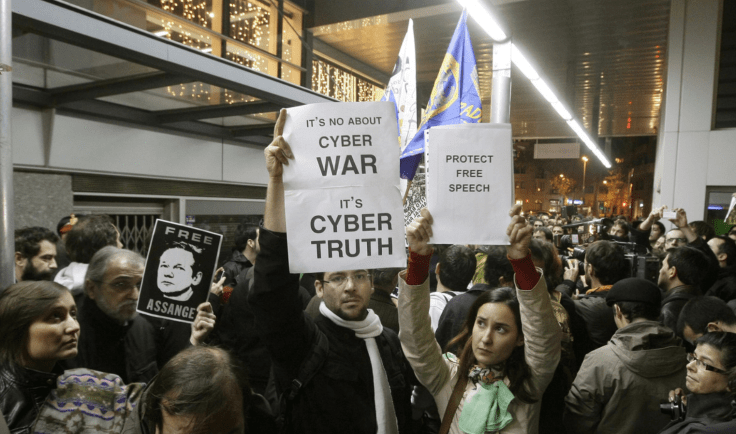
Julian Assange is a pioneering whistleblower in the digital-age, speaking truth to power like no one before him managed on such a significant scale. As he sits in a London jail cell, here’s why we should be grateful for his work.
By setting up the international non-profit organization WikiLeaksin Iceland in 2006, Assange irrevocably shifted the balance of power in the online era.
From humble beginnings as a master coder and hacker, caught by Australian authorities in 1995 but escaping a prison term, to the foremost publisher of sensitive, embarrassing and potentially dangerous material for the world to see, Assange’s storied career as a publisher and whistleblower has captured headlines, and the global public’s attention for years.
RT takes a look back at the key moments in Assange’s career that remind us why the world owes him such a debt of gratitude.
In 2007, WikiLeaks published emails exposing the manuals for Camp Delta, a controversial US detention center in Guantanamo Bay, Cuba which was the focal point for the US war on terror and the final destination for those captured as part of its extraordinary rendition campaign.
The following year the whistleblowing site posted emails from vice presidential candidate Sarah Palin’s private Yahoo email account, again exposing the newfound weakness of the political class in the digital age.
‘Collateral murder’
In a move that would reverberate online and across the world for years, in April 2010 WikiLeaks published footage of US forces summarily executing 18 civilians from an Apache attack helicopter in Iraq. It was an almost unheard of revelation of the brutality of war and the low price of human life in modern conflict.
2010 was a very busy year for Assange as in July WikiLeaks published more than 90,000 classified documents and diplomatic cables relating to the Afghanistan war.
Later, in October 2010, the organization published a raft of classified documents from the Iraq War. The logs were referred to as “the largest leak of classified documents in its history” by the US Department of Defense, according to the BBC. WikiLeaks followed that up in November by publishing diplomatic cables from US embassies around the world.
The Guantánamo Files and Spy Files
In April 2011, WikiLeaks published classified US military documents detailing the behavior and treatment of detainees held at Guantanamo Bay. This leak would be followed, once again, by a vast trove (250 million) of US diplomatic cables.
Throughout this sequence of widely-praised leaks, Assange invited a global audience behind the curtain of international diplomacy and warfare to expose the hidden truths of global power dynamics in a way which would forever change the power structure and landscape, affording a platform to analysts like Chelsea Manning to expose potential war crimes and misdeeds by the US military at large.
Assange and WikiLeaks would also help fellow whistleblowers like Edward Snowden to seek refuge from predatory US authorities, providing aid and comfort to those who risked everything in the pursuit of truth, exposing some of the most egregious mass surveillance programs the world has ever known.
DNC leak
As the 2016 US presidential election loomed, WikiLeaks published nearly 20,000 emails from the Democratic National Committee, which exposed the preferential treatment shown to then-candidate for president Hillary Clinton over her competitor Bernie Sandersin the Democratic primary. Assange boldly informed CNN’s Anderson Cooper that the release was indeed timed to coincide with the Democratic National Convention.
In October that same year, WikiLeaks began publishing emails from Clinton’s campaign manager John Podesta, which shed light on the inner workings of the Democratic nominee’s political machine.
These included excerpts from Clinton’s speeches to Wall Street, politically-motivated payments made to the Clinton Foundation, her consideration of choosing Microsoft co-founder Bill Gates or his wife as a potential running mate, her desire to covertly intervene in Syria, her intention to ring-fence China with missile defense batteries if it did not curtail North Korea’s nuclear ambitions.
Legacy
Following his arrest on the morning of April 11, 2019, Assange’s future remains unclear. He likely faces extradition to the US where it was inadvertently revealed that he has been charged under seal in a US federal court. Former Assange collaborator Chelsea Manning has been imprisoned for refusing to cooperate with the court in relation to the case.
Assange’s legal battle is only just beginning, it seems, but the international following he has forged will undoubtedly grant him a place in the pantheon of history’s champions of truth.
He remains a true digital pioneer, paving the way for so many to follow in his footsteps and expose the untold misdeeds of the powerful, be they political figures or entire militaries. Assange has defiantly shown what a powerful tool digital technology can be and how easily the dynamics of power can be shifted in the 21st century by those brave enough. Unfortunately, he also showed the consequences of wielding such power in the face of such overwhelming international and political opposition.
While Facebook claims to have deleted thousands of pages to prevent meddling in the Indian elections, the American company’s selective deletions have led at least one man to ask: Who is watching the election watchers?
A little over a week ahead of the beginning of elections in India this Thursday, Facebook raised some eyebrows when it announced that it had removed a number of politically oriented pages as a part of its “election integrity” efforts.
The social media giant removed 138 pro-opposition pages that had over 200,000 followers for “coordinated inauthentic behavior.”While they only removed 15 pro-government pages, as it turned out, those pages had a far wider reach with millions of likes.
Given the apparent imbalance, it is all the more concerning that the purge was conducted with assistance from the US-based Atlantic Council, a think tank that receives millions of dollars in funding from the US State Department and NATO allies.
Indian defense analyst and security expert Abhijit Iyer-Mitra is one of the people extremely concerned with the impact the American private company could have on India’s elections. He has even filed a criminal complaint with police in New Delhi, describing Facebook’s actions as an act of war, and an attack on the country’s sovereignty.
Speaking to RT, Iyer-Mitra blasted the social network for their glaring double standards: while making extensive efforts to protect American elections from foreign actors in the wake of the alleged “Russian meddling” scandal, the company seemingly had no qualms about letting a state-department-linked think tank act in place of Indian election officials.
“The point is they are an American company, this is an Indian election,” said Iyer-Mitra. “We are not willing to cede our sovereignty to other countries like this. I think they are making a big mistake and I intend to pursue this to the end.”











 Tom's Blog