By Tyler Durden
Update: Despite French President Emmanuel Macron letting his people “eat cake” with a six-month suspension of the government’s new “climate change” fuel taxes, the so-called “Yellow Vest” movement which has been protesting throughout France for more than three weeks is still spitting mad.

“We didn’t want a suspension, we want the past increase in the tax on fuels to be canceled immediately,” said Yellow Vest organizer Benjamin Cauchy on BFM TV. “Suspending the tax to re-instate it in six months is taking the French people for a ride. French people aren’t sparrows waiting for crumbs from the government.”
The president’s silence drew the wrath of some. “Macron has still not deigned to talk to the people,” said Laetitia Dewalle, a Yellow Vests spokeswoman, on BFM TV. “We feel his disdain. He maintains his international engagements but doesn’t speak to the people.”
Sebastien Chenu, a spokesman for L‘s far-right National Rally party which has supported the Yellow Vests in hopes of capturing their votes, said on LCI that “the French won’t be fooled. The government has understood nothing, it’s just playing for time.” –Greenwich Time
Others, however, may have been assuaged by the “limited time moratorium” on the taxes – as a Tuesday BVA opinion poll for La Tribune reveals that 70% of French citizens surveyed think the postponement justifies stopping the Yellow Vest protests.
Meanwhile, French police ordered the cancellation of two football matches scheduled for Saturday, while French interior minister Christophe Castaner told lawmakers on Tuesday that additional security personnel would reinforce the 65,000 police and gendarmes during this Saturday’s planned protests. Some police unions have floated the idea of drafting the army as backup, according to Paris-based journalist Catherine Field.
French students, meanwhile, have intensified their protests around the country – setting ire to buildings and engaging in violent clashes with the police. The students have “gradually started to get involved” with the Yellow Vest movement, leading to riots in southwest France, Lyon, Marseille, Bordeaux and the city of Orleans. A school in Blagnac, near Toulouse was reportedly set on fire Tuesday, according to Reuters.
Macron’s backing down comes as his popularity hit a new low. A poll by Ifop for Paris Match magazine and Sud-Radio released Tuesday found the president’s support had fallen six points to 23 percent. Philippe was at 26 percent. While Macron and parliament, where his party holds a majority, don’t face new elections until 2022, the reversal on taxes may undermine the rest of his reform agenda.
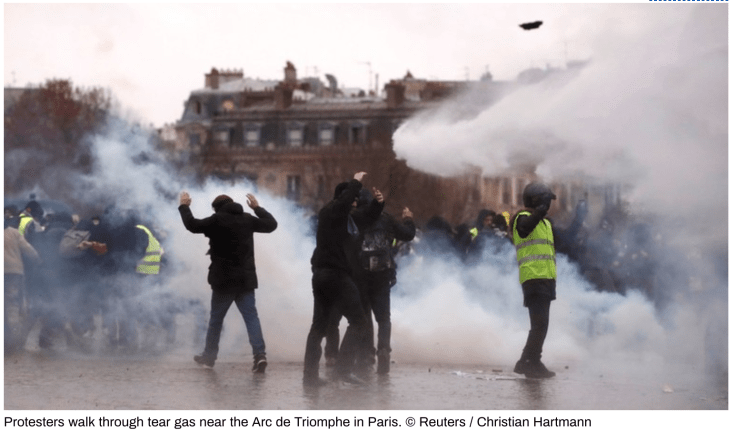
The protesters, who started out blockaded traffic across France, brought their fight to Paris over the last two weekends. They defaced the Arc de Triomphe, burned hundreds of cars and blocked roads and fuel depots. –Greenwich Time
Meanwhile, the Yellow Vest protests continue to take their toll on French businesses – with big-box retailers suffering an average 8% decline in sales on Saturday per Nielsen.

With all of that said, it will be interesting to see what Saturday brings.
***
With his popularity rating at record lows (recent polls put it at around 26%, on par with Hollande), his capital city burning and the populists he defeated during his stunning electoral victory last year making serious electoral inroads, French President Emmanuel Macron finally caved, and on Tuesday ordered a six month suspension of planned ‘fuel taxes’ which spurred widespread and destructive protests across France over the past three weeks.
After reportedly weighing declaring a state of emergency that would have cleared the way for an unprecedented crackdown on dissent, Macron decided that such measures would only intensify the popular opposition to his government. And according to Reuters, Prime Minister Edouard Philippe has declared a suspension of the staggeringly unpopular tax.

“No tax deserves to endanger the security of the nation,” Philippe said in a televised address, who on Monday held separate meetings with opposition party leaders, in which they demanded the scrapping of the planned increase in fuel taxes. The same day striking students closed down 100 high schools and rising fuel shortages were reported in some parts of the country.
A freeze of planned fuel tax increases was one of a number of measures called for in an editorial by 10 self-proclaimed gilets jaunes representatives published on Sunday in the Le Journal du Dimanche newspaper. They also demanded the holding of countrywide consultations over taxes.
The decision marked the first time that Macron has backed down from implementing an unpopular policy in his 18-month presidency as a result of the furious public response, and is set to unleash even more protests as the emboldened French people now realize that taking to the streets will results in success.

The suspension has come in the form of a “time limited moratorium”. Though a permanent suspension remains a possibility (particularly since demonstrators are already planning another round of violent rallies where 120,000 protesters were expected to try and reenact the storming of the Bastille). But there’s a catch: If taxes must be cut, then public spending will also be scaled back, Macron said; in other words once the smoke clears the anger will be even greater as social welfare programs are slashed.
The PM also explained natural gas tariffs won’t increase this winter.

The “yellow vest” movement – which kicked off with paralyzing protests on Nov. 17 as word of the protests spread on social media – has won a crucial victory in its attempt to force Macron to reverse a policy that many have decried for squeezing household spending at a time when France’s economy (and indeed economies throughout Western Europe) is struggling with tepid growth. The protests have even had a negative impact French shares.

The movement was named for the highly visible “yellow vests” that all French motorists are required to store in their cars. Macron justified the gas tax by saying it was essential for combating climate change. But his decision to suspend the tax marks a deeply embarrassing moment for the president, who is in Poland this week to discuss actions to combat climate change with other European leaders.

Meanwhile, amid the pervasive dissatisfaction with Macron and his policies, the fuel tax protests morphed into a broader anti-Macron movement, as the French people have criticized him for policies that they believe favor the rich over the working and middle-class.
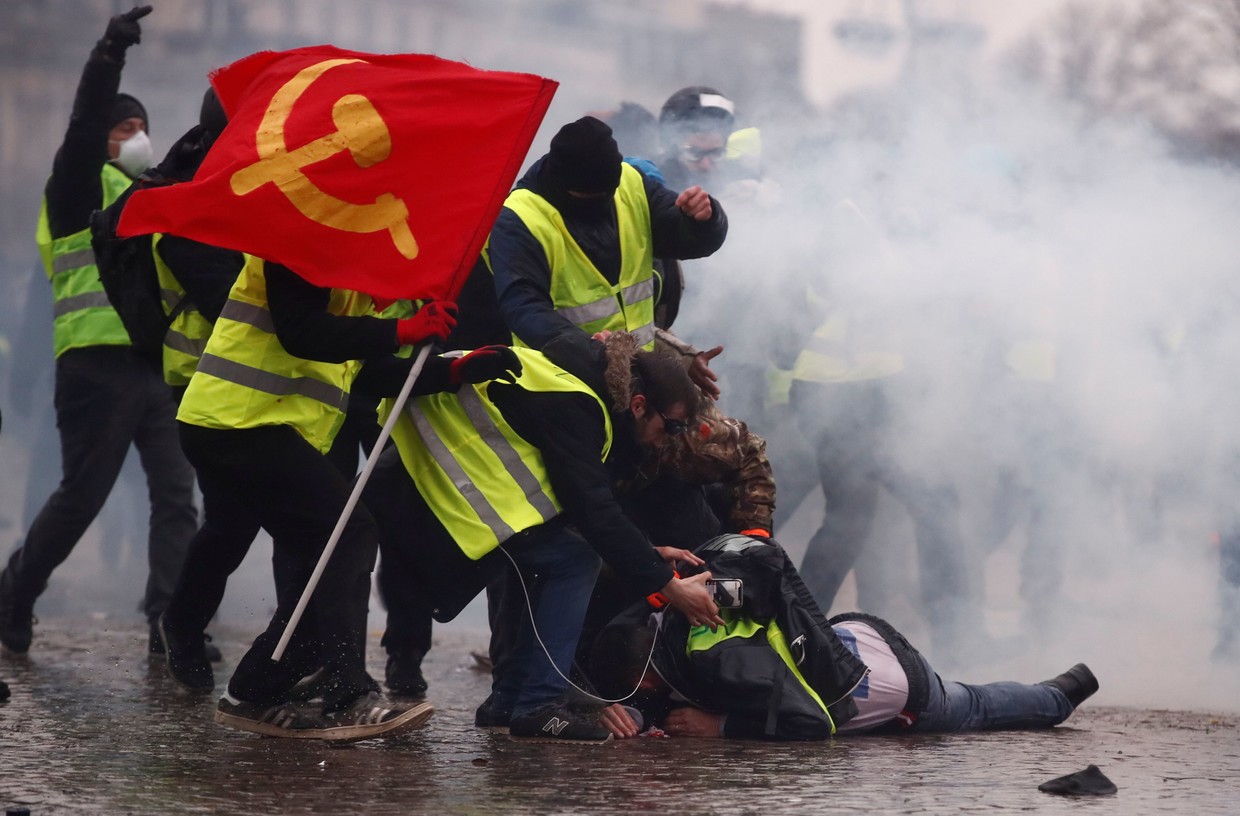
Already, a handful of deaths have occurred during protests over the past few weekends, further stoking the public’s anger. Acts of violence were widespread during the latest rally, as the Arc de Triomphe was defaced and roads off the Champs Elysees were damaged. The demonstrations have reportedly hurt retail spending and damaged the French economy during a holiday season that many retailers had been depending on to help push them into the black.
Macron successfully marketed himself as a pragmatic centrist during the 2017 French election. But a series of gaffes, scandals and policy missteps have helped him earn a reputation as the “President of the Rich” (before serving as president, Macron was a former economy minister and investment banker). To help combat this negative perception ahead of European Elections next year, Macron said he’s considering other “populist” policies like raising the minimum wage.

While it wasn’t immediately clear if Macron’s decision to suspend the tax would be enough to placate the seething anger of the French people – and it is safe to say his caving has merely emboldened the French to demand even more – but party officials have cautioned that he might need to back down on other policy “reforms” like cutting pension benefits.
In short order he made changes to the labour code to make hiring and firing easier, he took on the rail unions by forcing through changes to the national rail company, and he cut wealth taxes in a bid to stimulate investment.
However, in the process he earned the tag “president of the rich” for seeming to do more to court big business and ease the tax burden on the wealthy. Discontent has steadily risen among blue-collar workers and the middle-class struggling to make ends meet.
The government’s decision to push ahead with an increase in fuel taxes from January, part of a longer-term effort to discourage fossil fuel use,angered people in rural or outer urban areas who use their cars more.
It was not immediately clear if suspending the tax rise would be enough to placate the “yellow vests” or head off a repeat of the violence that erupted in Paris on Saturday, which officials said was driven by extreme groups on the far-left and far-right, such as the Black bloc and anarchist factions.
Recent polls have shown that most of France supports the cause of the yellow vests. Similar protests have broken out around Europe, spreading to Belgium, Italy and the Netherlands.
Meanwhile, more protests are scheduled: Christophe Castaner, the French interior minister, said on Sunday that measures under consideration by the government include the imposition of a state of emergency and the deployment of soldiers to help contain the next protests, which are scheduled for Saturday.


 Tom's Blog