
Published on May 15, 2019

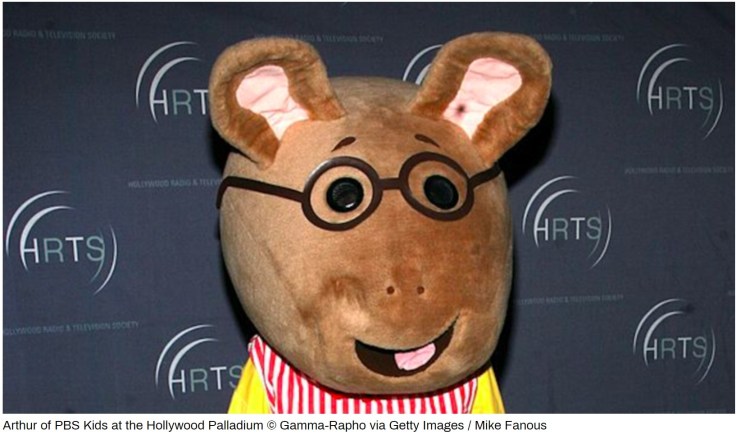
Come on, if there was one thing kids’ TV programming was desperately crying out for, it was a gay cartoon rat getting married, teaching us all a timely lesson about “diversity.”
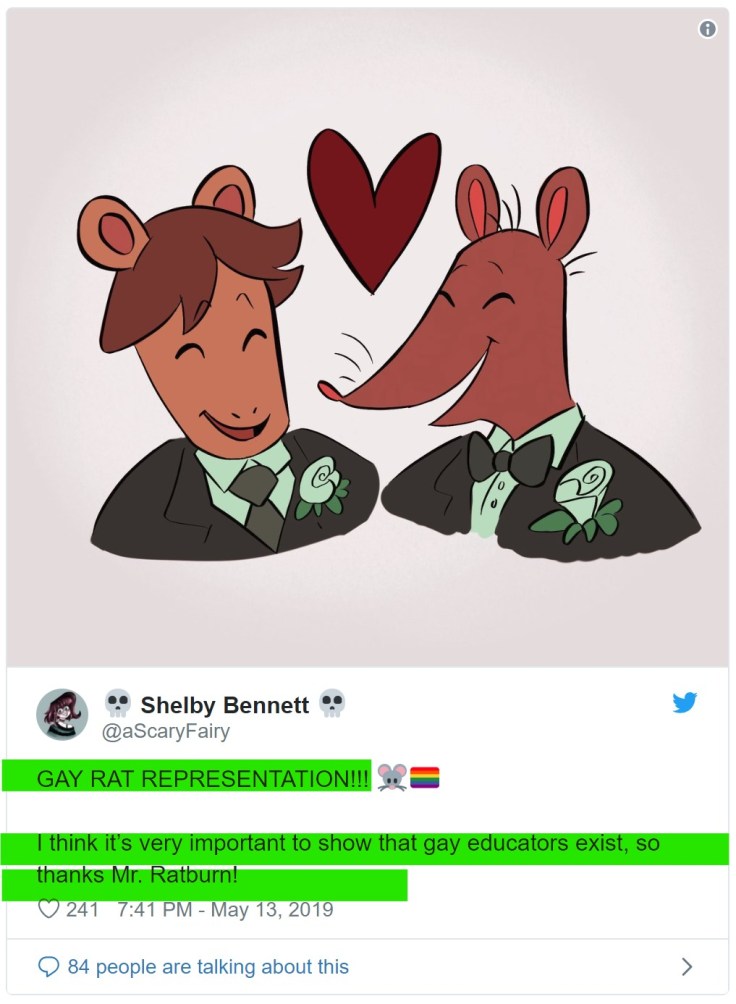
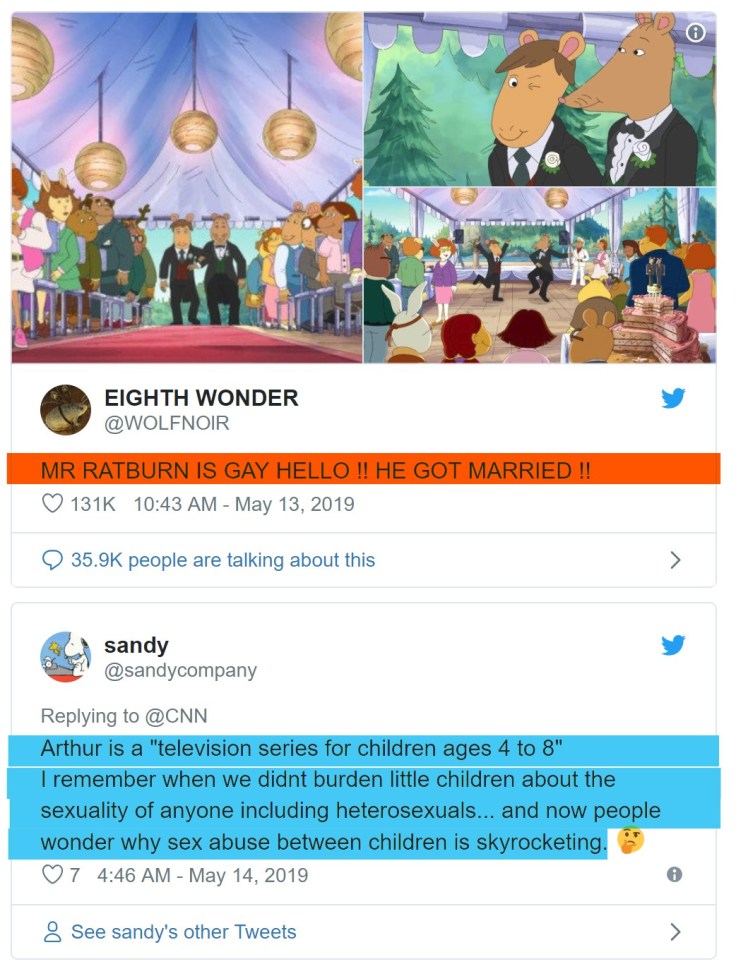
So, that’s exactly what the season premiere of the Public Broadcasting Service’s (PBS) “Arthur” cartoon delivered. The episode featured a surprise wedding between the titular aardvark’s humanoid rat teacher and his male partner who appears to also be an aardvark…as CNN put it, “leaving us all in happy tears.”

While many people seemed unsurprised that Mr. Ratburn, a ‘man’ whose principal interests include eating cake and bird-watching, turned out to be a homosexual, there were, nonetheless, heavy celebrations across social media post-nuptials.
Indeed, social justice warriors everywhere were hardly able to contain their glee over the inter-species, same-sex pairing up. If nothing else, the episode confirmed that even kids just barely out of toddlerhood can no longer avoid being pummelled with lessons about identity politics.
Arthur has been on the air for a whopping 22 SEASONS, making it the longest running children’s cartoon on television. So, perhaps we can chalk its success up to being so very in tune with the zeitgeist — and its willingness to take on responsibilities that might otherwise be left to parents. Like lessons about gay marriage, for example.
Should decisions of when and how to teach children about adult relationships really be made by television producers trying to impart their personal values onto everyone else’s kids? Regardless of whether the relationship is heterosexual or same-sex, marriage is hardly a topic many people would expect to be cropping up in a cartoon for four-year-olds.
What’s next? Are busy parents going to have to start vetting the shows their toddlers are watching and pick ‘liberal’ or ‘conservative’ ones depending on their own political persuasions? Can a parent not sit their child in front of a television show without wondering what wisdom and life lessons the friendly animated characters are going to be imparting next?
Of course, there’s no grave danger in a child learning about marriage and the basics of sexuality (some people are gay, some are straight, etc.), but are these topics really age-appropriate for the under-fives?
ALSO ON RT.COM‘Cartoons kill’: Kids’ movies show more death than adult ones, study finds
It’s not the first time that PBS has dealt with same-sex relationships in a supposedly child-friendly manner, either. The publicly-funded network ran an episode in 2005 which ambitiously featured two lesbian couples. Although, it appears on that occasion, “Arthur” was a bit ahead of its time and it was forced to pull the episode following parental complaints.
In a statement to People magazine, the network commented on the importance of accurately representing “the diversity of communities across the nation,” as well as the “wide array of adults in the lives of children who look to PBS KIDS every day.”
Social media reaction varied from extreme excitement that wedding bells were finally ringing for Mr. Ratburn to concern that PBS had taken their efforts to promote diversity and educate young kids a tad too far. Some were even downright angry that the channel had decided to “burden” children with thoughts of sexuality and adult relationships, homosexual or otherwise.
By Charlie Spiering
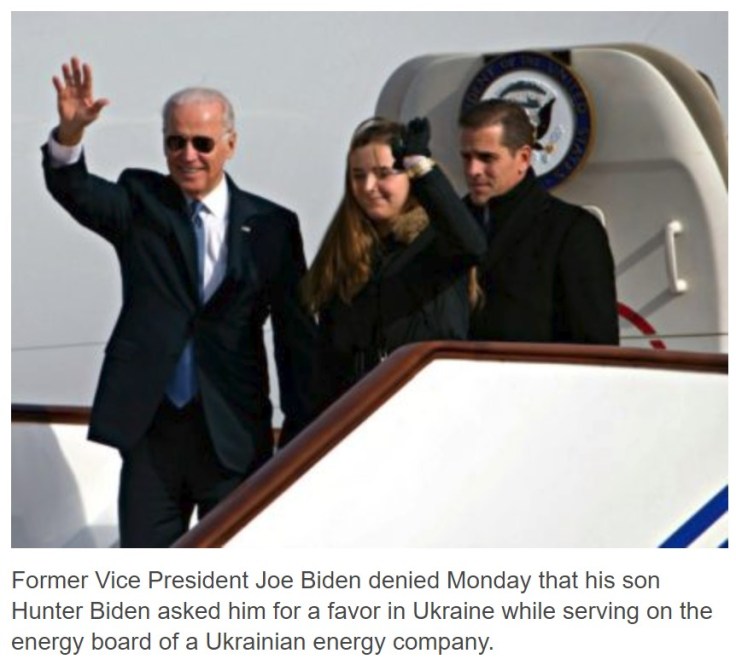
“We never once discussed it when he was there,” Biden told the Associated Press. “There’s not a single bit of evidence that’s been shown in any reporting that’s been done that he ever talked about it with me or asked any government official for a favor.”
When he was vice president, Joe Biden threatened to withhold $1 billion in loan guarantees for Ukraine if officials did not fire the country’s top prosecutor, who was pursuing a corruption investigation of an energy company while his son Hunter was serving on the board.
The connection was revealed in author Peter Schweizer’s best-selling book Secret Empires,and the reporting was confirmed in the New York Times.
Hunter Biden was paid as much as $50,000 per month while serving on the board, as his father led the Obama administration’s policy with Ukraine.
Biden’s “not a single bit of evidence” defense echoes former Secretary of State Hillary Clinton’s repeated assertion that there was no evidence of improper paybacks after she approved the Uranium One deal — despite receiving $145 million in pledges and donations for the Clinton Foundation.
Biden’s Ukraine connection made recent headlines after President Donald Trump’s personal attorney suggested he would travel to Ukraine to investigate the issue before ultimately deciding against it.
Biden criticized Giuliani for even considering the idea.
“I can’t remember any lawyer representing the president, conferring with the president, deciding to go overseas, where a government relies on U.S. largesse to try to get them to do something that everybody knows never happened,” Biden said during an interview with WMUR.
In the same interview, he also pointed to the reporting surrounding the conflict of interest.
“All the reports indicated that not a single, solitary thing was inappropriate about what my son did. He never talked to me. He never talked to anybody in the administration,” Biden said.
In his interview with the Associated Press, Biden defended his son’s role on the board.
“I have great confidence in my son,” he said. “He’s a man of great integrity.”
Researchers from Northwestern University performed an “algorithm audit” of the ‘Google Top Stories’ box, which is a major driver of traffic to news publishers and therefore prime online real estate. They examined results for nearly 200 searches relating to news events for one month in late 2017 and found “a left-leaning ideological skew.”
The researchers did allow some leeway for Google to defend itself, however, saying that while the left-leaning bias was detected, it is possible that the dominance of particular sources is a result of “successful strategic behavior” by those sources to achieve “algorithmic recognizability” — but whatever the reason, liberal sources still far eclipsed conservatives ones.
CNN, perhaps the outlet most-reviled by conservatives, was Google’s overall favorite source. Of the 6,302 articles appearing on Google’s ‘top stories’ during the month in focus, more than 10 percent came from CNN. The New York Times and Washington Post were up next, garnering 6.5 and 5.6 percent of the results, respectively.
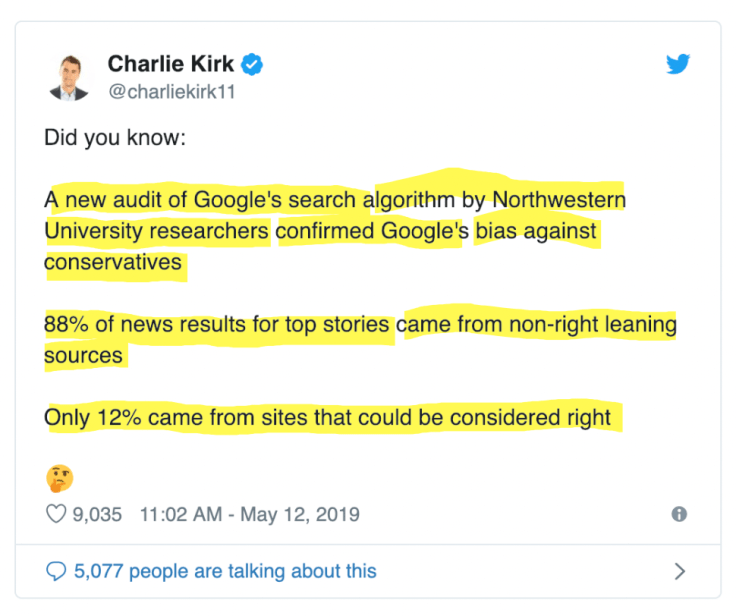
Fox News, the most mainstream right-wing outlet, was the source for only 3 percent of stories appearing in the top box. Then it was back to liberal outlets, with the BBC, USA Today, Los Angeles Times, The Guardian, Politico and ABC News filling out the rest of the top 10. Overall, 62.4 percent of the most common sources were left-leaning, while only 11.3 perfect were said to be right-leaning.
Ironically, despite the heavy promotion from Google in the online realm, CNN’s overall audience declined by a colossal 26 percent in April compared to a year earlier — and network boss Jeff Zucker admitted last November that CNN’s audience just “goes away” any time the channel switches from its (overwhelmingly negative) coverage of President Donald Trump to other topics. So it seems CNN is stuck in a vicious cycle; criticized for focusing too much on negative Trump stories, yet not being able to stop for fear of losing more viewers.
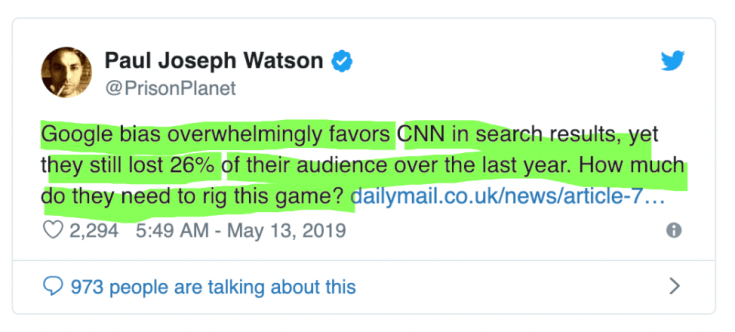
Perhaps an even more damning indictment than Google’s detected liberal bias, however, is that nearly all (86 percent) of the stories promoted by the search giant came from just 20 sources across the entire internet, which doesn’t exactly display much of a commitment to diversity of information and opinion.
ALSO ON RT.COM‘Poisonous connection’ of big tech: Google staff confer over anti-Trump search tweak
Publishers selected for the top box receive “a significant boost in traffic” which demonstrates Google’s ability to “pick winners and losers” based on where they decide to direct most of our attention. Such power and bias in favor of major sources could also be linked to the decline of local news, which is competing in an unfair online environment, the study suggested.
The detection of Google’s left-leaning preferences will hardly come as a shock to conservatives, who have been complaining in recent years that powerful online platforms like Facebook, Twitter and Google have all shown clear bias against conservative perspectives. The grumbling has not been without cause, either.
Most recently, Facebook slapped a number of popular conservative commentators with permanent lifetime bans — and Twitter has been caught out ‘shadowbanning’ Republicans and is accused of being quicker to suspend or ban conservative users over liberals for alleged rule-breaking.
Yet, while Facebook and Twitter have engaged in what many analysts and critics are calling direct political censorship, the story is more complicated when it comes to Google.
The researchers found that it’s not simply whether a source is left or right-leaning that determines whether it goes into the top stories box. Writing for the Columbia Journalism Review, one of the study authors acknowledged that there appears to be more news produced on the left overall, something which also affects the results. Even so, Google’s curation algorithms were still found to be “slightly magnifying” the already left-leaning skew in online news production.
Then there’s the bias toward timeliness; the fresher the story, the more likely it was to be promoted in the top box. The researchers called this Google’s “predilection towards recency” and said that huge news organizations like CNN which have the potential to quickly generate fresh content “may be better positioned” to garner more attention.
If Google really values diversity, the authors suggest it should acknowledge that high-quality journalism can have a longer shelf life and “consider relaxing the timeliness constraint to widen the scope of sources available to its curation algorithm.”
The results put to bed the notion, promoted by many Democrats and liberals that Google algorithm bias is a myth. Rep. Jerry Nadler last year called the notion of liberal bias online a “delusion” and a “right-wing conspiracy theory” — although Nadler, who chairs the House Judiciary Committee is still a chief proponent of the disproven conspiracy theory that Trump colluded with Russia to win the 2016 election.
Google has always denied that it is politically biased or abusing its monopoly position, but it looks like the search engine has plenty of work to do on its curation algorithms before it can convince anyone of its fairness.


 Tom's Blog