MAXINE WATERS WARNS FOES: ‘A BLACK WOMAN HAS THE GAVEL NOW — WILL HEAR THE SOUND ALL OVER THE WORLD!’

Maxine Waters warns foes: ‘A black woman has the gavel now — will hear the sound all over the world!’

“This is a new day and we’re not simply begging, we’re not simply pleading

American Mirror – FEBRUARY 25, 2019

Congresswoman Maxine Waters is now chairwoman of the powerful House Financial Services Committee, and she vowed Friday she would use her power to right what she sees as wrongs committed due to race.

While addressing Jesse Jackson’s Rainbow PUSH Wall Street Project, Waters praised Jackson, and warned there’s a new financial sheriff in town.

“I want this day to go down in honor of Rev. Jesse Jackson,” Waters told attendees, “in ways that is described as this is a new day.

“This is a new day and we’re not simply begging, we’re not simply pleading. A black woman has the gavel now,” she said as the crowd cheered wildly.

“And I’ve lived too long, experienced too much, struggled too hard not to use it. They will hear the sound of my gavel all over the world!” she said.

ust days before the Midterm elections, Waters warned she would use her committee power for paybacks.

“We have an election November 6th,” Waters said. “This is big. This may be the most important one that you’ve ever had to experience.

“This is the midterm election and often times people only vote in the presidential election because they don’t think this is important enough. But this is absolutely important,” she lectured.

“First of all, if we take back the House, most of the members of the Congressional Black Caucus will be chairs of the committees of the Congress of the United States of America,” Waters said, waving her fingers as the audience applauded.

“I will be the first African-American, the first woman to chair the powerful Financial Services Committee.

“That’s all of Wall Street. That’s all the insurance companies, that’s all the banks. And so, of course, the CEOs of the banks now are saying, ‘What can we do to stop Maxine Waters because if she gets in she’s going to give us a bad time?’” she said.

“I have not forgotten you foreclosed on our houses,” she warned.

“I have not forgotten that you undermined our communities,” she continued with the tone of a preacher.

“I have not forgotten that you sold us those exotic products, had us sign on the dotted line for junk,” she yelled, “and for mess that we could not afford.”

“I have people who are homeless who have never gotten back into a home. What am I going to do to you?

“What I am going to do to you is fair. I’m going to do to you what you did to us,” she vowed.

House Dems Ask For Secret Copy Of President’s Taxes…

By Hunter Walker

Screen Shot 2019-02-22 at 11.17.27 AM

WASHINGTON — House Democrats have asked for a confidential copy of President Trump’s tax returns from the IRS, but obtaining them won’t be simple or fast, Rep. Don Beyer, D-Va., said during an interview on Yahoo News’ “Skullduggery” podcast. Beyer said Democrats will need a “good legal rationale” to request Trump’s financial documents, adding that he believes the questions surrounding Trump’s ties to Russia are sufficient reason to ask for the documents.

Beyer is a member of the powerful House Committee on Ways and Means, which has the power to obtain a copy of President Trump’s tax returns thanks to an obscure law that’s almost a century old.

Trump’s tax returns have been something of a holy grail for Democrats who have consistently requested the release of the documents, particularly given the questions surrounding foreign business dealings at Trump’s sprawling real estate company. Beyer predicted that his committee will ultimately be able to get their hands on Trump’s elusive financial documents. But he explained that there are several obstacles to the process.

According to Beyer, the law allows “entities in Congress” to “request the tax return of any American citizen.” He said the Joint Taxation Committee theoretically could ask for the returns, but would be unlikely to do so due to Republican control of the Senate. This leaves the Ways and Means Committee, which is led by Democrats since they won control of the House last year. While Beyer said the Democrats on the committee have “begun the process,” he said it would be slow going.

“Our chairman, Richie Neal of Springfield, Mass., is going about this in a deliberate, thoughtful way. As he says, this is a really big, important, historic thing. He doesn’t want to not do it right. He wants to make sure that he’s crossing all the t’s and dotting all the i’s,” Beyer said.

Beyer said Neal had described some details about the process to his committee colleagues.

“As I understand it, at least as he’s explained it to us, the first step with his request is that the Internal Revenue Service will share it with him as the chairman confidentially,” Beyer said of Neal. “He will then review it and decide what can be shared with the full committee, and then ultimately, what can be shared with the American people.”

Trump became the first president in decades to break with longstanding tradition and not release his returns when he won the 2016 election. Democrats have consistently questioned what information might be in the documents, particularly given the questions surrounding foreign business dealings at Trump’s sprawling real estate company. Trump, who once promised to release the information, has cited a “routine audit” as why he has declined to do so.

While he stressed that he isn’t writing legal briefs on the issue, Beyer said he saw clear grounds for the request.

“There are so many suggestions that the president’s behavior with Russia, among others, … must be inextricably linked to his financial fortune. Why else would he give Putin a pass on damn near everything from Crimea to believing his intelligence rather than our own?” he said.

Beyer also predicted that Trump’s attorneys and allies would fight the release of the president’s returns.

“There is also anticipation that the White House is going to fight back right away, that once that request goes to them there’ll be requests for injunctions,” Beyer said.

Based on that opposition, Beyer predicted that Trump’s returns will remain hidden through the 2020 election.

“I think we need to do the best we can to get them, but it has been suggested more than once that it could be tied up in courts for two years,” he said.

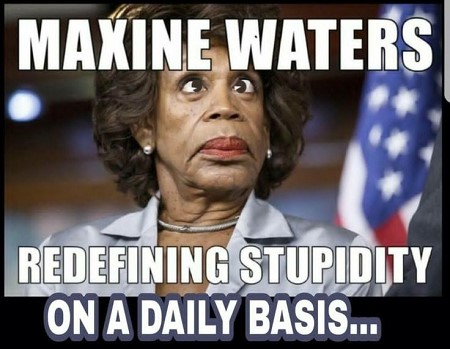
MAXINE MELTDOWN! Waters begs Americans to turn off TV during State of Union…

See the source image

by Kyle Olson

Maxine Waters doesn’t want to hear what Donald Trump has to say tonight.

The California congresswoman melted down when asked if she would be listening to Trump’s second State of the Union address this evening.

“I don’t even know why he wants to come and give the State of the Union,” Waters huffed to Essence magazine.

“The state of the union under him has not been good,” she claimed, dismissing record low unemployment rates for black Americans and strong economic activity.

“And he has been divisive, and I think he’s putting us all in harm’s way. And so he is not worthy of being listened to,” Waters sneered.

See the source image

“I don’t know why anybody would want to pay attention to anything that he has to say. He lies over and over again, like I said. 6,000 lies have been documented since he’s been there. I just can’t imagine what he’s going to try and say!” she said.

“But since he is a great liar, he’ll say anything,” and triggered Waters said, “uh, because he’s capable of saying anything without facts, without research. And so, I’m not looking forward to his State of the Union, and I hope people will turn the television off!”

Waters isn’t the only one triggered by Trump.

Last year, Luis Gutierrez, the illegal alien-loving congressman from Illinois, fled the House chamber.

Trump praised the Capitol building, calling it a monument to the American people.

As applause broke out, so did chants of “USA! USA! USA!”

Gutierrez left his seat as several Democrats patted him on the arm as he retreated to a safe space.

Watch:

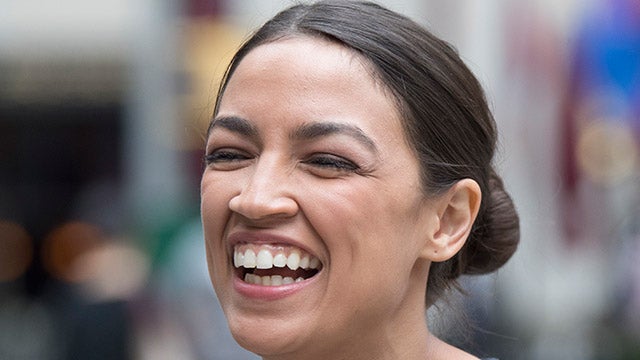
OCASIO-CORTEZ: Set To Party With Hollywood At Sundance… Medicare, free tuition for all! And she’s just getting started…

By

See the source image

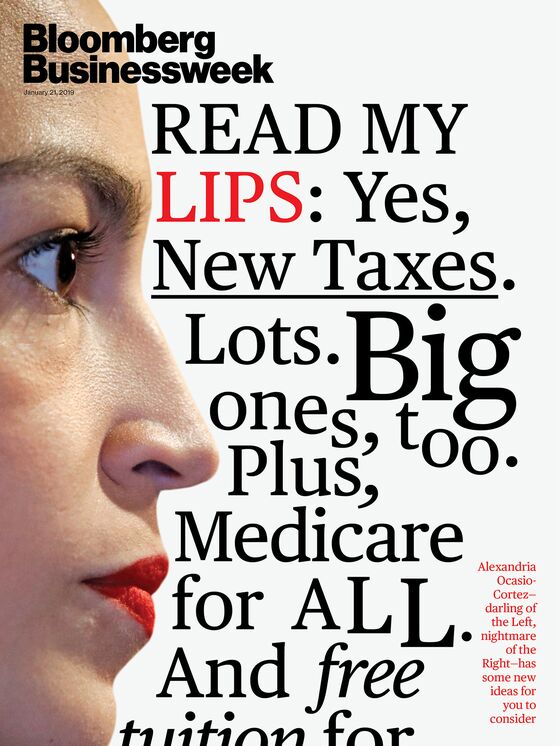
(Bloomberg Businessweek) — Alexandria Ocasio-Cortez might not have seen eye to eye with Joseph Overton, the late free-market advocate. But she has a firm grasp of the concept for which he is best known: the Overton Window. The term refers to the range of ideas that are at any given time considered worthy of public discussion. Thanks largely to her, the Overton Window on tax rates has just been moved significantly to the left.

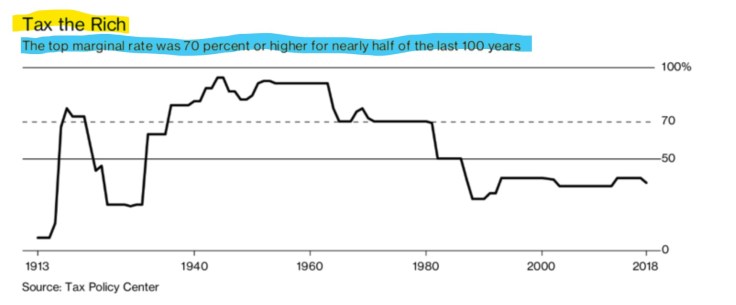
Ocasio-Cortez, the mediagenic 29-year-old from the Bronx, N.Y., is the youngest woman ever elected to the House of Representatives. In an appearance on 60 Minutes with Anderson Cooper that aired on Jan. 6, she was talking up the Green New Deal, a plan to move the U.S. to 100 percent renewable energy by 2035. Cooper challenged her by saying the program would require raising taxes. “There’s an element, yeah, where people are going to have to start paying their fair share,” she replied. Asked for specifics, she said, “Once you get to the tippy tops, on your 10 millionth dollar, sometimes you see tax rates as high as 60 or 70 percent.”


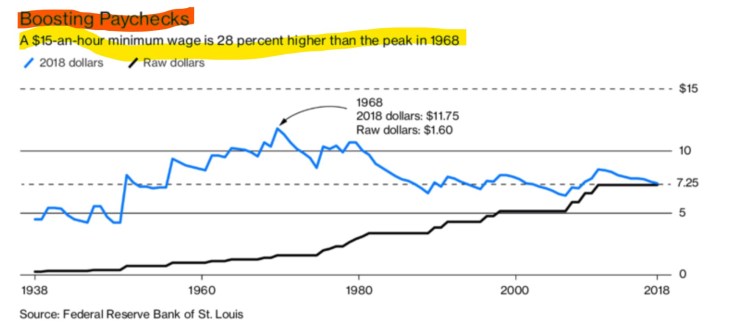
Seventy percent! For perspective, the top rate under the tax law that passed in December 2017 is 37 percent. And now, suddenly, a number so extreme that no one in polite society dared utter it became a focal point of debate. Ocasio-Cortez’s fans—she has 2.4 million followers on Twitter alone—loved it. Some pundits dug up economic research defending rates in the 70 percent range. Others pointed out that Ocasio-Cortez was actually lowballing the historical comparison: Top rates were 90 percent or higher as recently as the 1960s. Defenders of low tax rates heaped abuse on her, which backfired on them by inflaming her supporters.

See the source image

cap

What Ocasio-Cortez understands is that getting an idea talked about, even unfavorably, is a necessary, if insufficient, step on the path to adoption. (President Trump also gets this.) “It’s the easiest thing to say, ‘No, we can’t change anything,’ ” says Eric Foner, a Pulitzer Prize-winning historian who recently retired from Columbia University. “Most of the big ideas in American history started among radical groups who were told, ‘No, you’re never going to be able to achieve that.’ ” Foner sees parallels between the strategies of today’s left-leaning Democrats and the radical Republicans who fought slavery before the Civil War, “which was put out an agenda, be aware that you can’t just accomplish it all at once, obviously, but change the political discourse by pushing your agenda and then work with those who are willing to do some of it.”


Ocasio-Cortez was actually less radical than she could have been on 60 Minutes. She passed up the opportunity to move the Overton Window on another of her pet issues: budget deficits. She adheres to a doctrine called Modern Monetary Theory that’s catching on among young, left-leaning politicians and older policymakers alike.

Its counterintuitive core idea is that deficits don’t matter if you borrow in your own currency, just as long as they don’t cause inflation. Unless the economy is at risk of overheating, MMTers say, paying for a new government program doesn’t require cutting another or raising taxes.


Ocasio-Cortez could have said, “No, Anderson, we wouldn’t need to raise taxes to pay for the Green New Deal. But I want to raise taxes anyway, because I believe in redistributing money from the rich to the poor.” That really would have lit up the internet. Randall Wray, an MMT theorist who’s a senior scholar at the Levy Economics Institute of Bard College, wrote in an email that he was “a bit disappointed” that Ocasio-Cortez connected tax hikes to the Green New Deal. Stephanie Kelton, another MMT theorist and Bernie Sanders’s economic adviser during his race for the Democratic nomination in 2016, says she thinks reducing inequality is the real reason Ocasio-Cortez favors higher rates on the rich: “It’s kind of a recognition that levels of income and wealth inequality parallel those of the 1920s.”

cap

Whatever the particulars, Ocasio-Cortez wants to raise tax rates—by a lot. Since the Reagan Revolution of the 1980s, Democrats have been almost as allergic as Republicans to raising taxes. Hillary Clinton didn’t advocate increasing rates on top incomes at all during her 2016 presidential campaign. Even Sanders, that wild socialist from Vermont, dared propose a top rate of only 52 percent when he ran for president.

But with Ocasio-Cortez, antitax conservatives immediately sensed that a taboo was being broken, that a crack has opened up in the dam they’d spent decades building and reinforcing. Grover Norquist, the president of Americans for Tax Reform, who in 1986 devised the famous Taxpayer Protection Pledge that commits signers to vote against any net increases in taxes, on Twitter likened her proposal to slavery. “Slavery is when your owner takes 100% of your production. Democrat congresswoman Ocasio-Cortez wants 70% (according to CNN) What is the word for 70% expropriation?” he tweeted.

Alexandria Ocasio-Cortez Is the Darling of the Left, Nightmare of the Right

Norquist now says he remains confident that tax rates won’t rise to 70 percent, because “it’s such a bad idea.” In fact, he says he thinks Democrats are hurting only themselves by entertaining it. Ocasio-Cortez, he says, is a “pied piper” leading her party to its demise. It’s not at all clear, though, that higher taxes on the rich are a losing issue for Democrats. A Hill-HarrisX poll conducted on Jan. 12 and Jan. 13 found that 59 percent of registered voters supported the idea of raising the top rate to 70 percent. That included 45 percent of Republican voters. Thanks perhaps to the presidential campaign of Sanders, who like Ocasio-Cortez calls himself a democratic socialist, even “socialism” is no longer a dirty word: Gallup reported in August that 57 percent of Democrats and those leaning Democratic had a positive view of socialism, while only 47 percent had a positive view of capitalism.


What would a 70 percent top tax rate do to the U.S. economy and businesses? The rap on high rates is that they discourage work and promote wasteful tax-sheltering. Even many economists who think the rich pay too little say the better solution is to eliminate loopholes—subjecting more income to taxation rather than taxing a narrow base at a high rate.


Norquist argues that a 70 percent top rate would trigger an exodus of high-earning individuals from the U.S., saying that the last time U.S. rates were that high, they were also high in other nations, reducing the incentive to move. The Tax Foundation, a right-of-center think tank, said on Jan. 14 that a 70 percent top rate on ordinary income (not capital gains) exceeding $10 million “would not raise much revenue.” “Not much revenue” in this case means an estimated $189 billion in total over 10 years—or $292 billion before accounting for the likelihood that people in that tax bracket would work less and invest less in their noncorporate businesses.


On the other hand, economists supportive of Ocasio-Cortez were quick to point out that Denmark has among the world’s highest living standards despite a 56.5 percent tax rate on incomes above about $80,000 a year, a far lower threshold than her $10 million. A 2011 paper by Nobel laureate Peter Diamond of MIT and Emmanuel Saez of the University of California at Berkeley advocated top total tax rates (federal plus state) for the richest Americans of 73 percent on ordinary income (again, not capital gains). They assumed that an extra dollar of income for someone in that bracket has very little value in comparison to a dollar received by a lower-income person. Critics of their research have said Diamond and Saez treat the rich as sheep to be shorn and underestimate how much high tax rates would discourage people from getting advanced degrees or starting businesses. Diamond rejects the criticism, cites the need for more public investment, and says, “I’m perfectly comfortable” with Ocasio-Cortez’s 70 percent rate.

One thing that most people don’t know about Ocasio-Cortez is that she was a science nerd in high school in Westchester County, N.Y. In 2007, out of almost 1,500 students from 46 countries competing in the Intel International Science and Engineering Fair, she was one of four second-place winners in the microbiology category. (Her research was on the effect of antioxidants on roundworms.) It’s a biographical detail that adds another dimension to the story of a young woman born in the Bronx to parents of Puerto Rican descent who became the first in her family to attend college. While she was away at school her father died, pushing the family to the brink of financial ruin. “When you come from a working-class background, it often feels like you’re just one disaster away from everything falling apart,” she said in an Instagram video about a year ago.

cap

Like former President Barack Obama, Ocasio-Cortez became a community organizer after graduating from college, in 2011, and supported herself as a waitress and bartender. She worked for Sanders’s campaign in 2016. After that, things happened fast. She ran for the Democratic nomination in her Bronx-Queens congressional district and upset Joe Crowley. Chairman of the House Democratic Caucus, Crowley had been seen as a candidate to succeed Nancy Pelosi of California as speaker. He outspent Ocasio-Cortez 18 to 1 and had endorsements from New York Governor Andrew Cuomo, New York City Mayor Bill de Blasio, and both New York senators. She won huge.


No one shifts the Overton Window on any subject without strong communications skills, and Ocasio-Cortez is ninja-level in that department. She thrills supporters by going after critics hard on social media, which she uses the way an older generation used street rallies. “I’m a firm believer that organizing never stops,” she told Cooper in the 60 Minutes interview. One of her first acts after her election was to visit the office of Pelosi—not to seek her blessing but to support climate change activists who were occupying the soon-to-be speaker’s office. Now Ocasio-Cortez works two doors away from Pelosi—but not for her. She’s floated the idea of creating a progressive caucus among the Democrats, modeling it on the powerful Freedom Caucus on the right. Among her allies are new members Ilhan Omar of Minnesota, the first Somali-American elected to Congress; New Mexico’s Deb Haaland, one of the first American Indian women elected to Congress; and Rashida Tlaib of Michigan, the first Palestinian-American in Congress.

“This is a movement; this is not me,” Ocasio-Cortez said in an Instagram video last year.

Both Ocasio-Cortez and Trump are social media virtuosos. They excel at turning back attacks on their credibility. Attempts to challenge them on facts come across to their supporters as mean-spirited and unfair—the knee-jerk reaction of an establishment trying to suppress outside voices. So it was when Ocasio-Cortez mistakenly said on social media last year that the Pentagon had lost track of $21 trillion in funds, a figure that was about 30 times the Department of Defense’s annual budget. Unlike Trump, she corrects her mistakes. “The thing that’s hard is that you’re supposed to be perfect all the time on every issue and every thing,” she said on Instagram last year.

annotation 2019-01-17 160721

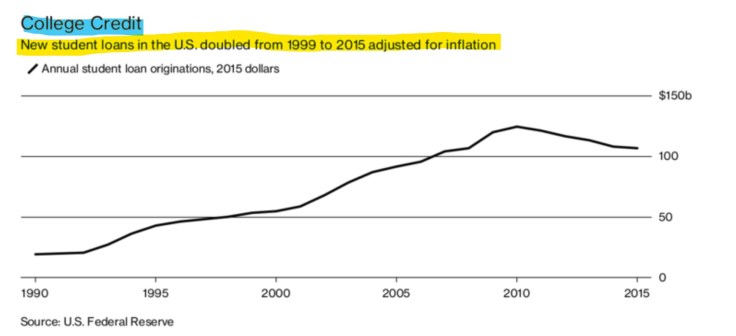
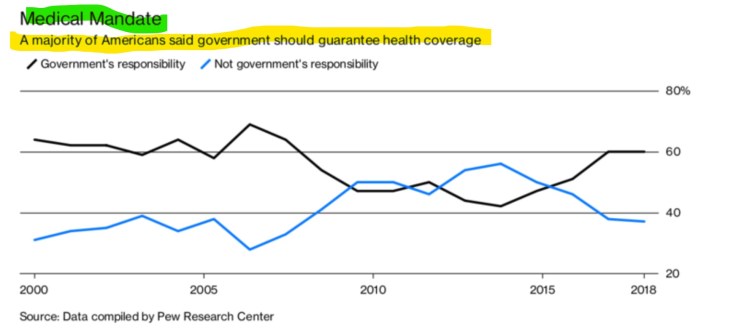
Implicit in that statement: Ocasio-Cortez has plenty more Overton Windows to shift and no intention of slowing down for the critics. Aside from the Green New Deal and higher taxes on the rich, she favors Medicare for all, a federal guarantee of a job, abolition of the U.S. Immigration and Customs Enforcement bureau, and tuition-free college or trade school. She also wants to slash military spending, ban assault weapons, and bring back Glass-Steagall, the Depression-era law that separated commercial and investment banks.


That may all sound like tail risk to American businesses, which have been enjoying deregulation under Trump. Saikat Chakrabarti, Ocasio-Cortez’s chief of staff, says, “This is the kind of plan where you can’t go to Wall Street executives first to try to get them to buy into it. You gotta show ’em.”

cap

The question is whether she’ll be able to show them, or anyone. A week after Ocasio-Cortez came to Washington, fellow Democrats complained that she was disruptive and not a team player. Chief among her sins: threatening to back the primary opponents of members of Congress who aren’t liberal enough for her. “I’m sure Ms. Cortez means well, but there’s almost an outstanding rule: Don’t attack your own people,” Representative Emanuel Cleaver II, a Missouri Democrat, told Politico. “We just don’t need sniping in our Democratic Caucus.”

To pass any of their initiatives, Ocasio-Cortez and her allies will have to defeat the proven Republican strategy of using budget deficits as a justification for opposing new spending. That’s where Modern Monetary Theory comes in. It says a government can spend money without raising taxes—indeed, without even borrowing from the public via bonds. The government simply creates new money to pay its bills. The only constraint on spending under MMT is that the government could use up too much of the nation’s productive capacity, which would result in high inflation. As long as inflation remains low, as it is now, deficits are no problem. The usual reply from other economists is that even a nation that owes debt in its own currency can suffer a crisis if investors lose faith in its ability to service the debt without resorting to the printing press.


One precinct where deficits still matter, and MMT most certainly does not, is the office of House Speaker Pelosi. On Jan. 3, under Pelosi’s direction, the House passed a set of rules including pay-as-you-go, which requires legislation that would increase the deficit to be offset by tax increases or spending cuts. PAYGO, as it’s known, is contrary to the spirit of MMT and hamstrings liberal Democrats by making most of their spending initiatives impossible. Ocasio-Cortez was one of only three Democrats to oppose the provision, along with Ro Khanna of California and Tulsi Gabbard of Hawaii.


Ocasio-Cortez had another setback when she was passed over for a coveted seat on the Ways and Means Committee, which oversees taxes, Social Security, and Medicare. But she recovered nicely by getting a seat along with other progressives on the powerful House Financial Services Committee, headed by Maxine Waters of California. Carolyn Maloney, a fellow New York Democrat, says, “I was once that young woman who others tried to rein in. I certainly don’t believe in doing that to anyone else. Representative Ocasio-Cortez is bringing new energy and a new approach, and we should all embrace that.”


Ocasio-Cortez’s disregard for political niceties is both her strongest quality as an activist and potentially her Achilles’ heel as a representative. She shows no sign of dialing back. One way or another, says Kelton, the economic adviser, “the conversation is shifting. The space is opening up.” —With Allison McCartney

‘THE SMOKING GUN’: Google Manipulated YouTube Search Results for Hot Topics …Leaked Convo: ’Tons of White- and Blacklists That Humans Manually Curate’… …Pro-Life Videos Demoted — After Left-Wing Journo Complaint!

screen shot 2019-01-16 at 11.19.47 am

By Allum Bokhari

In sworn testimony, Google CEO Sundar Pichai told Congress last month that his company does not “manually intervene” on any particular search result. Yet an internal discussion thread leaked to Breitbart News reveals Google regularly intervenes in search results on its YouTube video platform – including a recent intervention that pushed pro-life videos out of the top ten search results for “abortion.”

The term “abortion” was added to a “blacklist” file for “controversial YouTube queries,” which contains a list of search terms that the company considers sensitive. According to the leak, these include some of these search terms related to: abortion, abortions, the Irish abortion referendum, Democratic Congresswoman Maxine Waters, and anti-gun activist David Hogg.

The existence of the blacklist was revealed in an internal Google discussion thread leaked to Breitbart News by a source inside the company who wishes to remain anonymous. A partial list of blacklisted terms was also leaked to Breitbart by another Google source.

In the leaked discussion thread, a Google site reliability engineer hinted at the existence of more search blacklists, according to the source.

“We have tons of white- and blacklists that humans manually curate,” said the employee. “Hopefully this isn’t surprising or particularly controversial.”

Others were more concerned about the presence of the blacklist. According to the source, the software engineer who started the discussion called the manipulation of search results related to abortion a “smoking gun.”

The software engineer noted that the change had occurred following an inquiry from a left-wing Slate journalist about the prominence of pro-life videos on YouTube, and that pro-life videos were replaced with pro-abortion videos in the top ten results for the search terms following Google’s manual intervention.

“The Slate writer said she had complained last Friday and then saw different search results before YouTube responded to her on Monday,” wrote the employee. “And lo and behold, the [changelog] was submitted on Friday, December 14 at 3:17 PM.”
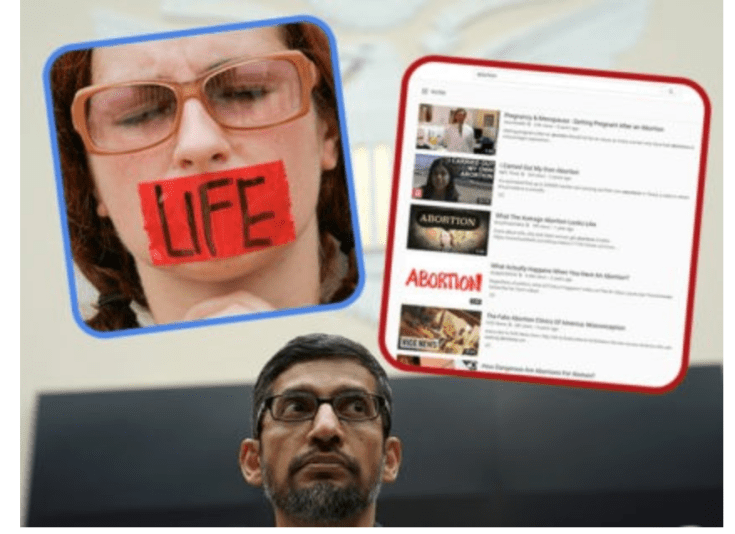
The manually downranked items included several videos from Dr. Antony Levatino, a former abortion doctor who is now a pro-life activist. Another video in the top ten featured a woman’s personal story of being pressured to have an abortion, while another featured pro-life conservative Ben Shapiro. The Slate journalist who complained to Google reportedthat these videos previously featured in the top ten, describing them in her story as “dangerous misinformation.”

Since the Slate journalist’s inquiry and Google’s subsequent intervention, the top search results now feature pro-abortion content from left-wing sources like BuzzFeed, Vice, CNN, and Last Week Tonight With John Oliver. In her report, the Slate journalist acknowledged that the search results changed shortly after she contacted Google.

The manual adjustment of search results by a Google-owned platform contradicts a key claim made under oath by Google CEO Sundar Pichai in his congressional testimony earlier this month: that his company does not “manually intervene on any search result.”

A Google employee in the discussion thread drew attention to Pichai’s claim, noting that it “seems like we are pretty eager to cater our search results to the social and political agenda of left-wing journalists.”

One of the posts in the discussion also noted that the blacklist had previously been edited to include the search term “Maxine Waters” after a single Google employee complained the top YouTube search result for Maxine Waters was “very low quality.”

Google’s alleged intervention on behalf of a Democratic congresswoman would be further evidence of the tech giant using its resources to prop up the left. Breitbart News previously reported on leaked emails revealing the company targeted pro-Democrat demographics in its get-out-the-vote efforts in 2016.

According to the source, a software engineer in the thread also noted that “a bunch of terms related to the abortion referendum in Ireland” had been added to the blacklist – another change with potentially dramatic consequences on the national policies of a western democracy.

youtube_controversial_query_blacklist

At least one post in the discussion thread revealed the existence of a file called “youtube_controversial_query_blacklist,” which contains a list of YouTube search terms that Google manually curates. In addition to the terms “abortion,” “abortions,” “Maxine Waters,” and search terms related to the Irish abortion referendum, a Google software engineer noted that the blacklist includes search terms related to terrorist attacks. (the posts specifically mentions that the “Strasbourg terrorist attack” as being on the list).

“If you look at the other entries recently added to the youtube_controversial_query_blacklist(e.g., entries related to the Strasbourg terrorist attack), the addition of abortion seems…out-of-place,” wrote the software engineer, according to the source.

After learning of the existence of the blacklist, Breitbart News obtained a partial screenshot of the full blacklist file from a source within Google. It reveals that the blacklist includes search terms related to both mass shootings and the progressive anti-second amendment activist David Hogg.

This suggests Google has followed the lead of Democrat politicians, who have repeatedly pushed tech companies to censor content related to the Parkland school shooting and the Parkland anti-gun activists. It’s part of a popular new line of thought in the political-media establishment, which views the public as too stupid to question conspiracy theories for themselves.

Here is the partial blacklist leaked to Breitbart:

2117 plane crash Russian

2118 plane crash

2119 an-148

2120 florida shooting conspiracy

2121 florida shooting crisis actors

2122 florida conspiracy

2123 florida false flag shooting

2124 florida false flag

2125 fake florida school shooting

2126 david hogg hoax

2127 david hogg fake

2128 david hogg crisis actor

2129 david hogg forgets lines

2130 david hogg forgets his lines

2131 david hogg cant remember his lines

2132 david hogg actor

2133 david hogg cant remember

2134 david hogg conspiracy

2135 david hogg exposed

2136 david hogg lines

2137 david hogg rehearsing

2120 florida shooting conspiracy

The full internal filepath of the blacklist, according to another source, is:

//depot/google3/googledata/superroot/youtube/youtube_controversial_query_blacklist

Contradictions

Responding to a request for comment, a YouTube spokeswoman said the company wants to promote “authoritative” sources in its search results, but maintained that YouTube is a “platform for free speech” that “allow[s]” both pro-life and pro-abortion content.

YouTube’s full comment:

YouTube is a platform for free speech where anyone can choose to post videos, as long as they follow our Community Guidelines, which prohibit things like inciting violence and pornography. We apply these policies impartially and we allow both pro-life and pro-choice opinions. Over the last year we’ve described how we are working to better surface news sources across our site for news-related searches and topical information. We’ve improved our search and discovery algorithms, built new features that clearly label and prominently surface news sources on our homepage and search pages, and introduced information panels to help give users more authoritative sources where they can fact check information for themselves.

In the case of the “abortion” search results, YouTube’s intervention to insert “authoritative” content resulted in the downranking of pro-life videos and the elevation of pro-abortion ones.

A Google spokesperson took a tougher line than its YouTube subsidiary, stating that “Google has never manipulated or modified the search results or content in any of its products to promote a particular political ideology.”

However, in the leaked discussion thread, a member of Google’s “trust & safety” team, Daniel Aaronson, admitted that the company maintains “huge teams” that work to adjust search results for subjects that are “prone to hyperbolic content, misleading information, and offensive content” – all subjective terms that are frequently used to suppress right-leaning sources.

He also admitted that the interventions weren’t confined to YouTube – they included search results delivered via Google Assistant, Google Home, and in rare cases Google ’s organic search results.

In the thread, Aaronson attempted to explain how search blacklisting worked. He claimed that highly specific searches would generate non-blacklisted results, even controversial ones. But the inclusion of highly specific terms in the YouTube blacklist, like “David Hogg cant remember his lines” – the name of an actual viral video – seems to contradict this.

Aaronson’s full post is copied below:

I work in Trust and Safety and while I have no particular input as to exactly what’s happening for YT I can try to explain why you’d have this kind of list and why people are finding lists like these on Code Search.

When dealing with abuse/controversial content on various mediums you have several levers to deal with problems. Two prominent levers are “Proactive” and “Reactive”:

  • Proactive: Usually refers to some type of algorithm/scalable solution to a general problem
    • E.g.: We don’t allow straight up porn on YouTube so we create a classifier that detects porn and automatically remove or flag for review the videos the porn classifier is most certain of
  • Reactive: Usually refers to a manual fix to something that has been brought to our attention that our proactive solutions don’t/didn’t work on and something that is clearly in the realm of bad enough to warrant a quick targeted solution (determined by pages and pages of policies worked on over many years and many teams to be fair and cover necessary scope)
    • E,g.: A website that used to be a good blog had it’s domain expire and was purchased/repurposed to spam Search results with autogenerated pages full of gibberish text, scraped images, and links to boost traffic to other spammy sites. It is manually actioned for violating policy

These Organic Search policies and the consequences to violating them are public

Manually reacting to things is not very scalable, and is not an ideal solution to most problems, so the proactive lever is really the one we all like to lean on. Ideally, our classifiers/algorithm are good at providing useful and rich results to our users while ignoring things at are not useful or not relevant. But we all know, this isn’t exactly the case all the time (especially on YouTube).

From a user perspective, there are subjects that are prone to hyperbolic content, misleading information, and offensive content. Now, these words are highly subjective and no one denies that. But we can all agree generally, lines exist in many cultures about what is clearly okay vs. what is not okay. E.g. a video of a puppy playing with a toy is probably okay in almost every culture or context, even if it’s not relevant to the query. But a video of someone committing suicide and begging others to follow in his/her footsteps is probably on the other side of the line for many folks.

While my second example is technically relevant to the generic query of “suicide”, that doesn’t mean that this is a very useful or good video to promote on the top of results for that query. So imagine a classifier that says, for any queries on a particular text file, let’s pull videos using signals that we historically understand to be strong indicators of quality (I won’t go into specifics here, but those signals do exist). We’re not manually curating these results, we’re just saying “hey, be extra careful with results for this query because many times really bad stuff can appear and lead to a bad experience for most users”. Ideally the proactive lever did this for us, but in extreme cases where we need to act quickly on something that is so obviously not okay, the reactive/manual approach is sometimes necessary. And also keep in mind, that this is different for every product. The bar for changing classifiers or manual actions on span in organic search is extremely high. However, the bar for things we let our Google Assistant say out loud might be a lot lower. If I search for “Jews run the banks” – I’ll likely find anti-semitic stuff in organic search. As a Jew, I might find some of these results offensive, but they are there for people to research and view, and I understand that this is not a reflection of Google feels about this issue. But if I ask Google assistant “Why do Jews run the banks” we wouldn’t be similarly accepting if it repeated and promoted conspiracy theories that likely pop up in organic search in her smoothing voice.

Whether we agree or not, user perception of our responses, results, and answers of different products and mediums can change. And I think many people are used to the fact that organic search is a place where content should be accessible no matter how offensive it might be, however, the expectation is very different on a Google Home, a Knowledge Panel, or even YouTube.

These lines are very difficult and can be very blurry, we are all well aware of this. So we’ve got huge teams that stay cognizant of these facts when we’re crafting policies considering classifier changes, or reacting with manual actions – these decisions are not made in a vacuum, but admittedly are also not made in a highly public forum like TGIF or IndustryInfo (as you can imagine, decisions/agreement would be hard to get in such a wide list – image if all your CL’s were reviewed by every engineer across Google all the time). I hope that answers some questions and gives a better layer of transparency without going into details about our “Pepsi formula”.

Best,

Daniel

The fact that Google manually curates politically contentious search results fits in with a wider pattern of political activity on the part of the tech giant.

In 2018, Breitbart News exclusively published a leaked video from the company that showed senior management in dismay at Trump’s election victory, and pledging to use the company’s power to make his populist movement a “hiccup” in history.

Breitbart also leaked “The Good Censor,” an internal research document from Google that admits the tech giant is engaged in the censorship of its own products, partly in response to political events.

Another leak revealed that employees within the company, including Google’s current director of Trust and Safety, tried to kick Breitbart News off Google’s market-dominating online ad platforms.

Yet another showed Google engaged in targeted turnout operations aimed to boost voter participation in pro-Democrat demographics in “key states” ahead of the 2016 election. The effort was dubbed a “silent donation” by a top Google employee.

Evidence for Google’s partisan activities is now overwhelming. President Trump has previously warned Google, as well as other Silicon Valley giants

Blog at WordPress.com.

Up ↑