‘We feel alien at home’: Austrians flood popular newspaper with desperate messages over migration

CAP

Austria’s largest newspaper has received an unexpected response after its columnist claimed that the term “population replacement” was not appropriate for the Alpine land. Hundreds of people said it is the reality they live in.

Austria’s Kronen Zeitung daily has admitted that it received“hundreds” of letters from its readers in just over a week, after they said they felt like foreigners in their own homeland because of mass immigration.

The strong response was provoked by the paper’s columnist, Conny Bischofberger. In an interview with Vice Chancellor Heinz-Christian Strache, she called the notion of “population replacement” a concept used by far-right extremists.”

ALSO ON RT.COMIntegration failure: Report finds 51% Vienna pupils don’t speak German at home

The term, which describes the gradual replacement of a native population by immigrants, is popular among those on the far-right. They use it to portray growing ethnic and religious diversity as a result of some deliberate malicious actions taken by “anti-popular forces.”

After she was confronted by people asking why they should not use the term, Bischofberger dismissed it in an explanatory piece as a conspiracy theory and a mere “feeling” that “may or may not correspond with the real general demographic developments.” However, she apparently failed to strike a chord with Kronen Zeitung readers, who sought to explain that this was a reality they have been living with for years.

On the streets, on public transport and in the municipal buildings: We feel alien at home.

“We were a happy household until 10 years ago. Then everything collapsed like a house of cards,” one person wrote to the newspaper.

“The mood in our condominium has deteriorated so much that we (65 and 68) are ready to move away to finally be able to live in peace again,” another couple wrote.
CAP

“Foreign-language parents with their children do not bother to speak our language… It’s sad, but one doesn’t feel well anymore,” another message read.

In our elementary school, no more excursions are conducted out of consideration for foreign languages, the diet is adapted to religious wishes and the violence of the foreign elementary school boys is frightening.

After receiving hundreds of similar messages, Bischofberger still insisted that, for many people, the notion of “population replacement” came in handy as it allowed them “not to think about the problem behind” mass immigration. However, she also admitted that “it would be cheap to defame all those people, who wrote to the Kronen Zeitung, as xenophobes, racists or far-right extremists.”

Those people were apparently asked “to accept too much migration” and did not receive enough attention from the authorities, the columnist said.

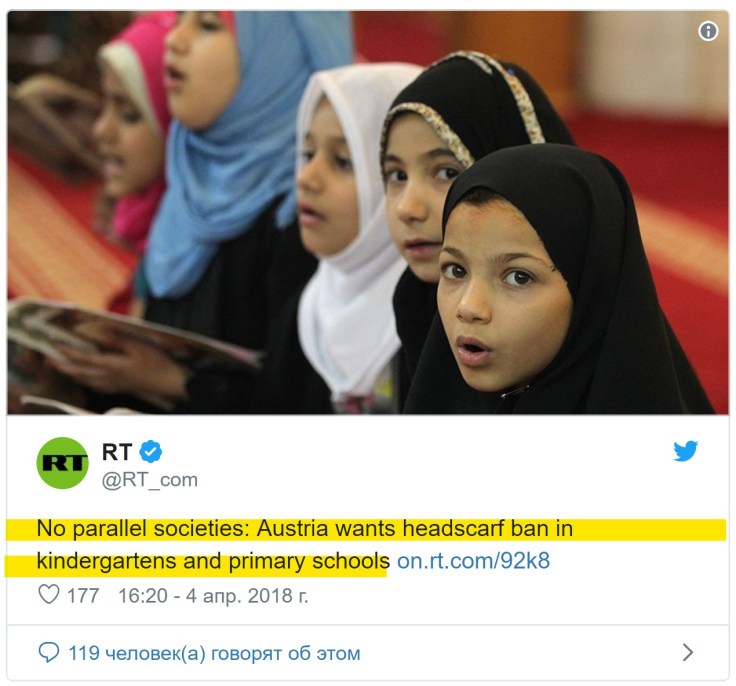
ALSO ON RT.COMTwitter up in arms after ex-Austrian MP says that girls wear headscarves to avoid migrant assaults

Austria took in one of the largest numbers of asylum seekers per capita during the refugee crisis. Some 150,000 people were accepted by the Alpine land since 2015 – which accounts for over one percent of its total population. Such developments gave rise to widespread anti-immigrant sentiment and brought a conservative coalition to power, which adopted a strict stance on migration.

Foreigners constitute 15.8 percent of the Austrian population, and 29.6 percent in the capital, Vienna, according to a 2018 survey. In February, a former MP from the conservative Austrian People’s Party, Marcus Franz, sparked a heated discussion on social media by saying that Austrian-born girls wear headscarves to prevent assaults from migrants on the streets of Vienna.

Anti-Defamation League Admits Colluding with Tech Giants to Facilitate Big Brother Censorship

CAP

This organization that foments hate against conservatives is doing everything in its power to manifest the Orwellian Nightmare.

By 

With pro-Trump voices being booted from Facebook and the social media crackdown ramping up before 2020, the Anti-Defamation League (ADL) is bragging about the legwork they have done to build up to this moment.

The ADL, once considered an admirable pro-Jewish organization that combated anti-Semitism, has turned into a partisan political censor facilitating Big Brother and trying to stifle President Donald Trump’s ‘America First’ agenda.

They admitted as much during a summit with the uber-globalist Council on Foreign Relations earlier this year where the organization’s leader bragged about enabling the tech giants’ push for extreme Draconian censorship.

“We work with Google on using AI to try and interrupt cyber-hate before it happens,” said Jonathan A. Greenblatt, Chief Executive Officer and National Director of the ADL, about his organization’s trailblazing work in the field of Orwellian pre-crime.

“We work with YouTube to get them to change their algorithms so it lessens the likelihood that a young person is going to run into some of these anti-Semitic conspiratorial videos,” he added.

Greenblatt brought up Facebook specifically and how the ADL enables the tech giant’s ability to manipulate information for the purposes of combating alleged hate. He deployed double-speak to justify his organization’s anti-constitutional push.

“So there are different ways [Facebook] can tweak their algorithms and adjust their products so they think not only about free speech… but protect the user’s right to not be harassed or hated,” he said.

He was particularly laudatory toward Facebook in how they were a front-runner in leading the charge toward Big Brother.

“They have done some good things to deal with very specific cases by taking swifter action when people perpetrate online bullying or online harassment,” Greenblatt said.

He feels that legislators should take further action in passing bills that would further destroy freedom of expression and other core liberties.

“There is a gap in the legal regime. There are techniques that extremists have used online to terrorize Jews and other people like doxing, and swatting and different forms of cyberbullying that are not covered by existing laws and need to be,” Greenblatt said.

He doesn’t seem particularly considered with left-wing terror groups like ANTIFA deploying these harmful tactics though. Democratic leaders like Reps. Ilhan Omar (D-MN) and Rashida Tlaib (D-MI) do not seem to be on his organization’s radar. Instead, his focus is entirely on restricting the speech of conservative and right-wing voices.

Greenblatt concluded by saying that “the abuse online can be far, far worse than anything physical” and that “we need legislators to catch up and fill some of the gaps.”

While the fake news media likes to ballyhoo about the Rooskies, it is organizations like the ADL that pose the real threat to the integrity of our democracy.

Report: Facebook Sets Up ‘War Room’ for European Elections

Zuckerberg to face pressure on taxes in meeting with Macron

By Lucas Nolan

Politico recently profiled Facebook’s new “European election war room” ahead of upcoming E.U. elections.

A recent report from Politico provides an insight into Facebook’s new “election war room” established ahead of the upcoming European election. Facebook has previously deployed a similar “war room” in the United States ahead of the midterm elections in November 2018. In October, Breitbart News reported on the war room providing an insight into the aim of the project. Facebook’s Product Manager of Civic Engagement, Samidh Chakrabarti, said in an interview that the war room is a physical room which will be used to “take quick and decisive action” against possible cases of foreign interference during the midterm elections.

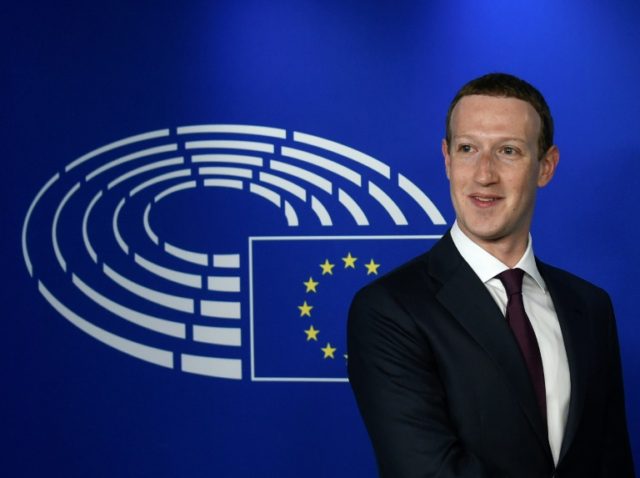
See the source image

“We have many measures that we’ve put in place to try to prevent problems: the political ad transparency, blocking fake accounts, combating foreign interference, and preventing the spread of misinformation. But we know we have to be ready for anything that happens,” stated Chakrabarti. “And so that’s why we’ve been building this war room, a physical war room [with] people across the company, of all different disciplines, who are there. So, as we discover problems that may come up in the hours leading up to the election, we can take quick and decisive action.”

Now, Politico has reported on the company’s efforts to establish a similar project in Dublin, Ireland ahead of the upcoming European elections. Politico described the project writing:

See the source image

The group of twentysomething coders, engineers and content specialists sit hunched over multiple screens, scanning the platform for potential illegal behavior. Wall-mounted television monitors keep them up to date on the latest chatter on the world’s largest social network, Instagram and WhatsApp. A single European Union flag hangs on the wall, next to a poster emblazoned with the slogan “New Ways of Seeing.”

Yet despite Facebook’s  40-person European election “operations center,” which got underway on April 29, the tech giant is struggling to keep on top of the threats.
Political groups from Hungary to Spain have been able to circumvent Facebook’s new political transparency tools to quietly buy partisan social media advertising aimed at swaying potential voters, according to an analysis by POLITICO. That includes paid-for messages by Viktor Orbán, the Hungarian prime minister, Verein Recht und Freiheit (Association for the Conservation of the Rule of Law and Civil Liberties), a support group for right-wing politicians in Germany and Petra De Sutter, a Belgian candidate for the Green Party.

It seems that Facebook is aware, however, of accusations of censorship and bias. The company’s chief lobbyist in Europe told Politico that Facebook is avoiding taking too harsh a line on the content allowed on the platform:

“We recognize that some people think we should remove everything,” said Richard Allan, Facebook’s chief lobbyist in Europe, in reference to the reams of political content now flooding the digital platform. “But we have concerns of removing everything during a political election.”

“We don’t believe it’s the right place to be for us to be the regulator of political campaigns,” he added. Facebook may not want the role, but its global reach puts it at the heart of the democratic process from France to the Philippines.


Politico described the new Dublin team tasked with monitoring misinformation, writing:

The team, which includes speakers of all of the EU’s 24 official languages, is split along national boundaries, with specialists — primarily men who would not look out of place in any startup office — monitoring activity on both Facebook’s social media platforms and those of rivals, notably Google and Twitter.

Facebook would not say how much content the group reviews daily, though each Facebook staffer had multiple screens open monitoring news events and other political discussions online.

Once an issue is flagged, Facebook’s engineers can then work with their counterparts across Europe and elsewhere to determine if the activity infringes the company’s standards, and then delete, play down or leave the content on the network, depending on the outcome. Topics for review include possible misinformation, voter suppression and hate speech, and the company said that it had investigated hundreds of incidents within the last week.

“Even though we’re a tech company, speaking face to face is invaluable,” said Sturdy, the Facebook executive.

SUPPORT PJW IN THE FIGHTBACK AGAINST CENSORSHIP

Support PJW in the Fightback Against Censorship

Here’s how you can help

 | Infowars.com – MAY 6, 2019

Facebook and the mainstream media are trying to silence me by falsely labeling me an “extremist”.

Conservatives and anyone who challenges the leftist orthodoxy are being deplatformed.

People have asked how they can support me.

I have created a SubscribeStar at https://www.subscribestar.com/paul-joseph-watson

The fight back against censorship requires resources.

I appreciate you having my back more than ever.

Please consider giving a small amount here if you wish to protect my voice from being silenced.

Or if you prefer, you can make a one time Paypal donation here.

Also, it’s imperative that you sign up for my free newsletter here so we can stay in touch.

CAP

WATCH: Walmart Leverages Tech Censorship For Lower Ad Rates According to Arkansas YouTuber

Boogie Walmart Tech CensorshipBoogie Walmart Tech CensorshipCAP

Boogie revealed that the tech censorship crisis may be inspired, at least partially, by advertisers’ desire for a lower rate.

By

During an appearance on the H3 podcast, the famous YouTuber revealed a personal conversation he had with a contact in Walmart advertising who said they do not care about big tech censorship, but are looking forward to the lower advertising rates they expect to pay as a result.

Facebook, Instagram, YouTube, and Twitter have all faced some extent of an advertiser boycott, with the blame levied on users who are deemed not to be “advertiser friendly.”

This has been YouTube’s excuse to demonetize popular right wing channels, and likely went into consideration for Twitter when they summarily banned Infowars, and Facebook and Instagram last week when they went a step further and said they would ban any user who so much as posted a link to Infowars video content or Alex Jones.

Boogie2988, a YouTube streamer who became famous for his parody videos, video game live streams, and for chronicling his weight loss journey, offered a nuanced take during the podcast.

“I know a lot of people that work at Walmart,” Boogie said on the podcast, “And I know people that work in advertising at Walmart, and somebody from Walmart, and I won’t say which person specifically, said to me ‘We don’t really care about any of that censorship crap, we don’t really care about any of the drama.’”

He continued, quoting his conversation with an anonymous Walmart advertising employee, “‘We care about lowering our bids, so we’re going to do a six months or one year hiatus, and when we come back, we’re going to have much lower bids.’”

If true, it would seem the exodus of large advertisers from big tech platforms, and the sacrifice of many large content creators that followed, may be driven almost entirely by finance.

If YouTube, Facebook, Instagram, and Twitter are perceived as dangerous places to advertise, the cost of doing so on the platforms would naturally decrease exponentially.

As Twitter user Justin Whang wrote succinctly, “Advertisers played YouTube like a fiddle.”

Facebook, Google Pour Big Money into Lobbying Congress While Blacklisting Conservatives

CAP

By Sean Moran

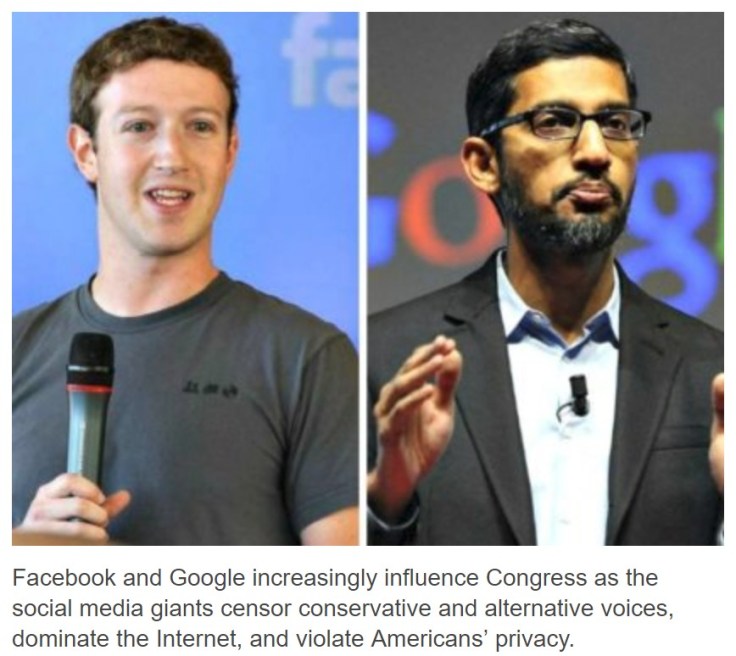
Facebook and Google increasingly influence Congress as the social media giants censor conservative and alternative voices, dominate the Internet, and violate Americans’ privacy.

Facebook announced on Thursday that they have banned several conservative personalities such as Infowars host Alex Jones, Infowars contributor and YouTube personality Paul Joseph Watson, journalist and activist Laura Loomer, and Milo Yiannopoulus. The social media giant also banned Louis Farrakhan from its platforms.

Facebook said that they banned these personalities because they were “dangerous.”

Amid calls for greater regulation of social media companies’ potential anticompetitive behavior, censorship of conservative and alternative voices, and privacy violations, Facebook and Google have remained at the top of Open Secret’s database of top spenders lobbying Congress.

So far in 2019, Facebook spent $3,400,000 and Google’s parent company, Alphabet, $3,530,00 in lobbying Congress. Alphabet also ranked as the eighth total highest spender in lobbying in 2018, spending $21,740,000, while Facebook spent $12,620,000.

Facebook’s influence has continued to rise over the years. In the early years of President Barack Obama, Facebook spent below one million dollars in 2008 and 2009. From 2011 to 2018, Facebook’s lobbying spending skyrocketed and reached historic highs in 2018, when they spent $12.6 million.

In 2019, Facebook lobbied heavily on H.R. 1644, the Save the Internet Act, a Democrat bill which would restore the Obama-era Federal Communications Commission (FCC) net neutrality regulations, which arose as the result of Google’s heavy lobbying of the Obama administration. In 2019, Google also lobbied on the Save the Internet Act.

See the source image

In 2018, one of Facebook’s bills on which they lobbied Congress was H.R. 2520, the Browser Act, sponsored by then Rep. and now Sen. Marsha Blackburn (R-TN), which would require social media companies such as Facebook and Google to obtain explicit permission from users for collecting their private data. The Browser Act would also stipulate that these social media companies cannot deny services to users who do not opt-in to these companies’ collection of their private data. In 2017, the Browser Act was the most important issue on Capitol Hill.

Sen. Blackburn said that her legislation would establish one set of rules that would balance the relationship between ISPs and Facebook and Google. The legislation would also prevent the social media giants from unfairly profiting off of Americans’ private data without their explicit consent.

“We need one set of rules for the entire internet ecosystem with the FTC [Federal Trade Commission] as the cop on the beat,” said Senator Blackburn. “The FTC has the flexibility to keep up with changes in technology and its principal mission is consumer protection. The BROWSER Act will enable consumers to make more educated decisions regarding the nature of their relationship with tech companies.”

In contrast, Alphabet’s most prominent issues in Congress in 2019 and 2018 related to labor and antitrust, as well as telecommunications and technology.

Facebook and Google’s dominance on the Internet has become increasingly apparent as Google has approximately 90 percent of web search traffic, whereas in digital advertising, Google and Facebook amount to nearly two-thirds of American digital ad spending, with Amazon at a “distant third” at under nine percent.

In 2018, Google lobbied Congress fourteen separate times on multiple pieces of legislation that would have increased liability for companies that enabled sex trafficking.

Facebook and Google’s influence in Congress extends to its trade group, the Internet Association. In the fourth quarter of 2018, the Internet Association spent $840,000. In total, the social media giants spent $2.6 million in 2018 for lobbying. In 2019, the association has spent $690,000 so far. Over the last two years, the Internet Association has focused on the Save the Internet Act as well as on legislation that would increase edge providers’ liability for hosting content that enables sex trafficking.

Facebook and Google influence political elections as well. During the 2018 election cycle, Alphabet donated:

  1. $223,269 to former Rep. Beto O’Rourke’s (D-TX) Senate campaign to unseat Sen. Ted Cruz (R-TX), a prominent critic of Silicon Valley censorship.

  2. $149,741 to Rep. Jacky Rosen’s Senate campaign (D-NV) to unseat Sen. Dean Heller (R-NV).

  3. $135,625 to Rep. Josh Harder’s congressional campaign.

  4. $124,508 to former Sen. Heidi Heitkamp’s unsuccessful re-election campaign.

  5. $97, 364 to former Sen. Claire McCaskill’s failed re-election campaign.

During the 2018 midterm elections, Facebook donated:

  1. $75,005 to O’Rourke’s Senate campaign.

  2. $37,954 to Sen. Doug Jones (D-AL) 2017 special Senate election against former Alabama judge Roy Moore.

  3. $34,534 to Heitkamp’s Senate election.

  4. $31,326 to McCaskill’s Senate campaign.

  5. $29,387 to Rosen’s successful campaign to unseat Heller.

As Facebook and Google and other social media giants continue to increasingly censor and blacklist conservative and alternative voices, more and more conservative voices have called for addressing the social media giants’ dominance of the Internet. Facebook and Google’s influence in Congress also relates to political confrontations; during a hearing in December 2018, the then-ranking member of the House Judiciary Committee delivered a sharp rebuke of Republican accusations of Google’s political bias affecting its search engines, even though Google was his top donor.

During a Senate Judiciary Committee hearing in April, Sen. Ted Cruz (R-TX) said  he envisions three potential remedies for big tech’s violation of free speech and dominance on the Internet.

Cruz’s three solutions include:

  1. Amending Section 230 of the Communications Decency Act
  2. Antitrust measures to address big tech’s dominant status on the Internet.
  3. Addressing potential cases of fraud and deception.

“No one wants to see the federal government regulating what is allowed to be said, but there are at least three potential remedies that can be considered by Congress or the administration or both,” Cruz said.

See the source image

Blog at WordPress.com.

Up ↑