
US media intensify pretext for ousting Trump
By Finian Cunningham
It’s no secret that since his election in 2016, powerful elements in the US political and media establishment have been running a non-stop campaign to remove Trump from the White House. Lately, the stakes have been raised.
Spearheading the media effort to defenestrate Trump are the New York Times and Washington Post. Both have been prominent purveyors of the “Russiagate” narrative over the past two years, claiming that Republican candidate colluded with Russian state intelligence, or at least was a beneficiary of alleged Russian interference, to win the presidency against Democratic rival Hillary Clinton.
Congressional investigations and a probe by a Special Counsel Robert Mueller, along with relentless media innuendo, have failed to produce any evidence to support the Russiagate narrative.
Now, the anti-Trump media in alliance with the Democratic leadership, the foreign policy establishment and senior ranks of the state intelligence agencies appear to have come up with a new angle on President Trump – he is a national security risk.
Ingeniously, the latest media effort lessens the burden of proof required against Trump. No longer has it to be proven that he deliberately collaborated with Russian President Vladimir Putin. Trump could have done it “unwittingly,” the media are now claiming, because he is a buffoon and reckless. But the upshot, for them, is he’s still a national security risk. The only conclusion, therefore, is that he should be removed from office. In short, a coup.
Over the past couple of weeks, the supposed media bastions have been full of it against Trump. An op-ed in the New York Times on January 5 by David Leonhardt could not have made more plain the absolute disdain. “He is demonstrably unfit for office. What are we waiting for?”
Follow-up editorials and reports have piled on the pressure. The Times reported how the Federal Bureau of Investigation – the state’s internal security agency – opened a counterintelligence file on Trump back in 2017 out of concern that he was “working for Russia against US interests.”

That unprecedented move was prompted partly because of Trump’s comments during the election campaign in 2016 when he jokingly called on Russia to release Hillary Clinton’s incriminating emails. Never mind the fact that Russian hackers were not the culprits for Clinton’s email breach.
Then the Washington Post reported former US officials were concerned about what they said was Trump’s “extraordinary lengths” to keep secret his private conversations with Russia’s Putin when the pair met on the sidelines of conferences or during their one-on-one summit in Helsinki last July.
The Post claimed that Trump confiscated the notes of his interpreter after one meeting with Putin, allegedly admonishing the aide to not tell other officials in the administration about the notes being sequestered. The inference is Trump was allegedly in cahoots with the Kremlin.
This week, in response to the media speculation, Trump was obliged to strenuously deny such claims, saying: “I have never worked for Russia… it’s a big fat hoax.”
What’s going on here is a staggering abuse of power by the US’ top internal state intelligence agency to fatally undermine a sitting president based on the flimsiest of pretexts. Moreover, the nation’s most prominent news media outlets – supposedly the Fourth Estate defenders of democracy – are complacently giving their assent, indeed encouragement, to this abuse of power.
The Times in the above report admitted, in a buried one-line disclaimer, that there was no evidence linking Trump to Russia.
Nevertheless, the media campaign doubled down to paint Trump as a national security risk.
The Times reported on January 14 about deep “concerns” among Pentagon officials over Trump’s repeated threats to withdraw the US from the North Atlantic Treaty Organization (NATO). The reporting portrays Trump as incompetent, ignorant of policy details and habitually rude to American allies. His capricious temper tantrums could result in the US walking away from NATO at any time, the newspaper contends.
Such a move would collapse the transatlantic partnership between the US and Europe which has “deterred Soviet and Russian aggression for 70 years,” claimed the Times.

The paper quotes US Admiral James Stavridis, the former supreme allied commander of NATO, calling Trump’s withdrawal whims “a geopolitical mistake of epic proportion.”
“Even discussing the idea of leaving NATO — let alone actually doing so — would be the gift of the century for Putin,” added Stavridis.
The Times goes on to divulge the media campaign coordination when it editorialized: “Now, the president’s repeatedly stated desire to withdraw from NATO is raising new worries among national security officials amid growing concern about Mr Trump’s efforts to keep his meetings with Mr Putin secret from even his own aides, and an FBI investigation into the administration’s Russia ties.”
Still another Times report this week reinforced the theme of Trump being a national security risk when it claimed that the president’s Middle East policy of pulling troops out of Syria was “losing leverage” in the region. It again quoted Pentagon officials “voicing deepening fears” that Trump and his hawkish National Security Advisor John Bolton “could precipitate a conflict with Iran”.
That’s a bit hard to stomach: the Pentagon being presented as a voice of sanity and peace, keeping vigilance over a wrecking-ball president and his administration.
READ MORE: Twitter erupts after NYT reveals FBI probe into Trump-Russia links that lead… nowhere
But the New York Times, Washington Post and other anti-Trump corporate media have long been extolling the military generals who were formerly in the administration as “the adults in the room.”
Generals H.R. McMaster, the former national security adviser, John Kelly, Trump’s ex-chief of staff, and James Mattis, the former defense secretary until he was elbowed out last month by the president, were continually valorized in the US media as being a constraining force on Trump’s infantile and impetuous behavior.
The absence of “the adults” seems to have prompted the US media to intensify their efforts to delegitimize Trump’s presidency.
A new House of Representatives controlled by the Democratic Party has also invigorated calls for impeachment of Trump over a range of unsubstantiated accusations, Russian collusion being prime among them. But any impeachment process promises to be long and uncertain of success, according to several US legal and political authorities.
Such a tactic is fraught with risk of failing, no doubt due to the lack of evidence against Trump’s alleged wrongdoing. A failed impeachment effort could backfire politically, increase his popularity, and return him to the White House in 2020.

Given the uncertainty of impeaching Trump, his political enemies, including large sections of the media establishment, seem to be opting for the tactic of characterizing him as a danger to national security, primarily regarding Russia. Trump doesn’t have to be a proven agent of the Kremlin – a preposterous idea. Repeated portrayal of him as an incompetent unwitting president is calculated to be sufficient grounds for his ouster.
When the Washington Post editorial board urges a state of emergency to be invoked because of “Russian meddling in US elections”, then the national mood is being fomented to accept a coup against Trump. The media’s fawning over the Pentagon and state intelligence agencies as some kind of virtuous bastion of democracy is a sinister signal for a military-police state.
Think your friends would be interested? Share this story!
Tom Fitton: No evidence Trump is Russia agent
Published on Jan 14, 2019
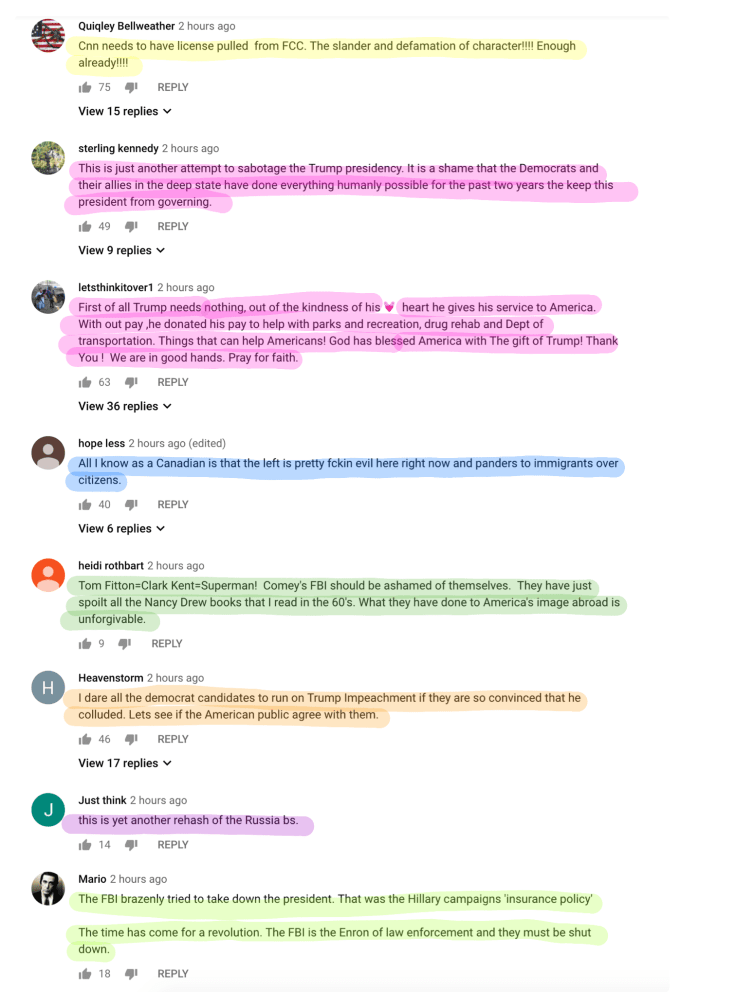
Twitter erupts after NYT reveals FBI probe into Trump-Russia links that lead… nowhere

Russiagate disciples are squealing with joy after the New York Times wrote about the FBI apparently probing if Trump was secretly working for the Russians. In fact, the article states there is no evidence to support the theory.
In what appears to be a last-ditch Russiagate Hail Mary, the New York Times breathlessly reported on Friday – of course, citing people ‘familiar with the investigation’ – that the FBI began looking into whether the president was a covert Kremlin agent, after Trump fired then-FBI Director James Comey in May 2017. According to the Times, “agents and senior FBI officials had grown suspicious of Mr. Trump’s ties to Russia during the 2016 campaign,” but were reluctant to launch a formal probe into the matter. This all changed, the Times tells us, after Comey got the boot.
The investigation was quickly handed over to special counsel Robert Mueller, who continues to lead a probe into alleged Russian meddling in the 2016 election and collusion with Trump’s presidential campaign.
According to the Times, counterintelligence investigators “had to consider whether the president’s own actions constituted a possible threat to national security.” Agents were also tasked with determining whether Trump “knowingly work[ed] for Russia or had unwittingly fallen under Moscow’s influence.”
The decision to secretly investigate the president for possibly threatening national security triggered a “vigorous debate” within the Justice Department. The FBI, however, apparently felt vindicated after Trump remarked that Comey’s firing had helped relieve Russia-related political pressure.
Among Russiagate’s devout faithful, the report was treated as an earth-shattering revelation that reinforced their core dogma – i.e., that Donald Trump is a Kremlin agent installed in the White House by Vladimir Putin to destroy democracy.
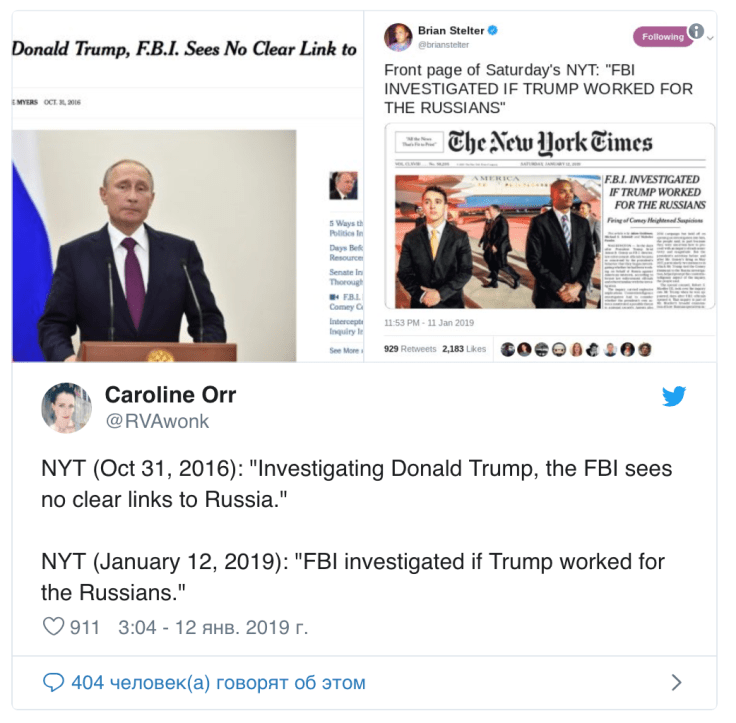
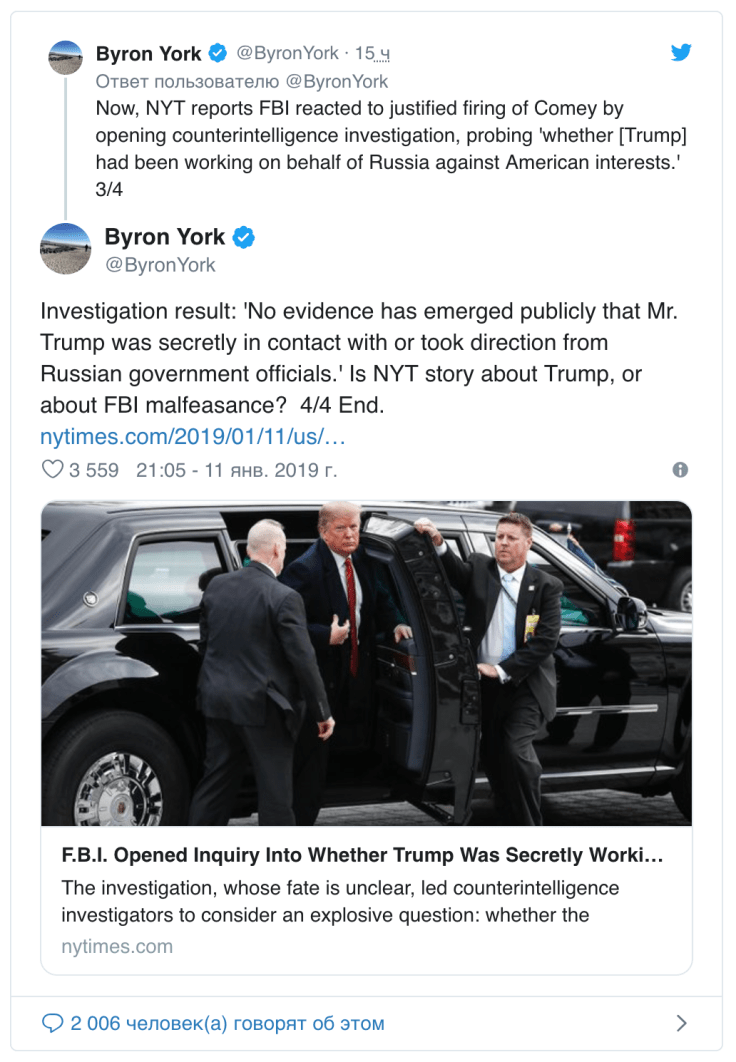
Unfortunately, even the Times begrudgingly admitted – albeit buried in the ninth paragraph – that “no evidence has emerged publicly that Mr. Trump was secretly in contact with or took direction from Russian government officials.”
Indeed, Twitter was swamped with indignant comments accusing the paper of cooking up a massive nothingburger. One observant netizen pointed out that in October 2016, the New York Times even ran a headline that stated unequivocally: “Investigating Donald Trump, the FBI sees no clear links to Russia.”
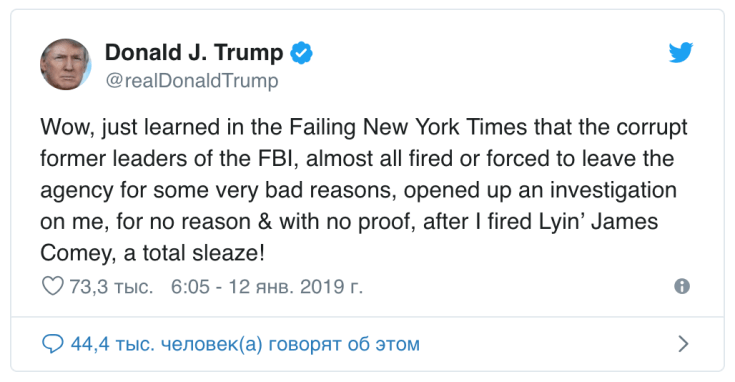
Trump himself took to Twitter to mock the report.
“Wow, just learned in the Failing New York Times that the corrupt former leaders of the FBI, almost all fired or forced to leave the agency for some very bad reasons, opened up an investigation on me, for no reason & with no proof, after I fired Lyin’ James Comey, a total sleaze!” he wrote.
The White House said in a statement that the notion that Trump was in bed with Russia makes little sense, given the administration’s hardline policies directed at Moscow.
“Unlike President Obama, who let Russia and other foreign adversaries push America around, President Trump has actually been tough on Russia.”
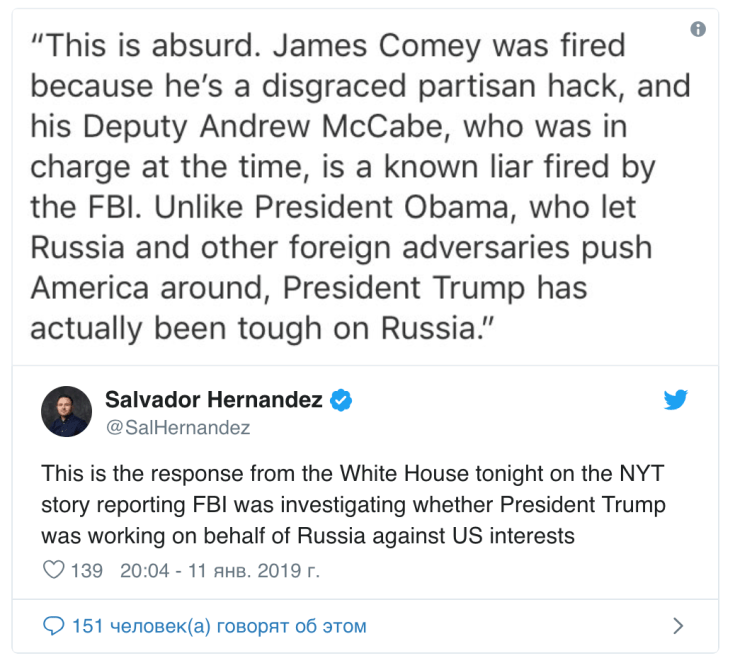
The report also raises questions about whether Comey was being entirely truthful when he testified to Congress in December that Trump wasn’t among the “four Americans” targeted by the FBI counterintelligence probe into Russian meddling.
As one political pundit observed, the Times’ story raises more questions about the FBI than it does about Trump and his still unproven ties to Russia.
“Is NYT story about Trump, or about FBI malfeasance?” Fox News contributor Byron York asked in a tweet.
Schumer says ‘enough with the memes’ in attack on Trump, gets bombarded by sea of memes

US Senate Minority Leader Chuck Schumer inadvertently activated the meme-generating powers of President Donald Trump‘s supporters after criticizing his handling of the government shutdown on Twitter.
“Enough with the memes. Just quit hurting innocent people and re-open the government,” Schumer tweeted on Saturday in response to a ‘Game of Thrones’-inspired meme that Trump had tweeted earlier to champion his border security fence project.

Trump tweeted a photo showing a barrier of steel slats below an image of his frowning face. The photo was captioned “The Wall is Coming,” channeling the famous “Winter is Coming” motto from the popular HBO series.
READ MORE: ‘Wall is Coming’: Trump raises stakes with another Game of Thrones meme
It was not the first time that Trump altered the Stark House slogan to bolster his agenda. Back when he reintroduced sanctions against Iran in November, the president tweeted a photo with “Sanctions are Coming. November 5” transposed over his image.
The president’s clumsy meme-making was entirely lost on Schumer, who chided Trump for indulging in picture-editing instead of working to reopen the government, now in its third week of shutdown.
The Twittersphere’s response was instantaneous: Schumer’s comments were flooded with dozens of memes.
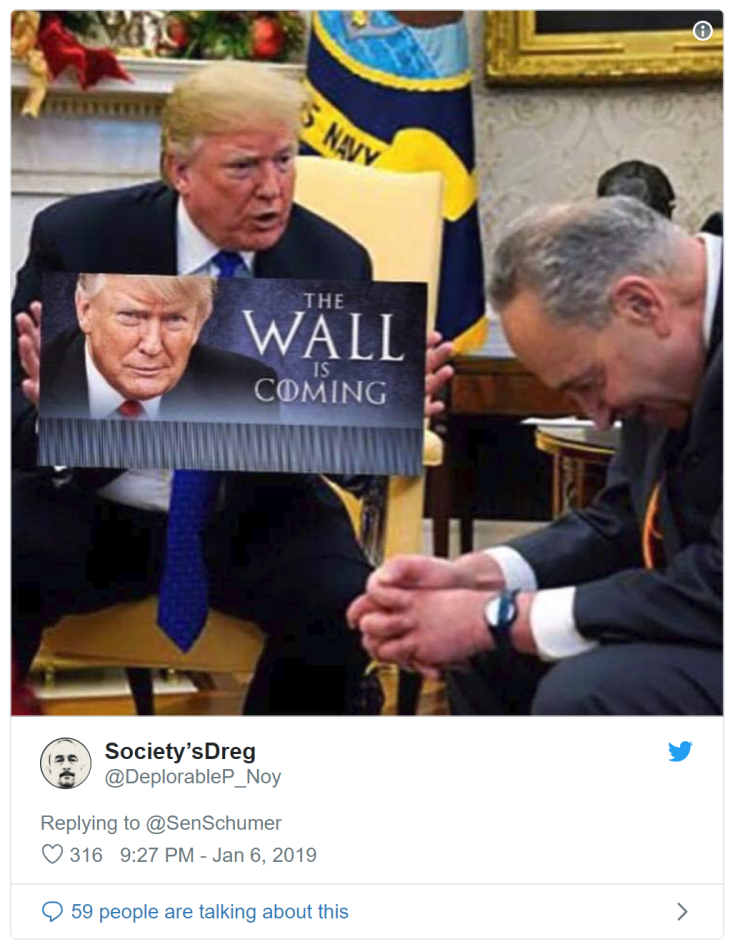

The unproven ‘Russia collusion’ allegations were also brought up.

The anti-Trump resistance crowd entered the meme battle with a few sorties of their own, dragging the Mueller investigation, the “blue wave,” and impeachment calls into the snowballing thread.
Irony alert: Firm that warned Americans of Russian bots…was running an army of fake Russian bots

By Danielle Ryan
The co-founders of cybersecurity firm New Knowledge warned Americans in November to “remain vigilant” in the face of “Russian efforts” to meddle in US elections. This month, they have been exposed for doing just that themselves.
Ryan Fox and Jonathan Morgan, who run the New Knowledge cybersecurity company which claims to “monitor disinformation” online, penned a foreboding op-ed in the New York Times on November 6, about “the Russians” and their nefarious efforts to influence American elections.
At the time, it struck me that Fox and Morgan’s reasoning seemed a little far-fetched. For example, one of the pieces of evidence presented to prove that Russia had targeted American elections was that lots of people had posted links to RT’s content online. Hardly a smoking gun worthy of a Times oped.
ALSO ON RT.COMThe only ‘Russian bots’ to meddle in US elections belonged to Democrat-linked ‘experts’Morgan and Fox, intrepid cyber sleuths that they are, claimed in the article they had detected more “overall activity” from ongoing Russian influence campaigns than social media companies like Facebook and Twitter had yet revealed — or that other researchers had been able to identify.

The New Knowledge guys even authored a Senate Intelligence Committee report on Russia’s alleged efforts to mess with American democracy. They called it a “propaganda war against American citizens.” Impressive stuff. They must be really good at their job, right?

This week, however, we learned that New Knowledge was running its own disinformation campaign (or “propaganda war against Americans,”you could say), complete with fake Russian bots designed to discredit Republican candidate Roy Moore as a Russia-preferred candidate when he was running for the US senate in Alabama in 2017.
The scheme was exposed by the New York Times — the paper that just over a month earlier published that aforementioned oped, in which Fox and Morgan pontificated about Russian interference online.
New Knowledge created a mini-army of fake Russian bots and fake Facebook groups. The accounts, which had Russian names, were made to follow Moore. An internal company memo boasted that New Knowledge had “orchestrated an elaborate ‘false flag’ operation that planted the idea that the Moore campaign was amplified on social media by a Russian botnet.”
Moore lost the race by 1.5 percent. To be fair, accusations published by the Washington Post that he pursued underage girls back in the 1980s may have had something to do with it as well, but that’s a different story.
Of course, New Knowledge and even the New York Times, which blew the lid of the operation, are trying to spin this as some kind of “small experiment” during which they “imitated Russian tactics” online to see how they worked. Just for research, of course. They have also both claimed that the scheme, dubbed ‘Project Birmingham’ had almost no effect on the outcome of the race.
The money for the so-called research project came from Reid Hoffman, the billionaire co-founder of LinkedIn, who contributed $750,000 to American Engagement Technologies (AET), which then spent $100,000 on the New Knowledge experiment. After the scheme was exposed, Hoffman offered a public apology, saying he didn’t know exactly how the money had been used and admitting that the tactics were “highly disturbing.”
ALSO ON RT.COMLinkedIn billionaire ‘sorry’ for funding ‘Russian bot’ disinformation campaign against Roy MooreIf people like Fox and Morgan actually cared about so-called Russian meddling or the integrity of American elections, they would not have run the deceptive campaign against Moore, no matter how undesirable he was as a candidate. Their sneaky and deceitful methods are in total contrast to the public profile they have cultivated for themselves as a firm fighting the good fight for the public good. But is it really that much of a surprise?
You would think that a newspaper like the New York Times would have cottoned on to the fact that guys like Fox and Morgan, with their histories in the US military and intelligence agencies, have clear agendas and are not exactly squeaky clean or the most credible sources of information when it comes to anything to do with Russia. But that kind of insight or circumspection might be too much to ask for in the age of Russiagate.
Facebook removed Morgan’s account on Saturday for “engaging in coordinated inauthentic behavior” around the Alabama election. Three days after publishing its initial article on the scandal (the one in which it played down the effects of New Knowledge’s disinfo campaign), the New York Times published a follow-up piece about the Facebook removal, in which it admitted that the controversy would be a “stinging embarrassment” for the social media researcher, noting that he had been a “leading voice” against supposed Russian disinformation campaigns.
In Fox and Morgan’s original NYT oped, they warned of the ubiquitous “Russia-linked social media accounts” and estimated that “at least hundreds of thousands, and perhaps even millions” of US citizens had engaged with them online. One must now wonder, were they including their own fake Russian bots in that count, or were they leaving those ones out?
It’s nearly two years into the Trump presidency and still we have no solid evidence that the Russian “collusion” theory is anything more than a fantasy concocted by Democrats desperate to provide a more palatable reason for Hillary Clinton’s loss than the fact that she simply ran a bad campaign.
In fact, at this point, we actually have more solid and irrefutable evidence of election meddling from the likes of dodgy American and British companies like Cambridge Analytica and New Knowledge than we do of any meddling orchestrated by Russia.
Like this story? Share it with a friend!
LinkedIn billionaire ‘sorry’ for funding ‘Russian bot’ disinformation campaign against Roy Moore
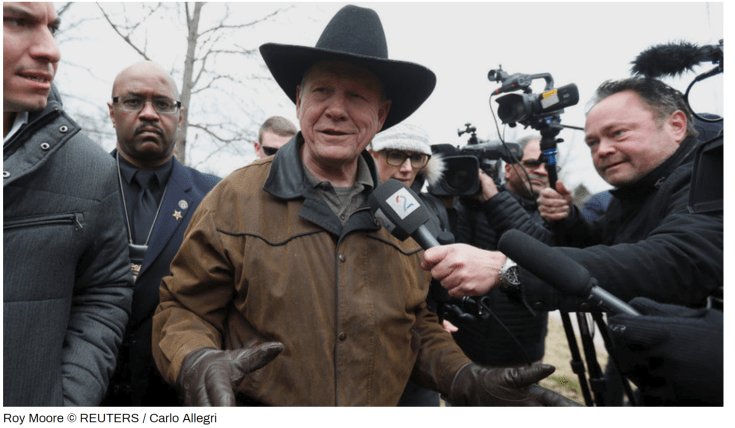
The co-founder of LinkedIn, Reid Hoffman, has apologized to Republican Roy Moore for funding an organisation that faked a ‘Russian bot’ involvement to mar his election campaign in Alabama.
American Engagement Technologies (AET), which Hoffman gave $750,000 to, put $100,000 of the entrepreneur’s money towards New Knowledge, a cybersecurity firm which fabricated some 1,000 Russian language Twitter accounts to follow Moore.
The company used the tactic to link the controversial Republican to so-called Russian influence campaigns and then fed it to the mainstream media. They also created misleading Facebook pages urging Republicans to support a ‘write-in’ candidate instead of supporting Moore. The ploy was revealed by New York Times earlier this month.
“I find the tactics that have been recently reported highly disturbing,” Hoffman told the Washington Post. “For that reason, I am embarrassed by my failure to track AET — the organization I did support — more diligently as it made its own decisions to perhaps fund projects that I would reject.”
AET is ran by former Barack Obama administration official, Mikey Dickerson, who previously helped the US government with its adoption of new technology.
Last week, Facebook suspended five accounts linked to the operation for “engaging in coordinated inauthentic behavior.”One of the accounts belonged to the CEO of New Knowledge, Jonathon Morgan, who claims he was acting alone as a researcher and not on behalf of the company.
READ MORE: Facebook suspends ‘researcher’ who faked Russian interference in Alabama election
Morgan is also one of the developers of the Hamilton 68 dashboard, a tool that purports to look into ongoing Russian social media operations by monitoring Twitter accounts, the list of which is too secret to be disclosed.
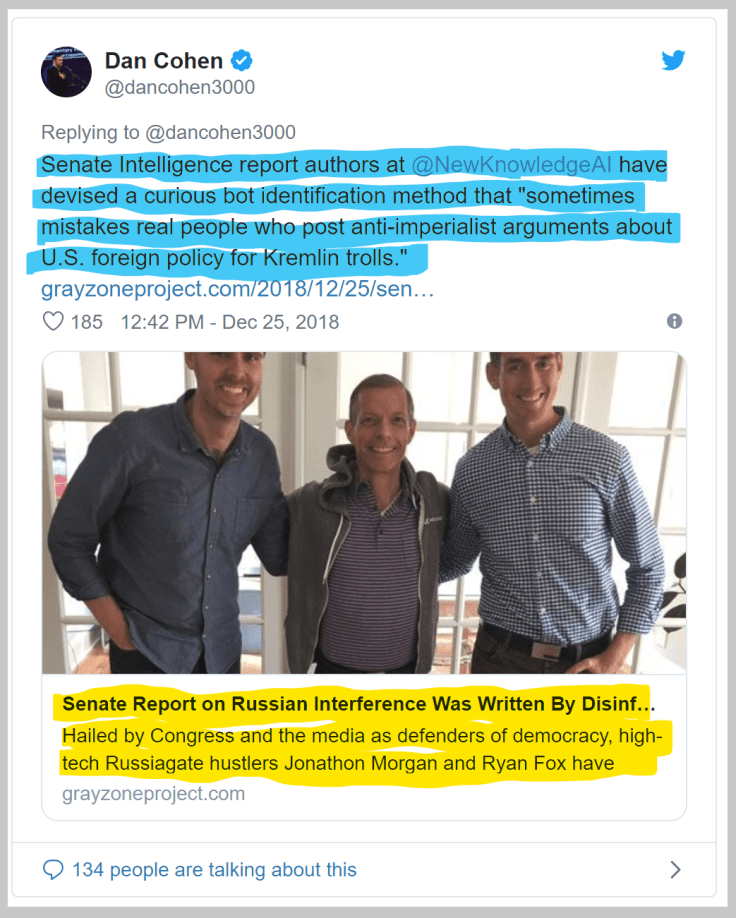
Hamilton 68 has been used by US publication Mother Jones to bolster a December 2017 article titled: ‘Russian Propagandists Are Pushing for Roy Moore to Win.’
Senator Doug Jones, the Democrat who narrowly defeated Moore last May, has called for a federal investigation. A move supported by the chastened Hoffman. “What is obvious now is that we have focused so much on Russia that we haven’t focused on the fact that people in this country could take the same playbook and do the same damn thing,” stated Jones.
Like this story? Share it with a friend!
All corrupt on the Western front? Der Spiegel latest to fall from media mountaintops

By Robert Bridge
Once again, a reporter has been accused of writing fake stories – over a span of years – reinforcing the suspicion that we are living in a post-truth world where words, to paraphrase Kipling, “are the most powerful drug.”
This week, Der Spiegel, the German news weekly, was forced to admit that one of its former star reporters, the award-winning Claas Relotius, “falsified his articles on a grand scale.”
Indeed, it seems the disgraced journalist was motivated more by fiction writers John le Carre and Tom Clancy than by any media heavyweights, like Andrew Breitbart and Walter Cronkite.
Relotius, who just this month took home Germany’s Reporterpreis (‘Reporter of the Year’) for his enthralling tale of a Syrian teenager, “made up stories and invented protagonists,” Der Spiegel admitted.

There is a temptation to rationalize Relotius’s multiple indiscretions, not to mention the failure of his fastidious employer to unearth them for so long, as an unavoidable part of the dog-eat-dog media jungle. After all, journalists are not robots – at least not yet – and we are all humans prone to poor judgment and mistakes, perhaps even highly unethical ones.
That explanation, however, falls short of explaining the internal forces battering away at the foundation of Western media, an institution built on the shifting sand of lies, disinformation and outright propaganda. And what is readily apparent to those outside of the Western media fortress is certainly even more apparent to those inside.
A good example is Russiagate. This elaborate myth, which has been peddled repeatedly and without an ounce of 100-percent real beef since the US election of 2016, goes like this: A group of Russian hackers, buying a few hundred social media memes for just rubles to the dollar, were able to do what all the Republican campaign strategists, and all the special interests groups, with all of their billions of dollars in their massive war chest, simply could not: keep Democratic voters at home on the couch come Election Day – a tactic now known as “voter suppression operations” – thereby handing the White House to Donald Trump on a silver platter. Or shall we say ‘a Putin platter’?

Don’t believe me? Here’s the opening line of a recent Washington Post article that should be rated ‘R’ for racist: “One difference between Russian and Republican efforts to quash the black vote: The Russians are more sophisticated, insidious and slick,” wailed Joe Davidson, who apparently watched too many Hollywood films where the Russkies play all of the villains. “Unlike the Republican sledgehammers used to suppress votes and thwart electorates’ decisions in various states, the Russians are sneaky, using social media come-ons that ostensibly had little to do with the 2016 vote.”
Meanwhile, Der Spiegel, despite being forced to come clean over the transgressions of Claas Relotius, will most likely never own up to its own factual shortcomings with regards to their dismal reporting on Russia.
For example, in an article published last year entitled ‘Putin’s work, Clinton’s contribution,’ the German weekly lamented that “A superpower intervenes in the election campaign of another superpower: The Russian cyber-attack in the US is a scandal.” Just like their fallen star reporter, Der Spiegel regurgitated fiction masquerading as news.
However, there is no need to limit ourselves to just media-generated Russian fairytales. The Western media has contrived other sensational stories, with its own cast of dubious characters, and with far greater consequences.
Consider the reporting in the Western media prior to the 2003 Iraq War, when most journalists were behaving as cheerleaders for military invasion as opposed to conscientious objectors, or at least objective observers. In fact, two reporters with the New York Times, Michael Gordon and Judith Miller, arguably gave the Bush administration and a hardcore group of neocons inside Washington, which had been pushing for a war against Saddam Hussein for many years, the barest justification it required for military action.
Just six months before the bombs started dropping on Baghdad, Gordon and Miller penned a front-page article in the Times that opened with this stunning claim: “Iraq has stepped up its quest for nuclear weapons and has embarked on a worldwide hunt for materials to make an atomic bomb, Bush administration officials said today.”
The article in America’s ‘paper of record’ then proceeded to build the case for military action against Iraq by quoting an assortment of anonymous senior administration officials, anonymous Iraqi defectors, and anonymous chemical weapons experts. In fact, much of the story was based on comments provided by one ‘Ahmed al-Shemri,’ a pseudonym for someone purported to have been connected to Hussein’s chemical-weapons program. The authors quoted the mystery man as saying: “All of Iraq is one large storage facility.”

Gordon and Miller also claimed their source had said that “he had been told that Iraq was still storing some 12,500 gallons of anthrax.” Several months later, just weeks before the US invasion of Iraq commenced, US Secretary of State Colin Powell invited the UN General Assembly to imagine what a “teaspoon of dry anthrax” could do if unleashed on the public.
Powell, who later said the testimony would be a permanent “blot” on his record, even shook a tiny faux sample of the deadly biological agent in the Assembly for maximum theatrical effect.
Shortly after the release of the Times piece, top Bush officials appeared on television and alluded to Miller’s story in support of military action. Meanwhile, UN inspectors on the ground in Iraq never found chemical weapons or the materials needed to build atomic weapons. In other words, the $1-trillion-dollar war against Iraq, which led to the deaths of tens of thousands of innocent civilians, was a completely senseless act of aggression against a sovereign state, which the US media helped perpetrate.
Aside from the question of whether readers really put much faith in these fantastic media stories, complete with pseudonymous characters and impossible to prove claims; there remains another question. Does the Western media itself believe its own stories? The answer seems to be no, at least not always.
With regards to the Russiagate story, for example, an investigative journalism outfit, Project Veritas, caught a few Western journalists off-guard about their true feelings in relation to the claims against Russia, and their feelings in general about the state of the media.
“I love the news business, but I’m very cynical about it – and at the same time so are most of my colleagues,” CNN Supervising Producer John Bonifield admitted, unaware he was being secretly filmed.

When pushed to explain why CNN was beating the anti-Russia drum on a daily basis, things became clearer: “Because it’s ratings,” Bonifield said. “Our ratings are incredible right now.”
In the same media sting operation, Van Jones, a prominent CNN political commentator who has pushed the anti-Russia position numerous times on-air, completely changed his tune when caught off-air and off-guard. “The Russia thing is just a big nothing burger,” he remarked.
This brings us back to the story of the fallen Der Spiegel journalist. It seems that a deep cynicism has taken hold in at least some parts of the Western media establishment. Journalists seem increasingly willing to produce extremely tenuous, fact-challenged stories, many of which are barely held together by a rickety composite of anonymous entities.
And why not? If their own media bosses are permitting gross fabrications on a number of major issues, not least of all related to Russia, and further afield in Syria, why should the journalists be forced to play by the rules?
Under such oppressive conditions, where the media appears to be merely the mouthpiece of the government’s position on a number of issues, those working inside this apparatus will eventually come around to the conclusion that truth is not the main priority. The main priority is hoodwinking the public into believing something even when the facts – or lack of them – point to other conclusions.
Thus, it is no surprise when we find Western reporters imitating the greatest fiction writers, because in reality that is what they have already become.
Think your friends would be interested? Share this story!
Psyop which saw Democrats pose as Russians ahead of Alabama poll swept under carpet (VIDEO)
A $100,000 Democrat psyop to fake Russian interference in an Alabama election was brushed aside by the US media as nonconsequential. But the alleged Russian operation of similar cost is treated as a Pearl Harbor-like attack.
The controversial social media operation, launched to undermine Republican candidate for Senate Roy Moore, was exposed by the New York Times this week.
The newspaper said it was an experiment which had little if any consequence on the outcome of the 2017 vote, which Democrat Doug Jones won by a less than 2-percent margin.
ALSO ON RT.COMTwitterstorm as bombshell Russiagate report suggests SEX TOYS penetrate US democracy
RT’s Murad Gazdiev wonders why a false flag operation involving Russia is not a bigger scandal for the US media. After all, they eagerly reported Russia’s alleged interference in the 2016 presidential election, which is claimed to have a similar budget, as a major crime or even an act of war on par with Pearl Harbor.
Watch the video and take a guess.
Russiagate eats itself: Democrat ‘tech experts’ try their hands at election meddling, report reveals

Doug Jones & Roy Moore © Reuters / Reuters Photographer
A group of Democrats working in secret replicated the deceptive social media tactics they claim Russians used to steal the 2016 election in order to win the 2017 Alabama Senate race, according to an explosive NYT report.
The primarily social-media-based campaign to bolster the candidacy of Democrat Doug Jones and smear Republican Roy Moore implemented many of the divisive techniques outlined in the reports released earlier this week on Russian social media influence operations, according to an internal report on the effort acquired by the New York Times. Such resemblance is not surprising, given that one of the Alabama effort’s ringleaders was Jonathon Morgan, whose company New Knowledge produced one of those reports.
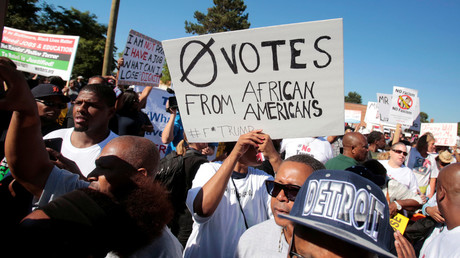
ALSO ON RT.COMRacist ‘Russians’ targeted African-Americans in 2016 election ploy, reports claimThe campaign was clearly meant to remain classified – the Times’ attempts to interview participants were as often as not met with claims of “I don’t remember” or pleading the Fifth. Others downplay the effect of their actions, or claim they were just meddling in the name of research. But, as much as they claim their actions had no consequences, they succeeded in electing the first Democrat to represent Alabama in the Senate for over 25 years.
In order to paint Roy Moore as the Kremlin candidate, the manipulators linked his campaign to thousands of Russian Twitter accounts that all started following him at once – drawing the attention and suspicion of the media, which obediently published rumors that his support numbers were artificially bolstered by Russian bots.
Morgan claims the botnet “false flag” – a term that actually appears in the report – “does not ring a bell,” dismissing the project as “a small experiment” in tactics that were not meant to sway the election. He pleads the Fifth on the report’s claims that the Alabama project intended to “enrage and energize Democrats” and “depress turnout” among Republicans, weaponizing accusations that Moore had tried to seduce teen girls while in his 30s. Morgan also claims to forget the names of the Twitter and Facebook accounts he set up to manipulate Moore voters.
Backed into a corner, Morgan finally opted to lie to the Times, claiming that while the project did create a generic Facebook page to lure conservative Alabamans, and was in contact with write-in candidate (and Moore rival) Mac Watson, its influence efforts stopped there. The report tells a different story: the Facebook page “boosted” Watson’s campaign, getting him interviews with major media outlets, and swelling the ranks of his Twitter followers. Watson confirms he received media assistance from a Facebook page with no human face to it – the only page that replied to his contact.
“The research project was intended to help us understand how these kind of campaigns operated,” Morgan told the Times. “We thought it was useful to work in the context of a real election but design it to have almost no impact.”
It’s a truism that so-called “coastal elites” have only disdain for Middle America, but the way Morgan describes the Alabama special election as an inconsequential throwaway contest fit only for a science experiment is eye-opening.
Morgan, it’s worth noting, was one of the developers of the infamous “Hamilton68” dashboard, beloved by Western media for its ability to link any troublesome narrative to “Russian bots.” Morgan’s co-developer, Clint Watts, has since distanced himself from the bot crusade, admitting he’s “not convinced on this bot thing.”
Everyone the Times spoke with was careful to shunt blame elsewhere. Renee diResta, who works with Morgan at New Knowledge and was the lead author of the group’s Russian report, said: “I know there were people who believed the Democrats needed to fight fire with fire,” emphasizing that she was not one of these people.
Moore campaign operatives remain frustrated at their narrow margin of loss – just 21,924 votes, less than the number of write-in ballots that were cast. They complained to Facebook about possible interference but were brushed off. Presented with incontrovertible evidence of wrongdoing by their opponents, Moore campaign manager Rich Hobson acknowledged that “any and all of these things could make a difference.”
“We still kick ourselves that Judge Moore didn’t win,” he said.
 Tom's Blog