2/4/2020
Hey press: It was Democrats last time too. “Russian Bots” translates to “Democrats” pretty reliably.

Wednesday night’s Democratic debate was not an enjoyable one for Harris, who went into the faceoff as a darling of the media and among the frontrunners for her party’s nomination. On the stage in Detroit, Hawaiian Congresswoman Tulsi Gabbard grilled Harris on her record as California’s attorney general.
In under a minute, Gabbard shredded Harris to pieces for jailing more than 1,500 nonviolent marijuana offenders while admitting in a radio interview that she had smoked marijuana in college, and for her “tough-on-crime” stances. “She blocked evidence that would have freed an innocent man from death row… she kept people in prison beyond their sentences to use them as cheap labor… and she fought to keep the cash bail system in place,” Gabbard continued, leaving Harris unable to counter.
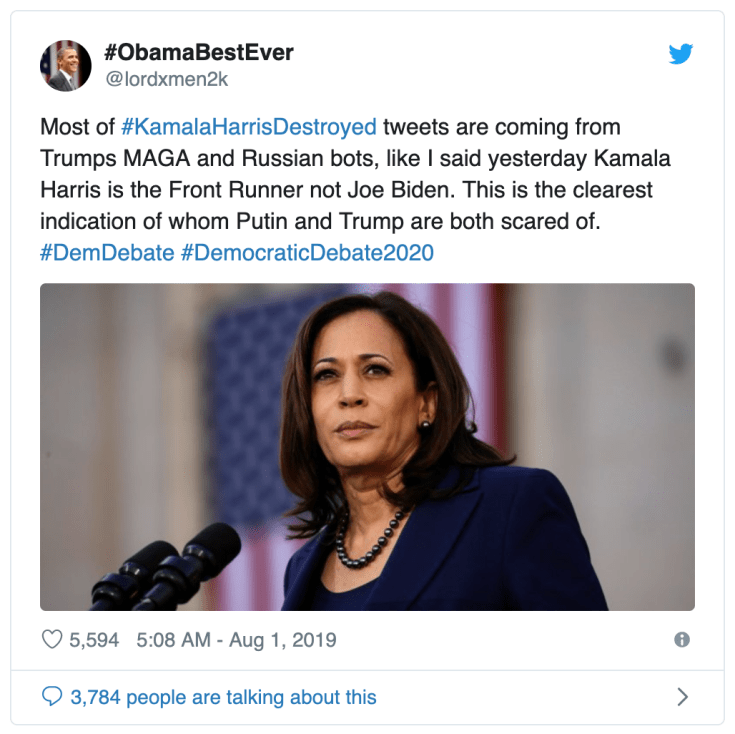
By Thursday morning, “#KamalaHarrisDestroyed” was trending on Twitter in the US.

Of course, any attack on an establishment Democrat is met with an equal and opposite reaction. Establishment pundits and their supporters responded with a familiar cry: “Russia!” Gabbard, they said, is propped up by Vladimir Putin, and #KamalaHarrisDestroyed is the work of “Putin’s bots and paid for shills.”

Even Harris’ press secretary, Ian Sams, labeled Gabbard’s supporters part of “the Russian propaganda machine.”
It’s worth noting that nobody shouting “Russian bots” did any data analysis to support their claims. Few noted too that, during the debate, ‘Tulsi Gabbard’ was the most searched for politician in every single US state, according to Google Trends.
But if the nefarious hashtag wasn’t the work of the Kremlin, then it must have been the work of the MAGA-hatted deplorables, some #resistance commenters argued.
That opponents would default to Russia to attack Gabbard is unsurprising. Running on an anti-interventionist, foreign-policy-focused platform, Gabbard has been accused of cosying up to Syrian leader Bashar al-Assad for her opposition to military action in Syria and for meeting with Assad in Damascus. That stance alone led to accusations that she was more closely aligned with the position of the Kremlin than that of the White House.
At present, Gabbard is a long-shot candidate, and is polling at around one percent.

The hashtag is familiar to anyone immersed in the murkier ends of American right-wing culture: think late night talk radio and dog-eared copies of ‘None Dare Call it Conspiracy’ passed around backwoods militia meetings.
Coined by writer and conspiracy theorist Danny Casolaro in the late 1980s, the phrase has since been used by conservatives to link the mysterious deaths of people in some way connected to Bill and Hillary Clinton, like the 1993 suicide of White House Deputy Counsel Vince Foster, and the fatal armed robbery of Democratic National Committee staffer Seth Rich in 2016.

Jeffrey Epstein found ‘injured & semiconscious’ with suspicious marks on neck in jail cell
Adding to the mystery, Casolaro himself committed suicide in 1991, while working on a story supposedly involving an international cabal.
The hashtag broke into the mainstream on Thursday, trending at number three in the US. Its emergence came after millionaire financier Jeffrey Epstein was found“injured and in a fetal position” on the floor of his New York jail cell just hours before. An associate of Bill Clinton, Epstein is currently facing up to 45 years in prison on charges of conspiracy and sex trafficking, with some of his alleged victims as young as 14.
Twitter sleuths joined the dots:
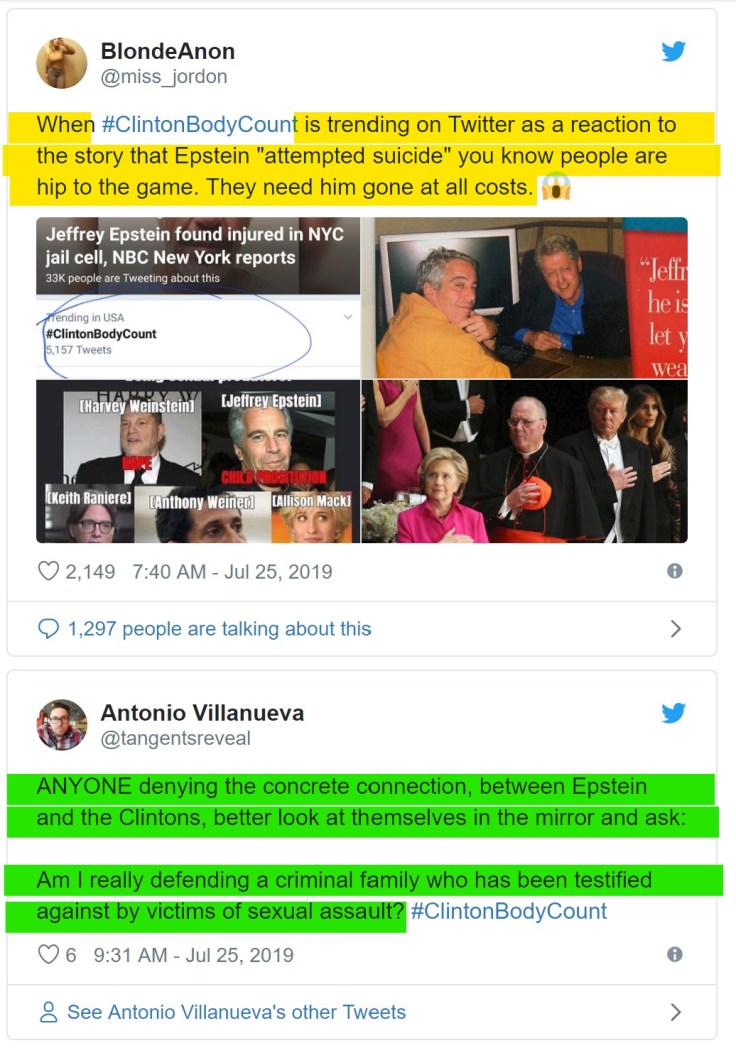
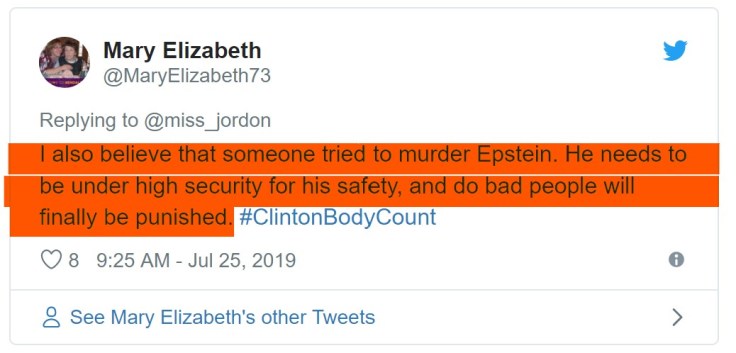
To some, the hashtag had nothing to do with a decades-old right-wing horror story. To an army of establishment bugmen, its sudden reappearance was the work of, surprise, surprise – “Russian bots.” The Democrat version of the conspiracy theory goes that Russian President Vladimir Putin was so incensed by the knockout testimony given by former special counsel Robert Mueller on Wednesday that he cranked up the output of his “troll farms” and swamped Twitter with the hashtag as a distraction.

Except the hole in that theory is that no amount of sneaky Russian meddling is needed to distract from Mueller’s testimony. Stammering through answers, seemingly forgetting key details from his report, and declining to answer any questions outside its scope, Mueller did a pretty good job deflating the expectations of Democrats hoping for some new ‘Russiagate’ revelations.
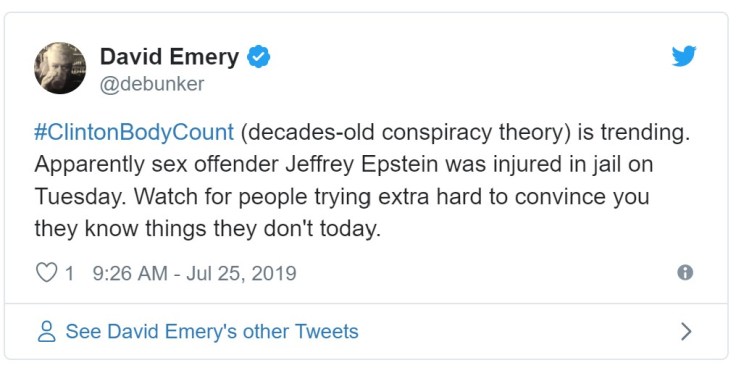
With the left and the right fighting an infowar forcontrol of the hashtag, one commenter summed up the state of the debate. “#ClintonBodyCount is trending… Watch for people trying extra hard to convince you they know things they don’t today.”

Tweeting out her discovery, Kamala Harris explained that Russia was “able to influence” the last presidential election because it “figured out” that “racism, sexism, anti-Semitism, homophobia, and transphobia are America’s Achilles heel.”
Armed with this top secret information, Russia was “able” to turn Americans against each other in a way never before seen in history (if you conveniently forget most of history, that is).
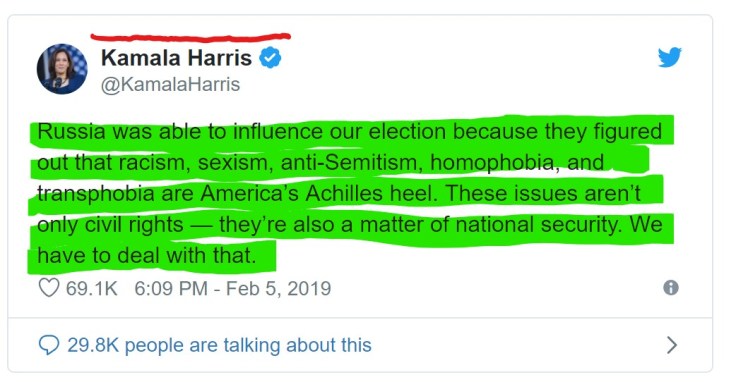
Now, you might be thinking, if it was that easy for the Russians to take a glimpse at the various domestic tensions plaguing the US in 2016 and then use the information to (allegedly) throw an election, why didn’t the Kremlin act before now? Surely, if it was so simple, Russia could have been choosing US presidents for decades?
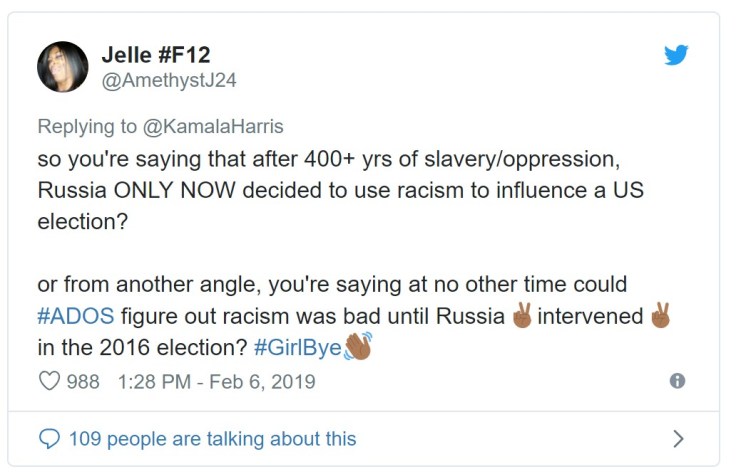
Harris’s tweet was hailed as “important” and insightful commentary from some of her supporters and Russia-obsessed journalists, but was instantly mocked by more skeptically-minded individuals, some of whom took issue with the premise that Russia had affected the 2016 election at all.
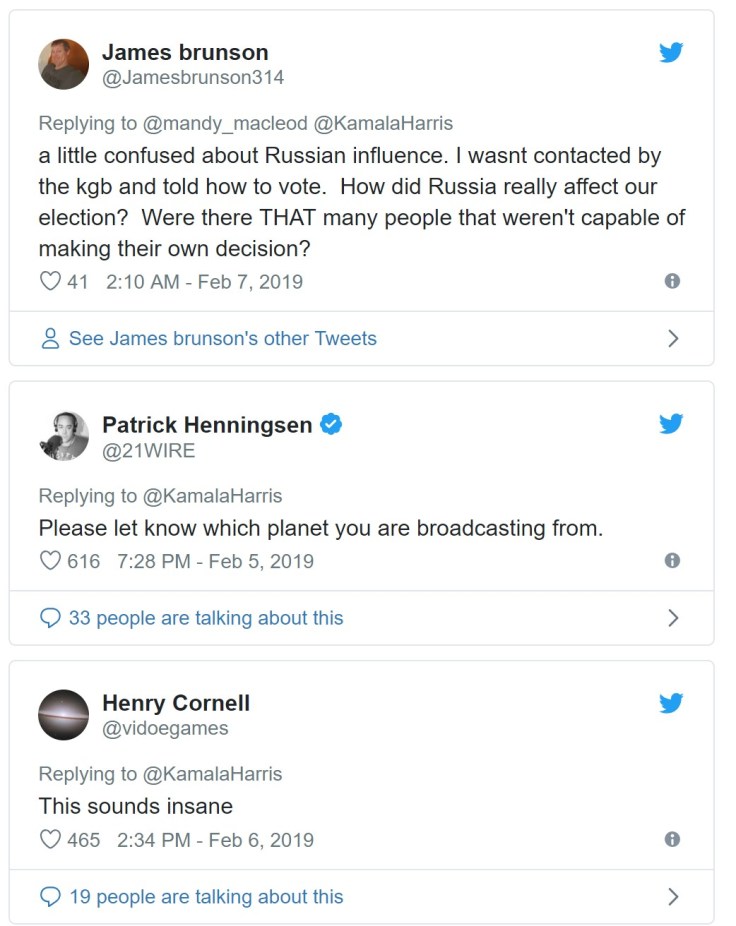
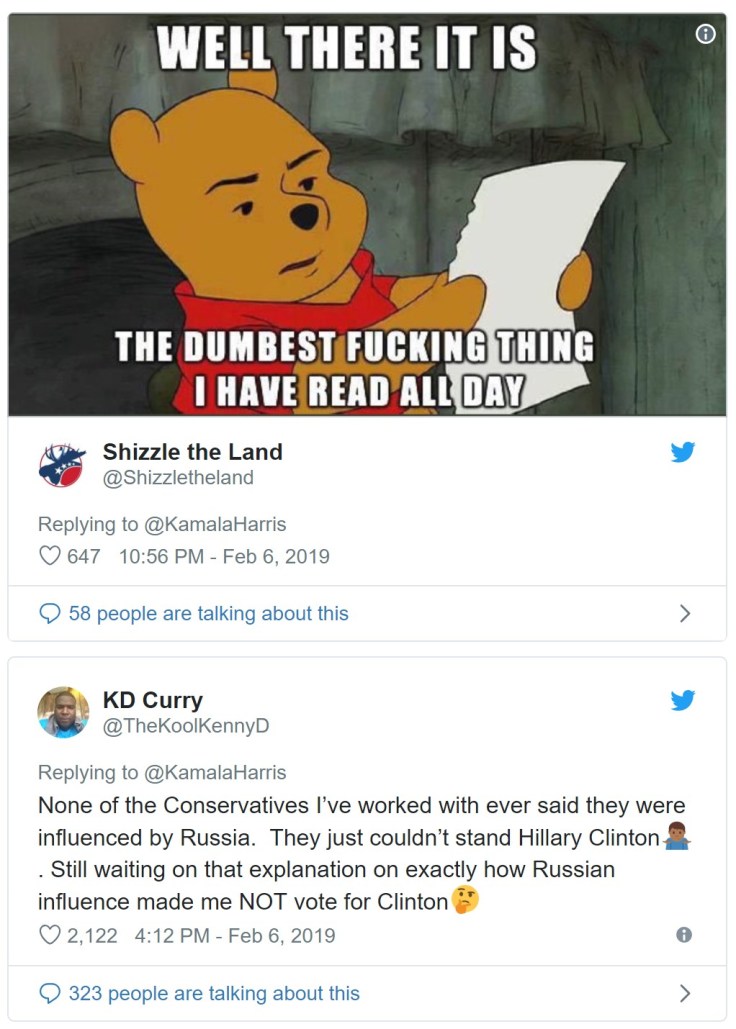
Others joked that they thought hatred and prejudice had never existed in the US prior to Russia’s “intervention.” Some also suggested that the focus on Russia was a way to distract from the fact that Democrats lost the last election because Hillary Clinton ran a flawed campaign, rather than because of anything to do with Russia.
Somehow Russian influence didn’t matter “until Hillary lost,” another said.
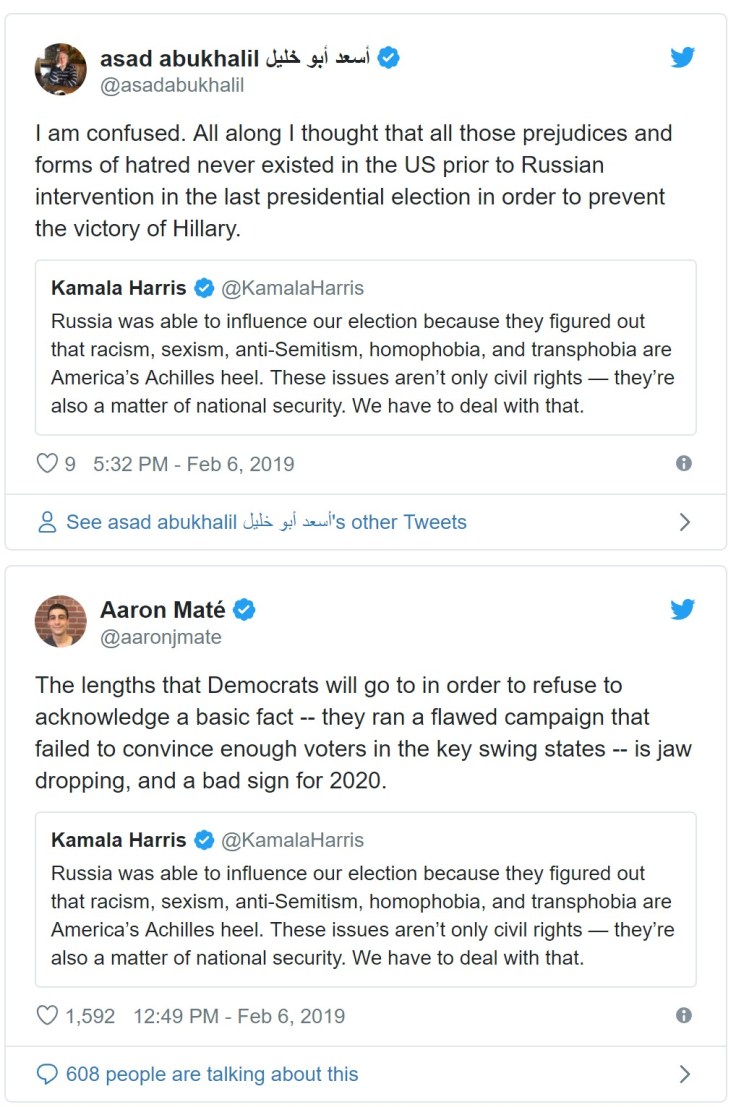
Some people also took offence, as Harris’s comment appeared to be insulting Americans, implying that they are so “stupid” that “a bunch of Russians” can easily manipulate them on social media.
However, one tweet suggested that the real Achilles Heel was the fact that over 60,000 people read Harris’s tweet and hit the ‘like’ button.


Mark Dice
Published on Feb 5, 2019
Published on Jan 14, 2019

By Danielle Ryan
Ryan Fox and Jonathan Morgan, who run the New Knowledge cybersecurity company which claims to “monitor disinformation” online, penned a foreboding op-ed in the New York Times on November 6, about “the Russians” and their nefarious efforts to influence American elections.
At the time, it struck me that Fox and Morgan’s reasoning seemed a little far-fetched. For example, one of the pieces of evidence presented to prove that Russia had targeted American elections was that lots of people had posted links to RT’s content online. Hardly a smoking gun worthy of a Times oped.
ALSO ON RT.COMThe only ‘Russian bots’ to meddle in US elections belonged to Democrat-linked ‘experts’Morgan and Fox, intrepid cyber sleuths that they are, claimed in the article they had detected more “overall activity” from ongoing Russian influence campaigns than social media companies like Facebook and Twitter had yet revealed — or that other researchers had been able to identify.

The New Knowledge guys even authored a Senate Intelligence Committee report on Russia’s alleged efforts to mess with American democracy. They called it a “propaganda war against American citizens.” Impressive stuff. They must be really good at their job, right?
This week, however, we learned that New Knowledge was running its own disinformation campaign (or “propaganda war against Americans,”you could say), complete with fake Russian bots designed to discredit Republican candidate Roy Moore as a Russia-preferred candidate when he was running for the US senate in Alabama in 2017.
The scheme was exposed by the New York Times — the paper that just over a month earlier published that aforementioned oped, in which Fox and Morgan pontificated about Russian interference online.
New Knowledge created a mini-army of fake Russian bots and fake Facebook groups. The accounts, which had Russian names, were made to follow Moore. An internal company memo boasted that New Knowledge had “orchestrated an elaborate ‘false flag’ operation that planted the idea that the Moore campaign was amplified on social media by a Russian botnet.”
Moore lost the race by 1.5 percent. To be fair, accusations published by the Washington Post that he pursued underage girls back in the 1980s may have had something to do with it as well, but that’s a different story.
Of course, New Knowledge and even the New York Times, which blew the lid of the operation, are trying to spin this as some kind of “small experiment” during which they “imitated Russian tactics” online to see how they worked. Just for research, of course. They have also both claimed that the scheme, dubbed ‘Project Birmingham’ had almost no effect on the outcome of the race.
The money for the so-called research project came from Reid Hoffman, the billionaire co-founder of LinkedIn, who contributed $750,000 to American Engagement Technologies (AET), which then spent $100,000 on the New Knowledge experiment. After the scheme was exposed, Hoffman offered a public apology, saying he didn’t know exactly how the money had been used and admitting that the tactics were “highly disturbing.”
ALSO ON RT.COMLinkedIn billionaire ‘sorry’ for funding ‘Russian bot’ disinformation campaign against Roy MooreIf people like Fox and Morgan actually cared about so-called Russian meddling or the integrity of American elections, they would not have run the deceptive campaign against Moore, no matter how undesirable he was as a candidate. Their sneaky and deceitful methods are in total contrast to the public profile they have cultivated for themselves as a firm fighting the good fight for the public good. But is it really that much of a surprise?
You would think that a newspaper like the New York Times would have cottoned on to the fact that guys like Fox and Morgan, with their histories in the US military and intelligence agencies, have clear agendas and are not exactly squeaky clean or the most credible sources of information when it comes to anything to do with Russia. But that kind of insight or circumspection might be too much to ask for in the age of Russiagate.
Facebook removed Morgan’s account on Saturday for “engaging in coordinated inauthentic behavior” around the Alabama election. Three days after publishing its initial article on the scandal (the one in which it played down the effects of New Knowledge’s disinfo campaign), the New York Times published a follow-up piece about the Facebook removal, in which it admitted that the controversy would be a “stinging embarrassment” for the social media researcher, noting that he had been a “leading voice” against supposed Russian disinformation campaigns.
In Fox and Morgan’s original NYT oped, they warned of the ubiquitous “Russia-linked social media accounts” and estimated that “at least hundreds of thousands, and perhaps even millions” of US citizens had engaged with them online. One must now wonder, were they including their own fake Russian bots in that count, or were they leaving those ones out?
It’s nearly two years into the Trump presidency and still we have no solid evidence that the Russian “collusion” theory is anything more than a fantasy concocted by Democrats desperate to provide a more palatable reason for Hillary Clinton’s loss than the fact that she simply ran a bad campaign.
In fact, at this point, we actually have more solid and irrefutable evidence of election meddling from the likes of dodgy American and British companies like Cambridge Analytica and New Knowledge than we do of any meddling orchestrated by Russia.
Like this story? Share it with a friend!

Doug Jones & Roy Moore © Reuters / Reuters Photographer
The primarily social-media-based campaign to bolster the candidacy of Democrat Doug Jones and smear Republican Roy Moore implemented many of the divisive techniques outlined in the reports released earlier this week on Russian social media influence operations, according to an internal report on the effort acquired by the New York Times. Such resemblance is not surprising, given that one of the Alabama effort’s ringleaders was Jonathon Morgan, whose company New Knowledge produced one of those reports.
ALSO ON RT.COMRacist ‘Russians’ targeted African-Americans in 2016 election ploy, reports claimThe campaign was clearly meant to remain classified – the Times’ attempts to interview participants were as often as not met with claims of “I don’t remember” or pleading the Fifth. Others downplay the effect of their actions, or claim they were just meddling in the name of research. But, as much as they claim their actions had no consequences, they succeeded in electing the first Democrat to represent Alabama in the Senate for over 25 years.
In order to paint Roy Moore as the Kremlin candidate, the manipulators linked his campaign to thousands of Russian Twitter accounts that all started following him at once – drawing the attention and suspicion of the media, which obediently published rumors that his support numbers were artificially bolstered by Russian bots.
Morgan claims the botnet “false flag” – a term that actually appears in the report – “does not ring a bell,” dismissing the project as “a small experiment” in tactics that were not meant to sway the election. He pleads the Fifth on the report’s claims that the Alabama project intended to “enrage and energize Democrats” and “depress turnout” among Republicans, weaponizing accusations that Moore had tried to seduce teen girls while in his 30s. Morgan also claims to forget the names of the Twitter and Facebook accounts he set up to manipulate Moore voters.
Backed into a corner, Morgan finally opted to lie to the Times, claiming that while the project did create a generic Facebook page to lure conservative Alabamans, and was in contact with write-in candidate (and Moore rival) Mac Watson, its influence efforts stopped there. The report tells a different story: the Facebook page “boosted” Watson’s campaign, getting him interviews with major media outlets, and swelling the ranks of his Twitter followers. Watson confirms he received media assistance from a Facebook page with no human face to it – the only page that replied to his contact.
“The research project was intended to help us understand how these kind of campaigns operated,” Morgan told the Times. “We thought it was useful to work in the context of a real election but design it to have almost no impact.”
It’s a truism that so-called “coastal elites” have only disdain for Middle America, but the way Morgan describes the Alabama special election as an inconsequential throwaway contest fit only for a science experiment is eye-opening.
Morgan, it’s worth noting, was one of the developers of the infamous “Hamilton68” dashboard, beloved by Western media for its ability to link any troublesome narrative to “Russian bots.” Morgan’s co-developer, Clint Watts, has since distanced himself from the bot crusade, admitting he’s “not convinced on this bot thing.”
Everyone the Times spoke with was careful to shunt blame elsewhere. Renee diResta, who works with Morgan at New Knowledge and was the lead author of the group’s Russian report, said: “I know there were people who believed the Democrats needed to fight fire with fire,” emphasizing that she was not one of these people.
Moore campaign operatives remain frustrated at their narrow margin of loss – just 21,924 votes, less than the number of write-in ballots that were cast. They complained to Facebook about possible interference but were brushed off. Presented with incontrovertible evidence of wrongdoing by their opponents, Moore campaign manager Rich Hobson acknowledged that “any and all of these things could make a difference.”
“We still kick ourselves that Judge Moore didn’t win,” he said.

 Tom's Blog