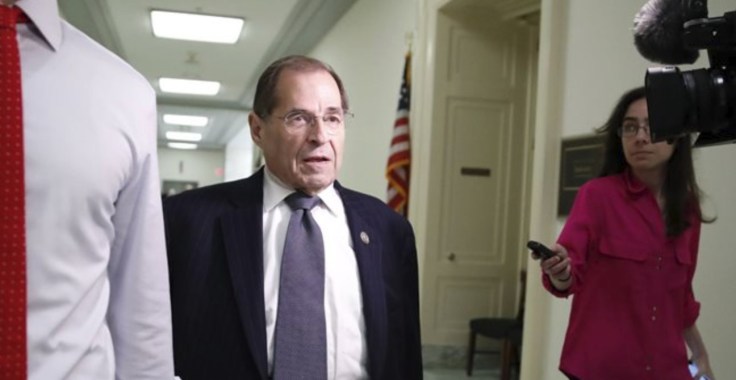
Hoo Boy: Are Democrats Planning to Move Forward With Impeachment, Regardless of What Mueller Finds?

By Guy Benson

CAP

For months and months, we’ve been told the following — and not without good reason: (1)The House Intelligence Committee’s Russia investigation is hopelessly partisan and beset with intense infighting.

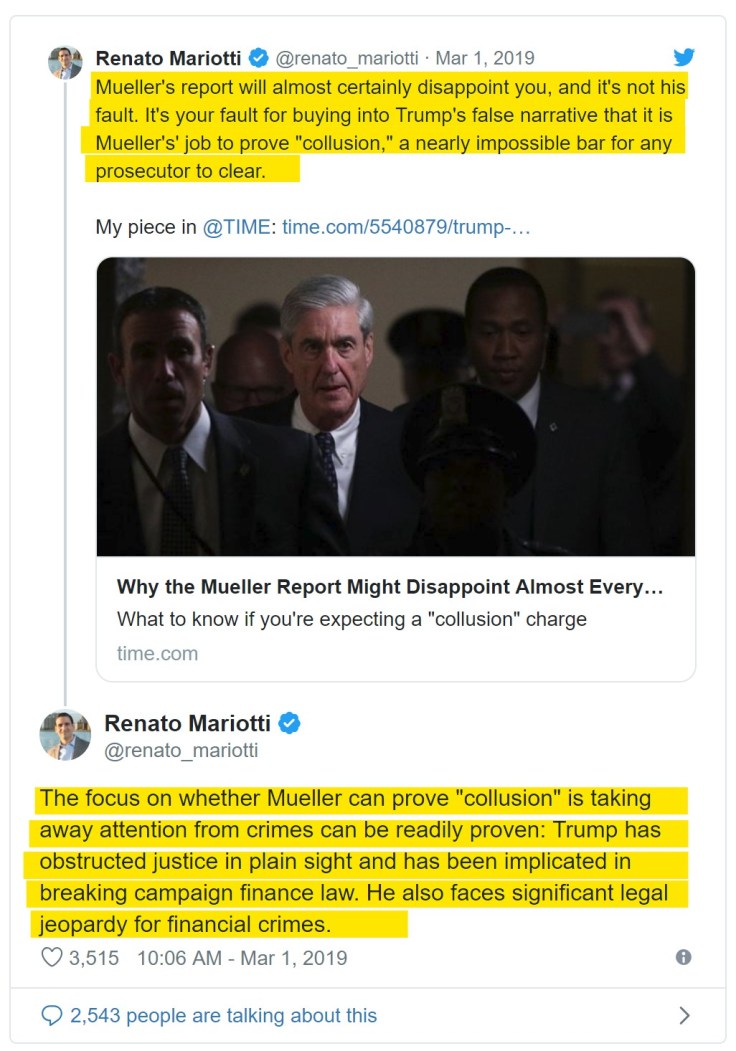
(2) The Senate panel’s parallel probe has been much more professionally handled, with sober bipartisan leadership, but its resources and powers are incomplete, so its ‘no collusion‘ findings cannot be considered conclusive. (3) What really matters are the findings of Special Counsel Robert Mueller and his team.  Mueller is so important, in fact, that there has been constant hand-wringing about his investigation being canceled or disrupted by Trump.  But now that it’s reportedly almost Mueller Time, there appears to be a concerted effort in anti-Trump circles to redefine the battlefield.  No matter what Mueller’s verdict may be on Russian ‘collusion,’ we’re increasingly told, Trump is already guilty:CAP
CAP

That first tweet is a CNN analyst preparing his audience for a potential letdown, preemptively pivoting to focusing on already-known facts if Mueller doesn’t drop new bombshells.  The second is the Senate Intelligence Committee’s ranking member (who is slowly backing away from his call for his state’s governor to resign) not exactly contradicting Chairman Burr, but basically arguing, “what we already know is bad enough.”  Perhaps most importantly, the new leader of the House committee that would instigate the impeachment process against the president went on television over the weekend and declared that he’s seen enough to conclude that its “very clear” the president has committed an impeachable crime:

Amid last week’s Michael Cohen hearings, a number of liberalsjournalists, and Republicans observed that the proceedings felt like the first step toward removing Trump from office.  Byron York argues that Democrats have now officially tipped their hand:

Think what you will about the reasons — calling an investigation a “witch hunt” is obstruction of justice? — but Nadler sounded less like a man weighing the evidence than a man who has has made up his mind.Given that, Nadler’s ABC interview led to a question: President Nixon was threatened with impeachment for obstruction of justice. President Clinton was impeached for obstruction of justice. Why is Nadler, who heads the committee in the House that originates articles of impeachment, not moving forward with impeaching President Trump right now? … Nadler’s talk with ABC was the clearest indication yet that Democrats have decided to impeach Trump and are now simply doing the legwork involved in making that happen. And that means the debate among House Democrats will be a tactical one — what is the best time and way to go forward — rather than a more fundamental discussion of whether the president should be impeached…

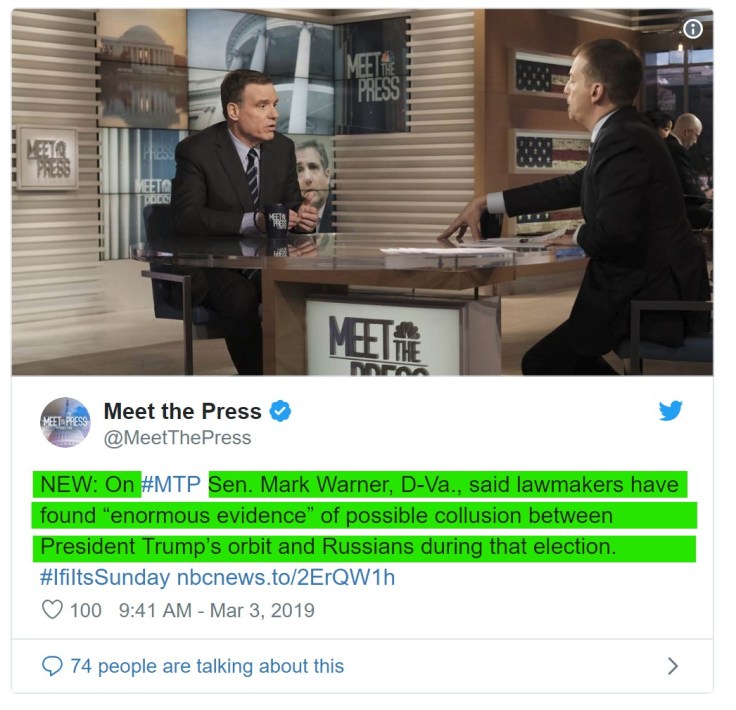
Other House Democrats are sending similar messages. “There is abundant evidence of collusion,” House Intelligence Committee Chairman Rep. Adam Schiff, D-Calif., said on CBS Sunday…So now the Democratic plan is coming into sharper relief. The impeachment decision has been made. Various committee chairs are moving forward in gathering and organizing the formal justification for removing the president. The timing decision is still up in the air, as is an overarching communications plan — selling impeachment to the American public, or more specifically those Americans who don’t already support impeachment…whatever the stated rationale, impeachment is on.

The goalposts are moving before our very eyes.  But Allahpundit seems to agree that the Axios-floated grand strategy from House Democrats is not to pull the trigger on the I-word over the next year-plus, but rather to execute a slow-bleed of politically-damaging pain over that time span. The idea would be to cripple and overwhelm Trump’s presidency all the way up to election day, then let the voters oust him from office. “The smart play is to do what they’re doing, launching an open-ended investigation that will dig up plenty of dirt on Trump and grind on to Election Day next year,” he writes. “Instead of passing articles of impeachment and seeing them die in the Senate, they’re probably going to produce a Democratic counterpart to the Mueller report, laying out everything they find in gory detail and publishing it next summer so that the Democratic nominee and the media have a treasure trove of oppo to use against Trump.” If I were a betting man, that would be my wager, too. I’ll leave you with Trump-skeptical conservative writer David French attacking the Steele Dossier (the credibility of which was further eroded by Cohen’s testimony):

Gowdy did, in fact, make this point, and Russia’s 2016 electoral interference undoubtedly deserved very serious scrutiny. But a shady and unverified Clinton/DNC oppo research scheme serving as a primary driver of key elements of the investigation is a very bad look — and it almost certainly fed a pernicious spiral of mutual mistrust between Trumpworld and the DOJ that has convinced people on each side that the other is dangerous and must be stopped.  The toxicity in American politics right now is palpable and worrisome.  By the way, not all Democrats agree that Nadler’s sprawling, open-ended investigation is a smart move:
UPDATE – Adam Schiff has apparently decided that Mueller’s verdict on collusion won’t be good enough. This is absurd:

In America, talk turns to something unspoken for 150 years: Civil war…

By  Greg Jaffe and Jenna Johnson

Screen Shot 2019-03-01 at 3.45.41 PM

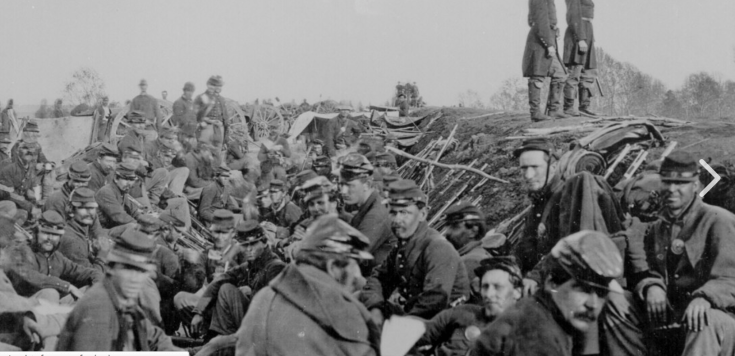
At a moment when the country has never seemed angrier, two political commentators from opposite sides of the divide concurred last week on one point, nearly unthinkable until recently: The country is on the verge of “civil war.”

First came former U.S. attorney Joseph diGenova, a Fox News regular and ally of President Trump. “We are in a civil war,” he said. “The suggestion that there’s ever going to be civil discourse in this country for the foreseeable future is over. . . . It’s going to be total war.”

The next day, Nicolle Wallace, a former Republican operative turned MSNBC commentator and Trump critic, played a clip of diGenova’s commentary on her show and agreed with him – although she placed the blame squarely on the president.

Trump, she said, “greenlit a war in this country around race. And if you think about the most dangerous thing he’s done, that might be it.”

With the report by special counsel Robert Mueller reportedly nearly complete, impeachment talk in the air and the 2020 presidential election ramping up, fears that once existed only in fiction or the fevered dreams of conspiracy theorists have become a regular part of the political debate. These days, there’s talk of violence, mayhem and, increasingly, civil war.

A tumultuous couple of weeks in American politics seem to have raised the rhetorical flourishes to a new level and also brought a troubling question to the surface: At what point does all the alarmist talk of civil war actually increase the prospect of violence, riots or domestic terrorism?

Screen Shot 2019-03-01 at 3.47.53 PM

Speaking to conservative pundit Laura Ingraham, diGenova summed up his best advice to friends: “I vote, and I buy guns. And that’s what you should do.”

He was a bit more measured a few days later in an interview with The Washington Post, saying that the United States is in a “civil war of discourse . . . a civil war of conduct,” triggered mostly by liberals and the media’s coverage of the Trump presidency. The former U.S. attorney said he owns guns mostly to make a statement, and not because he fears political insurrection at the hands of his fellow Americans.

The rampant talk of civil war may be hyperbolic, but it does have origins in a real crumbling confidence in the country’s democratic institutions and its paralyzed federal government. With Congress largely deadlocked, governance on the most controversial issues has been left to the Supreme Court or has come through executive or emergency actions, such as Trump’s border wall effort.

Then there’s the persistent worry about the 202o elections. “Given my experience working for Mr. Trump, I fear that if he loses the election in 2020 that there will never be a peaceful transition of power,” Michael Cohen, Trump’s former fixer and personal lawyer, told a congressional committee Wednesday.

On that score, Cohen’s not the only one who is concerned. As far back as 2016, Trump declined to say whether he would concede if he lost to Hillary Clinton, prompting former president Barack Obama to warn that Trump was undermining American democracy. “That is dangerous,” Obama said.

The moment was top of mind for Joshua Geltzer, a former senior Obama administration Justice Department official, when he wrote a recent editorial for CNN urging the country to prepare for the possibility that Trump might not “leave the Oval Office peacefully” if he loses in 2020.

“If he even hints at contesting the election result in 2020 . . . he’d be doing so not as an outsider but as a leader with the vast resources of the U.S. government potentially at his disposal,” Geltzer, now a professor at Georgetown Law School, wrote in his piece in late February.

Geltzer urged both major parties to require their electoral college voters to pledge to respect the outcome of the election, and suggested that it might be necessary to ask the secretary of defense and the chairman of the Joint Chiefs of Staff to reaffirm their loyalty to the Constitution over Trump.

“These are dire thoughts,” Geltzer wrote, “but we live in uncertain and worrying times.”

His speculation drew immediate reaction from the right. Former Alaska governor and Republican vice presidential nominee Sarah Palin tweeted a link to an article that called Geltzer’s warnings “rampant crazy.” News Punch, a far-right site that traffics in conspiracy theories, blared: “Obama Official Urges Civil War Against Trump Administration.”

Said Geltzer: “I don’t think I was being paranoid, but, boy, did I inspire paranoia on the other side.”

The concerns about a civil war, though, extend beyond the pundit class to a sizable segment of the population. An October 2017 poll from the company that makes the game Cards Against Humanity found that 31 percent of Americans believed a civil war was “likely” in the next decade.

More than 40 percent of Democrats described such a conflict as “likely,” compared with about 25 percent of Republicans. The company partnered with Survey Sampling International to conduct the nationally representative poll.

Some historians have sounded a similar alarm. “How, when, and why has the United States now arrived at the brink of a veritable civil war?” Victor Davis Hanson, a historian with Stanford University’s Hoover Institution, asked last summer in an essay in National Review. Hanson prophesied that the United States “was nearing a point comparable to 1860,” about a year before the first shots were fired on Fort Sumter, South Carolina.

Around the same time Hanson was writing, Robert Reich, a former secretary of labor who is now a professor at the University of California at Berkeley, imagined his own new American civil war, in which demands for Trump’s impeachment lead to calls from Fox News commentators for “every honest patriot to take to the streets.”

“The way Mr. Trump and his defenders are behaving, it’s not absurd to imagine serious social unrest,” Reich wrote in the Baltimore Sun. “That’s how low he’s taken us.”

Reich got some unlikely support last week from Stephen K. Bannon, Trump’s former chief strategist. “I think that 2019 is going to be the most vitriolic year in American politics since the Civil War, and I include Vietnam in that,” Bannon said in an interview with CBS’s “Face the Nation.”

All the doom, gloom and divisiveness have caught the attention of experts who evaluate the strength of governments around the world. The Economist Intelligence Unit’s Democracy Index, a measure widely cited by political scientists, demoted the United States from “full democracy” to “flawed democracy” in January 2017, citing a big drop in Americans’ trust for their political institutions.

Similarly, Freedom House, which monitors freedom and democracy around the world, warned in 2018 that the past year has “brought further, faster erosion of American’s own democratic standards than at any other time in memory.”

Those warnings about the state of America’s democratic institutions concern political scientists who study civil wars, which usually take root in countries with high levels of corruption, low trust in institutions and poor governance.

Barbara Walter, a professor of political science at the University of California at San Diego, said her first instinct was to dismiss any talk of civil war in the United States. “But the U.S. is starting to show that it is moving in that direction,” she said. “Countries with bad governance are the ones that experience these wars.”

James Fearon, who researches political violence at Stanford University, called the pundits’ warnings “basically absurd.” But he noted that political polarization and the possibility of a potentially serious constitutional crisis in the near future does “marginally increase the still very low odds” of a stalemate that might require “some kind of action by the military leadership.”

“I can’t believe I’m saying this,” he added, “but I guess it’s not entirely out of the question.”

Less clear in the near term is what kind of effect the inflammatory civil war rhetoric has on a democracy that’s already on edge. There’s some evidence that such heated words could cause people to become more moderate. A 2014 study found that when hard-line Israeli Jews were shown extreme videos promoting the Israeli-Palestinian conflict as essential to Israeli pride, a strong army or national unity, they took a more dovish position.

“Extreme rhetoric can lead some people to pull back from the brink,” said Boaz Hameiri, a professor at the University of Pennsylvania and co-author on the study. But that only happens when people already believe a “more moderate version of the extreme views” and find the more extreme message shocking, he said.

In such cases, people recognize the absurdity of their position, worry it reflects badly on them and reconsider it, he said.

If the extreme messages become a normal part of the political debate, the moderating effect goes away, the study found.

Violence is most likely to occur, Hameiri added, when political leaders use “dehumanizing language” to describe their opponents.

Most experts worried that the talk of conflict here, armed or otherwise, was serving to raise the prospects of unrest and diminish trust in America’s already beleaguered institutions.

Screen Shot 2019-03-01 at 3.59.52 PM

The latest warnings of civil war from diGenova drew an exasperated response from VoteVets, a liberal veterans advocacy group whose members have fought in actual civil wars in Iraq and Afghanistan.

“Amazing we have to say this but: 1. We are NOT in civil war. 2. Do NOT buy guns (or any weapons) to use against your fellow Americans,” Jon Soltz, the group’s chairman, tweeted in response to diGenova. “Trust us, we have seen war.”

As voice after voice gets purged from social media, still think there’s no censorship?

Screen Shot 2019-02-27 at 10.19.43 AM

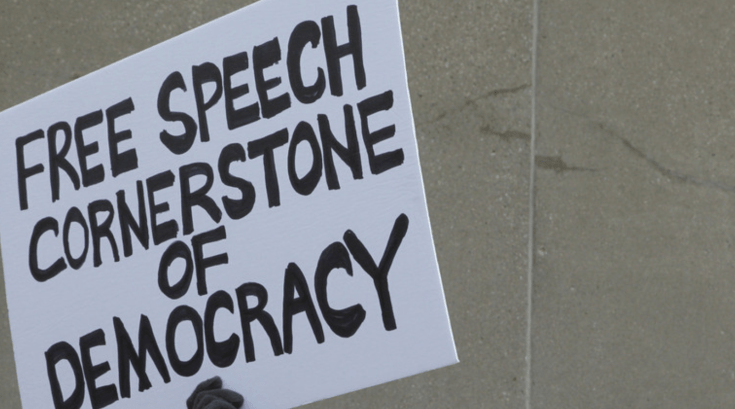
For a civilization that considers freedom of speech one of its fundamental principles and universal human rights, the West sure does a lot of censorship – and no, farming it out to ‘private companies’ does not change what it is.

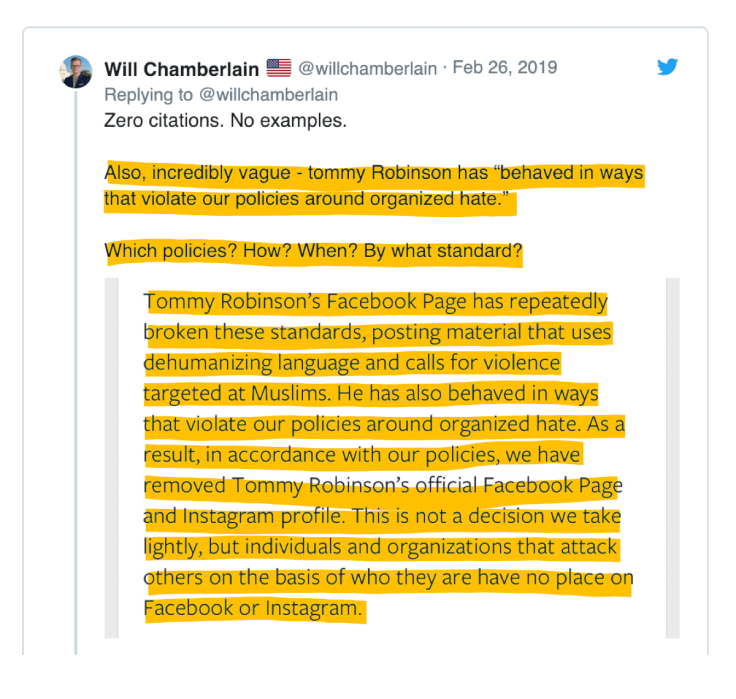
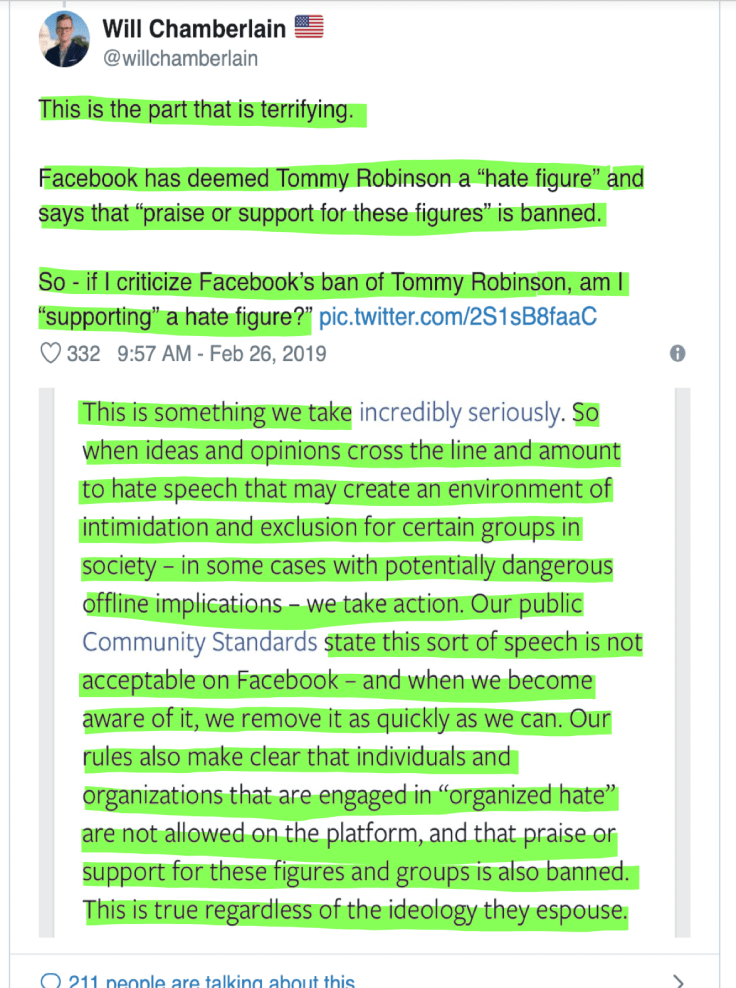
It happened again on Tuesday: British activist Tommy Robinson was erased from Facebook and Instagram. The social media behemoth said it has to act “when ideas and opinions cross the line and amount to hate speech that may create an environment of intimidation and exclusion for certain groups in society.”

As online polemicists are fond of saying, “citation needed!” Yet Facebook offers none: no evidence of specific violations, not even a definition of “hate speech,” just an arbitrary standard – and a threat of further bans for people who “support… hate figures.” Whatever that means.

Screen Shot 2019-02-27 at 10.24.19 AM

Screen Shot 2019-02-27 at 10.28.38 AM

How did journalists – those paladins of free speech, the fabled Fourth Estate, the valiant protectors of values that would die in darkness without their intrepid efforts – greet this news? Did they object to a British citizen being muzzled and wax about the dangers to digital democracy? Oh no, they rejoiced: Finally, what took so long?!

The same process repeated itself later in the day, when Twitter banned Jacob Wohl. The self-described supporter of US President Donald Trump had reportedly boasted about setting up fake accounts to influence the 2020 election. That is regarded as the sin-above-all-sins by social media executives, terrified of Congress blaming them for Hillary Clinton losing the White House to Trump in 2016, even though 99 percent of US media considered it rightfully hers.

Here’s the thing, though: Twitter still hasn’t banned Jonathon Morgan, CEO of New Knowledge, a company that was proven to have set up thousands of fake accounts to swing the Senate race in Alabama to the Democrats, and later paid by the Senate to blame Russia for its tactics.

Screen Shot 2019-02-27 at 10.30.03 AM

Let’s also remember the suspension of several Facebook pages belonging to Maffick Media, an outfit that partners with Ruptly, a RT subsidiary. After the “Twitter police” at the German Marshall Fund and CNN raised a fuss about these pages having “Kremlin ties,” Facebook blocked them until they agreed to put up a notice about being “funded by Russia.”So they did, even though there is no such rule that would be universally applied.

Surely it is entirely a coincidence that a CNN reporter went around actively badgering social media outlets to ban Alex Jones, way back in August 2018, and would not stop until they all did?

Screen Shot 2019-02-27 at 10.30.54 AM

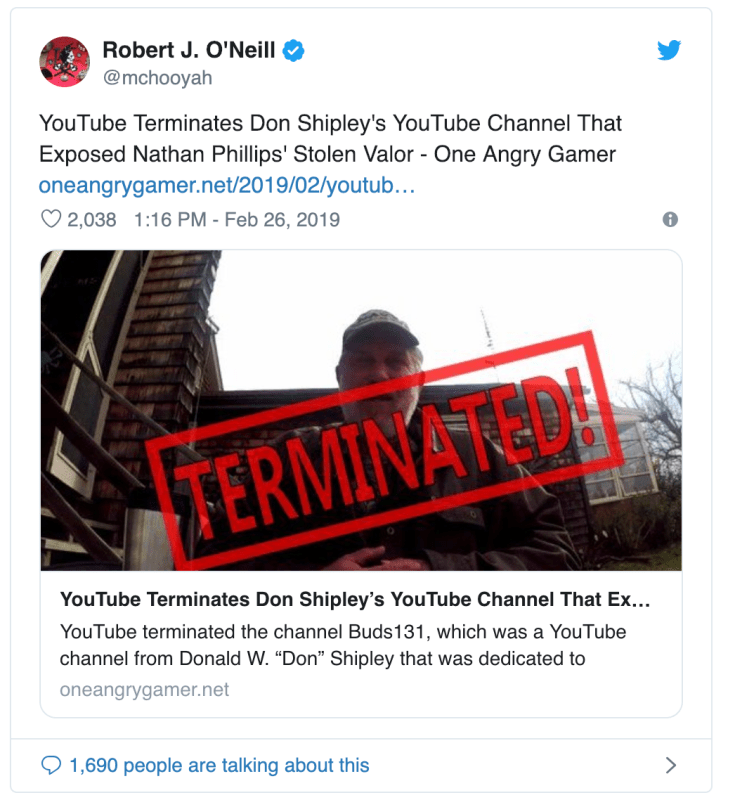
But wait, there is more! It was confirmed on Tuesday that retired Navy SEAL Don Shipley, known as a crusader against “stolen valor,” got his YouTube channel deleted earlier this month. There were no details as to why, but this was right after Shipley had exposed Nathan Phillips – the Native American activist who claimed he was victimized by Kentucky high school students, in what turned out to be fake news – as falsely claiming he served in Vietnam.

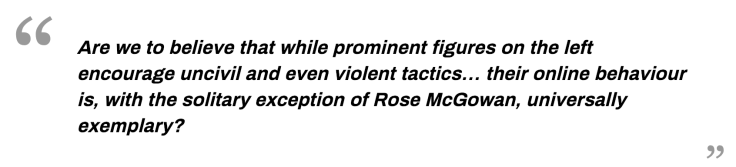
Columbia University researcher Richard Hanania offered an interesting analysis a couple of weeks ago, showing that of the 22 prominent figures suspended by Twitter in recent years, 21 were supporters of President Donald Trump, and only one – Rose McGowan – was a Democrat. McGowan had clearly violated the platform’s rule against doxxing, and was reinstated after she deleted the post. Many of those 21 Trump supporters were not so lucky, getting permanent bans from the platform. So he asked:

Screen Shot 2019-02-27 at 10.31.52 AM

What are the odds? Astronomical, actually – Hanania showed that conservatives would have to be four times as likely to violate Twitter rules for even a 5 percent chance of producing the 21-1 ratio. Yet those who routinely cite statistical “disparate impact” to cry racism are perfectly fine claiming there is no bias here? Really?

But [insert social media giant here] is a private company! They can do what they want! So cry the sudden champions of capitalism and deregulation, who in their previous breath claimed Trump abolishing Net Neutrality rules would break the internet. Make up your mind, folks!

In the McCarthyite atmosphere whipped up after the 2016 US presidential election, the social media that once promised unprecedented freedom of expression have turned into the tools of censorship – and not on behalf of a governing party, either, but the bipartisan political establishment united in opposition to an outsider president and anyone who dares support him, or criticize their conduct.

By the way, the “terrible dictator” Trump hasn’t lifted a finger to stop this persecution, let alone sic the IRS or the FBI on his critics.

Screen Shot 2019-02-27 at 10.34.49 AM

The idea behind free speech is not that all opinions are valid, but that they ought to be debated rather than imposed by force. Another fundamental principle of western civilization is that the law ought to apply equally to everyone.

One does not have to agree with Robinson, Wohl, Shipley, Maffick, Jones – or Trump, for that matter – to realize that a world in which there is one set of rules for “us” and another for “them,” in which it doesn’t matter what is done but Who is doing it to Whom, is not a land of liberty but something quite different.

Richard Blumenthal: Democrats May Subpoena Full Mueller Report If It’s Not Released

By Josh Hammer

On Thursday, Sen. Richard Blumenthal (D-CT) confirmed that congressional Democrats may seek to subpoena the impending full report of Special Counsel Robert Mueller, in the event newly confirmed Attorney General William Barr chooses to redact or otherwise only partially release the much-anticipated document.

Bloomberg reports:

“The public will feel rightly that there is a coverup” if details are withheld, [Blumenthal] told CNN Thursday.

Blumenthal, who is on the Senate Judiciary Committee, said he hopes the Republican-led panel would be among the congressional committees that seek to compel the release of any details that aren’t forthcoming. The subpoenas could seek the full report or even Mueller himself. “A Senate or House committee can subpoena anyone,” he said.

As Bloomberg notes, Mueller is expected to submit his report’s final prosecutorial decisions to Barr as early as next week. Barr, as Attorney General, then retains ultimate discretion as to how to act (or not) upon the report’s conclusions and recommendations.

As Roll Call notes, Barr has been noncommittal as to whether he would permit Mueller to testify before Congress, as well as whether he would resist a hypothetical subpoena for Mueller’s report.

Rep. Jerrold Nadler (D-NY), Chairman of the House Judiciary Committee, echoed Barr’s comments last month. As CNN reported, at the time, Nadler told Anderson Cooper at the time: “If necessary, our committee will subpoena the report. If necessary, we’ll get Mueller to testify. The American people need the information here.”

As The Daily Wire reported earlier today, CNN appears to be actively attempting to lower its viewers’ expectations as to what to expect from the Mueller report’s impending release:

Asked by “New Day” host Alisyn Camerota Wednesday if he believed the Mueller investigation would find “enough” to take down Trump, former National Intelligence Director and rabid anti-Trump CNN analyst James Clapper attempted to temper the audience’s expectations.

“That’s the big question,” Clapper said. …”I think the hope is that the Mueller investigation will clear the air on this issue once and for all. I’m really not sure it will, and the investigation, when completed, could turn out to be quite anti-climactic and not draw a conclusion about that.”

The Mueller investigation has been dominating news cycles for much of the past week, due in no small part to the firestorm caused by fired former FBI Deputy Director Andrew McCabe’s remarkable “60 Minutes” interview with Scott Pelley, in which McCabe claims that he and Deputy Attorney General Rod Rosenstein had openly discussed the possibility of invoking the 25th Amendment after President Trump’s firing of then-FBI Director James Comey. Last week, The Daily Wire’s Emily Zanotti reported:

The New York Times reports that McCabe claims “top Justice Department officials were so alarmed by President Trump’s decision in May 2017 to fire James B. Comey, the bureau’s director,” that they reached out to individual Cabinet members to judge their receptiveness to triggering the removal clause of the 25th Amendment, which allows the Cabinet to “vote out” a president who is incapacitated or otherwise unable to fulfill the duties of his job.

McCabe also claims that Comey’s firing “prompted Mr. McCabe to order the bureau’s team investigating Russia’s election interference to expand their scope to also investigate whether Mr. Trump had obstructed justice.”


Justice Department preparing for Mueller report as early as next week

See the source image

By Evan PerezLaura Jarrett and Katelyn Polantz,

Attorney General Bill Barr is preparing to announce as early as next week the completion of special counsel Robert Mueller‘s Russia investigation, with plans for Barr to submit to Congress soon after a summary of Mueller’s confidential report, according to people familiar with the plans.

The preparations are the clearest indication yet that Mueller is nearly done with his almost two-year investigation.
The precise timing of the announcement is subject to change.
The scope and contours of what Barr will send to Congress remain unclear. Also unclear is how long it will take Justice officials to prepare what will be submitted to lawmakers.
But with President Donald Trump soon to travel overseas for a summit with North Korean leader Kim Jong Un, Justice officials are mindful of not interfering with the White House’s diplomatic efforts, which could impact the timing.
The Justice Department and the special counsel’s office declined to comment.
Barr has said that he wants to be as “transparent” as possible with Congress and the public, “consistent with the rules and the law.”
Under the special counsel regulations, Mueller must submit a “confidential” report to the attorney general at the conclusion of his work, but the rules don’t require it to be shared with Congress, or by extension, the public. And, as Barr has made clear, the Justice Department generally guards against publicizing “derogatory” information about uncharged individuals.
As a result, one of the most pressing questions Barr will face in the coming weeks is the extent to which Mueller’s findings should be disclosed to Congress.
The regulations require Mueller to explain in his report all decisions to prosecute or not prosecute matters under scrutiny. Barr would also need to inform Congress if the Justice Department prevented the special counsel team from pursuing any investigative steps.
Trump said Wednesday that it’s “totally up to Bill Barr” as to whether Mueller’s report comes out while he is overseas in Vietnam next week.
“That’ll be totally up to the new attorney general. He’s a tremendous man, a tremendous person, who really respects this country and respects the Justice Department, so that’ll be totally up to him,” Trump told reporters in the White House.
Speculation about the end of the probe has been running rampant in Washington. NBC News reported recently the probe would be done by mid-February.

Life after Mueller

While the Mueller investigation may soon come to a close, there continue to be court cases that will be handled by other federal prosecutors.
In addition, Mueller has referred certain matters that fell outside the scope of the Russia probe to other US Attorneys to pursue. Some of those investigations have already been revealed, including the investigation in New York into former Trump’s former lawyer, Michael Cohen. That probe has spawned subsequent federal investigations in New York into the Trump Organization and the Trump Inaugural Committee. It is possible the special counsel’s team has referred other matters that have not yet come to light.
For close watchers of the federal courthouse and the Mueller team, small changes have added up in recent weeks.
On Monday, Tuesday and Wednesday last week, special counsel’s office employees carried boxes and pushed a cart full of files out of their office — an unusual move that could foreshadow a hand-off of legal work.
At the same time, the Mueller prosecutors’ wo
-rkload appears to be dwindling. Four of Mueller’s 17 prosecutors have ended their tenures with the office, with most returning to other roles in the Justice Department.
And the grand jury that Mueller’s prosecutors used to return indictments of longtime Trump confidant Roger Stone, former Trump campaign chairman Paul Manafort, and several Russians hasn’t apparently convened since January 24 the day it approved the criminal charges against Stone.
Even with these signs of a wrap up, the DC US Attorney’s office has stepped in to work on cases that may continue longer than Mueller is the special counsel.
That office has joined onto some of the Mueller’s team’s casework, including the cases against Stone, a Russian social media propaganda conspiracy, and in an ongoing foreign government-owned company’s fight against a grand jury subpoena.
Mueller and his prosecutors are still reporting to work as frequently as ever — with some even coming in on recent snow days and Presidents’ Day. But also visiting them more often than ever before are the prosecutors from the DC US Attorney’s Office and others in the Justice Department who’ve worked on the Mueller cases.
In one court case, against Concord Management for its alleged support for the social media conspiracy prosecutors told a judge in January there’s still a related “matter occurring before the grand jury.”
In other cases, including Manafort’s, the Mueller team has made heavy redactions to its recent public court filings, including to protect pending investigations and people who haven’t been charged with crimes.

ADAM SCHIFF REFUSES TO STAND DOWN IF MUELLER FINDS NO COLLUSION

Adam Schiff Refuses to Stand Down If Mueller Finds No Collusion

‘We’re going to have to do our own investigation, and we are,’ he tells CNN

Washington Examiner – FEBRUARY 17, 2019

House Intelligence Committee Chairman Adam Schiff, D-Calif., wouldn’t say Sunday if he would accept special counsel Robert Mueller being unable to find direction collusion between President Trump’s 2016 campaign and Russia.

The House Intelligence Committee is embarking on a sweeping investigation into Trump’s financial transactions and Russia, and Schiff adamantly stressed that his panel will continue its work unimpeded regardless of what Mueller says.

During an interview on CNN, Schiff discussed at length all the “evidence in plain sight” of collusion he believes there is, but said “it will be up to Mueller to decide if that amounts to criminal conspiracy.”

However, when he was asked point blank if he would accept Mueller’s findings if no clear evidence of collusion is determined, Schiff demurred. Instead he focused his answer on how his committee will conduct its own inquiry and how he’ll fight to gain access to Mueller’s evidence should it be withheld from public view.

“We’re going to have to do our own investigation, and we are. We’ll certainly be very interested to learn what Bob Mueller finds. We may have to fight to get that information. Bill Barr has not been willing to commit to provide that report either to the Congress or to the American people. We’re going to need to see it,” Schiff said on “State of the Union,” referring to Trump’s newly confirmed attorney general.

“The American people need to see it. We may also need to see the evidence behind that report,” he added. “There may be, for example, evidence of collusion or conspiracy that is clear and convincing. But not proof beyond a reasonable doubt. The American people are entitled to know if there is evidence of a conspiracy between either the president or the president’s campaign and a foreign adversary. At the end of the day, the most important thing for the American people to know is whether the president is somehow compromised, whether there’s a leverage the Russians could use over the president, and if the Russians are in a position to expose wrongdoing by the president or his campaign.”

Host Dana Bash pressed Schiff again, asking if he would accept Mueller’s findings separate from his own investigation. Schiff’s response focused on the integrity of Mueller’s operation.

“You know, I will certainly accept them in this way, Dana. I have great confidence in the special counsel. And if the special counsel represents that he has investigated and not been interfered with and not been able to make a criminal case, then I will believe that he is operating in good faith,” Schiff said.

Schiff and his Democratic majority are reopening the House Intelligence Committee’s inquiry into Russian interference after the GOP-led panel in the last term completed an investigation that found no evidence of collusion between the Trump campaign and the Kremlin. At the time, the Democrats said the GOP-led effort wrapped prematurely.

Schiff also dismissed a recent assertion made by Senate Intelligence Committee Chairman Richard Burr, R-N.C., that Schiff’s panel’s Russia investigation has yet to turn up evidence of collusion. He quipped “Chairman Burr must have a different word for” collusion, citing such controversies as the infamous 2016 Trump Tower meeting and Trump campaign staffer George Papadopoulos, who last year served 12 days for lying to FBI investigators about his contact with people linked to Russia during the 2016 campaign.

MCCABE: DOJ DISCUSSED REMOVING TRUMP…

By Dylan Stableford

Senior Editor
Capture

Former FBI Deputy Director Andrew McCabe says that after President Trump fired his boss, FBI Director James Comey, there were discussions within the Department of Justice about invoking the 25th Amendment to remove Trump from office.

Last year, the New York Times reported that Deputy Attorney General Rod Rosenstein discussed recruiting Cabinet members to invoke the 25th Amendment.

McCabe confirmed the report in a new interview with “60 Minutes” host Scott Pelley, who relayed what McCabe told him on “CBS This Morning” Thursday.

“There were meetings at the Justice Department at which it was discussed whether the vice president and a majority of the Cabinet could be brought together to remove the president of the United States under the 25th Amendment,” Pelley said.

In a statement released by the Justice Department, Rosenstein said McCabe’s account of a discussion of invoking the 25th amendment was “inaccurate and factually incorrect.”

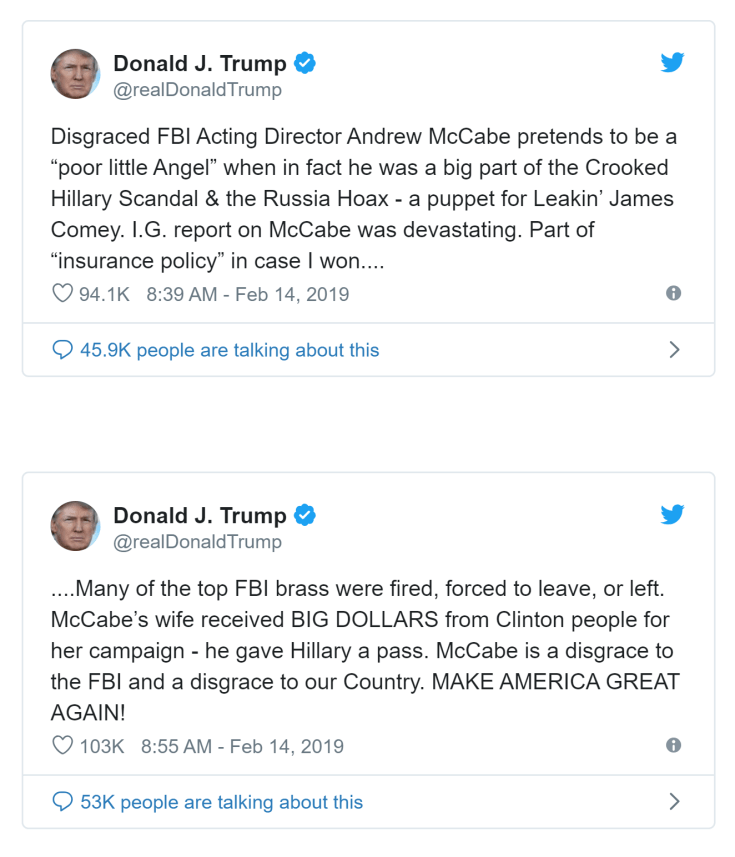
Trump responded in a pair of tweets later Thursday morning.

Capture

The discussions occurred between the time of Comey’s firing in May of 2017 and the appointment eight days later of special counsel Robert Mueller to oversee the FBI’s investigation into Russian interference in the 2016 election.

According to the Times, Rosenstein also suggested that he secretly record Trump in the White House. Rosenstein disputed the account, and a Justice Department official said he made the remark sarcastically. But McCabe told Pelley that Rosenstein’s offer to wear a wire was made more than once and that he ultimately took it to the lawyers at the FBI to discuss.

McCabe, who was named acting director of the bureau after Comey’s firing, launched obstruction of justice and counterintelligence investigations into whether Trump obstructed justice by firing Comey.

He told Pelley he did so in order to preserve the FBI’s Russian probe in case there was an effort by Trump to terminate it.

“I was very concerned that I was able to put the Russia case on absolutely solid ground, in an indelible fashion,” McCabe said. “That were I removed quickly, or reassigned or fired, that the case could not be closed or vanish in the night without a trace.”

McCabe’s comments come ahead of the release of his new book, “The Threat: How the FBI Protects America in the Age of Terror and Trump,” due out next week.

In an excerpt of the book published Thursday in the Atlantic, McCabe describes a phone call he received from Trump on his first full day on the job as acting director of the FBI. According to McCabe, Trump told him that he had “hundreds of messages from FBI people [saying] how happy they are that I fired [Comey].”

“You know — boy, it’s incredible, it’s such a great thing, people are really happy about the fact that the director’s gone, and it’s just remarkable what people are saying,” Trump said, according to McCabe. “Have you seen that? Are you seeing that, too?”

McCabe was eventually fired in March 2018, less than two days before he would have collected a full early pension for his FBI career.

“Andrew McCabe FIRED,” Trump tweeted on the day of McCabe’s dismissal. “A great day for the hard working men and women of the FBI – A great day for Democracy.”

Trump has since railed against McCabe dozens of times on Twitter. “He LIED! LIED! LIED! McCabe was totally controlled by Comey – McCabe is Comey!” he exclaimed last April. “No collusion, all made up by this den of thieves and lowlifes!”

(THE FBI IS PART OF THE DEEP STATE) – Trump Slams McCabe As “Disgrace To The FBI & Country” After Russia Probe Admission

By Tyler Durden

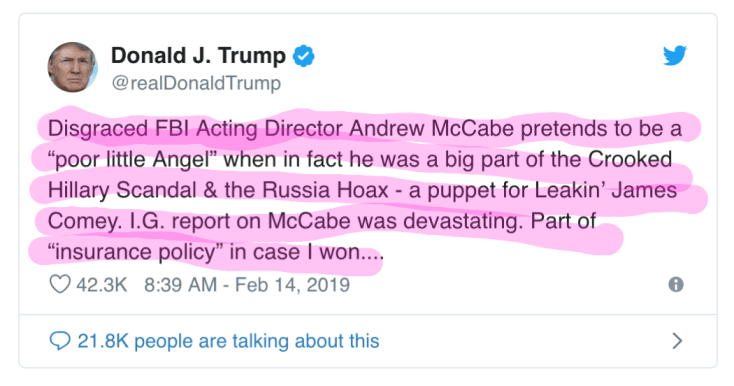
Update: As one might expect, President Trump has chimed in on twitter, where he slammed McCabe for giving Hillary Clinton a pass and accused the former deputy director, who admitted to lying to the DOJ’s inspector general, of giving “Hillary a pass.”

Screen Shot 2019-02-14 at 10.15.03 AM

Screen Shot 2019-02-14 at 10.17.18 AM

And as Breitbart’s Sean Davis reminds us, Trump’s criticisms are very much justified.

Screen Shot 2019-02-14 at 10.20.04 AM

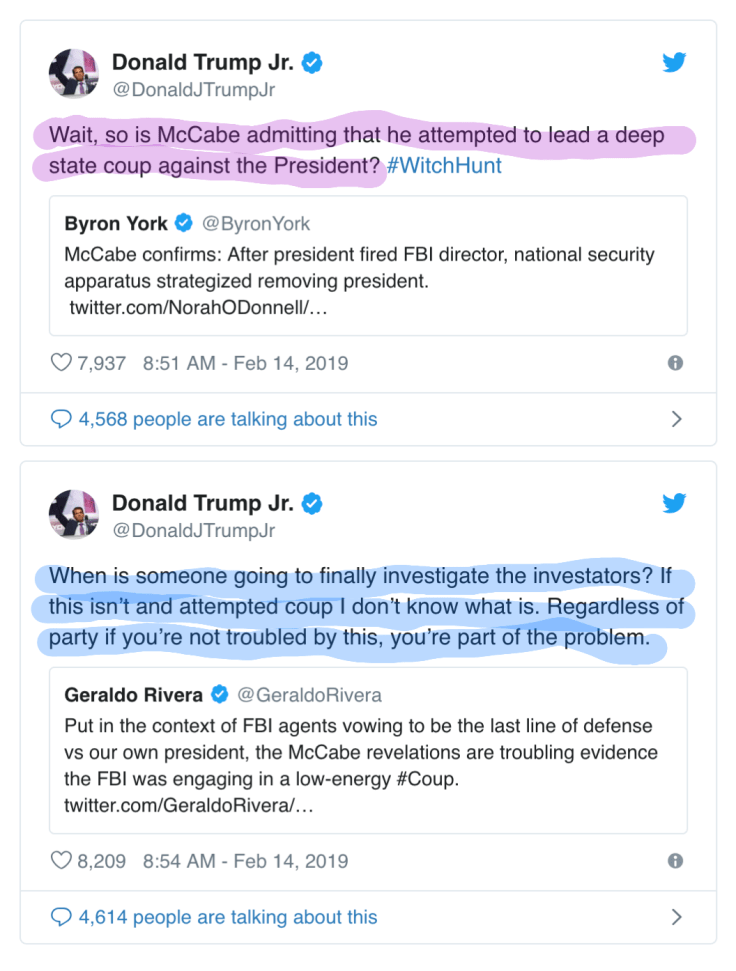
Trump Jr. took the attack one step further, accusing McCabe of trying to orchestrate a “deep state coup” against his father, before declaring that it’s time that somebody should “investigate the investigators.”

Screen Shot 2019-02-14 at 10.24.01 AM

And though Rosenstein has already announced his plans to resign from the DOJ after William Barr has been confirmed, Freedom Caucus leader Mark Meadows is renewing the call for him to resign immediately following McCabe’s revelations.

Screen Shot 2019-02-14 at 10.28.07 AM

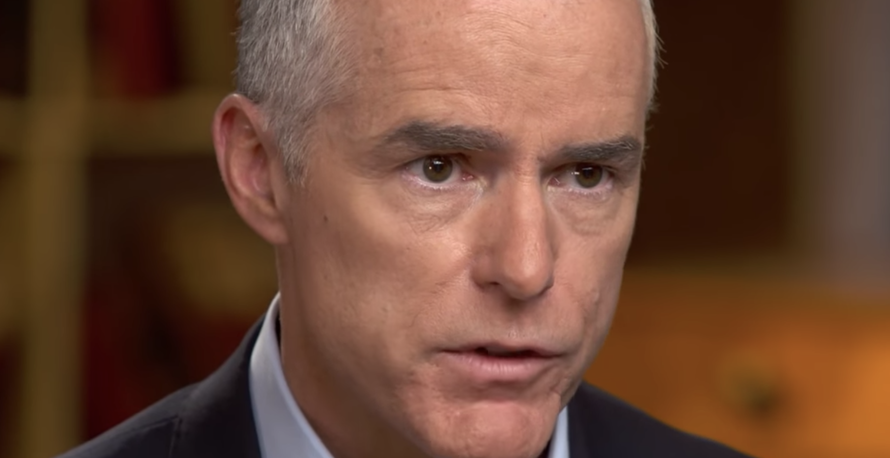
In his first interview about the Russia probe since he was summarily fired by President Trump just 26 hours before he was set to retire and collect his pension, and while the possibility of criminal charges over his attempts to cover up his leaks to the press, former Deputy FBI Director Andrew McCabe sat for an interview with CBS about the early days of the Russia probe.

McCabe

In an excerpt of the full interview, which is set to air on Sunday, McCabe described how he quickly moved to start the Russia probe a day after meeting with Trump in May 2017 in the days after James Comey‘s firing, over fears that he would soon be fired. After authorizing the investigation into Trump’s Russia ties, McCabe sought to ensure that the investigation – which was eventually rolled into the probe eventually taken over by Special Counsel Robert Mueller – would be on “solid ground” even if he was booted from the FBI.

“I was very concerned that I was able to put the Russia case on absolutely solid ground in an indelible fashion that were I removed quickly or reassigned or fired that the case could not be closed or vanish in the night without a trace,” McCabe told CBS.

The interview marked the first time McCabe has ever opened up about his thought process when he launched the probe. In his recounting of his conversation with President Trump, McCabe said he felt intimidated by the president.

“I was speaking to the man who had just run for the presidency and won the election for the presidency and who might have done so with the aid of the government of Russia, our most formidable adversary on the world stage,” McCabe said in an excerpt aired on CBS on Thursday. “And that was something that troubled me greatly.”

He compared Trump’s request that McCabe allow him to visit the FBI – a visit that McCabe suggest would have been well outside the bounds of decorum – to tactics used by Russian mobsters that McCabe had once prosecuted.

“In this moment, I felt the way I’d felt in 1998, in a case involving the Russian Mafia, when I sent a man I’ll call Big Felix in to meet with a Mafia boss named Dimitri Gufield,” McCabe wrote. “The same kind of thing was happening here, in the Oval Office. Dimitri had wanted Felix to endorse his protection scheme. This is a dangerous business, and it’s a bad neighborhood, and you know, if you want, I can protect you from that. If you want my protection. I can protect you. Do you want my protection? The president and his men were trying to work me the way a criminal brigade would operate.”

Of course, nobody in the mainstream press has pointed out that the timing of McCabe’s decision to launch the probe would suggest that he was looking for leverage to stop him from being fired along with Comey…though, thanks to his decision to lie to the DOJ’s inspector general, that problem swiftly took care of itself.

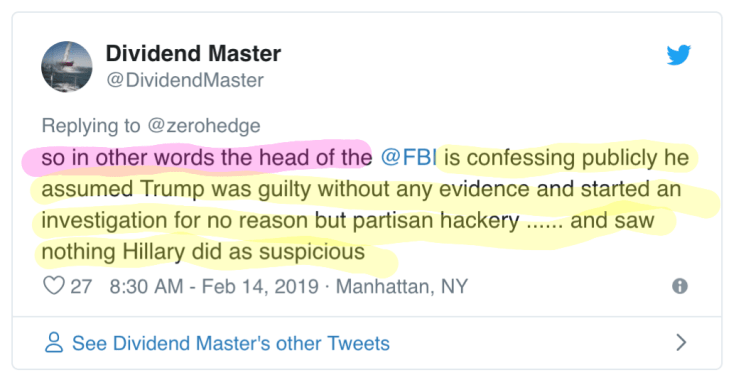
He also admitted that he launched the investigation without any actual evidence…just partisan hackery.

Screen Shot 2019-02-14 at 10.30.32 AM

In a discussion about the interview, McCabe’s interviewer Scott Pelley said McCabe affirmed that there had been discussions about invoking the 25th amendment to remove Trump – something that was the subject of a series of leaks last year

…about a plot allegedly concocted by Rod Rosenstein (Rosenstein, for what its worth, has issued a statement denying McCabe’s assertion that the Deputy Attorney General raised the issue of Trump Administration officials wearing a wire during their talks with the president).

The Deputy Attorney General never authorized any recording that Mr. McCabe references. As the Deputy Attorney General previously has stated, based on his personal dealings with the President, there is no basis to invoke the 25th Amendment, nor was the DAG in a position to consider invoking the 25th Amendment.

Finally, the Deputy Attorney General never spoke to Mr. Comey about appointing a Special Counsel. The Deputy Attorney General in fact appointed Special Counsel Mueller, and directed that Mr. McCabe be removed from any participation in that investigation. Subsequent to this removal, DOJ’s Inspector General found that Mr. McCabe did not tell the truth to federal authorities on multiple occasions, leading to his termination from the FBI.”

The full interview will air Sunday night at 7 pm. But CBS has published an excerpt below:

WATCH: Klobuchar Vows to Avenge Clinton’s Loss on Maddow

By Peter D’Abrosca

A U.S. Senator and 2020 presidential candidate vowed to avenge Hillary R. Clinton’s shocking 2016 loss to President Donald J. Trump on MSNBC’s “The Rachel Maddow Show” on Monday.

“We need to make sure the 2020 election is protected so that what happened to Hillary Clinton never happens again,” Sen. Amy Klobuchar (D-Minn.) said.

Klobuchar was speaking in the context of “Russian interference” in the 2016 election, conspiracy theorizing that some sort of Russian-driven voter fraud cost Clinton the election. Maddow made no effort counter these wild claims, or to point out that Clinton lost because she was the least likable and most out-of-touch presidential candidate in recent American history who failed to campaign in Wisconsin. These are minor details to Democrats, who cannot accept the premise that they lost because ordinary Americans who live between New York and Los Angeles just aren’t that into them.

Speaking of unlikeable candidates, Klobuchar announced her candidacy outside, in near-blizzard conditions, just days after reports that her Senate staffer hated her.

Big League Politics reported:

Klobuchar, known for her nasty questioning of Supreme Court Justice Brett Kavanaugh at his confirmation hearings last year, and particularly for her apparent disdain for his enjoyment of beer (ironically, she held a pre-announcement party with her staff at a local brewery Saturday night) has been embroiled in a bit of controversy for acting abusively towards her Senate staffers.

“At least three people have withdrawn from consideration to lead Sen. Amy Klobuchar’s nascent 2020 presidential campaign — and done so in part because of the Minnesota Democrat’s history of mistreating her staff,” a Wednesday report said.

The report continued:

But some former Klobuchar staffers, all of whom spoke to HuffPost on condition of anonymity, describe Klobuchar as habitually demeaning and prone to bursts of cruelty that make it difficult to work in her office for long.

It is common for staff to wake up to multiple emails from Klobuchar characterizing one’s work as “the worst” briefing or press release she’d seen in her decades of public service, according to two former aides and emails seen by HuffPost.

Although some staffers grew inured to her constant put-downs (“It’s always ‘the worst,’” one said sarcastically, “‘It was ‘the worst’ one two weeks ago”), others found it grinding and demoralizing. Adding to the humiliation, Klobuchar often cc’d large groups of staffers who weren’t working on the topic at hand, giving the emails the effect of a public flogging.

WATCH:


Blog at WordPress.com.

Up ↑