Homeland Security warns terrorists may exploit COVID-19 pandemic

By Alexander Mallin and Josh Margolin – 3/25/2020

A Department of Homeland Security memo sent to law enforcement officials around the country warns that violent extremists could seek to take advantage of the COVID-19 pandemic by carrying out attacks against the U.S.

“Violent extremists probably are seeking to exploit public fears associated with the spread of COVID-19 to incite violence, intimidate targets and promote their ideologies, and we assess these efforts will intensify in the coming months,” according to the intelligence bulletin, compiled by the agency’s Counterterrorism Mission Center and Countering Weapons of Mass Destruction Office.

At this time, DHS said it has “no information indicating any active plotting is underway,” but that it has observed certain extremist groups, both foreign and domestic, looking to spread misinformation about the coronavirus.

The memo, which was circulated on Monday, comes after assurances from FBI Director Chris Wray in a video message that agents would be even more vigilant in monitoring threats to the U.S. as the virus spreads.

“With all the worry and uncertainty out there, we want the public to know that there are still things they can count on: We’re here, and we’re going to stay here, to protect them, no matter what,” Wray said. “Because our criminal and national security adversaries sure aren’t going to take a day off — whether that’s for the coronavirus or, for that matter, anything else.”

Among the activities by extremist organizations cited in the DHS bulletin is a clipping from a weekly ISIS newsletter, which called for supporters to carry out attacks against overburdened health care systems in various Western countries.

Another portion of the bulletin singles out activity by white supremacists online who the DHS says have “advocated for violence against a range of targets, including critical infrastructure and faith-based and minority communities — including Asian Americans in response to the COVID outbreak.”

ABC News reported on Monday on an alert from the FBI’s New York field office that showed intelligence gathered on racist extremist groups, including neo-Nazis, that were encouraging followers who contract COVID-19 to spread the disease to Jewish people and police officers.

Countries are starting to hoard food, threatening global trade

Screen Shot 2020-03-25 at 9.58.06 AM

By Isis Almeida and Agnieszka de Sousa

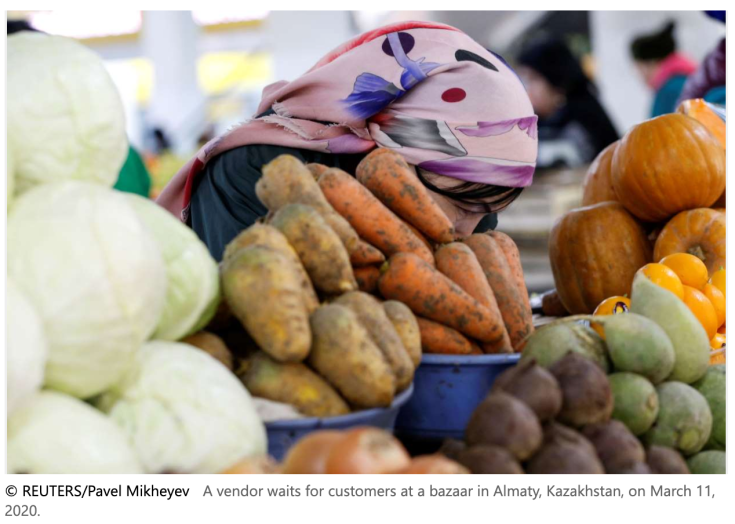
Kazakhstan, one of the world’s biggest shippers of wheat flour, banned exports of that product along with others, including carrots, sugar and potatoes. Serbia has stopped the flow of its sunflower oil and other goods. Russia is leaving the door open to shipment bans and said it’s assessing the situation weekly.
To be perfectly clear, there have been just a handful of moves and no sure signs that much more is on the horizon. Still, what’s been happening has raised a question: Is this the start of a wave of food nationalism that will further disrupt supply chains and trade flows?

“We’re starting to see this happening already — and all we can see is that the lockdown is going to get worse,” said Tim Benton, research director in emerging risks at think tank Chatham House in London.

Though food supplies are ample, logistical hurdles are making it harder to get products where they need to be as the coronavirus unleashes unprecedented measures, panic buying and the threat of labor crunches.

Consumers across the globe are still loading their pantries — and the economic fallout from the virus is just starting. The specter of more trade restrictions is stirring memories of how protectionism can often end up causing more harm than good. That adage rings especially true now as the moves would be driven by anxiety and not made in response to crop failures or other supply problems.

Related video: Food supply is not where it’s needed

As it is, many governments have employed extreme measures, setting curfews and limits on crowds or even on people venturing out for anything but to acquire essentials. That could spill over to food policy, said Ann Berg, an independent consultant and veteran agricultural trader who started her career at Louis Dreyfus Co. in 1974.

“You could see wartime rationing, price controls and domestic stockpiling,” she said.

Some nations are adding to their strategic reserves. China, the biggest rice grower and consumer, pledged to buy more than ever before from its domestic harvest, even though the government already holds massive stockpiles of rice and wheat, enough for one year of consumption.

Key wheat importers including Algeria and Turkey have also issued new tenders, and Morocco said a suspension on wheat-import duties would last through mid-June.

a close up of a map: Food Dependence© Bloomberg Food Dependence

As governments take nationalistic approaches, they risk disrupting an international system that has become increasingly interconnected in recent decades.

Kazakhstan had already stopped exports of other food staples, like buckwheat and onions, before the move this week to cut off wheat-flour shipments. That latest action was a much bigger step, with the potential to affect companies around the world that rely on the supplies to make bread.

For some commodities, a handful of countries, or even fewer, make up the bulk of exportable supplies. Disruptions to those shipments would have major global ramifications. Take, for example, Russia, which has emerged as the world’s top wheat exporter and a key supplier to North Africa.

“If governments are not working collectively and cooperatively to ensure there is a global supply, if they’re just putting their nations first, you can end up in a situation where things get worse,” said Benton of Chatham House.

He warned that frenzied shopping coupled with protectionist policies could eventually lead to higher food prices — a cycle that could end up perpetuating itself.

“If you’re panic buying on the market for next year’s harvest, then prices will go up, and as prices go up, policy makers will panic more,” he said.

And higher grocery bills can have major ramifications. Bread costs have a long history of kick-starting unrest and political instability. During the food price spikes of 2011 and 2008, there were food riots in more than 30 nations across Africa, Asia and the Middle East.

“Without the food supply, societies just totally break,” Benton said.

Ample supplies have kept prices relatively low since the 2011 spike© Bloomberg Ample supplies have kept prices relatively low since the 2011 spike

Unlike previous periods of rampant food inflation, global inventories of staple crops like corn, wheat, soybeans and rice are plentiful, said Dan Kowalski, vice president of research at CoBank, a $145 billion lender to the agriculture industry, adding he doesn’t expect “dramatic” gains for prices now.

While the spikes of the last decade were initially caused by climate problems for crops, policies exacerbated the consequences. In 2010, Russia experienced a record heat wave that damaged the wheat crop. The government responded by banning exports to make sure domestic consumers had enough.

The United Nations’ measure of global food prices reached a record high by February 2011.

“Given the problem that we are facing now, it’s not the moment to put these types of policies into place,” said Maximo Torero, chief economist at the UN’s Food and Agriculture Organization. “On the contrary, it’s the moment to cooperate and coordinate.”

Read More on Food Issues in Virus Era:

There’s Plenty of Food in the World, Just Not Where It’s Needed

Americans Drop Kale and Quinoa to Lock Down With Chips and Oreos

Cargill Says China Offers Hope for Meat Markets Hit by Virus 

Of course, the few bans in place may not last, and signs of a return to normal could prevent countries from taking drastic measures. Once consumers start to see more products on shelves, they may stop hoarding, in turn allowing governments to back off. X5 Retail, Russia’s biggest grocer, said demand for staple foods is starting to stabilize. In the U.S., major stores like Walmart Inc. have cut store hours to allow workers to restock.

In the meantime, some food prices have already started going up because of the spike in buying.

Wheat futures in Chicago, the global benchmark, have climbed more than 6% in March as consumers buy up flour. U.S. wholesale beef has shot up to the highest since 2015, and egg prices are higher.

At the same time, the U.S. dollar is surging against a host of emerging-market currencies. That reduces purchasing power for countries that ship in commodities, which are usually priced in greenbacks.

n the end, whenever there’s a disruption for whatever reason, Berg said, “it’s the least-developed countries with weak currencies that get hurt the most.”

CORONAVIRUS – Canadian Students Gather at St. Patrick’s Day Party, Laugh About Spreading Coronavirus

Ignored police warnings not to congregate.


Students in Kingston, Ontario ignored warnings about gathering in large groups and attended a St. Patrick’s Day party while laughing at the prospect of spreading the coronavirus.

Dismissing an advisory by police not to congregate, the students appeared to be more fixated on getting drunk than anything else.

“Last week, Kingston Police, Public Health and Queen’s University urged students not to attend St. Patricks Day parties. Today, the university district streets are filled with students- many telling me they aren’t afraid of COVID-19,” tweeted Kraig Krause.

One video features a young man acknowledging that such parties will help spread COVID-19.

“I’m not worried. I know it will. It’s not a question. It will definitely spread the disease because it will definitely spread the disease,” he said.

The man then burst out in laughter before adding, ” You know, do what you can. If you’re sick, then don’t go. If you’re worried about it, then don’t go. If you do attend these, be in isolation after the fact. You can do your part for the community.”

Another clip shows a young woman claiming, “I have a compromised immune system, but I’m still only 21 … I’m not even worried because I take supplements and I self medicate.”

Reportedly, Kingston Police responded to the gathering by ordering students to get off the streets.


European Union Demands Greece Provide Asylum to Migrants Storming Turkish Border

The globalists aren’t having Greece’s border controls.

By 

Unelected bureaucrats of the European Union are demanding that Greece uphold asylum rights for the latest wave of migrants storming its border, weeks after the southern European nation suspended all asylum claims.

Thousands of itinerant migrants have been seeking to enter Greece in recent weeks after Turkey allowed the large migrant population it had been housing to pass through the country.

Ylva Johansson, the EU commissioner for home affairs and a Swedish national, is traveling to the country on Thursday to state a list of demands and mandates from Brussels for the nation. Johansson isn’t happy that Greece is refusing to provide a byzantine(no pun intended) legal process for so-called refugees storming the country.

Johansson claims Greece is treaty-obligated as a member of the union to permit migrants to apply for asylum.

“Individuals in the European Union have the right to apply for asylum. This is in the treaty, this is in international law. This we can’t suspend.”

It probably won’t go over well in the Mediterranean country that a foreign bureaucrat intends to lecture them on their response to the crisis of mass immigration flowing over the border from Turkey. Citizens of Greece largely expect the EU to assist them in dealing with the problem, namely in compelling Turkey to shut down the transit of migrants from the eastern parts of the country to its European border with Greece.

Greece is the latest country to question in policy the supposedly universal right to request asylum, a legal tactic often applied by illegal immigrants without a genuine case for refugee protections and utilized by human smugglers to facilitate illegal immigration in Europe and North America.

Thousands of migrants remain camped on Greece’s border with Turkey. Unfortunately for them, they can’t count on solidarity and assistance from the European Union in dealing with the problem, but rather a set of mandates and demands to let them in.

Blog at WordPress.com.

Up ↑