Iran confiscates British tanker in Strait of Hormuz – IRGC

Screen Shot 2019-07-19 at 2.46.34 PM

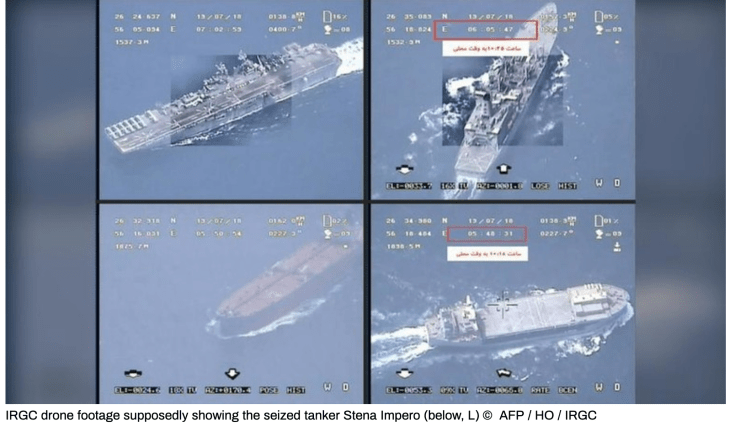
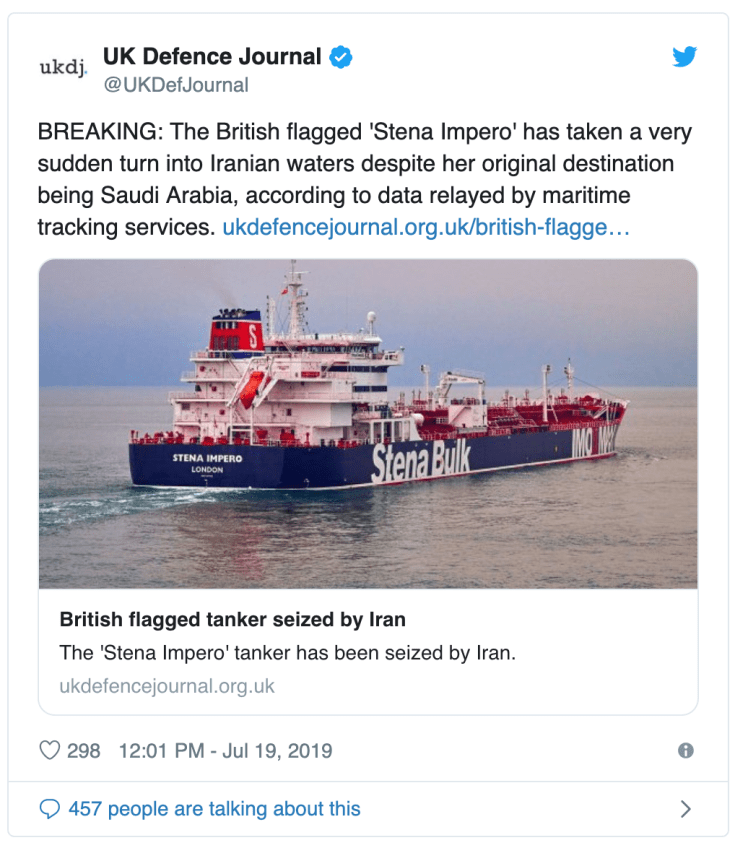
The Islamic Revolutionary Guard Corps has seized the British oil tanker Stena Impero in the Strait of Hormuz, Iranian media reported. UK authorities said the tanker had ‘veered off course’ before capture.

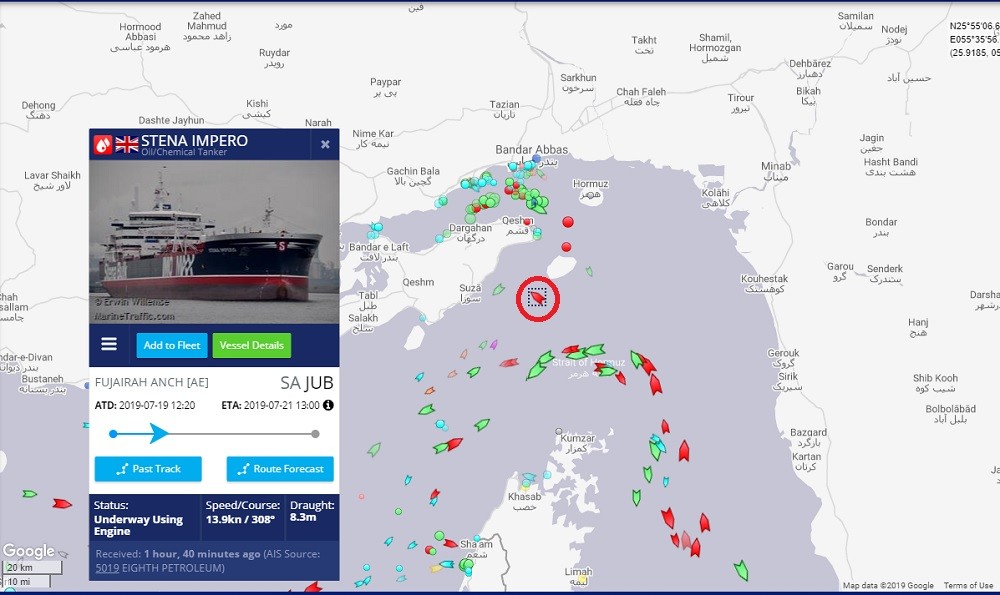
The Stena Impero was headed to Saudi Arabia but left the international sea lanes and headed north towards the Iranian island of Qeshm, marine tracking data showed on Friday.

Prior to the seizure, the tanker turned off its tracking device and had ignored warnings, Iranian military sources told state media.

“The reason behind the detention of the British tanker is that it did not adhere to the sea routes in the Strait of Hormuz, turned off the automatic identification system (AIS), polluted international waters and did not pay attention to the warnings of Iran,” the source said.

The 30,000-ton tanker is owned by Stena Bulk, and was bound for the Saudi port of Al Jubail.

Stena issued a statement that the ship was “approached by unidentified small crafts and a helicopter during transit of the Strait of Hormuz, while the vessel was in international waters.”
Screen Shot 2019-07-19 at 2.49.20 PM

The company is “presently unable to contact the vessel which is now heading north towards Iran.” There are 23 crew members aboard.

UK authorities said they were “assessing the situation following reports of an incident in the Gulf.”

Another tanker, the Liberian-flagged Mesdar, abruptly changed course and headed for the Iranian mainland on Friday evening. The ship is owned by Norbulk Shipping UK and was bound for Ras Tanura in Saudi Arabia.

Screen Shot 2019-07-19 at 2.51.21 PM

Tehran and London have been at odds since July 4, when Royal Marines boarded and seized Iranian tanker Grace 1 off Gibraltar, accusing the ship of illegally transporting oil to Syria. Iranian authorities condemned the seizure as “piracy” and vowed to retaliate.
Six days later, the Royal Navy said its frigate HMS Montrose intervened to prevent several Iranian boats from seizing the UK-flagged tanker British Heritage in the Persian Gulf.

Earlier this week, alarms were raised after the disappearance of the Emirati-based tanker MT Riah, flying the Panamanian flag. Iran said the tanker experienced technical troubles and had been towed to port for repairs.

On Thursday, a US warship entered the Persian Gulf and reportedly shot down an Iranian drone that had approached to within 1,000 meters in a “threatening” manner. Iran has denied losing any drones, however.

Washington has sought to establish a “coalition” of allied navies in the region to ensure “freedom of navigation” in the Strait of Hormuz, one of the most important shipping lanes in the world for oil traffic.
 

US Navy shoots down Iranian drone in Strait of Hormuz – Trump

Screen Shot 2019-07-18 at 3.02.42 PM

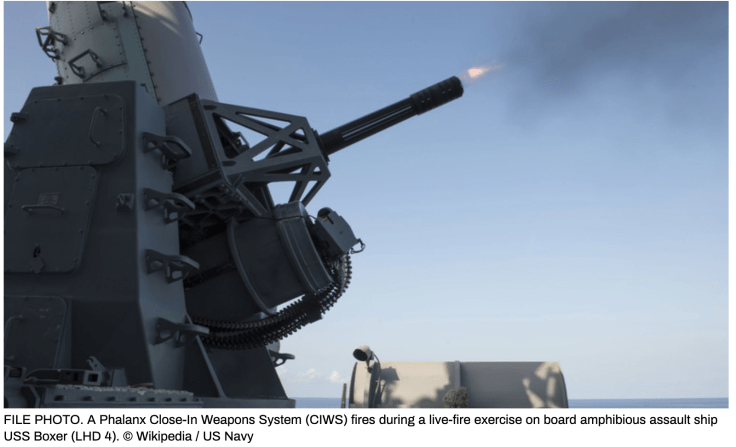
Shortly after entering the Persian Gulf, a US warship shot down an Iranian drone that had approached to within less than a kilometer, US President Donald Trump said at a White House press event.

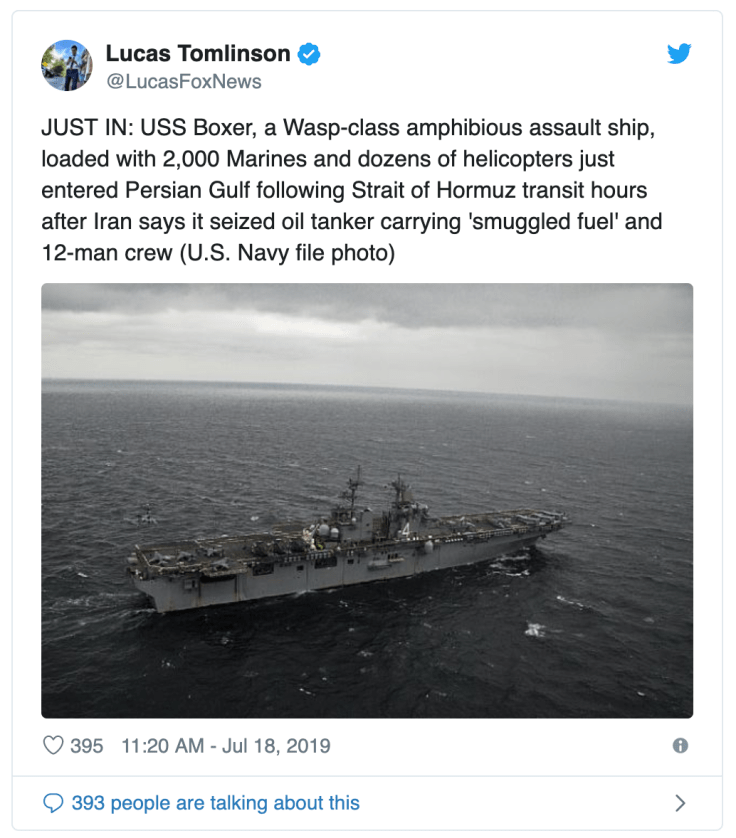
Amphibious assault ship USS Boxer took “defensive action” against an Iranian drone that approached to within 1,000 yards (900 meters), and ignored multiple calls to stand down, Trump said on Thursday.

Screen Shot 2019-07-18 at 3.04.39 PM

The drone was “threatening the safety of the ship and the ship’s crew,” the president said, adding that the US “reserves the right to defend our personnel, facilities and interests.”

Screen Shot 2019-07-18 at 3.06.04 PM

The Boxer sailed into the Persian Gulf earlier in the day, following the reports that the Iranian Revolutionary Guard Corps had seized the Panamanian-flagged oil tanker MT Riah and its 12-man crew.

The aircraft carrier USS Abraham Lincoln and the accompanying task force – which have been rehearsing a possible strike against Iran for the past two months – are still in the Arabian Sea, conducting search and rescue operations for a missing sailor.

Trump also called on other countries to “condemn Iran’s attempts to disrupt freedom of navigation and global commerce” in the Strait of Hormuz, a vital international shipping lane for transport of oil from the Persian Gulf.

Washington has called for an international “coalition” to patrol the strait.

Watch: U.S. Navy Releases Video of Drone Shoot Down over Strait of Hormuz

By Simon Kent

U.S. Central Command (CENTCOM) released vision Friday morning that confirms a U.S. Navy Broad Area Maritime Surveillance (or BAMS-D) ISR Global Hawk drone was lost to an Iranian surface-to-air missile.

The downed aircraft is large–wingspan the size of a Boeing 757–and designed for high altitude spy missions.

The command said the $240 million unmanned aircraft was operating in international airspace over the Strait of Hormuz at approximately 11:35 p.m. GMT on June 19, 2019 when it was lost.

CENTCOM refuted Iranian reports that the aircraft was over its territory. Iran, for its part, released footage of its own that allegedly shows the drone being taken out by a surface-to-air missile:

The vision from both sides was made public at the same time the New York Times reported President Donald Trump ordered air and naval strikes against Iranian targets in response to the attack but canceled them “abruptly.”

Northrop Grumman, manufacturer of the RQ-4 Global Hawk, describes it as a “premier provider of persistent intelligence, surveillance and reconnaissance information.”

The attack by Iran came just 48-hours after the Pentagon released new images which officials said offered more evidence operatives from the Islamic Revolutionary Guard Corps (IRGC) were responsible for last week’s attacks on oil tankers in the Gulf of Oman.

Iran Navy Begins “Massive Drill” Stretching Across World’s Key Oil Chokepoints

By Tyler Durden

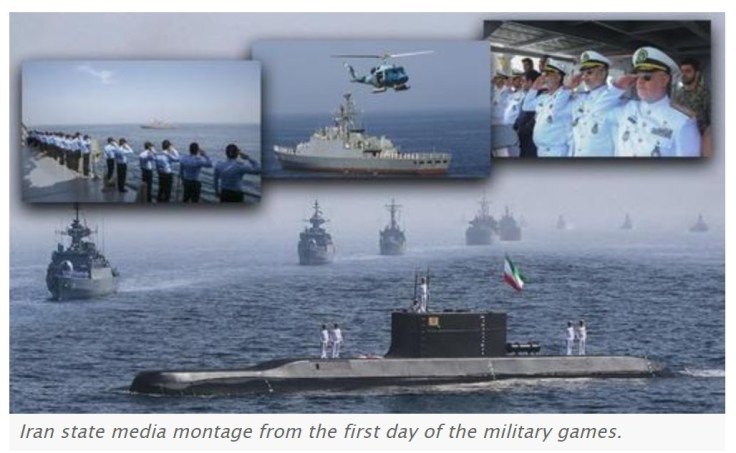
Iran’s navy has begun a three day war game exercise on Friday in the Persian Gulf, in an expansive area encompassing Strait of Hormuz in the Persian Gulf, to the Sea of Oman and even stretching to northern parts of the Indian Ocean, state media reports. Some reports indicate the games could go on for as much as a week, but all emphasized the “large-scale” nature of the drills in which Iran’s navy will showcase the Fateh-class submarine — a domestically built sub carrying cruise missiles and torpedoes, as well as its Sahand destroyer.

The cruise missile-firing capable Fateh, or “Conqueror”, was launched for the first time at the start of this week and has been touted as “state-of-the-art” and with the ability to stay underwater for five weeks at a time. Crucially, the large exercises come after last week’s US-sponsored Warsaw conference in which both Israeli and US officials made threats of war with Tehran. Indeed during the conference Israeli PM Benjamin Netanyahu openly stated that he was attending the summit with an aim to “advance the common interest of war with Iran.”

CAP

The games also come at a time when even foreign policy establishment insiders, such as the Council on Foreign Relation’s Steven Cook, increasingly acknowledge that the White House’s “march to war against Iran” is now “echoing the drumbeats” of the lead up to the 2003 Iraq invasion.

Writing in Foreign Policy, Cook warns:

Taken together—the Warsaw conference, Pence’s bullying of the Europeans, Bolton’s threatening video, and the broader background noise in Washington—the events of the past week were familiar in a foreboding way. The chatter about Iran has not become the war fever that gripped Washington in 2002 over Iraq, but the echoes of that year are not hard to miss in the Trump administration’s effort to shape the domestic and international debate about Iran.

Iran’s drills in the coming days will further involve battleship exercises and amphibious and anti-amphibious warfare maneuvers, according to Iranian military statements.

Though there’s general agreement that Iran’s navy poses no match of US superiority on the sea and in the skies, Iran seeks to be a significant disruptor of American Persian Gulf capabilities.

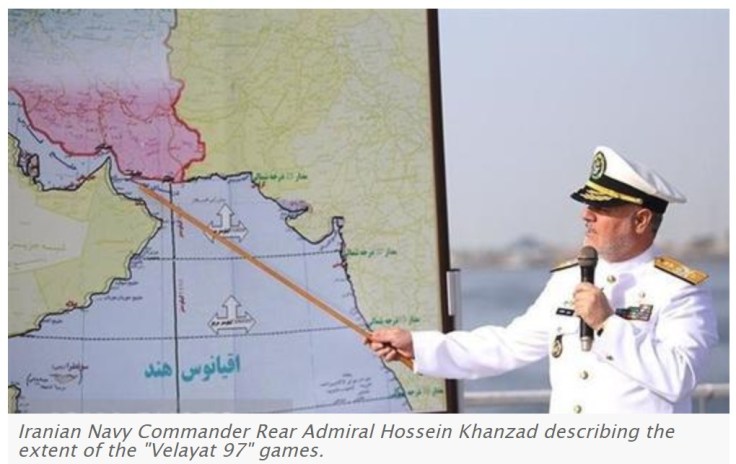
Rear Admiral Hossein Khanzadi, commander of Iran’s navy, reflected this in comments announcing the inauguration of the games: “For the first time, these weapons will be tested seriously and we can make the maritime region unsafe for the enemy in any way possible,” he said. He said the games, formally called “Velayat 97,” will begin 2km from the Strait of Hormuz and extend 10 degrees north of the Indian Ocean, in an extended zone some analysts worry may indicate broader intentions regarding Oman and Yemen

CAP

As the Jerusalem Post summarizes of this concern“In Yemen Iran has supported the Houthi rebels who have used Iranian technology to target Saudi Arabia with ballistic missiles.” And recently, “In addition Oman enjoys decent relations with Iran but Oman also hosted Prime Minister Benjamin Netanyahu last year and has sought to play a role in the Israel-Palestinian peace efforts.”

In the past, Iranian war games have resulted in close encounters with US warships traversing parts of the Persian Gulf. But this somewhat “routine” occurrence could potentially spark a major incident considering the high level of aggressive rhetoric coming out of Washington at this time.

Blog at WordPress.com.

Up ↑