The CNN search engine? Google favors stories from liberal news sites, study finds

Screen Shot 2019-05-13 at 3.03.29 PM

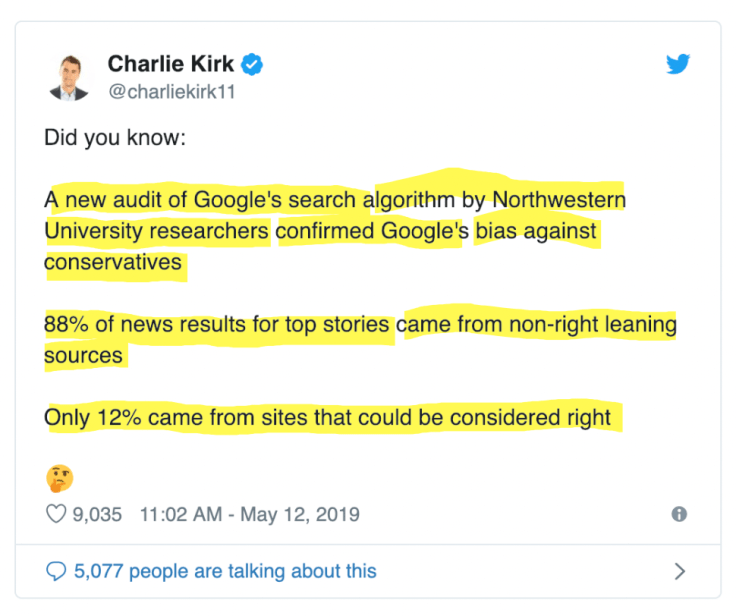
When it comes to political bias online, left-leaning Facebook and Twitter have been the most common punching bags, but a new study confirms that Google’s search algorithms are also skewed in favor of liberal viewpoints.

Researchers from Northwestern University performed an “algorithm audit” of the ‘Google Top Stories’ box, which is a major driver of traffic to news publishers and therefore prime online real estate. They examined results for nearly 200 searches relating to news events for one month in late 2017 and found “a left-leaning ideological skew.”

ALSO ON RT.COMGoogle flipped seats, shifted millions of votes to Dems in 2018 midterms, researcher tells RT


The researchers did allow some leeway for Google to defend itself, however, saying that while the left-leaning bias was detected, it is possible that the dominance of particular sources is a result of “successful strategic behavior” by those sources to achieve “algorithmic recognizability” — but whatever the reason, liberal sources still far eclipsed conservatives ones.

CNN, perhaps the outlet most-reviled by conservatives, was Google’s overall favorite source. Of the 6,302 articles appearing on Google’s ‘top stories’ during the month in focus, more than 10 percent came from CNN. The New York Times and Washington Post were up next, garnering 6.5 and 5.6 percent of the results, respectively.
Screen Shot 2019-05-13 at 3.06.37 PM

Fox News, the most mainstream right-wing outlet, was the source for only 3 percent of stories appearing in the top box. Then it was back to liberal outlets, with the BBC, USA Today, Los Angeles Times, The Guardian, Politico and ABC News filling out the rest of the top 10. Overall, 62.4 percent of the most common sources were left-leaning, while only 11.3 perfect were said to be right-leaning.

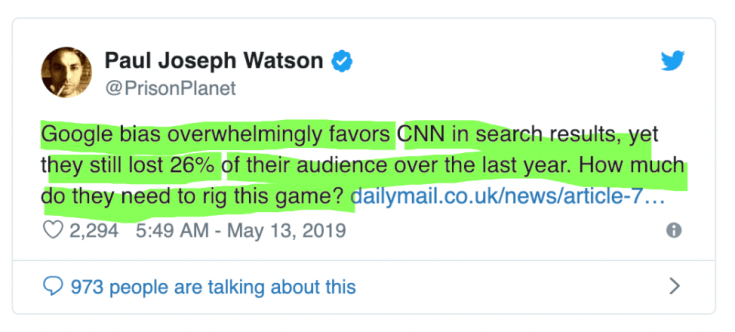
Ironically, despite the heavy promotion from Google in the online realm, CNN’s overall audience declined by a colossal 26 percent in April compared to a year earlier — and network boss Jeff Zucker admitted last November that CNN’s audience just “goes away” any time the channel switches from its (overwhelmingly negative) coverage of President Donald Trump to other topics. So it seems CNN is stuck in a vicious cycle; criticized for focusing too much on negative Trump stories, yet not being able to stop for fear of losing more viewers.
Screen Shot 2019-05-13 at 3.08.55 PM

Perhaps an even more damning indictment than Google’s detected liberal bias, however, is that nearly all (86 percent) of the stories promoted by the search giant came from just 20 sources across the entire internet, which doesn’t exactly display much of a commitment to diversity of information and opinion.

ALSO ON RT.COM‘Poisonous connection’ of big tech: Google staff confer over anti-Trump search tweak

Publishers selected for the top box receive “a significant boost in traffic” which demonstrates Google’s ability to “pick winners and losers” based on where they decide to direct most of our attention. Such power and bias in favor of major sources could also be linked to the decline of local news, which is competing in an unfair online environment, the study suggested.

The detection of Google’s left-leaning preferences will hardly come as a shock to conservatives, who have been complaining in recent years that powerful online platforms like Facebook, Twitter and Google have all shown clear bias against conservative perspectives. The grumbling has not been without cause, either.

Most recently, Facebook slapped a number of popular conservative commentators with permanent lifetime bans — and Twitter has been caught out ‘shadowbanning’ Republicans and is accused of being quicker to suspend or ban conservative users over liberals for alleged rule-breaking.

Yet, while Facebook and Twitter have engaged in what many analysts and critics are calling direct political censorship, the story is more complicated when it comes to Google.

The researchers found that it’s not simply whether a source is left or right-leaning that determines whether it goes into the top stories box. Writing for the Columbia Journalism Review, one of the study authors acknowledged that there appears to be more news produced on the left overall, something which also affects the results. Even so, Google’s curation algorithms were still found to be “slightly magnifying” the already left-leaning skew in online news production.

Then there’s the bias toward timeliness; the fresher the story, the more likely it was to be promoted in the top box. The researchers called this Google’s “predilection towards recency” and said that huge news organizations like CNN which have the potential to quickly generate fresh content “may be better positioned” to garner more attention.

If Google really values diversity, the authors suggest it should acknowledge that high-quality journalism can have a longer shelf life and “consider relaxing the timeliness constraint to widen the scope of sources available to its curation algorithm.”

ALSO ON RT.COMFive examples that show internet censorship is as much a threat to the left as the right

The results put to bed the notion, promoted by many Democrats and liberals that Google algorithm bias is a myth. Rep. Jerry Nadler last year called the notion of liberal bias online a “delusion” and a “right-wing conspiracy theory” — although Nadler, who chairs the House Judiciary Committee is still a chief proponent of the disproven conspiracy theory that Trump colluded with Russia to win the 2016 election.

Google has always denied that it is politically biased or abusing its monopoly position, but it looks like the search engine has plenty of work to do on its curation algorithms before it can convince anyone of its fairness.

WATCH: Walmart Leverages Tech Censorship For Lower Ad Rates According to Arkansas YouTuber

Boogie Walmart Tech CensorshipBoogie Walmart Tech CensorshipCAP

Boogie revealed that the tech censorship crisis may be inspired, at least partially, by advertisers’ desire for a lower rate.

By

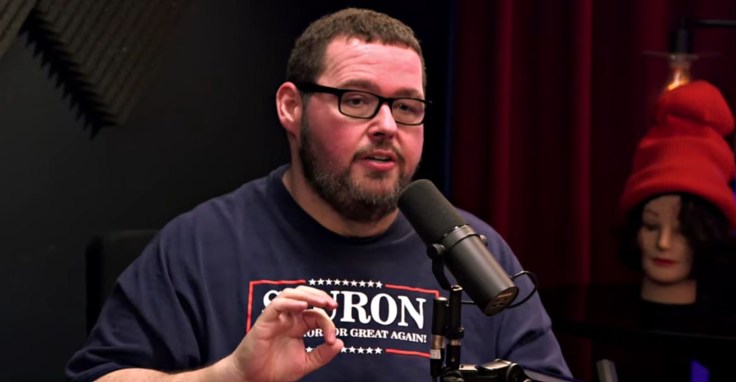
During an appearance on the H3 podcast, the famous YouTuber revealed a personal conversation he had with a contact in Walmart advertising who said they do not care about big tech censorship, but are looking forward to the lower advertising rates they expect to pay as a result.

Facebook, Instagram, YouTube, and Twitter have all faced some extent of an advertiser boycott, with the blame levied on users who are deemed not to be “advertiser friendly.”

This has been YouTube’s excuse to demonetize popular right wing channels, and likely went into consideration for Twitter when they summarily banned Infowars, and Facebook and Instagram last week when they went a step further and said they would ban any user who so much as posted a link to Infowars video content or Alex Jones.

Boogie2988, a YouTube streamer who became famous for his parody videos, video game live streams, and for chronicling his weight loss journey, offered a nuanced take during the podcast.

“I know a lot of people that work at Walmart,” Boogie said on the podcast, “And I know people that work in advertising at Walmart, and somebody from Walmart, and I won’t say which person specifically, said to me ‘We don’t really care about any of that censorship crap, we don’t really care about any of the drama.’”

He continued, quoting his conversation with an anonymous Walmart advertising employee, “‘We care about lowering our bids, so we’re going to do a six months or one year hiatus, and when we come back, we’re going to have much lower bids.’”

If true, it would seem the exodus of large advertisers from big tech platforms, and the sacrifice of many large content creators that followed, may be driven almost entirely by finance.

If YouTube, Facebook, Instagram, and Twitter are perceived as dangerous places to advertise, the cost of doing so on the platforms would naturally decrease exponentially.

As Twitter user Justin Whang wrote succinctly, “Advertisers played YouTube like a fiddle.”

Facebook, Google Pour Big Money into Lobbying Congress While Blacklisting Conservatives

CAP

By Sean Moran

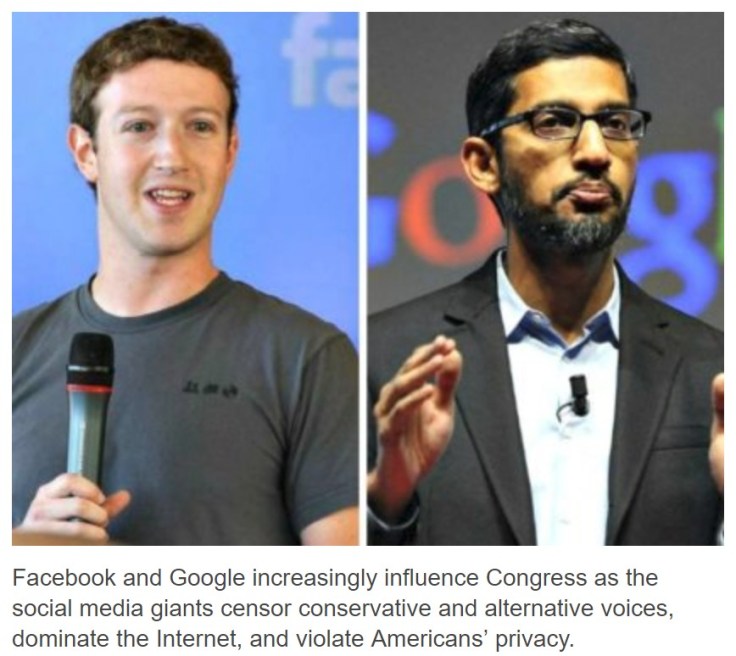
Facebook and Google increasingly influence Congress as the social media giants censor conservative and alternative voices, dominate the Internet, and violate Americans’ privacy.

Facebook announced on Thursday that they have banned several conservative personalities such as Infowars host Alex Jones, Infowars contributor and YouTube personality Paul Joseph Watson, journalist and activist Laura Loomer, and Milo Yiannopoulus. The social media giant also banned Louis Farrakhan from its platforms.

Facebook said that they banned these personalities because they were “dangerous.”

Amid calls for greater regulation of social media companies’ potential anticompetitive behavior, censorship of conservative and alternative voices, and privacy violations, Facebook and Google have remained at the top of Open Secret’s database of top spenders lobbying Congress.

So far in 2019, Facebook spent $3,400,000 and Google’s parent company, Alphabet, $3,530,00 in lobbying Congress. Alphabet also ranked as the eighth total highest spender in lobbying in 2018, spending $21,740,000, while Facebook spent $12,620,000.

Facebook’s influence has continued to rise over the years. In the early years of President Barack Obama, Facebook spent below one million dollars in 2008 and 2009. From 2011 to 2018, Facebook’s lobbying spending skyrocketed and reached historic highs in 2018, when they spent $12.6 million.

In 2019, Facebook lobbied heavily on H.R. 1644, the Save the Internet Act, a Democrat bill which would restore the Obama-era Federal Communications Commission (FCC) net neutrality regulations, which arose as the result of Google’s heavy lobbying of the Obama administration. In 2019, Google also lobbied on the Save the Internet Act.

See the source image

In 2018, one of Facebook’s bills on which they lobbied Congress was H.R. 2520, the Browser Act, sponsored by then Rep. and now Sen. Marsha Blackburn (R-TN), which would require social media companies such as Facebook and Google to obtain explicit permission from users for collecting their private data. The Browser Act would also stipulate that these social media companies cannot deny services to users who do not opt-in to these companies’ collection of their private data. In 2017, the Browser Act was the most important issue on Capitol Hill.

Sen. Blackburn said that her legislation would establish one set of rules that would balance the relationship between ISPs and Facebook and Google. The legislation would also prevent the social media giants from unfairly profiting off of Americans’ private data without their explicit consent.

“We need one set of rules for the entire internet ecosystem with the FTC [Federal Trade Commission] as the cop on the beat,” said Senator Blackburn. “The FTC has the flexibility to keep up with changes in technology and its principal mission is consumer protection. The BROWSER Act will enable consumers to make more educated decisions regarding the nature of their relationship with tech companies.”

In contrast, Alphabet’s most prominent issues in Congress in 2019 and 2018 related to labor and antitrust, as well as telecommunications and technology.

Facebook and Google’s dominance on the Internet has become increasingly apparent as Google has approximately 90 percent of web search traffic, whereas in digital advertising, Google and Facebook amount to nearly two-thirds of American digital ad spending, with Amazon at a “distant third” at under nine percent.

In 2018, Google lobbied Congress fourteen separate times on multiple pieces of legislation that would have increased liability for companies that enabled sex trafficking.

Facebook and Google’s influence in Congress extends to its trade group, the Internet Association. In the fourth quarter of 2018, the Internet Association spent $840,000. In total, the social media giants spent $2.6 million in 2018 for lobbying. In 2019, the association has spent $690,000 so far. Over the last two years, the Internet Association has focused on the Save the Internet Act as well as on legislation that would increase edge providers’ liability for hosting content that enables sex trafficking.

Facebook and Google influence political elections as well. During the 2018 election cycle, Alphabet donated:

  1. $223,269 to former Rep. Beto O’Rourke’s (D-TX) Senate campaign to unseat Sen. Ted Cruz (R-TX), a prominent critic of Silicon Valley censorship.

  2. $149,741 to Rep. Jacky Rosen’s Senate campaign (D-NV) to unseat Sen. Dean Heller (R-NV).

  3. $135,625 to Rep. Josh Harder’s congressional campaign.

  4. $124,508 to former Sen. Heidi Heitkamp’s unsuccessful re-election campaign.

  5. $97, 364 to former Sen. Claire McCaskill’s failed re-election campaign.

During the 2018 midterm elections, Facebook donated:

  1. $75,005 to O’Rourke’s Senate campaign.

  2. $37,954 to Sen. Doug Jones (D-AL) 2017 special Senate election against former Alabama judge Roy Moore.

  3. $34,534 to Heitkamp’s Senate election.

  4. $31,326 to McCaskill’s Senate campaign.

  5. $29,387 to Rosen’s successful campaign to unseat Heller.

As Facebook and Google and other social media giants continue to increasingly censor and blacklist conservative and alternative voices, more and more conservative voices have called for addressing the social media giants’ dominance of the Internet. Facebook and Google’s influence in Congress also relates to political confrontations; during a hearing in December 2018, the then-ranking member of the House Judiciary Committee delivered a sharp rebuke of Republican accusations of Google’s political bias affecting its search engines, even though Google was his top donor.

During a Senate Judiciary Committee hearing in April, Sen. Ted Cruz (R-TX) said  he envisions three potential remedies for big tech’s violation of free speech and dominance on the Internet.

Cruz’s three solutions include:

  1. Amending Section 230 of the Communications Decency Act
  2. Antitrust measures to address big tech’s dominant status on the Internet.
  3. Addressing potential cases of fraud and deception.

“No one wants to see the federal government regulating what is allowed to be said, but there are at least three potential remedies that can be considered by Congress or the administration or both,” Cruz said.

See the source image

Snoop Dogg Encourages Everyone to Post Louis Farrakhan Footage on Facebook and Instagram

Credit: Daniel Boczarski / Stringer Editorial #: 467066492 Collection: Getty Images Entertainment Date created: March 20, 2015

By Jerome Hudson

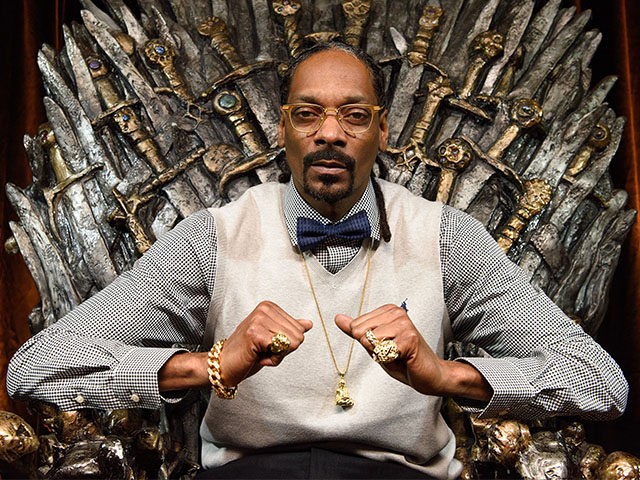
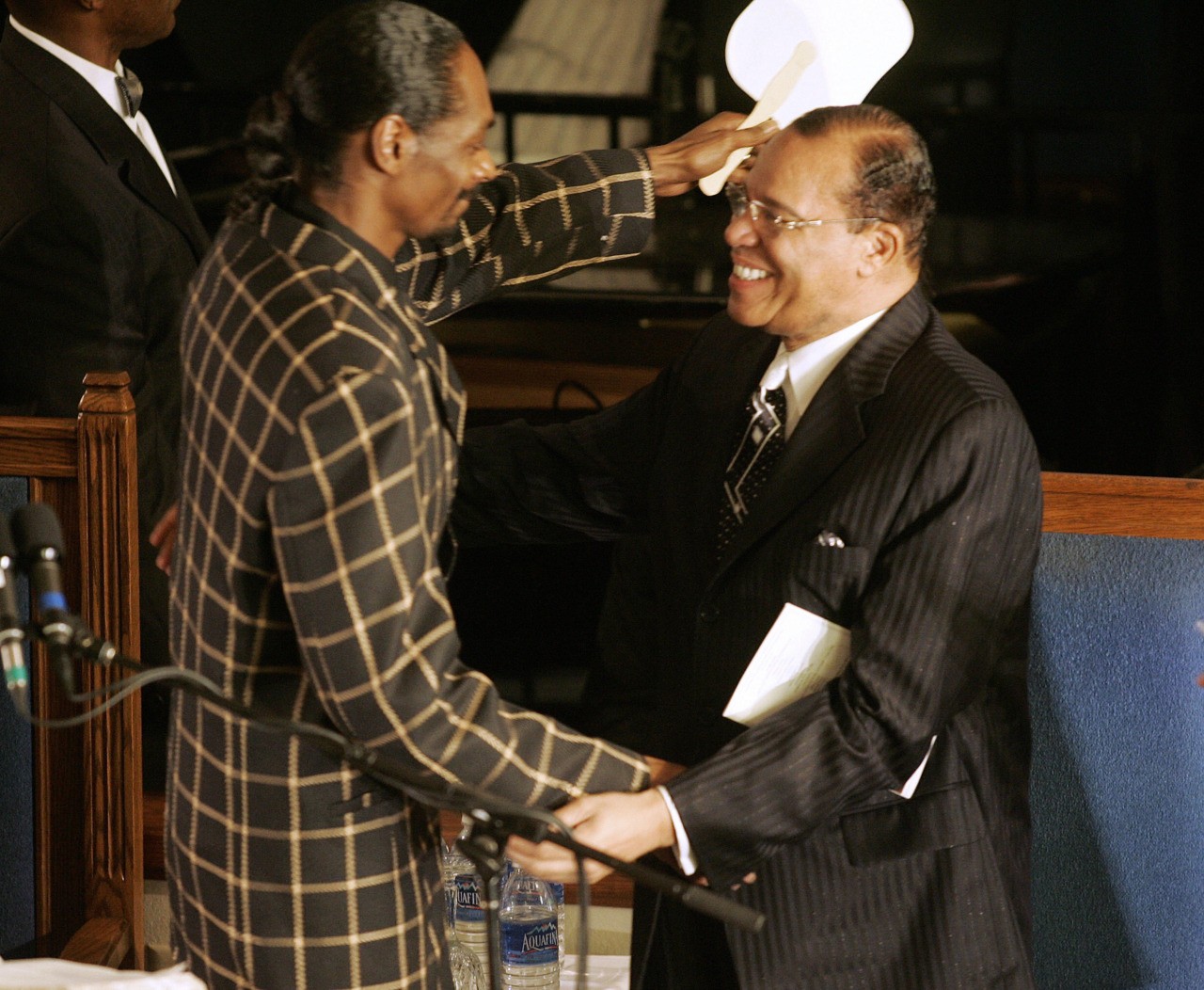
Rapper and game show host Snoop Dogg took to Instagram late Thursday and urged his 31 million followers to post and share videos of Louis Farrakhan to Facebook and Instagram. The antisemitic Nation of Islam leader was banned from both platforms for what the social media giant said was Farrahkahn’s decision to “promote or engage in violence and hate.”

“If you’re down with it like I’m down with it, post your favorite Mr. Farrakhan videos on your Instagram and Facebook page,” Snoop Dogg said in an Instagram video posted Thursday. “Show some love to a real brother.”

***Graphic Langauge***

Breitbart TV

View this post on Instagram

P. S. A. 👊🏿🎥

A post shared by snoopdogg (@snoopdogg) on

“How the fuck y’all gonna ban Minister Louis Farrakhan for putting the truth out there?” Snoop asked in a separate video. “I stand with him. I’m with him. Ban me, motherfucker.”

Snoop Dogg encouraging his followers to post videos of Farrakahn on Facebook and Instagram appears to be in clear violation of the platform’s rules, which do not allow the promotion of “hate speech […] because it creates an environment of intimidation and exclusion and in some cases may promote real-world violence.”

As recently as October Farrakhan posted a video to Twitter in which he called Jews “termites.” Twitter removed Farrakhan’s “verified” blue checkmark for hate speech.

Facebook and Instagram’s purge of conservative personalities also included Infowars host Alex Jones, Infowars contributor Paul Joseph Watson, and journalist and activist Laura Loomer.

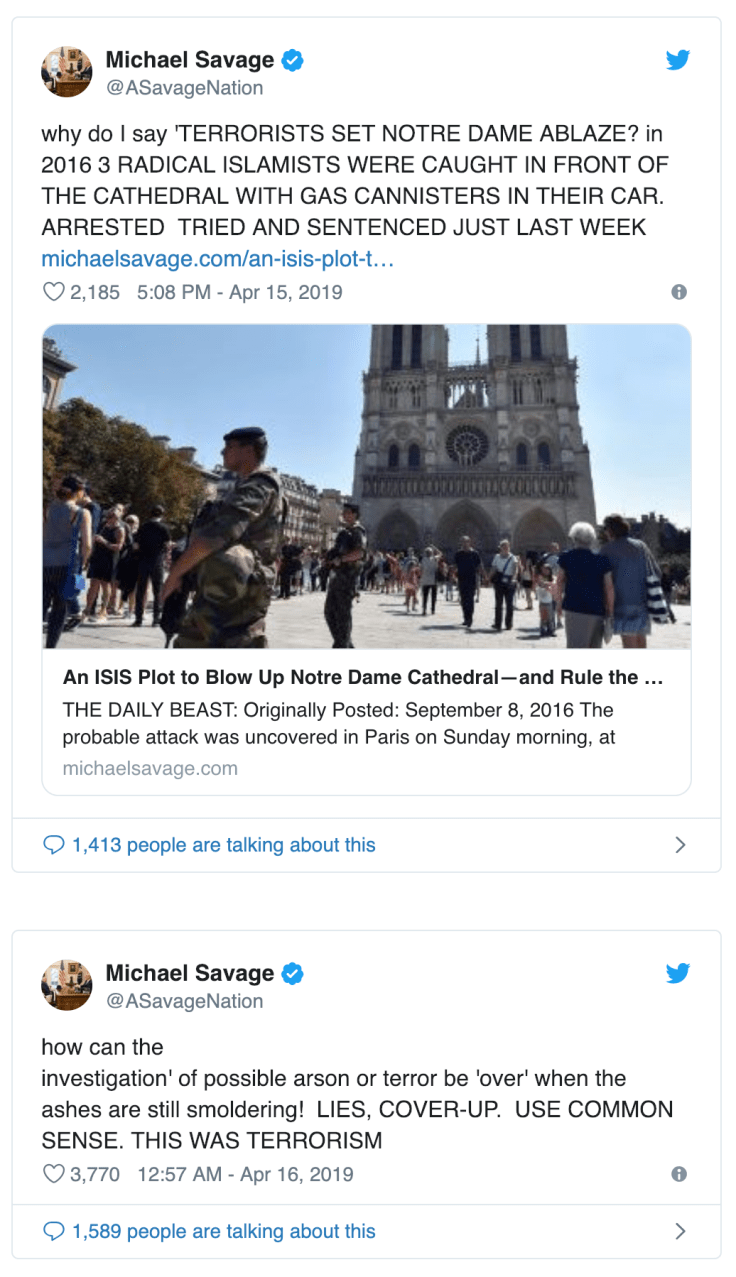
TWITTER SHADOW BANS MICHAEL SAVAGE FOR QUESTIONING NOTRE DAME FIRE NARRATIVE

Twitter Shadow Bans Michael Savage For Questioning Notre Dame Fire Narrative

Conservative host “may join the rebels in the shadows”.

Steve Watson | Infowars.com – APRIL 25, 2019

Michael Savage believes that Islamist terrorists may have been behind the Notre Dame blaze, and he is being vocal about it. In response, Twitter has reportedly moved to shadow ban Savage to stop his opinion spreading.

Savage’s reasoning is that terrorists attempted to set the cathedral on fire as recently as 2016, in addition to the fact that hundreds of churches in France have been desecrated over the past year.

Screen Shot 2019-04-25 at 10.53.35 AM

Savage found that after he expressed that opinion, Twitter stopped a lot of other users from seeing his posts.

“It became apparent Sunday after being temporarily blocked last week following the burning of Notre Dame, that now he may join the rebels in the shadows,” wrote Amanda Metzger, who works for Savage on his website.

“Some followers who used to receive notifications of his tweets on their smartphones no longer received them,” she added.

Metzger also noted that Savage “suddenly found his Periscope live broadcast was limited in the number of viewers.” (Periscope is owned by Twitter).

Infowars’ Alex Jones is still permanently banned from Twitter. No explanation was ever given, other than the vague suggestion that Jones ‘violated’ T&C’s.

It appears Savage now finds himself in the Twitter sin bin along with Jones and many others.

“Who is in the shadows deciding who is heard and who is silenced? Someone in a dark room behind a bright screen in a foreign country with no First Amendment?” Metzger asked, adding “maybe it’s an American trying to create a safe space online.”

“I can’t think of anything less safe – anything more damaging – than limiting the exchange of ideas,” she continued. “We’re in a dangerous place when we’ve forgotten the phrase, ‘I disapprove of what you say, but I will defend to the death your right to say it.’”

“We are getting closer to the point where federal regulation of social media is inevitable. The airwaves are regulated. In this case, my plea is that there is some transparency in who is banned, blocked or deplatformed and why,” Metzger urged, adding “I would prefer no one find themselves silenced by another.”

“Maybe you don’t care who was deplatformed last year. You didn’t agree with them anyway and seeing their tweets and posts ruined your day,” Metzger concluded. “But if you don’t stand up for them now, they won’t have a voice to come to your defense when you are silenced.”

In related news, it appears that Twitter is planning to allow users to report tweets that they believe are an attempt to ‘mislead’ people at election time.

What could go wrong there?

In a blog post regarding the change, Twitter declared that “Any attempts to undermine the process of registering to vote or engaging in the electoral process is contrary to our company’s core values.”

The move appears to be an effort on behalf of Twitter to adhere to the EU ‘Code of Practice against disinformation’ which Facebook and Google have also signed up to.

YouTube Streamer Destiny Calls For Violence Against Conservatives, Wants Them ‘Excised’

Destiny Calls for Violence Against Conservatives

The YouTube and Twitch star added that he wants conservatives “excised” from the United States.

By Tom Pappert

The popular Twitch and YouTube streamer Destiny, real name Steven Donnell, recently called for “real violence” against conservatives while streaming with a guest.

Donnell, who has grown a reputation for using crass language to describe his views, told his guest that he “hates” conservatives, and has moved on to the “real violence level” when it comes to how to deal with them.

“You really do hate conservatives, don’t you?” Asked his guest during the Twitch live stream, to which Donnell responded in the affirmative.

“Very much so,” he said. “I’ve moved full on to the political violence level, or the real violence level, when it comes to conservative people.”

This striking call for violence is far less vague than the alleged threat used by Big Tech platforms to ban Alex Jones, who was banned from Twitter after he simply encouraged his viewers to sleep “with their battle rifles ready” to prepare for defense.

Donnell, however, continued by saying he believes conservatives should be physically removed from the United States.

“Yeah, I think they need to be excised from my f*cking country. I think they are demonstrably f*cking evil people by any moral system that most people would use,” said Donnell, adding, “I just hate them because they tend to destroy the outcomes related to this country, which is what I’m concerned about, yeah, absolutely.”

This type of behavior would seem to directly contradict Twitch’s community guidelines, which state that “Hateful conduct is any content or activity that promotes, encourages, or facilitates discrimination, denigration, objectification, harassment, or violence based on race, ethnicity, national origin, religion, sex, gender, gender identity, sexual orientation, age, disability, medical condition, physical characteristics, or veteran status, and is prohibited.”

Big League Politics and others have attempted to contact Twitch to understand why Destiny is allowed to advocate violence on its platform. We have not received a response.

Donnell grew an audience streaming popular video games including Call of Duty, League of Legends, and Starcraft. He was previously banned from Twitch for using homophobic slurs and derogatory remarks about the disabled, including use of the words “faggot” and “retard.” He was eventually allowed to rejoin the platform.

He was also banned from Twitter after threatening to bomb a Cox Communications Internet node, though he maintained it was a joke.

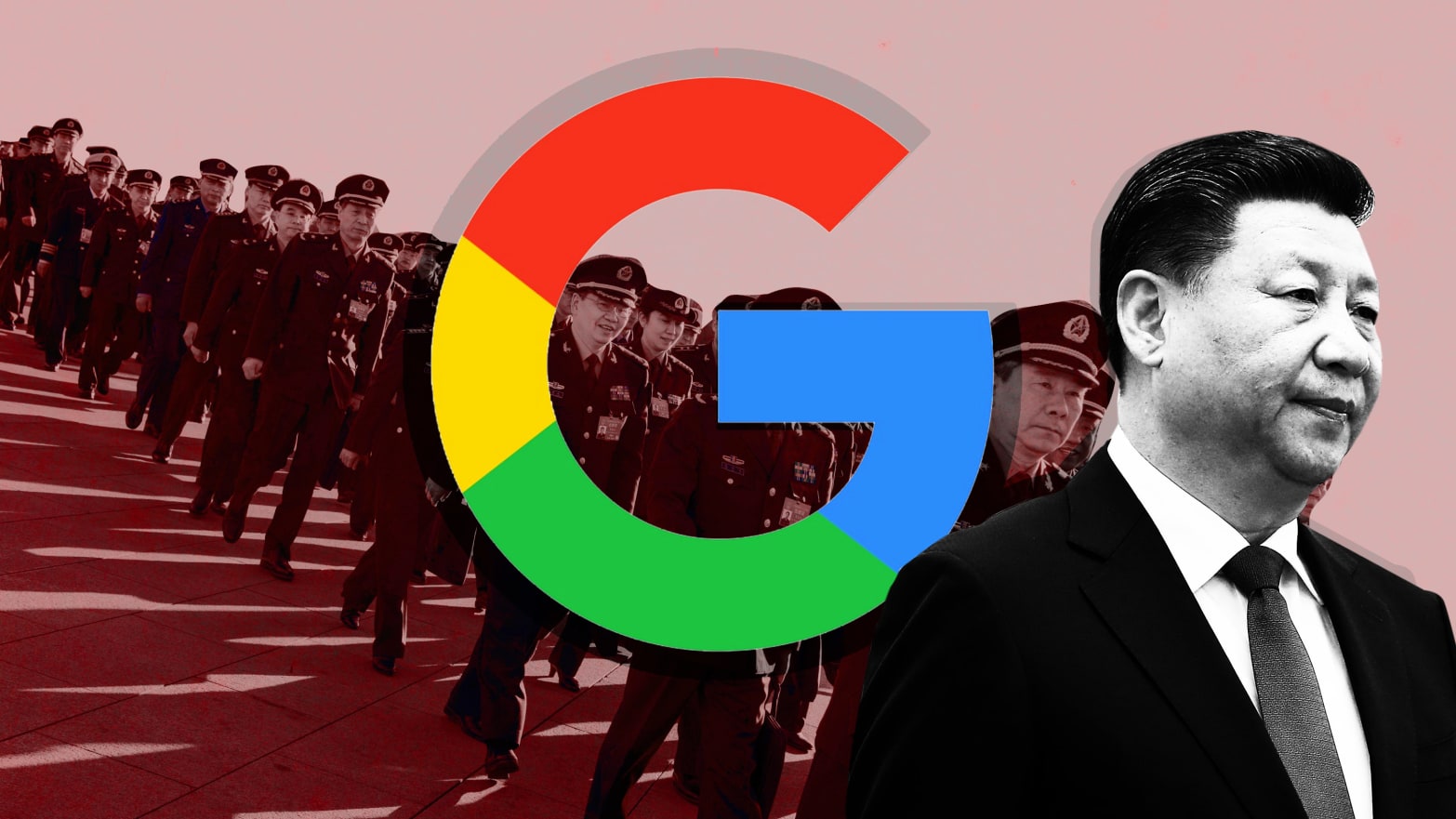
GOOGLE Helping Beijing Build ‘Global Digital Dictatorship’…

By Gordon G. Chang

Google’s decision to help China is paving the way for Beijing’s ‘digital dictatorship.’ Ultimately, Washington must make a political decision to criminalize such collaboration.

General Joseph Dunford, America’s top military officer, has announced he will be meeting with Google representatives this week to talk about the company’s assistance to China’s People’s Liberation Army.

Dunford, chairman of the Joint Chiefs of Staff, first stoked the controversy over Google on March 14 during his appearance before the Senate Armed Services Committee. “The work that Google is doing in China is indirectly benefiting the Chinese military,” he said.

“We watch with great concern when industry partners work in China knowing that there is that indirect benefit,” he added later. “Frankly, ‘indirect’ maybe not be a full characterization of the way it really is. It’s more of a direct benefit to the Chinese military.”

Google issued a firm denial in response to Dunford’s comments. “We are not working with the Chinese military,” a spokesperson said. “We are working with the U.S. government, including the Department of Defense, in many areas including cybersecurity, recruiting and healthcare.”

But Dunford is correct. The denial, even if technically accurate, is nonetheless misleading. Google maintains arrangements that it either knows or should know directly benefit the Chinese military.

For instance, in December 2017 the company announced the formation of the Google AI China Center in Beijing.

Due to Chinese ruler Xi Jinping’s announced policy of “civil-military fusion,” there is no longer any meaningful distinction between civil and military research, especially in areas like AI that Xi has determined China must dominate. As Bob Work, once U.S. deputy defense secretary, said of the new facility in the Chinese capital, “Anything that’s going on in that center is going to be used by the military.”

Similarly, acting Defense Secretary Patrick Shanahan sounded the alarm at that Senate Armed Services Committee hearing on March 14. “The fusion of commercial business with military is significant,” he said. “The technology that is developed in the civil world transfers to the military world. It’s a direct pipeline. Not only is there a transfer, there’s also systematic theft of U.S. technology that facilitates even faster development of emerging technology.”

Dunford, in comments last Thursday, pointed to the requirement of having Communist Party cells in companies. The cells, he said, will lead to the transfer of intellectual property to the Chinese military.

The Daily Beast asked Google if its AI China Center hosts a Communist Party cell but has not received a reply.

Google’s AI center in Beijing is not the only project of concern. “Google is partnering with several state entities for various projects to expedite their research,” Bandon Weichert, a national security analyst specializing in emerging technology, told The Daily Beast.

The company is already participating in AI research at Tsinghua University, one of China’s two premier institutions, and is cooperating with Peking University, the other top institution, and the University of Science and Technology of China.

Research: Google Search Bias Flipped Seats for Democrats in Midterms

By Allum Bokhari

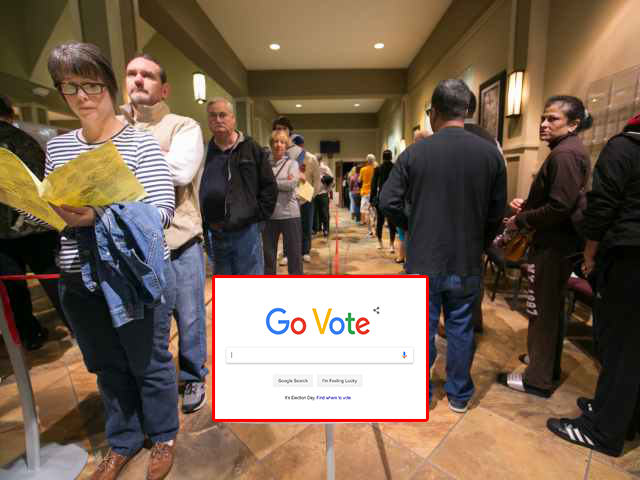
Google encourages users to "go vote"

New research from psychologist and search engine expert Dr. Robert Epstein shows that biased Google searches had a measurable impact on the 2018 midterm elections, pushing tens of thousands of votes towards the Democrat candidates in three key congressional races, and potentially millions more in races across the country.

The study, from Epstein and a team at the American Institute for Behavioral Research and Technology (AIBRT)analyzed Google searches related to three highly competitive congressional races in Southern California. In all three races, the Democrat won — and Epstein’s research suggests that Google search bias may have tipped them over the edge.

The research follows a previous study conducted in 2016 which showed that biased Google results pushed votes to Hillary Clinton in the presidential election. Democrats and Google executives have disputed these findings.

Epstein says that in the days leading up to the 2018 midterms, he was able to preserve “more than 47,000 election-related searches on Google, Bing, and Yahoo, along with the nearly 400,000 web pages to which the search results linked.”

Analysis of this data showed a clear pro-Democrat bias in election-related Google search results as compared to competing search engines. Users performing Google searches related to the three congressional races the study focused on were significantly more likely to see pro-Democrat stories and links at the top of their results.

As Epstein’s previous studies have shown, this can have a huge impact on the decisions of undecided voters, who often assume that their search results are unbiased. Epstein has called this the Search Engine Manipulation Effect (SEME).

According to Epstein’s study, at least 35,455 undecided voters in the three districts may have been persuaded to vote for a Democrat candidate because of slanted Google search results. Considering that each vote gained by a Democrat is potentially a vote lost by a Republican, this means more than 70,910 votes may have been lost by Republicans in the three districts due to Google bias. In one of these districts, CA 45, the Democrat margin of victory was just over 12,000 votes.

The total Democrat win margin across all three districts was 71,337, meaning that bias Google searches could account for the vast majority of Democrat votes. Extrapolated to elections around the country, Epstein says that bias Google results could have influenced 4.6 million undecided voters to support Democrat candidates.

Moreover, Epstein’s findings are based on modest assumptions, such as the assumption that voters conduct one election-related search per week. According to Epstein, marketing research shows that people typically conduct 4-5 searches per day, not one per week. In other words, the true impact of biased search results could be much higher.

Epstein’s study may also understate the level of liberal bias in Google search results, due to its use of a 2017 study from Harvard’s Berkman Klein Center to rank sources by their bias. The study assigns conservative sources like Breitbart News a far higher bias rating than ostensibly centrist but in fact highly liberal sources like the New York Times. The study also gives online encyclopedia Wikipedia a non-liberal bias rating, despite the fact that its most controversial pages are typically hijacked by its cabal of left-wing editors to push partisan liberal narratives.

As the Los Angeles Times notes, Epstein is not a Republican and publicly supported Hillary Clinton in 2016. Nevertheless, Democrats and liberals continue to ignore or doubt his findings. House Judiciary Committee chairman Rep. Jerry Nadler (D-NY) has repeatedly called claims of big tech bias a “conspiracy theory,” as have other congressional Democrats. And left-wing academics interviewed by the Los Angeles Times also heaped doubt on Epstein’s work.

Dr. Robert Epstein is featured in the 2018 documentary The Creepy Line, which was produced by Breitbart News editor-at-large Peter Schweizer and explores the bias amongst the Masters of the Universe in Silicon Valley.

Breitbart News continues to expose left-wing bias at Google. Recent reports reveal that company managers have told employees that the tech giant must stop “fake news” because “that’s how Trump won,” that Google-owned YouTube adjusted its algorithms to push pro-life content off its top search results, and that the company’s own internal researchers describe the company’s changes in policy since 2016 as a “shift towards censorship.”

Blog at WordPress.com.

Up ↑