
Published on May 4, 2019
By Sean Moran
Facebook announced on Thursday that they have banned several conservative personalities such as Infowars host Alex Jones, Infowars contributor and YouTube personality Paul Joseph Watson, journalist and activist Laura Loomer, and Milo Yiannopoulus. The social media giant also banned Louis Farrakhan from its platforms.
Facebook said that they banned these personalities because they were “dangerous.”
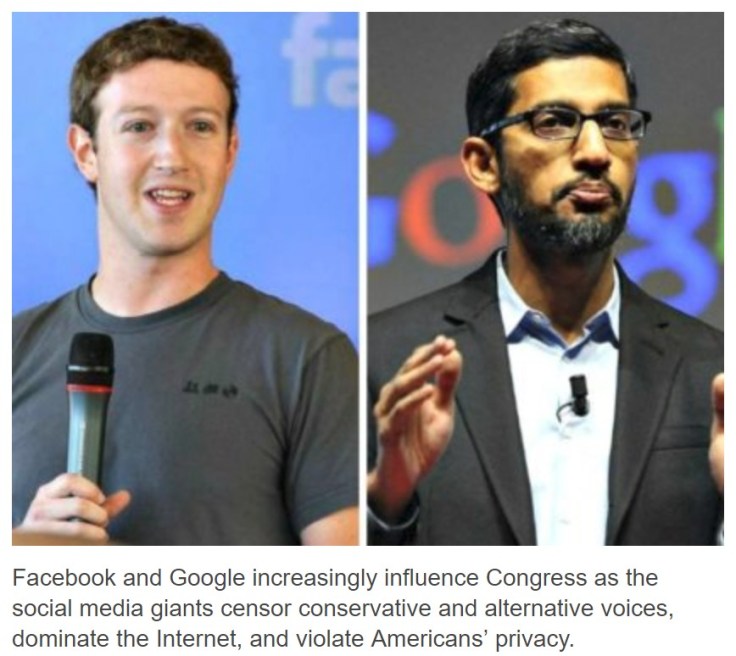
Amid calls for greater regulation of social media companies’ potential anticompetitive behavior, censorship of conservative and alternative voices, and privacy violations, Facebook and Google have remained at the top of Open Secret’s database of top spenders lobbying Congress.
So far in 2019, Facebook spent $3,400,000 and Google’s parent company, Alphabet, $3,530,00 in lobbying Congress. Alphabet also ranked as the eighth total highest spender in lobbying in 2018, spending $21,740,000, while Facebook spent $12,620,000.
Facebook’s influence has continued to rise over the years. In the early years of President Barack Obama, Facebook spent below one million dollars in 2008 and 2009. From 2011 to 2018, Facebook’s lobbying spending skyrocketed and reached historic highs in 2018, when they spent $12.6 million.
In 2019, Facebook lobbied heavily on H.R. 1644, the Save the Internet Act, a Democrat bill which would restore the Obama-era Federal Communications Commission (FCC) net neutrality regulations, which arose as the result of Google’s heavy lobbying of the Obama administration. In 2019, Google also lobbied on the Save the Internet Act.
In 2018, one of Facebook’s bills on which they lobbied Congress was H.R. 2520, the Browser Act, sponsored by then Rep. and now Sen. Marsha Blackburn (R-TN), which would require social media companies such as Facebook and Google to obtain explicit permission from users for collecting their private data. The Browser Act would also stipulate that these social media companies cannot deny services to users who do not opt-in to these companies’ collection of their private data. In 2017, the Browser Act was the most important issue on Capitol Hill.
Sen. Blackburn said that her legislation would establish one set of rules that would balance the relationship between ISPs and Facebook and Google. The legislation would also prevent the social media giants from unfairly profiting off of Americans’ private data without their explicit consent.
“We need one set of rules for the entire internet ecosystem with the FTC [Federal Trade Commission] as the cop on the beat,” said Senator Blackburn. “The FTC has the flexibility to keep up with changes in technology and its principal mission is consumer protection. The BROWSER Act will enable consumers to make more educated decisions regarding the nature of their relationship with tech companies.”
In contrast, Alphabet’s most prominent issues in Congress in 2019 and 2018 related to labor and antitrust, as well as telecommunications and technology.
Facebook and Google’s dominance on the Internet has become increasingly apparent as Google has approximately 90 percent of web search traffic, whereas in digital advertising, Google and Facebook amount to nearly two-thirds of American digital ad spending, with Amazon at a “distant third” at under nine percent.
In 2018, Google lobbied Congress fourteen separate times on multiple pieces of legislation that would have increased liability for companies that enabled sex trafficking.
Facebook and Google’s influence in Congress extends to its trade group, the Internet Association. In the fourth quarter of 2018, the Internet Association spent $840,000. In total, the social media giants spent $2.6 million in 2018 for lobbying. In 2019, the association has spent $690,000 so far. Over the last two years, the Internet Association has focused on the Save the Internet Act as well as on legislation that would increase edge providers’ liability for hosting content that enables sex trafficking.
Facebook and Google influence political elections as well. During the 2018 election cycle, Alphabet donated:
During the 2018 midterm elections, Facebook donated:
As Facebook and Google and other social media giants continue to increasingly censor and blacklist conservative and alternative voices, more and more conservative voices have called for addressing the social media giants’ dominance of the Internet. Facebook and Google’s influence in Congress also relates to political confrontations; during a hearing in December 2018, the then-ranking member of the House Judiciary Committee delivered a sharp rebuke of Republican accusations of Google’s political bias affecting its search engines, even though Google was his top donor.
During a Senate Judiciary Committee hearing in April, Sen. Ted Cruz (R-TX) said he envisions three potential remedies for big tech’s violation of free speech and dominance on the Internet.
Cruz’s three solutions include:
“No one wants to see the federal government regulating what is allowed to be said, but there are at least three potential remedies that can be considered by Congress or the administration or both,” Cruz said.
By Justin Caruso
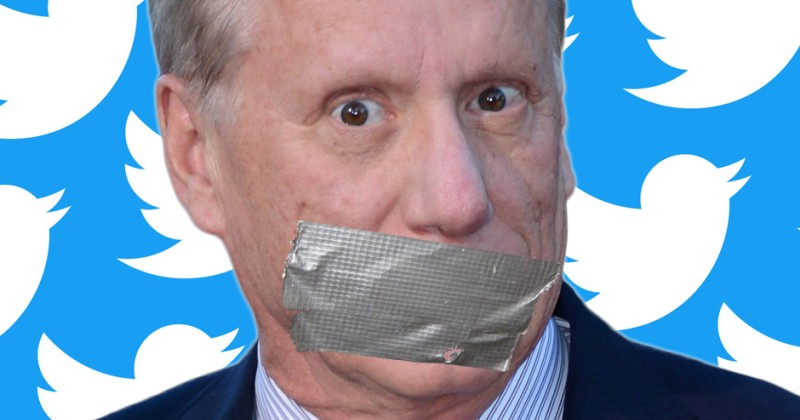
Twitter suspended Woods for a tweet that read, “‘If you try to kill the King, you best not miss’ #HangThemAll,” according to his girlfriend Sara Miller.
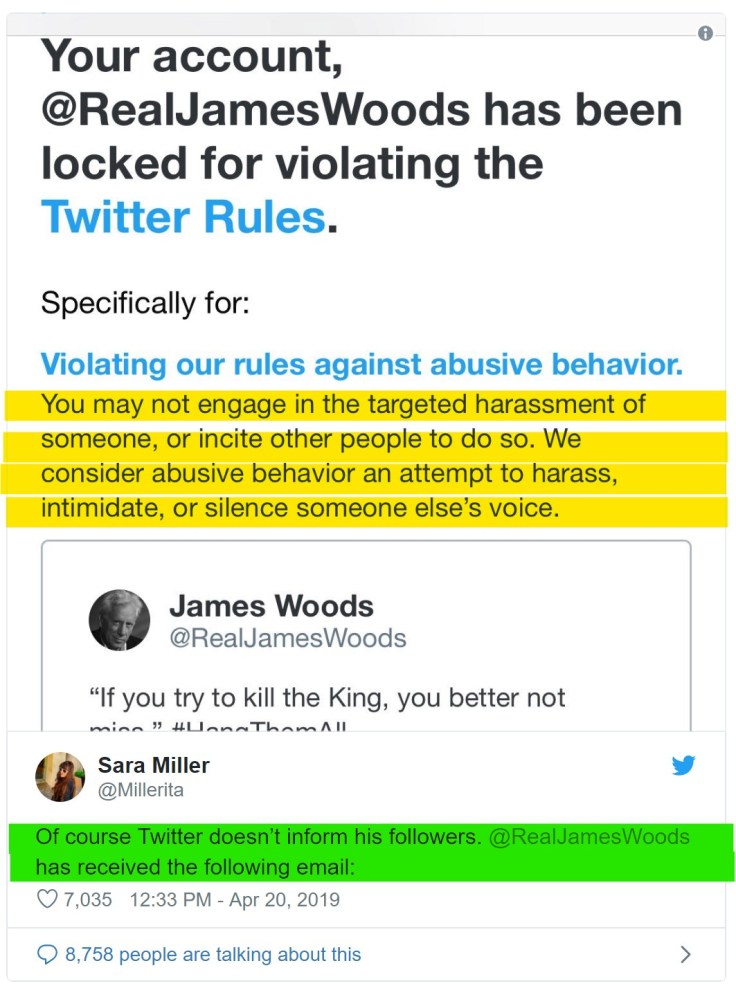
The tweet was apparently in reference to the Mueller report, which found no conspiracy between the Trump campaign and Russia. The quote is from Ralph Waldo Emerson and has been used in various forms in movies and TV shows like The Wire.
Nevertheless, this post apparently met the threshold on Twitter for “abusive behavior.”
Twitter does not appear to have the same standard for leftists. As Breitbart News has reported, there are several examples of actual violent threats going unchecked by the social media company.
Woods has been locked out of his account before for posting a meme.
Twitter CEO Jack Dorsey has previously claimed that while he is “more left-leaning,” his company does not target users over political views.
“I think the real question behind the question is, are we doing something according to political ideology or viewpoints? We are not. Period. We do not look at content with regards to political viewpoint or ideology. We look at behavior,” he said last year.

By Jose Nino
At The Federalist, Rebecca Kathryn Jude highlighted a troubling scenario at an ethics seminar, “The ‘Perfect’ Match: Selecting Clients for Successful Representation (Ethics),” that she was attending.
Adam Kilgore, general counsel for the Mississippi Bar, put forward a hypothetical scenario the group of civil and criminal lawyers in attendance:
A man has been fired from his job. He is upset. He hires you as his attorney. You are of the opinion he has an excellent case and file a complaint on his behalf. You later discover he possesses a permit to carry a firearm. He also has a so-called enhanced carry license. While his case is wending through the courts, your client goes to a public area outside his former workplace. He displays signs that say he has been wrongfully fired. The man has no history of criminal activity, violence, or threatening anyone.
The instructor then asked the class what action they would pursue in this situation. In Jude’s view, “there was no reason to do anything except proceed with the client’s case.”
She then added that she “would also advise my client to avoid confrontations with anyone who worked for his former employer and what he might consider saying if approached by the media.”
Much to her surprise, however, was her peers’ response.
According to Jude, “many lawyers immediately said they would terminate the attorney-client relationship and contact law enforcement to report their client was potentially dangerous. The only reason offered was his firearm permits.”
Jude was “flabbergasted” and for good reason.
Mississippi is one of the most pro-gun states in the country, ranked in 16th place according to the Guns & Ammo magazine.
It is also one of the 16 states in the country with Constitutional Carry.
Jude was appalled that her colleagues “were proposing to violate the attorney-client privilege, which establishes one of the most sacrosanct confidential relationships” in this hypothetical scenario put forward.
She noted that the attorneys “focused on the fact the client owned a gun and had firearm permits” and that this “was enough to label him as reasonably certain to cause death or serious bodily harm and report him to the police.”
By Jerome Hudson
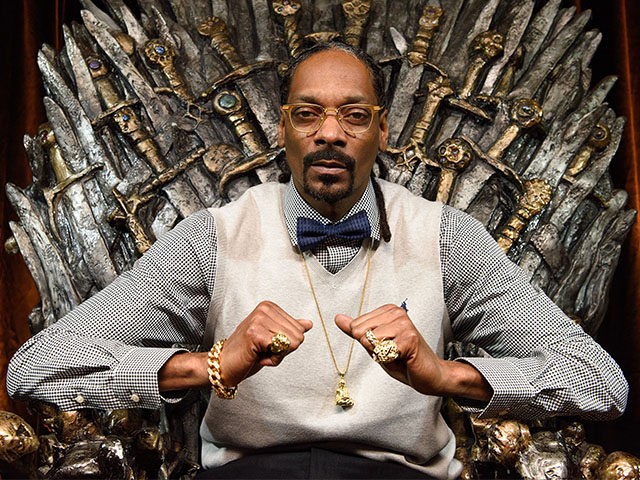
“If you’re down with it like I’m down with it, post your favorite Mr. Farrakhan videos on your Instagram and Facebook page,” Snoop Dogg said in an Instagram video posted Thursday. “Show some love to a real brother.”
Breitbart TV
“How the fuck y’all gonna ban Minister Louis Farrakhan for putting the truth out there?” Snoop asked in a separate video. “I stand with him. I’m with him. Ban me, motherfucker.”
Snoop Dogg encouraging his followers to post videos of Farrakahn on Facebook and Instagram appears to be in clear violation of the platform’s rules, which do not allow the promotion of “hate speech […] because it creates an environment of intimidation and exclusion and in some cases may promote real-world violence.”
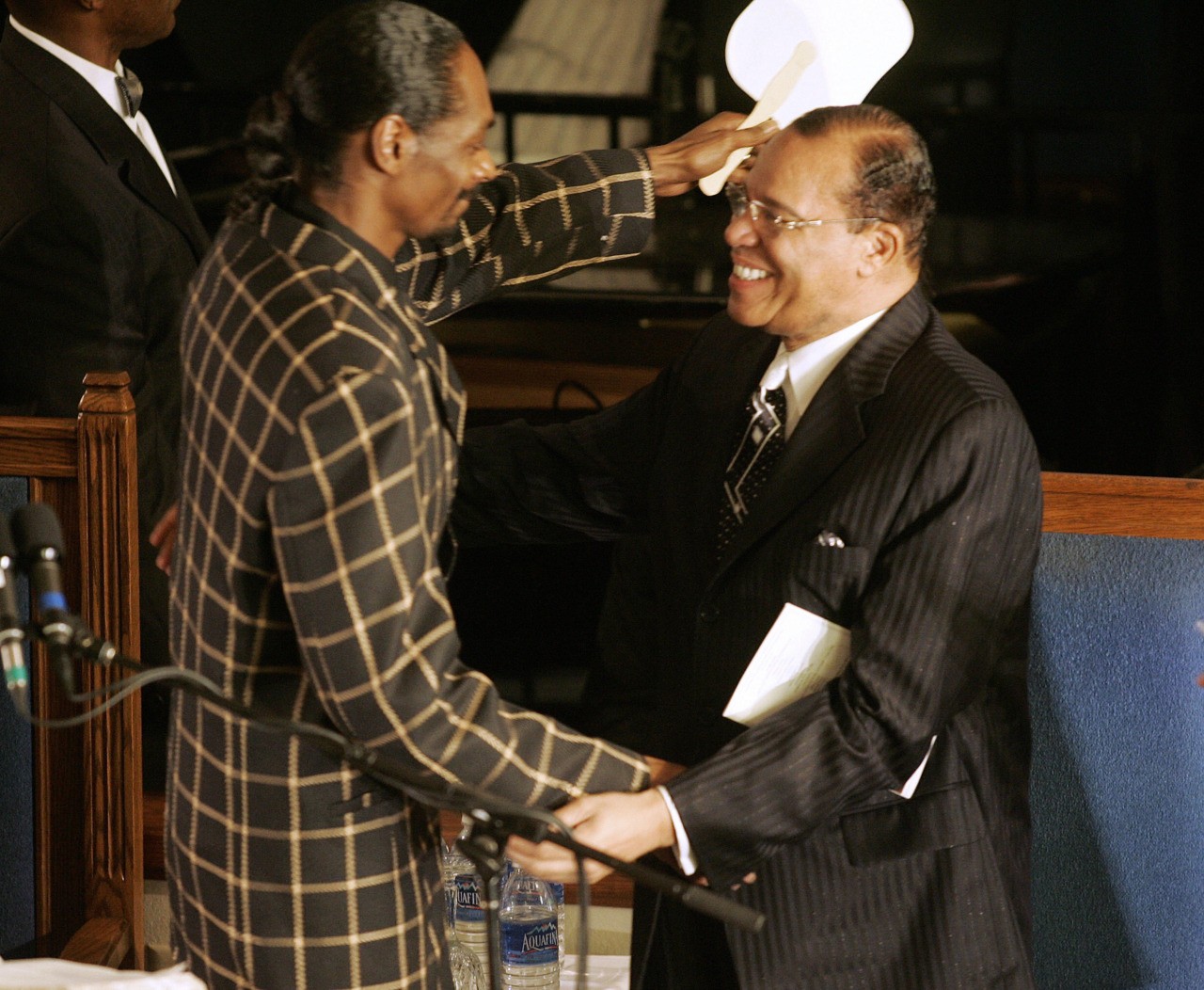
As recently as October Farrakhan posted a video to Twitter in which he called Jews “termites.” Twitter removed Farrakhan’s “verified” blue checkmark for hate speech.
Facebook and Instagram’s purge of conservative personalities also included Infowars host Alex Jones, Infowars contributor Paul Joseph Watson, and journalist and activist Laura Loomer.
MAY 3, 2019
CNBC lamented shortly after Facebook announced its ban of Infowars that Facebook cannot completely clamp down on accounts, essentially playing “whack-a-mole.” CNBC reported:
It’s yet another sign that while huge companies such as Facebook and YouTube have to fight to keep content under control, it’s tough for both to monitor and remove accounts and content that can pop right back up with new pages. It’s like a big game of whack-a-mole.
Censorship is ramping up around the world as mainstream news outlets rally for “regulations” on the first amendment.
While anti-establishment voices are silenced, technological advancements are being made that will bring “fake news” to a whole new level.
Artificial Intelligence systems are currently being developed that will “deep fake” news articles, just as photos and videos have been infamously faked.
In a little-noticed story in July of 2017, it was revealed that a Google grant of €706,000 was given to the United Kingdom’s Press Association to use artificial intelligence to write news articles.
The A.I. system, called RADAR (Reporters And Data And Robots), comes from Google’s Digital News Initiative.
As reported by the Guardian, RADAR will “…auto-generate graphics, video and pictures to add to stories.”


 Tom's Blog